Source: The Hindu, Page 9 Published: 15 October 2026
Why in the News
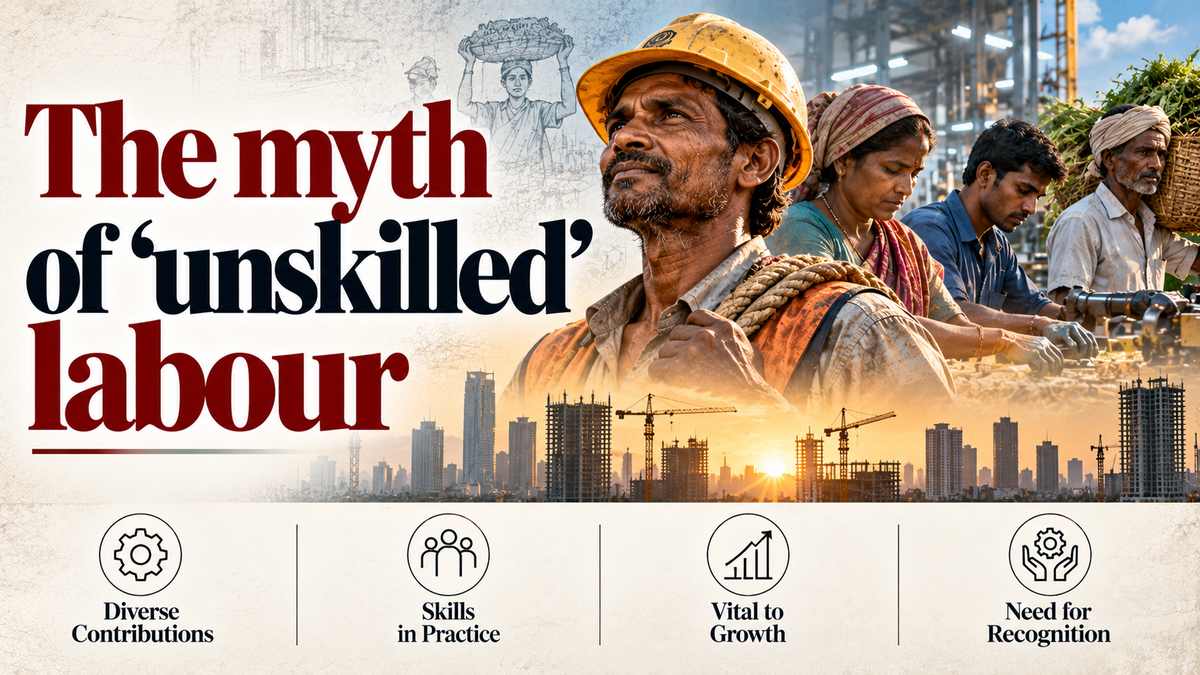
The ‘unskilled’ wage grade was meant to set minimum wages by the skill a job demands. Factories now use it to withhold annual increments, health benefits and safety training. Labelled workers lose more fingers in accidents and suffer more wage theft, and the state’s own wage schedules keep the label alive.
What does the ‘unskilled’ label do?
- What it is: Wage law sorts workers into grades, from unskilled to highly skilled, each with its own minimum wage, like a pay scale where the grade, not the work done, fixes pay.
- Legal basis: The Code on Wages, 2019 requires governments to weigh skill level, geographical area and whether work is arduous or hazardous when fixing minimum wages.
- Separate floors: Union wage schedules then set different floors for otherwise comparable work. September’s daily farm rate ran from ₹528 for unskilled to ₹694 for highly skilled work.
- Official definition: Weeding and manually watering crops count as unskilled, needing “only” physical effort. Highly skilled work means calibrating a combine harvester or managing pest outbreaks.
- The takeaway: The grade decides pay, benefits and training, so a wrong label costs a worker far more than a wage gap.
What does the label cost workers?
- Injury gap: The Safe in India Foundation found that ‘unskilled’ auto sector workers lost 2.27 fingers per accident on average, against 1.54 for skilled workers.
- Cause of injuries: Employers put ‘unskilled’ workers on dangerous power press machines without training or safety measures.
- Contractor practices: Contractors deny construction workers personal protective equipment and often the final month’s pay, knowing labourers lack legal recourse.
- Wage theft: The International Institute of Migration and Development, Thiruvananthapuram, estimates ‘unskilled’ migrant workers in Keralam’s construction and hospitality sectors face 40% more wage theft.
- Unequal relief: After wage protests in Noida and New Delhi, Uttar Pradesh raised interim pay to ₹13,690 a month for ‘unskilled’ and ₹16,868 for ‘skilled’ workers, who face the same inflation.
Why is ‘unskilled’ a misnomer?
- Skills expected: ‘Unskilled’ workers must spot defects, use power tools, hold tolerances in repetitive production, and recognise hazardous gases in confined spaces.
- Learned farm techniques: Weeding and irrigation need learned skills: identifying weeds, assessing soil and planning work around the weather.
- Credentials over competence: Workers gain embodied knowledge (skill learned by doing), yet institutions call them unskilled because they lack formal credentials, which concentrates them in informal jobs.
- Social ranking: The labour market ranks workers by caste, class, gender and increasingly migration, and this ranking shapes what work counts as ‘skilled’.
How does the state keep workers ‘unskilled’?
- State made status: ‘Unskilled’ is a status the state keeps in place, not a natural fact about the work, and the state fails to improve these workers’ job security.
- Informalisation: Municipal corporations hire sanitation workers through contractors, so competence matters less for job status. These workers also miss safety protocols.
- Self reinforcing trap: Low wages stop workers from earning qualifications or escaping precarious work, and precarious work makes employers unwilling to train them.
Challenges
- Grades by job title: Wage schedules grade the task, not the worker’s tested competence, so experienced workers stay at the bottom.
- Weak recourse: Workers without contracts or legal support rarely contest withheld pay or unsafe assignments.
- Safety tied to grade: Safety training follows the worker’s grade rather than the hazard of the machine they operate.
Way Forward
- Certify skill on the job: Expand Recognition of Prior Learning under Skill India to certify skills workers already use.
- Regrade by task content: The Union and States should regrade wage schedules by each task’s hazard and judgment content.
- Safety for every grade: Labour inspectors should enforce training and protective gear for anyone on hazardous machines.
- Equal inflation relief: Wage revisions should index every grade to the same inflation measure.
Conclusion
The ‘unskilled’ grade has turned from a wage category into a social ranking that denies workers pay, safety and benefits. Whether wage boards regrade work by what it demands and certify skills learned on the job will decide if the label stops trapping workers.
Back2Basics: Code on Wages, 2019
- What it does: It consolidates four wage laws, including the Minimum Wages Act, 1948 and the Payment of Wages Act, 1936.
- Statutory floor wage: The Centre sets a floor, and no State may fix its minimum wage below it.
- Universal coverage: Minimum wages now cover every worker, up from about 30% of workers earlier.
- In force: It is one of the four Labour Codes, in effect from 21 November 2025.
PYQ
[2024, GS3, 15 marks] Discuss the merits and demerits of the four ‘Labour Codes’ in the context of labour market reforms in India. What has been the progress so far in this regard?
