Why in the News
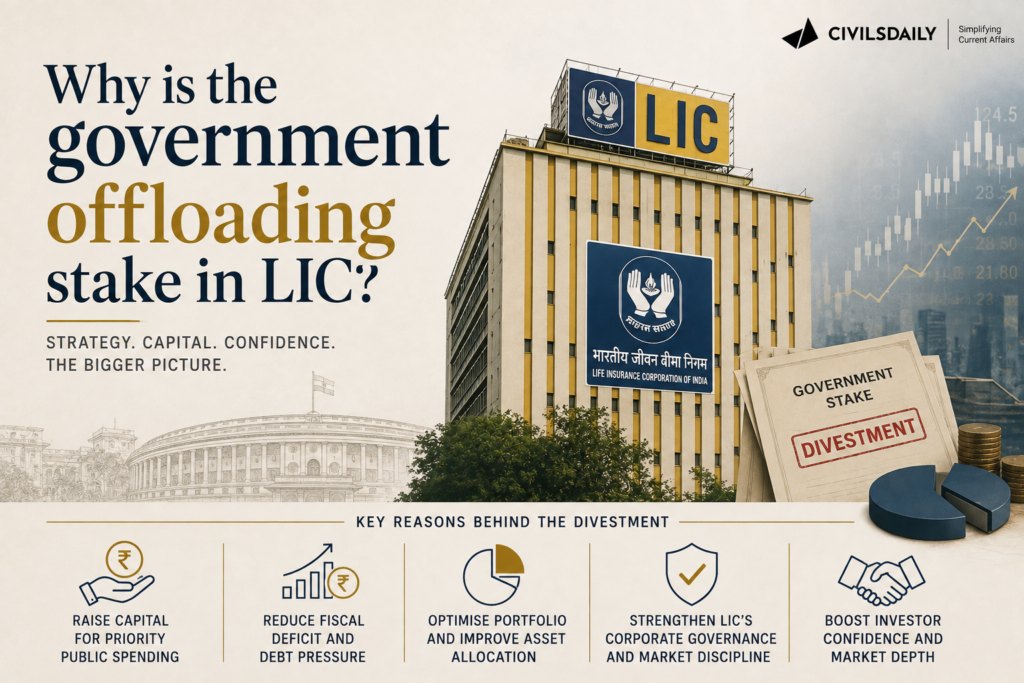
The Government of India has launched an Offer for Sale (OFS) to reduce its stake in the Life Insurance Corporation of India (LIC). The move aims to meet SEBI’s minimum public shareholding (MPS) requirement and contribute to the government’s FY27 disinvestment target.
What is an Offer for Sale (OFS)?
- Definition: An Offer for Sale (OFS) is a mechanism through which an existing shareholder (promoter) sells shares to the public through the stock exchange.
- No Fresh Capital: The company does not receive any funds; the sale proceeds go to the selling shareholder.
- Current Issue: The Government offered 2.5% equity, with a 4% green shoe option, at a floor price of Rs 382 per share.
- Discount: The floor price represented about a 10% discount to LIC’s closing market price on 3 August.
What is the Minimum Public Shareholding (MPS) norm?
- Requirement: SEBI mandates that listed companies maintain a minimum level of public shareholding.
- LIC Deadline: LIC has been given time until 16 May 2027 to achieve 10% public shareholding.
- Purpose: The OFS helps LIC move towards compliance with this regulatory requirement.
Why is the Government selling its stake now?
- Regulatory Compliance: To meet SEBI’s public shareholding norms.
- Disinvestment Target: The sale contributes towards the FY27 disinvestment target of Rs 80,000 crore.
- Estimated Receipts: At the base price, the issue could raise around Rs 31,000 crore.
- Strong Demand: The institutional investor portion was oversubscribed 3.32 times, leading to the exercise of the green shoe option.
- Implementing Agency: The process is managed by the Department of Investment and Public Asset Management (DIPAM).
What is LIC’s position in the insurance sector?
- Market Leader: LIC accounted for over 56% of India’s life insurance market in FY26.
- Systemically Important: LIC is designated as a Domestic Systemically Important Insurer (D-SII), subject to enhanced regulatory supervision.
- Listing History: LIC’s 2022 IPO sold 3.5% government stake and raised Rs 20,557 crore.
[2025] Consider the following statements:
I. Capital receipts create a liability or cause a reduction in the assets of the Government.
II. Borrowings and disinvestment are capital receipts.
III. Interest received on loans creates a liability of the Government.
Which of the statements given above are correct?
(a) I and II only
(b) II and III only
(c) I and III only
(d) I, II and III