| PYQ Relevance [UPSC 2016] To what extent is Article 370 temporary? Discuss future prospects. Linkage: The PYQ directly tests the constitutional character of Article 370 that this article’s central event revolves around. Now after its abrogation the theme extends to statehood demand of J&K. |
Mentor’s Comment
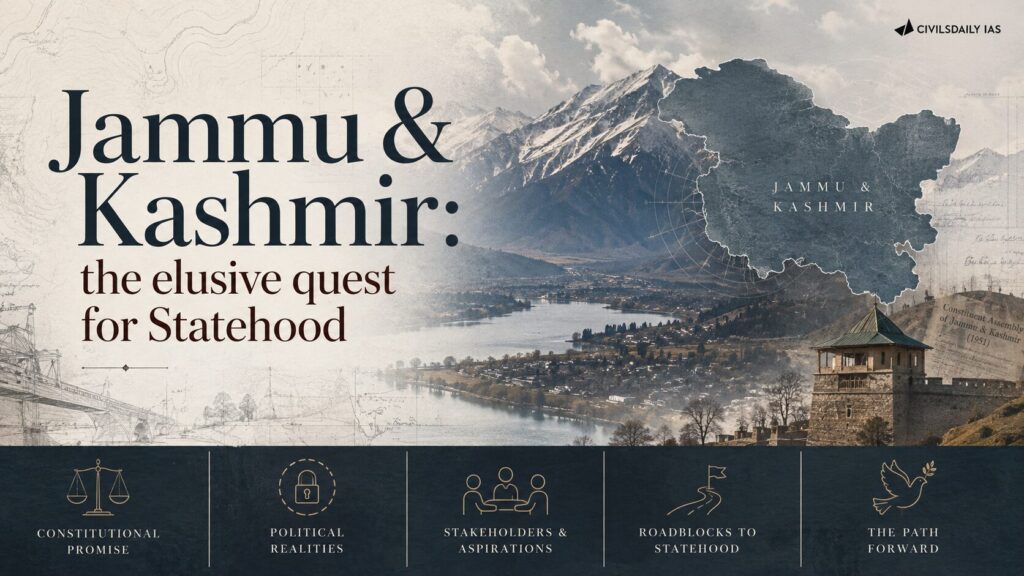
August 5, 2026, marks seven years since Jammu and Kashmir’s special status under Article 370 was revoked; August 9 will mark seven years since it lost Statehood. Seven years on, the promised trade-off of temporary central control for security and economic growth remains unfulfilled, even as the Lieutenant-Governor’s unaccountable powers have expanded further.
Has the trade-off of temporary central control for security and economic growth delivered its promised outcomes?
- No formal emergency, emergency-scale measures: The 2019 actions were accompanied by troop deployment, detention of over 5,000 political leaders and cadre, curfew, and a communications blockade, without any emergency being formally declared.
- Violence has spread, not receded: Terrorist attacks continued in 2025 at Pahalgam in April and Delhi’s Red Fort in November, and violence spread to previously dormant areas such as Poonch-Rajouri and adjoining districts.
- Economic convergence has reversed: J&K’s per capita income as a share of the national average fell from 79.9% in 2013-14 to 76.6%, per the J&K Economic Survey 2025-26, a decline of 3.3 percentage points.
- Unemployment remains structurally high: Overall unemployment is close to twice the national average; graduate unemployment stands at 23.9%.
- Peaceful response met with intensified control: Kashmiris responded to the Pahalgam attack with peace marches and candlelit demonstrations, but the Union Home Ministry responded with the most militarised Amarnath Yatra in J&K’s history, routine PSA and UAPA charges, summons to over 2,000 people after a single incident, near-continuous curfews, and the highest number of internet shutdowns of any region in the country since 2019.
What made the process of revoking Article 370 and Statehood constitutionally unprecedented?
- Executive fiat over Article 370: Article 370 was hollowed out through executive action; the Governor later stated he was directed by the Union Home Minister to sign.
- Legislative fiat over Statehood: Statehood was removed through Parliament without consulting J&K’s people or its elected political leadership.
- First such downgrade since 1956: J&K became the first State since Delhi in 1956 to lose Statehood.
- Basic structure implications: Together, the two actions represent a departure from constitutional principles and the basic structure of the Union.
- Treated as an exception, not a precedent: The actions were framed as specific to a conflict-ridden J&K rather than examined as part of a broader strain on India’s constitutional democracy.
Why have judicial and administrative checks failed to restore accountable government in J&K?
- Prolonged judicial deference: The Supreme Court allowed the Union’s security-justification argument to stand unchallenged for four years before weakly recommending that Statehood be restored “as soon as possible.”
- No timeline since: Three years after that recommendation, the Court has not heard petitions seeking a definite restoration timeline.
- No test of necessity: At no point has the Court examined the Union’s measures against constitutional or pragmatic standards of necessity.
- Six-month limit bypassed: The Constitution caps emergency conditions at six months, yet J&K has remained under emergency-like conditions for seven years without formal invocation.
- Lieutenant-Governor holds core powers: Under the 2024 Transaction of Business Rules, the Lieutenant-Governor, an appointee, controls the administration, police, and government prosecutors, despite J&K having had an elected government since 2024.
- Powers still expanding: The Lieutenant-Governor has since been granted emergency powers over telecommunications.
- High Court strictures without reform: The J&K High Court has repeatedly criticised the police’s misuse of draconian laws, without this leading to institutional reform.
Why is the security-driven justification for prolonged unaccountable rule fundamentally flawed?
- Moral flaw: The claim that subjugation is a means to a desirable end conceals the fact that subjugation is a repugnant end in itself, never a legitimate means.
- Pragmatic flaw: Subjugation breeds disaffection, which expresses itself as violence once peaceful means of expression are disallowed, a pattern India has already experienced under colonial rule.
- Empirical failure confirms the flaw: The continued rise and spread of violence, alongside declining economic indicators, demonstrates that the justification has failed on its own practical terms.
- Judicial non-scrutiny entrenches the flaw: The absence of any judicial test of the argument’s utility has allowed it to function as a durable substitute for accountable governance rather than a genuinely temporary emergency measure.
What would it take for J&K to move from unaccountable control to democratic accountability?
- Constitutional design points to elected government: The Constitution recognises an elected administration as the only structure capable of delivering accountability.
- Downstream institutions depend on it: An independent legislature, institutional oversight, autonomous bodies, and a free media all require an elected administration to develop.
- Civil society space is conditional: Civil society gains room to push for reform under an elected administration that it lacks under an appointed one.
- Renewed political campaign: J&K’s National Conference has renewed the campaign for Statehood restoration, earlier pursued only fitfully by the Congress, now framed explicitly around accountability.
- A record of “ugly firsts”: J&K has been the first State to see wide use of semi-lethal pellet guns (2016), the first to lose special status and Statehood (2019), and the first to undergo a communal delimitation altering Jammu’s demography through additional Hindu-majority constituencies (2022).
- A possible “positive first”: The 2024 State election produced a majority for the pluralist National Conference-Congress alliance despite the delimitation exercise, showing that engineered political outcomes can be overcome through the ballot; Statehood restoration would be a fitting next “first.”
Conclusion
Seven years of Central rule in Jammu and Kashmir have not delivered the promised improvements in security or economic development. Instead, power has become concentrated in the Lieutenant Governor, reducing the role of the elected government. The argument that prolonged Central control is necessary for security is flawed because it weakens democratic accountability and can increase public alienation. Restoring Statehood remains the constitutional path to accountable governance, but it requires timely political and judicial action rather than indefinite delay.