Why in the News
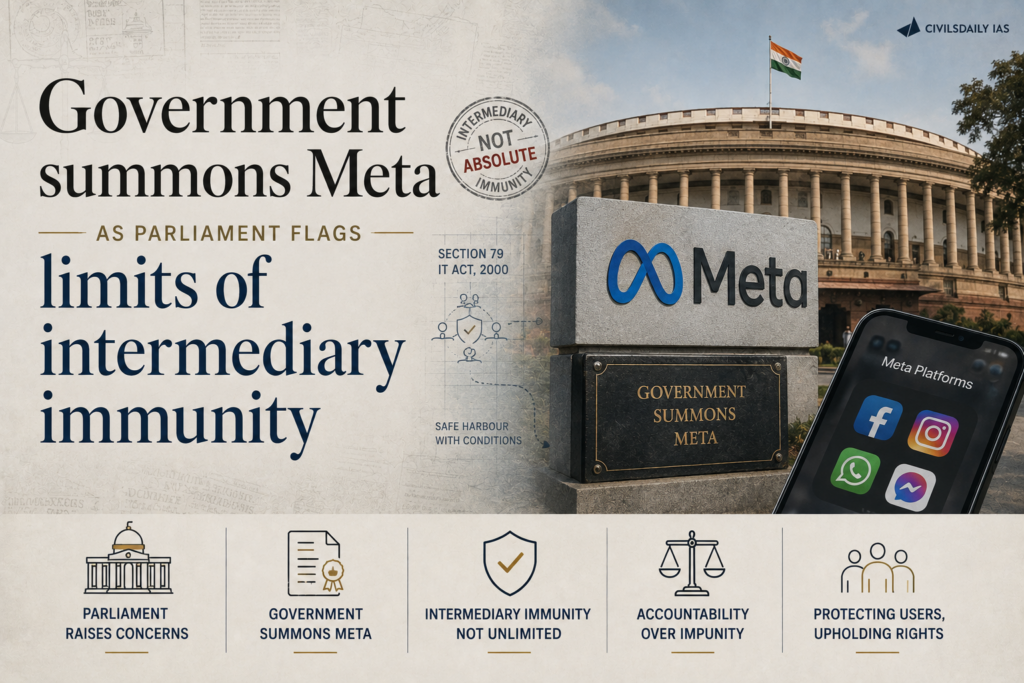
A parliamentary panel warned a large social media company that its legal immunity could be withdrawn after a content takedown and content safety failures. The tension is between platform safe harbour and the state’s demand for accountability.
What is intermediary immunity under Section 79 of the IT Act, 2000?
- Definition of intermediary: An intermediary is any person or entity that receives, stores, or transmits an electronic record on behalf of another person, or provides any service with respect to that record. It includes, Internet and telecom providers, Web-hosting and cloud service providers, Search engines, Online marketplaces and e-commerce websites, Social media and messaging platforms, Online payment and auction sites and Cyber cafes.
- Safe harbour: Section 79 of the Information Technology Act, 2000 shields an intermediary from liability for third party content it hosts.
- Conditions: This protection applies only if their function is limited to providing access to communication, and they do not initiate, select, or modify the content, and they comply with due diligence requirements (such as removing unlawful content upon receiving actual knowledge or a court order).
- Intermediary test: The immunity depends on the platform qualifying as an intermediary rather than a content publisher.
What triggered the summons?
- Video takedown: The platform briefly removed a video of the Prime Minister and later apologised.
- Harmful content: The government flagged child sexual abuse material and deepfake content on its platforms.
- Panel ultimatum: The Standing Committee on Information Technology sought testimony from the platform’s global head.
Why is the immunity in question?
- Compliance failures: Officials argue the platform did not act on directives and grievances.
- Definition dispute: Officials contended it may not fall within the intermediary definition.
- Withdrawal threat: Loss of Section 79 cover would expose it to liability for user content.
Conclusion
The episode tests how far platform immunity survives repeated compliance failures. The next milestone is the platform’s response to the committee’s summons.
Back2Basics
Standing Committee on Communications and Information Technology
It is a department-related parliamentary committee in India tasked with overseeing specific ministries, examining legislation, reviewing budget demands, and ensuring executive accountability. It was renamed from the Standing Committee on Information Technology in November 2021.
Structure and Composition
- Total Members: 31 members (21 from Lok Sabha nominated by the Speaker and 10 from Rajya Sabha nominated by the Chairperson).
- Leadership: The Chairperson is appointed by the Lok Sabha Speaker.
- Tenure: The term of office for members does not exceed one year.
- Ministers: Sitting ministers are barred from holding membership on this committee
Ministries under its Jurisdiction
- Ministry of Communications (including the Department of Telecommunications and Department of Posts)
- Ministry of Electronics and Information Technology (MeitY)
- Ministry of Information and Broadcasting (MIB)
Core Functions
- Scrutinizing the annual Demands for Grants of the designated ministries.
- Examining Bills referred to it by the Lok Sabha Speaker or Rajya Sabha Chairperson.
- Considering national policy documents, performance reports, and long-term trends related to digital infrastructure, telecommunications, media regulations, and cyber security.
PYQ Relevance
[UPSC 2024] Social media and encrypting messaging services pose a serious security challenge. What measures have been adopted at various levels to address the security implications of social media? Also suggest any other remedies to address the problem.
Linkage: The PYQ examines the regulatory and legal measures to address the security and accountability challenges posed by social media platforms. The article highlights the limits of intermediary immunity under Section 79 and the need for greater platform accountability for harmful content.