Why in the News
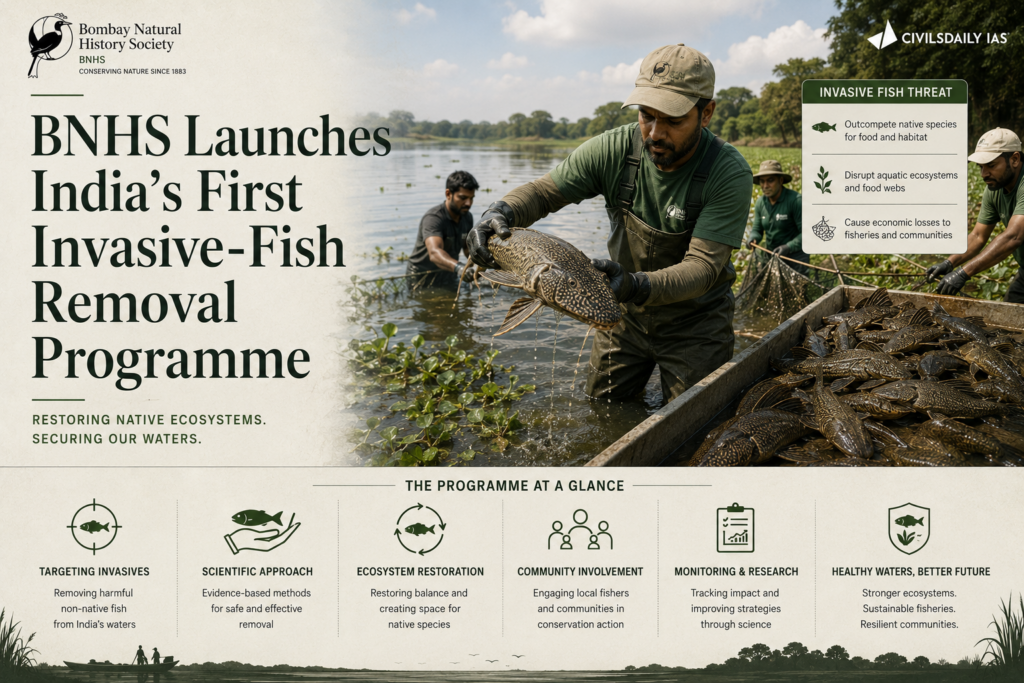
The Bombay Natural History Society (BNHS) has launched India’s first community-driven removal programme for the invasive suckermouth catfish in Ujani Reservoir, Maharashtra.
Suckermouth Catfish: Key Facts
- Origin: Amazon River basin, South America.
- Entry into India: Introduced through the aquarium trade and later released into natural waterways.
- Local name: “Helicopter fish”.
- Why invasive?
- Feeds on fish eggs.
- Competes with native bottom-feeding fish.
- Burrows into riverbanks and can weaken earthen structures.
- Adapts to adverse conditions.
Scale of the Invasion
- Around 97% of fish in Ujani are alien species including suckermouth catfish, Tilapia and African catfish.
- Native fish account for only 3%.
- Suckermouth catfish alone constitute around 30 to 40% of the total fish population.
Impact on Fishermen
- Around 20,000 people including fishermen, traders, transporters and labourers depend on the reservoir.
- Invasive fish damage fishing nets and reduce the catch of economically valuable Rohu, Catla and Mrigal.
- Fishermen may need to replace nets every 15 to 20 days, adding to costs.
BNHS Removal Model
- Collection centre established at Bhigwan fish market.
- Fishermen receive financial incentives for collecting the invasive fish.
- 36+ tonnes have already been removed.
- Fish is processed into molasses used as fertiliser.
- Creates a removal + livelihood + waste-utilisation model.
“[2023] Invasive Species Specialist Group (that develops Global Invasive Species Database) belongs to which one of the following organizations?
(a) The International Union for Conservation of Nature
(b) The United Nations Environment Programme
(c) The United Nations World Commission for Environment and Development
(d) The World Wide Fund for Nature.
