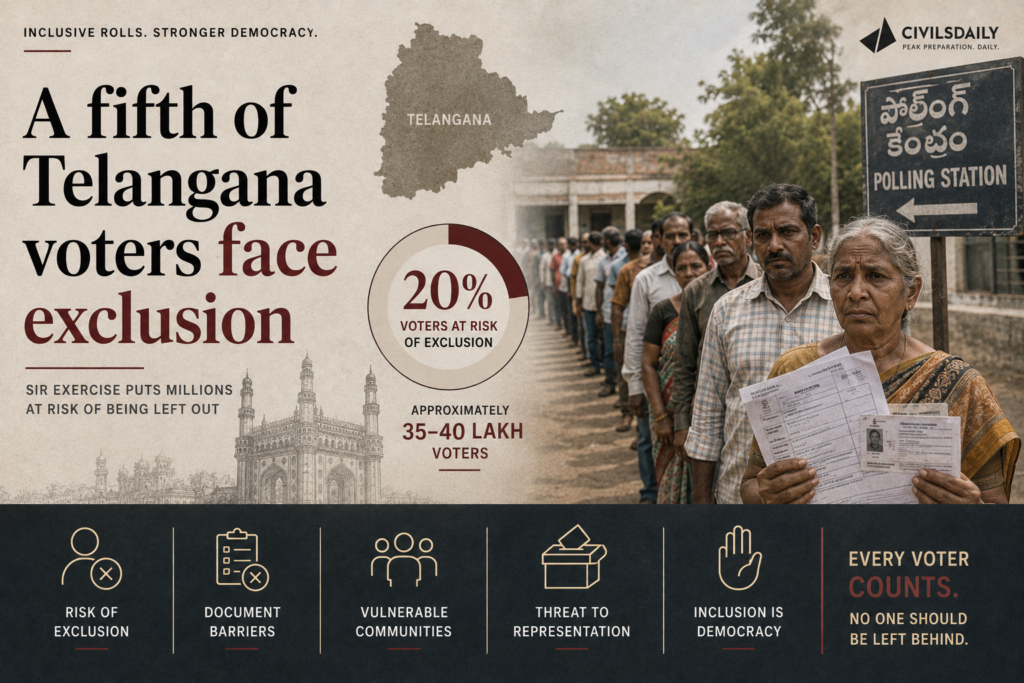
Why in the News
In Telangana, 73.47 lakh enumeration forms, nearly 22% of the electorate, were marked “Uncollectable” during the Special Intensive Revision (SIR) of electoral rolls. The large number raises concerns about balancing clean electoral rolls with the risk of excluding genuine voters.
What is Special Intensive Revision (SIR)?
- SIR: Special Intensive Revision of electoral rolls.
- Conducted by the Election Commission of India (ECI) through comprehensive, house-to-house enumeration.
- Electors submit enumeration forms; non-returned forms may be marked “Uncollectable”.
- Doubtful cases may receive notices from Electoral Registration Officers (EROs) for verification.
Current Status in Telangana
- Enumeration ended: August 10, 2026.
- Uncollectable: 73,47,075 forms, nearly 22% of the electorate.
- Draft rolls: Scheduled for August 17.
- Claims and objections will follow publication of the draft rolls.
Why is it Concerning?
- Disenfranchisement risk: Genuine voters may be deleted along with ineligible entries.
- Burden on voters: Migrants, poor households and hard-to-reach groups may struggle to submit forms.
- Short timeline: Limited time to reconcile uncollectable forms before draft publication.
- Legal concerns: The process has faced challenges regarding deletion procedures.
Safeguards After Draft Roll
- Claims and objections: Voters can seek restoration of wrongly deleted names.
- ERO verification: Doubtful cases can be examined before finalisation.
- Appeals: Aggrieved voters can approach higher electoral authorities and courts.
Constitutional & Legal Framework
- Article 324: Gives the Election Commission of India (ECI) superintendence, direction and control over elections and electoral rolls.
- Article 325: Provides for one general electoral roll and prohibits exclusion on grounds of religion, race, caste or sex.
- Article 326: Provides for adult suffrage.
- Representation of the People Act, 1950 (RPA 1950): Governs preparation and revision of electoral rolls.
- Registration of Electors Rules, 1960: Provides procedures for claims, objections and revision.
Back2Basics: Election Commission of India
- Type: Constitutional body under Article 324.
- Established: 1950.
- Composition: Chief Election Commissioner and other Election Commissioners.
- Mandate: Conducts elections to Parliament, State legislatures, and the offices of President and Vice-President.
- Role in rolls: Conducts summary and intensive revisions to maintain accurate electoral rolls.
Challenges
- Wrongful deletion of genuine voters.
- Exclusion of migrants and seasonal workers.
- Duplicate, dead and ineligible entries.
- Compressed timelines for verification and objections.
- Documentation burden on vulnerable voters.
- Loss of public trust due to perceived lack of transparency.
[2017] For election to the Lok Sabha, a nomination paper can be filed by
(a) Anyone residing in India
(b) A resident of the constituency from which the election is to be contested
(c) Any citizen of India whose name appears in the electoral roll of a constituency
(d) Any citizen of India
