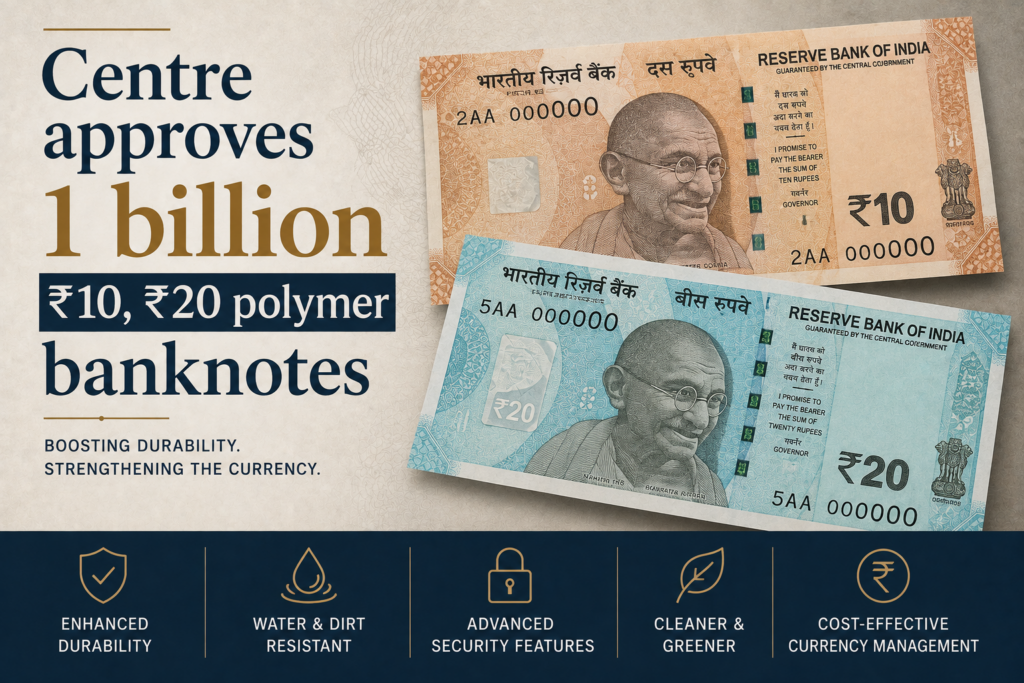
Why in News?
Government approved 1 billion polymer notes each of ₹10 and ₹20 for field trials, following an RBI proposal under Section 25 of the RBI Act, 1934.
What are Polymer Banknotes?
- Made from a thin plastic film instead of cotton-paper.
- More durable, moisture-resistant and hygienic.
- Offer enhanced anti-counterfeiting features.
- Have a longer circulation life, reducing replacement needs.
Government Approval
- Denominations: ₹10 and ₹20.
- Quantity: 1 billion each.
- Will circulate alongside paper notes.
- Regular issuance will depend on successful field trials.
- Procurement is at an initial stage, so cost and timeline are not yet fixed.
Why Polymer Notes?
- Longer life → lower replacement costs.
- Higher security → difficult to counterfeit.
- Better durability → resistant to dirt, water and wear.
- Global precedent → used by several countries.
Currency Management: Key Facts
- RBI: Sole issuer of banknotes, except ₹1 note.
- Government of India: Issues coins and ₹1 note.
- Section 22, RBI Act: RBI’s sole right to issue banknotes.
- Section 24: Specifies permissible denominations.
- Section 25: Design, form and material require Central Government approval on RBI recommendation.
- Coinage Act, 2011: Governs coins and ₹1 note.
Back2Basics: RBI
- Established under RBI Act, 1934; began operations in 1935.
- Nationalised in 1949.
- Functions as India’s central bank and monetary authority.
- Manages currency, monetary policy, banking and payment systems.
[2025] Which of the following are the sources of income for the Reserve Bank of India?
I. Buying and selling Government bonds
II. Buying and selling foreign currency
III. Pension fund management
IV. Lending to private companies
V. Printing and distributing currency notes
Select the correct answer using the code given below.
[A] I and II only
[B] II, III and IV
[C] I, III, IV and V
[D] I, II and V
