Why in the News
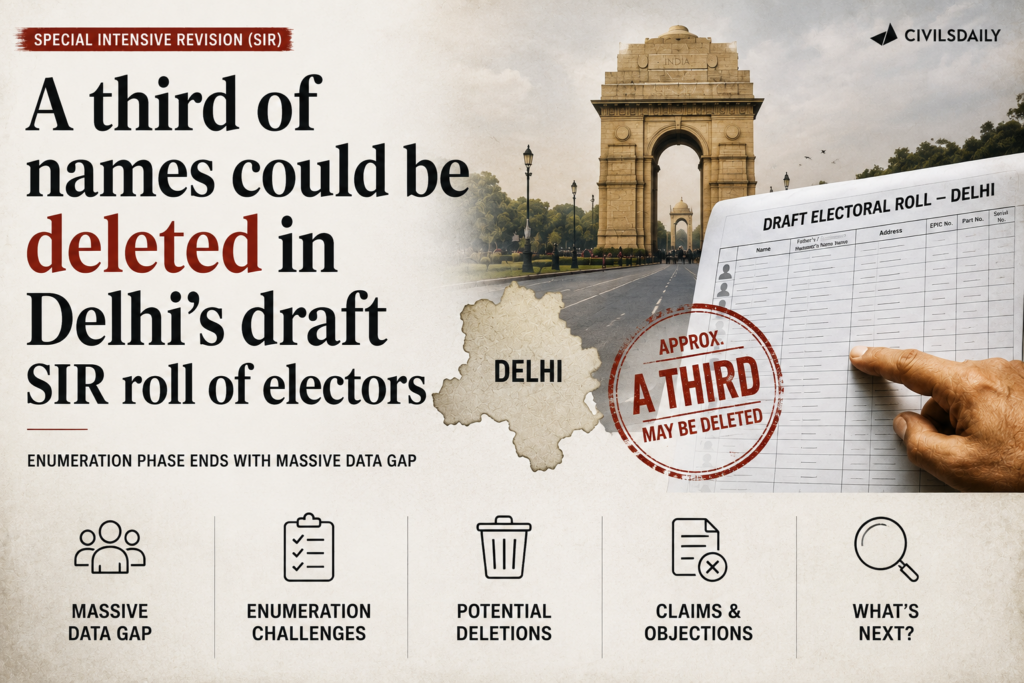
The enumeration phase of the Special Intensive Revision (SIR) of electoral rolls closed with forms uploaded for only 97.47 lakh of Delhi’s 1.45 crore electors, implying a deletion of about 32.41 per cent, the highest in the country. The same exercise has left 2.08 crore forms uncollected in Maharashtra and 1.08 crore Karnataka electors outside the draft roll. The revision is designed to purify the roll, and the figures show that the burden of staying on it has shifted to the elector within a fixed calendar.
What is the Special Intensive Revision of electoral rolls?
- About: A house to house revision of electoral rolls conducted by the Election Commission of India (ECI) in which every existing elector must be re verified rather than only new applicants being added.
- Enumeration phase: Booth Level Officers (BLOs) carry pre filled enumeration forms door to door, help electors complete them and upload the details to the official portal.
- Mapping requirement: Electors are required to map themselves or their lineage to an earlier reference roll, the 2002 roll in the States covered so far.
- Consequence of non collection: A name whose form is not collected and digitised does not appear in the draft roll published at the end of the phase.
- Restoration route: Exclusion from the draft is not final, since an elector may apply afresh during the claims and objections window.
What is the ASDDO category?
- About: ASDDO stands for Absent, Shifted, Dead, Duplicate and Other, the classification used for electors whose enumeration forms could not be collected.
- What it does not mean: A form recorded as uncollected does not by itself establish that the elector is dead, has shifted or is ineligible, since the elector may simply not have been traced at the recorded address.
What is Form 6 in the electoral roll process?
- About: Form 6 is the application for inclusion of a name in the electoral roll, prescribed under the Registration of Electors Rules, 1960.
- Use in this revision: Electors dropped from the draft roll must file Form 6 during the claims and objections period to be added to the final roll.
What do the State level enumeration figures show?
- Delhi: Forms were uploaded for 97.47 lakh electors, about 67 per cent of the 1.45 crore on the roll when the exercise began, leaving 47.62 lakh marked uncollectible.
- Maharashtra: Of an electorate of 9,78,54,049, forms for 7,69,52,262 or 78.64 per cent were digitised, 2,07,93,916 or 21.25 per cent were uncollected and 1,07,871 or 0.11 per cent remained pending.
- Karnataka: 1.08 crore electors fall in the ASDDO list, of whom 65.61 lakh or 11.84 per cent have permanently shifted, 16.38 lakh or 2.96 per cent are dead and 15.28 lakh or 2.76 per cent are untraceable or absent.
- Karnataka notices: A further 25.14 lakh electors face notices under the No Mapping category for failing to link themselves or their lineage to the 2002 roll, with about 4.46 crore mapped electors digitised at 80.46 per cent.
- Telangana: 73.39 lakh names were deleted in the draft roll, 60 lakh showed anomalies and 32 lakh remain unmapped, so 92 lakh electors will receive notices out of a total of 3.38 crore.
- Telangana breakdown: 9,22,229 electors or 2.73 per cent have died, 57,46,803 or 16.99 per cent were found shifted or absent and 6,70,203 or 1.98 per cent were enrolled in more than one place.
- Published draft rolls so far: Telangana recorded the highest deletion at 21.59 per cent, followed by Arunachal Pradesh at 19.09 per cent and Uttar Pradesh at 18.7 per cent.
How do the numbers differ between urban and rural districts?
- City comparison: Deletions in the draft roll stand at 32.41 per cent in Delhi, 40.09 per cent in Hyderabad, 27.16 per cent in Pune and 20.26 per cent in Gurgaon.
- Maharashtra’s four largest urban districts: Thane, Mumbai City, Mumbai Suburban and Pune account for 94.47 lakh uncollected forms, 45.4 per cent of the State total, while holding only 27.5 per cent of the electorate.
- District level peaks: Thane leads with 28.88 lakh of 74.51 lakh electors uncollected at 38.77 per cent, followed by Mumbai City at 37.57 per cent, Mumbai Suburban at 34.48 per cent and Pune at 31.92 per cent.
- Next tier: Nagpur recorded 14.06 lakh uncollected forms at 30.32 per cent, Palghar 6.87 lakh at 28.88 per cent and Raigad 5.91 lakh at 23.33 per cent.
- Rural contrast: Uncollected forms stand at 8.82 per cent in Hingoli, 9.10 per cent in Buldhana, 9.93 per cent in Ratnagiri and 10.62 per cent in Latur.
- Concentration: Seven districts hold about 1.21 crore or 58.3 per cent of all uncollected forms while holding about 37 per cent of Maharashtra’s electorate.
- Movement in the final days: Maharashtra’s uncollected figure rose from 1.80 crore on 12 August to 2.08 crore on 17 August, an increase of about 27.3 lakh in five days.
Why are deletion rates highest in the largest cities?
- Floating population: Officials attribute the urban pattern to large migrant workforces recorded at addresses they no longer occupy.
- Address updation gap: Government employees and salaried private sector workers move frequently and rarely update their address in the roll.
- Physical verification limits: A Booth Level Officer must find the elector at the recorded address, which fails in high rise and high churn neighbourhoods.
- Refusal category: Delhi officials estimate 1 to 2 lakh electors in the Other category, covering those who refuse to sign or submit enumeration forms.
- Booth level concentration: In nearly 3,000 booths in Karnataka, deletion rates exceed 60 per cent, so the effect is concentrated rather than spread evenly.
- Timeline pressure: Delhi’s enumeration was extended twice, from 29 July to 8 August and then to 17 August, because digitisation of forms lagged.
Does a shorter roll necessarily mean a more accurate one?
- Two defensible objectives: Removing dead, shifted and duplicate entries protects the roll, and retaining every genuine elector protects the franchise, and the same procedure serves both unevenly.
- Category conflation: A single uncollected label covers the dead, the shifted, the duplicated and the merely absent, so an administrative failure to trace is recorded alongside genuine ineligibility.
- Reversal of the burden: The elector must now prove entitlement afresh within a fixed window rather than the State proving ineligibility before deletion.
- Unequal cost of restoration: Filing Form 6 and producing documents is easiest for those with stable addresses and hardest for the migrant workers who dominate the deletion lists.
- Contested reading of the data: Officials state that the draft is not a permanent deletion, while civil society groups in Karnataka petitioned the Chief Minister that about half of Bengaluru’s electors face removal.
- Demand for more time: Civil society groups have asked the Karnataka government to seek a three month extension of the revision and to approach the Supreme Court if necessary.
What is the timeline from draft roll to final roll?
- Draft publication: Draft electoral rolls are published on 24 August in Delhi, Maharashtra and Karnataka.
- Claims and objections: Electors may file claims and objections in Delhi until 23 September, and in Telangana from 17 August to 16 September.
- Disposal window: Claims and objections in Delhi are to be disposed of between 24 August and 22 October, and in Telangana until 15 October.
- Notices for incomplete forms: Electors who submitted forms with incomplete details receive notices seeking proof of eligibility over the following two months.
- Final roll: The final electoral roll for Delhi is published on 27 October, and only that number settles the actual scale of exclusion.
- Pre draft correction: Booth Level Agents of political parties and residents may point out errors in the list before the draft is published.
Challenges to the Special Intensive Revision
- Documentary burden on the poor: Proof of lineage against a 2002 roll is hardest for those without stable records. e.g. Karnataka has issued No Mapping notices to 25.14 lakh electors who could not link themselves to the 2002 list.
- Compressed calendar: Enumeration, notice and disposal phases overlap, leaving little time for genuine electors to respond. e.g. Delhi’s enumeration was extended twice and still closed with 47.62 lakh forms uncollected.
- Booth Level Officer workload: One official covers a full booth in a fixed window with no realistic revisit capacity. e.g. Thane recorded nearly four in ten forms uncollected against fewer than one in ten in Hingoli.
- Migrant disenfranchisement: India has no portable voting right, so a worker deleted at the home address is not automatically enrolled at the workplace. e.g. Mumbai Suburban recorded 26.99 lakh uncollected forms in a district built on internal migration.
- Political contestation of the process: Deletion figures become an electoral dispute rather than an administrative one. e.g. a leading public figure in Karnataka reported being marked as shifted during enumeration.
- Verification quality: Duplicate and dead entries are identified by field report rather than by linkage to a civil registration database. e.g. Telangana classified 9.22 lakh electors as dead on field verification alone.
- Appeal capacity: Disposal of lakhs of claims within two months strains Electoral Registration Officers. e.g. Telangana must dispose of notices to 92 lakh electors by 15 October.
Conclusion
The revision has converted a routine roll correction into a mass re registration event whose cost falls hardest on internal migrants in large cities. The published deletion figures record failure to trace as much as genuine ineligibility, and the two are not separated in the draft. Draft rolls publish on 24 August, claims and objections close on 23 September in Delhi, and the final roll on 27 October is the first number that will show how many genuine electors were actually lost. The scale of restoration achieved in that window is the real test of the exercise.
[2024, GS2, 10 marks] Examine the need for electoral reforms as suggested by various committees with particular reference to “one nation-one election” principle.”
