Why in the News
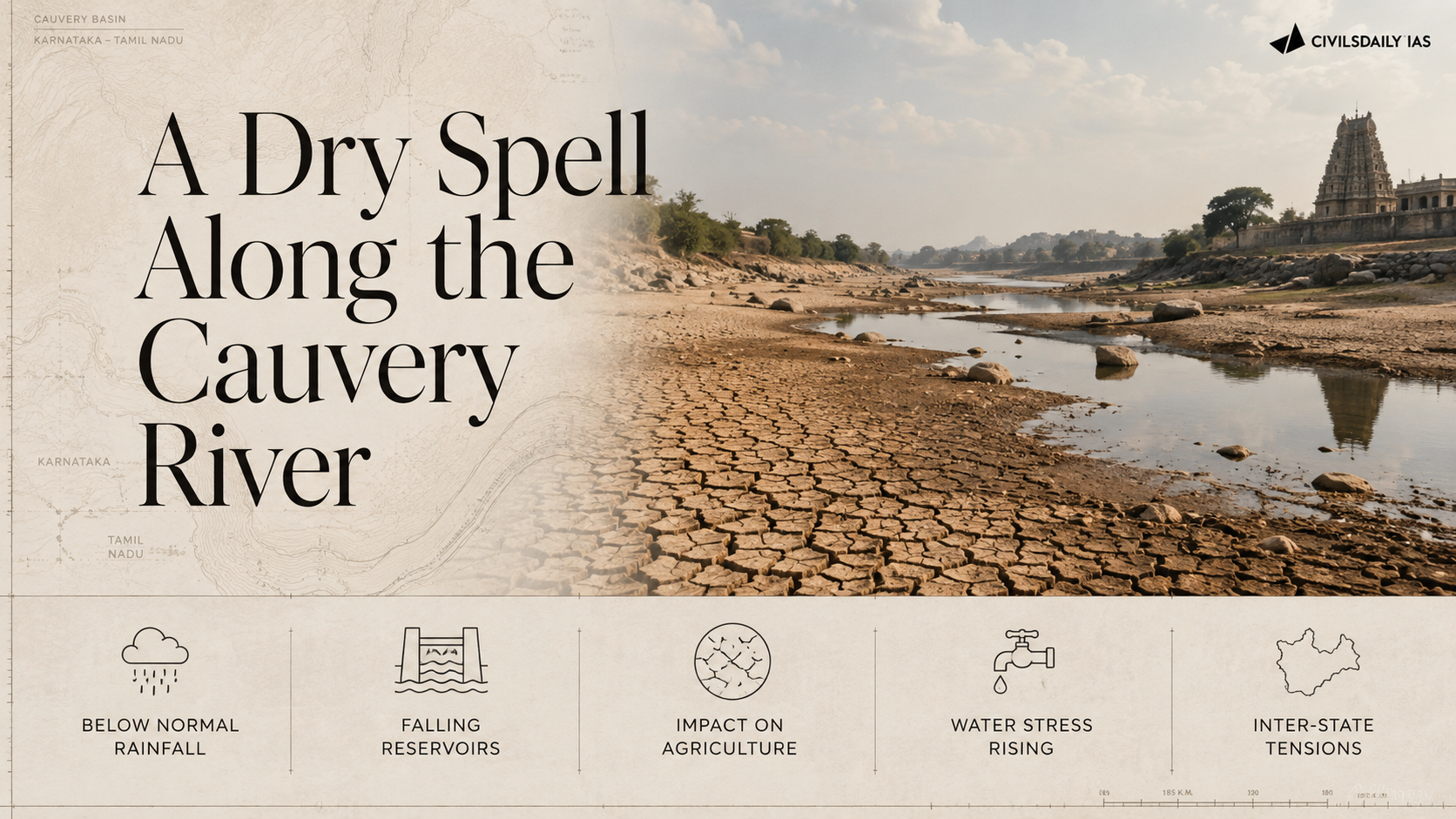
Karnataka appealed to the Cauvery Water Management Authority (CWMA) on 11 August to cut its daily release to Tamil Nadu from 12,000 cusecs to 10,000 cusecs. It warned of a severe drinking water shortage if more water were released for crops in the Cauvery basin. Tamil Nadu had already chosen not to open the Mettur dam for irrigation on the customary date of 12 June, given a poor south-west monsoon forecast attributed to a super El Nino. Large tracts of the Cauvery delta consequently remain barren in a season that normally carries two crops. The dispute is no longer only between an upper and a lower riparian State, because Karnataka is simultaneously rationing its own canal irrigation and committing reservoir water to Bengaluru’s drinking supply.
What is the Cauvery water-sharing arrangement?
- The dispute predates the States: The sharing of the Cauvery is a vexed issue going back more than 130 years, to agreements between the Mysore Kingdom and the Madras Presidency that were drawn without regard to any future State boundary.
- The award fixes an annual quota and a monsoon share: The Cauvery Water Disputes Tribunal and the Supreme Court provided for Karnataka to release 123.14 thousand million cubic feet of the 177.25 thousand million cubic feet annual quota during the south-west monsoon. That share is mostly meant to support paddy cultivation in the Samba season.
- A central authority administers the sharing: The CWMA was set up in June 2018 by the Union government to handle water-sharing from the Cauvery among Karnataka, Tamil Nadu, Kerala and Puducherry.
- A technical committee advises it: The Cauvery Water Regulation Committee (CWRC) assesses storage and crop requirement and recommends releases to the CWMA, and both bodies sit under the Supreme Court’s continuing supervision.
What is a cusec?
- A cusec measures flow, not volume: A cusec is one cubic foot per second, so a release order of 12,000 cusecs fixes the rate at which water must cross the inter-State point rather than a total quantity.
What is a TMC?
- A TMC measures volume: A thousand million cubic feet (TMC) is a stock of water, roughly 28.3 million cubic metres. Reservoir capacity and annual quotas are stated in TMC rather than in the cusecs used for daily obligations.
Why does the delta’s cropping calendar depend on a single dam opening date?
- One release date sets the whole season: Water released from the Mettur dam, built in Salem district across the Cauvery, on 12 June for irrigation ordinarily reaches Tiruvarur about 300 km downstream by 23 or 24 June. This year nothing reached it.
- Two seasons run off that release: Paddy is ordinarily cultivated across 5.3 lakh acres in the delta during the short-term Kuruvai season, followed by 12.9 lakh acres during the longer Samba-Thaladi season.
- Samba is the season that matters: Samba transplantation begins in late July or early August and the harvest ends in mid-January, and the crop is both a food security crop and the mainstay of the delta’s rural economy.
- Kuruvai is the higher-yield gamble: The shorter-duration Kuruvai crop can offer higher yields and is largely dependent on groundwater drawn through energised pumpsets rather than on canal water.
- The acreage has already collapsed: Tamil Nadu government data put the area under paddy cultivation this year at 4.5 lakh acres, against the 5.3 lakh acres the Kuruvai season alone normally covers.
How is Karnataka rationing its own irrigation?
- Farmers sowed against official advice: Farmers across Karnataka’s Cauvery basin defied advice against sowing water-intensive crops such as paddy and sugarcane this season, amid a predicted deficient monsoon and inadequate inflows into the basin’s reservoirs.
- A brief August revival encouraged them: The Krishna Raja Sagara (KRS) reservoir has a full level of 124.8 feet. It rose from 93 to 94 feet to over 100 feet within days in the first week of August before stagnating at 109 feet.
- The canal system runs off that reservoir: The Visvesvaraya canal system draws water from the KRS reservoir, located across the Cauvery near Mysuru, and serves the Mandya belt.
- Releases were cut to four rotational cycles: The Cauvery Irrigation Advisory Committee, a regional body chaired by the Karnataka Water Resources Minister, met in Bengaluru on 19 August and decided to release canal water in only four rotational cycles during the crop season instead of continuously.
- The stated purpose is storage, not irrigation: The decision was taken to conserve reservoir storage and ensure water availability for other needs, including drinking water.
- Rotation does not sustain a standing crop: A pattern of about 15 days of release followed by 15 days without will not provide enough water for paddy and sugarcane, and leaves farmers able to grow only dry crops.
What are farmers at the canal’s tail end facing?
- The tail end gets water last or not at all: A farmer in Kuntanahalli village of Maddur taluk in Mandya district has raised a paddy nursery on a two-acre plot lying at the tail end of the Visvesvaraya canal system.
- The window is measured in days: Without water in the next 7 to 10 days he loses both the sowing season and the Rs 8,000 already spent on raising the nursery.
- Switching crops is not a safe alternative: Semi-dry crops such as ragi, pulses and oilseeds are the fallback, and heavy rain arriving late can damage a ragi crop just as its absence damages paddy.
- Position on the canal decides outcomes: Paddy transplantation is nearly complete in Karekura and Hosahalli, close to the KRS reservoir, and even there farmers who normally take two crops a year doubt the second.
- Losing a crop means becoming a labourer: Most agricultural labourers in the region earn Rs 400 to Rs 500 for a day’s work from 7 a.m. to noon, which is the fallback income for a farmer whose second crop fails.
- Sugarcane is exposed for longer: A standing sugarcane crop in Pandavapura taluk needs another nine months before harvest, and without timely rain may not even be fit for use as cattle fodder.
- Debt is the binding constraint: Farmers have taken interest-free short-term loans from primary agricultural cooperative credit societies and high-interest loans from microfinance companies, and are seeking a waiver and restraint on aggressive recovery agents.
Does Bengaluru’s drinking water come at the cost of the Cauvery’s irrigators?
- A new drinking water stage is already sanctioned: The Cauvery Stage VI drinking water project is a Rs 6,939 crore initiative approved by the Karnataka government this February.
- It adds a fixed annual claim on the river: The project requires an additional 6 thousand million cubic feet of Cauvery water every year, which is a permanent first charge rather than a seasonal allocation.
- The service area extends beyond the city: It will supply 500 million litres per day to roughly 30 lakh residents in Bengaluru and the adjoining towns of Bidadi, Hoskote, Anekal, Devanahalli and Nelamangala.
- The diversion is from the same reservoir: Farmers in Maddur taluk are bracing for confrontation with the State government over the proposed diversion of KRS water. Their canal draws from the same reservoir.
- The competing claim is now internal: The canal rationing decision was justified by the need to protect drinking water, so the same argument that limits releases to Tamil Nadu also limits releases to Karnataka’s own irrigators.
Why has farmer protest stayed muted this year?
- Mobilisation has fallen flat: Protests over poor rainfall and releases to Tamil Nadu have remained muted compared with previous years, and a Karnataka bandh called by a Kannada activist on 13 August drew a lukewarm response outside parts of Maddur taluk.
- Farm bodies cannot bring out their own members: The organising secretary of the Mandya District Raithara Hitharakashana Samithi, a farmers’ welfare committee, records that farmers who are the main stakeholders are not responding to calls for struggle.
- Ruling party leaders are discouraging the streets: Cultivators say ruling party leaders are warning them against joining what they call an “Opposition trap”, and against the police stations and court appearances that follow a protest.
- The Chief Minister has publicly discouraged it: The Karnataka Chief Minister has chastised activists for staging Cauvery protests “for the sake of publicity”, and warned against wading into the river after the Water Resources Department issued a flood alert over releases from the near-brimming Kabini reservoir.
- The State’s own position is two-sided: The Chief Minister has acknowledged that Karnataka’s dams are not yet full and vowed to protect farmers’ interests. The same statement emphasised compliance with directions on releasing water to Tamil Nadu.
- Farmers question the State’s legal effort: The president of the State Sugarcane Farmers’ Association questions whether the government and its legal team have made a strong enough case before the CWRC, the CWMA and the Supreme Court about the water crisis inside Karnataka.
What positions have the two States taken?
- Tamil Nadu blames storage and shortfall in releases: Low storage at the Mettur dam and Karnataka’s failure to release a sufficient share of the water it received in June and July are the two grounds Tamil Nadu cites for the barren delta.
- The reservoir is far below the release threshold: The Mettur dam level is now about 85 feet against a full capacity of 120 feet, and farmer bodies argue that no water should be released until the level reaches at least 100 feet.
- The opening date is still unannounced: The Tamil Nadu government has not announced when the Mettur dam will be opened, and it continues its legal battle with Karnataka to secure the State’s share.
- It is contesting the reduction in court: Tamil Nadu has strongly opposed Karnataka’s push to reduce releases and is pressing the Supreme Court to ensure strict adherence to the mandated 12,000 cusecs daily flow.
- The position is framed as a rights claim: The Tamil Nadu Chief Minister has said the legitimate rights of lower riparian States and the livelihoods dependent on assured river flows must be fully protected.
What does the delta contribute and what is it losing?
- The delta is the State’s rice bowl: Located along the eastern coast and spanning Thanjavur, Tiruvarur, Mayiladuthurai and Nagapattinam, it is characterised by fertile alluvial soil and a tropical climate carried by the Cauvery’s flow.
- It supplies most of the State’s procured paddy: During the 2025-26 procurement year, from 1 September 2025 to 31 July 2026, the region contributed 39.5 lakh tonnes of paddy out of a Statewide procurement of 57.5 lakh tonnes.
- The failure is visible across districts: A drive of over 200 km from Tiruchi through Thanjavur, Thiruvaiyaru, Tiruvarur and Mannargudi shows largely barren paddy fields where the previous year showed continuous green.
- The official acreage may overstate the crop: Some agriculturists dispute the reported figure, citing stunted growth and crops showing signs of withering, which make an area-sown count unreliable as a measure of what will be harvested.
- The loss spreads beyond the fields: Economic activity in the region is crippled by the erosion of livelihood opportunities, and shops and other businesses in Mannargudi now down their shutters by 7 p.m.
- The poorest bear it first: Much of the zone remains economically backward with a majority dependent on agriculture, and Scheduled Castes, who live there in large numbers, constitute the dominant segment of landless agricultural labourers.
Why is groundwater not a fallback for the delta?
- The water table is falling even between two rivers: In Peramur, about 10 km from Thiruvaiyaru and located between the Cauvery and its branch the Coleroon, the water level is going down.
- Extraction technology has migrated to the delta: Submersible pumpsets, once more common in the dry districts of Coimbatore and Dharmapuri, have become commonplace in the delta.
- Over-extraction has damaged the resource permanently: Excess withdrawal has led to salinity ingress in many areas, which removes land from cultivation rather than merely reducing a season’s yield.
- The Kuruvai fallback is therefore closing: The shorter crop that depends on pumped groundwater is becoming harder to raise in the very years when canal water fails, so the two sources fail together rather than covering for each other.
What do farmers want, and what will they get?
- Compensation demands have begun: Several farmers’ groups have started demanding compensation for crop losses across the delta.
- The announced waiver is considered inadequate: Farmers are unhappy with the crop loan waiver scheme announced by the Tamil Nadu Chief Minister and are seeking a full, unconditional waiver of up to Rs 1 lakh for every farmer who has taken a crop loan.
- Relief is conditional on a disaster classification: Any compensation will be subject to the Union and State governments’ norms for natural disasters and to a survey by the departments concerned.
- Officials are still counting on the monsoon: With about a month left in the season, officials continue to hope for a revival that would allow at least a partial Samba crop.
Challenges to Cauvery water sharing
- The award has no distress-year formula: The allocation assumes a normal monsoon and offers no proportionate sharing rule for a deficit year, so every shortfall becomes a fresh contest. Eg. Karnataka’s request to cut releases from 12,000 to 10,000 cusecs has to be argued case by case rather than settled by a rule. Fix. Notify a pro-rata distress sharing schedule tied to measured basin inflow, so releases fall automatically and equally in a deficit year.
- Drinking water and irrigation are not ranked: The award prioritises drinking water in principle without capping how much a growing city may draw, so urban demand expands against a fixed river. Eg. Delhi’s drinking water share of the Yamuna has been litigated against upstream States in the Supreme Court for over two decades. Fix. Fix an audited ceiling on urban drawal from the basin, conditional on the city reusing a notified share of its treated wastewater.
- The Article 262 bar is routinely circumvented: Article 262 lets Parliament exclude the courts from water disputes, and States nonetheless reach the Supreme Court through special leave petitions under Article 136. Eg. The Cauvery allocation has been litigated in the Supreme Court repeatedly after the Tribunal’s award. Fix. Amend the Inter-State River Water Disputes Act, 1956 to make a tribunal award final on quantum, leaving only implementation questions justiciable.
- Tribunals take decades to decide: Article 262 sets no time limit, so an award arrives after the cropping economy it was meant to govern has already changed. Eg. The Cauvery Water Disputes Tribunal took 17 years to deliver its decision. Fix. Enact the pending Inter-State River Water Disputes (Amendment) Bill and apply its timelines to disputes already before a tribunal.
- Flow data is contested rather than shared: Each State measures inflow and utilisation on its own gauges, so the basic facts of a deficit year are disputed before the sharing question is reached. Eg. Karnataka and Tamil Nadu differ on how much of the June and July inflow was actually released downstream. Fix. Operate a single telemetered gauge network under the CWMA with readings published in real time and binding on both States.
- The dispute pays politically: Regional parties gain from an unresolved conflict, so neither an implementation habit nor a negotiated settlement is rewarded at the ballot. Eg. A bandh call and a protest ban were both issued in the same fortnight in Karnataka this month. Fix. Route inter-State negotiation through the Inter-State Council under Article 263, where a recorded agreement carries a political cost to abandon.
Conclusion
A deficient monsoon has converted the Cauvery allocation from a sharing arrangement into a distress-year contest that the award was never designed to settle. Karnataka is rationing its own canal command to four rotational cycles and committing an additional annual volume to Bengaluru’s drinking supply. Tamil Nadu’s delta has lost a season because the Mettur dam was never opened. The immediate decisions rest with the Cauvery Water Management Authority on the daily release rate and with the Tamil Nadu government on the dam opening date. Neither will be settled this season without a rule for sharing a shortfall, which is exactly what the existing award does not contain.
“[2024, GS3, 15 marks] What are the major challenges faced by Indian irrigation system in recent times? State the measures taken by the government for efficient irrigation management.”
