💥Join UPSC 2027,2028 Mentorship (July Batch) + XFactor Notes & Microthemes PDF

GS Paper: GS3-05.Different types of irrigation and irrigation systems

  • Elaborate the impact of National Watershed Project in increasing agricultural production from water-stressed areas.

    The NWP is a World Bank-assisted initiative that supports the watershed development component of India’s Pradhan Mantri Krishi Sinchayi Yojana (PMKSY).

    Project Objectives

    Strengthen Institutions – for better planning, implementation, and monitoring

    Use Technology for Efficiency – using scientific tools like GIS, remote sensing etc

    Improve Water & Soil Management

    Support Rural Livelihoods

    Positive Impact on Agricultural Production in Water-Stressed Areas

    Improved Water Availability – Groundwater levels increased by 0.5-1.2 metres on average in treated watersheds (CWC evaluation).

    Increase in Cropping Intensity

    by 35-60% in many watershed districts (ICAR-NAAS study).

    Higher Crop Yields – Yield increased by 25-40% in millets, 30-60% in pulses, 20-35% in oilseeds (NRSC 2021).

    Diversification to High-Value Crops due to reliable water.

    Reduced Soil Erosion by 40-60% – enhancing long-term soil productivity.

    Growth in Livestock Productivity – Fodder production increased 3-5 times, boosting dairy income in dryland regions.

    Improved Household Income by 27-45%, poverty reduced 12-20% in watershed villages. (World Bank)

    Climate Resilience Strengthened – Enhanced capacity to withstand dry spells, delayed rainfall, and drought cycles.

    Limitations

    Uneven Implementation Across States

    Delays in Planning & Fund Release

    Weak Community Participation

    Poor Post-Project Maintenance

    Limited Integration With Micro-Irrigation

    Fragmented Convergence With Schemes like MGNREGA, PMKSY

    To scale its impact nationally, watershed programmes must be linked with micro-irrigation, FPOs, and market access.

  • What are the salient features of the Jal Shakti Abhiyan launched by the Government of India for water conservation and water security?

    Jal Shakti Abhiyan is a time-bound, mission-mode campaign launched in 2019 to promote water conservation, recharge, and water security in stressed districts.

    Salient Features of the Jal Shakti Abhiyan (JSA)

    Targets blocks with critical or over-exploited groundwater across India, prioritising arid and semi-arid regions.

    Five Key Intervention Areas

    Water Conservation & Rainwater Harvesting

    Renovation of Traditional & Existing Water Bodies

    Reuse & Recharge of Borewells/Watershed Structures

    Watershed Development

    Intensive Afforestation

    Convergence of Multiple Departments – Brings together Rural Development, Water Resources, Agriculture, Forest, Urban Development, Panchayati Raj under a unified water conservation plan.

    Block-Level Water Conservation Plans and a scientific water budget for area-specific interventions.

    Central nodal officers monitor implementation through field visits and performance reviews.

    Jan Andolan – Engages panchayats, SHGs, NGOs, youth groups, schools, and citizens for mass awareness and behavioural change.

    Integration With MGNREGA & PMKSY for creation of check-dams, percolation tanks, ponds, trenches, recharge pits etc.

    Urban Water Conservation Measures (JSA – 2021 onwards)

    Ensuring mandatory Rainwater Harvesting (RWH) as per Model Building By-Law (MBBL) 2016.

    reuse of treated wastewater,

    Setting Up RWH Cells in Urban Local Bodies

    “Catch the Rain – Where it Falls, When it Falls” campaign

    Its integrated approach has strengthened water conservation practices and laid the groundwork for long-term water security.

  • Suggest measures to improve water storage and irrigation system to make its judicious use under depleting scenario.

    India has 18% of the world’s population but only 4% of the freshwater resources. As per NITI Aayog “Composite Water Management Index”, 60 Cr people are experiencing high to extreme water stress.

    ~85% of India’s freshwater is used in agriculture (FAO).

    Groundwater depletion:

    1,006 blocks are over-exploited or critical (CGWB, 2023).

    Punjab and Haryana – ~1 metre annual groundwater decline.

    Per capita water availability fell from 1,820 m³ (2001)1,486 m³ (2025).

    “Day Zero” in cities like Chennai, Bengaluru, and Shimla

    By 2030, water demand could outstrip supply by twofold. (NITI Aayog)

    21 cities could exhaust groundwater by 2030. (NITI Aayog)

    The World Resources Institute ranks India 13th among the 17 most water-stressed nations globally

    2024 Annual Groundwater Quality Report – that 70% of India’s water sources are contaminated

    World Bank projects that climate-induced water scarcity could reduce India’s GDP by up to 12% by 2050

    Measures to improve water management

    Enhancing Water Storage Infrastructure

    Renovation Traditional Water Bodies – Example: Mission Kakatiya (Telangana) and Kudimaramath (Tamil Nadu).

    Farm-Level Storage – Promote farm ponds, percolation tanks, check dams, and contour bunds through MGNREGA. Eg- jalyukta Shivar of Maharashtra

    Rainwater Harvesting – Mandatory rooftop harvesting in water-stressed cities. Eg- Chennai Model

    Interlinking of Rivers – Eg- Projects like Ken-Betwa Link can ease water shortages in Bundelkhand.

    Use recharge wells to replenish aquifers through Atal Bhujal Yojana

    Dam Modernisation to enhance water storage capacity

    Improving Irrigation Efficiency

    Micro-Irrigation Expansion through PMKSY-PDMC. Eg- Drip saves 30-50% water; sprinkler saves 25-35%.

    Canal Modernisation- Improves efficiency from .

    Precision Farming – Use of sensors, fertigation, controlled irrigation for sustainable agriculture and optimal water use.

    Remote Sensing & GIS for Water Accounting – Monitor aquifers, rainfall-runoff, and canal leakages.

    Increase Capital Investment in Irrigation Systems and Fast-track AIBP projects

    Strengthening Community-Led Measures – Eg- Pani Panchayats in Odisha.

    Demand-Side Management

    Crop Diversification – Shift from water-intensive crops (paddy, sugarcane) to millets, pulses, oilseeds, horticulture. Example: Haryana’s Mera Pani Meri Virasat.

    Water Budgeting at Village Level through Gram Sabhas. Eg- Pani Foundation villages in Maharashtra.

    Water Pricing – Rational, volumetric pricing to reduce wastage.

    Water Users Associations (WUAs) – Participatory Irrigation Management for equitable distribution and canal maintenance.

    Incentivise Water Saving – Eg- Punjab’s Pani Bachao Paise Kamao for reducing groundwater usage.

    Implementing Mihir Shah Committee recommendations of One Water Approach by merging CGWB and CWC into a National Water Commission (NWC) is essential to achieve a water-secure economy.

  • How and to what extent would micro-irrigation help in solving India’s water crisis?

    Micro irrigation is a water-efficient irrigation technique that delivers water directly to plant roots using drip or sprinkler systems, reducing water wastage.

    18% of the world’s population but only 4% of global freshwater resources.

    ~85% of India’s freshwater is used in agriculture (FAO).

    Groundwater depletion:

    1,006 blocks are over-exploited or critical (CGWB, 2023).

    Punjab and Haryana – ~1 metre annual groundwater decline.

    Per capita water availability fell from 1,820 m³ (2001)1,486 m³ (2025).

    Role of Micro-Irrigation in Solving India’s Water Crisis

    Significant Water Saving – saves around 30-50% water compared to flood irrigation.

    Higher Water Use Efficiency (WUE)

    Sprinkler Irrigation – 75%

    Drip Irrigation – 90%

    Higher Yields: Eg- increases yields by 45% for wheat, 20% for gram, and 40% for soybean.

    Reduced Water Loss through evaporation, runoff, and deep percolation

    Lower Fertilizer Use: Through fertigation, fertilizers are applied directly to the plant roots along with water

    Reduced Groundwater Extraction – Eg- Drip in sugarcane in Maharashtra reduced water use by 22-25%.

    Improves Climate Resilience – Provides controlled irrigation during dry spells.

    Micro-irrigation can double irrigation coverage using existing water resources (NITI Aayog).

    Limitations of micro-irrigation

    Low Adoption – micro-irrigation covers only 7.6% of the net sown area

    High Initial CostEg- Drip irrigation costs .

    Regular maintenance needs to avoid clogging, leakage, and damage is technically difficult for farmers.

    Technical Knowledge Gap: lack of know-how to correctly install, operate, and maintain micro-irrigation systems.

    Social and Cultural Barriers: Traditional farming practices and resistance to change.

    Regional imbalance – Eastern and northern states lag.

    Not Suitable for all crops– Eg-Flood irrigation is preferred for water-intensive crops like paddy

    Government Initiatives

    PMKSY “Per Drop More Crop” – subsidies up to 55%.

    Micro-Irrigation Fund under NABARD – 10000 Cr

    Andhra Pradesh Micro-Irrigation Project (APMIP)

    Micro-irrigation is critical for achieving equitable, efficient and sustainable irrigation management. (“Vision for Sujalam Bharat”)

  • What are the major challenges faced by Indian irrigation system in recent times? State the measures taken by the government for efficient irrigation management.

    The agriculture sector utilizes approximately 78% of India’s total usable water resources. However, 45% of agricultural land is rainfed.

    Major challenges faced by Indian Irrigation system

    P – Political Factors

    Political populism – Eg- power and irrigation subsidies in Punjab

    Inter-State Water Disputes – Conflicts such as the Cauvery Water Dispute and the Satluj Yamuna Link Canal hinder efficient water distribution and irrigation planning.

    Prioritization of Large-Scale Projects – Political support often favors large-scale projects that benefit influential farmers and regions.

    E – Economic Factors

    Declining Public Investment since the 1980s, with a shift toward input subsidies rather than capital investment. (Economic Survey)

    High Cost of Irrigation Infrastructure

    85% farmers have <2 ha, making modern irrigation systems uneconomical

    S – Social Factors

    Weak Water Users Associations (WUAs) – lack capacity and resources.

    Uneven Irrigation Distribution – Northern & coastal regions have better irrigation, while central and western India suffer inadequate supply.

    T – Technological Factors

    Low Water Use Efficiency (WUE) – Flood irrigation (~70%) leads to evaporation, runoff, and seepage losses.

    Aging & Poorly Maintained Canal Systems – Unlined canals cause 40-50% seepage losses.

    Low adoption of technology – Eg- micro-irrigation covers only 7.6% of the net sown area

    L – Legal / Governance Factors

    Weak Enforcement of Water Governance Rules (Mihir Shah Committee)

    E – Environmental Factors

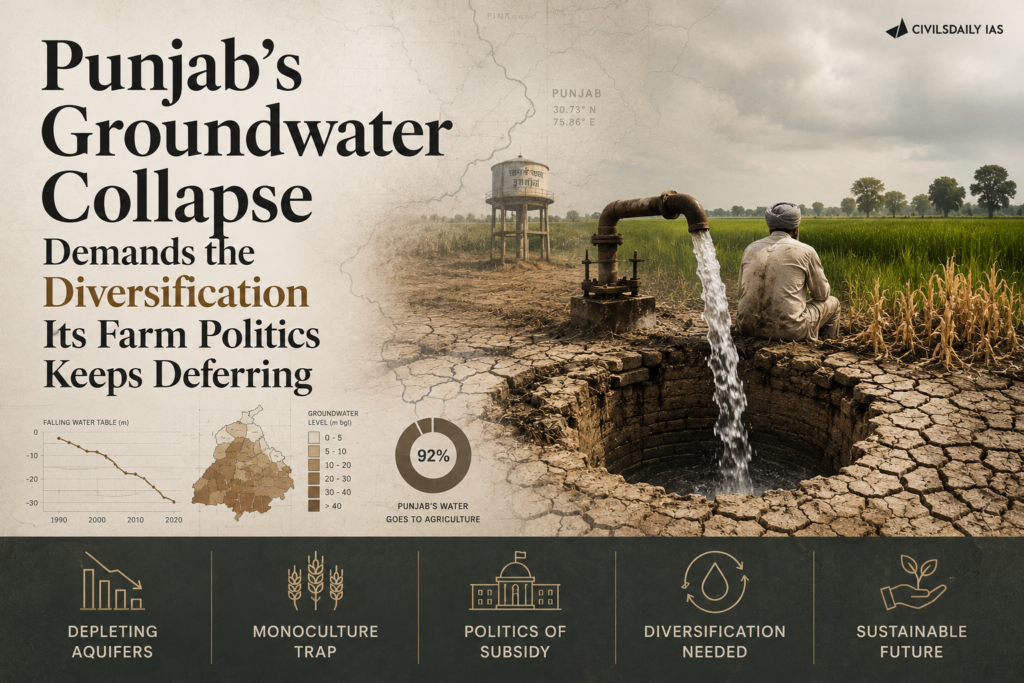
    Groundwater Depletion – Eg- Punjab’s water table declines by ~1 meter annually.

    Poor drainage leads to salinization and reduced soil fertility, especially in canal-irrigated regions.

    Climate Change Impact – Eg- glacial retreat in the Himalayas threatens long-term river flows.

    Government Measures for Efficient Irrigation Management

    PM Krishi Sinchayee Yojana (PMKSY) – Promotes micro-irrigation (drip/sprinkler) through subsidies.

    Components: Har Khet Ko Pani, Per Drop More Crop, Watershed Development.

    Micro-Irrigation Fund (NABARD) – Dedicated fund of to expand drip and sprinkler systems.

    Atal Bhujal Yojana (Atal Jal) – Focus on groundwater management in water-stressed districts through community participation.

    Accelerated Irrigation Benefits Programme (AIBP) – Financial assistance for completion of long-pending major and medium irrigation projects.

    Participatory Irrigation Management (PIM) by strengthening Water Users Associations (WUAs).

    Bureau of Water Use Efficiency under Ministry of Jal Shakti – To improve water use efficiency by 20%

    State level initiatives

    Mission Kakatiya, Telangana – Restoration of 46,531 minor irrigation tanks

    Jalyukt Shivar Abhiyan, Maharashtra – watershed development, farm ponds, desilting of streams.

    Crop Diversification Initiatives

    Mission for Integrated Development of Horticulture (MIDH)

    Increase in MSP for Pulses and Millets. Eg- 60% for Ragi

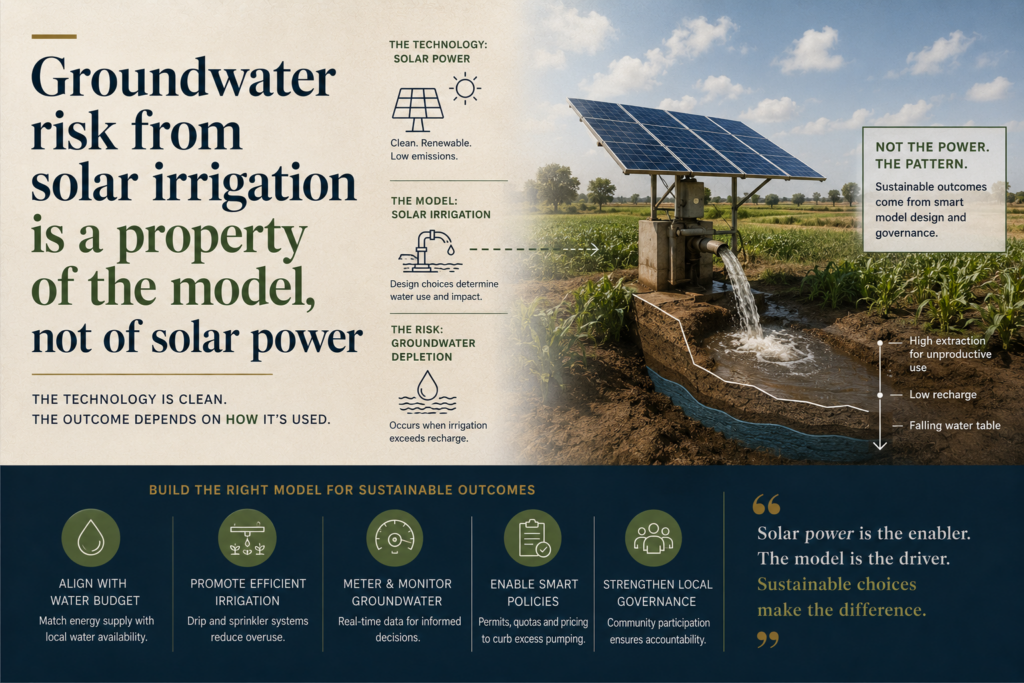
    PM KUSUM: Promotes the use of solar-powered pumps for micro-irrigation

    Timely and efficient implementations of government programmes is essential for achieving equitable, efficient and sustainable irrigation management. (“Vision for Sujalam Bharat”)

  • How rice farmers can cut methane and make money off it

    Introduction

    Rice cultivation traditionally relies on continuous flooding, creating anaerobic soil conditions conducive to methane-producing bacteria. Given that over 86% of Indian farmers are small and marginal, scalable, low-cost mitigation practices are essential. Alternate Wetting and Drying (AWD) comes across as a practical solution that reduces emissions without yield loss, supported by empirical data from Telangana, Andhra Pradesh, Odisha, and Tamil Nadu.

    Why in the News?

    Paddy cultivation contributes 28% of global methane emissions, with methane having 28 times the global warming potential of CO₂ over 100 years. The article highlights a first-of-its-kind, farmer-level implementation in India where Alternate Wetting and Drying (AWD) reduced methane emissions while enabling farmers to earn carbon credits. Unlike earlier mitigation efforts focused only on productivity, this approach integrates climate finance, water conservation, and income generation, marking a structural shift in rice farming practices.

    Why Does Traditional Paddy Cultivation Produce High Methane Emissions?

    1. Continuous Flooding: Maintains 4-5 cm water depth for the first 65 days of the crop cycle.
    2. Anaerobic Conditions: Support methanogenic microbes that decompose organic matter.
    3. Emission Intensity: Methane is 28 times more potent than CO₂ in warming potential.
    4. Global Impact: Paddy cultivation accounts for 28% of global methane emissions.

    What Is Alternate Wetting and Drying (AWD)?

    1. Irrigation Technique: Periodic drying of fields instead of continuous flooding.
    2. Operational Threshold: Irrigation resumes when water level falls to 15 cm below soil surface.
    3. Adoption Window: Implemented after first 20 days of transplantation.
    4. Institutional Support: Promoted by International Rice Research Institute (IRRI).

    How Does AWD Reduce Methane Emissions Without Yield Loss?

    1. Aeration of Soil: Disrupts methane-producing microbial activity.
    2. Water Savings: Reduces irrigation requirement significantly.
    3. Yield Stability: No statistically significant reduction in grain output.
    4. Ancillary Benefits: Lower weed pressure and improved nutrient efficiency.

    What Evidence Supports the Effectiveness of AWD in India?

    1. Field Study: Conducted across 30 sites in Telangana and Andhra Pradesh.
    2. Emission Reduction: Methane emissions reduced by 20-40%.
    3. Water Use: Comparable decline in irrigation water requirement.
    4. Scalability: Validated across varied agro-climatic conditions.

    How Are Farmers Monetising Methane Reduction?

    1. Measurement: Acrylic chambers used to quantify methane emissions.
    2. Verification: Samples analysed in accredited laboratories.
    3. Carbon Credits: 1 carbon credit = 1 tonne CO₂ equivalent.
    4. Earnings: ₹1,300-₹7,000 per farmer per season depending on region.
    5. Aggregation Model: Credits pooled and sold to international buyers.

    What Institutional Models Are Enabling This Transition?

    1. Climate Tech Intermediaries: Facilitate monitoring, reporting, and verification (MRV).
    2. Carbon Markets: Buyers include energy-intensive global corporations.
    3. Corporate Partnerships: Shell Energy India supported AWD adoption.
    4. Scale: Over 12,000 farmers across 13 states integrated.

    Conclusion

    The article demonstrates that methane mitigation in rice farming is technically feasible, economically viable, and scalable. By linking irrigation practices with carbon markets, AWD represents a paradigm shift where climate action strengthens farm incomes rather than constraining them.

    Value Addition

    Scale of Methane Emissions from Agriculture

    1. Global Share: Agriculture contributes ~40% of global anthropogenic methane emissions.
    2. India’s Context: Agriculture is the largest source of methane emissions in India, exceeding energy and waste sectors.
    3. Paddy Cultivation: Responsible for ~28-30% of global agricultural methane emissions.
    4. Livestock: Enteric fermentation from ruminants contributes ~32-35% of agricultural methane.
    5. Climate Impact: Methane has ~28-34 times higher Global Warming Potential (GWP) than CO₂ over 100 years and ~80 times over 20 years.

    Other Proven Models to Cut Methane Emissions in Agriculture

    1. Direct Seeded Rice (DSR)
      1. Mechanism: Eliminates continuous flooding by sowing seeds directly.
      2. Outcome: Reduces methane emissions by 20-50%.
      3. Co-benefits: Lower water use, reduced labour costs.
      4. Limitation: Higher weed management requirement.
    2. System of Rice Intensification (SRI)
      1. Mechanism: Wider plant spacing, intermittent irrigation, younger seedlings.
      2. Outcome: Reduces methane emissions due to improved soil aeration.
      3. Productivity: Often increases yield with lower input intensity.
      4. Constraint: High skill and labour precision required.
    3. Mid-Season Drainage
      1. Mechanism: Temporary drainage during tillering stage.
      2. Outcome: Interrupts anaerobic conditions, suppressing methanogenesis.
      3. Adoption: Practiced in parts of East Asia and Southeast Asia.
      4. Risk: Needs precise timing to avoid yield stress.
    4. Straw and Residue Management
      1. Mechanism: Avoids incorporation of fresh organic matter in flooded fields.
      2. Outcome: Reduces methane formation from anaerobic decomposition.
      3. Best Practice: Composting or biochar conversion of rice straw.
    5. Biochar Application
      1. Mechanism: Alters soil microbial activity and improves aeration.
      2. Outcome: Reduces methane emissions while enhancing soil carbon storage.
      3. Co-benefit: Improves soil fertility and water retention.
    6. Feed Additives in Livestock (Complementary Model)
      1. Examples: Seaweed-based additives, 3-NOP compounds.
      2. Outcome: Reduce enteric methane emissions by 20-80%.
      3. Status: Pilot-stage in India; commercial use expanding globally.
    7. Market-Based Methane Mitigation Instruments
      1. Carbon Credits: 1 credit = 1 tonne CO₂ equivalent avoided.
      2. Aggregation Models: Smallholder emissions pooled for viability.
      3. Buyers: Energy, aviation, cement, and data-centre industries.
      4. Trend: Shift from voluntary offsets to high-integrity, agriculture-based credits.

    PYQ Relevance

    [UPSC 2020] What are the major factors responsible for making the rice-wheat system a success? In spite of this success, how has this system become a bane in India?

    Linkage: The article directly addresses the environmental externalities of flooded paddy cultivation, especially methane emissions and water stress, which constitute the “bane” aspect of the rice-based system. 

  • Need for technological solutions to use water for agriculture more sustainably

    The article examine the use of water for sugarcane and rice cultivation in India and its impact. 

    Water availability and usage in India

    • As per the Central Water Commission’s reassessment of water availability, India receives a mean annual precipitation of about 3,880 billion cubic meters (BCM) but utilises only 699 BCM (18 percent) of this; the rest is lost to evaporation and other factors.
    • The demand for water is likely to be 843 BCM in 2025 and 1,180 BCM by 2050.
    • As per the UN’s report on Sustainable Development Goal-6 (SDG-6) on “Clean water and sanitation for all by 2030”, India achieved only 56.6 per cent of the target by 2019.
    • Further, as per the Niti Aayog’s Composite Water Management Index (2019), 75 per cent households in India do not have access to drinking water on their premises.
    • India ranks 120th amongst 122 countries in the water quality index.
    • India is identified as a water-stressed country with its per capita water availability declining from 5,178 cubic metre (m3)/year in 1951 to 1,544 m3 in 2011 — this is likely to go down further to 1,140 cubic metre by 2050.

    How free or highly subsidised electricity skews water use pattern

    • Despite decades of large public and private investments in irrigation, only about half of India’s gross cropped area:198 million hectares is irrigated.
    • Groundwater contributes about 64 per cent, canals 23 per cent, tanks 2 per cent and other sources 11 per cent to irrigation.
    • This results primarily from incentive policy of free or highly subsidised power, particularly in the country’s north-west, the site of the erstwhile Green Revolution.
    • Overexploitation of groundwater has made this region amongst the three highest water risk hotspots.
    • Overall, about 1,592 blocks in 256 districts in India are either critical or overexploited.

    Need to focus on rice and sugarcane

    • Agriculture uses about 78 per cent of fresh water resources.
    • As per a NABARD-ICRIER study on Water Productivity Mapping, these crops alone consume almost 60 per cent of India’s irrigation water.
    • We need a paradigm shift to increase land productivity measured as tonnes per hectare (t/ha), and to maximise applied irrigation productivity measured as kilogrammes, or Rs, per cubic metre of water (kg/m3).
    • Figure 1 shows applied irrigation water productivity against land productivity for rice and sugarcane in important growing states.
    • Note that while Punjab scores high on land productivity of rice, it is at the bottom with respect to applied irrigation water productivity.
    • In the case of sugarcane, irrigation water productivity in Andhra Pradesh, Karnataka, Maharashtra and Tamil Nadu is only 1/3rd of that in Bihar and UP (Figure 2).
    • There is, thus, a need to realign cropping patterns based on per unit of applied irrigation water productivity.

    Use of technology

    • There are technologies to produce the same output of rice and sugarcane with almost half the irrigation water.
    • Jain Irrigation, for instance, has set up drip irrigation pilots for paddy and sugarcane.
    • The results of these pilots indicate while it takes 3,065 litres of water to produce 1 kg of paddy grain (yield level 7.75 t/ha) under traditional flood irrigation, under drip, it can be reduced to just 842 litres.
    • The benefit cost ratio of drip with fertigation in case of sugarcane in Karnataka is observed to be 2.64.
    • An extension to this is the “Family Drip System” innovated by Israel-based — Netafim.
    • The company has also launched its largest demonstration project in Asia at Ramthal, Karnataka.
    • Technologies like Direct Seeded Rice (DSR) and System of Rice Intensification (SRI) can also save 25-30 per cent of water compared to traditional flood irrigation.

    Need for right pricing policies

    • Technological solutions cannot make much headway unless pricing policies of agri-inputs are put on the right track and farmers are incentivised for saving water.
    • The Punjab government, along with the World Bank and J-PAL, has started some pilots with an innovative policy of “Paani Bachao Paise Kamao” to encourage rational use of water among farmers.

    Consider the question “Examine the impact of rice and sugarcane cultivation on the groundwater table in India. How technological solutions can help use water more sustainably for agriculture?”

    Conclusion

    Overall, it seems it is time to switch from the highly subsidised price policy of water/power (and even fertilisers) to direct income support on a per hectare basis, and investment policies that help with newer technologies and innovations.

  • Buddah Nullah

    The Punjab govt. has approved ₹650 crore in the first phase for rejuvenation of the highly polluting Buddah Nullah — a seasonal tributary of Sutlej in Ludhiana.

    Buddah Nullah

    • Buddah Nullah or Budha Nala is a seasonal water stream that runs through the Malwa region of Punjab.
    • It passes through highly populated Ludhiana and drains into Sutlej River, a tributary of the Indus river.
    • It has also become a major source of pollution in the region as well the main Sutlej river, as it gets polluted after entering the highly populated and industrialized Ludhiana city, turning it into an open drain.
    • Also, since a large area in south-western Punjab solely depend on the canal water for irrigation, and water from Buddha Nullah enters various canals after Harike waterworks.

    Why such move?

    • The pollution in the Buddah Nullah is a major threat to public health and environment and the main sources of pollution in the nullah are direct flow of pollutants by industries and dairies.
    • Also, treated effluents from existing STPs, based on UASB technology, does not meet the required quality and overflow from sewer lines add to the problem.
    • The NGT has already directed the government to take proactive steps to immediately address the problem.
  • Irrigation In India – PMKSY, AIBP, Watershed Management, Neeranchan, etc.

    Neeranchal National Watershed Project

    As a part GS-3 – Irrigation systems, We need to focus on relevant projects/schemes launched in 2015-16. We will try to bring all such important projects/schemes. One such project is, “Neeranchal” for the Watershed Component of the Pradhan Mantri Krishi Sinchayi Yojana (PMKSY), Let’s see it in brief!

    What is a watershed?

    A watershed also known as drainage basin is an extent or an area of land where surface water from rain, melting snow or ice converges to a single point at a lower elevation, usually the exit of the basin, where the waters join another waterbody, such as a river, lake etc.


    What is watershed management?

    • Watershed management is an adaptive, comprehensive, integrated multi-resource management planning process that seeks to balance healthy ecological, economic, and cultural/social conditions within a watershed.
    • Watershed management serves to integrate planning for land and water; it takes into account both ground and surface water flow, recognizing and planning for the interaction of water, plants, animals and human land use found within the physical boundaries of a watershed.

    What are the objectives of Neeranchal?

    • The Neeranchal Project will support PMKSY to improve watershed management practices and demonstrate measurable results in selected sub-watersheds
    • It will introduce new hydrological approaches and innovative tools for community participation with a more integrated watershed planning process
    • Pilot new field practices that will improve conservation outcomes, water availability, agricultural yields and climate resilience, and scale up a more effective monitoring and evaluation system to track performance
    • The project will be implemented by the Ministry of Rural Development over a six-year period (2016-21)

    Let’s first learn about Pradhan Mantri Krishi Sinchai Yojana (PMKSY)

    • PMKSY is a central scheme that aims at providing irrigation facilities to every village in the country by converging ongoing irrigation schemes
    • The vision of extending the coverage of irrigation ‘Har Khet Ko Paani’ and improving water use efficiency ‘More crop per drop’ in a focused manner
    • With end to end solution on source creation, distribution, management, field application and extension activities
    • A dynamic annual fund allocation methodology mandates states, to allot more funds to irrigation sectors for becoming eligible to access funds under this scheme, is being considered

    The Pradhan Mantri Krishi Sinchayee Yojana programme should concentrate on 2 important things –

    • First, it should quickly put to use 20–40 million ha of unutilised irrigation potential created in major, medium and minor irrigation projects
    • Second, it should provide better quality power rations to farmers during the time of peak irrigation demand.
    • Madhya Pradesh has done precisely this and multiplied the state’s irrigated area quickly, at small incremental cost, delivering double-digit agricultural growth

    What about funding ?

    • The Government of India and the World Bank have signed a US$ 178.50 million credit for the Neeranchal National Watershed Project to improve watershed management in rural rainfed areas
    • The credit will support the watershed activities of the PMKSY in selected states of Andhra Pradesh, Telangana, Chhattisgarh, Gujarat, Jharkhand, Madhya Pradesh, Maharashtra, Odisha and Rajasthan
    • It will cover about 400 sub-watersheds of about 5,000 ha each and reach approximately 482,000 farmer households and two million people
    • The credit is from the International Development Association (IDA) – the World Bank’s concessionary lending arm with a maturity of 25 years, including a 5 year grace period

    [IDA – International financial institution which offers concessional loans and grants to the world’s poorest developing countries. The IDA is a member of the World Bank Group]

    Concerns that will be addressed by Neeranchal-

    • Bring about institutional changes in watershed and rainfed agricultural management practices in India
    • Build systems that ensure watershed programmes and rainfed irrigation management practices are better focused, and more coordinated, and have quantifiable results
    • Devise strategies for the sustainability of improved watershed. management practices in programme areas, even after the withdrawal of project support
    • Through the watershed plus approach, support improved equity, livelihoods, and incomes through forward linkages, on a platform of inclusiveness and local participation


     What are the benefits?

    • Lead to reducing surface runoff of rainwater
    • It will increase recharge of groundwater and better availability of water in rainfed areas
    • It resulting in incremental rainfed agriculture productivity, enhanced milk yield and increased cropping intensity through better convergence related programmes in project areas
    • It will strengthen and provide technical assistance to enhance delivery capacity
    • This is an area development programme and all people living in the project area will be benefitted

    What are the challenges ahead?

    • Enhanced participation of communities, building stronger capacities and systems to plan, implement, monitor and post-project sustainability of local institutions and assets
    • These challenges, if not resolved, can result in implementation delays, slow disbursements and benefits

    Want to read more?

    Published with inputs from Arun