Why in the News
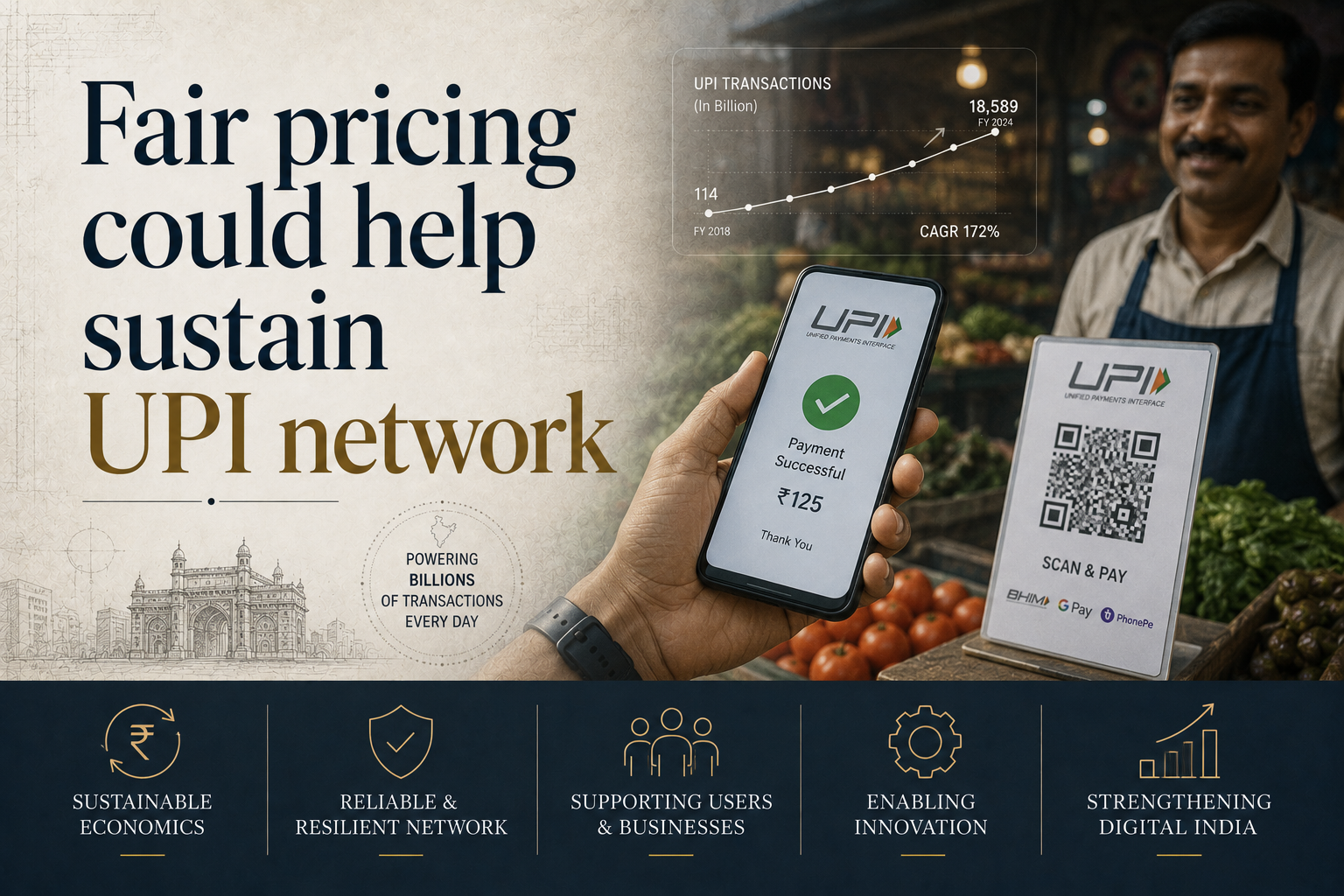
The op-ed, by a NITI Aayog consultant, argues that the zero-Merchant Discount Rate (MDR) regime underpinning Unified Payments Interface (UPI)‘s free-to-use model is financially unsustainable, and proposes a differentiated pricing structure as the Department of Financial Services examines whether to restore MDR for high-threshold transactions or merchants. The piece is pegged to a Parliamentary Standing Committee on Finance report tabled this month, which cited an industry estimate of about Rs 20,700 crore in annual UPI operating costs against a Rs 2,000 crore government allocation under the zero-MDR regime.
What is the fiscal problem with UPI’s current pricing model, and what does the op-ed propose?
- The cost-subsidy gap is large and quantified: The Parliamentary Standing Committee on Finance’s report cited industry estimates of roughly Rs 20,700 crore in annual UPI operating costs, against a government allocation of only Rs 2,000 crore under the zero-MDR regime, with banks and payment companies absorbing the balance.
- Two restructuring options are formally under examination: The Department of Financial Services is examining restoring MDR for certain high-threshold transactions or merchants, and separately, phasing out government support through a tiered incentive structure.
- The op-ed’s proposed principle is differentiated, not uniform, pricing: It argues for keeping UPI free for consumers and small merchants while allowing a capped MDR for larger commercial users and higher-value transactions, on the basis that a uniform rate would be negligible for a large retailer but consequential for a street vendor.
- The author’s own research links merchant ecosystem formalisation to UPI adoption: Citing research with Sharon Buteau, the op-ed states that more formalised merchant ecosystems are associated with higher UPI use, and that MDR design should be calibrated to where acceptance networks are still developing rather than applied uniformly.
- Aggregated payment data is proposed as a second, non-MDR revenue and policy tool: The op-ed cites PhonePe’s PulsePro and a recent MoU with the Ministry of Electronics and Information Technology (MeitY) to integrate UPI transaction metrics into PM GatiShakti for infrastructure and economic planning, arguing that privacy-safe aggregated payment signals have public value independent of any pricing decision.
Conclusion
The op-ed’s position is that UPI’s zero-MDR model has reached a fiscal limit documented by Parliament’s own Standing Committee, and that a threshold-based, differentiated MDR, protecting small merchants and consumers while pricing larger commercial transactions, is a more sustainable path than either continuing an unfunded subsidy or imposing a uniform fee that would slow onboarding in less-formalised markets.
Back2Basics
- Merchant Discount Rate (MDR): The fee a merchant pays to their bank or payment service provider for accepting digital payments, historically waived to zero on UPI and RuPay debit card transactions in India since January 2020 to encourage adoption.
- Unified Payments Interface (UPI): A real-time payment system developed by the National Payments Corporation of India (NPCI) that enables instant interbank transactions through a single mobile application.
“[2023, GS3, 10 marks] What is the status of digitalization in the Indian economy? Examine the problems faced in this regard and suggest improvements.”
