Why in the News
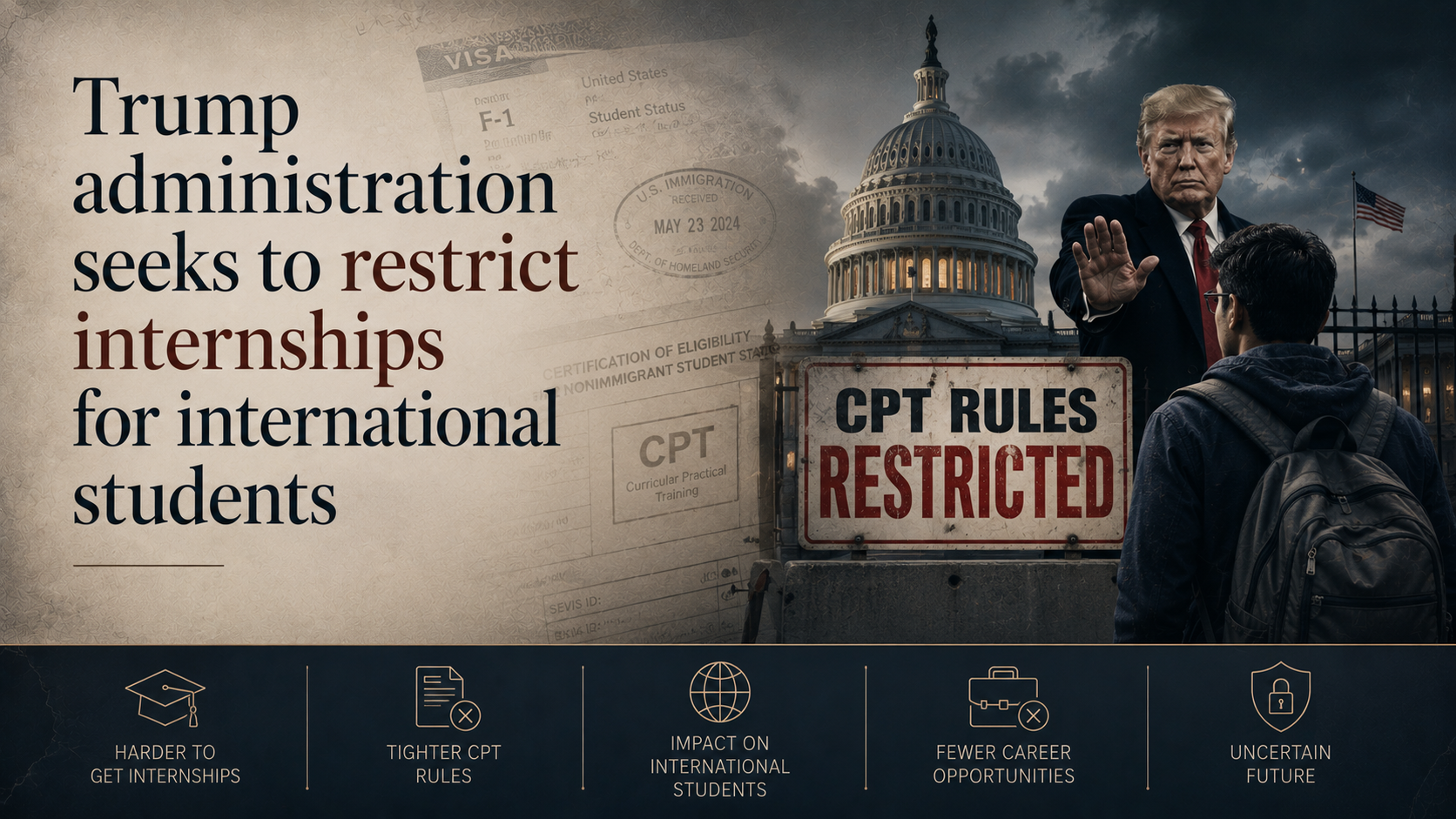
The Trump administration issued a memo, dated August 24, directing US universities to restrict Curricular Practical Training (CPT) work authorisations for international students. The Student and Exchange Visitor Program (SEVP), part of US Immigration and Customs Enforcement, said it had observed a rise in CPT authorisations that appear to violate the rule permitting CPT only where the training is an integral, curriculum-linked requirement. The memo warned that non-compliant institutions could lose certification to enrol foreign students, prompting the University of California, Los Angeles and the University of California, Berkeley to pause certain CPT applications.
Why does the CPT restriction matter for Indian students?
- Indian students form a large share of the affected pool: Indian nationals are among the largest cohorts of international students in the United States, concentrated in graduate programmes in science, technology, engineering and business where CPT and its post-study counterpart, Optional Practical Training, are commonly used to gain early work experience.
- CPT often bridges study and full-time employment: Many international students use CPT internships to secure the practical experience and employer relationships that later translate into full-time job offers and sponsored work visas, so tighter CPT rules narrow that pathway at its earliest stage.
- Institutional caution creates immediate uncertainty: Universities such as UCLA and UC Berkeley pausing CPT applications while they review the guidance leaves currently enrolled students without a clear timeline for authorisations they may need for the coming term.
Challenges the CPT tightening creates
- Ambiguity in what counts as curriculum-integral training: The memo does not precisely define the line between legitimate curriculum-linked internships and authorisations SEVP considers a violation, leaving universities to interpret the standard conservatively. Eg. UC Berkeley’s international office described the August 24 memo as “more narrow in focus” and “more restrictive in nature” than earlier guidance, without full clarity on the new threshold. Fix. SEVP could issue detailed, program-specific criteria for curriculum integration, developed in consultation with universities, rather than a general compliance warning.
- Institutional risk pushes universities toward blanket caution: Because non-compliance risks an institution’s certification to enrol any foreign student, universities have an incentive to pause CPT broadly rather than assess applications individually, even where most are legitimate. Eg. UCLA paused certain CPT authorisations altogether while it determines next steps, affecting students beyond those the memo specifically targets.
What is Curricular Practical Training (CPT)?
Work authorisation tied to the curriculum: Curricular Practical Training is a work authorisation available to international students on an F-1 visa that allows off-campus employment or internships considered an integral part of an established academic curriculum, distinct from Optional Practical Training, which applies mainly after a course of study is completed.
