Why in the News
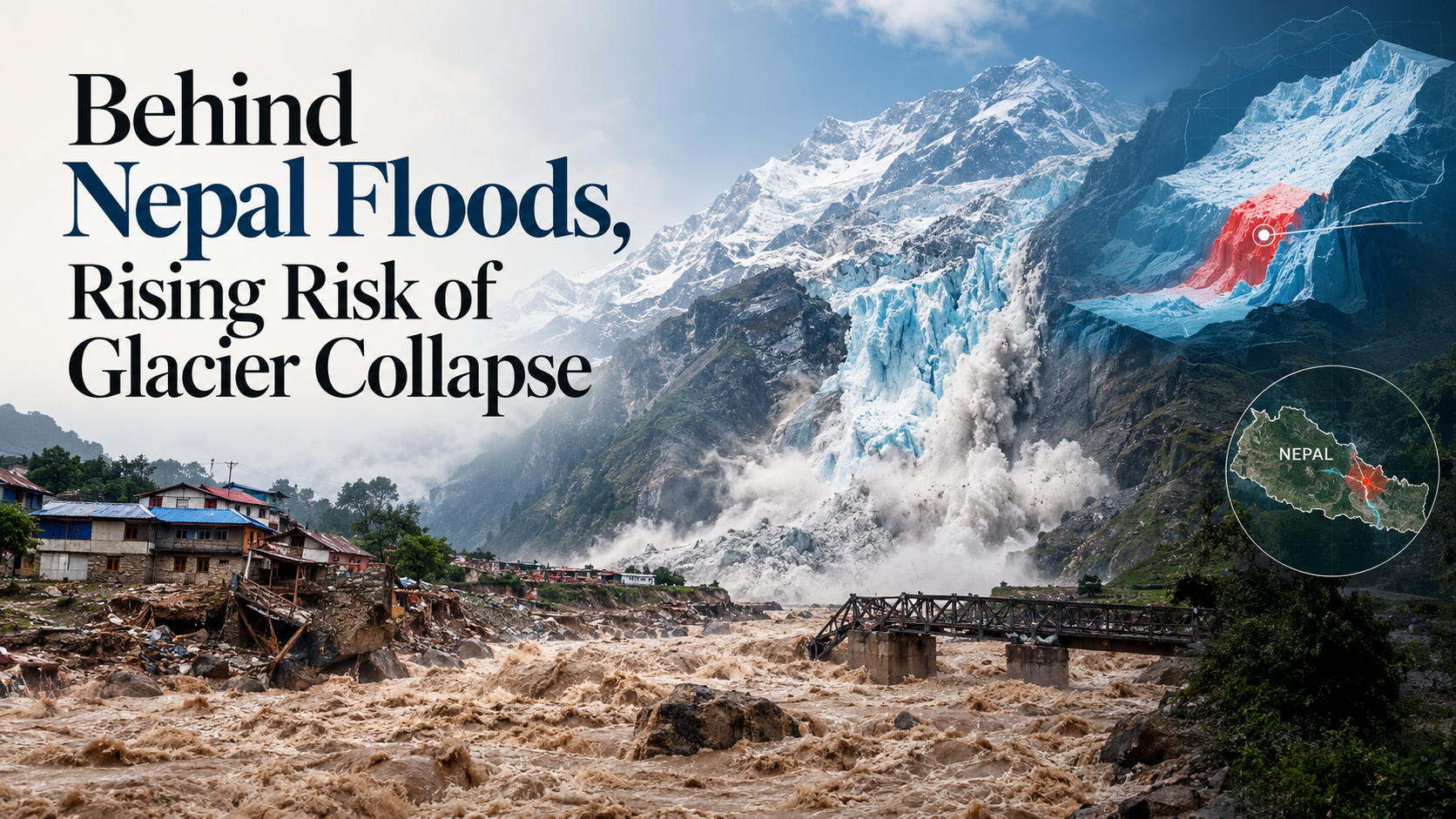
Flash floods that swept through parts of Nepal and Tibet this week followed a glacial collapse in the Himalayas. The collapse sent a mass of ice and rock debris into the Lhende Khola and Bhote Koshi river system, and this debris reached inhabited valleys downstream. Glaciologists say such collapses are becoming more frequent because of faster warming in the Himalayas, and disaster planning for hydropower siting and early warning has not kept pace with this rising risk.
What is a glacial collapse?
- Sudden mass failure of a glacier: A glacial collapse is the sudden detachment of a large mass of ice, rock and water from a glacier resting on a steep mountain slope.
- Triggered by geological and physical factors: Earthquakes, temperature changes and other physical changes unfolding within a glacier can trigger a collapse.
How does a glacier’s own structure fail under stress?
- Formation builds a heavy, moving mass: Snow that survives several melting seasons compresses into firn (a granular midpoint stage between fresh snow and glacial ice) before recrystallising into the solid ice of a glacier.
- Gradient driven flow creates fracturing stress: Once a glacial mass is heavy enough it flows outward along the mountain gradient. This acceleration creates stress that exceeds the strength of the ice, and sustained movement eventually fractures it.
- Surface melting weakens the ice from within: Meltwater pools inside surface cracks over repeated freeze and thaw cycles. This repeated pressure eventually splits the ice all the way through.
Why do wet base glaciers in the Himalayas pose a distinct collapse risk?
- Soft beds trap and channel meltwater: Where a glacier rests on soft mud or clay, trapped water moves through networks of cracks within the ice and travels toward the base.
- Subglacial tunnels concentrate large volumes of water: In wet base Himalayan glaciers, water collects at the base in large quantities and is occasionally connected by tunnels, so a collapse can release a concentrated volume of water at once.
Why can a single glacial collapse trigger a second wave of flooding?
- Debris blocks the river before it breaks free: Collapsed ice and rock piles can block narrow river channels and form temporary natural dams downstream.
- A dam break repeats the flood: When such a temporary dam breaks under continuous pressure, it unleashes a second round of flooding, as happened in Nepal this week.
Challenges to managing glacial collapse risk
- Rising baseline risk from faster warming: The incidence of glacier breakages in the Himalayas has increased because the region is warming faster than the global average. Eg. This week’s Nepal and Tibet collapse and debris flow into the Lhende Khola and Bhote Koshi system is one instance of this rising baseline risk. Fix. Expand year round remote seismic monitoring and high altitude early warning systems across the central Himalayan glacier belt, not only at individual high risk sites.
- Search and rescue capacity has not kept pace: More frequent and physically more demanding glacial collapse events place a growing burden on search and rescue missions in remote high altitude terrain. Eg. Reaching debris blocked valleys along the Bhote Koshi system after this week’s floods required search teams to operate in terrain cut off by the same collapse. Fix. Pre position high altitude search and rescue teams and equipment at seasonal staging points along known glacial risk corridors before the summer melt season.
- Critical infrastructure remains sited in high risk zones: Hydropower plants and other critical infrastructure continue to be built in areas exposed to glacial collapse and the flooding it can trigger. Eg. Downstream hydropower installations on Himalayan rivers were damaged in the 2021 Rishiganga Dhauliganga disaster in Uttarakhand, when an upstream ice and rock avalanche triggered a sudden flash flood. Fix. Make hazard zonation for glacial collapse and outburst flood risk a mandatory clearance requirement before critical infrastructure is sited in glacier fed river valleys.
- Upstream glacial instability is not systematically shared across borders: Himalayan river systems cross national boundaries, but instability observed on a glacier upstream is not routinely communicated to downstream countries before a disaster strikes. Eg. This week’s collapse originated in Tibet and Nepal before its effects reached downstream valleys, showing how upstream instability in one country can affect communities in another with little warning. Fix. Establish a standing India, Nepal and China data sharing mechanism for real time glacial and river monitoring in shared Himalayan basins.
Conclusion
Himalayan glacial collapses are becoming more frequent as regional warming outpaces the historical baseline, and this week’s Nepal and Tibet floods are a fresh instance of that pattern. The next step for disaster managers is to convert scattered seismic monitoring and hazard mapping efforts into a standing, cross border early warning system, before the next collapse rather than after it.
