Source: The Indian Express, Page 1 Published: 15 October 2026
Why in the News
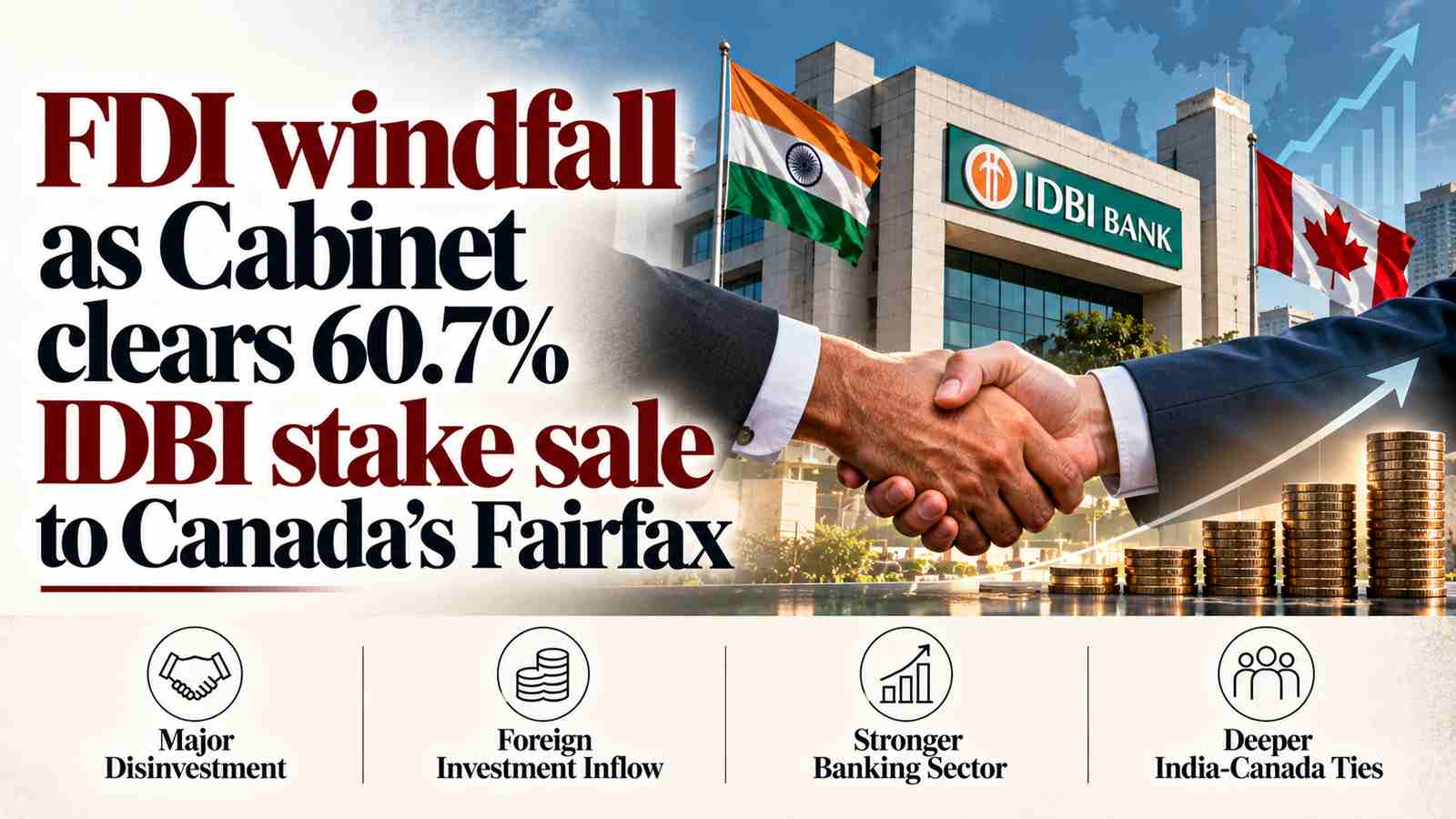
IDBI Bank is passing from Life Insurance Corporation (LIC) and government control to a foreign strategic buyer, in the largest ever foreign direct investment (FDI) in India’s financial sector. The Cabinet Committee on Economic Affairs (CCEA) has chosen Toronto based Fairfax Financial Holdings to buy a 60.72% stake for Rs 52,878 crore.
What is the IDBI sale, and why is it called a restructuring?
- What it is: In a strategic disinvestment, the state sells a controlling stake, with management control, to a private buyer, like a family selling most of its business to a new owner who runs it.
- How IDBI reached LIC: Poor financial health led LIC to buy a majority stake in IDBI Bank in 2019 and become its promoter, the controlling owner. The bank was then classed as private. {{diagram:3}}
- The takeaway: A sale pending for over four years now hands a state backed bank to a foreign promoter, and the state keeps a minority stake.
What conditions come with the sale?
- Continuity terms: Fairfax must retain the bank’s name for three years after completion, and its capital is locked in for five years.
- One promoter, one bank: Fairfax owns 40% of Thrissur based CSB Bank through FIH Mauritius Investments. Since one promoter cannot own two banks, it must merge CSB with IDBI Bank or exit CSB within two years.
- Glide path: Fairfax must cut its stake to 26% over 15 years, on a schedule to be settled with the Reserve Bank of India (RBI). It must first clear the RBI’s compliance process.
- LIC’s exit path: LIC must bring its holding down to 15% within two years of completion.
- Residual sale: The CCEA has empowered the Alternative Mechanism, a panel of Union Ministers that settles sale terms, to sell the government’s remaining stake on the open market.
Why does it matter for the budget and the banking sector?
- Disinvestment target: The proceeds will help the Centre meet its Rs 80,000 crore disinvestment target for 2026-27.
- Raised so far: The Department of Investment and Public Asset Management (DIPAM), which runs government stake sales, reports Rs 55,757 crore raised so far.
- Foreign capital in finance: Other foreign buyers of Indian lenders include Emirates NBD, with 60% of RBL Bank, and Japan’s Mitsubishi UFJ Financial Group (MUFG), with 20% of Shriram Finance.
- Disinvestment record: Earlier strategic sales include Air India and Neelachal Ispat Nigam Limited in 2022, Ferro Scrap Nigam Limited in early 2025, and Indian Medicines Pharmaceuticals Corporation Limited in May.
Is the price fair?
- Bid premium: Fairfax bid Rs 81 a share, above the Rs 70.38 close on the last trading day before ‘best offer bids’ were invited.
- Market reaction: On the day of approval IDBI Bank shares surged 9% to close at Rs 90.39, on speculation the sale was imminent.
- Employee objection: IDBI Bank officers and the employees’ union oppose the sale, saying the price is too low. A separate fund now covers the pensions of former employees.
Challenges
- Slow dilution: Promoter control stays concentrated for years, and the exact stake reduction path is still to be settled with the RBI.
- Merger disruption: Folding CSB Bank into IDBI Bank within the deadline can unsettle customers and staff of both banks.
- Valuation dispute: A market price above the bid feeds the charge that a public asset was sold cheap.
Way Forward
- Publish the glide path: The RBI should set out Fairfax’s stake reduction schedule before completion.
- Disclose the valuation basis: DIPAM should publish how the reserve price was set, to answer the underpricing charge.
- Protect staff terms: The new promoter should honour existing service conditions through the CSB Bank decision.
Conclusion
The IDBI sale turns a long stalled privatisation into a foreign owned bank. What to watch is the RBI’s approval of the glide path, Fairfax’s choice on CSB Bank, and whether the deal closes on schedule.
Key numbers
- Sale timeline: best offer bids invited 18 May 2026; completion expected by March 2027.
- Emirates NBD in RBL Bank: nearly $3 billion, completed June 2026.
- MUFG in Shriram Finance: $4.4 billion.
- Sumitomo Mitsui Banking Corporation (SMBC) in YES Bank: 24.2% for a little under $2 billion (2025).
PYQ
[2026] Which one of the following best describes the ‘Crowding Out Effect’ in the context of fiscal policy?
(a) A situation where private investment increases due to increased Government spending
(b) A situation where Government borrowing leads to higher interest rates, which reduces private investment
(c) A situation where an increase in taxes leads to increased private sector investment
(d) A situation where Government spending has no impact on aggregate demand
ANSWER: B
