Source: The Hindu, Page 12 Published: 15 October 2026
Why in the News
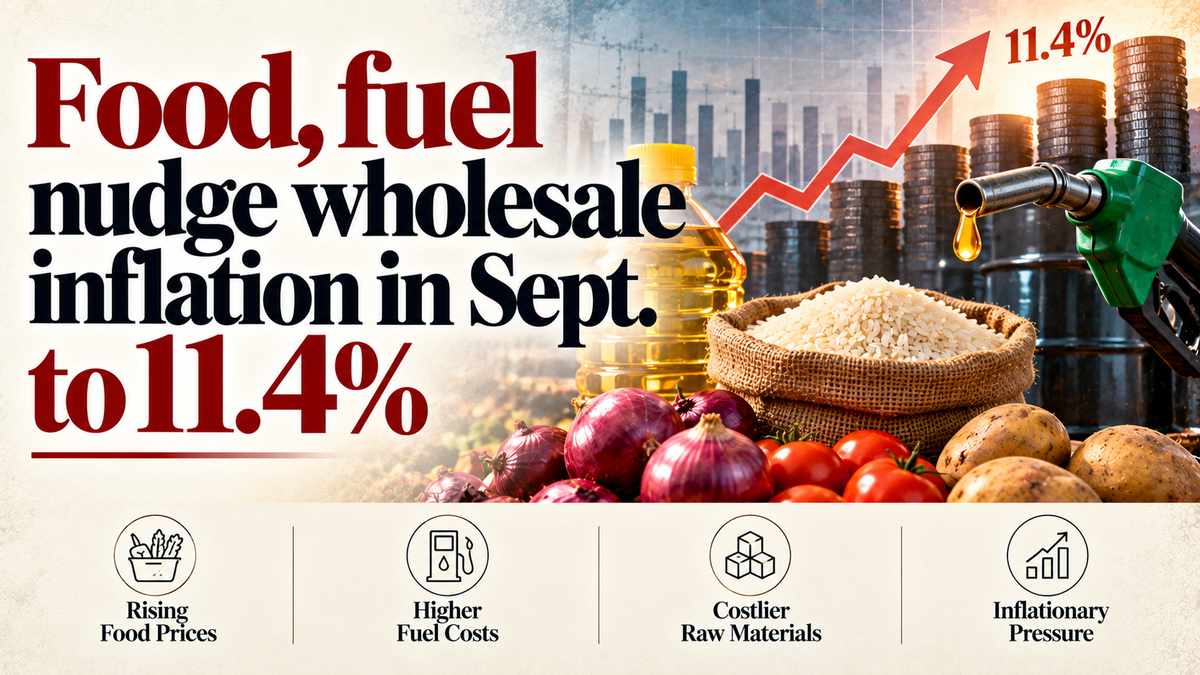
Wholesale inflation is usually read as a food and fuel story, but in September non food manufactured goods, known as core inflation, drove more than half of the rise over August. Wholesale Price Index (WPI) inflation reached 11.4%, a record in the new series and a 49 month high on the old one.
What is the WPI, and why does it have two series?
- What it is: The WPI tracks the average change in prices of goods traded in bulk between businesses, before they reach shops. It is like the price a shopkeeper pays the wholesaler, not the price a customer pays.
- What it covers: It covers only goods, in three groups: primary articles (farm and mineral goods), fuel and power, and manufactured products.
- New series: The new WPI uses 2022-23 as its base year, the year whose prices are set at 100.
- Old series: The older series, on a 2011-12 base, has a long history. The new one starts only in April 2024, so September’s figure is read on both.
- The takeaway: Wholesale prices show cost pressure on firms before it reaches shop shelves, so a rise here warns of higher inflation ahead for households.
Why does the core reading matter?
- Core WPI: It covers non food manufactured goods and leaves out volatile food and fuel, so it shows whether price rises have spread through industry.
- Driver of the rise: Core WPI accounted for more than half of the 147 basis point uptick in the headline. A basis point is a hundredth of a percentage point.
- Cost pass through: ICRA, a credit rating agency, reads this as pass through of input costs: firms paying more for fuel and materials raise the prices of what they make.
- Broad based pressure: The PHD Chamber of Commerce and Industry said the rise across food, fuel and manufactured products means businesses must closely monitor input costs and pricing.
Challenges
- Retail spillover: Higher factory costs tend to reach consumer prices with a lag, adding to household inflation.
- Short new series: With only two and a half years of data, the new series offers little history for judging trends.
- Base effects: A low year ago base can exaggerate the headline, as with food this September.
- Imported fuel: India imports most of its crude oil, so global price swings pass straight into fuel and power.
Way Forward
- Watch core WPI: The Monetary Policy Committee should weigh core wholesale inflation alongside the retail measure it targets.
- Link the two series: The Office of the Economic Adviser, which compiles the WPI, should publish a linked back series joining the new and old indices.
- Cushion fuel costs: The Centre should calibrate fuel taxes to limit pass through of fuel price spikes.
Conclusion
Wholesale inflation is no longer only about food and fuel, since factory goods now carry much of the rise. Whether core WPI keeps climbing, and how much of it reaches retail prices, is what to watch in the coming months.
PYQ
[2022] In India, which one of the following is responsible for maintaining price stability by controlling inflation ?
(a) Department of Consumer Affairs
(b) Expenditure Management Commission
(c) Financial Stability and Development Council
(d) Reserve Bank of India
(a) Department of Consumer Affairs
(b) Expenditure Management Commission
(c) Financial Stability and Development Council
(d) Reserve Bank of India
ANSWER: (d)
