Source: The Hindu, Page 4 Published: 15 October 2026
Why in the News
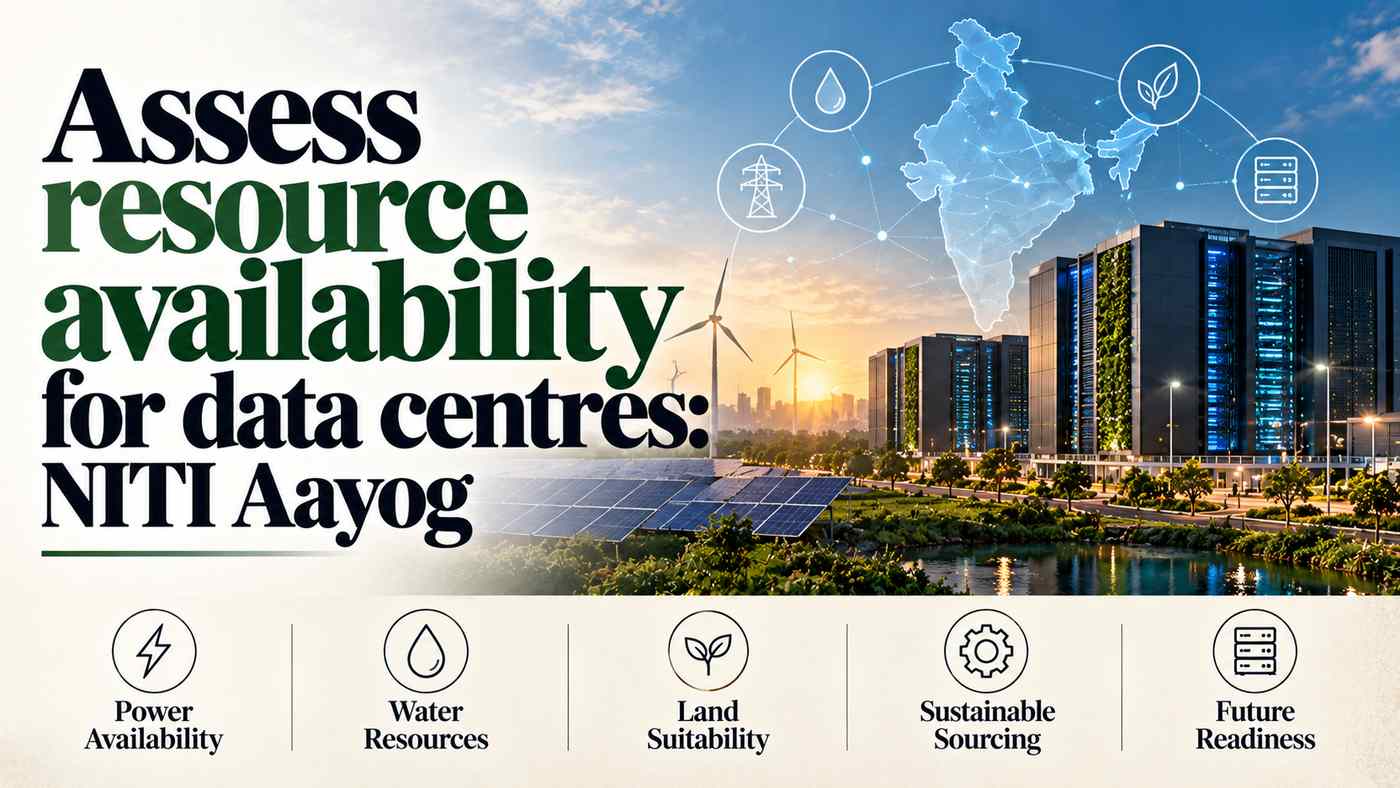
Data centre approvals would move from project by project clearances to approvals tied to verified availability of electricity, water and other infrastructure, planned across whole infrastructure corridors rather than site by site. The shift is proposed in an evaluation framework developed jointly by the National Institution for Transforming India (NITI) Aayog and Deloitte India. The framework also asks States to weigh each project’s economic benefits against the public support it receives.
What is a data centre, and why does it strain local resources?
- What it is: A data centre is a building full of servers, powerful computers that store and process data for apps, cloud services and artificial intelligence. It works like a factory that never shuts and must always be kept cool.
- Power and water demand: Servers draw electricity round the clock, and many sites use water to cool them, so a large campus competes with nearby homes, farms and industry for both.
- Local opposition: As the sector has expanded rapidly, residents have opposed projects over the water, electricity and land they take.
- The takeaway: Clearing a data centre without first checking local power and water can leave residents paying for a facility the area cannot sustain.
How fast is India’s data centre capacity growing?
- Number of facilities: India had 271 data centres as of January 2026, according to the Council on Energy, Environment and Water (CEEW), a policy research institution.
- Installed capacity: Their capacity, the electrical load the facilities are built to draw, stood at about 1.57 gigawatts (GW) in August 2026, according to the Union government.
- Projected capacity: Industry estimates put capacity at 4.5 to 6.5 GW by 2030, several times today’s level.
What does the framework ask of States and developers?
- Long range water checks: Before a project is sited, States would assess how much water is available in each season over the next 20 to 30 years.
- Existing users first: States must protect existing users of water and power, so a new campus does not cut supply to towns and farms.
- Developer funded grid: Developers must pay for grid assets, the power lines and equipment built only for their projects, rather than passing that cost to other consumers.
- Net benefit test: States must count the land, infrastructure and utility concessions they give a project as a public cost, and set that cost against the economic benefits they claim.
- Outcome linked incentives: The framework proposes tying incentives to measurable results: employment, renewable energy use, efficiency and local procurement.
Who will oversee it, and is it binding?
- Five pillar framework: The framework is organised as a ‘five pillar framework’, which also covers environmental safeguards, climate risks and governance.
- Central audit: The framework proposes a central audit mechanism to check compliance. The Ministry of Electronics and Information Technology (MeitY) would be the nodal, or lead, Ministry.
- Legal status unclear: The document does not say whether the framework has been formally adopted or whether its recommendations will bind States.
Challenges
- Advisory status: Until it is adopted, States competing for investment can skip the resource checks and keep offering open ended concessions.
- Water stressed hubs: Data centres cluster in large cities that already face water shortages. Eg. Chennai, a data centre hub, ran short of water in 2019.
- Coal heavy grid: Round the clock demand is met largely from coal fired power, so rapid growth raises emissions unless renewable supply keeps pace.
- Thin water data: Few States hold the long term hydrological records that multi decade seasonal assessments require.
- Few local jobs: Highly automated facilities employ few people once built, so employment linked incentives reward little.
Way Forward
- Formal notification: MeitY should issue the framework as guidelines and link any central support to compliance.
- Published assessments: States should publish water and power assessments for each corridor before allotting land.
- Low water cooling: Developers should adopt closed loop or air cooling and disclose annual water and power use.
- Verified green power: Developers should contract renewable power for new capacity, checked by the central audit.
Conclusion
India’s data centre growth now has a resource first framework on paper, with no word yet on whether it binds anyone. Whether MeitY adopts it and States write its water and power checks into their own data centre policies is the step to watch.
PYQ
[2026] An e-commerce revenue model where the seller has control over pricing but doesn’t keep products in stock and instead transfers customer orders and shipment details to a third-party supplier, who then ships the goods directly to the customer, is called:
(a) Dropshipping Model
(b) Affiliate Revenue Model
(c) Transaction Fee Revenue Model
(d) Agency Revenue Model
ANSWER: A
