- Recent archaeological excavations at Nagardhan near Nagpur have provided concrete evidence on the life, religious affiliations and trade practices of the Vakataka dynasty that ruled parts of Central and South India between the third and fifth centuries.
- After a 1,500 year-old sealing was excavated for the first time, a new study in Numismatic Digest has tried to understand the Vakataka rule under Queen Prabhavatigupta.
Nagardhan
- Nagardhan is a large village in Nagpur district, about 6 km south of Ramtek taluka headquarters.
- Archaeological remains were found on a surface spread over a 1 km × 1.5 km area. The researchers excavated the site during 2015-2018.
- The existing village sits on top of the ancient habitation. The Nagardhan Fort stands south of present-day Nagardhan village.
- This was constructed during the Gond Raja period and later renovated and re-used by the Bhosales of Nagpur during the late 18th and 19th centuries.
Importance of the excavation
- Very little was known about the Vakatakas, the Shaivite rulers of Central India between the third and fifth centuries.
- All that was known about the dynasty, believed to hail from the Vidarbha region, was largely through some literature and copperplates.
- There were assumptions that the excavated site of Nagardhan is the same as Nandhivardhan, the capital city of the eastern branch of the Vakatakas.
- It was after archaeological evidence from here that Nagardhan was understood to have served as a capital of the Vakataka kingdom.
The seals so found
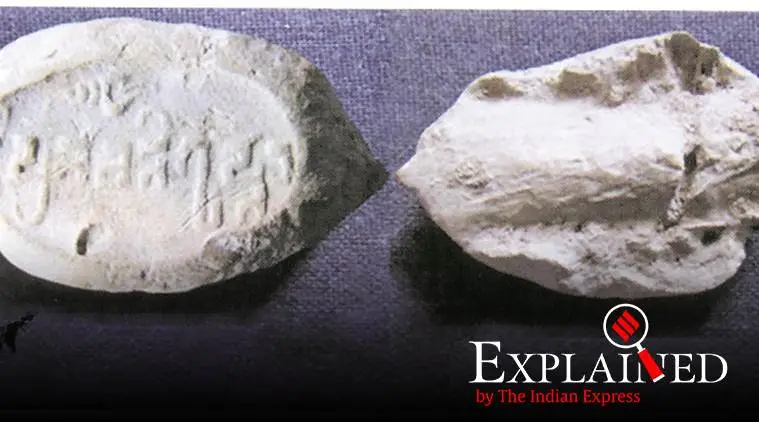
- It is the first time clay sealings have been excavated from Nagardhan.
- The oval-shaped sealing belongs to the period when Prabhavatigupta was the queen of the Vakataka dynasty.
- It bears her name in the Brahmi script along with the depiction of a conch.
- The presence of the conch, scholars say, is a sign of the Vaishnava affiliation that the Guptas held.
- The sealing was traced on top of a mega wall that researchers now think could have been part of a royal structure at the capital city of the kingdom.
Who was Queen Prabhavatigupta?
- The copperplate issued by Queen Prabhavatigupta starts with a genealogy of the Guptas, mentioning the Queen’s grandfather Samudragupta and her father Chandragupta II.
- These are strong indicators of Vaishnava signatures on the royal seals of the Vakatakas reiterate that Queen Prabhavatigupta was indeed a powerful woman ruler.
- Since the Vakataka people traded with Iran and beyond through the Mediterranean Sea, scholars suggest that these sealings could have been used as official royal permission issued from the capital city.
- Besides, these were used on documents that sought mandatory royal permissions.
Why are the findings on Queen Prabhavatigupta significant?
- Scholars say Queen Prabhavatigupta was among a handful of women rulers in India to have reigned over any kingdom during ancient times.
- The Vakataka rulers were known to have forged several matrimonial alliances with other dynasties of their times.
- One of the key alliances was with Prabhavatigupta of the mighty Gupta dynasty, which was then ruling north India. The Guptas were way more powerful than the Vakatakas.
- After marrying Vakataka king Rudrasena II, Prabhavatigupta enjoyed the position of Chief Queen.
- When she took over the Vakataka kingdom, after the sudden demise of Rudrasena II, her stature as a woman Vakataka ruler rose significantly.
- This is evident from the fact that the sealings were introduced and issued during her period as a ruler, that too from the capital city of Nagardhan.
Why is the sign of Vaishnava affiliation important?
- The Vakataka rulers followed the Shaiva sect of Hinduism while the Guptas were staunch Vaishnavites.
- Excavators say that many religious structures indicating affinity to the Vaishnava sect, and found in Ramtek, were built during the reign of Queen Prabhavatigupta.
- While she was married into a family that belonged to the Shaiva sect, the queen’s powers allowed her to choose a deity of worship, that is, Lord Vishnu.
What else has been excavated from Nagardhan so far?

- Earlier results from the excavations here had traced evidence in the form of ceramics, ear studs of glass, antiquities, bowls and pots, a votive shrine and tank, an iron chisel, a stone depicting a deer, and terracotta bangles.
- Some terracotta objects even depicted images of gods, animals and humans, along with amulets, scotches, wheels, skin rubbers and spindle whorls.
- An intact idol of Lord Ganesha, which had no ornaments adorned, too was found from the site.
- This confirmed that the elephant god was a commonly worshipped deity in those times.
- On the means of living of the Vakataka people, researchers found animal rearing to be one of the main occupations.
- Remains of seven species of domestic animals — cattle, goat, sheep, pig, cat, horse and fowl — were traced in an earlier study by the team.