Mains Ready By December. Smash Mains & Smash PYQ Admissions Open

GS Paper: GS2-18.Bilateral, regional and global groupings and agreements involving India and/or affecting India’s interests.

  • India and the plausible multilateralism of BRICS

    Why in the News

    The 18th BRICS summit has been held in New Delhi and has produced a consensus declaration among all 11 member countries. It was the first annual summit of the grouping since the United States and Israel began their war on Iran in February 2026, and the host was a close strategic partner of both. India used the occasion to restore a balancing position in West Asia, after initially declining to condemn the strikes, and it received the President of Iran in Delhi while the war continued. The contested point is whether a grouping carrying deep internal divisions, and a standing risk of Russian and Chinese domination, protects India’s room for manoeuvre or dilutes its partnership with Washington.

    How is BRICS read within India’s strategic community?

    1. The optimists: They argue that BRICS can function as an institution capable of multipolarising the global order, or of expediting that transition.
    2. The sceptics: They point to the grouping’s internal divisions and to the possibility of its domination by Russia and China.
    3. The dismissive view: A third group writes BRICS off as an annual gathering that generates strategic noise. It argues that India should limit its association with the grouping and expand its partnership with the United States instead.

    What made the Delhi summit consequential?

    1. Timing: The summit was held on 12 and 13 September 2026, the first since the United States and Israel launched their war against Iran on 28 February 2026. The Presidents of Iran, Russia and China were among the leaders present.
    2. Consensus among 11 members: New Delhi secured agreement among all 11 member countries, including the United Arab Emirates (UAE) and Iran, which are involved in an undeclared conflict.
    3. The Delhi Declaration: The document records that member countries continue to find value in a BRICS worldview rooted in the pursuit of a more representative global order.
    4. Compromise as the method: The consensus was reached through compromises by every party rather than through convergence on a single position.

    How did India restore its balancing position in West Asia?

    1. The starting position: The Prime Minister was in Israel two days before Israel and the United States began bombing Iran. India then refrained from condemning the attacks or the assassination of Iran’s Supreme Leader, which created an impression that New Delhi was siding with Washington and Tel Aviv.
    2. The diplomatic cost: Pakistan seized the opening created by the war and stepped in as a mediator between the United States and Iran while India watched from the sidelines.
    3. The correction at Bishkek: India strongly endorsed the September resolution of the Shanghai Cooperation Organisation (SCO), a Eurasian security grouping, condemning the strikes on Iran and expressing condolences over the killing.
    4. The correction at Delhi: India hosted the President of Iran at the BRICS summit even as the war in West Asia continued.
    5. Why the platform matters: A multilateral forum let India recover a balancing posture without inflicting strategic damage on its bilateral relationships.

    Why does India keep engaging its competitors through the grouping?

    1. A channel that survives a bilateral freeze: Border problems with China continue to simmer with no immediate resolution. The forum keeps India and China engaged even when high level bilateral visits are not taking place.
    2. The cost of disengagement: A lack of engagement between competing major powers deepens mistrust. Mistrust combined with the security dilemma of their competition carries dangerous consequences.
    3. Guardrails for competitive coexistence: The two countries have to manage a troubled relationship rather than resolve it, and sustained bilateral and multilateral contact is what keeps the competition bounded.
    4. Convergence against unilateralism: On artificial intelligence regulation, the rules governing global trade and finance, climate change, border conflicts, and the role of multilateral bodies, members hold different priorities. They converge on the position that unilateralism by any bloc or power damages their interests.

    What does the American context add to the summit?

    1. A predictable approach: The United States approach to the rest of the world is predictable in that it subordinates other considerations to its own dominance.
    2. Tariffs on India: India was subjected to varying tariffs by Washington a few months before the summit.
    3. Economic exposure from the war: India was among the countries most affected economically by the United States and Israel war on Iran.
    4. The sanctions legislation: The United States House of Representatives passed the Russia sanctions Bill on 16 September, seeking tariffs of up to 100 per cent on countries including India.
    5. The Indian formulation: India’s foreign policy has been read by a section of commentators as a tilt towards the American camp, on the strength of the Prime Minister’s own statement that India had overcome its “hesitation of history”. The parallel official formulation of multi alignment, stated as ‘sabke sath’, has run alongside it throughout.

    What do the frontline cases show about great power alignment?

    1. Pakistan: A state that became a frontier in great power rivalry carries the cost of that position long after the rivalry that produced it has moved on.
    2. The UAE and Iran: Both would have been better placed dealing with each other than facing their present situation. Their bilateral meeting on the sidelines of the Delhi summit used a multilateral platform to address a bilateral problem.
    3. Ukraine: Backed by the North Atlantic Treaty Organization (NATO), it has fought Russia for more than four years and holds no platform for direct contact with Moscow. Its diplomatic options therefore rest with Brussels and Washington rather than with itself.
    4. The Indian conclusion drawn: The strategic partnership with Washington remains important for India’s progress, and the outcome India must avoid is becoming a frontline in the competition between the United States and China.

    Challenges to BRICS as a vehicle for Indian strategic autonomy

    1. The weight of the largest economy: The grouping’s economic and institutional centre of gravity sits with China, so an agenda item can carry Chinese preferences without being stated as such. Eg. The push to admit countries heavily dependent on Chinese lending widens the membership in a direction that suits one member.
      The Fix: Fix written membership criteria for new entrants and partner countries, so admission turns on economic fit rather than on a sponsor’s preference.
    2. No secretariat and no charter: BRICS runs on rotating chairs and summit declarations, so a commitment made at one summit has no standing body to carry it to the next. Eg. The grouping has no permanent secretariat of the kind the European Union and the Association of Southeast Asian Nations maintain.
      The Fix: Create a small standing secretariat with a mandate limited to tracking implementation of summit commitments.
    3. De dollarisation moves slower than the declarations: Local currency settlement remains marginal against a dollar that still clears the overwhelming share of global trade and reserves. Eg. India and the UAE settled a crude oil payment in rupees and dirhams, which remains an exception rather than a channel.
      The Fix: Link the existing local currency settlement arrangements into one interoperable messaging and clearing layer, so a bilateral experiment becomes a usable route.
    4. Low trade among the members themselves: Members trade more with advanced economies than with each other, which limits what a shared declaration can deliver commercially. Eg. Most members still depend on G7 markets for high technology imports and services exports.
      The Fix: Prioritise tariff and standards work in a few sectors where member complementarity is real, rather than a general trade agenda across 11 economies.
    5. Expansion dilutes the agenda: A larger membership with wider political differences lowers the ambition of what a consensus document can say. Eg. The grouping now spans functioning democracies and authoritarian states, which keeps human rights and governance language out of joint texts.
      The Fix: Run substantive work through issue based coalitions of willing members, leaving the full summit to agree only what all members can carry.

    Conclusion

    India’s case for BRICS does not rest on the grouping being cohesive. It rests on the grouping giving a middle power somewhere to stand that is neither an alliance nor an isolation, which is what a country facing tariffs from one partner and a border dispute with another actually needs. The internal contradictions and the external convergence work against each other, and that unresolved pull is what keeps any one member from owning the platform. What to watch is whether the Delhi Declaration’s commitments acquire any machinery to carry them forward, and whether the Russia sanctions legislation is applied to India in a way that forces the choice this grouping exists to postpone.

    About BRICS

    1. Origin: The term was coined in 2001 by a Goldman Sachs economist to identify high growth emerging economies. The first leaders’ summit was held at Yekaterinburg in Russia in 2009.
    2. Membership: South Africa joined in 2011, and expansion decided at the 2023 Johannesburg Summit brought in Egypt, Ethiopia, Iran and the UAE in 2024 and Indonesia in 2025.
    3. Weight: The grouping accounts for over 45 per cent of the world’s population and roughly 37 per cent of global gross domestic product measured by purchasing power parity, a share larger than that of the G7.
    4. Partner country category: Introduced in 2024, it engages states such as Malaysia, Thailand and Nigeria without granting full membership.

    Initiatives under BRICS

    1. New Development Bank: Headquartered at Shanghai, it lends for infrastructure and sustainable development projects in member and partner countries, and has approved over $35 billion in loans.
    2. Contingent Reserve Arrangement: A $100 billion fund that provides short term liquidity support to a member facing balance of payments pressure.
    3. BRICS Pay: A cross border payment system in pilot stage, intended to settle trade among members without routing through existing Western messaging networks.
    4. Partnership on New Industrial Revolution: A cooperation programme covering artificial intelligence, digitalisation and green technology among member states.

    Matching Previous Year Question

    “[2026, GS2, 10 marks] “BRICS acts as a powerful counterweight in global governance, actively amplifying the voice and influence of the Global South.” Explain the role of BRICS in projecting itself as an alternative to other groupings.”
  • India, EU to sign free trade agreement on December 16

    Why in the News

    India and the European Union (EU) will sign their Free Trade Agreement (FTA) on 16 December, in Brussels. The European Commission, the EU’s executive arm, has finalised the text of the deal and sent it to the European Council. The signing follows a negotiation that both sides closed by leaving contentious issues out of the text rather than making “the best the enemy of the good”. That choice is what secured the deal majority support in Europe. The contested point is whether an agreement built on exclusions delivers the depth its billing implies.

    What is the India-EU Free Trade Agreement?

    1. Scope of the instrument: The agreement is a treaty removing or reducing customs duties on goods traded between India and the European Union’s 27 member states. Each side schedules the products on which duties fall and the products it keeps out.
    2. Negotiating history: Talks restarted in June 2022 after a long hiatus and were concluded in January 2026. Leaders on both sides have called the agreement the “mother of all deals”.
    3. Ratification route: The deal will not require separate ratification by each EU country once the European Council gives its go ahead. Majority approval within Europe is what removes that requirement.

    What do the tariff schedules actually concede on each side?

    1. The EU side: The EU will drop tariffs on 99.5 per cent of the items India exports to the region. Most of those tariffs go down to zero immediately once the agreement comes into effect.
    2. The India side: India has given tariff concessions on 97.5 per cent of the traded value between the two economies.
    3. Different measuring bases: The EU figure counts items India exports, and the India figure counts traded value. The two headline percentages describe different things and are not directly comparable.

    What still stands between the signing and the roll out?

    1. European Council clearance: The Council must give its go ahead on the text the Commission has sent it. The signing follows that step.
    2. European Parliament passage: After the signing, passage in the European Parliament will take another one to two months.
    3. Roll out timeline: Implementation is expected in “early 2027”.

    Why does this signing sit inside a crowded December trade calendar?

    1. Three agreements, three destinations: The Prime Minister’s December travel covers Canada, the United States and Belgium. Three separate FTAs are either being negotiated or in the process of approval across those three.
    2. The Canada agreement: The Prime Minister is expected to travel to Canada first, probably around 12 December. India’s High Commissioner to Canada expects the India-Canada FTA to be completed by November, with the signing during that visit.
    3. The G20 deadline: Canada’s Prime Minister has said the two leaders committed at last year’s G20 to conclude negotiations by this year’s G20. That summit is in Miami on 14 and 15 December.
    4. The United States track: The India-US Interim Agreement on trade and a larger Bilateral Trade Agreement (BTA) will also be on the agenda at the G20 meeting. Both have already missed several deadlines.

    Challenges to the India-EU Free Trade Agreement

    1. Contentious issues left outside the text: Closure was reached by keeping the hardest questions out of the agreement, so those disputes return through other channels instead of being settled. Eg. The EU’s Carbon Border Adjustment Mechanism puts a carbon charge on imported steel, aluminium, cement and fertilisers, and it sits outside any tariff schedule.
      The Fix: Attach a standing bilateral review mechanism with a fixed meeting calendar to the agreement, so an excluded issue carries a forum rather than lapsing.
    2. Non tariff barriers outlast tariff cuts: A zero duty does not deliver market access where standards, testing and certification requirements stop the consignment. Eg. The EU Deforestation Regulation requires geolocation level proof that coffee, cocoa, rubber, soya, timber and cattle products are deforestation free.
      The Fix: Fund traceability and conformity assessment support for exporters in the covered commodities before the duty cuts take effect.
    3. A share of traded value says nothing about sensitive lines: A headline share does not tell an Indian producer which sectors will face duty free European competition and from which date. Eg. Dairy, wines and spirits and automobiles are the lines Indian industry has contested in every recent trade negotiation.
      The Fix: Publish the tariff elimination schedule line by line with its phase in periods, so affected sectors plan against dates rather than percentages.
    4. The European Parliament vote is a political gate: The vote is a political one, so the roll out date sits outside either government’s control. Eg. The EU-Mercosur agreement was concluded in 2019 and has still not entered into force.
      The Fix: Sequence India’s customs notifications and rules of origin procedures to the Parliament vote rather than to the signing date.
    5. Rules of origin decide who actually benefits: A tariff line at zero helps only goods that meet the agreement’s origin criteria, which is where processing heavy exporters lose. Eg. Indian textile exporters use imported yarn and fabric, which can fail a domestic value addition threshold.
      The Fix: Negotiate cumulation provisions and publish the origin certification procedure alongside the tariff schedules.

    Conclusion

    The agreement’s value now rests less on what it cut than on what it set aside. A deal that closed by parking its hardest questions has bought speed at the cost of scope, and those questions do not disappear on signature. The marker to watch is whether the European Parliament stage produces a standing bilateral mechanism for the excluded issues, or whether India is left handling each of them as a separate dispute.

    Back2Basics: European Union

    1. Formation: The European Union was established by the Maastricht Treaty, signed in 1992 and in force from 1993. It succeeded the European Economic Community.
    2. Membership and seats: It has 27 member states. Its principal institutions sit in Brussels, Luxembourg and Strasbourg.
    3. Customs union and trade competence: Member states form a customs union with a common external tariff. Trade policy is an exclusive competence of the Union, so member states do not negotiate their own trade agreements.
    4. Currency: The euro is the shared currency of a subset of the member states, known collectively as the eurozone.

    Matching Previous Year Question

    “[2017] ‘Broad-based Trade and Investment Agreement (BTIA)’ is sometimes seen in the news in the context of negotiations held between India and (a) European Union (b) Gulf Cooperation Council (c) Organization for Economic Cooperation and Development (d) Shanghai Cooperation Organization Answer: (a)”

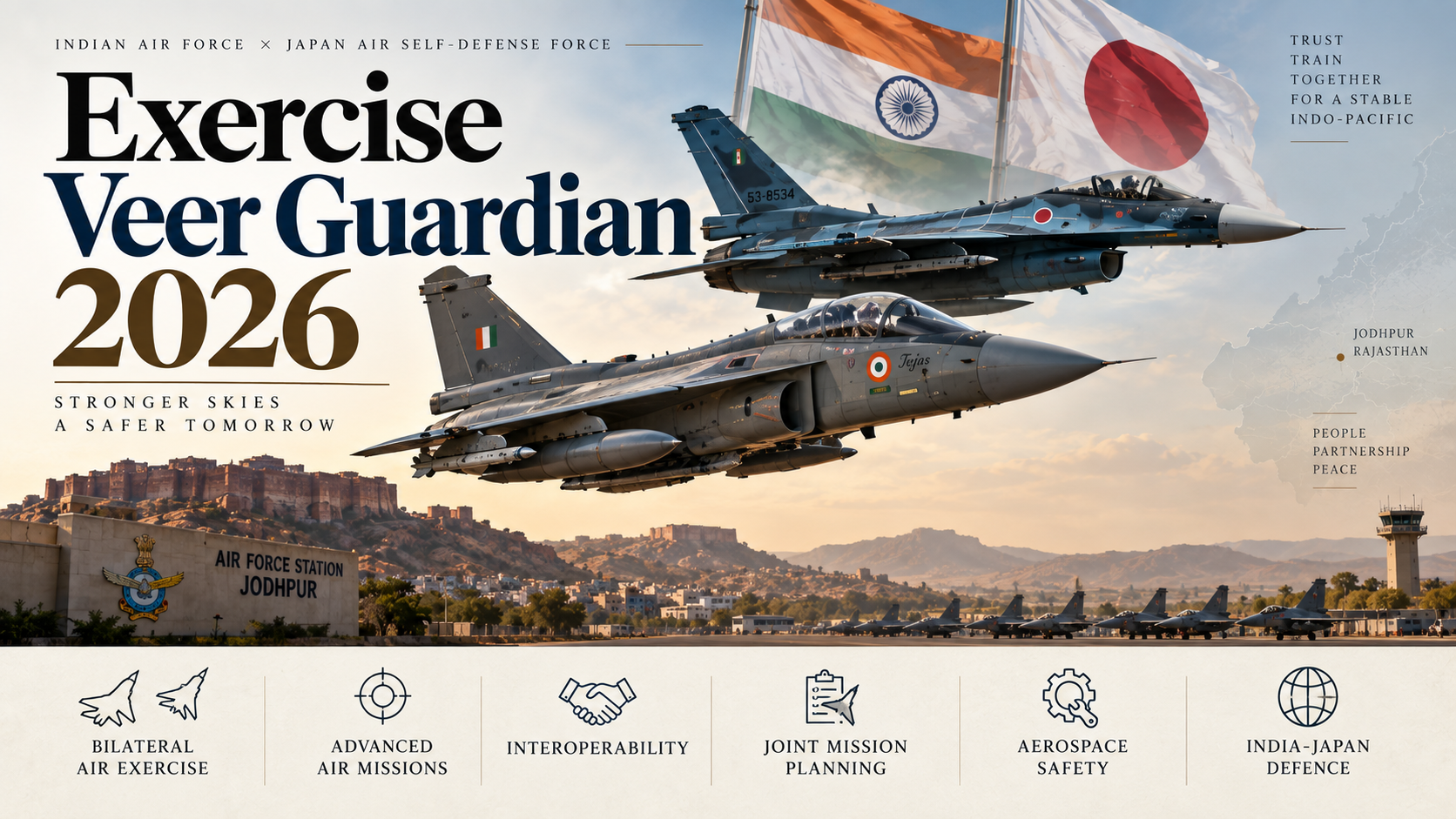
  • Exercise Veer Guardian 2026

    Exercise Veer Guardian 2026

    Why in the News?

    • Exercise Veer Guardian 2026, a bilateral air exercise between the Indian Air Force (IAF) and Japan Air Self Defense Force (JASDF), concluded on 22 September 2026 at Air Force Station Jodhpur.

    Key Highlights

    • Participants: Indian Air Force (IAF) and Japan Air Self Defense Force (JASDF).
    • Duration: 14 days.
    • Venue: Air Force Station Jodhpur.
    • Indian aircraft: Su-30 MKI, Rafale and indigenous LCA Tejas.
    • Japanese aircraft: F-2A fighter aircraft.
    • Focused on:
      • Within Visual Range (WVR) combat
      • Coordinated multi-aircraft missions
      • Enhancing interoperability between the two air forces.
    • General Takehiro Morita, Chief of Staff, JASDF, and Air Chief Marshal AP Singh, Chief of the Air Staff, visited the exercise.
    • Both officials flew the indigenous Tejas fighter aircraft.

    Strategic Significance

    • Strengthens India-Japan defence cooperation.
    • Enhances interoperability and operational coordination.
    • Deepens the strategic partnership between the two countries.
    • Provides exposure to each other’s operational procedures, maintenance practices and capabilities.

    Prelims Quick Revision

    • Exercise: Veer Guardian 2026
    • Countries: India and Japan
    • Air forces: IAF and JASDF
    • Venue: Air Force Station Jodhpur
    • Duration: 14 days
    • IAF aircraft: Su-30 MKI, Rafale, LCA Tejas
    • JASDF aircraft: F-2A
    • Key focus: WVR combat and coordinated multi-aircraft missions

    UPSC Prelims Trap

    • Veer Guardian is a bilateral India-Japan air exercise, involving IAF and JASDF.
    • Tejas was deployed by the IAF, while F-2A was deployed by the JASDF.
    • The exercise was conducted at Jodhpur, not in Japan.
    • Do not confuse WVR combat with beyond-visual-range combat.
  • AI is now a great-power game. Three difficult questions for India

    Why in the News

    The United States and China are opening a formal bilateral dialogue on artificial intelligence (AI) and its risks, with the Chinese President received in Washington by the US President on Thursday for their third summit in less than 10 months. The meeting comes barely 10 days after the Delhi BRICS summit, where China offered its own vision of international cooperation on AI. The two events set out opposite agendas for the same technology, one built on openness and diffusion and the other on preventing accidents, miscalculation and misuse. BRICS rhetoric on AI may be multipolar. Technological power at the frontier remains concentrated in the United States and China.

    What is strategic stability in the AI age?

    1. Strategic stability: A condition in which neither of two rival powers has an incentive to strike first or to race, sustained by shared understanding of each other’s capabilities and by channels that stop an accident being read as an attack.
    2. Origin of the term: It comes from nuclear arms control, where the United States and the Soviet Union negotiated rules to reduce mutual risk during an active contest for advantage.
    3. What it covers in AI: Preventing accidents, miscalculation and misuse arising from the most capable models, including their military applications.
    4. What it does not cover: It is narrower than agreement on the technological order as a whole, so a strategic stability understanding can be reached with chips, export controls and market access still contested.

    What does China’s BRICS offer on AI amount to?

    1. Openness, access and diffusion: The Chinese framing at Delhi placed the emphasis on spreading AI capability rather than on containing its risks.
    2. World Artificial Intelligence Cooperation Organisation (WAICO): BRICS members were invited to join this body, which China launched in Shanghai this summer as a venue for international AI cooperation.
    3. Open models for the forum: China proposed that BRICS host an open-source AI community, which makes models and tools available for others to use and adapt.
    4. Champion of affordable access: China presented itself as the advocate of developing countries seeking affordable access to AI models and applications.

    Why does the Washington agenda invert the BRICS agenda?

    1. Subject of the conversation: The Washington discussion concerns the dangers generated by increasingly powerful models and the need to prevent accidents, miscalculation and misuse, which is the opposite end of the technology from access and diffusion.
    2. Who is writing the security rules: As the world’s leading AI powers, the United States and China are beginning to shape the security and geopolitical architecture of the new technology.
    3. The distance between rhetoric and capability: Multipolar language at BRICS does not change where the most advanced capability sits, and the journey from Delhi to Washington in barely 10 days is what makes that visible.
    4. Cold War precedent: The United States and the Soviet Union competed and cooperated in the nuclear and space domains at the same time, and the rules they negotiated inevitably affected the rest of the world.

    What has the US-China AI channel produced, and where does it still diverge?

    1. Opening of the channel: A tentative channel was opened by the Biden administration after the two leaders met at Woodside, California, in November 2023.
    2. The one concrete outcome: At Lima a year later the two leaders affirmed that humans, not artificial intelligence, must control decisions on the use of nuclear weapons.
    3. Guardrails discussed without result: The two leaders discussed possible AI “guardrails” when they met in Beijing in May, and no formal arrangement followed.
    4. What is now on the table: After talks in New York last weekend between the US Treasury Secretary and the Chinese Vice-Premier, Washington said the two sides had considered a standing AI dialogue and a notification system for incidents with national-security consequences.
    5. Why such a mechanism matters: In a crisis the first requirement is not agreement on the entire technological order. It is the ability to establish what has happened, whether it was accidental or deliberate, and who is responsible.
    6. The American objective: The United States wants a framework to manage the risks posed by powerful models and their military applications.
    7. The Chinese objection: China treats safety discussions as a possible instrument for preserving American technological advantage and for legitimising restrictions on its own access to advanced computing.
    8. The named disagreements: The two also disagree on open-source models, data governance, state regulation and the legitimacy of export controls.
    9. Entanglement with trade: Safety discussion under the present US administration runs alongside disputes over advanced chips, export controls, rare earths, tariffs, computing power and the race to build the most capable models, so no grand bargain is at hand and what is sought is a narrower understanding on strategic stability.

    What three questions does this leave India?

    1. Navigating the technological contest: India sits inside the US-led Pax Silica initiative on technology and supply chains, which follows from its deep integration with the American digital and AI ecosystem, and it has stayed out of China’s WAICO amid enduring security problems and mutual distrust. As a BRICS member it still cannot avoid AI rhetoric shaped by the forum’s dominant power.
    2. Competing offers to developing societies: India’s emphasis on making AI work for developing societies found considerable resonance at the Delhi AI summit earlier this year. China’s deeper capabilities in computing, infrastructure, hardware and advanced models let it offer the Global South a wider package of technological cooperation.
    3. Rule-setting by two powers: A dialogue that begins on strategic stability could become an effort to set rules for everyone else, producing discriminatory technology controls against states outside it.
      Counter-pressure: Geopolitical rivalry and competition for markets between the two powers could limit such collusion and create leverage for emerging technological powers such as India.

    Challenges to a US-China understanding on AI risk

    1. Absence of a countable unit: Model capability cannot be counted or inspected the way delivery systems were, so compliance with any understanding cannot be confirmed. Eg. The New START treaty rested on declared launcher numbers and on-site inspection, and neither has an analogue for a training run or a set of model weights.
      The Fix: Anchor the dialogue on physical proxies such as data-centre compute capacity and chip transfers, which are countable and already tracked.
    2. Controls that leak through third countries: Export controls bind firms rather than territory, so restricted chips move through intermediaries in jurisdictions outside any bilateral arrangement. Eg. Washington’s October 2022 controls on advanced computing chips were widened a year later after routes through third countries emerged.
      The Fix: Tie the notification commitment to a shared list of controlled items, so a transfer is traceable rather than disputed after the fact.
    3. Capability held by private developers: The most capable models are built by companies, so a state-to-state understanding does not bind the actors doing the building. Eg. The 2023 Bletchley Park declaration on frontier model safety rested on voluntary commitments from developers rather than obligations on them.
      The Fix: Require incident reporting from developers under domestic law, so a state can honour a notification commitment over conduct it does not itself control.
    4. Exclusion of the states the rules will govern: Terms settled between two powers become conditions of access for everyone else without their participation. Eg. India stayed outside the Nuclear Non-Proliferation Treaty and needed a separate Nuclear Suppliers Group waiver in 2008 before it could trade in nuclear material.
      The Fix: Route AI risk rules through a body with wider membership, so conditions of access are negotiated by the states they bind.

    Conclusion

    Two states are writing the safety rules for a technology they also lead, and the rules will reach states that were not in the room. India’s exposure is therefore not the rhetoric of any forum but the possibility of inheriting terms it did not negotiate. What decides its position is measurable and domestic: computing power, semiconductors, models, research, capital and talent. The thing to watch is whether the risk channel the two powers settle on is opened to third states or kept strictly bilateral.

    What is technology diplomacy?

    1. About: The use of a state’s technological assets, innovation ecosystem and digital standards to build international partnerships, influence global governance and secure national interests.
    2. Two halves: Tech-cooperation shares working tools such as digital payment systems with other states. Tech-governance shapes the norms for artificial intelligence and 6G.
    3. Named pillars: Exporting digital public infrastructure as a public good, securing lithium and cobalt through the Mineral Security Partnership, building trusted semiconductor supply chains, and cyber diplomacy.
    4. Why it is a distinct instrument: A state that sets a standard shapes the conduct of every state that adopts it, which gives technological capability a diplomatic return that trade or aid does not.

    Government Initiatives on artificial intelligence

    1. IndiaAI Mission (2024): Approved with an outlay of Rs 10,371 crore and implemented by IndiaAI under the Ministry of Electronics and Information Technology (MeitY), it builds compute, datasets, models, skills and safety capacity for startups, researchers and students.
    2. IndiaAI Compute: A national AI compute grid of over 38,000 graphics processing units, offering eligible users up to 40 per cent lower compute costs.
    3. AIKosh: The national AI dataset repository, carrying over 3,000 datasets and 243 models across 20 sectors for developers who cannot assemble their own data.
    4. IndiaAI Safety Institute: The mission’s trust pillar, covering bias mitigation, privacy, explainability and AI governance.

    Back2Basics: Pax Silica

    1. What it is: A United States-led initiative on technology and supply chains, which India is part of.
    2. Purpose: Building resilient semiconductor and electronics supply chains among trusted partners, so production is not concentrated in a single jurisdiction.
    3. Why it matters for India: Membership follows from India’s integration with the American digital and AI ecosystem, and it sits opposite the China-led venue India has declined to join.

    Matching Previous Year Question

    “[2026, GS2, 10 marks] “BRICS acts as a powerful counterweight in global governance, actively amplifying the voice and influence of the Global South.” Explain the role of BRICS in projecting itself as an alternative to other groupings.”
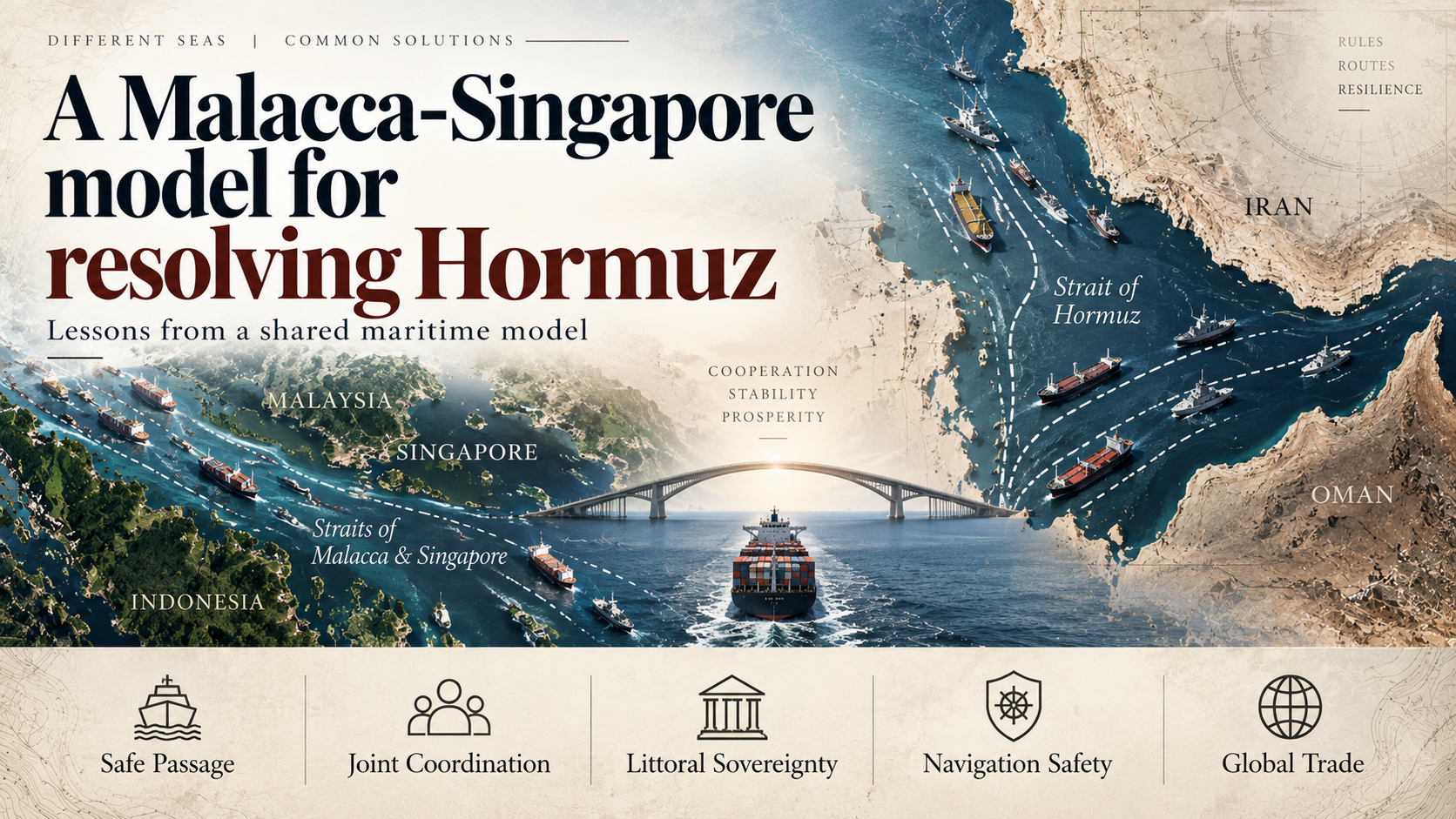
  • A Malacca-Singapore model for resolving Hormuz

    A Malacca-Singapore model for resolving Hormuz

    Question (2022, GS1 – 15 Marks): “Mention the significance of straits and isthmus in international trade.
    Linkage: This highlights how narrow bottlenecks like the Straits of Hormuz, Malacca, and Singapore handle vital portions of global trade and energy flows, making the legal rights of transit passage across these straits crucial to global supply chains.

    [2026] Ships from which of the following countries have to cross the Strait of Hormuz to reach out to the Indian Ocean?
    1. Bahrain
    2. Syria
    3. Qatar
    4. Egypt
    Select the answer using the code given below:
    [A] 1 and 2
    [B] 1 and 3
    [C] 2 and 3
    [D] 3 and 4

    Mentor Comment

    Siege warfare continues in the Strait of Hormuz and the Strait has not reopened. The Straits of Malacca and Singapore settled a structurally similar problem in the 1970s, when the territorial sea claims of the littoral States met in the middle and left no high seas corridor through them. That settlement produced the transit passage regime in the United Nations Convention on the Law of the Sea (UNCLOS) and, in 2007, a Cooperative Mechanism funding navigation safety without any toll on shipping. Iran and Oman have apparently agreed on a framework for reopening Hormuz, and the United States has not accepted the arrangement. The tension is that the technical parallels between the two waterways are close while the conditions that made the Malacca settlement possible, a convention still being negotiated and great powers willing to trade, no longer exist.

    What is transit passage and how does it differ from innocent passage?

    1. Innocent passage: It is the right of a foreign vessel to pass through another State’s territorial sea. The coastal State may suspend it for security reasons, and it excludes submerged submarines.
    2. Transit passage: It is a right of passage through straits used for international navigation that connect areas of high seas or exclusive economic zones, in a “continuous and expeditious” manner with no stopping or loitering.
    3. Why the difference matters: Transit passage applies to warships as well, and cannot be suspended by the coastal State, so it goes beyond mere innocent passage.
    4. Where it comes from: The concept was introduced by the United Kingdom as UNCLOS entered its final phase of formulation in the 1970s, specifically to solve the problem of straits narrower than two territorial seas.

    How did the Malacca and Singapore Straits stop being treated as international waters?

    1. The geography: The Strait of Malacca runs some 800 kilometres between the Malay Peninsula and the Indonesian island of Sumatra, connecting the Andaman Sea to the Strait of Singapore. The Strait of Singapore, some 105 km long, connects onward to the South China Sea.
    2. Indonesia’s archipelagic claim: A newly decolonised Indonesia feared for the security of its individual islands and in 1957 declared that all waters “surrounding, between and connecting the islands” were Indonesian waters.
    3. The 12 nautical mile claims: Indonesia insisted its territorial waters extend 12 nautical miles from the outermost islands. Malaysia revised the stance it had taken at the 1958 UNCLOS conference and also announced a 12 nautical mile territorial sea, despite its 1963 armed conflict with Indonesia over Borneo.
    4. The closure of the corridor: At their narrowest points the Straits are well under 24 nautical miles wide, so once both States claimed 12 nautical mile territorial seas the zones met in the middle, leaving no strip of high seas or exclusive economic zone (EEZ) between them.
    5. The consequence under the law of the time: The Straits became simply territorial seas, where foreign vessels enjoyed only innocent passage, a right Indonesia or Malaysia could suspend.
    6. The 1971 joint statement: Malaysia, Indonesia and Singapore jointly challenged the older international character of the Straits and proposed a coordinating body of representatives of the three States to administer them.
    7. Singapore’s reservation: As an island nation dependent on trade and shipping, Singapore did not agree to declaring the Straits “not international”, but made common cause with Malaysia on the safety of navigation.

    How did the great powers respond to the littoral claim?

    1. Japan, cooperation over internationalisation: Japan was a major player through the Japan funded Malacca Strait Council, and offered cooperation with the three States rather than seeking an internationalised regime.
    2. The United States and the Soviet Union, aligned: Otherwise rivals, they were allies on this one issue, seeking to keep the Straits open for ships to retain the right of “continued, politically uncluttered transit”.
    3. The United Kingdom, a legal solution: It introduced the transit passage concept, which preserved great power naval mobility while conceding the littoral States’ territorial claim.
    4. Indonesia, a traded concession: It agreed to the transit passage formulation with reservations, trading its acceptance for greater security for its archipelago, which UNCLOS eventually addressed separately.
    5. Malaysia, technical conditions: Its concerns centred on environmental safety, insurance requirements and permissible vessel draught rather than on the passage right itself.

    What did the 2007 Cooperative Mechanism actually settle?

    1. What it built on: In 2007 the three States, working with the international community, arrived at a Cooperative Mechanism built on a traffic separation scheme similar to what Iran and Oman had agreed for the Strait of Hormuz in the 1960s.
    2. The core bargain: User States and industry contribute to a fund for aids to navigation, hydrographic surveys and safety projects, administered jointly with the littoral States.
    3. Who funds it: The Aids to Navigation Fund is supported by voluntary contributions from non profit organisations such as The Nippon Foundation and the International Foundation for Aids to Navigation, along with industry stakeholders and States with an interest in safe use of the Straits.
    4. How it is governed: The fund is administered on a rotation basis by a committee of representatives of the three littoral States and the contributors.
    5. The line that makes it work: These contributions do not amount to tolls, and Indonesia, Malaysia and Singapore impose no fees, tolls or any other payment on ships exercising the right of transit passage.

    Where does the Hormuz geography match the Malacca case?

    1. The intersecting territorial seas: The territorial waters of Iran and Oman intersect, making sections of the Strait of Hormuz part of their territorial waters, which is the same structural condition that closed the high seas corridor through Malacca.
    2. The precedent already borrowed: The traffic separation scheme that the 2007 Cooperative Mechanism built on was itself modelled on the Iran and Oman arrangement of the 1960s, so the two waterways have shared technical machinery before.
    3. A regional sponsor exists: Qatar is among the Persian Gulf nations that have supported the Iran and Oman talks, and it had also mooted the Malacca and Singapore Straits as a model.
    4. Cooperation has precedent in the Gulf: Persian Gulf nations have a history of both conflict and cooperation, and the United Arab Emirates was among Iran’s leading trading partners.

    Why can the Malacca settlement not simply be transplanted?

    1. The convention moment has passed: The Malacca issue was resolved as UNCLOS itself was being put into effect, when trade offs were part of negotiating a convention intended to govern the world’s oceans. No comparable bargaining table exists now.
    2. One party is outside the convention: Iran has not ratified UNCLOS, so the transit passage compromise that bound the Malacca littorals does not bind it in the same way.
    3. A contrary domestic law is in force: In 1993 Iran passed a law requiring foreign warships to seek its authorisation to pass through the Strait, and this continues to be a sore point.
    4. The core issue is different: In the Malacca and Singapore Straits the key concerns were safety of navigation and the environment. In the Strait of Hormuz the key issue is Iran’s security, which no navigation fund can answer.
    5. The decisive user State may refuse: Even if the Gulf nations arrive at a framework they all agree on, the United States has shown it may not accept it, and it has not accepted the Iran and Oman framework already reached.

    Challenges to building a cooperative mechanism for the Strait of Hormuz

    1. A funding model cannot address a security demand: The Malacca fund bought navigation safety, which was what the littorals wanted. Hormuz is closed over sanctions and military pressure, which money does not purchase. Eg. The Iran and Oman framework has been agreed without the Strait reopening.
      The Fix: Pair any navigation mechanism with a separate sanctions and de escalation track, so the technical body is not asked to carry a political settlement it cannot deliver.
    2. Voluntary contributions leave the mechanism hostage to the largest funder: A body financed by user States and industry depends on the continued participation of the states with the biggest stake. Eg. The Aids to Navigation Fund for the Malacca and Singapore Straits rests on voluntary contributions from foundations and industry.
      The Fix: Fix assessed minimum contributions by volume of transiting tonnage, so the mechanism’s budget is not renegotiated every cycle.
    3. India’s exposure is concentrated and cannot be hedged quickly: A large share of India’s crude and liquefied petroleum gas moves through this one waterway, so a closure transmits directly into domestic fuel prices. Eg. Brent crude crossed $120 per barrel during the Hormuz blockade.
      The Fix: Accelerate use of the pipelines that bypass the Gulf, including the East West pipeline across Saudi Arabia and the Habshan to Fujairah line, and raise strategic petroleum reserve cover.
    4. War risk insurance can close a strait without a blockade: Premiums rise faster than any legal regime can respond, and a shipowner withdraws tonnage on commercial grounds alone. Eg. Marine war risk premiums for vessels entering the Gulf rose by over 1,000 percent during the crisis.
      The Fix: Create a sovereign backed reinsurance facility for Indian flagged and Indian chartered tonnage on the route, so freight does not stop before the diplomacy concludes.
    5. Seafarer safety has no institutional owner in a closure: Crews remain aboard commercial vessels inside a contested waterway with no flag State machinery to extract them. Eg. Nearly 700 Indian sailors were stuck on commercial ships near Hormuz during the 2026 crisis.
      The Fix: Negotiate a standing humanitarian corridor protocol with the littoral States covering crew relief and medical evacuation, activated automatically on a declared closure.

    Conclusion

    The two waterways share a legal problem and not a political one. Malacca was settled because the littoral claim could be traded inside a larger convention that every major power wanted concluded, and Hormuz offers no equivalent prize to trade against Iran’s security demand. The two things that cannot both hold are a littoral framework built by the Gulf States themselves and a user State that reserves the right to reject it. What to watch is whether the Iran and Oman framework attracts the acceptance of the principal user States, since the Strait’s reopening now turns on that acceptance rather than on the framework’s contents.

    Maritime Choke Points and India

    1. What a choke point is: It is a narrow section of a shipping route where traffic must converge, so a disruption at that point affects a disproportionate share of global trade and cannot be routed around cheaply.
    2. India’s exposure: India imports close to 85 percent of its crude requirement, and a large majority of its liquefied petroleum gas supply moves through the Strait of Hormuz, making the waterway a direct input into domestic energy prices.
    3. The eastern approach: The Strait of Malacca is the corresponding eastern choke point, through which a reported 60 percent of India’s trade passes, and the Andaman and Nicobar Islands sit at its western approach.
    4. The other two that matter: The Gulf of Aden with the Bab el Mandeb, and the Suez Canal, complete the set on India’s westward routes to Europe, Africa and the Americas.

    Government Initiatives on Maritime Security and Choke Point Resilience

    1. Information Fusion Centre, Indian Ocean Region (IFC-IOR): Established at Gurugram to build maritime domain awareness across the region, it hosts international liaison officers and links with partner centres including the European Union’s Maritime Security Centre for the Horn of Africa.
    2. SAGAR and MAHASAGAR: Security and Growth for All in the Region is India’s maritime cooperation doctrine for the Indian Ocean littoral, covering capacity building, hydrography, surveillance and disaster response for smaller island and coastal States.
    3. Chabahar Port: India Ports Global Limited took over operations of the Shahid Beheshti terminal under a 10 year agreement signed in 2024, giving India a sea and land route to Afghanistan and Central Asia that avoids the Pakistan corridor.
    4. India Middle East Europe Economic Corridor (IMEC): A rail and shipping corridor linking India to Europe through the Gulf and Israel, intended as a land and sea bridge that reduces dependence on the Suez route.
    5. Strategic Petroleum Reserves: Underground crude storage at Visakhapatnam, Mangaluru and Padur is held by Indian Strategic Petroleum Reserves Limited, with further capacity approved, to cover supply interruption at the import choke points.

    Back2Basics

    1. United Nations Convention on the Law of the Sea (UNCLOS): Adopted in 1982 and in force from 1994, it is the framework treaty setting out the rights and duties of States in the use of the oceans.
    2. The maritime zones it fixes: A 12 nautical mile territorial sea, a 24 nautical mile contiguous zone, and a 200 nautical mile exclusive economic zone measured from the baseline.
    3. Its dispute machinery: Disputes may go to the International Tribunal for the Law of the Sea at Hamburg, the International Court of Justice, or arbitration under the Convention’s annexes.
    4. Membership relevant here: India ratified UNCLOS in 1995. Iran has signed but not ratified it, which is why its 1993 law on warship authorisation sits outside the Convention’s transit passage regime.
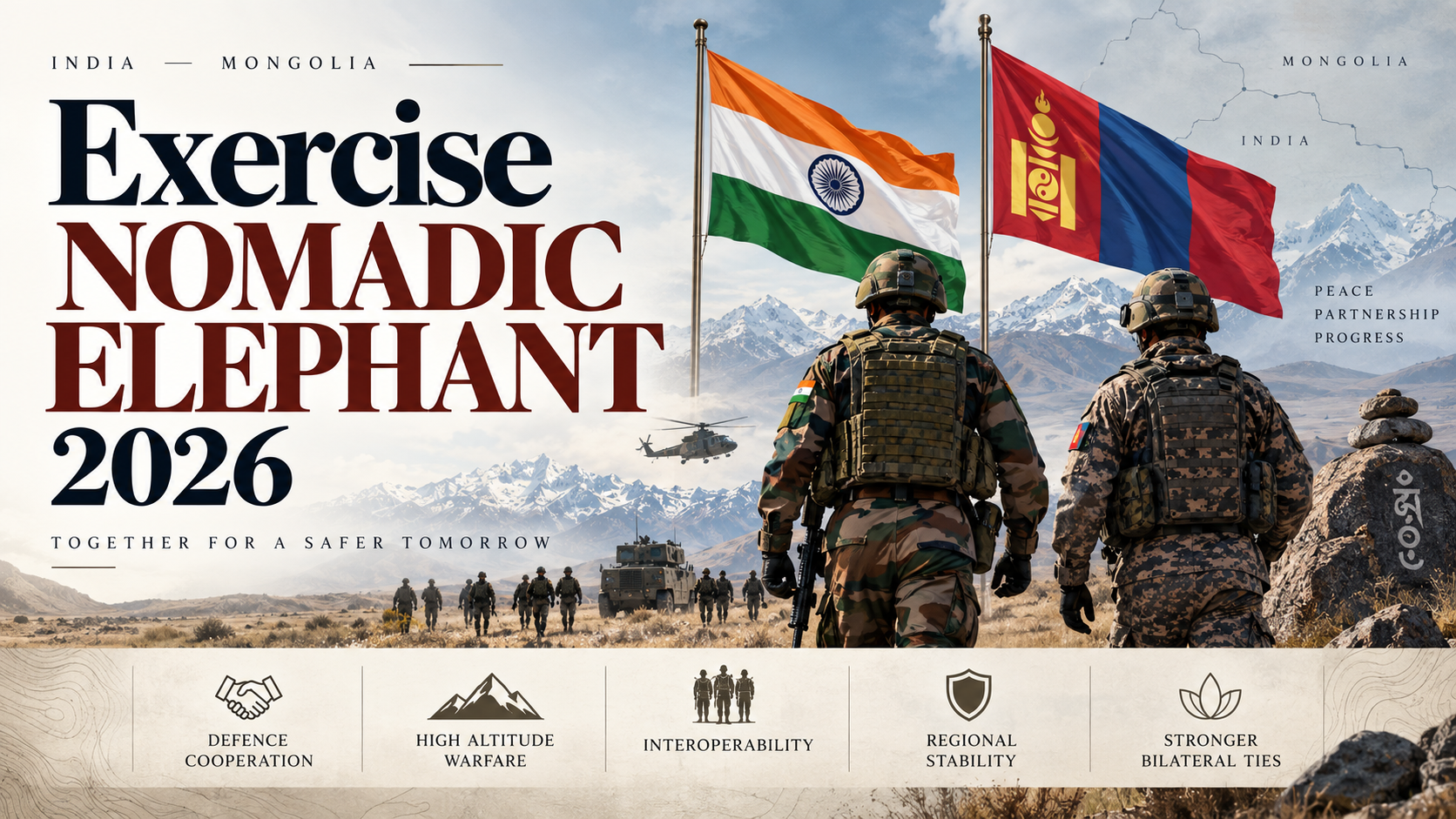
  • Exercise NOMADIC ELEPHANT 2026

    Exercise NOMADIC ELEPHANT 2026

    Why in the News?

    • The 18th edition of India-Mongolia Joint Military Exercise NOMADIC ELEPHANT commenced on 21 September 2026 at the Foreign Training Node, Pithoragarh, Uttarakhand.
    • The exercise will continue till 03 October 2026.

    Key Highlights

    • Participants: Indian Army and Mongolian Armed Forces.
    • Strength: 45 personnel each.
    • Nature: Annual platoon-level military exercise.
    • Conducted alternately in India and Mongolia.
    • 17th edition: Held at Ulaanbaatar, Mongolia, in May-June 2025.
    • Focus: Enhancing joint military capability for Counter-Insurgency Operations.
    • Terrain: Semi-urban and mountainous terrain.
    • Operations conducted under a United Nations Mandate.

    India-Mongolia Defence Cooperation

    • Strengthens defence cooperation between India and Mongolia.
    • Enhances interoperability and joint operational capability.
    • Reinforces bilateral friendship and mutual trust.

    UPSC Prelims Trap

    • NOMADIC ELEPHANT is an India-Mongolia exercise, not an India-Nepal or India-Bhutan exercise.
    • It is conducted alternately in India and Mongolia.
    • It is a platoon-level exercise, not a tri-service exercise.
    • The 2026 edition is being held at Pithoragarh, Uttarakhand, while the previous edition was held in Ulaanbaatar, Mongolia.
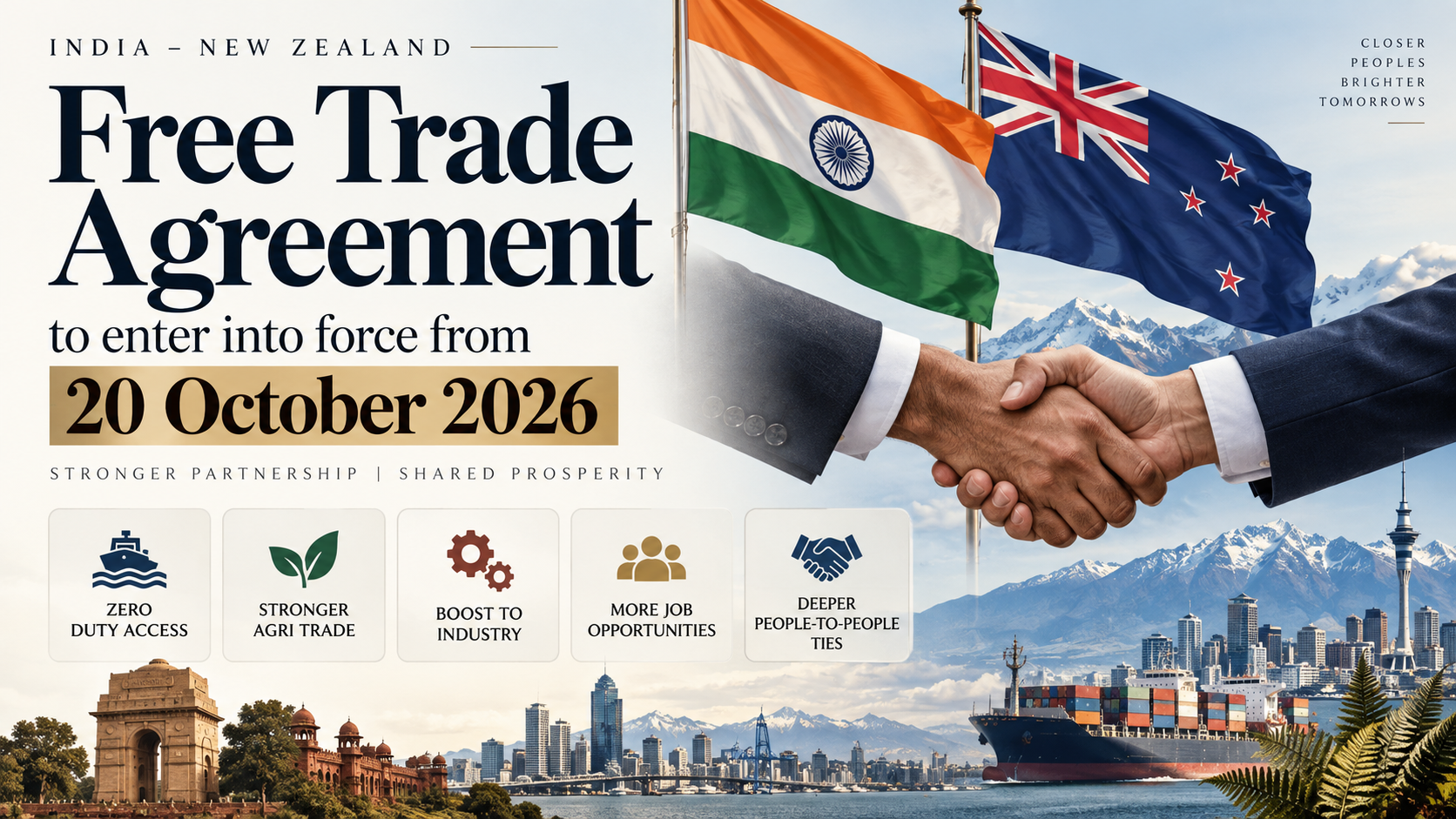
  • India-New Zealand FTA

    India-New Zealand FTA

    Why in the News?

    • The India-New Zealand Free Trade Agreement (FTA) will enter into force on 20 October 2026.
    • The agreement was signed on 27 April 2026 in New Delhi after completion of internal processes in both countries.

    Key Highlights

    • 100% of India’s exports to New Zealand will become duty-free from the first day.
    • New Zealand’s tariffs of up to 10% will be eliminated on Indian exports.
    • Major beneficiary sectors:
      • Textiles and apparel
      • Leather and footwear
      • Gems and jewellery
      • Engineering goods
      • Processed foods
    • Tariff-free access to inputs such as:
      • Wooden logs
      • Coking coal
      • Metal scrap
    • Bilateral merchandise trade was around USD 1.1 billion in 2025-26.
    • Strategic Partnership announced in July 2026, with an aspirational goal of doubling bilateral goods and services trade to NZ$7 billion by 2030.

    Agriculture and Farmers

    • Sensitive Indian products excluded from tariff concessions:
      • Dairy
      • Animal meat except sheep
      • Key agricultural commodities
      • Sugar
      • Edible oils
    • New Zealand’s apples, kiwifruit and Manuka honey receive calibrated access through:
      • Tariff Rate Quotas (TRQs)
      • Minimum Import Price
      • Seasonal import windows
    • Agriculture Productivity Partnership established to improve:
      • Productivity
      • Quality
      • Farmer incomes
    • Centres of Excellence will focus on orchard management, post-harvest practices, supply chains, food safety and sustainable beekeeping.

    Services, Investment and Mobility

    • New Zealand committed to facilitate USD 20 billion investment into India.
    • Indian services companies gain access across roughly 118 sectors.
    • Most-Favoured Nation (MFN) treatment locked in across about 139 sub-sectors.
    • Mobility provisions:
      • 5,000 Temporary Employment Entry visas for skilled Indians
      • 1,000 Working Holiday visas annually for young Indians
    • Student mobility:
      • Post-study work rights up to 3 years for STEM graduates
      • Up to 4 years for doctoral scholars

    Pharmaceuticals and Medical Devices

    • New Zealand will accept inspection approvals from regulators including:
      • US FDA
      • EMA
      • UK MHRA
      • Health Canada
    • Intended to reduce regulatory delays and facilitate faster market entry for Indian pharmaceutical and medical device exporters.

    Prelims Quick Revision

    • Entry into force: 20 October 2026
    • FTA signed: 27 April 2026, New Delhi
    • India’s exports to New Zealand: 100% duty-free from day one
    • Bilateral trade target: NZ$7 billion by 2030
    • New Zealand investment commitment: USD 20 billion
    • Skilled Indian mobility quota: 5,000 visas
    • Working Holiday visas: 1,000 annually
    • Trade in 2025-26: Around USD 1.1 billion

    UPSC Prelims Trap

    • FTA does not mean unrestricted agricultural imports: sensitive Indian products such as dairy, sugar and edible oils remain excluded from tariff concessions.
    • TRQ is not the same as complete tariff elimination: apples, kiwifruit and Manuka honey receive calibrated access under specified conditions.
    • MFN treatment applies to specified services sub-sectors, not automatically to all sectors.
    • 20 October 2026 is the date of entry into force, while 27 April 2026 is the date of signing.
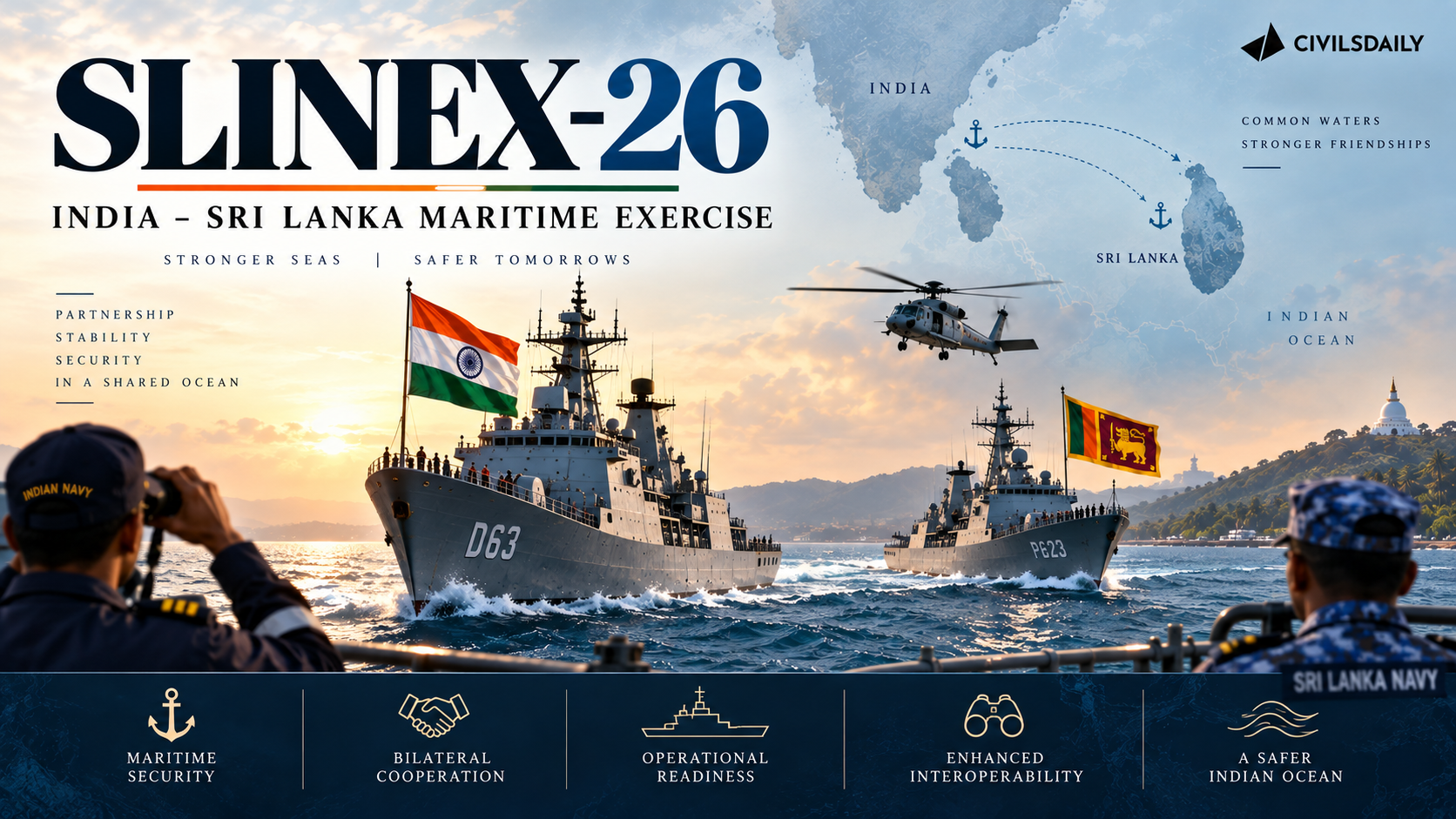
  • SLINEX-26: India-Sri Lanka Maritime Exercise

    SLINEX-26: India-Sri Lanka Maritime Exercise

    Why in the News?

    The 13th edition of the Sri Lanka-India bilateral maritime exercise, SLINEX-26, is being conducted at Visakhapatnam from 17-21 September 2026.

    Key Highlights

    • Exercise: SLINEX-26
    • Edition: 13th
    • Venue: Visakhapatnam
    • Dates: 17-21 September 2026
    • Participating navies:
      • Indian Navy: INS Kavaratti and INS Jyoti
      • Sri Lanka Navy: SLNS Sindurala
    • Exercise has two phases:
      1. Harbour Phase : Professional interactions, Cross-deck visits, Sharing of best practices, Yoga, Sports, and Cultural activities
      2. Sea Phase : Coordinated activities at sea, Operational synergy, Interoperability between the two navies

    About SLINEX

    • Conceptualised in 2005.
    • Provides a platform for:
      • Maritime cooperation
      • Interoperability
      • Mutual understanding
      • Sharing of best practices

    Strategic Significance

    • SLINEX-26 supports India’s MAHASAGAR vision and aims to strengthen cooperation for a secure, stable and inclusive maritime environment.
    • It also reinforces the enduring maritime partnership between India and Sri Lanka.

    Prelims Quick Revision

    • SLINEX: India-Sri Lanka bilateral maritime exercise.
    • Conceptualised: 2005
    • 2026 edition: 13th
    • SLINEX-26 venue: Visakhapatnam
    • Indian ships: INS Kavaratti + INS Jyoti
    • Sri Lankan ship: SLNS Sindurala
    • Two phases: Harbour Phase + Sea Phase
    • Linked with India’s MAHASAGAR vision.
  • Japan Air Force chief flies in Tejas jet, hails progress in defence partnership

    Why in the News

    The Chief of the Air Staff and the Japan Air Self Defense Force (JASDF) Chief of Staff have flown together in a Light Combat Aircraft (LCA) Tejas formation at Jodhpur. The sortie took place during Veer Guardian 2026, the second edition of the India Japan bilateral air exercise, held at Air Force Station Jodhpur from 9 to 22 September. JASDF F-2A fighters have operated from Indian soil for the first time in this edition. The Indian Air Force (IAF) is flying Tejas, Su-30MKI and Rafale aircraft alongside them. The significance is that a visiting air chief flying an Indian designed fighter turns a training exercise into a statement about that aircraft’s credibility as an export. The two chiefs have separately pointed to the space domain as the next area of cooperation.

    What is Veer Guardian 2026?

    1. What it is: Veer Guardian is the bilateral air combat exercise between the Indian Air Force and the JASDF, flown between fighter squadrons of the two air forces.
    2. Editions: The first edition was held in January 2023 at air bases in Japan, and the second is being held at Air Force Station Jodhpur from 9 to 22 September 2026.
    3. A first for the JASDF: Japanese fighter aircraft have operated from Indian soil for the first time in this edition.
    4. Aircraft fielded: The IAF is participating with Tejas, Su-30MKI and Rafale fighters, and the JASDF has brought F-2A fighters.

    Why does the Tejas sortie carry weight?

    1. Who flew what: The Chief of the Air Staff led the formation in a fighter aircraft. The JASDF Chief of Staff flew in a trainer aircraft, with the Commanding Officer of the Tejas squadron as captain.
    2. The stated reading: The IAF described the sortie as a clear example of the faith and trust placed in a homegrown aircraft.
    3. Export signalling: A foreign air chief flying an Indian designed fighter is the strongest endorsement available short of a purchase order, and India has been offering the Tejas to several air forces abroad.
    4. Industrial claim: The sortie was tied to a stated expectation that India’s defence aviation industry and its research and development base will now reach higher levels.

    What does the partnership cover beyond tactical training?

    1. Beyond tactics: The JASDF assessment is that the bilateral engagement has moved past exercises aimed merely at refining tactical capabilities.
    2. Breadth of contact: Cooperation now runs across exercises, leadership interactions and subject matter exchanges.
    3. The space domain: The space domain was named as a potential area of cooperation between the two air forces.
    4. The stated frame: The partnership is described as resting on mutual respect, professional trust and a shared commitment to peace and stability, captured in the Japanese term kizuna, meaning enduring bonds forged through trust and support.

    Challenges to the India Japan defence partnership

    1. Constitutional limits on Japanese force projection: Article 9 of Japan’s Constitution and the self defence framing built on it bound how far the JASDF can commit to operations beyond Japan’s own defence. Eg. Japan’s 2022 National Security Strategy treated counterstrike capability as a new departure precisely because the earlier reading barred it.
      The Fix: Anchor cooperation in the areas the framework already permits, such as air defence training, logistics and space situational awareness.
    2. No major equipment sale has concluded: The two states signed a defence equipment and technology transfer agreement in 2015, and no major platform sale has followed it. Eg. Negotiations on the ShinMaywa US-2 amphibious aircraft ran for years without a contract.
      The Fix: Begin with subsystem and component level transfers, which clear procurement thresholds faster than a whole platform deal.
    3. Unit cost is the recurring obstacle: Japanese defence platforms carry high unit costs from small domestic production runs, which sits against Indian procurement’s price ceilings. Eg. The US-2 was quoted well above comparable options available to the Indian Navy.
      The Fix: Route any future purchase through co production in India under the Defence Acquisition Procedure, so volume brings the unit cost within the ceiling.
    4. The China factor sets the pace: Both states manage large economic relationships with China, so each calibrates how much visible defence content the partnership carries. Eg. Japan remains one of China’s largest trading partners while contesting Chinese activity around the Senkaku islands.
      The Fix: Concentrate the partnership on defensive capability areas such as maritime domain awareness and anti submarine warfare training, which carry a lower escalation cost.
    5. Indigenous platform delivery record: An export pitch for the Tejas is judged on deliveries rather than on a demonstration flight. Eg. Tejas Mk1A deliveries have run behind the contracted schedule because of engine supply delays.
      The Fix: Secure a second engine supply line and publish a delivery calendar, so a prospective export customer can price the delivery risk.

    Conclusion

    The exercise is the operational layer of a partnership that has been widening through agreements and dialogues for over a decade. What changed here is that the two air forces trained together on Indian built equipment on Indian soil, which neither had done before. The markers to watch are whether the space domain cooperation the two chiefs raised is converted into a stated work programme, and whether the next edition is scheduled in Japan on the same rotation.

    Back2Basics: Light Combat Aircraft (LCA) Tejas

    1. What it is: Tejas is a single engine, multirole light fighter, the smallest and lightest aircraft in its class in service anywhere.
    2. Who built it: It was designed by the Aeronautical Development Agency under the Defence Research and Development Organisation (DRDO) and is manufactured by Hindustan Aeronautics Limited (HAL).
    3. Induction: The IAF inducted its first Tejas squadron, No. 45 Squadron, in 2016.
    4. Current variant: The Mk1A carries an active electronically scanned array radar and an electronic warfare suite, with 83 aircraft contracted in 2021 and a further 97 ordered since.

    Matching Previous Year Question

    “‘The time has come for India and Japan to build a strong contemporary relationship, one involving global and strategic partnership that will have a great significance for Asia and the world as a whole.’ Comment.”

  • India’s BRICS diplomacy is more than one summit’s result

    Why in the News

    Eleven members of BRICS have adopted the New Delhi Declaration 2026 by consensus, reiterating the importance of the Palestinian question and the two state solution. The Rio BRICS Declaration 2025 had gone further, condemning the military strikes against Iran as a violation of international law and the United Nations Charter. That formula was no longer available in Delhi. Iran had by then struck targets across the Gulf, including the territory of fellow BRICS members. The United Arab Emirates (UAE) had suspended trade and financial dealings with Tehran. The tension is whether a plurilateral forum is judged by the settlements it produces or by the dialogue it makes possible between members who have become belligerents against one another.

    Why was the Rio formula unavailable in New Delhi?

    1. Position in June 2025: Iran was a BRICS member that had been attacked, so every other member could condemn the strikes without contradicting its own position.
    2. The February 2026 escalation: The United States and Israel struck Iran again. Iran responded by striking targets across the Gulf, including the territory of fellow BRICS members.
    3. The UAE’s exposure: The UAE absorbed more Iranian projectiles than any other member of the Gulf Cooperation Council (GCC), the six state grouping of Arab Gulf monarchies. It then suspended trade and financial dealings with Tehran.
    4. Why the formula lapsed: The condemnation language became unavailable because members had become belligerents against one another, not because the chair lacked resolve.

    What makes consensus among eleven members the achievement?

    1. The ministerial failure: BRICS foreign ministers met in New Delhi in May 2026 and produced no outcome document at all.
    2. The chair’s own assessment: The Ministry of External Affairs conceded in March that members were directly involved in the conflict, and that India as chair was working the Sherpa channel, the track of leaders’ personal representatives who negotiate summit texts before the leaders meet, to narrow differences.
    3. The turnaround: Four months after the ministerial failure, eleven members adopted a declaration by consensus.
    4. Precision where agreement existed: On the Palestinian question and the two state solution the language stayed precise rather than general.
    5. A floor where it did not: On the contested questions the text built a floor instead of delivering a verdict.

    Does a dialogue floor count as an outcome?

    1. The competing standard: One view tests a forum such as BRICS on the tangible outcomes it produces, not on the agency for dialogue and diplomacy it provides.
    2. Why that test misfires in a live conflict: The initiation of a dialogue cannot be expected to produce an immediate settlement, so judging it by the ends it may ultimately achieve dismisses it before it can work.
    3. The first bilateral since the war: Iran and the UAE used the summit for their first high level bilateral meeting since the war began.
    4. The declaration’s own significance: The importance of the West Asia text lies not only in what it says but in the fact that there was a declaration at all.
    5. Means as outcome: Where members are themselves parties to the conflict, the floor a summit provides is the result rather than a step toward one.

    What has a decade of Gulf engagement built?

    1. A changed agenda: India’s engagement with the Gulf has shifted from oil and trade toward defence, technology and security.
    2. Relationships across binaries: India’s relationships in West Asia are not organised as mutually exclusive choices between Iran and the Arab Gulf states.
    3. Access on the Arab Gulf side: India can register the security anxieties of the Arab Gulf without treating Iran’s isolation as an objective.
    4. Access on the Iranian side: India can engage Iran without appearing indifferent to Gulf security.
    5. Strategic autonomy restated: Strategic autonomy does more than create manoeuvring room for India. It creates diplomatic room between others.

    What are the limits of India’s position?

    1. Not a mediator: A summit declaration does not make India a direct mediator in West Asia.
    2. What formal mediation requires: Mediation requires acceptance by the parties, a mandate and a negotiating agenda, none of which a consensus text confers.
    3. What India can offer instead: Trusted channels where they are scarce, political access across opposing capitals, and the ability to enlarge the space for accommodation.
    4. The price not charged: That access is offered without demanding geopolitical allegiance from any of the parties.

    Challenges to India’s BRICS diplomacy

    1. Consensus rule lowers the ceiling: Every member holds an effective veto over the text, so an expanded membership reduces what any declaration can say. Eg. BRICS declarations record national positions on the Ukraine conflict rather than a common one.
      The Fix: Move contested items to issue based coalitions of willing members and keep the leaders’ declaration to the ground the whole group holds.
    2. No standing institutional memory: The grouping has no charter and no permanent secretariat, so continuity depends on the capacity of each rotating chair. Eg. The New Development Bank in Shanghai is the only permanent BRICS institution with a headquarters and a staff.
      The Fix: Establish a small standing secretariat to carry the Sherpa agenda across chairs rather than rebuilding it annually.
    3. Rivalry between the two largest members: India and China carry an unresolved boundary dispute into every agenda, which limits how far the group can act as a bloc. Eg. Disengagement along the Line of Actual Control has proceeded patrol point by patrol point through bilateral talks, never through a BRICS channel.
      The Fix: Keep bilateral disputes on bilateral tracks and confine the BRICS agenda to finance, health, space and technology, where member interests converge.
    4. Expansion dilutes coherence: A grouping spanning democracies and autocracies finds shared positions on norms harder to draft as it grows. Eg. Full membership has moved from five states to eleven within two years.
      The Fix: Publish admission criteria tied to economic and functional contribution, so each addition does not further widen the range of positions to be reconciled.
    5. Dollar dependence persists: The group’s financial alternatives remain marginal against dollar clearing, so the autonomy claimed in declarations is not matched by settlement practice. Eg. The US dollar still settles over 80% of global trade.
      The Fix: Extend existing bilateral local currency settlement arrangements to the trade flows that already run a recurring surplus, rather than pursuing a common currency.

    Conclusion

    The standard applied to a plurilateral grouping decides what it is seen to be worth. Judged by settlements signed, a forum whose members are firing at one another will always read as a failure. Judged by whether hostile parties still meet inside it, Delhi did the one thing that was no longer available to the chair at Rio. What to watch is whether the channels opened at the summit produce a second Iran and UAE meeting away from a summit setting, and whether the next chair carries the same text forward rather than reopening it.

    About BRICS

    1. Origin: The acronym BRIC was coined in 2001 to group high growth emerging economies, the first foreign ministers’ meeting was held on the margins of the United Nations General Assembly in 2006, and the first leaders’ summit was held at Yekaterinburg in 2009.
    2. Membership: South Africa joined in 2011, expansion opened at the 2023 Johannesburg summit, and Egypt, Ethiopia, Iran and the UAE joined in 2024 and Indonesia in 2025, taking full membership to eleven.
    3. Weight: Members account for over 45% of world population, roughly 37% of global Gross Domestic Product measured at purchasing power parity, which exceeds the G7 share, and about 42% of global oil production.
    4. Partner tier: A partner country category introduced in 2024 engages states such as Malaysia, Thailand and Nigeria without granting full membership.

    Schemes and Initiatives for BRICS

    1. New Development Bank (NDB): Headquartered in Shanghai, it finances infrastructure and sustainable development projects in member states and has approved over $35 billion in loans.
    2. Contingent Reserve Arrangement (CRA): A $100 billion pool providing short term liquidity support to members facing balance of payments pressure.
    3. BRICS Pay: A cross border payment system in pilot stage, intended to settle trade between members outside the SWIFT messaging network.
    4. BRICS Vaccine Research and Development Centre: Launched during the pandemic to facilitate technology transfer and vaccine access across members.
    5. Partnership on New Industrial Revolution (PartNIR): A standing cooperation track on artificial intelligence, digitalisation and green technology.
    6. Remote Sensing Satellite Constellation: Six satellites contributed by member states sharing earth observation data for disaster management, alongside a BRICS Space Council set up in 2025 to coordinate deep space and lunar research.

    Matching Previous Year Question

    ““BRICS acts as a powerful counterweight in global governance, actively amplifying the voice and influence of the Global South.” Explain the role of BRICS in projecting itself as an alternative to other groupings.”