Mains Ready By December. Smash Mains & Smash PYQ Admissions Open

GS Paper: GS2-18.Bilateral, regional and global groupings and agreements involving India and/or affecting India’s interests.

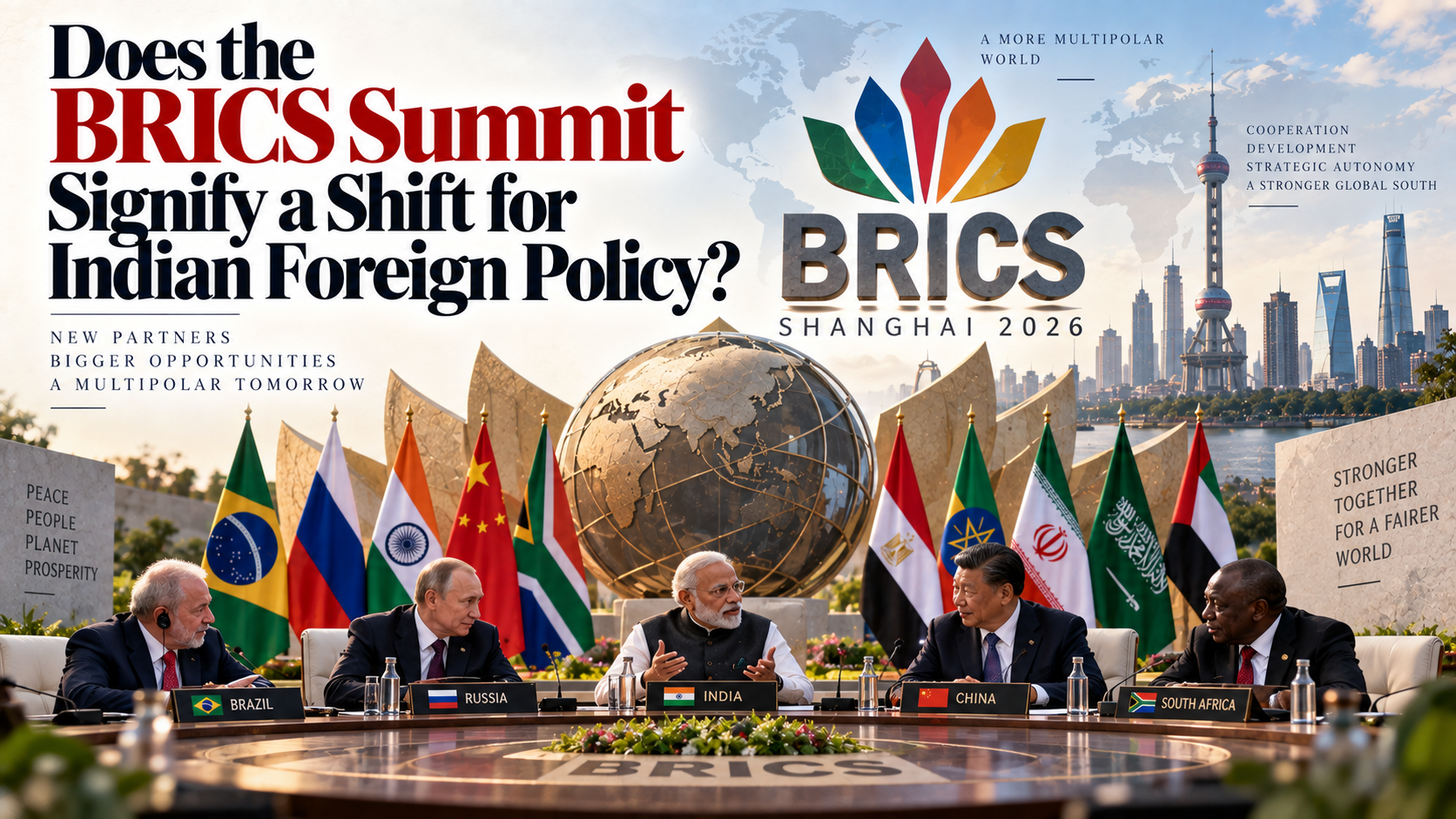
  • Does the BRICS summit signify a shift for Indian foreign policy?

    Does the BRICS summit signify a shift for Indian foreign policy?

    Why in the News

    The New Delhi Declaration of 2026, adopted at the BRICS summit hosted by India, pushes back against unilateral western sanctions, criticises Israel over the killing of civilians, the attacks on Lebanon and the forced occupation of Palestinian territory, and supports United Nations reform together with a BRICS payment mechanism. The declaration has been likened to the foreign policy of India’s non aligned past. It is also the first BRICS declaration since 2022 to carry no reference to Ukraine. The tension is whether the text marks an actual shift in Indian foreign policy, or is multilateral language that a national position is not expected to follow.

    Is the New Delhi Declaration a return to non alignment?

    1. Continuity, not a shift: The declaration is in keeping with Indian foreign policy, whether that is described as strategic autonomy and multi alignment or as multi vector engagement. What has changed is optics, with India on the front foot and less apologetic about being emphatically part of a non western forum.
    2. Non alignment does not describe the present aim: Non alignment was a strategy for a weak state in a bipolar world. The declared ambition in India today is to become one of the poles in a multipolar world.
    3. The Bandung reference: The declaration invokes the Bandung Spirit in pursuit of a fairer, more inclusive and representative multilateral system. On the second reading that invocation is nostalgia rather than operative policy.
    4. What the platform is: BRICS is a political platform and not a security platform, so a declaration adopted in it cannot commit a member to anything it would not do bilaterally.

    What did the summit’s optics carry, and what did they not?

    1. A return after seven years: The Chinese President had not travelled to India in nearly seven years before this summit.
    2. Who else was at the table: The Abu Dhabi Crown Prince sat at the same table, and the outreach session brought in powers that do not otherwise enter great power conversations.
    3. Socialisation as the actual product: What the platform generated was contact inside it and on its margins rather than agreement, and that contact is not by itself shaping the world order.
    4. National positions expressly preserved: The declaration calls for exercising restraint and for protecting civilians and civilian infrastructure. It also pointedly recalls the respective national positions of each member.
    5. Why a multilateral text can go further than a national one: A country can say in a high level multilateral document what it will not say in a national statement. Eg. The phrase “unilateral coercive measures” is understood to mean US actions, without naming a measure or a date.

    Why did the declaration drop Ukraine?

    1. A break in precedent: Every BRICS summit declaration since 2022, including the 2024 summit held in Russia, carried a reference to Ukraine.
    2. Attributed to Russian insistence: The omission is attributed to a Russian veto exercised to preserve consensus. The Rio declaration last year had condemned a Ukrainian attack on Russia with no equivalent condemnation of anything Russia had done, and dropping the subject entirely replaced that one sided formulation.
    3. An error of omission: A major multilateral geopolitical forum that stays silent, rather than calling on the belligerents to end the war, has left the central question unaddressed.
    4. India’s own incentive: India had little reason to press for the language, having sided with the Russian Federation in this war indirectly if not directly.
    5. The option not taken: Neutral language on Ukraine was available on the precedent of the earlier joint declarations, and was not used.

    How does the Israel language sit with India’s bilateral position?

    1. The bilateral signal: The Prime Minister told the Israeli parliament during a visit in February 2026 that India stood “shoulder to shoulder” with Israel.
    2. The disjunction: The declaration’s condemnation of Israel is strong, which creates a clear break between the multilateral text and that bilateral statement. The text may be intended to counter the perception that India was drawing too close to Israel.
    3. Shelter in United Nations language: The declaration cites UN Security Council Resolution 2803 of November 2025, which provided for an International Stabilisation Force and a Board of Peace. Some of the declaration’s language is drawn from that resolution.
    4. No contradiction of settled policy: The two state solution has been India’s standing position, so the text does not contradict Indian policy on Palestine.
    5. The room shaped the text: With the United Arab Emirates, Egypt, Iran and Indonesia at the table, there was a limit to how far India could push back against the harshness of the language.
    6. Where the balance actually sits: The partnership with Israel remains the weightier commitment, since a bilateral address to a parliament is consequential while a multilateral declaration is symbolic.

    What does the economic agenda amount to?

    1. The bloc’s weight: The grouping’s membership accounts for 40 percent of the global economy and 25 percent of global trade.
    2. Two different propositions in payments: India supports local currency payment mechanisms for bilateral trade. India has not supported a permanent payment mechanism operating under the BRICS umbrella.
    3. Why a common settlement currency is resisted: There is no single approach to currency settlement that suits every pair of trading partners. A non dollar mechanism would in practice elevate the next dominant currency, and on present weight that currency would be China’s.
    4. BRICS against the Group of Seven: BRICS is a counterpoint to the Group of Seven (G7), an economic grouping that also carries geopolitical responsibilities.
    5. India sits on both sides of that line: India is a standing invitee to the G7 along with Australia and South Korea. One proposal is that the G7 dissolve itself into a Democratic 10 (D10) including those three, with India as the bridge between east and west and a voice of the south.

    Where should India spend its diplomatic capital next?

    1. The immediate calendar: The ASEAN East Asia Summit in the Philippines falls in November. Visits by the Prime Minister to the United States, Canada and Brussels follow, with three trade agreements potentially in reach.
    2. Multi vector engagement as the method: The approach is to keep all stakeholders engaged in multiple directions at once rather than to choose a camp.
    3. Diplomatic capital is finite: India has only so much of it, so battles, forums and partners have to be picked rather than attended to uniformly.
    4. The rooms that will decide the next order: The forums framing global rules on artificial intelligence and the governance of space are where the next world order will be made, rather than a platform such as BRICS.

    Challenges to BRICS as a vehicle for Indian foreign policy

    1. The consensus rule produces silence: A single member’s objection removes a subject from the declaration altogether instead of producing balanced language. Eg. The complete absence of any reference to Ukraine from the New Delhi Declaration.
      The Fix: Issue a chair’s summary alongside the declaration, so positions that fail consensus are still on the record.
    2. Expansion dilutes coherence: Members with opposed interests make a common position harder to reach as the grouping grows. Eg. Egypt, Ethiopia, Iran and the United Arab Emirates joined in 2024 and Indonesia in 2025.
      The Fix: Anchor the agenda in a small set of deliverables such as development finance, where the members’ interests already converge.
    3. Moving off the dollar substitutes one dependence for another: Replacing the dollar as a settlement currency hands the same structural leverage to whichever currency takes its place. Eg. The New Development Bank suspended new transactions in Russia in 2022 to protect its own access to international capital markets.
      The Fix: Expand bilateral local currency settlement arrangements rather than build a single common currency mechanism.
    4. The platform cannot handle its members’ own disputes: A grouping with no security function offers no channel for a conflict between two of its members. Eg. India and China are both members while their boundary dispute is handled entirely bilaterally.
      The Fix: Keep security questions in the bilateral and plurilateral formats built for them, and hold the grouping to economic and governance reform.
    5. Declarations carry no implementing mechanism: A position agreed in a summit text has no follow through between summits. Eg. Calls for Security Council reform recur in these declarations while two of the grouping’s own members do not support expanding permanent membership.
      The Fix: Attach a named working group and a reporting deadline to each declaration commitment.

    Conclusion

    The declaration reads as a shift and functions as a signal. What a grouping’s text says and what its members do bilaterally have been allowed to diverge, and India’s positions on Israel and on Russia both sit inside that gap. The unresolved question is whether multi vector engagement can keep both registers running once a partner insists on consistency between them. The next test is the sequence of bilateral visits and trade negotiations that follows the summit, where the same positions have to survive contact with a single counterpart.

    About BRICS

    1. Formation: The grouping began as BRIC, with Brazil, Russia, India and China holding their first leaders’ summit in 2009. South Africa joined in 2010 and the grouping became BRICS.
    2. Expansion: Egypt, Ethiopia, Iran and the United Arab Emirates were admitted as members in 2024, and Indonesia joined in 2025.
    3. New Development Bank: Agreed at the 2014 Fortaleza summit and headquartered in Shanghai, it finances infrastructure and sustainable development projects in member states and other developing countries.
    4. Contingent Reserve Arrangement: Also agreed in 2014, it is a currency swap framework members can draw on to meet short term balance of payments pressure.

    Back2Basics: Non-Aligned Movement

    1. Origin: The Bandung Conference of 1955 brought together Asian and African states and set out principles of sovereignty, non interference and peaceful coexistence.
    2. Founding: The Movement was formally established at the Belgrade Conference of 1961.
    3. Core idea: Member states declined formal military alignment with either Cold War bloc while retaining the freedom to engage both.
    4. India’s role: India was among its founding members and hosted the seventh summit at New Delhi in 1983.

    Matching Previous Year Question

    “[2026, GS2, 10] “BRICS acts as a powerful counterweight in global governance, actively amplifying the voice and influence of the Global South.” Explain the role of BRICS in projecting itself as an alternative to other groupings.”
  • India softens EU steel import curbs hit, secures 80% exports

    Why in the News

    India has safeguarded more than 80% of its steel supplies to the European Union (EU) by negotiating that the steel concessions contained in the free trade agreement between India and the EU be front loaded, so they apply before the agreement comes into force. The step answers a curb the EU has already imposed. Since July 2026 the EU has run an amended quota based system for certain steel imports that sharply cut country wise quotas in order to reduce overall steel imports. The tension is that the quota relief does not remove the cost barrier. Indian steelmakers will still have to pay the EU’s separate Carbon Border Adjustment Mechanism (CBAM) charge even where their exports fall within the quota.

    What is the EU’s steel quota system?

    1. The mechanism: It caps the volume of specified steel products that may enter the EU from each country at a preferential duty, with shipments beyond the cap facing a higher duty.
    2. Country wise quotas: Each supplying country receives a named tonnage for the product categories inside the quota mechanism.
    3. Residual quotas: Beyond the country specific allocation, a residual pool is available, and India’s access to that pool comes from the free trade agreement.

    How much did India’s quota actually move?

    1. The negotiated text: The trade deal text set India’s quota at 16.5 lakh tonnes for the items within the quota mechanism.
    2. The implemented figure: When the system was finally implemented in July, India’s quota was expanded to 19 lakh tonnes.
    3. With residual access: Counting the residual quotas India receives under the free trade agreement, the total potential quota for Indian steel exports now stands at 28 lakh tonnes.
    4. Measured against past trade: India exported an average of 30 lakh tonnes of steel products falling under the quota regime over 2022 to 2024, so full use of the residual quotas secures more than 80% of quota based steel exports.

    Why does front loading matter before the agreement is in force?

    1. The timing problem: The EU’s amended quota system took effect in July 2026, while the free trade agreement had not yet come into effect, which would have left India inside the tightened country quota with no concession to draw on.
    2. The concession obtained: The EU agreed to make the steel concessions applicable from July 2026, ahead of the agreement’s own entry into force.
    3. Where the agreement stands: The text is currently with the European Commission to sign, which the government expects to take place in December.

    Why does CBAM still bite despite the quota gain?

    1. A separate instrument: CBAM is a carbon charge on imports and operates independently of the quota, so quota compliant steel is not exempt from it.
    2. Verification as the practical cost: Exporters must have their embedded carbon figures verified, and Indian exporters currently have to look abroad for that service.
    3. The response under way: India is working with the EU to build domestic capacity for CBAM verification, including recognition of Indian verification agencies, with the government trying to get at least 10 agencies verified.

    Challenges to India’s steel exports to the EU

    1. Carbon intensity of the production route: Indian steel is made largely through the coal based blast furnace route, so its declared embedded carbon sits above that of EU producers and the levy scales with that gap. Eg. Coal based production accounts for the bulk of India’s crude steel output.
      The Fix: Route export grade capacity through electric arc furnaces and direct reduced iron so the verified carbon content falls at source.
    2. Residual quota exhaustion: Residual pools are allotted on a first come first served basis within each period, so an exporter shipping late in the period can find the pool used up. Eg. Steel entering the EU outside the safeguard quota faces a duty of 25%.
      The Fix: Publish a shipment calendar allocating the residual pool across Indian exporters within each quarter, rather than leaving it to who files first.
    3. Concentration on a single destination: Securing 80% of quota based exports to one bloc leaves that volume exposed to a single regulator’s next revision. Eg. The EU cut country wise quotas in July 2026 without a corresponding change in Indian production plans.
      The Fix: Build parallel quota and tariff access in other markets so a single revision does not move the whole export book.
    4. Compliance capacity in smaller mills: Carbon accounting at installation level requires measurement systems that secondary and smaller producers do not maintain. Eg. Much of India’s steel capacity sits with secondary producers operating induction furnaces.
      The Fix: Fund a shared carbon measurement and reporting facility for secondary producers at the cluster level.

    Conclusion

    The quota outcome is real but partial. India has converted a tightening safeguard into slightly more room than the trade deal text promised, and has done it before the deal is signed. The cost barrier has simply moved from the quota to the carbon charge, which no volume concession addresses. The next marker is the European Commission’s signature, expected in December, and the number of Indian verification agencies the EU actually recognises.

    Back2Basics: Carbon Border Adjustment Mechanism (CBAM)

    1. What it is: An EU measure that charges imports of specified goods for the greenhouse gas emissions embedded in their production, so imported goods bear a carbon cost comparable to EU produced goods.
    2. Sectors covered: Iron and steel, aluminium, cement, fertilisers, electricity and hydrogen.
    3. How it operates: Importers must report the embedded emissions of each consignment and surrender certificates priced against the EU’s own carbon market.
    4. Timeline: A transitional reporting only phase began in October 2023, with the financial obligation on importers beginning from 2026.

    Matching Previous Year Question

    “[2017] ‘Broad-based Trade and Investment Agreement (BTIA)’ is sometimes seen in the news in the context of negotiations held between India and (a) European Union (b) Gulf Cooperation Council (c) Organization for Economic Cooperation and Development (d) Shanghai Cooperation Organization Answer: (a)”

  • Currency conundrum

    Why in the News

    The BRICS New Delhi Declaration records only incremental progress on local currency trade. Its paragraph on the subject acknowledges the efforts of various task forces and committees and offers no concrete proposal. The Declaration promotes local currency trade “while respecting national priorities and acknowledging that there is no one-size-fits-all approach”, which is the language of a member that wanted its reservations placed on record. India’s rupee trade with its BRICS partners is limited to the United Arab Emirates and Russia, and even those volumes are small. The tension is that India gains from being paid in dollars as an exporter and from paying in cheaper local currencies as an importer, and it cannot hold both positions indefinitely.

    What is local currency trade settlement?

    1. Definition: Local currency trade settlement is the invoicing and payment of a cross border transaction in the currency of one of the two trading countries, rather than in a third currency such as the dollar. The exporter is paid in a currency that one of the two governments issues.
    2. Mechanism: The importing country’s bank credits the exporting country’s currency into a designated account held with a bank in the exporter’s country. The Reserve Bank of India (RBI) operationalised this for India in July 2022 through Special Rupee Vostro Accounts, which hold a foreign bank’s rupee balances for settling trade.
    3. What it does not do: Settlement in a local currency changes the unit of account for a transaction and creates no new common currency and no shared central bank. The parties still have to agree an exchange rate and find uses for the balances that accumulate.

    Where does India’s rupee trade actually stand?

    1. Two partners only: Within BRICS, only the United Arab Emirates and Russia are engaged in rupee trade with India. The volumes involved are relatively small.
    2. Russia’s surplus problem: Russia struggled to dispose of the rupees it was accumulating from its exports to India. A surplus holder that cannot spend or invest a currency has no reason to keep accepting it.
    3. A partial opening: Some avenues have opened, with Russia importing petroleum products from India after Ukraine’s attacks on its refining capacity. That flow is small against the size of the bilateral trade imbalance.
    4. A third currency as ‘local’: Another option is to treat any BRICS currency as local. India has already been using the UAE Dirham to pay for Russian oil, which sidesteps the dollar without using the rupee.

    Why is this not a simple choice for India?

    1. The exporter’s interest: India would prefer to continue being paid for its exports in dollars. A depreciating rupee means every dollar received converts into a larger rupee amount, and a country pushing exports wants to retain that advantage.
    2. The importer’s interest: India is also a major importer, and it would prefer to pay in relatively cheaper local currencies. The two preferences point in opposite directions on the same policy.
    3. The choice is deferred, not avoided: A country cannot indefinitely invoice its exports in one currency and its imports in another without its partners noticing the asymmetry. India will eventually have to settle which of the two interests governs.

    Why does China’s share turn this into a question about the yuan?

    1. Concentration of BRICS trade: China accounts for about two-thirds of all BRICS exports. Local currency trade across the grouping will therefore largely be trade in the yuan.
    2. Political reluctance: Relations with China are thawing, and India would still be reluctant to conduct its business in the yuan. A settlement currency creates a standing dependence on the issuing country’s banking system and payment rails.
    3. Why the general language matters: A grouping whose largest exporter issues the default settlement currency cannot offer a single formula that suits every member. The Declaration’s rejection of a one-size-fits-all approach is the recorded consequence of that arithmetic.

    How does local currency trade differ from a BRICS currency?

    1. Local currency trade: This is a bilateral settlement arrangement between two members, with no common issuer. India has been cautiously supportive of it.
    2. A BRICS currency: This would be a shared unit requiring a common issuer, a reserve pool and agreed rules of issuance. India has been vocal in opposing it, largely because China would likely dominate such a currency.
    3. The external cost: The United States President has threatened 100% tariffs on countries adopting a BRICS currency. India has taken a pragmatic approach in dealing with the United States and will not court such tariff threats lightly.
    4. Different motivations across members: Countries such as Iran and Russia have pressing reasons to move away from the dollar, both being under extensive sanctions. India does not have a comparable compulsion, and the Declaration reflects that difference.

    Challenges to local currency trade in BRICS

    1. Limited convertibility of the rupee: The rupee is not fully convertible on the capital account, so a partner accumulating rupee balances has few assets to park them in. Eg. Russian banks accumulated rupee balances in Special Rupee Vostro Accounts that they could not deploy at scale.
      The Fix: Widen the permitted investment avenues for vostro balances, including government securities and corporate debt, so a surplus holder has a yield bearing use for them.
    2. Structural trade imbalance: Settlement currency follows the direction of the surplus, and a partner running a persistent surplus with India will not accept rupees indefinitely. Eg. India’s oil imports from Russia are far larger than its exports to Russia.
      The Fix: Pair settlement arrangements with targeted market access for the partner’s goods, so the imbalance narrows rather than being financed.
    3. Thin currency markets and hedging costs: Direct rupee to partner currency markets are shallow, so exchange rates are volatile and forward cover is expensive. Eg. Exporters settling in a partner currency carry a risk that a dollar contract would have passed to the market.
      The Fix: Build reference rate mechanisms and a bank led forward market for the main partner currency pairs before volumes are scaled up.
    4. Secondary sanctions and payment channel risk: Banks handling settlement for a sanctioned partner risk losing access to dollar clearing, so large lenders stay out and the business shifts to small institutions. Eg. Several Indian banks limited Russia related settlement business rather than risk their correspondent relationships.
      The Fix: Route sanctioned trade through designated institutions with no dollar clearing exposure, keeping the wider banking system insulated.
    5. Domestic monetary consequences: A widening use of the rupee abroad transmits offshore demand into the domestic money market and complicates exchange rate management. Eg. The RBI has intervened repeatedly to contain rupee volatility during periods of capital outflow.
      The Fix: Sequence internationalisation against clearly stated convertibility milestones, so the external use of the rupee grows with the depth of the domestic market rather than ahead of it.

    Conclusion

    India supports settlement in local currencies and opposes a common BRICS currency, and the New Delhi Declaration carries both positions without reconciling them. The reason is not drafting: the grouping’s trade runs through one member, and a shared settlement currency would hand that member the instrument. What India lacks is the compulsion its partners have, so its de-dollarisation is a hedge rather than a strategy. The unresolved point is whether India can keep collecting export receipts in dollars while asking its partners to accept rupees for the goods it buys.

    Matching Previous Year Question

    ““BRICS acts as a powerful counterweight in global governance, actively amplifying the voice and influence of the Global South.” Explain the role of BRICS in projecting itself as an alternative to other groupings.”
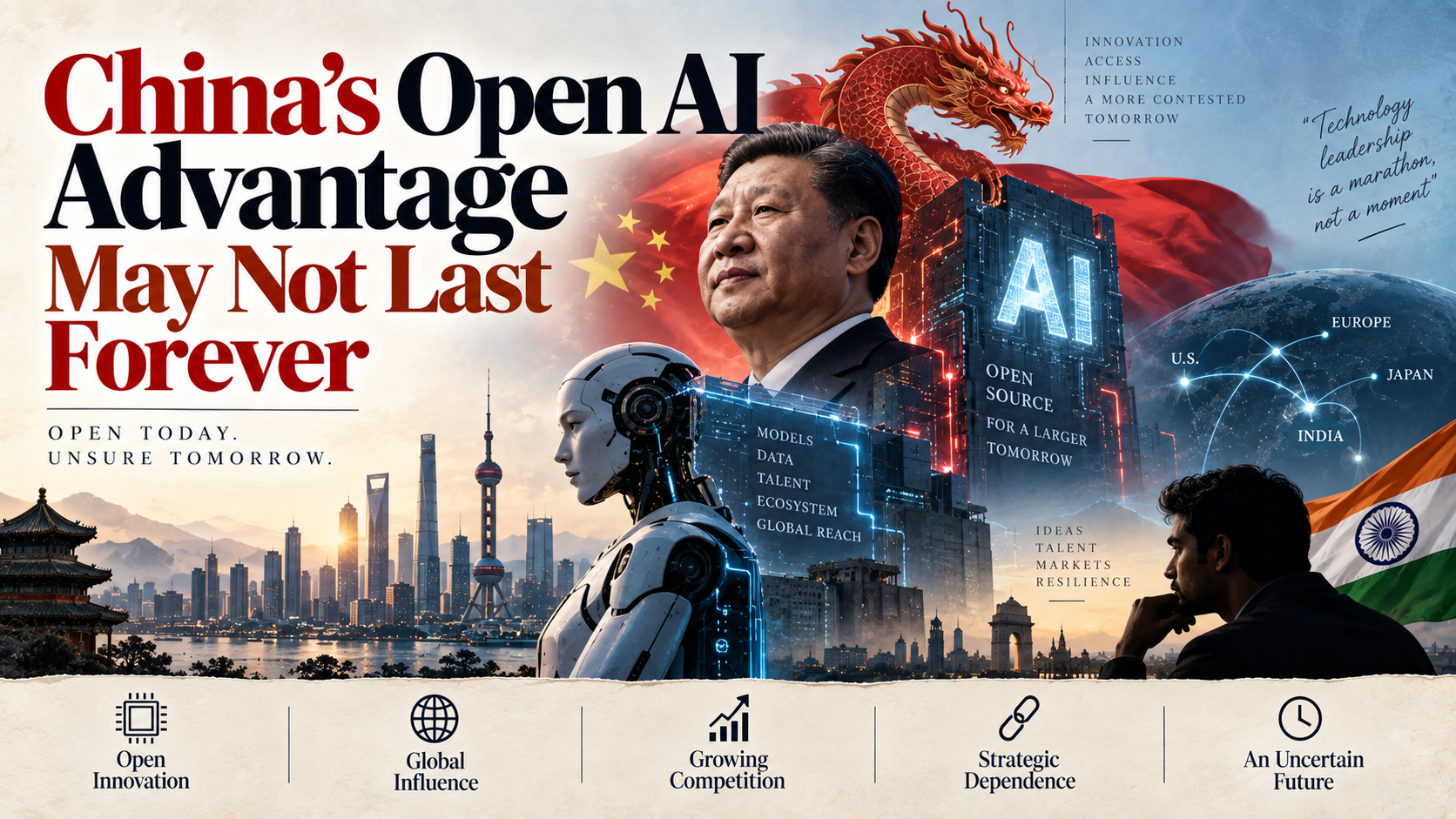
  • China’s open AI advantage may not last forever

    China’s open AI advantage may not last forever

    Why in the News

    Indian startups are rebuilding their products on Chinese open weight foundation models, with Qwen, DeepSeek and Kimi delivering large cost savings and lagging the American frontier by about six months. Reporting from July 2026 records Indian companies increasingly switching to Chinese large language models (LLMs) to contain Artificial Intelligence (AI) costs, with startups cutting costs by an order of magnitude. This open weight release is neither charity nor a workaround for chip export controls, and rests on five reinforcing logics that make the strategy durable. The tension is that durable is not permanent, and the assessment set out here is that China will begin graduating access to its frontier open weight models around late 2028.

    What is an open weight model?

    1. What is released: The trained parameters of the model are published, so anyone can download the model and run it on their own hardware.
    2. How it differs from an interface: A proprietary model is reached through an interface the provider controls, and the provider can price it, restrict it or withdraw it. A downloaded model keeps working whatever the provider later decides.
    3. What it enables: The holder can fine tune the model on its own data and modify its behaviour, which a provider controlled interface does not permit.
    4. Why the distinction is strategic: The choice between the two forms decides whether capability sits with the user or with the supplier.

    How far have Indian firms moved onto Chinese models?

    1. Products rebuilt on Chinese foundations: Indian startups are constructing their products on Qwen, DeepSeek and Kimi rather than on American frontier models.
    2. Performance is close enough: These models run almost as well as the American frontier and trail it by roughly six months, which is within tolerance for most commercial applications.
    3. The cost difference is not marginal: One venture investor cited startups cutting costs by an order of magnitude, which changes what is affordable rather than trimming a bill.
    4. The switch is deliberate: The stated reason for the move is cost containment rather than any assessment of capability.

    What are the five logics behind China’s open weight strategy?

    1. Cost: DeepSeek trained its R1 model for $294,000, a fraction of what American frontier laboratories incur, with distillation from American models and architectural efficiency breakthroughs compressing research spending.
    2. Prestige: DeepSeek’s January 2025 release wiped roughly a trillion dollars off American technology stocks, and open weighting has since been converted into diplomacy through the 29 country World Artificial Intelligence Cooperation Organization (WAICO) bloc and 5,000 training slots offered to developing countries.
    3. Commoditisation: American laboratories monetise proprietary weights, so free models good enough for most commercial work attack their pricing power. Chinese firms need not beat the competing product, only destroy the ability to charge for it.
    4. Capital: Financial repression traps household savings in state banks that lend cheaply to strategic sectors, producing the same subsidisation and overcapacity that flattened the global solar and electric vehicle markets. In AI it produced 820 LLMs registered with China’s cyberspace authority by early 2026.
    5. Infrastructure: Free models drive adoption, which drives demand for the complementary products China dominates in energy, cloud and physical infrastructure. Alibaba’s cloud revenue grew 34 percent year on year while it gave Qwen away.

    What conditions would make Beijing close the gates?

    1. The consultation is already under way: Chinese regulators led by the Ministry of Commerce have been consulting Alibaba, Bytedance and Zhipu on limiting the transfer of training data abroad and on whether foreign users should continue to freely download model weights.
    2. Consolidation: Beijing can coordinate five firms and cannot coordinate 800, and the state news agency has announced the shift from the “Hundred Model War” to the “Top Five Basic Models”. American export controls, by raising costs for Chinese laboratories, are accelerating the very consolidation that makes restriction feasible.
    3. Lock in: Restricting access before global developers are deeply embedded in the Chinese cloud stack would send them elsewhere and break the flywheel. That threshold is currently far from being reached.
    4. Saturation: Once the pricing power of frontier American laboratories is sufficiently commoditised, and open weight releases from Meta, Mistral, Nvidia and others sustain the pressure independently, further Chinese releases buy nothing. The gap here is narrowing and still exists.

    What would graduated restriction actually look like?

    1. Not a switch: The likely outcome is a set of graduated pathways rather than a single closure, appearing from around late 2028.
    2. Embargoed weights: Frontier models served through an interface first, with the weights released only after a six month embargo.
    3. Licensing above a capability threshold: Commercial licensing required beyond a stated capability level, with smaller distilled models left free as the entry route.
    4. Scaffolding withheld: Model weights released openly while tool use and agentic scaffolding, which is what turns a model into a working system, are held back.
    5. Preferential access: Members of the WAICO bloc receiving access on better terms than non members, which converts model access into a membership benefit.

    What should India do with the open window?

    1. Price in the switching costs: The open ecosystem should be used on the assumption that access terms will change, so the cost of moving between stacks is budgeted now rather than discovered later.
    2. Model agnostic architecture in the public sector: Government departments and regulated sectors should be built on abstraction layers and harnesses that work across stacks, so a change of supplier becomes a configuration change.
    3. A routing layer instead of hardware subsidies: The Ministry of Electronics and Information Technology (MeitY) should consider running a public sector routing service across models, in place of offering compute subsidies on slices of graphics processing units.
    4. Atmashakti rather than self sufficiency: Effort should concentrate where India can actually win, in applications, industrial and language data, edge inference silicon design and domain specific fine tuning. This is self strength built in a few selected segments, in place of full self sufficiency that India cannot afford and does not need.
    5. Use the window diplomatically: India should shape open weight norms in multilateral forums while the commons is still open and Beijing still needs legitimacy for it.

    Challenges to India’s reliance on open weight models

    1. Dependence is being built into production systems: Cost driven adoption embeds a foreign model in products that cannot be rewritten quickly when terms change. Eg. Startups rebuilding their core products on a single model family carry the switching cost inside their architecture.
      The Fix: Require an abstraction layer in any publicly funded AI deployment, so the model can be swapped without rebuilding the application.
    2. Diffusion is mistaken for capability: Rapid adoption of adequate models raises productivity and builds no domestic ability to produce the next model. Eg. Most Indian AI activity sits in applications rather than at the frontier.
      The Fix: Tie public procurement preference to firms that contribute datasets, evaluations or fine tuned models back into a shared national repository.
    3. Language and data coverage is thin: A model trained elsewhere performs worse on Indian languages and on Indian administrative data, which is where public sector value lies. Eg. Low resource Indian languages remain weakly represented in the training corpora of major open models.
      The Fix: Treat curated Indian language and sectoral datasets as the national asset to fund, since a data advantage survives a change of model supplier.
    4. Compute access is governed elsewhere: The hardware needed to fine tune or serve a large model at scale is subject to export controls set by other governments. Eg. Advanced processor supply to India and to China is determined by controls neither country sets.
      The Fix: Prioritise edge inference silicon design, where India can build a position that does not depend on access to frontier training hardware.
    5. Security review of downloaded models is weak: An openly released model can carry behaviour that surfaces only under specific conditions, and there is no standing capability to test for it. Eg. Backdoor behaviour triggered by particular inputs has been demonstrated in publicly released models.
      The Fix: Mandate evaluation of any model used in a regulated sector against a published test suite before deployment.

    Conclusion

    The open models now cutting Indian costs are being given away because a strategic competition is currently being fought that way, and that is the fact to plan against rather than the saving to celebrate. India can take the cost advantage and still owe itself an architecture that survives the moment the giving stops. The marker to watch is the Chinese consultation on foreign downloads of model weights, since a decision there arrives well before any formal restriction does.

    Government Initiatives for Artificial Intelligence in India

    1. IndiaAI Mission: Approved in 2024 with an outlay of Rs 10,371 crore and implemented by IndiaAI under MeitY, it builds compute, datasets, skills and startup financing as a single ecosystem programme.
    2. IndiaAI Compute: A national AI compute grid of over 38,000 graphics processing units, offering eligible users up to 40 percent lower compute costs.
    3. AIKosh: A national repository of non personal datasets and models, carrying thousands of datasets across sectors including agriculture, health, climate and governance.
    4. IndiaAI Safety Institute: The national trust framework within the mission, covering bias mitigation, privacy, explainability and AI governance.
    5. India AI Impact Summit 2026: Hosted by India under the mission, it repositions the global discussion from AI safety towards AI for development and convenes Global South participation.

    Matching Previous Year Question

    [2023] “Introduce the concept of Artificial Intelligence (AI). How does AI help clinical diagnosis? Do you perceive any threat to privacy of the individual in the use of AI in healthcare?”

  • After BRICS, it’s time to navigate the realities of great power rivalries

    Why in the News

    China now accounts for roughly three fifths of the combined Gross Domestic Product of the eleven member BRICS grouping, against less than half of the four member BRIC forum’s output when it was formed in 2006. The United States has moved the same way inside the G7, from less than two fifths of that group’s nominal output three decades ago to close to three fifths now. The BRICS summit in New Delhi closed with multipolarity as its stated theme, and the Chinese President travels to Washington next week for a second meeting with the US President this year. The tension is between a declared multipolar order and a measured concentration of economic weight in two states.

    What do a G2 and a G3 order describe?

    1. G2: It describes a world order managed in effect by the United States and China, on the ground that they are the only two states with the scale to shape economic order, technology standards and supply chains.
    2. G3: It describes the same arrangement with Russia admitted as a third manager, on the strength of its military power and its reach across Eurasia rather than its economic size.
    3. Neither is an institution: Both are descriptions of where decisions are actually taken. Neither has a charter, a secretariat or a membership list.
    4. Agreement is not implied: A G2 does not mean the two agree. It means their disagreements set the terms everyone else operates under.

    Why has economic weight concentrated inside BRICS and the G7?

    1. Enlargement did not dilute: BRICS grew from four members to eleven, and China’s share of the group’s output rose across the same period rather than falling.
    2. Beijing outgrows its own grouping: China continues to gain in economic size and geopolitical influence faster than the forum it sits in.
    3. What widened the G7 gap: Japan’s stagnation, Europe’s weaker growth and its demographic pressures, together with American advantages in energy, capital markets and artificial intelligence, account for the shift.
    4. Preponderance underwrites alliance behaviour: American willingness to turn harshly on its closest partners rests in part on that expanding economic weight. Eg. Pressure applied to Canada and Britain, and to the North Atlantic Treaty Organization (NATO) and the European Union (EU).

    Why must Washington and Beijing manage the rivalry, and where does Russia fit?

    1. Mutual dependence: Each seeks to reduce its vulnerability to the other, and neither can readily escape the other’s market, technology, capital or industrial capacity.
    2. No condominium: The disputes over trade, technology and Taiwan are too deep for the two to divide the world between them.
    3. Management rather than settlement: The meetings rest on a recognition that the rivalry has to be handled through sustained high level contact.
    4. The calendar of contact: A Washington meeting next week is expected to be followed by another on the margins of the Asia Pacific Economic Cooperation (APEC) summit in Shenzhen, and the United States hosts the annual G20 summit in Miami in December.
    5. Russia’s residual weight: Russia is economically diminished and still holds enough military power, geographical reach and diplomatic weight to influence the balance between the two across Eurasia.
    6. Moscow’s alignment: Moscow has drawn Beijing closer than ever before, while Washington has made an overture to Russia.
    7. What would produce a G3: Progress in the American peace initiative on Ukraine could open a rapprochement with Moscow, a trilateral summit and a Russian presence at the G20. The conflict between Moscow and Europe over Ukraine is what complicates it.

    What does the concentration do to the G20?

    1. Its distinguishing membership: Unlike the G7 it includes China, Russia, India, Brazil, Indonesia, Saudi Arabia and South Africa. Unlike BRICS it includes the United States, Europe and Japan.
    2. Why that composition mattered: That mix is what made the G20 the one forum plausibly capable of collective action on the global economy.
    3. The failure this month: Differences between the United States and China at the G20 finance ministers’ meeting in Washington prevented the forum from issuing a joint statement.
    4. The point of objection: China objected to the language on trade surpluses and export led growth.
    5. The second way it loses: Bilateral deal making between Washington and Beijing can come at the expense of the other members, so the forum is diminished whether the two disagree or agree.

    What does this mean for India’s multipolarity claim?

    1. The stated preference: A multipolar order is Delhi’s declared objective, and the Delhi summit was organised around that theme.
    2. The measured position: Multipolarity has not arrived, and the distribution of power is arguably moving away from it rather than towards it.
    3. What the forums actually do: APEC, BRICS, the EU, the G7 and NATO do not shape world order. They operate within parameters set by great power politics.
    4. Where a summit still earns its cost: Collective progress at these annual gatherings is rare, and their value lies in the bilateral meetings held on their margins. Eg. The attempted reset of India China relations by the Indian Prime Minister and the Chinese President at the Delhi summit.
    5. The task that follows: Indian foreign policy has to work the rivalry between Washington, Beijing and Moscow as it stands, rather than the order it would prefer.

    Challenges to BRICS as a vehicle for multipolarity

    1. One member carries most of the group’s weight: A grouping in which a single economy supplies the bulk of the output cannot easily adopt positions that constrain that economy. Eg. The New Development Bank still raises and lends predominantly in United States dollars, which limits how far it reduces members’ dependence on the dollar system.
      The Fix: Cap any single member’s share of the capital of BRICS institutions, so financial weight does not convert directly into agenda control.
    2. No mechanism for the members’ own disputes: The grouping holds members with live bilateral disputes and has no standing machinery to address them. Eg. The India China boundary question was taken up on the margins of the Delhi summit rather than by the grouping itself.
      The Fix: Keep the collective agenda to functional cooperation where members already converge, and route bilateral disputes to dedicated bilateral channels.
    3. Enlargement thins the common interest: Each addition widens the range of national interests the text must accommodate, which makes the agreed language weaker. Eg. The grouping now holds states closely aligned with Washington on security alongside states in open confrontation with it.
      The Fix: Adopt a concentric design, with a core membership taking binding commitments and partner states joining specific projects.
    4. Declarations carry no implementation machinery: The grouping issues an annual declaration and has no permanent secretariat to carry it forward or to report on it. Eg. Its commitment on pathways for plurilateral initiatives at the WTO binds no member to any act.
      The Fix: Create a standing secretariat that publishes, before each summit, what the previous declaration’s commitments actually produced.
    5. Payment ambitions outrun financial capacity: Reducing dependence on the dollar requires deep local currency bond markets and open capital accounts, which most members do not have. Eg. Russian exporters accumulated rupee balances they could not readily deploy once bilateral trade was settled in national currencies.
      The Fix: Build settlement capacity around a payment messaging link and local currency clearing for trade pairs that are already close to balanced, rather than around a common currency.

    Conclusion

    The question is no longer whether the world is multipolar, but whether the forums India invests in can act at all when the two largest economies disagree. On present evidence they cannot, and the decisions that matter are taken in bilateral rooms India does not sit in. That leaves an unresolved gap between the order Delhi argues for and the order it has to operate inside. The thing to watch is whether a trilateral meeting convenes on the margins of the APEC summit, since that format would confirm that the management of world order has moved outside the multilateral bodies.

    Back2Basics: G7

    1. Nature: It is an informal grouping of advanced economies that coordinates on economic and security policy, with no treaty basis and no permanent secretariat.
    2. Membership: Canada, France, Germany, Italy, Japan, the United Kingdom and the United States, with the European Union taking part in its meetings.
    3. Origin: It began as a finance ministers’ grouping in the 1970s and became an annual leaders’ summit, with the presidency rotating each year.
    4. Russia’s place: Russia joined to make it the G8 in 1997 and was suspended in 2014 after the annexation of Crimea.

    Matching Previous Year Question

    ““BRICS acts as a powerful counterweight in global governance, actively amplifying the voice and influence of the Global South.” Explain the role of BRICS in projecting itself as an alternative to other groupings.”

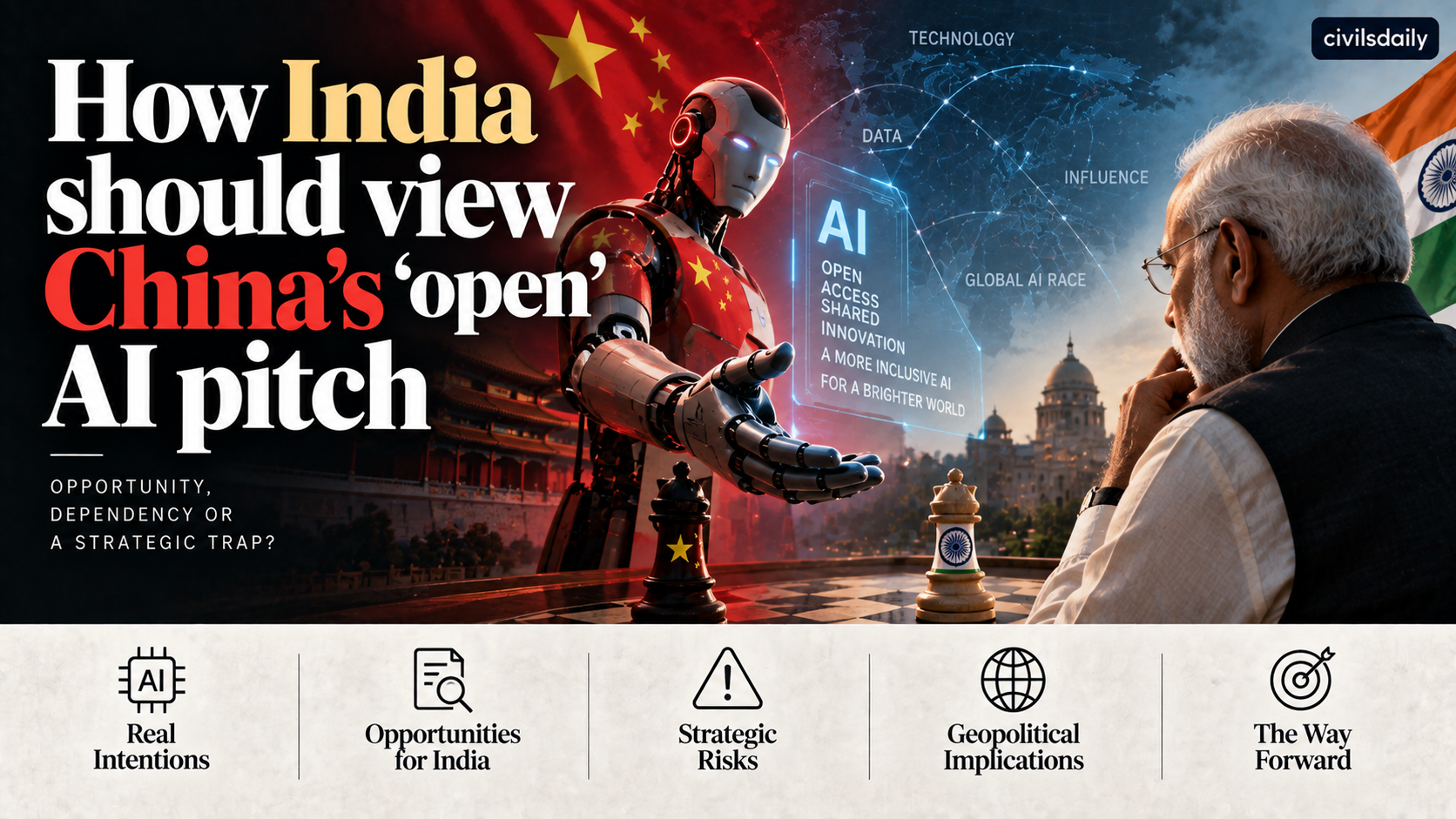
  • How India should view China’s ‘open’ AI pitch

    How India should view China’s ‘open’ AI pitch

    Why in the News

    China has offered to lead the creation of a BRICS open source artificial intelligence (AI) community, along with a BRICS digital ecosystem cloud platform, support for cooperation on large language models and a programme of AI training. The offer was made by the Chinese President at the BRICS Summit in New Delhi. The New Delhi Declaration issued after the summit mentions neither the community nor the cloud platform, and commits members instead to broader cooperation on improving access to AI resources. The pitch positions Chinese AI technology as an alternative to proprietary systems controlled largely by companies in the United States. For India the question is whether a grouping wide platform led by Beijing widens access to AI for developing countries or routes that access through a single supplier.

    What is the proposed BRICS AI open source community?

    1. China in the lead: China would take the lead in setting up the community.
    2. Model cooperation: It would support cooperation among members on developing and deploying large language models (LLMs), systems trained on very large text collections to generate and interpret language.
    3. Training and seminars: It would run specialised AI seminars and training courses, described as building an open AI ecosystem.
    4. Cloud platform and adjacent areas: A BRICS digital ecosystem cloud platform was proposed alongside it, with expanded cooperation on digital skills, technology exchanges and intelligent manufacturing.

    Why is China making this pitch to developing countries now?

    1. An alternative to proprietary systems: The initiative widens Beijing’s effort to position its AI technology against systems controlled largely by companies in the United States.
    2. Commitments already made: At the World Artificial Intelligence Conference in Shanghai in July, 5,000 AI training and seminar opportunities for developing countries over five years were announced.
    3. Cooperation centres: AI application cooperation centres were proposed with groupings including BRICS, ASEAN and the African Union.
    4. A contest for the Global South: Both India and China aspire to be the leading voice of the Global South, and Beijing holds a clear edge in AI capabilities.

    What is open source artificial intelligence?

    1. Open weights and code: A model released under a licence that lets others run, modify and redistribute it.
    2. Contrast with a proprietary system: A proprietary model’s weights stay with the vendor and are reached only through an interface the vendor controls and prices.
    3. Why it bears on access: A released model can be run on a user’s own hardware, which removes the need to buy access from the developer for every use.
    4. Limits of the label: Openness of weights does not always extend to the training data or to the terms on which the model may be used commercially.

    Why was the proposal not adopted by the grouping?

    1. The declaration is silent: The New Delhi Declaration does not mention the proposed open source community or the cloud platform.
    2. What it commits to instead: Members are committed more broadly to cooperation on improving access to AI resources, with a focus on safety, security, reliability and inclusiveness.
    3. Existing text carried forward: The declaration refers to an earlier BRICS statement on global AI governance and records that members will continue cooperation in the area.
    4. The proposal can return: China takes over the BRICS chairship in 2027 and could place the proposals before the grouping again.

    What is India’s own position on access to AI?

    1. The access demand: At the AI Impact Summit earlier this year India pushed for broader access to compute, datasets, models and other AI infrastructure, particularly for developing countries.
    2. Domestic capacity: The IndiaAI Mission funds subsidised compute infrastructure and supports Indian foundation models and datasets.
    3. The two run alongside each other: Any eventual BRICS programme on models or cloud infrastructure would sit next to India’s own effort to expand access without relying entirely on foreign providers.

    Challenges to a BRICS platform for open source AI

    1. Compute is the binding constraint, not model access: Releasing model weights does not give a developing country the accelerators or the electricity to train or serve them at scale. Eg. Advanced AI accelerators are subject to United States export controls that reach third countries.
      The Fix: Pair any model sharing commitment with pooled access to compute capacity physically located in member countries.
    2. Dependence on one member’s technology stack: A cloud platform built and operated by a single member leaves participants dependent on that member’s chips, software and terms of service. Eg. Huawei’s Ascend accelerators and their accompanying software stack underpin much of China’s domestic AI infrastructure.
      The Fix: Require any BRICS platform to expose hardware neutral interfaces, so a workload can be moved to another member’s infrastructure.
    3. Divergent data governance among members: Members differ on cross border data transfer and on state access to data, which blocks a shared dataset pool. Eg. India’s Digital Personal Data Protection Act, 2023 sets its own regime for transfers outside the country.
      The Fix: Begin with model and training cooperation and leave datasets to bilateral arrangements until a common transfer standard exists.
    4. Language and content coverage: A model released by any one member carries that member’s language priorities, so coverage of other members’ languages stays thin. Eg. Indian language performance in globally released models lags their performance in English.
      The Fix: Make a language corpus contribution from each member a condition of participation in the community.
    5. Safety obligations left unattached to release: An open release removes the developer’s ability to withdraw a model later found unsafe, because copies already exist. Eg. Once weights are downloaded and mirrored, a subsequent restriction cannot reach the copies in circulation.
      The Fix: Attach an evaluation and disclosure requirement at the point of release rather than relying on a recall mechanism afterwards.

    Conclusion

    Access to AI is being contested as a question of who supplies it, not of whether it should be shared. An offer to open the models while owning the platform beneath them widens use without widening capability, and that is the distinction India has to hold on to. What to watch is whether the grouping’s next chair converts the access language already agreed into a commitment on compute, or leaves it as a statement of intent.

    Back2Basics: IndiaAI Mission

    1. A national mission under the Ministry of Electronics and Information Technology, approved in 2024.
    2. Built around seven pillars, including IndiaAI Compute Capacity, the IndiaAI Innovation Centre and the IndiaAI Datasets Platform.
    3. Its compute pillar subsidises access to graphics processing units for startups, researchers and public institutions.
    4. Its remaining pillars cover application development, skilling, startup financing and safe and trusted AI.

    Matching Previous Year Question

    “[2026, GS2, 10 marks] “BRICS acts as a powerful counterweight in global governance, actively amplifying the voice and influence of the Global South.” Explain the role of BRICS in projecting itself as an alternative to other groupings.”

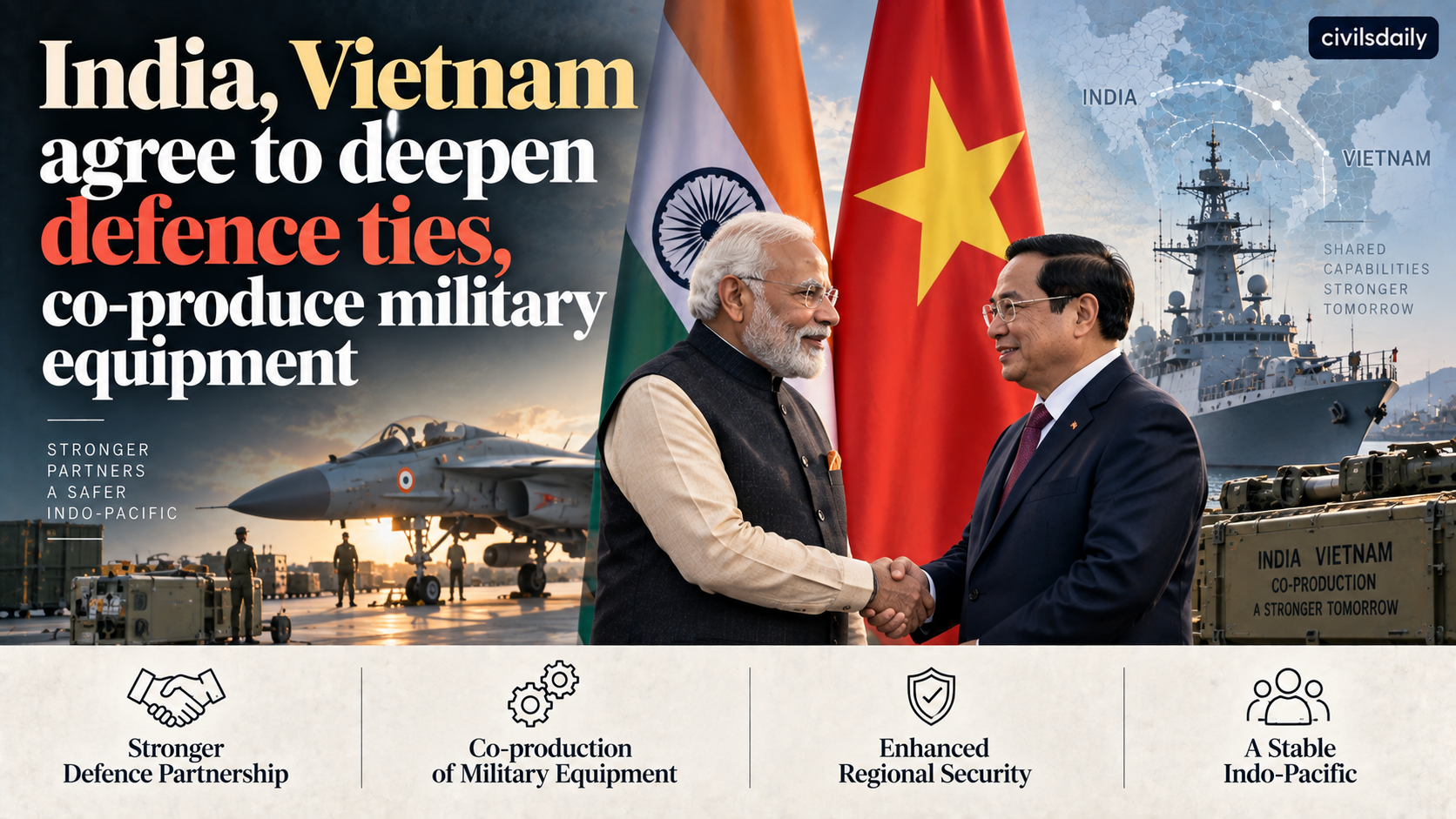
  • India, Vietnam agree to deepen defence ties, co-produce military equipment

    India, Vietnam agree to deepen defence ties, co-produce military equipment

    Why in the News

    India and Vietnam have agreed to deepen defence and security cooperation, including through joint production of Indian defence items. The agreement came out of the 19th India Vietnam Joint Commission Meeting on trade, economic, scientific and technological cooperation, chaired jointly by the two foreign ministers in New Delhi. The Joint Commission met for the first time in three years, and it met after the relationship had been raised to an Enhanced Comprehensive Strategic Partnership during the State Visit from Vietnam in May 2026. India’s defence supply to Vietnam has so far run through gifted platforms and lines of credit. Joint production changes what the relationship is, from the transfer of equipment to a stake in Vietnam’s own defence industry, in a region where China’s assertive behaviour in the Indo Pacific is the shared concern.

    What is the India Vietnam Enhanced Comprehensive Strategic Partnership?

    1. The tier: The highest level at which India holds bilateral ties with Vietnam, reached during the State Visit of Vietnam’s General Secretary and President in May 2026.
    2. A regional first: Vietnam is the first country in the region with which India has bilateral ties at that level.
    3. Defence as a central pillar: Defence and security cooperation sits among the central pillars of the partnership.
    4. The review mechanism: The Joint Commission Meeting on trade, economic, scientific and technological cooperation is where the full spectrum of the partnership is reviewed by the two foreign ministers.

    How has India’s defence supply to Vietnam been built so far?

    1. A gifted platform: India gifted the indigenously built missile corvette INS Kirpan to Vietnam in July 2023.
    2. Credit financed boats: Twelve high speed guard boats built by Larsen & Toubro were handed over in June 2022, under a bilateral line of credit of USD 100 million.
    3. Further lines of credit: Two more lines of credit, of USD 120 million and USD 180 million, were signed between the Exim Bank of India and Vietnam’s Finance Ministry in July 2024 and are being executed now.
    4. Beyond equipment: Engagement has diversified into wider military to military dialogue, capacity building and training across all arms of the forces.

    What did the two sides identify beyond defence?

    1. Trade and supply chains: Expanding trade, investments and mutually beneficial supply chains.
    2. Market access: Access for Indian marine and agricultural products and pharmaceuticals.
    3. Connectivity: Financial, port and air connectivity between the two countries.
    4. New sectors: Opportunities in nuclear energy and the space sector.
    5. Standards and heritage: Cooperation on standards for seafarers, and on heritage conservation.
    6. People to people ties: Capacity building and people to people ties, with the growing popularity of yoga in Vietnam noted. Next year will be observed as the Year of India Vietnam Friendship, marking 55 years of diplomatic ties.

    Where does Vietnam sit in India’s regional frameworks?

    1. Act East Policy: Vietnam is a key pillar of India’s Act East Policy, a relationship rooted in deep civilisational linkages.
    2. Vision MAHASAGAR: Vietnam is a key partner in Vision MAHASAGAR, meaning Mutual and Holistic Advancement for Security and Growth Across Regions, which is India’s stated outlook for the Indo Pacific.
    3. The ASEAN track: Vietnam is an important partner within India’s Comprehensive Strategic Partnership with the Association of Southeast Asian Nations (ASEAN).
    4. Maritime cooperation: Vietnam’s engagement under India’s Indo Pacific Oceans Initiative (IPOI) was welcomed at the meeting.
    5. The strategic backdrop: The deepening of defence ties was framed against China’s assertive behaviour in the Indo Pacific region.

    Challenges to India Vietnam defence joint production

    1. A Russian origin inventory: Vietnam’s forces run largely on Russian platforms, which limits what Indian systems can be integrated into without redesign. Eg. Vietnam’s Kilo class submarines and Su 30 combat aircraft are of Russian origin.
      The Fix: Concentrate joint production on segments where Indian industry already services Russian origin fleets, such as spares, sensors and patrol craft.
    2. Vietnam’s balancing with China: Vietnam manages an economic relationship with China that constrains how visible its defence alignment can be. Eg. China remains Vietnam’s largest trading partner.
      The Fix: Keep the programme industrial and commercial in framing, delivered through shipyards and licensed production rather than through basing or joint patrols.
    3. Slow conversion of credit into deliveries: Indian lines of credit take years to become contracted orders, because procurement approvals and yard capacity lag the signing. Eg. The defence line of credit of USD 500 million extended to Vietnam in 2016 took years to translate into orders.
      The Fix: Attach dated milestones and a named executing yard to each tranche of an existing line of credit.
    4. Competition on terms, not goodwill: Vietnam has diversified its arms procurement toward suppliers offering technology transfer, so India bids against others on commercial terms. Eg. Israeli suppliers have provided Vietnam with air defence systems and small arms production lines.
      The Fix: Build transfer of technology and local content commitments into the joint production package instead of offering finished units.

    Conclusion

    The relationship has moved past the stage at which India’s contribution can be counted in platforms handed over. Joint production asks India to be a supplier that stays, through spares, training and yard capacity inside Vietnam. The marker to watch is whether the two sides name a first item and a manufacturer, rather than announcing a further round of credit.

    Back2Basics: Indo Pacific Oceans Initiative

    1. Announced by India at the East Asia Summit in Bangkok in November 2019.
    2. An open, non treaty based arrangement for cooperation on maritime security and the sustainable use of ocean resources.
    3. Organised around seven pillars, including maritime security, maritime ecology, maritime resources, disaster risk reduction and management, and trade connectivity and maritime transport.
    4. Individual pillars are led by partner countries rather than directed by a central secretariat.

    Matching Previous Year Question

    “[2020, GS2, 15 marks] What is the significance of Indo-US defence deals over Indo-Russian defence deals? Discuss with reference to stability in the Indo-Pacific region.”

  • BRICS backs an Expert Group on Traditional Medicine [Examples]

    Why in News

    BRICS members agreed to support an Expert Working Group on Traditional Medicine and called for cooperation grounded in evidence. AYUSH stands for Ayurveda, Yoga and Naturopathy, Unani, Siddha and Homoeopathy, the traditional and complementary systems of medicine promoted by the Ministry of AYUSH.

    Core facts

    The outcome advances a standing BRICS track on Traditional, Complementary and Integrative Medicine (TCIM). The proposed expert group aims to build a shared, evidence based approach to traditional medicine across member states. The nodal ministry on the Indian side is the Ministry of AYUSH.

    Static Context

    India hosts the World Health Organization (WHO) Global Traditional Medicine Centre at Jamnagar, Gujarat, established under a host country agreement with the WHO. The Ministry of AYUSH signed a project collaboration agreement with the WHO on traditional and complementary medicine. Traditional medicine cooperation is a recurring instrument of India’s health diplomacy within plurilateral groupings.

    Prelims angle

    Remember the full form of AYUSH, the location of the WHO Global Traditional Medicine Centre at Jamnagar, and that BRICS runs sectoral working groups beyond trade and finance.

    Mains angle

    GS2, groupings and India’s soft power. Useful as an illustration of how India uses sectoral cooperation within BRICS to project traditional knowledge systems and health diplomacy.

    Matching Previous Year Question

    “No direct PYQ traced in the provided files for traditional medicine cooperation. Closest tracked Microthemes are GroupingsXRegional (International Relations) for the BRICS dimension and SchemeXHealth (Governance) for the health systems dimension.”

    PIB Link

    https://www.pib.gov.in/PressReleasePage.aspx?PRID=2309695&reg=3&lang=1

  • 18th BRICS Summit concludes in New Delhi with the New Delhi Declaration

    Why in News

    The 18th BRICS Summit was held in New Delhi on 12 and 13 September 2026 under India’s BRICS Chairship. The grouping adopted the New Delhi Declaration on 12 September 2026.

    Core facts

    BRICS is a plurilateral grouping originally of Brazil, Russia, India, China and South Africa, now expanded to 11 members. India’s presidency theme is “Building for Resilience, Innovation, Cooperation and Sustainability”. The PIB Backgrounder records the bloc’s weight as 49.5% of global population, 40% of global Gross Domestic Product (GDP) and 26% of global trade. Named institutional outcomes across ministerial tracks include a BRICS Centre of Excellence on Agro Ecology and a Digital Agriculture Network, a BRICS Mission for Healthy Lifestyle (2026 to 2029), BRICS CONNECT for Skilling, a Smart Grids and Energy Storage Digital Centre of Excellence, an MSME Cooperation Portal, a Startup Innovation Fund and a Logistics Supply Chain Cooperation Framework. Alongside the summit, the BRICS Bharat Innovates Exposition at Bharat Mandapam showcased 37 Indian deep technology startups.

    Static Context

    The first BRICS summit was held in 2009 at Yekaterinburg, Russia, as BRIC. South Africa joined in 2010, making it BRICS. The bloc runs the New Development Bank (NDB), headquartered in Shanghai, and the Contingent Reserve Arrangement (CRA), a currency swap facility for members facing balance of payments pressure. The 2014 Fortaleza Declaration established the NDB. India previously chaired the grouping in 2012, 2016 and 2021. Membership expansion has added Egypt, Ethiopia, Iran, Saudi Arabia, the United Arab Emirates and Indonesia in recent cycles, with a separate partner country category.

    Prelims angle

    Track the host city and chair of each recent summit, the members added in the latest expansion, the theme wording, and the two BRICS institutions (NDB and CRA) with their headquarters and functions. Fortaleza links to the NDB.

    Mains angle

    GS2, groupings involving or affecting India. Frame BRICS as a counterweight in global governance that amplifies the Global South, its role in multilateral reform, and the friction between expansion and cohesion. India’s bilateral engagements with African and Global South leaders on the summit sidelines illustrate the outreach dimension.

    Matching Previous Year Question

    “[2025] Consider the following statements with regard to BRICS:
    I. The 16th BRICS Summit was held under the Chairship of Russia in Kazan.
    II. Indonesia has become a full member of BRICS.
    III. The theme of the 16th BRICS Summit was Strengthening Multiculturalism for Just Global Development and Security.
    Which of the statements given above is/are correct?
    (a) I and II
    (b) II and III
    (c) I and III
    (d) I only
    Answer: (a)”

    “[2026, GS2, 10 marks] BRICS acts as a powerful counterweight in global governance, actively amplifying the voice and influence of the Global South. Explain the role of BRICS in projecting itself as an alternative to other groupings.”

    PIB Link

    https://www.pib.gov.in/PressReleasePage.aspx?PRID=2309642&reg=3&lang=1 and the BRICS PIB Backgrounder https://www.pib.gov.in/PressNoteDetails.aspx?NoteId=159946&ModuleId=3&reg=3&lang=1

  • Defence to space, trade to tech: India, Philippines to deepen ties

    Why in the News

    A year after New Delhi and Manila elevated their relationship to a strategic partnership, the Prime Minister and the President of the Philippines agreed to deepen cooperation across defence and security, trade and investment, space, railway infrastructure, fintech and education. The Philippines also decided to join the India led Coalition for Disaster Resilient Infrastructure (CDRI). The two leaders met on the sidelines of the 18th BRICS Summit in New Delhi. The Philippines President attended the Summit as the current chair of the Association of Southeast Asian Nations (ASEAN), which places the meeting inside India’s Act East policy and its Comprehensive Strategic Partnership with ASEAN. Both sides are driven by shared concerns over China’s territorial assertiveness in the Indo Pacific and the South China Sea, and the engagement is therefore being built on defence supply and maritime law at the same time as on trade and technology.

    What does the partnership now cover?

    1. The declared breadth of cooperation: The two sides agreed to deepen collaboration across defence and security, trade and investment, space, railway infrastructure, fintech, education, tourism, science and technology, innovation and people to people ties.
    2. The 2025-29 defence roadmap: India and the Philippines adopted a 2025-29 roadmap to expand military training, staff talks and maritime security cooperation in the Indo Pacific.
    3. Philippine accession to the CDRI: The Philippines has decided to join the CDRI, which brings a highly disaster exposed archipelago into a coalition India created.
    4. The ASEAN chairship as the regional frame: The visit’s significance rests on the Philippines holding the ASEAN chair while India runs a Comprehensive Strategic Partnership with the grouping.

    What anchors the defence relationship?

    1. The BrahMos supply deal of 2022: The 2022 deal to supply BrahMos supersonic cruise missiles to the Philippine Navy marked the major milestone in security ties.
    2. Tri service staff talks: Both countries hold regular staff talks for their Army, Navy and Air Force to improve joint security cooperation.
    3. The roadmap’s named focus areas: The roadmap’s focus is military training, staff talks and maritime security, which are the areas a supply relationship has to be converted into.

    Where does the economic relationship stand?

    1. Bilateral trade volume: Bilateral trade has grown past $3 billion.
    2. Drivers of the trade growth: The growth has been driven by Indian pharmaceutical exports, information technology services and agricultural cooperation.
    3. Space, railways and fintech as new areas: Space, railway infrastructure and fintech have been named as expansion areas, which are sectors with no existing trade base to build on.

    Why does the South China Sea frame the engagement?

    1. Shared assessment of Chinese assertiveness: Both sides are driven by shared concerns over China’s aggressive territorial assertiveness in the Indo Pacific and the South China Sea.
    2. India’s stated legal position: India has consistently supported a rules based maritime order in the South China Sea, based on international law and the United Nations Convention on the Law of the Sea (UNCLOS), the treaty that defines maritime zones and the rights of states within them.
    3. Value of the legal position to Manila: A legal position held by a large external power supports a claimant state that cannot match China’s naval weight on its own.

    Challenges to the India Philippines strategic partnership

    1. A defence supply relationship is narrow and slow to widen: One missile contract does not by itself create a standing industrial relationship, and follow on orders depend on the buyer’s budget cycle rather than on political intent. Eg. The BrahMos supply arrangement dates from 2022 and remains the single flagship item in the defence relationship.
      The Fix: Move from outright sale to a maintenance, repair and overhaul facility in the Philippines, so the relationship generates recurring work rather than a single delivery.
    2. Trade is small relative to both economies: A bilateral figure near $3 billion is a fraction of what either country trades with China, which limits the economic leverage either can bring. Eg. Indian pharmaceutical exports and information technology services carry most of the existing trade, and neither is a large employer in the Philippines.
      The Fix: Open negotiations on a preferential trade arrangement within the ASEAN framework, so tariff lines rather than announcements decide the growth rate.
    3. ASEAN itself does not hold a common line on the South China Sea: The grouping works by consensus, so a member with close economic ties to Beijing can block a collective position. Eg. The Code of Conduct negotiations between ASEAN and China have run since 2002 without a binding text.
      The Fix: Build the maritime agenda through bilateral and minilateral arrangements with individual claimant states, rather than waiting on a grouping wide position.
    4. Escalation risk sits in the same waters as the cooperation: Maritime security cooperation with a claimant state can be read by China as taking sides in a live dispute, which raises the cost of the relationship. Eg. Chinese and Philippine vessels have repeatedly come into contact around contested shoals in the South China Sea.
      The Fix: Frame cooperation as capacity building for coast guard and humanitarian response, so the activity is defensible in law and difficult to characterise as an alignment.
    5. Disaster exposure is a standing constraint on both economies: An archipelago that absorbs several typhoons a year loses infrastructure faster than it can add it, which limits the returns on any investment commitment. Eg. The Philippines is among the most disaster exposed countries in the world, which is why its accession to the CDRI matters.
      The Fix: Tie Indian infrastructure financing in the Philippines to resilience standards set through the CDRI, so the assets built survive the hazard they are built into.

    Conclusion

    The partnership is a year old and has moved from a single defence sale to a dated roadmap, a disaster resilience coalition and a list of new sectors. What it does not yet have is volume, since a trade relationship of about $3 billion and one missile contract cannot carry the strategic weight both sides describe. The measurable markers over the next year are whether the 2025-29 roadmap produces a second defence contract and whether India converts the Philippines’ ASEAN chairship into movement on the India ASEAN trade agreement review.

    Back2Basics: Coalition for Disaster Resilient Infrastructure

    1. Coalition membership and purpose: An international partnership of national governments, United Nations agencies, multilateral development banks, the private sector and academic institutions, working to make infrastructure systems resilient to disaster and climate risk.
    2. Launch at the 2019 United Nations Climate Action Summit: It was launched by India at the United Nations Climate Action Summit in September 2019.
    3. Secretariat location: Its secretariat is in New Delhi.
    4. The Infrastructure for Resilient Island States programme: Its flagship programme is the Infrastructure for Resilient Island States initiative, which supports small island developing states in building infrastructure that can withstand extreme events.

    Matching Previous Year Question

    “[2020, GS2, 15 marks] What is the significance of Indo-US defence deals over Indo-Russian defence deals? Discuss with reference to stability in the Indo-Pacific region.”