Mains Ready By December. Smash Mains & Smash PYQ Admissions Open

GS Paper: GS2-18.Bilateral, regional and global groupings and agreements involving India and/or affecting India’s interests.

  • PM Modi flags weaponisation of technology and critical minerals

    Why in the News

    Closing the 18th BRICS Summit in New Delhi, the Prime Minister warned that the weaponisation of technology and of access to critical minerals can hinder the grouping’s shared progress, and set against it a commitment to inclusivity in the adoption of technology. The summit ran under the theme “Resilience, cooperation and sustainability” and issued the New Delhi Declaration, and India used its chair position to launch a set of standing mechanisms covering disease surveillance, disaster data, logistics, startup finance, small enterprise linkage and clean energy. The stated framing was that as BRICS enters its third decade the world expects concrete results from it rather than “merely ideas and commitments”. The tension inside the summit is that the members diagnosing the same problem, an order that disadvantages them, arrived with different remedies, from India’s delivery mechanisms to Russia’s sanctions workarounds and China’s call to rally the Global South.

    What did India’s chair position argue?

    1. Weaponisation of technology and critical minerals: Technology and access to critical minerals can both be used as instruments of pressure, and that use obstructs the development of the grouping’s members.
    2. Inclusivity in technology adoption: Inclusivity in the adoption of technology was placed as the answer, meaning access on terms that do not depend on the supplier’s political posture.
    3. Rising number of global conflicts: The rising number of global conflicts has an increasingly negative and far reaching effect on the lives of ordinary people.
    4. Resilience as the organising idea: Pandemics, climate disasters and supply chain disruptions have all shown that no crisis stays confined to one region, so the work was framed around identifying challenges in time, being prepared and acting promptly.
    5. The delivery test for the third decade: Entering its third decade, BRICS is expected to produce concrete results rather than ideas and commitments.

    What new BRICS mechanisms were announced?

    1. BRICS Integrated Early Warning System: Agreed for the prevention of and response to infectious diseases.
    2. Early Warning Data Integration Guidelines: Prepared for disaster management across member states.
    3. BRICS Logistics Supply Chain Cooperation Framework: Intended to make member supply chains more reliable and resilient.
    4. BRICS Incubator Network and BRICS Startup Innovation Fund: The network connects startups and incubators across member states, and the fund has been proposed to back innovative and scalable solutions.
    5. BRICS Network on Digital Agriculture: Connects artificial intelligence, geospatial technology and Digital Public Infrastructure, meaning shared open digital platforms for identity, payments and data exchange, to the working needs of farmers.
    6. BRICS CONNECT: Aimed at skills, employability, women in the workforce, social security and capacity building.
    7. BRICS MSME Cooperation Portal: Set up to link small enterprises to knowledge, finance and new markets.
    8. BRICS Urban Mobility Hub: Established to share urban transport practices between member cities.
    9. BRICS Digital Centre of Excellence: Established for smart grids and energy storage under the sustainability pillar of India’s strategy for the grouping.
    10. Agriculture and climate centres: Centres of Excellence for Agro Ecology and Regenerative Agriculture were set up, alongside agreed principles for community based climate adaptation that treat indigenous knowledge as a foundation for climate action.

    What did the other members put on the table?

    1. China called for rallying the Global South: The Chinese President urged BRICS to rally the Global South so that an increasingly volatile international order is “free from double standards”, and stated that the logic of might makes right does not hold.
    2. The norms China named: Global South countries were asked to defend sovereign equality, non interference in internal affairs and the peaceful settlement of disputes, and to insist that international law applies to all.
    3. China’s five technology initiatives: An artificial intelligence open source community, an open ecosystem for artificial intelligence, a special economic zone partnership, a digital ecosystem cloud platform, and science and technology talent development.
    4. Russia proposed two instruments against sanctions: The Russian President proposed a BRICS insurance mechanism and a collaborative BRICS grain market, and noted the grouping has independent routes for moving capital, labour and technologies.
    5. The Western insurance bar on Russian crude: The G7, the European Union and the United Kingdom barred Western companies from insuring any ship carrying Russian crude unless the oil was bought at or below a specified price cap, which directly restricted Russian crude exports.
    6. The New Development Bank was cited as the working asset: The multilateral development bank established by BRICS is handling projects worth $140 billion.
    7. Iran pressed for national currency trade: The Iranian President argued that excessive dependence on existing financial and trade systems leaves emerging economies exposed to political shocks, backed expanded trade in national currencies and a strengthened New Development Bank, and said unilateral sanctions directly affect global food security.

    What did the New Delhi Declaration record?

    1. Historical racial injustice: The declaration took note of the racial injustice Africans have suffered historically.
    2. A new inequality instrument: It noted the Brazilian and South African plan to start an “international panel on inequality”.
    3. The historical frame invoked: It referred to decolonisation and to Asian African solidarity as displayed at the Bandung conference of 1955.
    4. The Gaza proceedings: It named the South Africa initiated legal process at the International Court of Justice against Israel over its military campaign in the Gaza Strip, recording that those proceedings reaffirmed Israel’s legal obligation to ensure the provision of humanitarian aid in Gaza.

    Challenges to BRICS as a delivery platform

    1. Announced mechanisms have no compliance machinery behind them: A framework, a portal or a network created by summit declaration binds no member and carries no penalty for non participation. Eg. Eleven separate initiatives were announced in one closing session, none attached to a dated implementation milestone.
      The Fix: Attach each mechanism to a named lead member, a secretariat line and an annual reporting obligation to the next summit, so progress is recorded rather than assumed.
    2. The membership no longer shares an economic interest: An expanded grouping now contains net oil exporters and net importers, and sanctioned and unsanctioned economies, so a single position on trade or energy is difficult to reach. Eg. Russia’s proposals at this summit were sanctions workarounds, while other members trade freely with the economies imposing them.
      The Fix: Move substantive work to plurilateral coalitions of the willing inside BRICS, so a mechanism is not held to the pace of its least interested member.
    3. Two members carry an unresolved bilateral dispute: India and China sit inside the same grouping while an unsettled boundary question and a wide trade imbalance run between them. Eg. India’s trade deficit with China reached a record $112.6 billion in 2025-26.
      The Fix: Keep the grouping’s agenda to functional cooperation where the two members’ interests already align, such as disease surveillance and logistics, rather than to security coordination.
    4. The de dollarisation agenda outruns the settlement infrastructure: Trade in national currencies requires convertibility, a clearing arrangement and an accepted reserve asset, and the grouping has none of the three at scale. Eg. Iran’s call for expanded national currency trade rests on the New Development Bank, which is capitalised in a fraction of the size of the trade flows involved.
      The Fix: Build a bilateral local currency settlement network with published reference rates before pursuing a common instrument, so the mechanism follows the trade rather than preceding it.
    5. A larger grouping dilutes decision making: Expansion has raised the grouping’s representational claim while lowering the odds of consensus on anything contested. Eg. The grouping now runs to eleven members with a widening set of partner countries attending its summits.
      The Fix: Adopt a variable geometry rule under which an initiative proceeds with a stated minimum number of members rather than requiring unanimity.
    6. Critical mineral security cannot be built by declaration: Processing capacity, not deposits, is the choke point, and it is concentrated outside most of the membership. Eg. The summit warned against the weaponisation of access to critical minerals without announcing any joint processing or stockpiling arrangement.
      The Fix: Create a joint BRICS strategic reserve and a shared processing investment vehicle for named minerals, so the warning is backed by capacity.

    Conclusion

    India’s chair year has ended with a set of standing mechanisms rather than a communique alone, which is the specific test the chair set for the grouping at the opening of its third decade. Those mechanisms are administrative rather than binding, and each one now needs a host institution, a budget line and a reporting schedule before it can be judged. The markers to watch are whether the proposed Startup Innovation Fund is capitalised and whether the Integrated Early Warning System is stood up with named national focal points before the next summit, since those two are the initiatives that require money and institutional commitment rather than agreement alone.

    Back2Basics: New Development Bank

    1. New Development Bank: A multilateral development bank established by the BRICS countries to finance infrastructure and sustainable development projects in member states and other emerging economies.
    2. Headquarters in Shanghai: Its headquarters is in Shanghai, and it operates regional offices in member countries.
    3. Equal shareholding among founders: Founding members hold equal shareholding, which distinguishes it from the weighted voting used by the Bretton Woods institutions.
    4. A project book of $140 billion: It is handling projects worth about $140 billion.

    Matching Previous Year Question

    “[2025] Consider the following statements with regard to BRICS: I. The 16th BRICS Summit was held under the Chairship of Russia in Kazan. II. Indonesia has become a full member of BRICS. III. The theme of the 16th BRICS Summit was Strengthening Multiculturalism for Just Global Development and Security. Which of the statements given above is/are correct? (a) I and II (b) II and III (c) I and III (d) I only ANSWER: (a)”

  • India gets 1.64 mt EU steel quota, imports of EU cars may rise 6-fold

    Why in the News

    The draft text of the India European Union (EU) Free Trade Agreement (FTA) gives India a country specific steel export quota of 1.64 million tonnes (mt) across 16 categories, including specialised items such as metallic coated sheets and stainless hot rolled quarto plates. The quota answers the tightening of EU steel entry through the Steel Overcapacity Regulation, which came into force on 1 July this year, and through the Carbon Border Adjustment Mechanism (CBAM), a levy that prices the carbon embedded in an imported good so that it carries the same carbon cost as an EU produced one. In exchange the EU has won a first year quota of 1,00,000 completely built up cars, close to six times what it currently ships to India. Only a part of India’s steel quota is actually reserved for India, while the automotive concession is the first of its kind India has given to a major economy after the United Kingdom.

    What is a Tariff Rate Quota?

    1. The instrument: A Tariff Rate Quota (TRQ) limits the quantity of a particular item that is eligible for a lower duty, so volume inside the quota enters cheap and volume beyond it pays the full tariff.
    2. Two components in India’s steel quota: The FTA component of 0.69 mt is reserved for India. The most favoured nation component of 0.95 mt is open to all partner countries.
    3. The assured component against the open component: Only the FTA component is assured, and India’s products must compete with other exporting countries for the remaining categories.

    How much steel market access has India actually secured?

    1. Breadth of the quota: The 1.64 mt covers 16 categories of steel, including specialised products such as metallic coated sheets and stainless hot rolled quarto plates.
    2. Value added lines are inside it: India has received quotas on several value added categories, which are the lines that carry a higher realisation per tonne.
    3. The assured share is small: The reserved FTA component is under half the headline quota, so the larger part of India’s access depends on outcompeting other suppliers for the same tonnage.
    4. The framing regulation: The TRQs follow the EU’s Steel Overcapacity Regulation, whose stated aim is to protect the EU steel industry against the effects of global overcapacity.

    What does the EU gain in India’s car market?

    1. A first year quota six times current trade: The EU has won a first year TRQ of 1,00,000 completely built up internal combustion and non plug in hybrid cars, against the 17,191 cars India imported from the EU in 2025.
    2. The ten year volume ramp: The quota rises to 1,60,000 cars by the 10th year of the agreement.
    3. A price floor protects the mass market: The concession applies only to cars priced above €15,000, and India has given no concession at all to cars below that price to protect Indian car manufacturers.
    4. The duty schedule for the mid segment: For cars priced between €15,000 and €35,000, the in quota duty falls from 110% to 35% in the first year and to 10% by the fifth year of the deal coming into effect.
    5. The duty schedule for the luxury segment: For cars priced above €35,000, tariffs decline from 66% to 30% in the first year and to 10% over the same period.
    6. A reserved luxury band: The quota is divided across three price bands, with 43,000 units reserved for cars priced above €50,000 from Year 5 onward.

    What does the separate electric vehicle schedule protect?

    1. Concessions begin later: Concessions on battery electric vehicles, plug in hybrids and cars using other technologies begin only in the fifth year of the agreement.
    2. A higher price floor applies: They apply only to vehicles priced at €20,000 or more, and electric and other eligible cars below that price get no concession.
    3. The volume ramp is slow: The completely built unit quota starts at 20,000 cars in the fifth year, rises to 50,000 in the tenth year and reaches 90,000 from the fourteenth year onwards.

    What must India do to use the steel quota?

    1. Move up the product ladder: Shifting toward higher value added steel products reduces the applicable CBAM tax burden and improves India’s competitive position in the EU market, per an Indian Council for Research on International Economic Relations (ICRIER) note.
    2. Pair the shift with industrial policy: The ICRIER note holds that this structural transition must be supported by industrial policies that integrate Production Linked Incentives with dedicated research and development funding.
    3. Carry the smallest firms through compliance: Targeted financial and technical assistance, including concessional financing, access to clean technology and investment guarantees, is treated as essential to ease the disproportionate compliance burden on Micro, Small and Medium Enterprises (MSMEs).

    What is the Carbon Border Adjustment Mechanism?

    1. The charge on embedded carbon: An importer of a covered good declares the greenhouse gas emissions released in producing it and surrenders certificates priced against the European Union’s own carbon market. The imported tonne therefore carries the same carbon cost as a tonne produced inside the EU.
    2. Covered goods: CBAM applies to emissions intensive goods traded in bulk, including iron and steel, aluminium, cement, fertilisers, electricity and hydrogen, which are the sectors where production is most easily relocated to a jurisdiction with no carbon price.
    3. Default values where data is absent: An exporter that cannot supply verified plant level emissions data is charged on a default value rather than on its actual emissions. Eg. A low emission Indian plant that does not document its emissions is charged as though it used the high emission route.
    4. Phasing: A transitional stage requires importers only to report embedded emissions, and the financial obligation attaches at the definitive stage, so the reporting burden arrives before the cost does.

    Challenges to the India EU Free Trade Agreement steel and auto package

    1. The quota covers well under half of existing trade: Most of what India already ships to the EU falls outside the country specific quota and meets the full tariff. Eg. India’s steel exports to the EU currently stand at 4 mt.
      The Fix: Concentrate the residual volume in categories where the per tonne realisation absorbs the out of quota duty, rather than treating the quota as the whole of the market.
    2. The out of quota wall is punitive: The Steel Overcapacity Regulation sets free of duty quotas at 18.3 mt overall with a 50% duty on out of quota imports, so exceeding the quota is close to a trade stop. Eg. The same regulation introduced a melt and pour regime that traces where steel was first cast, which narrows the scope for rerouting through third countries.
      The Fix: Seek an annual review clause that indexes the country specific quota to India’s realised shipments rather than fixing it at the level negotiated once.
    3. The carbon charge sits outside the quota: A tonne of steel that enters inside the quota still carries its CBAM liability, so tariff relief and carbon cost are two separate gates. Eg. CBAM prices embedded emissions per tonne, which penalises India’s coal based blast furnace and induction furnace routes regardless of quota access.
      The Fix: Build verified plant level emissions accounting into Indian steel exports so that lower carbon Indian output is recognised at the EU border instead of being charged on a default value.
    4. The automotive concession sets a precedent for other partners: The EU becomes the second major trade partner after the United Kingdom to secure automotive tariff concessions from India under an FTA. Eg. The Global Trade Research Initiative (GTRI) holds that these precedents could prompt other key trade partners such as Japan and South Korea to seek similar preferential market access and TRQs.
      The Fix: Fix a common automotive concession template across agreements, so each new negotiation starts from a stated ceiling rather than from the last deal signed.

    Conclusion

    The draft text is published rather than ratified, so the numbers in it are a negotiating position and not yet a schedule in force. What the package does settle is the shape of the bargain: India trades a widening opening of its passenger vehicle market for steel access that is only partly reserved and wholly separate from its carbon liability. The marker to watch is whether the reserved FTA component of the steel quota is enlarged in the final text, and whether India’s shipments move into the value added categories the quota already covers.

    Matching Previous Year Question

    “[2025, GS3, 10 marks] What are the challenges before the Indian economy when the world is moving away from free trade and multilateralism to protectionism and bilateralism? How can these challenges be met?”

  • [12th September 2026] The Hindu OpED: A bigger BRICS, shaped by India’s vision

    [12th September 2026] The Hindu OpED: A bigger BRICS, shaped by India’s vision

    Question (2023, GS2): “‘Virus of Conflict is affecting the functioning of the SCO’. In the light of the above statement point out the role of India in mitigating problems.
    Linkage: This question directly mirrors the central tension of the New Delhi BRICS summit: holding a common line and delivering technical outputs when key member states are at war or experiencing severe conflict. It highlights India’s strategic role as a mediator and consensus-builder in multilateral forums

    Mentor Comment

    India has used its chairship of BRICS to convert the grouping’s agenda into a set of named functional outputs, and the New Delhi summit on 12 and 13 September 2026 is where those outputs are placed before the leaders. The chairship ran around 350 meetings across Indian cities, 22 of them at ministerial level, following the template India used for the G-20 Summit it hosted in New Delhi in 2023. India reframed the acronym around “building resilience, innovation, cooperation and sustainability”, and the deliverables track that framing: centres of excellence, a logistics framework, an enterprise portal and a set of research repositories. The grouping now carries 11 members and about 10 partner countries, and its collective output measured at purchasing power parity, meaning output adjusted for differences in domestic price levels, exceeds that of the G-7. The tension in the summit lies between the two things it is being asked to do at once, settle a set of technical cooperation outputs, and hold a common line among members several of whom are at war.

    Pillars of BRICS cooperation

    1. Political and security: The first pillar covers the grouping’s positions on conflicts, security cooperation and global governance questions.
    2. Finance and the economy: The second pillar covers trade, payments, development finance and economic cooperation among members.
    3. Culture and people-to-people exchanges: The third pillar covers education, health, skilling and social cooperation between member societies.
    4. Where India’s chairship agenda sits: The agenda India pursued relates more to the second and third pillars than to the first, since the leaders themselves settle the large geopolitical questions.

    Why is the Delhi summit a landmark?

    1. The backdrop: It takes place against geopolitical turbulence produced by a combination of forces, ongoing wars and conflicts, a breakdown in global governance, and the changing nature of global alliances.
    2. The grouping’s weight: BRICS now has 11 prominent members and about 10 partner countries, and its collective economic output in purchasing power parity terms outstrips that of the G-7, making it one of the largest and most important transcontinental groupings outside the West.
    3. The technology contest: Technological forces such as artificial intelligence and quantum computing are being weaponised, with both great powers trying to win the battle for tech supremacy.

    How did India prepare for the chairship?

    1. The template: India followed the approach it had used for the 2023 G-20 Summit in New Delhi.
    2. The scale of the process: Around 350 meetings were conducted in cities across the country, with 22 held at the ministerial level.
    3. The stated focus: India announced that it would focus on “building resilience, innovation, cooperation and sustainability”, giving a new expansion to the BRICS acronym.
    4. The intent behind the framing: The reframing was used to refocus and recalibrate the BRICS agenda rather than to inherit the previous year’s priorities unchanged.

    What has the chairship delivered on resilience?

    1. A digital centre for grids and storage: The BRICS Digital Centre of Excellence for Smart Grids and Energy Storage was launched under India’s stewardship.
    2. A logistics framework: The BRICS Logistics Supply Chain Cooperation Framework was adopted.
    3. Centres on farming systems: Centres of Excellence on Agro-Ecology and Regenerative Agriculture were established.
    4. What they are expected to do: Once operationalised, these initiatives are intended to provide the ballast that would make member economies genuinely resilient.

    What is on the innovation agenda?

    1. Capital for new firms: A start-up innovation fund and an incubator network were proposed.
    2. A digital public infrastructure repository: Members would pool digital public infrastructure, meaning the shared digital systems for identity, payments and data exchange that public services run on.
    3. A science and research repository: A common repository for scientific and research material was proposed alongside it.
    4. A plan for large research facilities: The action plan of the BRICS Working Group on research infrastructures and mega science projects sits within this pillar.
    5. Why pooling matters here: Members are not all at the same level of development in scientific research, so shared facilities and repositories are worth more to some members than to others.

    What does the cooperation pillar carry?

    1. Trade rules: Leaders are expected to endorse recommendations on revitalising the multilateral trading system.
    2. Health: A network of centres of excellence on mental wellness is to be welcomed by the leaders.
    3. Cities: A BRICS urbanisation forum is to be established.
    4. Women and digital access: Enhancing the digital capacity of women forms part of the recommendations.
    5. Skills and small enterprise: Cooperation is to be intensified in education and youth skilling, and through the BRICS Micro, Small and Medium Enterprises (MSME) Cooperation Portal.

    What does the sustainability agenda add?

    1. It continues the previous chair’s priority: Sustainability was the centrepiece of Brazil’s agenda in the preceding year, and India built on that base rather than replacing it.
    2. Land and forests: Combating desertification, and guidelines for disaster management and forest-fire preparedness, are specific areas of cooperation under this head.
    3. Aviation fuel: A BRICS forum on sustainable aviation fuels forms part of the agenda.
    4. Adaptation rather than mitigation: Advancing climate resilience through people-centric and community-based adaptation is included, which matters because international fora tend to focus almost exclusively on mitigation.

    Can a functional agenda hold when summit level geopolitics pulls the other way?

    1. The two tracks belong to different pillars: The chairship’s outputs sit in the economic and people-to-people pillars, and the large geopolitical questions are settled by the leaders under the first.
    2. The functional track is the more predictable of the two: Substantive outcomes appear assured on the strength of the ministerial and working group meetings already chaired, independent of what the leaders’ session produces.
    3. The caveat on the grouping: BRICS has to avoid being caught in geopolitical currents that are not of its own making and carry no strategic value for its members.
    4. Why it survives the contradiction: The grouping is now too large to be either ignored or allowed to fail, which gives members an interest in a working agenda even where they diverge politically.
    5. What it is ultimately for: The grouping helps members enhance their strategic options and push geopolitics towards a multipolar order, both of which are organising principles of India’s foreign policy.

    Challenges to India’s BRICS chairship agenda

    1. The deliverables are institutions without budgets: A centre of excellence, a framework and a portal each need a host, staff and recurring funding, none of which a one year chairship can commit on the group’s behalf. Eg. The BRICS Vaccine Research and Development Centre, announced in 2020, functions as a virtual network of national institutions rather than a staffed facility.
      The Fix: Attach each new centre to a named host institution with a member funded budget line recorded in the summit declaration.
    2. Repositories hold only what members choose to deposit: A digital public infrastructure repository and a science repository depend on voluntary contribution, and members operate under differing national data and procurement rules. Eg. Members’ identity and payment systems sit under separate data laws, so specifications and code are not equally shareable.
      The Fix: Settle a common licence and a deposit obligation for contributed material before the repositories open.
    3. A declaration carries no review of the last one: Outcomes are recorded as commitments in a communique, and no member reports against them the following year. Eg. The Rio declaration of July 2025 ran to 126 points with no implementation review attached to it.
      The Fix: Require the incoming chair to publish an implementation report against the previous declaration alongside the new one.
    4. The enterprise agenda needs a payments channel that is not yet working: An MSME portal and a start-up fund assume a listed supplier in one member country can be paid from another without routing through third currency correspondent banking. Eg. The grouping’s own cross border payment initiative remains at pilot stage.
      The Fix: Sequence the portal behind a working local currency settlement arrangement for the member pairs that already trade at scale.

    Conclusion

    The chairship’s output is a set of centres, frameworks, repositories and portals, and their value is decided after the summit closes rather than in its declaration. What converts an announced centre into a working institution is a host, a staff and a recurring budget, and none of those is a summit level decision. The grouping’s own design works against this, since priorities reset annually with the rotating chair and nothing obliges the next one to carry a predecessor’s working groups forward. What to watch is whether the declaration names a host institution and a funding source for the new centres, and whether the chair that follows India adopts the research infrastructure action plan rather than substituting its own themes.

    About BRICS

    1. What it started as: The acronym was coined in 2001 by a Goldman Sachs economist to identify a set of high growth emerging economies, and it was an investment category before it was a forum.
    2. How it became a grouping: The first meeting of Foreign Ministers took place on the margins of the United Nations General Assembly in 2006, and the first formal Leaders’ Summit was held at Yekaterinburg in Russia in 2009.
    3. How it expanded: South Africa joined in 2011. The 2023 Johannesburg Summit opened membership further, with Egypt, Ethiopia, Iran and the United Arab Emirates joining in 2024 and Indonesia in 2025.
    4. The partner tier: A Partner Country category was introduced in 2024 to engage states such as Malaysia, Thailand and Nigeria without conferring full membership.

    Institutions and Initiatives of BRICS

    1. New Development Bank: Headquartered in Shanghai, it lends for infrastructure and sustainable development, and has approved over $35 billion in loans.
    2. Contingent Reserve Arrangement: A $100 billion pool of member foreign exchange reserves providing short term liquidity support to a member under balance of payments pressure.
    3. BRICS Pay: A cross border payment initiative intended to settle trade among members in local currencies rather than through existing dollar based messaging channels.
    4. Remote Sensing Satellite Constellation: Six satellites contributed by member states, sharing earth observation data for disaster management and resource monitoring.

    Key Facts about BRICS

    1. Population weight: The grouping represents over 45 per cent of the world’s population, about 3.6 billion people.
    2. Energy weight: Members account for roughly 42 per cent of global oil production and exports, which is what the inclusion of Iran, Saudi Arabia and the United Arab Emirates added to the bloc.

    Challenges in BRICS

    1. Consensus across 11 members with different political systems: A joint declaration needs every member’s assent, so the text settles at the level the most reluctant member accepts. Eg. Declarations avoid language on human rights and democratic norms, since the membership spans elected governments and authoritarian ones.
      The Fix: Adopt a variable geometry, letting a subset of willing members carry an initiative under the BRICS name without requiring unanimity.
    2. One member’s economic weight shapes the agenda: China’s size gives it disproportionate influence over what the grouping prioritises and whom it admits. Eg. It has pushed for the inclusion of states carrying heavy Chinese debt exposure, which would tilt the bloc towards a China centred platform.
      The Fix: Publish membership criteria weighted to economic complementarity and regional balance rather than to any single member’s sponsorship.
    3. Reducing dollar dependence moves slower than the rhetoric: Settlement habits, contract law and reserve holdings all favour the incumbent currency. Eg. The US dollar still settles over 80 per cent of global trade.
      The Fix: Target local currency invoicing on the bilateral pairs that already have settlement arrangements, rather than pursuing a common currency.
    4. There is no permanent secretariat or charter: Each chair runs the calendar from its own foreign ministry, so institutional memory travels out with the chair. Eg. Working group records and unfinished action plans are held by the outgoing chair rather than by the grouping.
      The Fix: Create a small standing secretariat funded by member contributions to hold working group records and track commitments between summits.
    5. Trade within the bloc remains thin: Members trade more with the industrialised economies than with each other, which limits what economic cooperation can deliver. Eg. Most members still rely on G7 markets for high technology imports and for services exports.
      The Fix: Negotiate a tariff preference schedule among members on a limited list of manufactured goods, which is achievable without a full trade agreement.
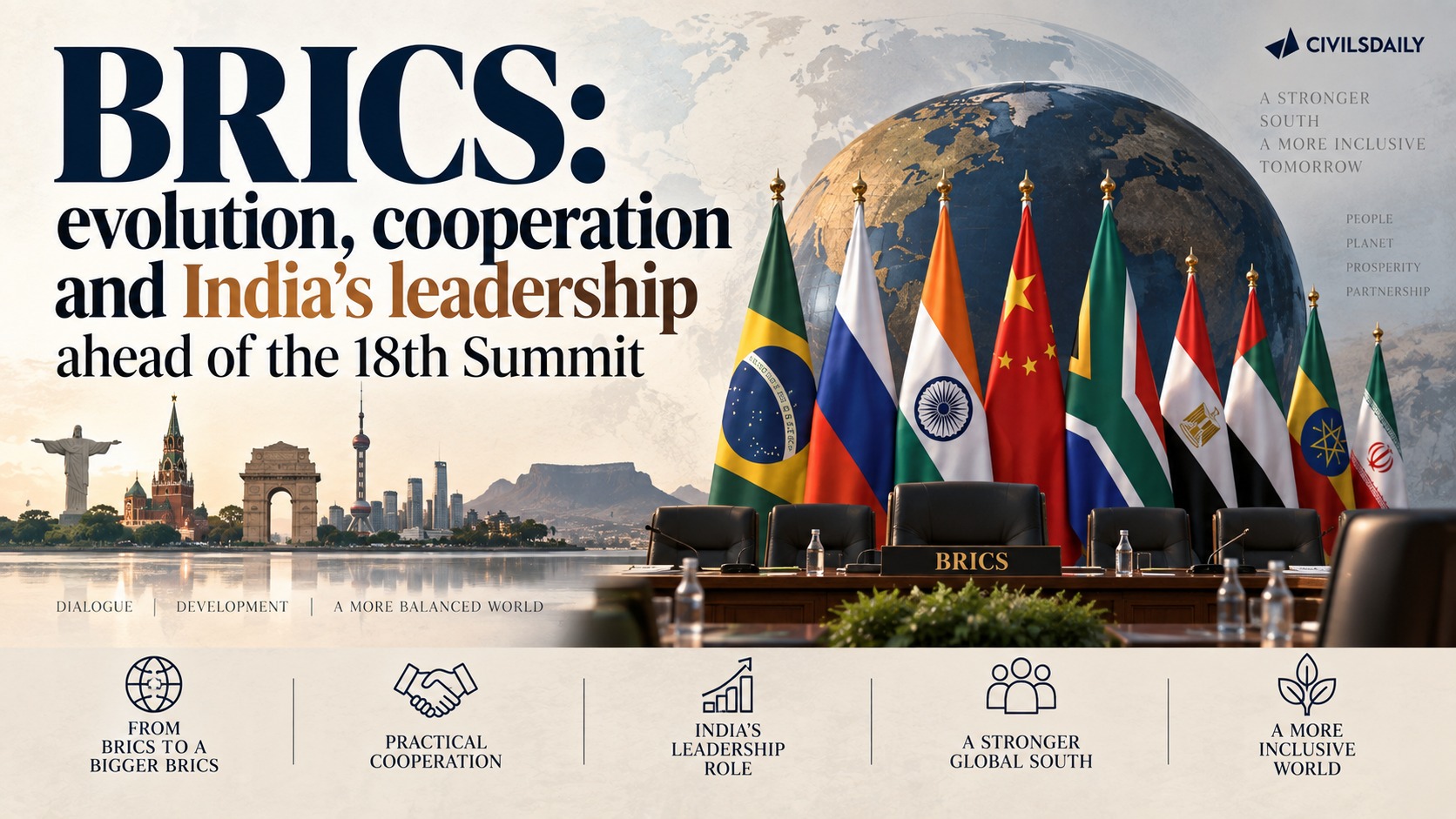
  • BRICS: evolution, cooperation and India’s leadership ahead of the 18th Summit

    BRICS: evolution, cooperation and India’s leadership ahead of the 18th Summit

    Why in News

    India hosts the 18th BRICS Summit on 12 to 13 September 2026 at Bharat Mandapam, New Delhi. BRICS is a grouping of major emerging economies.

    Current stage and next milestone

    India chairs BRICS for the fourth time in 2026. The leaders’ sessions run on 12 to 13 September 2026. The chairship has already run over 350 ministerial meetings across 25 cities.

    Core facts

    1. Origin: The acronym BRIC was coined in 2001 by Goldman Sachs. It projected Brazil, Russia, India and China as future major economies.
    2. Formation: South Africa joined in 2010, forming BRICS.
    3. Membership now: The grouping has 11 full members: Brazil, China, Egypt, Ethiopia, India, Indonesia, Iran, Russia, Saudi Arabia, South Africa and the United Arab Emirates. A Partner Country framework adds ten more nations.
    4. Weight: Members hold 49.5% of global population, 40% of global Gross Domestic Product and 26% of global trade.
    5. India’s chairships: They occurred in 2012, 2016, 2021 and 2026.
    6. Theme 2026: Building for Resilience, Innovation, Cooperation and Sustainability.
    7. Three pillars: Political and security cooperation, economic and financial cooperation, and cultural exchanges.
    8. 2026 agenda: Agriculture, health, urban infrastructure, Micro, Small and Medium Enterprises, supply chains and climate resilience.

    Static Context

    1. The New Development Bank (NDB) is the BRICS development bank. It was set up at the 6th Summit via the Fortaleza Declaration of 2014. Its headquarters is in Shanghai.
    2. The Contingent Reserve Arrangement is the BRICS currency swap framework for balance of payments support.
    3. The 16th Summit was held at Kazan, Russia, in 2024. The latest expansion admitted Egypt, Ethiopia, Iran, Saudi Arabia and the United Arab Emirates.

    Prelims angle

    NDB headquarters at Shanghai and its Fortaleza Declaration origin; BRICS membership list and the 11 member count; India’s chairship years; the NDB is a BRICS body, not an Asia Pacific Economic Cooperation body.

    Mains angle

    GS Paper 2, global groupings affecting India’s interests. BRICS suits a question on its role as a counterweight in global governance and a platform for the Global South.

    Matching Previous Year Question

    “[2025] Consider the following statements with regard to BRICS:
    I. The 16th BRICS Summit was held under the Chairship of Russia in Kazan.
    II. Indonesia has become a full member of BRICS.
    III. The theme of the 16th BRICS Summit was Strengthening Multiculturalism for Just Global Development and Security.
    Which of the statements given above is/are correct?
    (a) I and II
    (b) II and III
    (c) I and III
    (d) I only
    Answer: (a)”

    “[2026, GS2, 10 marks] “BRICS acts as a powerful counterweight in global governance, actively amplifying the voice and influence of the Global South.” Explain the role of BRICS in projecting itself as an alternative to other groupings.”

  • The BRICS Summit allows India to advance its global ambitions

    Why in the News

    India hosts the BRICS Summit at the Bharat Mandapam in New Delhi, with leaders and representatives of 11 BRICS countries opening deliberations on the future of global governance. Forging a joint statement is never easy at a multilateral conference whose members are themselves parties to ongoing conflicts. The grouping was a five member body at India’s earlier hostings, where managing consensus was easier, and enlargement since 2024 has changed that. The largest share of the host’s difficulty comes from the United States, which has accused the bloc of working against the dollar and has threatened tariffs on every member over its payments agenda. India is at the same time seeking to restore ties with that administration on trade and on its Indo-Pacific strategy, so hosting the bloc risks the relationship the hosting is partly meant to balance.

    Why is consensus harder than at India’s earlier hostings?

    1. The scale of the responsibility: Hosting BRICS is the second time in recent years, after the G-20 Summit in 2023, that India has had to shoulder a major multilateral conference.
    2. The earlier hostings were smaller: India hosted the coalition of emerging economies in 2012, 2016 and virtually in 2021, when it was a grouping of just five major powers.
    3. Who joined: The expansion in 2024 added Egypt, Ethiopia, Iran, Saudi Arabia and the UAE, and Indonesia was inducted in 2025.
    4. What the enlargement did and did not do: BRICS’ identity has evolved with the new membership. A common focus remains elusive.

    Which conflicts among members block a common text?

    1. Conflicts involving members have multiplied: Global conflicts involving BRICS members have grown alongside the enlargement.
    2. The war involving Iran is the sharpest case: Iran is a victim of the United States and Israeli strikes, and the UAE was attacked by Iran in retaliation. Both are members of the grouping.
    3. Neither will accept a shared account: Iran and the UAE have been unwilling to agree to a common narrative on the problem, which is precisely what a joint statement requires.
    4. India’s own position has divided the grouping: India’s position on Israel came into conflict with other members earlier this year, since the grouping has traditionally taken a much more critical line on Israel’s actions.

    Why does the United States pose the largest problem for the host?

    1. The accusation is about the dollar: The United States President has accused the grouping of plotting to overthrow the United States dollar’s domination of the global economy.
    2. The threatened instrument: He has been threatening tariffs on all members for planning to increase intra-BRICS payments and trade.
    3. What India is attempting in parallel: The government is seeking to restore ties with the United States administration on trade and on its Indo-Pacific strategy.
    4. The risk is not proportionate to the conduct: Hosting BRICS risks invoking American displeasure however irrational that displeasure is, so the host cannot manage the risk simply by adjusting the agenda.

    Why is a grouping that refuses the anti-western label still a counter to the G-7?

    1. The label the bloc rejects: The grouping prefers not to be called anti-western.
    2. What it functions as: It is a powerful counter to the G-7 and to western-led thinking.
    3. The scale behind the counter: BRICS accounts for half the world’s population, two fifths of the global economy and a fourth of global trade.
    4. Its energy position: It includes many of the world’s top energy producers and its biggest consumers, which gives it weight in energy markets that requires no declaration to exercise.
    5. The rise that produced this: BRICS was first conceptualised 25 years ago and convened a summit in 2009, and its countries have risen in global stature and economic heft since, with intra-BRICS trade benefitting.

    What does the presidency deliver for India?

    1. Heft on the global high table: Being part of BRICS gives India more weight in advancing its ambitions in global forums.
    2. Visibility from the chair: The presidency has ensured India prominence on the world stage.
    3. What a successful summit would signal: A presidency that reconciles the grouping’s competing strands would demonstrate the bloc’s capacity to act, and would count as a significant achievement for Indian diplomacy.
    4. The cost side of the same presidency: The prominence comes with exposure, since the host is read abroad as the author of whatever the bloc’s declaration says.

    Challenges to India’s BRICS presidency

    1. Consensus gives every member a veto over the text: A declaration requires all eleven members to agree, so the member with the narrowest interest sets the ceiling on what the document can say. Eg. The bloc’s Rio declaration of 2025 ran to 126 points, which is what accommodating every member’s preferred language produces.
      The Fix: Move contested political language into a chair’s statement issued alongside the declaration, so a single dispute does not shrink the agreed economic text.
    2. Enlargement raised the number of bilateral disputes inside the room: Every admission adds that member’s quarrels to the set the chair must accommodate in one document. Eg. The grouping now contains both Iran and Saudi Arabia, whose diplomatic relations were restored only in 2023.
      The Fix: Publish admission criteria requiring a candidate to hold working diplomatic relations with every existing member, so enlargement does not import an active rupture.
    3. The forum has no secretariat to carry work between summits: BRICS has no treaty and no permanent staff, so each chair rebuilds the agenda and the follow up machinery for a single year. Eg. Ministerial and working group outcomes are recorded in a declaration with no standing body tracking their implementation.
      The Fix: Create a small permanent secretariat funded by member contributions, mandated only to track commitments made in past declarations.
    4. The dollar question is a liability the bloc cannot settle: Members disagree on currency arrangements and the disagreement is read abroad as a shared plan, so the bloc absorbs the cost of a policy it has not adopted. Eg. Tariff threats have been aimed at every member over intra-BRICS payments, including at members that oppose a common currency.
      The Fix: State in the declaration that payment interoperability is a transaction cost measure and that no common currency is under consideration, so the agenda and the accusation are separated on the record.
    5. A chair’s agenda outlives the chairship only if the successor adopts it: A one year presidency sets themes that lapse where the next chair’s priorities differ. Eg. The sustainability agenda India is building on was the centrepiece of Brazil’s chairship the previous year.
      The Fix: Record a three year rolling work programme in the declaration, so an incoming chair inherits commitments rather than restating themes.

    Conclusion

    The presidency’s difficulty is not the agenda but the arithmetic. A grouping of eleven operating by consensus produces the text its least flexible member will accept. India’s gain from the chair is visibility, and visibility is also what attaches the bloc’s positions to the host. The two objectives this summit is being judged against, a document every member can sign and a relationship with Washington that survives it, pull in opposite directions and neither has been given up. What to watch is how the declaration handles the payments question, since that single paragraph is where the summit’s diplomatic cost will be set.

    Back2Basics: how BRICS takes decisions

    1. It is an informal grouping: BRICS has no founding treaty, no charter and no permanent secretariat, so it operates as a coordination forum rather than as an international organisation.
    2. The chair rotates annually: One member holds the chairship for a calendar year, hosts the leaders’ summit and sets the year’s agenda and meeting calendar.
    3. Decisions are taken by consensus: Every outcome document is adopted by agreement among all members, so no member can be outvoted and any member can withhold language.
    4. Outputs are political, not binding: A summit declaration records agreed positions and commitments with no enforcement mechanism, and implementation rests with each member’s own government.

    Matching Previous Year Question

    “[2025, GS2, 10 marks] With the waning of globalization, post-Cold War world is becoming a site of sovereign nationalism. Elucidate.”

  • Brazil to Iran: Why you can’t put all of BRICS in the anti-West box

    Why in the News

    India presides over the BRICS summit in Delhi with a two fold task: to convey the forum’s shared objective of democratising the international system, and to dispel the widespread impression that it seeks to overthrow the United States led order. Both the forum’s champions and its detractors read it through an anti-Western lens. Supporters celebrate BRICS as a vehicle for resisting Western dominance, and critics warn that it is becoming a counter-bloc led by China and Russia. Neither reading survives contact with the membership, which is divided over whether its national aim is accommodation with the West, autonomy from it, parity within it, or direct confrontation. Delhi’s burden at this summit is to keep the forum from conflating autonomy from America with antagonism towards it.

    Why does one anti-Western label not fit eleven members?

    1. Four national aims, not one: Members differ over whether their national aim is accommodation with the West, autonomy from it, parity within it, or direct confrontation, so the forum’s political orientation is a spectrum rather than a position.
    2. The confrontational pole: Iran sits closest to an anti-Western pole, since resistance to United States power is central to its state ideology and its recent history.
    3. The other end of the spectrum: At the opposite end sit members with deep economic, security and institutional ties to the West, which they maintain while pursuing greater autonomy.
    4. Where the two largest powers sit: Russia and China lie between the extremes. Both are in strategic competition with the West, and neither can be understood apart from its desire for status, influence and a seat at the Western high table.

    Why does Brazil break the West versus Global South opposition?

    1. Its standing in the grouping: Brazil is Latin America’s largest power and a strong advocate for reforming global institutions.
    2. Its institutions are Western in origin: Its geography, language, religion, legal tradition, political institutions and elite reference points are rooted in the Iberian and Euro-Atlantic worlds.
    3. Its diplomatic tradition reinforces this: Brazil is a constitutional democracy whose diplomatic tradition privileges international law and multilateralism.
    4. What it is actually dissatisfied with: Brazil is not seeking to overthrow the West from outside. It is a Western power dissatisfied with how authority is distributed within the order it inhabits.
    5. What that produces in practice: Brasilia rejects automatic alignment with Washington, and is equally uncomfortable with systematic anti-Western mobilisation.
    6. Distance from Eurasia shapes the position: Brazil sits far from Eurasia and, unlike Delhi, is not emotionally invested in Moscow.
    7. China is an economic partner rather than a security problem: Brazil has no direct conflict with Russia or China, and does not share India’s security challenges with Beijing. Beijing is a leading economic partner of Brazil.

    What is Brazil’s position on de-dollarisation and a common currency?

    1. What it supports: Brazil supports cheaper and faster bilateral settlement mechanisms, including trade in national currencies where that is useful.
    2. What it rejects: Brazil has rejected the notion that BRICS must promote de-dollarisation or develop a common currency to displace the dollar.
    3. The stated reason: A shared currency would require political trust, economic convergence and institutional integration that BRICS does not have.
    4. What the position reveals: Brazil’s engagement with the great powers rests on national interest rather than on ideology, and its payments position is the clearest instance of that.

    How is India’s non-Western position different from an anti-Western one?

    1. The identity claim: The External Affairs Minister has consistently underlined India’s non-Western identity, which rests on India being a post-colonial state and a developing country.
    2. Where the distinction lies: India shares political values with the West. It does not want to become a geopolitical appendage to the United States and Europe.
    3. The record of Western partnership: India’s partnerships with the United States, Europe, Japan and Australia have deepened across trade, technology, defence and diaspora.
    4. Two memberships held at once: Delhi’s participation in the Quadrilateral Security Dialogue (Quad) sits alongside its membership of BRICS.
    5. What makes the forum useful, and what would end that: BRICS is useful to India precisely because of its diversity. It ceases to serve Indian interests if it becomes a China-led alliance against the West.
    6. Why the anti-Western framing is also poor analysis: Delhi knows that Moscow and Beijing, despite their confrontations with Washington, remain interested in negotiating a new balance with it.

    Why are Russia and China not seeking an exit from the Western order?

    1. Russia’s break is structural: Russia’s contradiction with the West is now deep and structural, shaped by the Ukraine war, the North Atlantic Treaty Organization (NATO) role in European security, and sanctions.
    2. Yet Moscow wants recognition inside it: Russia is also eager for Western recognition as a great power, and for a say in managing European and global security.
    3. What China challenges: China challenges American primacy in Asia, reduces its exposure to Western technology restrictions, and presents BRICS as part of a more representative order.
    4. Why it cannot exit: China’s rise was inseparable from access to Western markets, capital and technology, and it retains strong economic interdependence with the United States.
    5. What Beijing is actually seeking: China is not seeking an exit from the United States led world. It wants to be America’s co-equal in shaping it.

    Where do the newer members and Iran sit on the spectrum?

    1. Egypt: Egypt remains tied to Washington on security.
    2. The United Arab Emirates: The UAE has extensive commercial and strategic links with the United States and Europe.
    3. Indonesia: Indonesia’s “free and active” diplomacy is designed to retain manoeuvring room among the major powers.
    4. What the three have in common: They seek autonomy, closer ties with China and a stronger voice for the Global South. None seeks membership of a unified anti-Western camp.
    5. Iran is the nearest exception: Resistance to the United States and Israel is central to the Islamic Republic’s political identity, and BRICS offers Tehran legitimacy and a means to counter the American effort to isolate it.
    6. Even Iran is not settled internally: Iran’s domestic debate continues to pit advocates of resistance against those favouring diplomacy and reconciliation with the United States.

    Challenges to India’s position that BRICS is non-Western rather than anti-Western

    1. A consensus text is attributed to every signatory: Language agreed with members at the confrontational end of the spectrum is read abroad as the position of all eleven, including the host. Eg. Tariff threats were aimed at every BRICS member over an alleged collective plan against the dollar, not only at the members proposing one.
      The Fix: Insist that any payments or currency language in a declaration name the specific mechanism and its purpose, so a settlement arrangement cannot be read as currency displacement.
    2. The forum has no charter to bound what it commits members to: BRICS has no treaty and no defined competence, so nothing limits the subjects a declaration may cover. Eg. The grouping’s declarations have expanded from development finance into positions on conflicts in West Asia and in Europe.
      The Fix: Adopt a standing framework document defining the forum’s subject areas, so an item outside them needs an explicit decision rather than a paragraph.
    3. Expansion imports the members’ own quarrels: Each admission adds a set of bilateral disputes the forum must now accommodate inside a single text. Eg. Iran and the United Arab Emirates are both members, and the UAE was attacked by Iran during the current war in West Asia.
      The Fix: Handle conflict language through a separate chair’s statement rather than the consensus declaration, so one dispute cannot hold the economic agenda hostage.
    4. Hedging is cheap only while both sides decline to price it: Simultaneous membership of the Quad and of BRICS is sustainable while neither partner charges for it, and a partner that does charge converts India’s balance into a cost. Eg. The tariff round on India last year followed disagreements in trade talks alongside its Russian oil purchases.
      The Fix: Separate India’s BRICS agenda from its security alignments in public terms, so each partner judges a defined economic programme rather than an alignment.

    Conclusion

    The anti-Western reading of BRICS is wrong as description and useful as politics, which is why it survives. It lets a critic in Washington treat eleven different national calculations as one bloc, and it lets a member at the confrontational end claim the weight of the other ten. India’s difficulty is that the second use invites the first, and the forum has no rule that stops either. What to watch is whether the Delhi declaration describes the reform of institutions its members intend to remain inside, or the displacement of an order most of them depend on.

    About BRICS

    1. How it began: The acronym BRIC was coined in 2001 by a Goldman Sachs economist to identify four high growth emerging economies. The first meeting of their foreign ministers took place on the margins of the United Nations General Assembly in 2006.
    2. How it became a summit body: The first formal leaders’ summit was held at Yekaterinburg in Russia in 2009, and South Africa joined in 2011, which gave the grouping its present acronym.
    3. How it expanded: The 2023 Johannesburg summit decided on enlargement. Egypt, Ethiopia, Iran and the United Arab Emirates joined in 2024 and Indonesia in 2025, with Saudi Arabia’s formal status remaining nuanced.
    4. The partner tier: A “Partner Country” category was introduced in 2024 to engage states such as Malaysia, Thailand and Nigeria without granting full membership.

    Initiatives and Institutions under BRICS

    1. New Development Bank: Established in 2015 and headquartered in Shanghai, it lends for infrastructure and sustainable development in emerging economies, and had approved over $35 billion in infrastructure loans by 2025.
    2. Contingent Reserve Arrangement: A $100 billion fund created in 2015 to provide short term liquidity support to a member under balance of payments pressure.
    3. BRICS Pay: A cross-border payment system in pilot stage, intended to let members settle trade without routing instructions through SWIFT.
    4. Research and technology bodies: The grouping has set up a Vaccine Research and Development Centre for technology transfer, a Partnership on New Industrial Revolution covering artificial intelligence and green technology, and a Space Council created in 2025 to coordinate deep space and lunar research.

    Key Facts about BRICS

    1. Membership: Eleven full members: Brazil, Russia, India, China, South Africa, Egypt, Ethiopia, Indonesia, Iran, Saudi Arabia and the United Arab Emirates.
    2. Share of population and output: The grouping represents over 45% of the world’s population and accounts for roughly 37% of global GDP measured at purchasing power parity, which is above the G7’s share.
    3. Energy weight: Members together control roughly 42% of global oil production and exports.
    4. How it is organised: BRICS works through an annually rotating chairship, with the chair hosting the leaders’ summit and setting the year’s agenda. Decisions are taken by consensus among all members.

    Matching Previous Year Question

    “[2026, GS2, 10 marks] “BRICS acts as a powerful counterweight in global governance, actively amplifying the voice and influence of the Global South.” Explain the role of BRICS in projecting itself as an alternative to other groupings.”

  • India’s BRICS balancing act

    Why in the News

    India is hosting the two day BRICS summit in New Delhi on 12 and 13 September 2026, and treats the grouping as a hedge against the Western economic order rather than a replacement for it. The United States and the European Union remain India’s largest export market and its largest source of investment. The same dependence has become a source of exposure. The United States imposed steep tariffs on India last year amid disagreements in trade deal negotiations, and India’s sovereign decision to purchase Russian oil during the Ukraine war turned it into a target. Tariffs are only the most visible instrument. Patent rules blocked a developing country waiver on vaccines at the height of the Covid-19 pandemic, a widening American sanctions regime has repeatedly halted an Indian port project in Iran, and European environment linked trade measures now act as a barrier to Indian exports. India therefore has to reduce reliance on an order it cannot yet do without.

    Why does India treat BRICS as a hedge and not a replacement?

    1. The bloc’s weight has grown: The BRICS share of global gross domestic product (GDP) grew from 17% to 35% between 1995 and 2024, surpassing the G7’s share.
    2. The West still supplies the markets and the capital: The United States and the European Union continue to be India’s largest export market and its largest source of investments.
    3. Western integration built the services sector: Integration with Western economies aided the growth of India’s service sector, which is where most of the new, well paid jobs have been created.
    4. What the hedge could deliver, and when: Expansion of south-south trade, the geographic concentration of critical minerals in the BRICS region and growth in alternative development finance such as the BRICS bank could support India’s growth. None of this is a counter-balance to the Western economic order today, and it could reduce India’s reliance a decade on.
    5. The stated rationale for the hedge: A former Reserve Bank of India (RBI) governor argues that India should treat the emerging international financial architecture around BRICS and the Asian Infrastructure Investment Bank (AIIB) as a “risk mitigant” and a rational response to an ever-expanding sanctions regime.

    What did the TRIPS waiver refusal reveal about patent control?

    1. What was asked for: In October 2020, at the height of the Covid-19 pandemic, India and South Africa sought a waiver of certain provisions of the Trade-Related Aspects of Intellectual Property Rights (TRIPS) Agreement to help developing nations obtain vaccines and other life saving medicines.
    2. What TRIPS is: TRIPS is an international agreement administered by the World Trade Organisation (WTO) that sets minimum standards for protecting intellectual property (IP) in every member country.
    3. Who backed the request: India, South Africa and sixty other developing countries pressed for the waiver.
    4. What happened to it: The developed countries turned the request down.
    5. How the episode is read: A former trade negotiator holds that the failure exposed the danger in an existing patent regime which accords “primacy to patents over patients”.

    How large has the Western sanctions regime become?

    1. The total and the single largest source: A working paper titled ‘Asphyxiation by Sanctions: Harm, Fear and Smog’, written by a former Reserve Bank of India governor, counts 1,325 sanctions imposed globally since 1949, of which 486 were imposed by the United States.
    2. The programmes currently running: The United States currently administers over 30 sanctions programmes, making it responsible for three times as many sanctions as any other country or international body.
    3. When the expansion happened: United States led sanctions jumped in recent decades after the collapse of the Soviet Union.
    4. The second largest sanctioner: The European Union is the second largest sanctioner after the United States.
    5. Trade and financial sanctions grew most: The paper’s decade wise count records financial sanctions rising from 4 in the 1950s to 327 between 2010 and 2022, and trade sanctions from 21 to 209 across the same span.
    6. Travel, military and arms restrictions followed: Travel sanctions rose from 8 to 205 over the same period, military aid sanctions from 1 to 62, and arms sanctions from 7 to 67, so the spectrum has widened from trade measures to military ones.
    7. The reach now includes the messaging layer: Iran and Russia have been removed from the Society for Worldwide Interbank Financial Telecommunication (SWIFT), the secure global messaging network financial institutions use to transmit payment instructions.
    8. The label the paper applies: The paper calls the United States the “hegemonic sanctioner”.

    What does Chabahar show about sanctions risk to an Indian project?

    1. When it started: India’s plan to develop Chabahar Port in Iran began in 2003.
    2. The first halt: United States sanctions targeting Iran imposed a “hard break” on progress.
    3. The window that opened: The project was revived between 2015 and 2017 after the United States eased sanctions.
    4. The window that closed again: India signed a ten year agreement with Iran to operate and develop the port in 2024, and shortly afterwards the United States again warned of sanctions.
    5. What the sequence shows: The project’s viability tracked United States policy toward a third country rather than the project’s own economics or India’s own decisions.

    Why do BRICS members reject the European Union’s environment linked trade measures?

    1. The measures at issue: The European Union has implemented a range of environment linked trade regimes which act as a barrier to India’s export growth.
    2. The bloc’s stated position: BRICS nations have “condemned and rejected” the European Union’s Carbon Border Adjustment Mechanism (CBAM) and similar trade curbs, on the ground that they undermine their transition to a cleaner economy.
    3. The reading Indian trade experts give it: Indian trade experts hold that a trade and climate linkage through regulations such as CBAM is less about protecting the environment and more about promoting the interests of the developed world.
    4. The contrast with the tariff instrument: The United States has been explicit in using tariffs to cut imports from developing nations. The European measure arrives instead as an environmental regulation.

    Challenges to India’s BRICS hedge

    1. The grouping grants no market access: BRICS is not a free trade area and issues no tariff preference, so membership cannot substitute for the export markets the hedge is meant to make India less dependent on. Eg. India’s tariff reductions have come through bilateral agreements such as the one being concluded with the European Union, not through the bloc.
      The Fix: Negotiate a BRICS tariff preference on a narrow list of goods members already trade heavily in, so the grouping delivers a measurable trade gain rather than a declaration.
    2. Alternative development finance is too small to displace anything yet: The financing available through BRICS institutions is a fraction of what India raises from Western markets and from the older multilateral banks. Eg. India’s annual external commercial borrowing exceeds its entire cumulative borrowing from the BRICS bank.
      The Fix: Set a share target for BRICS sourced project finance inside the public capital expenditure plan, so the alternative is used rather than only cited.
    3. Mineral concentration is not the same as mineral access: The critical minerals sit inside the BRICS region and their processing capacity sits largely with one member, so geography does not convert into supply security for India. Eg. China accounts for the majority of global rare earth separation and processing capacity.
      The Fix: Tie offtake agreements with Brazil, South Africa and the Gulf members to refining capacity built in India, so the supply arrives in a processable form.
    4. A hedge invites the retaliation it is meant to insure against: Visible participation in the bloc has itself drawn tariff threats, so the insurance carries a premium paid in the very relationship being hedged. Eg. Tariff threats were directed at BRICS members over the grouping’s “un-American” policies.
      The Fix: Keep India’s BRICS agenda on development finance, payments efficiency and supply chains, and off currency displacement, so the hedge is defensible as economic policy rather than as alignment.

    Conclusion

    India’s position is not a choice between two economic orders. It is a dependence on one while building an option on the other. That option is not yet large enough to price, so every instrument the hedge rests on remains smaller than the exposure it is meant to offset. The cost of the hedge is already being paid in the relationship it insures against. What to watch is whether the Delhi declaration commits to anything carrying a number and a date, since a hedge that produces only text leaves the exposure where it was.

    Back2Basics: Carbon Border Adjustment Mechanism

    1. What it is: CBAM is a European Union measure that charges an importer for the greenhouse gas emissions embedded in certain imported goods, set against the carbon price a European producer of the same good already pays.
    2. The goods it covers: It applies to cement, iron and steel, aluminium, fertilisers, electricity and hydrogen, the emission intensive sectors most exposed to import competition.
    3. How it is phased: A transitional phase requiring importers only to report embedded emissions ran from October 2023, and the definitive phase charging for those emissions began in 2026.
    4. India’s stated objection: India treats it as a unilateral trade barrier inconsistent with the principle of Common But Differentiated Responsibilities, since it charges a developing country producer at a developed country’s carbon price.

    Matching Previous Year Question

    “[2019, GS2, 15 marks] “The long-sustained image of India as a leader of the oppressed and marginalised Nations has disappeared on account of its new found role in the emerging global order”. Elaborate.”

  • India and EU close to sealing trade deal, await nod from top Council in Brussels

    Why in the News

    The European Commission has forwarded its proposal for the conclusion of a Free Trade Agreement (FTA) between the European Union (EU) and India to the European Council, the step that immediately precedes signature. The Commission is the EU’s main executive body and proposes the trade legislation. The European Council, comprising the heads of state or government of the 27 member states along with its own President and the President of the Commission, takes the final decision on authorising signature. On authorisation this becomes the largest trade agreement either side has concluded, eliminating or reducing tariffs on 96 per cent of EU goods exports to India and securing market access for more than 99 per cent of India’s exports to the EU by trade value. Signature is not conclusion, since the European Parliament’s consent and India’s own internal ratification both remain. The agreement also answers a problem neither side names in its text, which is that both import most of their industrial inputs from China.

    How does an EU trade agreement get approved?

    1. The Commission negotiates and proposes: The European Commission conducts the negotiation and then proposes the legislation for concluding the agreement.
    2. The Council authorises signature: The European Council defines the general political direction and priorities of the EU, and its members take the final decision on whether the agreement is signed.
    3. Parliament’s consent follows signature: The agreement then requires the consent of the European Parliament before conclusion and entry into force.
    4. India ratifies in parallel: Indian authorities are going through their own internal ratification procedures at the same time.

    What is the existing size of the relationship?

    1. Current trade: The EU and India already trade over Euro 180 billion worth of goods and services a year, with one Euro equal to about US $1.16.
    2. Employment on the EU side: That trade supports close to 800,000 EU jobs.
    3. What the agreement would be: On authorisation it would be the largest trade agreement ever concluded by either the EU or India.

    What does the agreement give the EU?

    1. Tariff elimination on almost all its goods: Tariffs on 96 per cent of EU goods exports to India would be eliminated or reduced.
    2. The value of the duty relief: The reductions would save around Euro 4 billion a year in duties on European products.
    3. Competitive position in the Indian market: European companies would find it easier to access the Indian market and to compete on a more level playing field.
    4. The consumer side: Indian consumers would gain increased choice and more competitive prices.

    What does the agreement give India?

    1. Near total market access for goods: It would secure market access for more than 99 per cent of India’s exports to the EU by trade value.
    2. Services and the movement of professionals: It unlocks high-value commitments in services, complemented by a comprehensive mobility framework enabling the movement of skilled Indian professionals.
    3. The labour-intensive sectors it targets: Textiles, apparel, leather, footwear, marine products, gems and jewellery, handicrafts, engineering goods and automobiles are named as the gainers.
    4. The immediate tariff effect: Tariffs of up to 10 per cent on almost $33 billion of Indian exports fall to zero on the agreement’s entry into force.

    Why did the two sides restart negotiations in 2022?

    1. China’s trade surplus was the trigger: A key reason for reopening talks in 2022 was China’s growing trade surplus with both partners.
    2. Both import their industrial inputs from the same source: The EU and India each import most of their industrial requirements from China, and Beijing’s tightening grip on manufacturing supply chains is reflected in its record trade surplus, which trade friction with the United States has not reduced.
    3. Both are restricting Chinese goods in strategic sectors: Brussels imposed tariffs of up to 35 per cent on Chinese electric vehicles in 2024, and India continues to levy over 100 per cent duty on automobiles imported from China, and is opening the sector to developed countries through trade agreements.
    4. The dependence has been assessed and not removed: A 2025 report by the Delhi Policy Group found both India and the EU still significantly dependent on China.
    5. The pandemic changed the calculation: The COVID-19 pandemic in 2020 exposed the vulnerability of China-centric supply chains, prompting both to reassess dependencies and to pursue diversification and de-risking.

    What pressure is the United States applying to both sides?

    1. The stated objective: India and the EU are both under US pressure to reduce dependence on Chinese products and to avoid being used as transhipment hubs.
    2. Indian manufacturing clusters named: A US report last month described several global manufacturing city clusters as “ugly sister” cities, including the Pune-Gujarat-Chennai industrial corridor, and stated that the United States loses when these hubs win.
    3. The argument it makes: The report held that the longer the system operates unchecked, the harder it becomes to restore lost industrial capacity, and that illegal transhipment hubs will continue to siphon off American manufacturing one product line at a time.

    Challenges to the India-EU free trade agreement

    1. A carbon levy sits outside the tariff schedule: The EU’s Carbon Border Adjustment Mechanism, a charge on the embedded carbon of an imported good, applies irrespective of the tariff concessions granted. Eg. It covers iron and steel, aluminium, cement, fertilisers, electricity and hydrogen, with the definitive charge beginning in 2026.
      The Fix: Agree mutual recognition of India’s carbon pricing under its Carbon Credit Trading Scheme, so a charge paid in India is set off at the EU border.
    2. Deforestation rules add a traceability duty to a tariff cut: The EU Deforestation Regulation requires geolocation of the plot of production for listed commodities, which a smallholder supply chain cannot document. Eg. Coffee, cocoa, rubber, soy, palm oil, cattle and wood are covered by it.
      The Fix: Fund plot-level geolocation through the commodity boards, so the compliance cost does not fall on the individual grower.
    3. Rules of origin decide who actually uses a zero duty: A concession is usable only where the product clears the value addition test, and an export assembled from imported inputs may not. Eg. Electronics assembled in India from imported components can fail a threshold that garments made from Indian fabric clear comfortably.
      The Fix: Agree cumulation, so inputs sourced from the partner count as originating and the concession reaches assembled goods.
    4. Ratification is a sequence, not a decision: Council authorisation and Parliament consent are separate steps, and an agreement classed as mixed can additionally require ratification by each member state. Eg. The EU’s agreement with Mercosur concluded negotiations in 2019 and remained outside force for years afterwards.
      The Fix: Split the text so the trade chapters enter into force on Parliament’s consent, with investment protection carried in a separate instrument.
    5. Non-tariff measures bind harder than tariffs in food trade: Sanitary and phytosanitary limits decide whether a consignment enters at all, and a zero tariff does nothing for a rejected shipment. Eg. Indian marine and food consignments face EU rejections on antibiotic residue and aflatoxin limits.
      The Fix: Agree recognition of testing by notified Indian laboratories, so a consignment is certified once at origin rather than retested at the border.

    Conclusion

    The text is settled and the decision has moved from negotiators to governments. Three gates remain in sequence: authorisation by the Council, consent of the European Parliament, and India’s internal ratification, and the concessions take effect only at entry into force. Those concessions are also the part of the agreement least likely to decide its value, since the measures that actually restrict Indian exports operate through carbon, deforestation and food safety rules that no tariff schedule touches. What to watch is the Council’s authorisation decision, and whether the agreement is classed as a mixed agreement, which would add ratification by every member state to the path.

    Matching Previous Year Question

    “[2010] In the context of bilateral trade negotiations between India and European Union, what is the difference between European commission and European Council? 1. European Commission represents the EU in trade negotiations whereas European Council participated in the legislation of matters pertaining to economic policies of the European Union 2. European Commission comprises the heads of State of govt. of member countries whereas the European Council comprises of the persons nominated by European Parliament Which of the statements given above is/are correct? (a) 1 only (b) 2 only (c) Both 1 and 2 (d) Neither 1 nor 2 ANSWER: (d)”

  • 9th ASEAN India Ministerial Meeting reaffirms commitment to food security and resilient value chains [Dossier]

    PIB class: Press Release. Ministry: Ministry of Agriculture and Farmers Welfare.

    Why in News

    The 9th ASEAN India Ministerial Meeting on agriculture reaffirmed commitment to food security, sustainable agriculture and resilient value chains.

    Core facts

    1. The forum: ASEAN is the Association of Southeast Asian Nations, a ten member regional grouping. India is a dialogue partner and a strategic partner of ASEAN.
    2. Stated themes: Food security, sustainable agriculture and resilient agricultural value chains formed the agenda of the ministerial meeting.
    3. Figures and specific deliverables: Not verifiable this run and therefore omitted.

    Static Context

    1. ASEAN was established in 1967 through the Bangkok Declaration. Its members are Brunei, Cambodia, Indonesia, Laos, Malaysia, Myanmar, the Philippines, Singapore, Thailand and Vietnam.
    2. India ASEAN relations run through a structured framework. India joined as a sectoral dialogue partner in 1992 and a full dialogue partner in 1996. The relationship became a Comprehensive Strategic Partnership in 2022.
    3. The ASEAN India Trade in Goods Agreement is under review. Agriculture cooperation runs through a rolling plan of action agreed by the two sides.
    4. Food security cooperation links to India’s Act East Policy. It ties agriculture trade to India’s wider Indo Pacific engagement.

    Prelims angle

    ASEAN founding year 1967 and the Bangkok Declaration. The ten members. India’s status as a Comprehensive Strategic Partner since 2022. India ASEAN connectivity projects such as the Kaladan Multi Modal Transit Transport Project and the India Myanmar Thailand Trilateral Highway.

    Mains angle

    GS2, regional groupings affecting India’s interests. Agriculture and food security cooperation as a pillar of the Act East Policy and of India’s Indo Pacific strategy.

    Matching Previous Year Question

    “[2026] Which of the following connectivity projects is/are a part of cooperation between India and the ASEAN member countries? 1. Kaladan Multi-Modal Transit Transport Project 2. IMT Trilateral Highway 3. Agartala-Akhaura Rail Line (a) 1 and 2 (b) 2 and 3 (c) 1 and 3 (d) 2 only. Answer: (a)”

  • BRICS [PIB Backgrounder]

    PIB class: PIB Backgrounder. Unit: PIB feature unit.

    Why in News

    PIB published a thematic Backgrounder on BRICS, the intergovernmental grouping.

    Core facts (static, definitional)

    1. BRICS is an intergovernmental grouping. The founding members are Brazil, Russia, India, China and South Africa.
    2. Origin: The term BRIC began as an economic grouping in 2006. South Africa joined in 2010, making it BRICS.
    3. Expansion: The grouping admitted new members from January 2024. Indonesia became a full member in January 2025 and is the first Southeast Asian state in the bloc.
    4. Institutions: The New Development Bank (NDB) finances infrastructure and sustainable development projects. The Contingent Reserve Arrangement (CRA) is a currency swap framework for balance of payments support.

    Static Context

    1. The New Development Bank (NDB) was established in 2015 and is headquartered in Shanghai. Founding members subscribed equal capital, so no single member dominates its voting.
    2. The Contingent Reserve Arrangement (CRA) is a treaty based safety net. It lets members access foreign currency during short term liquidity pressure.
    3. BRICS positions itself as a voice of the Global South. It presses for reform of the United Nations Security Council and of the Bretton Woods institutions.
    4. The 16th BRICS Summit was held at Kazan, Russia in 2024 under the Russian chairship. Its theme concerned strengthening multilateralism for just global development and security.

    Prelims angle

    Founding versus new members. The NDB headquarters at Shanghai and its equal capital structure. The CRA as a swap arrangement. Latest summit host and chair. Indonesia as the first Southeast Asian member.

    Mains angle

    GS2, global groupings affecting India’s interests. BRICS as a counterweight in global governance and a platform for the Global South, weighed against internal divergence among members.

    Matching Previous Year Question

    “[2025] Consider the following statements with regard to BRICS: I. The 16th BRICS Summit was held under the Chairship of Russia in Kazan. II. Indonesia has become a full member of BRICS. III. The theme of the 16th BRICS Summit was Strengthening Multiculturalism for Just Global Development and Security. Which of the statements given above is/are correct? (a) I and II (b) II and III (c) I and III (d) I only. Answer: (a)”

    “[2026, GS2, 10 marks] BRICS acts as a powerful counterweight in global governance, actively amplifying the voice and influence of the Global South. Explain the role of BRICS in projecting itself as an alternative to other groupings.”