For the first time (since 2004), Nagaland is scheduled to conduct Urban Local Body elections.
Context:
The state cabinet approved on April 26 for conducting Urban Local Body polls for Nagaland’s 3 Municipal Councils and 36 Town Councils.
Further, the State Election Commission (SEC) released the election schedule, with voting slated for June 26.
BACK2BASICS: Constitutional Provisions for Urban Local Body Elections:
The 74th Constitutional Amendment bars the interference by courts in the electoral matters of municipalities.
Article 243U mandates a five-year tenure for urban local governments.
The superintendence, direction and control of the preparation of the electoral rolls for, and the conduct of, all elections to the panchayats and municipalities shall be vested in the State Election Commission (SEC).
Article 371 (A)- It makes the special provisions for Nagaland in such a way that the Acts of Parliament would not apply to Nagaland unless the State Legislature Assembly so decides especially in terms of the Religious or social practices of the Naga.
What does the Janaagraha Survey say about the status of Municipal Elections in India?
According to the annual survey made by Janaagraha (a non-profit institution), over 1,400 municipalities in India did not have elected councils in place as of September 2021.
According to the Comptroller and Auditor-General of India (CAG), between 2015 and 2021, over 1,500 municipalities didn’t have elected councils. Major cities like Chennai, Delhi, Mumbai, and Bengaluru faced delays ranging from months to years in holding elections.
The story behind the contention surrounding the Urban Local Body polls in Nagaland:
The Nagaland Municipal Act of 2001 was amended in 2006 to introduce a 33% reservation for women in local bodies, by constitutional amendments.
However, this amendment became a subject of controversy due to opposition from tribal bodies, citing conflicts with Naga customary laws.
These laws under Article 371(A) of the Constitution violated Naga customary practices where women have traditionally not been part of decision-making bodies.
In 2009, the state government deferred municipal elections scheduled for the following year due to the controversy surrounding the Act.
Despite opposition, advocacy groups such as the Naga Mothers’ Association (NMA) fought for the implementation of women’s reservations.
In 2011, the NMA petitioned the Gauhati High Court, which directed the Nagaland government to hold local body elections.
In 2012, the state assembly passed a resolution rejecting women’s reservations in the polls, leading to further legal battles. The NMA filed a special leave petition in the SC, which in 2017 directed the government to hold the polls.
When the government moved to conduct the elections as per the Supreme Court directive, violent protests erupted, resulting in casualties. Under mounting pressure, then Chief Minister T R Zeliang resigned from his position.
In November, during a special emergency session, the assembly passed the Nagaland Municipal Bill, 2023.
This new legislation retains the 33% reservation for women in urban local bodies, aligning with constitutional amendments, but removes provisions such as reservation for the post of chairperson and taxes on immovable property.
Conclusion: Nagaland needs to foster community engagement and participation in the electoral process by promoting inclusive governance structures that involve diverse community members, including women, youth, and marginalized groups.
Mains PYQ:
Q Recent directives from Ministry of Petroleum and Natural Gas are perceived by the ‘Nagas’ as a threat to override the exceptional status enjoyed by the State. Discuss in light of Article 371A of the Indian Constitution.(UPSC IAS/2013)
The Election Commission of India (ECI) has issued notifications regarding complaints of violations of the Model Code of Conduct (MCC) against prominent leaders in India.
Model Code of Conduct (MCC)
Set of guidelines : The Model Code of Conduct (MCC) is a set of guidelines issued by the Election Commission of India (EC) for political parties and candidates.
Aim: It aims to establish standards of conduct during election campaigns and polling.The MCC includes provisions for lodging complaints with EC observers and dictates the conduct of ministers from ruling parties during the MCC period.
In 2019, an addition was made concerning election manifestos, prohibiting promises contrary to constitutional ideals.
The MCC is not legally binding as it is not a statutory document enacted by Parliament.
While violating many MCC guidelines may not result in punitive action, certain actions are categorized as electoral offenses and corrupt practices under the Indian Penal Code and the Representation of the People Act, 1951.
Violators of these laws will face appropriate punishment.
Evolution of MCC:
Origin: The Model Code of Conduct (MCC) originated as a small set of guidelines for the Assembly election in Kerala in 1960.
Initially, it covered various aspects such as the conduct of election meetings, processions, speeches, slogans, posters, and placards.
Expansion of MCC: Under Chief Election Commissioner (CEC) K V K Sundaram in 1968, the EC consulted with political parties and expanded the MCC to ensure minimum standards of behavior for free and fair elections.
Standard practice: By 1979, it became a standard practice for the EC to circulate the MCC before every General Election.
Consolidation of MCC: Over time, the MCC evolved further with consultations between the EC and political parties. In 1991, it was consolidated and re-issued with additional sections, including restrictions on the “party in power” to prevent the misuse of authority for unfair advantages.
Features of MCC:
Activation of MCC: The Model Code of Conduct (MCC) is activated immediately upon the announcement of the election schedule by the Election Commission and remains in effect until the completion of the election process, including the announcement of results.
Applicable on all election: It applies to all elections to the Lok Sabha, State Assemblies, State Legislative Council elections from Local Bodies, and Graduates’ and Teachers’ Constituencies.
Across all India: During General elections, the MCC is enforced across India, while during Legislative Assembly elections, it is enforced in the specific state going to polls.
Funded to adhere with MCC: All organizations, committees, corporations, and commissions funded wholly or partially by the Central or State governments are obligated to adhere to the MCC.
List of Political parties: In addition to listed political parties and candidates, non-political organizations conducting campaigns in support of a political party or candidate are also required to follow specific guidelines outlined by the Election Commission.
Issues related to MCC:
The political environment in the country has become more intense, leading to a decrease in the effectiveness of the Model Code of Conduct (MCC).
Instances of violations of the MCC are increasing rapidly and are becoming widespread and aggressive.
Political leaders are using their influence, resources, and persuasive tactics more aggressively than ever, often exploiting loopholes between the literal and intended meanings of the MCC.
Money power has become more prominent than physical strength, and advancements in technology have provided new ways to circumvent regulations.
The MCC lacks clarity on the consequences of violations, which weakens its ability to deter misconduct.
Delayed responses to violations reduce the impact of penalties and erode public trust in the Election Commission’s credibility.
Way Forward
Strengthen Enforcement: Enhance the enforcement mechanisms to ensure strict adherence to the MCC guidelines.
Technological Solutions: Leverage technology to improve monitoring and enforcement of MCC compliance. Implement tools such as social media monitoring, data analytics, and surveillance technology to detect and deter violations effectively.
Swift and Transparent Action: Ensure timely and transparent action against MCC violations. Establish clear protocols for investigating complaints and imposing penalties on violators. Swift action will enhance the deterrent effect of the MCC.
Mains PYQ:
Q ‘Simultaneous election to the Lok Sabha and the State Assemblies will limit the amount of time and money spent in electioneering but it will reduce the government’s accountability to the people’ Discuss. [2017]
In recent times, the Central government has exerted significant political and financial control over the regional states.
What is Federalism?
Federalism is a system of government in which power is divided and shared between a central authority (usually a national government) and constituent political units (such as states or provinces).
Both levels of government have their spheres of authority, and they coexist within the same political framework.
Indian Federalism:
India opted for a federal form of government because of linguistic and regional diversity. It has dual objectives, to safeguard and promote the unity, and to accommodate regional diversity.
However, Indian Federalism has been described as quasi-federal since it contains major federation and union features (Article 1says, “India that is ‘Bharat’, shall be the Union of the states”).
The central government has more authority, especially in fiscal matters (due to which it is sometimes called “asymmetrical federalism”).
Federalism is part of the basic structure which cannot be altered or destroyed under the constituent powers of the Parliament without undergoing judicial review by the Supreme Court.
Federal Features
Non-federal features
The Present Political Federal Issues in India:
Centralization of Power: Certain propositions laid down in the Supreme Court’s judgment, have upheld the prospects of Federalism in India
For example, the abrogation of Article 370 concerning Jammu and Kashmir’s special status by the central government without adequate consultation with the state government was seen as a move towards the Centralization of power.
Reorganization of States: The provision underArticle 3of the Constitution states that the President shall refer the Bill for the reorganization of any State to the legislature of the State concerned to elicit its opinion.
The recent SC’s verdict that dismissed the challenges to the abrogation of Article 370 led to a serious undermining of federalism and the rights of the elected State legislatures.
Lack of clarity in Division of Powers: Although the subjects are enlisted in the Seventh Schedule and Emergency Provisions of the Constitution,the distribution of power between the Central government and the states lacks clarity and equity.
For example, internal security assumes utmost importance with the Maoist challenge and cross-border terrorism, which threaten all the states across the country.
The Constitution does not refer either to ‘security’ or ‘internal security’ anywhere. However, it mentions five related terms namely ‘pubic order’ (List II, Entry 2), ‘war’ (Article 352), ‘external aggression’ (Article 352), ‘armed rebellion’ (Article 352), and ‘internal disturbance’ (Article 355).
Further, the imposition of President’s Rule in states under Article 356 has been recently criticized for being used arbitrarily by the central government.
Unequal Representation in Rajya Sabha: The representation of states in Parliament and other federal institutions does not accurately reflect their population, size, or contributions. Some states are over-represented while others are under-represented.
For example, the allocation of 80 Lok Sabha seats to Uttar Pradesh and only one to Sikkim results in unequal representation, impacting resource distribution and decision-making.
Simultaneous Elections: Measures discussed and recommended like the“One Nation One Election”undermined India’s federal structure and conflated the different priorities voters had for National, State, and “Panchayati raj” institutions, degrading each one’s different sphere of responsibility.
The Present Fiscal Federal issues in India:
Fiscal Divisible Pool: Thestates often face financial constraints due to their dependence on the central government for funds. The unequal distribution of resources can exacerbate disparities among states.
For example, states like Bihar and Uttar Pradesh receive more funds from the central government under various schemes. However, recently the Kerala government faced serious financial crunches due to a lack of funds.
Implementation of Goods and Services Tax (GST): GST’s implementation has raised issues related to fiscal autonomy. States have voiced concerns about the loss of their taxation powers and uncertainties regarding compensation from the central government for revenue losses.
Bodies related to the Federal System in India:
The Inter-State Council: It was constituted under Article 263 of the Constitution, and serves as a constitutional entity aimed at fostering coordination and collaboration between the Central government and the states regarding shared interests and issues of significance.
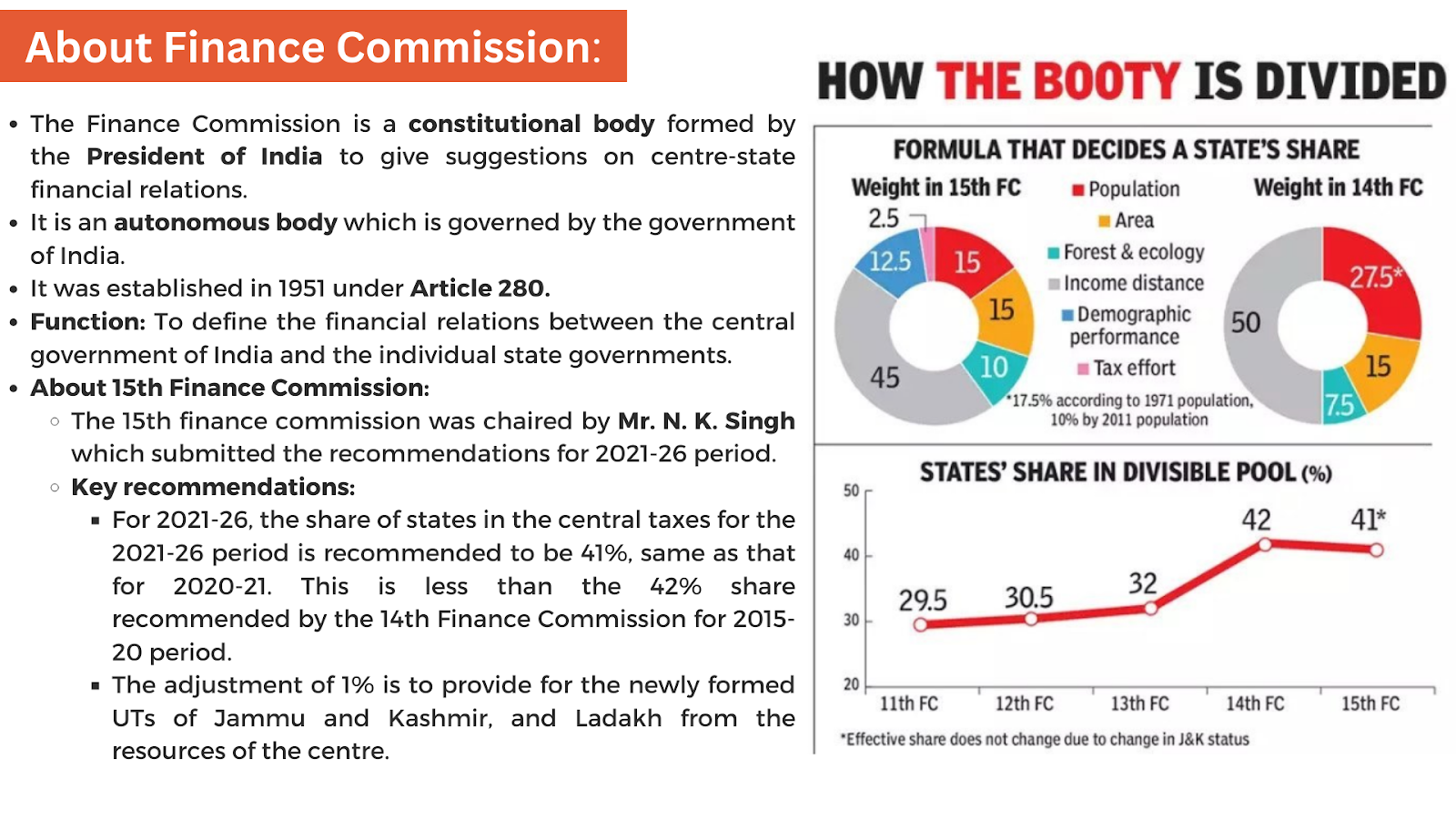
The Finance Commission: It is a Constitutional Body established under Article 280 of the Constitution to recommend the distribution of revenues between the Centre and the states.
The NITI Aayog: Established in 2015 to replace the Planning Commission. It fosters cooperative federalism by involving states in policy formulation and implementation.
CommitteeRecommendation:
Sarkaria Commission (1983):
Balanced Distribution of Powers: Recommended a balanced distribution of powers between the central government and states, ensuring that each level of government has adequate authority to perform its functions.
Cooperative Federalism: Emphasized the need for cooperative federalism, where the central and state governments work together in the spirit of partnership and collaboration.
Punchhi Commission (2007):
Strengthening Inter-State Council: Recommended strengthening the Inter-State Council, an institution tasked with promoting cooperation among states and between the center and states.
Revisiting Center-State Relations: Suggested revisiting and updating the provisions related to center-state relations to address contemporary challenges and promote cooperative federalism.
Way Forward: The Centre cannot afford to ignore the importance of states to effectively respond to the Federal issues:
Empowerment of State Governments: Strengthen the powers and autonomy of state governments in decision-making processes, allowing them greater authority over issues within their jurisdiction, and revenue management is necessary.
Promoting Co-operative Federalism: Enhance the effectiveness of the Inter-State Council as a forum for dialogue and cooperation between the Centre and states on matters of common interest, ensuring meaningful participation of state leaders in decision-making processes.
Need a Balanced Approach: First, the government needs to review and make necessary amendments to clarify the distribution of powers, ensuring a more balanced and transparent framework for political governance. Second, implement a balanced system of grants where states with weaker fiscal capacities receive adequate support to address developmental disparities.
Bringing Clarity: Clearly define revenue-sharing boundaries and internal security mechanisms between the Centre and states to ensure equitable distribution of resources.
Prelims PYQ
Q) Which one of the following is not a feature of Indian federalism? (UPSC IAS/2017)
a) There is an independent judiciary in India.
b) Powers have been clearly divided between the Centre and the States.
c) The federating units have been given unequal representation in the Rajya Sabha.
d) It is the result of an agreement among the federating units.
Q) Consider the following statements: (UPSC IAS/2020)
1) The Consititution of India defines its ‘basic structure’ in terms of federalism, secularism, fundamental rights and democracy.
2) The Constitution of India provides for ‘judical review to safeguard the citizens’ liberties and to preserve the ideals on which the Constitution is based.
Which of the Statement given above is/are correct?
a) 1 only
b) 2 only
c) Both 1 and 2
d) Neither 1 nor 2
Mains PYQ
Q1 How far do you think cooperation, competition and confrontation have shaped the nature of federation in India? Cite some recent examples to validate your answer. (UPSC IAS/2020)
Q2 The concept of cooperative federalism has been increasingly emphasised in recent years. Highlight the drawbacks in the existing structure and the extent to which cooperative federalism would answer the shortcomings.
Q To enhance the quality of democracy in India the Election Commission of India has proposed electoral reforms in 2016. What are the suggested reforms and how far are they significant to make democracy successful? (UPSC IAS/2017)
Q “Institutional quality is a crucial driver of economic performance”. In this context suggest reforms in the Civil Service for strengthening democracy.(UPSC IAS/2020)
Note4Students:
Mains: Polity; Indian Party System;
Mentor comments: Recent campaigning gathers pace for the 2024 general election, distant seem the days when the world hailed our elections as a wondrous and clamorous affair that reaffirmed our greatest achievement: being the world’s largest democracy. But in the past decade, Part Democracy has diminished in the eyes of Global countries, and to some extent our own, to an “Electoral Autocracy”. There is a palpable sense that in this election, we are fighting to save our democracy itself.
Let’s learn
—
Why in the News?
As Indians wait to elect their 18th Lok Sabha, at stake are not only 543 seats but also the ‘India’ and ‘Bharat’ of the Constitution.
History Associated with “Bharat” & “India”:
The word “India” and its variant, such as “Hind” in Arabic, have foreign origins. These names were historically used by outsiders to refer to the ‘Land of South’ and ‘East of the Indus’ or ‘Sindhu River’.
Under Afghan and Mughal dominion, the term “Hindustan” frequently denoted the northern territories of the Indian subcontinent.
Subsequently, European colonial forces, notably the British, adopted “India” to encompass not just the northern expanse but the entirety of the subcontinent, viewing it primarily as a geographical delineation.
Effect of Renaissance and Nationalism: The Indian Renaissance was pivotal in fostering the awareness that the inhabitants of the Indian subcontinent formed a unified nation.
Advocates of this movement aimed to trace Indian Nationalism back to its Ancient origins and rejected the notion of adopting a name bestowed by outsiders as unacceptable.
They preferred the term “Bharat” and its variations in different languages.
Controversy: The Muslim League voiced reservations regarding the designation “India” for the recently emancipated Nation.
They contended that “India” should denote the Hindu-majority territories, while the Muslim-majority regions ought to be acknowledged as a distinct nation, Pakistan.
This name dispute reflected the deep-seated religious and political divisions during the partition.
Amalgamation: Leaders like Netaji Subhas Chandra Bose advocated for a syncretic word, “Hind,” which could be acceptable to a wide range of people, including those from different faiths.
How Indian Democracy has evolved through Elections?
Evolution of Democracy: Over the span of 70 years since India’s first general election, significant changes have occurred in the perception and appreciation of democracy.
The passage suggests that as time passes, the audacity and significance of that democratic experiment are increasingly taken for granted.
Transformation in Conditions: It implies that conditions have changed over time, perhaps becoming less challenging compared to the post-colonial era.
Progress in Nation-Building: India has made progress in nation-building since its first general election. Previously, India has dealt with the aftermath of Partition, rehabilitating refugees, and integrating Princely States.
Advancements in Governance: The drafting of India’s Constitution and the passage of significant Legislation like the Representation of the People Act, 1950, demonstrate advancements in governance and Legal Frameworks. These changes indicate a maturation of Indian Democratic Institutions.
Demographic Shifts: The demographic composition of eligible voters has likely changed over the years. Around 85% of eligible voters were illiterate in 1950, improvements in education and literacy rates have altered this Demographic profile.
Conclusion: India’s constitutional balance between “Bharat” and “India” is maintained through official publication in English and Hindi, recognition of both versions, constitutional amendments allowing Hindi use, and Article 1(1) emphasizing both names.
The Supreme Court has decided to hear petitions seeking 100% cross-verification of the Voter Verifiable Paper Audit Trail (VVPAT) slips with the vote count as per Electronic Voting Machines (EVMs).
What is the history of the Voting Process?
First two General Elections: In the Elections of 1952 and 1957, a separate box was placed for each candidate with their election symbol. Voters had to drop a blank ballot paper into the box of the candidate whom they wanted to vote for.
Third Election: In the third election, the ballot paper with names of candidates and their symbols was introduced with voters putting a stamp on the candidate of their choice.
Introduction of EVM in Lok Sabha Elections: In the 2004 general elections to the Lok Sabha, EVMs were used in all 543 constituencies.
Global Scenario:
Many Western democracies, including England, France, The Netherlands, and the United States, have opted to continue using paper ballots for their National or Federal Elections instead of Electronic Voting Machines (EVMs).
Some countries have discontinued the use of EVMs after trials over the past two decades. For example, Germany’s Supreme Court declared the use of EVMs in elections unconstitutional in 2009.
Significance of EVM:
Prevention of Booth Capturing: EVMs have significantly reduced the likelihood of booth capturing, a practice where unauthorized individuals seize control of polling booths to manipulate votes.
Elimination of Invalid Votes: EVMs have effectively eliminated invalid votes, which were a common issue with paper ballots.
Environmental Sustainability: With a large electorate size like India’s, which is close to one billion, the use of EVMs contributes to environmental sustainability by reducing the consumption of paper.
Administrative Convenience: EVMs provide administrative convenience for polling officers on the day of the poll. They simplify the voting process, making it easier for voters to cast their ballots and for officials to manage polling stations efficiently.
Limitations on using EVM:
Susceptibility to Hacking Allegations: Despite assurances from electoral authorities, doubts have been raised about the security of EVMs, with concerns that they may be vulnerable to hacking due to their electronic nature.
Limited Sample Size for VVPAT Verification: The current practice of verifying the EVM count with Voter Verifiable Paper Audit Trail (VVPAT) slips has a small sample size of only five per assembly constituency/segment.
Identification of Polling Behavior: The process of matching EVM counts with VVPAT slips at the booth level allows for the identification of polling behavior by various political parties. This information could potentially be used for profiling voters and intimidation, undermining the secrecy and fairness of the electoral process.
Way Forward:
Enhancing Transparency and Comprehensibility: In a transparent democracy, citizens should be able to understand and verify the election process without requiring specialized technical knowledge.
Scientific Sampling for EVM-VVPAT Matching: Rather than a 100% match, the sample for matching the EVM count with VVPAT slips should be determined scientifically, possibly by dividing each state into large regions as suggested by experts.
Error Resolution: In case any error is detected, the VVPAT slips for the concerned region should be fully counted, forming the basis for results. This would instill statistically significant confidence in the counting process.
Mains PYQ
Q In the light of recent controversy regarding the use of Electronic Voting Machines (EVM), what are the challenges before the Election Commission of India to ensure the trustworthiness of elections in India?
Q To enhance the quality of democracy in India the Election Commission of India has proposed electoral reforms in 2016. What are the suggested reforms and how far are they significant to make democracy successful?
The Supreme Court has decided to address petitions advocating for a comprehensive verification of Voter Verified Paper Audit Trail (VVPAT) slips in upcoming general elections.
What are VVPATs?
VVPAT machines, attached to Electronic Voting Machines (EVMs), print a slip showing the voter’s choice, allowing voters to verify their vote for 7 seconds before the slip drops into a secured box.
The concept emerged in 2010, leading to the creation of prototypes by Bharat Electronics Limited (BEL) and Electronics Corporation of India (ECIL).
After trials and feedback, the design was approved in February 2013.
The Conduct of Elections Rules, 1961, were amended to incorporate VVPATs.
They were first used in Nagaland’s Noksen Assembly constituency in 2013 and were implemented in all polling stations by the 2019 Lok Sabha elections.
Current VVPAT Slip Counting Protocol
In 2018, the ECI consulted the Indian Statistical Institute (ISI) to determine a statistically robust sample size for VVPAT slip verification.
Initially, VVPAT slips of one randomly selected polling station per Assembly constituency were counted.
This was increased to five polling stations per Assembly seat after a Supreme Court judgment in 2019.
The ISI suggested counting VVPAT slips from 479 EVMs to ensure a high confidence level that the proportion of defective EVMs is less than 2%.
Recent petitions regarding VVPAT
Opposition parties advocate for heightened VVPAT verification, ranging from 50% to 100%, to bolster electoral transparency and uphold the sanctity of democratic processes.
However, the Election Commission emphasizes the need to balance transparency with operational constraints, citing logistical challenges and potential delays in result declaration.
About Electronic Voting Machines (EVMs) in India
Details
Introduction
EVMs introduced in Paravur Assembly Constituency, Kerala, 1982.
Adoption
Election Commission increasingly used EVMs since 1998. All state elections and by-elections used EVMs by 2003.
Use of EVMs for Lok Sabha elections implemented in 2004.
Development
Developed by the Technical Experts Committee (TEC) of Election Commission, with Bharat Electronics Ltd,
Bangalore, and Electronic Corporation of India Ltd, Hyderabad.
Functionality
Consists of Control Unit and Balloting Unit connected by cable.
Voters press blue button on Ballot Unit to record vote.
Key Features
Each EVM records up to 2,000 votes.
Operates without electricity, powered by battery from Bharat Electronics Ltd/Electronic Corporation of India.
Uses one-time programmable/masked chip for security.
Stand-alone machines without an operating system for enhanced security.
PYQ:
[2017] Right to vote and to be elected in India is a
Allegations by the regional government (Recently Kerala govt.) on the Centre using the Governor’s position to destabilize state governments have been made since the 1950s. This calls for Governor-state relations.
What is the law on Governor-state relations?
The Governor, although meant to be apolitical and act on the advice of the council of ministers, holds significant powers granted under the Constitution.
These include giving or withholding assent to bills passed by the state legislature and determining the time needed for a party to prove its majority in cases of a hung verdict in an election.
While the Constitution grants powers to the Governor, there are no specific provisions on how the Governor and the state government should publicly engage when there is a difference of opinion.
What have been the friction points in recent years?
Controversial Actions: Some actions by governors have sparked controversy, such as dissolving assemblies amidst government formation discussions (Jammu and Kashmir), and inviting leaders without public consultation (Maharashtra) this government lasted just 80 hours. And Six months later, the Governor refused to nominate CM Uddhav Thackeray.
Interference in State Affairs: Governors have been criticized for allegedly interfering in state affairs, including commenting on law and order situations (West Bengal), and refusing requests from state governments (Kerala) regarding legislative matters.
Legal Challenges: Some decisions made by governors have faced legal challenges, such as the invitation to the BJP to form the government in Karnataka, which was challenged and subsequently modified by the Supreme Court.
Dismissal after independence:
Dismissals in the 1950s: Allegations of the Centre using the Governor’s position to destabilize state governments date back to the 1950s. In 1959, Kerala’s E M S Namboodiripad government was dismissed based on a report by the Governor.
Dismissals in the Post-1960s: Several state governments were dismissed between 1965 and 1990 through President’s Rule orders issued by Governors. These dismissals included governments such as Birender Singh in Haryana (1967), M Karunanidhi in Tamil Nadu (1976), and N T Rama Rao in Andhra Pradesh (1984).
Decrease in Dismissals: The frequency of state government dismissals decreased during the coalition era at the Centre and the emergence of strong regional parties. This suggests a shift in political dynamics and possibly less direct interference by the Centre through Governors in state politics.
Causes of such Governor-State Frictions:
Answerable only to the Centre: The Governor is not directly accountable to the people and is answerable only to the Centre.
Appointment and Tenure: The Governor is appointed by the President on the Centre’s advice and holds office at the pleasure of the President. Although the tenure is typically five years
Lack of Impeachment Provision: There is no provision for impeaching the Governor, further limiting mechanisms for holding them accountable.
Absence of Guidelines: The Constitution does not provide clear guidelines for the exercise of the Governor’s powers, including the appointment of a Chief Minister or the dissolution of the Assembly. Additionally, there are no limits set for how long a Governor can withhold assent to a Bill, raising questions about arbitrary use of power.
Governor as Agent of the Centre: The National Commission to Review the Working of the Constitution highlighted concerns that Governors may act in accordance with instructions from the Union Council of Ministers, leading to perceptions that they are “agents of the Centre.”
Reform suggested by the ARC of 1968 to the Sarkaria Commission of 1988:
Selection Process: Establishing a panel consisting of the Prime Minister, Home Minister, Lok Sabha Speaker, and Chief Minister to select Governors.
Fixed Tenure: Recommendations advocate for fixing the Governor’s tenure for five years.
Impeachment Provision: Suggestions include introducing a provision to impeach the Governor by the State Assembly.
Conclusion: Governors often side with the central government and aren’t accountable enough. Kerala’s case shows a problem with the law. Proposed changes aim to make things clearer and fairer.
Mains PYQs
Q Discuss the essential conditions for exercise of the legislative powers by the Governor. Discuss the legality of re-promulgation of ordinances by the Governor without placing them before the Legislature. (UPSC IAS/2022)
Q Whether the Supreme Court Judgement (July 2018) can settle the political tussle between the Lt. Governor and elected government of Delhi? Examine. (UPSC IAS/2018)
A high-level committee chaired by former President Ram Nath Kovind has proposed conducting simultaneous elections
Context
It has proposed conducting simultaneous elections for the Lok Sabha and State Assemblies as the initial step.
Subsequently, municipal and panchayat elections would be held within 100 days following the general elections.
What is Simultaneous elections?
Simultaneous elections, also known as “One Nation, One Election,” refer to the practice of holding elections for all levels of government – national, state, and local – simultaneously, or within a short period of time.
This means that voters would cast their ballots for parliamentary (Lok Sabha), state legislative assembly (Vidhan Sabha), and local government (municipalities, panchayats) elections on the same day or within a closely coordinated timeframe.
Article 83 (Duration of Houses of Parliament): Article 83 specifies the tenure of the Lok Sabha, the lower house of Parliament. It states that the Lok Sabha’s duration is five years from the date of its first sitting unless dissolved earlier. The President has the authority to dissolve the Lok Sabha before the completion of its five-year term, leading to general elections.
Article 172 (Duration of State Legislatures): Article 172 deals with the duration of the Legislative Assemblies in the states. It mandates that the Legislative Assembly of a state will continue for five years from the date of its first sitting unless dissolved earlier. Similar to the Lok Sabha, the Governor of a state holds the power to dissolve the Legislative Assembly before the completion of its five-year term, leading to fresh elections.
Recommendation as per Committee-
Synchronization Proposal: The committee proposed a method to synchronize elections by setting an ‘Appointed Date’ after the general elections. State Assemblies formed after this date and before the completion of the Lok Sabha’s term would conclude before subsequent general elections, enabling simultaneous polls.
Tenure and Fresh Elections: The committee suggested that if a hung House or a no-confidence motion occurs, fresh elections could be conducted. However, the tenure of the House would only last for the remaining term of the preceding full term.
Continuation of New Assemblies: In the case of fresh elections for Legislative Assemblies, the new Assemblies would continue until the end of the full term of the Lok Sabha unless dissolved earlier.
Constitutional Amendments: Amendments to Article 83 and Article 172 of the Constitution are recommended to facilitate these changes regarding the duration of Parliament and State legislatures.
Implementation of Changes: An implementation group is proposed to oversee the execution of the recommended amendments by the committee.
Examining the issue of Simultaneous elections:
Law Commission’s Action: The 22nd Law Commission, concurrently examining the issue of simultaneous elections, is anticipated to submit its report to the Law Ministry soon. It is likely to recommend simultaneous polls from the 2029 general election cycle.
Ratification by States-
Amendments to Constitution Articles: The committee recommends amendments to Article 324A to enable simultaneous elections in panchayats and municipalities. Amendments to Article 325 are suggested to empower the Election Commission of India (EC) to collaborate with state election authorities in preparing a unified electoral roll and voter ID cards.
Article 324A: This article pertains to the recommendations for amendments to enable simultaneous elections in panchayats and municipalities.
It implies that changes to Article 324A would empower the Election Commission of India (EC) to conduct elections for local bodies concurrently with state and national elections.
The proposed amendment aims to streamline the electoral process and reduce the frequency of elections, aligning with the broader goal of synchronizing all levels of elections.
Article 325: It deals with the right to vote and preparation of electoral rolls.
The suggested amendments to Article 325 would authorize the Election Commission of India (EC), in consultation with state election authorities, to prepare a unified electoral roll and issue voter ID cards.
This amendment seeks to establish a uniform and standardized voter registration process across different levels of elections, ensuring consistency and efficiency in voter identification and participation.
Significance of “One Nation, One Election”:
Governance Efficiency: Conducting elections at all levels simultaneously can streamline the electoral process, reducing the disruptions caused by frequent elections. This leads to more stable governance and allows elected representatives to focus on their duties rather than preparing for elections.
Cost Savings: Simultaneous elections can significantly reduce the financial burden associated with conducting multiple elections at different times. It helps in optimizing resources, cutting down on campaign expenses, and minimizing the overall cost to the exchequer.
Voter Engagement: Coordinating elections at all levels encourages higher voter turnout by consolidating electoral activities. It simplifies the voting process for citizens and promotes greater participation in the democratic process.
Policy Continuity: Simultaneous elections facilitate better policy planning and implementation by ensuring that elected governments at various levels have concurrent tenures. This continuity promotes stability and coherence in policymaking, leading to more effective governance.
Reduced Political Polarization: By aligning electoral cycles, simultaneous elections can mitigate the intense political polarization often witnessed during election periods. It fosters a more collaborative political environment and encourages constructive dialogue among political parties.
Conclusion:
The proposal for simultaneous elections requires constitutional amendments and careful implementation. Cooperation among states and the Election Commission is essential for its success.
Mains PYQ-
Q- Simultaneous election to the Lok Sabha and the State Assemblies will limit the amount of time and money spent in electioneering but it will reduce the government’s accountability to the people’ Discuss.( UPSC IAS/2017)
PYQ Relevance: Prelims: The Government of India has established NITI Aayog to replace the [UPSC CSE 2015] a) Human Rights Commission b) Finance Commission c) Law Commission d) Planning Commission
Mains: 1. How have the recommendations of the 14th Finance Commission of India enabled the States to improve their fiscal position? [UPSC CSE 2021]
2. How is the Finance Commission of India constituted? What do you know about the terms of reference of the recently constituted Finance Commission? Discuss. [UPSC CSE 2018]
3. Though the federal principle is dominant in our Constitution and that principle is one of its basic features, it is equally true that federalism under the Indian Constitution leans in favor of a strong Centre, a feature that militates against the concept of strong federalism. [UPSC CSE 2014]
From The Hindu
Note4Students:
Mains: Finance Commission;Centre-State relations;
Prelims: Recommendations by Finance Commission;
Mentor comments: The issue of declining shares of some States in central transfers, is particularly affecting southern States like Karnataka and Tamil Nadu, stems from factors like the income distance criterion and changes in population data used for calculations. The income distance criterion, which rewards states further from the highest income state, has led to losses for southern States. To address this issue, we need to reduce the weight of the income distance criterion and limiting cesses and surcharges of the Centre’s gross tax revenues. Overall, today’s debate is over central transfers who need to have a balanced approach that considers various criteria like income distance and population while ensuring equitable distribution among all states.
Let’s learn.
—
Why in the News?
The Southern States have been facing a decline in their share out of the resources transferred from the Centre to the States. Considering this situation, there are many issues that the Sixteenth Finance Commission will have to deal with.
Background:
The revenue sharing through the Finance Commission between Centre and the Southern States has fallen over the last two decades.
The share of states in combined revenue receipts rose but has since fallen, highlighting the need for fair distribution mechanisms.
Additionally, the shift in population data from 1971 to 2011 has impacted tax devolution, with some southern states feeling disadvantaged.
What is the income distance criterion and how does it affect state shares? The income distance criterion in the context of Finance Commission allocations is a measure of the distance between a state’s income and the state with the highest income, calculated based on the average per capita Gross State Domestic Product (GSDP). States with lower per capita income receive a higher share to ensure equity among states.
Significance of this criteria:
It remains crucial for ensuring fair distribution among states. It also plays a significant role in determining the distribution of union taxes to each state, with states further from the highest income state receiving a higher share.
What are the 3 major challenging observations in Centre-State Tax Devolution?
1) Issue of share with states in Tax Devolution:
Firstly, we need to look at which States have been gaining and which are losing their share over time; the criteria of horizontal distribution which has led to some States steadily losing their share; and what can be done to reverse this trend.
In Table 1, the shares of groups of States and those for selected States are shown, for the 12th FC to the 15th FC (final report).
Southern States have been on a steady fall in their share, from 19.785% to 15.800%. The northern and eastern States have also lost. The ‘gainer States’ were the hilly, central, and western States including Maharashtra.
The low-income States such as Bihar and Uttar Pradesh show, in terms of their overall share, a loss of 0.970% points and 1.325% points.
The main reason for the loss to the southern States due to the distance criterion amounted to 8.055% points, although the overall loss was much less at 3.985% points, implying that there was a gain under other criteria.
2) Issue over the Income Distance:
Inconsistency: Table 2 provides a list of the different criteria used by Finance Commissions, from the Twelfth to the Fifteenth.
Decreasing weight: The distance criterion has been accorded the highest weight amongst these criteria. Its weight was reduced from 50% to 47.5% by the 13th FC and further reduced to 45% by the 15th Fifteenth FC.
Hampering equalization: The above two observations challenge the Socio-economic justice principles which has always been regarded as a key principle in governing distribution.
3) Issue over the Population:
Data Updation issue: Until the Fourteenth Finance Commission, the data for the population in 1971 was used. For the Fifteenth Finance Commission, data for the population in 2011 was used.
Mismatched data: In order not to penalize States 15th FC showed better performance in reducing fertility rates, and the demographic change criterion was eventually introduced.
The joint impact of these two changes has been marginal for all groups of States. For Tamil Nadu, the joint impact was marginally positive.
Recommendation for Sixteenth Finance Commission:
Balanced allocation approach: Need to consider reducing the weight of the income distance criterion by 5% to 10% points. On Cesses and Surcharges: Need to evaluate and potentially impose an upper limit on cesses and surcharges to safeguard the divisible pool size and states’ revenue shares.
What steps need to be taken? (Way Forward)
Maintain Income Distance Criterion: The income distance criterion is essential for equitable distribution among states and should not be abandoned. We need to consider reducing its weightage while enhancing other criteria to balance allocations.
Manage Divisible Pool Size: We need to limit cesses and surcharges to 10% of the Centre’s gross tax revenues to prevent reducing the size of the divisible pool.The increase in states’ share from 32% to 42% by the Fourteenth Finance Commission should not be offset by additional levies.
Review Revenue Sharing Trends: Need to analyze the impact of changing criteria on state shares over time to ensure fair and balanced distribution. Further, we also need to address concerns raised by states experiencing declining shares due to existing allocation mechanisms.
A longstanding dispute between Punjab and Himachal Pradesh over the ownership of the Shanan hydropower project has escalated, leading to legal intervention by both parties.
As the 99-year-old lease of the project expired on March 2, the Centre has issued orders to maintain status quo until a final decision is reached.
Shanan Hydropower Project and the Dispute
Location: It is located on the Uhl River, a tributary of the Beas River, in Mandi district, Himachal Pradesh, India.
British-era Lease: The 110-MW Shanan hydel project was leased to Punjab in 1925 by the then-ruler of Mandi, Raja Joginder Bahadur, under a 99-year lease agreement.
Competing Claims: Himachal Pradesh contends that the project should revert to its control upon the expiry of the lease, citing historical and legal grounds for its claim.
Economic Significance: The project has significant economic implications for both states, contributing to their power generation capacities and regional development.
Punjab’s Claims over the Project
Historical Ownership: The project historically supplied power to undivided Punjab and Delhi before Independence, and it was allocated to Punjab during the reorganization of states in 1966.
Legal Basis: Punjab asserts its legal control over the project under the provisions of the Punjab Reorganisation Act, 1966, reinforced by a central notification issued in 1967.
Utilization of Resources: Punjab argues that it has invested in the maintenance and operation of the project, making it a vital component of its energy infrastructure.
Legal Proceedings and Centre’s Intervention
Supreme Court Petition: Punjab has filed a suit in the Supreme Court, seeking a permanent injunction against Himachal Pradesh from disturbing its lawful possession of the project.
Interim Status Quo Order: The Centre, invoking its powers under relevant laws, has ordered the status quo on the project’s functioning until a final decision is made, emphasizing the public interest in maintaining stability.
Legal Interpretation: The interpretation of historical agreements and legislative acts will be pivotal in determining the rightful ownership of the project.
Implications and Future Course of Action
Interim Measure: The Centre’s order is an interim measure to prevent disruption in the functioning of the Shanan Power House until the dispute is resolved.
Legal Framework: Both parties are expected to proceed further within the legal framework to settle the dispute, ensuring adherence to due process and fairness.
Regional Cooperation: A collaborative approach between Punjab and Himachal Pradesh, facilitated by federal authorities, could lead to a mutually beneficial resolution and promote inter-state harmony.


![[12 March 2024] The Hindu Op-ed: Central transfers — arresting the decline in shares of some States](https://d18x2uyjeekruj.cloudfront.net/wp-content/uploads/2024/03/Frame-2715-1-1568x882.jpg)