💥Join UPSC 2027,2028 Mentorship (August Batch) + XFactor Notes & Microthemes PDF

GS Paper: Federalism

  • On Irregularities in Vertical Devolution

    On Irregularities in Vertical Devolution

    Introduction

    • Recent agitations and concerns raised by state governments highlight critical issues in the practice of fiscal federalism in India.
    • Kerala and Karnataka governments, supported by others, have underscored the urgency for the 16th Finance Commission (FC) to address vertical and horizontal inequalities in devolution

    Also read:

    Explained: Financial Devolution among States

    Trends in Vertical Devolution

    • Shrinking Divisible Pool: Historically, the divisible pool consisted mainly of income taxes and excise duties shared with states. However, recent changes have seen the exclusion of certain taxes, like corporation taxes, from the divisible pool, reducing the share available for states.
    • Expansion of Cesses and Surcharges: Despite the GST implementation, new cesses and surcharges continue to be introduced, contributing to the exclusion of an increasing share of gross tax revenue from net proceeds, impacting vertical devolution.
    • Conflicting Data: Discrepancies in government-released information on the quantum of cesses and surcharges have raised concerns about transparency and accurate reporting, which are vital for assessing the true extent of vertical devolution challenges.

    Financial Implications

    • Collection Trends: Disaggregated data analysis reveals a significant rise in the collection of cesses and surcharges over the past decade, with amounts not shared with states but retained solely by the Union government, exacerbating the vertical devolution imbalance.
    • Cumulative Collection: Cumulatively, substantial amounts have been collected as cesses and surcharges, depriving states of their rightful share and necessitating corrective measures to address historical wrongs in vertical devolution.

    Challenges in Tied Transfers

    [A] Nature of Transfers:

    • Central Schemes: The requirement for state contributions to centrally sponsored schemes and central sector schemes places a financial burden on states, undermining their fiscal autonomy and perpetuating a patron-client relationship with the Union government.
    • Conditionalities: Grants provided to states often come with conditionalities, such as labelling requirements, further limiting states’ flexibility in utilizing funds according to their specific needs.
    • Loan Nature: Most capital transfers to states are in the form of loans, adding to states’ debt burdens and constraining their financial freedom.

    [B] Impact on Federal Dynamics:

    • Centralizing Tendency: Imposed conditionalities and the reliance on centrally sponsored schemes reinforce a centralizing tendency, eroding the principles of cooperative fiscal federalism and undermining states’ autonomy in fiscal matters.
    • Substitution of Untied Transfers: The substitution of untied transfers with centrally sponsored schemes introduces rigidity in Union-State relations, hindering effective collaboration and diluting the spirit of cooperative federalism envisioned in the Indian federal structure.

    Scrutiny by Comptroller and Auditor General (CAG)

    • Non-Transfer of Funds: Instances of non-transfer or short transfer of collected amounts, as highlighted by the Comptroller and Auditor General (CAG), raise concerns about the effective utilization of funds and the transparency of financial management practices.
    • Consequences:
      1. Defeat of Collection Logic: The failure to transfer cesses and surcharges to the designated reserve funds undermines the intended purpose of their collection, leading to inefficiencies and potential misappropriation of funds.
      2. Ruse for Fund Diversion: The discrepancies in fund transfers raise suspicions regarding the true intent behind cesses and surcharges, with indications that they may serve as a means to divert funds away from the divisible pool for other government expenditures.

    Deviations from Finance Commission (FC) Recommendations

    [A] Assessment of Union Government’s Claims:

    • Retention of Gross Tax Revenue: While the retention of a portion of gross tax revenue by the Union government has a basis in constitutional provisions, the failure to adhere to FC recommendations on sharing net proceeds raises questions about the government’s commitment to equitable fiscal federalism.
    • Failure in Net Proceeds Sharing: Analysis of the share of central taxes devolved to states against FC-stipulated percentages reveals consistent underperformance by the Union government, indicating a significant deviation from FC recommendations.

    [B] Quantitative Analysis:

    • Shortfalls: Comparisons of actual devolutions with FC-recommended shares highlight substantial shortfalls, amounting to significant cumulative amounts over the years, representing a systemic failure in achieving equitable distribution of resources among states.
    • Cumulative Impact: The cumulative amounts not devolved to states underscore the magnitude of the fiscal imbalance and the urgent need for corrective measures to rectify historical injustices in vertical devolution.

    Way Forward: Reform Agenda for the 16th Finance Commission

    [A] Corrective Measures

    • Compensations to States: Addressing historical wrongs in vertical devolution requires compensatory measures to ensure fair resource distribution among states and rectify past imbalances.
    • Accurate Reporting: Mandating accurate reporting of “net proceeds” in budget documents is essential for transparency and accountability in fiscal management, enabling stakeholders to assess the true extent of resource allocation.
    • Addressing Shortfalls: Providing lump sum untied grants to states to offset past shortfalls in devolution is crucial to restoring states’ fiscal autonomy and promoting cooperative federalism.

    [B] Legislative Action:

    • Limiting Cesses and Surcharges: Enacting legislation to impose strict limits on the collection of cesses and surcharges, with provisions for automatic expiry and prevention of rechristening, is necessary to prevent misuse and ensure transparency in revenue generation.

    Conclusion

    • The stance of the 16th Finance Commission on vertical devolution is pivotal for the survival of fiscal federalism in India, requiring decisive action to address existing challenges and uphold the principles of cooperative federalism.
  • In news: Appointment of Election Commissioner

    Introduction

    • The impending retirement of Election Commissioner Anup Chandra Pandey on February 14 signals a significant shift in India’s electoral procedures.
    • For the first time, his successor will be selected through a consultative process, departing from past practices of government discretion as per the Chief Election Commissioner and Other Election Commissioners (Appointment, Conditions of Service and Term of Office) Act, 2023.

    EC Appointments: Judicial Imperative

    • Supreme Court Intervention: In March 2023, the Supreme Court intervened to address the longstanding legislative gap surrounding the appointment of Chief Election Commissioner (CEC) and Election Commissioners (ECs).
    • Emphasis on Independence: The Court emphasized the need for an independent Election Commission, paralleling other constitutional bodies with autonomous appointment mechanisms.

    CEC and EC Appointment Act, 2023: Key Provisions

    • Appointment Process: The Law establishes a Selection Committee comprising the Prime Minister, Union Cabinet Minister, and the Leader of the Opposition or the largest opposition party’s leader in the Lok Sabha.
    • Eligibility and Conditions: Eligible candidates must have held or hold positions equivalent to the Secretary to the central government, with salary parity to the Cabinet Secretary.
    • Removal Mechanism: The Law outlines the removal process, retaining the constitutional provision for the CEC’s removal akin to a Supreme Court Judge and ECs’ removal upon the CEC’s recommendation.

    Appointment of the CEC and ECs: Present Mechanism

    [A] Constitutional Provisions:

    • Part XV (Elections) of the Constitution outlines Articles 324-329, governing electoral processes.
    • The Constitution does not prescribe a specific legislative procedure for appointing the CEC and ECs.
    • Article 324 vests the responsibility of overseeing elections in an Election Commission comprising the CEC and other ECs, as determined by the President.
    • President appoints them based on the Union Council of Ministers’ advice, led by the Prime Minister.
    • Law Minister proposes suitable candidates to the Prime Minister, who advises the President on the appointments.

    [B] Removal:

    • Commissioners have the liberty to resign or be removed before completing their term.
    • The removal process for the CEC mirrors that of a Supreme Court judge, necessitating parliamentary action.
    • Removal of any other EC can only occur upon the CEC’s recommendation.

    Current Challenges and Concerns

    • Transparency and Independence: Concerns arise over the potential monopolization of the Selection Committee by ruling party members, undermining diversity and independence.
    • Executive Influence: Equating the salary of Election Commissioners with that of executive officials raises apprehensions regarding government influence.
    • Eligibility Criteria: Restricting eligibility to civil servants may limit diversity and expertise within the Election Commission.
    • Lack of Parity: Disparities in the removal process between the CEC and ECs raise questions about fairness and institutional autonomy.

    Way forward

    • Safeguarding Independence: Upholding the integrity and independence of the Election Commission remains paramount, necessitating robust oversight mechanisms.
    • Addressing Concerns: Mitigating concerns surrounding transparency, executive influence, and eligibility criteria is essential to foster public trust and confidence.
    • Continued Judicial Vigilance: Ongoing judicial oversight is crucial to ensure the effective implementation of electoral reforms and uphold democratic principles.

    Conclusion

    • The transition towards a consultative process for appointing Election Commissioners reflects a significant milestone in India’s electoral governance.
    • While the reform bill marks a commendable step towards enhancing transparency and inclusivity, addressing current challenges and safeguarding institutional independence will be pivotal in fostering public trust and strengthening democratic institutions.
  • The severe erosion of fiscal federalism

    Fiscal federalism in dire straits?

    Central Idea:

    The article discusses Kerala’s protest against the imposition of a Net Borrowing Ceiling (NBC) by the Central Government, which restricts the state’s ability to borrow funds. It argues that this imposition undermines fiscal federalism and challenges the constitutional authority of the state legislature over financial matters.

    Key Highlights:

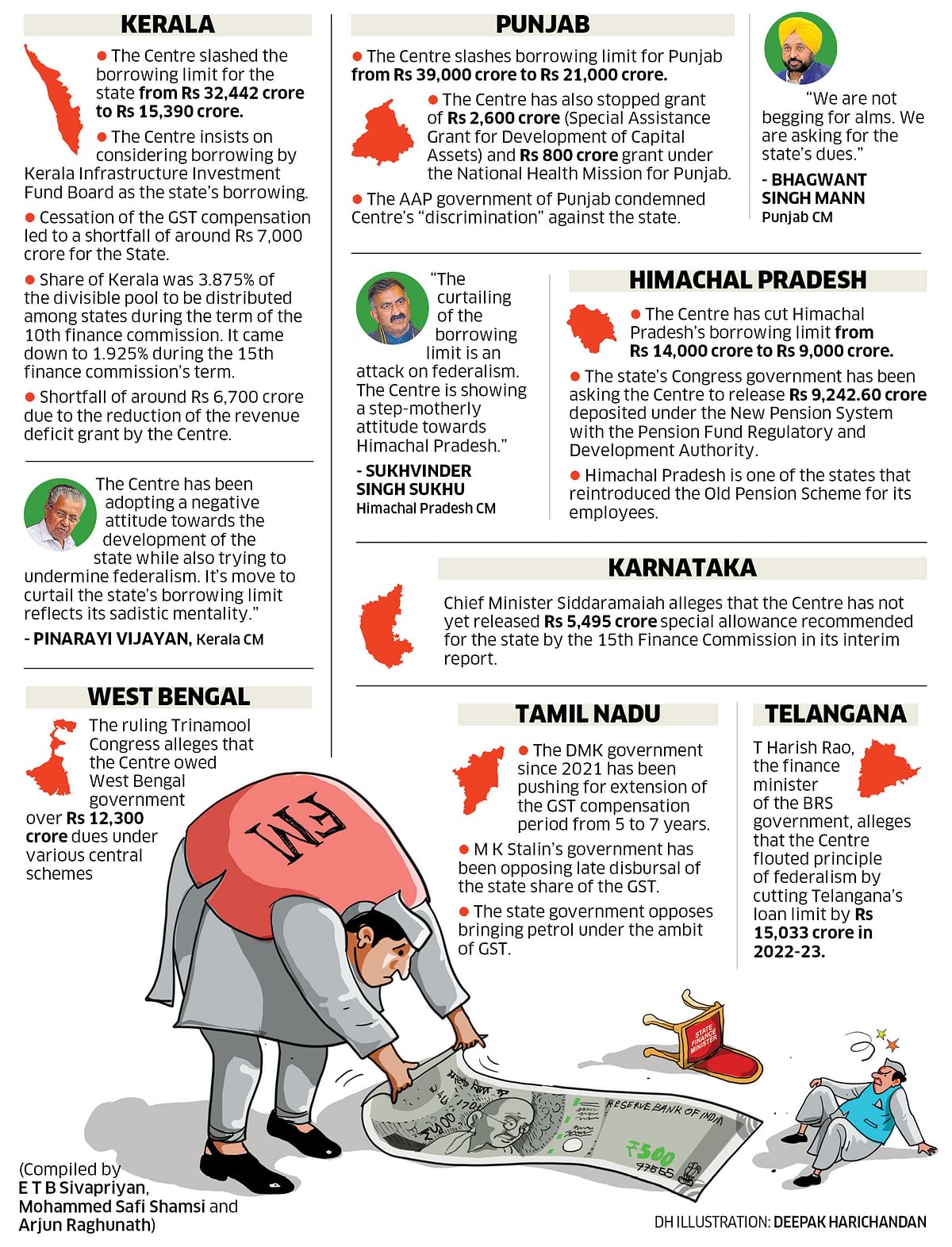
    • Kerala Chief Minister Pinarayi Vijayan leads a protest against the Central Government’s imposition of a financial embargo on Kerala.
    • The NBC limits states’ borrowings, including those from state-owned enterprises like the Kerala Infrastructure Investment Fund Board (KIIFB), leading to a severe financial crisis in Kerala.
    • The article questions the constitutionality of including state-owned enterprises’ debt in the state’s total debt, arguing that it encroaches on the state legislature’s authority over financial matters.
    • Kerala’s Fiscal Responsibility Act, 2003, aims to reduce fiscal deficit, demonstrating the state’s commitment to fiscal discipline.
    • The article criticizes the move towards “annihilative federalism,” where the central government’s actions detrimentally affect states’ ability to meet welfare obligations.

    Key Challenges:

    • Balancing fiscal discipline with the need for states to fund development projects and welfare schemes.
    • Addressing the erosion of fiscal federalism and the encroachment of central authority over state finances.
    • Resolving the conflict between the powers of the central government and state legislatures regarding financial matters.
    • Mitigating the impact of borrowing restrictions on states’ ability to fulfill their financial obligations.

    Key Terms:

    • Net Borrowing Ceiling (NBC): Limit imposed on states’ borrowings from all sources.
    • Kerala Infrastructure Investment Fund Board (KIIFB): State-owned body responsible for funding infrastructure projects.
    • Fiscal Responsibility Act: Legislation aimed at reducing fiscal deficit and promoting financial discipline.
    • Fiscal Federalism: Distribution of financial powers and responsibilities between the central government and states.
    • Annihilative Federalism: Central government actions that undermine states’ financial autonomy and welfare obligations.

    Key Quotes:

    • “The wide array of constitutional issues…point at the severe erosion of fiscal federalism in the country.”
    • “The borrowing restrictions are an example of ‘annihilative federalism’ at play.”

    Key Examples and References:

    • Kerala’s protest led by Chief Minister Pinarayi Vijayan against the financial embargo imposed by the Central Government.
    • The inclusion of KIIFB’s debt in Kerala’s total debt, leading to funding constraints for welfare schemes.
    • Comparison of Kerala’s fiscal deficit reduction efforts with the central government’s fiscal deficit estimates.

    Key Facts and Data:

    • Kerala’s fiscal deficit reported to have reduced to 2.44% of the GSDP.
    • Central government’s fiscal deficit estimated to be 5.8% for 2023-2024.

    Critical Analysis:

    The article underscores the tension between central authority and state autonomy in financial matters, highlighting the constitutional ambiguity surrounding the imposition of borrowing restrictions. It argues for a balanced approach that acknowledges states’ fiscal responsibilities while ensuring fiscal discipline.

    Way Forward:

    • Reevaluate the imposition of borrowing restrictions to ensure they do not unduly impede states’ ability to meet financial obligations.
    • Enhance dialogue and cooperation between the central government and states to address fiscal challenges while respecting constitutional principles.
    • Clarify the division of financial powers between the central government and state legislatures to mitigate conflicts and promote fiscal federalism.
  • Tax contribution by States needs to be revisited


    16th Finance Commission - INSIGHTSIAS


    Central Idea:

    The article advocates for the inclusion of tax contribution, particularly from Goods and Services Tax (GST) and petroleum consumption, as a significant efficiency indicator in the distribution formula used by Finance Commissions to allocate Union tax revenue among states. The authors argue that these measures provide a fair and stable representation of a state’s economic contribution to the national exchequer.

    Key Highlights:

    • Finance Commissions play a crucial role in recommending the distribution of Union tax revenues among states.
    • Historically, tax contribution had less weight in the distribution formula, but it was completely dropped since the 10th Finance Commission.
    • The article contends that tax contribution, especially under the GST regime, is a reliable measure of efficiency, unlike other indicators like tax effort and fiscal discipline.
    • The authors propose that GST and petroleum consumption, being stable and indicative of income, should be given a substantial weight in the distribution formula.

    Key Challenges:

    • Resistance from states that may perceive a potential shift in their shares based on tax contribution.
    • The stability of indicators like tax effort and fiscal discipline is questioned, making it challenging to assign them higher weights.
    • The need to ensure that the inclusion of tax contribution does not lead to unfair outcomes or discourage states from adopting progressive tax policies.

    Key Terms:

    • Goods and Services Tax (GST): A unified consumption-based destination tax equally divided between the State and Central governments.
    • Tax Contribution: The amount of revenue generated by a state through taxes, considered as an efficiency indicator.
    • Finance Commission: A body responsible for recommending the distribution of Union tax revenues among states in India.

    Key Phrases:

    • “Equity and efficiency in tax revenue transfers.”
    • “Tax contribution as an efficiency indicator.”
    • “GST and petroleum consumption as fair measures of states’ contributions to the national exchequer.”

    Key Quotes:

    • “Tax contribution is an efficiency indicator because a State’s level of development and economic structure decides its tax contribution.”
    • “GST satisfies the criterion of stability in tax structure, making it an ideal efficiency indicator.”
    • “There is a persuasive case for the 16th Finance Commission to debate and include these ratios as a measure of efficiency.”

    Key Statements:

    • “Since the 10th Finance Commission, tax contribution was dropped from the distribution formula.”
    • “GST is a consumption-based destination tax that is equally divided between the State and Central governments.”
    • “The Finance Commissions have always favored assigning more than 75% weight to equity indicators.”

    Key Examples and References:

    • The article references the 15th Finance Commission’s distribution formula, which included tax effort, fiscal discipline, and demographic performance.
    • The stability of GST as an efficiency indicator is supported by calculations presented by the authors.

    Key Facts:

    • The share of personal and corporate income taxes is 64% in Central tax revenue in 2021-22.
    • Finance Commissions historically assigned 10% to 20% weight to tax contribution in the distribution formula.

    Key Data:

    • The weightage of tax effort in the 15th Finance Commission’s distribution formula was 2.5%, with demographic performance receiving a weight of 12.5%.
    • The recommended weight for equity indicators in the same formula was 85%.

    Critical Analysis:

    The article provides a compelling argument for the inclusion of tax contribution in the distribution formula, highlighting the stability and fairness of GST as an efficiency indicator. However, potential challenges such as resistance from states and the need for careful consideration to prevent unintended consequences are acknowledged.

    Way Forward:

    The authors suggest that the 16th Finance Commission should actively debate and consider including GST and petroleum consumption with a substantial weight in the distribution formula. This, they argue, would better represent states’ contributions to the national exchequer and promote efficiency in resource allocation.

  • How the Northeast was ‘invented’, 52 years ago?

    Northeast India

    Central Idea

    • On December 30, 1971, two pivotal laws were enacted, reshaping the administrative landscape of Northeast India.
    • These laws marked a transition from the traditional unit of Assam to the broader concept of ‘Northeast India’.

    Formation and Composition of Northeast India

    • States in the Northeast: The region officially includes Arunachal Pradesh, Assam, Manipur, Meghalaya, Mizoram, Nagaland, Sikkim, and Tripura, under the North-Eastern Council.
    • Pre-Independence Structure: Before Independence, Arunachal Pradesh, Assam, Meghalaya, Nagaland, and Mizoram were part of colonial Assam. Manipur and Tripura were princely states with British political officers, while Sikkim, under British paramountcy, became an independent country in 1947 and was annexed by India in 1975. Sikkim joined the North-Eastern Council in 2001.

    Colonial Context and Frontier Province Dynamics

    • Assam as a Frontier Province: Colonial Assam was a frontier province in British India, akin to the North West Frontier Province (now Khyber Pakhtunkhwa, Pakistan).
    • Administrative Divisions: The province was divided into ‘settled districts’ (like present-day Assam and Sylhet in Bangladesh) and ‘excluded areas’ or ‘Hill areas’ (like modern-day Arunachal Pradesh and parts of Nagaland).

    The North Eastern Council (NEC) is composed of the following members:

    • Governors and Chief Ministers of the Member States: Each of the eight states in the North Eastern region, including Assam, Arunachal Pradesh, Meghalaya, Mizoram, Tripura, Sikkim, Nagaland, and Manipur, is represented by their respective Governors and Chief Ministers. These members are ex-officio members of the Council.
    • Chairman: The Chairman is also a member of the Council, although the specific identity of the Chairman is not mentioned in the provided sources.
    • Three Members Nominated by the President: The President of India nominates three additional members to the Council. These members are also part of the NEC

    Post-Independence Security and Administrative Shifts

    • Unique Post-1947 Challenges: After 1947, the region’s borders became largely international, with a narrow land corridor connecting it to the rest of India.
    • Creation of Nagaland: The state of Nagaland was created in 1963, following the Sino-Indian War of 1962, as part of efforts to integrate the Naga people into the Indian state.

    North-Eastern Areas (Reorganisation) Act of 1971

    • Statehood and Union Territories: Manipur and Tripura were elevated to statehood, Meghalaya was formed from Assam, and Mizoram and Arunachal Pradesh were established as union territories, later becoming states in 1987.
    • Strategic Reorganization: This Act represented a strategic shift from the colonial frontier governance to a modern state structure.

    Concept and Implications of ‘Northeast India’

    • Directional Naming and Identity: The term ‘Northeast India’ highlights the region’s distinct identity and its hierarchical relation to the Indian heartland.
    • Racial and Cultural Dimensions: The term ‘Northeasterner’ has often led to racial stereotyping and issues of identity and recognition.

    Conclusion

    • Complex Administrative Evolution: The formation of Northeast India is a testament to the region’s complex history and the Indian state’s response to unique geopolitical challenges.
    • Continued Struggle for Recognition: Despite legislative milestones, Northeast India continues to face challenges in national integration, identity politics, and equitable development.
  • In news: Mullaperiyar Dam

    Mullaperiyar Dam

    Central Idea

    • Tamil Nadu cancelled the decision to open the spillway shutters of Mullaperiyar dam after a lull in rainfall and reduced inflow of water to the dam.

    Do you know?

    The Mullaperiyar dam is located in Kerala on the river Periyar but is operated and maintained by the neighbouring state of Tamil Nadu.

    John Pennycuick (the architect of this dam) sold his family property in England to mobilize money to fund the project! People of the region fondly name their children under his name a remark of reverence.

    Mullaperiyar Dam

    • It is a masonry gravity dam on the Periyar River in Kerala.
    • It is located on the Cardamom Hills of the Western Ghats in Thekkady, Idukki District.
    • It was constructed between 1887 and 1895 by John Pennycuick (who was born in Pune) and also reached in an agreement to divert water eastwards to the Madras Presidency area.
    • It has a height of 53.6 m (176 ft) from the foundation, and a length of 365.7 m (1,200 ft).

    Operational issue

    • The dam is located in Kerala but is operated and maintained by Tamil Nadu.
    • The catchment area of the Mullaperiyar Dam itself lies entirely in Kerala and thus not an inter-State river.
    • In November 2014, the water level hit 142 feet for first time in 35 years.
    • The reservoir again hit the maximum limit of 142 feet in August 2018, following incessant rains in the state of Kerala.
    • Indeed, the tendency to store water to almost the full level of reservoirs is becoming a norm among water managers across States.

    Dispute: Control and safety of the dam

    • Supreme court judgment came in February 2006, has allowed Tamil Nadu to raise the level of the dam to 152 ft (46 m) after strengthening it.
    • Responding to it, the Mullaperiyar dam was declared an ‘endangered’ scheduled dam by the Kerala Government under the disputed Kerala Irrigation and Water Conservation (Amendment) Act, 2006.
    • For Tamil Nadu, the Mullaperiyar dam and the diverted Periyar waters act as a lifeline for Theni, Madurai, Sivaganga, Dindigul and Ramnad districts.
    • Tamil Nadu has insisted on exercising the unfettered colonial rights to control the dam and its waters, based on the 1886 lease agreement.

    Rule of Curve issue

    • A rule curve or rule level specifies the storage or empty space to be maintained in a reservoir during different times of the year.
    • It decides the fluctuating storage levels in a reservoir.
    • The gate opening schedule of a dam is based on the rule curve. It is part of the “core safety” mechanism in a dam.
    • The TN government often blames Kerala for delaying the finalization of the rule curve.

    Back2Basics: Periyar River

    • The Periyar is the longest river in the state of Kerala with a length of 244 km.
    • It is also known as ‘Lifeline of Kerala’ as it is one of the few perennial rivers in the state.
    • It originates from Sivagiri hills of Western Ghats and flows through the Periyar National Park.
    • The main tributaries of Periyar are Muthirapuzha, Mullayar, Cheruthoni, Perinjankutti.
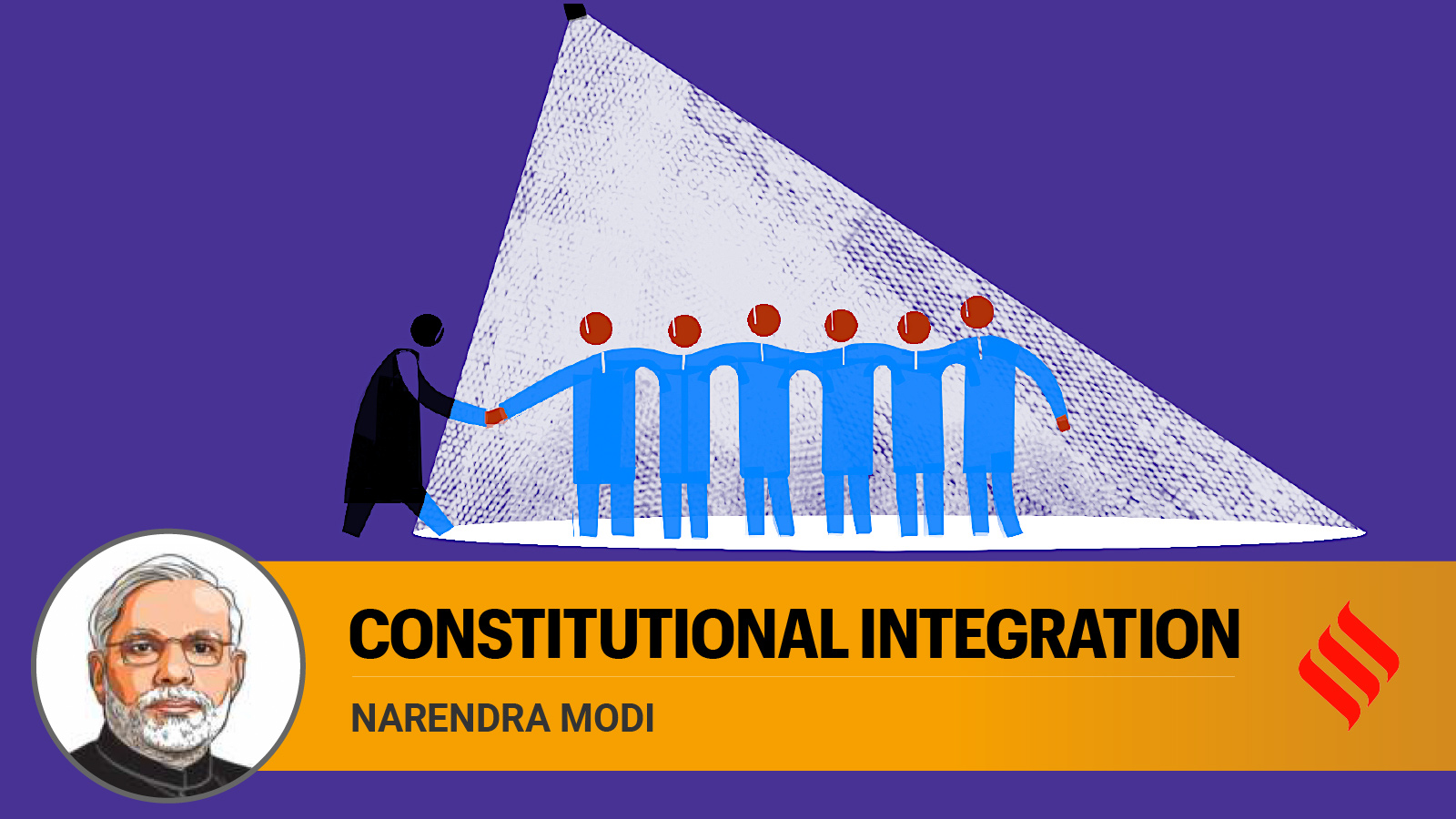
  • Narendra Modi writes on Article 370 verdict: Today, a clean canvas for every child in J&K

    Narendra Modi writes on Article 370 verdict: Today, a clean canvas for  every child in J&K | The Indian Express

    Note for students: This article is written by our prime minister hence it becomes very important from UPSC Perspective. 

    Central idea 

    The text discusses the historic Supreme Court judgment upholding the abrogation of Articles 370 and 35(A) in Jammu and Kashmir. It highlights the positive impact of this decision, emphasizing a shift towards grassroots democracy and renewed focus on development in the region. The author advocates for continued engagement, national integration, and sustained efforts to address historical challenges.

    Key Highlights:

    • Historic Supreme Court Judgment: Upheld the abrogation of Articles 370 and 35(A), emphasizing India’s sovereignty.
    • Long-standing Issues: Jammu, Kashmir, and Ladakh faced violence and instability for seven decades.
    • Leadership Perspective: The author expresses commitment to addressing people’s aspirations and removing perceived injustices.
    • Articles 370 and 35(A) as Obstacles: Seen as major hindrances to development and rights in Jammu and Kashmir.
    • Development Initiatives: Government implemented various initiatives, including a 2015 special package, to address infrastructure, job creation, tourism, and handicraft industry support.
    • Grassroots Democracy: Last four years witnessed renewed focus, improving representation for women, SCs, STs, and marginalized sections.
    • Positive Impact of Abrogation: Visible development, improved infrastructure, increased tourist inflows, and a boost to various government schemes.

    Key Challenges:

    • Historical Confusion: Stemming from centuries of colonization, leading to a lack of clarity on basic issues.
    • Violence and Instability: Jammu, Kashmir, and Ladakh experienced the worst forms of violence and instability for seven decades.
    • Initial Choice at Independence: The narrative suggests a choice between a fresh start for national integration and continuing with a confused approach.

    Key Terms and Phrases:

    • Articles 370 and 35(A): Constitutional provisions abrogated to enhance constitutional integration.
    • Karyakarta: Term referring to a political worker or activist.
    • Insaniyat, Jamhooriyat, and Kashmiriyat: A message emphasizing humanity, democracy, and the unique cultural identity of Kashmir.
    • Fit India Dialogues: Dialogues promoting fitness and well-being.
    • Panchayat Polls: Elections at the grassroots level for local self-governance.

    Key Quotes and Statements:

    • “August 5, 2019, is etched in the hearts and minds of every Indian.”
    • “The people of J&K want development and they want to contribute to the development of India based on their strengths and skills.”
    • “The success of Panchayat polls indicated the democratic nature of the people of J&K.”

    Key Examples and References:

    • Afshan Ashiq: Mentioned as a talented footballer symbolizing positive change from stone-pelting to sports.
    • Dr. Syama Prasad Mookerjee: Quoted for quitting the Nehru Cabinet over the Kashmir issue, becoming a source of inspiration.
    • Atal ji’s “Insaniyat, Jamhooriyat, and Kashmiriyat” message: Referenced as a source of great inspiration.

    Key Facts and Data:

    • Over 150 ministerial visits from May 2014 to March 2019: Highlighting the government’s effort to interact directly with the people of Jammu and Kashmir.
    • Special assistance of Rs 1,000 crore announced in 2014 for rehabilitation after floods: Demonstrating the government’s commitment during crises.
    • Saturation of key central government schemes: Mentioned in sectors like Saubhagya, Ujjwala, housing, tap water connections, and financial inclusion.

    Critical Analysis:

    • Positive Impact of Abrogation: The author emphasizes the positive changes and development in Jammu, Kashmir, and Ladakh post the abrogation of Articles 370 and 35(A).
    • Renewed Faith in Grassroots Democracy: The text suggests a positive shift towards grassroots democracy, with increased representation for marginalized sections.
    • Historical Confusion and Choices: The narrative criticizes historical confusion and advocates for a clearer approach at the time of independence.

    Way Forward:

    • Continued Development: Continue the focus on development, infrastructure, and addressing the aspirations of the people.
    • Sustained Grassroots Engagement: Maintain engagement at the grassroots level, ensuring representation for all sections of society.
    • National Integration: Strengthen the spirit of “Ek Bharat, Shreshtha Bharat” for unity and good governance.
  • Explained: SC Verdict on Abrogation of Article 370

    Article 370

    Central Idea

    • A Constitution Bench of the Supreme Court on Monday unanimously upheld the power of the President to abrogate Article 370 in August 2019, leading to the reorganisation of the full-fledged State of Jammu and Kashmir to two Union Territories and denuding it of its special privileges.

    Key Issues and Court’s Findings

    [A] On the Sovereignty of Jammu and Kashmir:

    • Petitioners’ Claim: They argued that J&K retained an element of sovereignty when it acceded to India in 1947, different from other princely states.
    • Court’s Examination: The Court noted that J&K was listed as a Part III state in the Indian Constitution and Section 3 of J&K’s Constitution declared it an integral part of India.
    • Final Ruling: The Court held that J&K did not retain sovereignty, and the process of integration was ongoing, culminating in the Presidential declaration under Article 370(3).

    [B] Whether Article 370 is Temporary or Permanent:

    • Arguments Presented: Petitioners argued for Article 370’s permanence, while others viewed it as temporary.
    • Court’s Opinion: Both CJI Chandrachud and Justice Kaul concurred that Article 370 was a temporary provision.

    [C] Legality of Abrogating Article 370:

    • Abrogation Process: On August 5, 2019, President Ram Nath Kovind issued CO 272, amending Article 367 and redefining “Constituent Assembly of Jammu and Kashmir” as the “Legislative Assembly of Jammu and Kashmir.”
    • Court’s Upholding: The Court upheld this process, with CJI Chandrachud stating that post-dissolution of J&K’s Constituent Assembly, the President could have unilaterally abrogated Article 370.

    [D] Actions Under President’s Rule:

    • Challenge to Union’s Actions: The challenge was to the extent of powers appropriated under Article 356 (President’s rule).
    • Reference to Bommai Ruling: The Court, citing the 1994 Bommai ruling, stated that actions under the President’s rule must not be mala fide or irrational.

    Upholding Centre’s (Union) Supremacy

    • Parliament’s Unilateral Actions: The Court’s interpretation suggests Parliament can change a state’s status under the President’s rule.
    • Article 3 Reference: The President referred the Jammu and Kashmir Reorganisation Bill, 2019, to Parliament for its views, as the state was under President’s rule.
    • Validity of Executive Orders: The Court applied Bommai ruling standards to validate the executive orders, emphasizing the need for proof of mala fides to challenge the actions.

    Conclusion

    • J&K’s Integral Status Affirmed: The Court conclusively ruled that J&K has always been an integral part of India.
    • Temporary Nature of Article 370: The ruling clarifies that Article 370 was a temporary provision.
    • Expansion of Union Powers: The judgment potentially expands the Union’s powers under President’s rule, affecting the federal balance.
    • Constitutional Precedent: This ruling sets a significant precedent in interpreting Union and state powers, reflecting on the dynamics of Indian federalism.
  • Karan Singh’s Proclamation of 1949

    karan singh

    Central Idea

    • On December 11, the Supreme Court upheld the abrogation of Article 370, affirming that Jammu and Kashmir (J&K) did not retain sovereignty after joining the Union of India.
    • CJI D Y Chandrachud, writing for himself and Justices B R Gavai and Surya Kant, cited a 1949 proclamation by Yuvraj Karan Singh (successor of J&K titular Maharaja) as a key factor in this decision.

    Karan Singh’s 1949 Proclamation

    • Repeal of the Government of India Act, 1935: The proclamation declared the repeal of the Government of India Act, 1935, which previously governed J&K’s constitutional relationship with India.
    • Adoption of the Indian Constitution: It stated that the Indian Constitution would govern J&K’s relationship with the Union of India and abrogate inconsistent constitutional provisions in the state.

    Reason behind the Proclamation

    • Karan Singh’s Perspective: Speaking to The Indian Express, Karan Singh, aged 92, explained that the proclamation was necessary to eliminate ambiguity regarding J&K’s integration with India.
    • Instrument of Accession’s Ambiguity: He noted that while his father, Hari Singh, signed the Instrument of Accession like other rulers, J&K retained a measure of autonomy, leading to questions about its complete integration.

    Supreme Court’s Findings

    • Essence of the Judgment: The Court stated that J&K did not retain any form of sovereignty upon joining India.
    • Significance of the 1949 Proclamation: The Court highlighted that Karan Singh’s proclamation superseded all constitutional provisions inconsistent with the Indian Constitution, effectively surrendering J&K’s sovereignty.

    Alignment with the Centre’s Argument

    • Centre’s Stance: The Union government argued that the 1949 proclamation acknowledged the supremacy of the Indian Constitution and surrendered sovereignty to it, where the sovereign is ‘We the people of India’.
    • Court’s Agreement: The Supreme Court’s ruling aligns with this argument, affirming the complete integration of J&K into India.

    Conclusion

    • The Supreme Court’s decision clarifies the constitutional status of J&K post the abrogation of Article 370, confirming its full integration into the Indian Union without any retained sovereignty.
    • The ruling underscores the historical context of J&K’s accession and the role of the 1949 proclamation in shaping its constitutional relationship with India.
  • It is high time the colonial institution of the governor is reined in

    The Tussle Between Chief Ministers and Governors: Preserving the Sanctity  of Legislative Processes - Civilsdaily

    Central idea

    The article delves into the persistent constitutional challenges posed by the role of governors in India, emphasizing historical debates, predicting issues realized over time, and proposing judicial and constitutional solutions for effective governance and accountability.

    Key Highlights:

    • Governor’s Constitutional Role: The article highlights the constitutional concerns regarding the role of governors in Indian states, emphasizing their appointed nature and potential overreach in state matters.
    • Recent Instances in Tamil Nadu: Specific instances in Tamil Nadu, where Governor R N Ravi returned bills for assent and delayed decisions, serve as examples of the ongoing issues related to gubernatorial powers.
    • Constitutional Design Critique: The piece delves into the historical debates in the Constituent Assembly, expressing concerns raised by members like Dakshayani Velayudhan about the replication of colonial structures and the centralized nature of power.
    • Unaddressed Predictions: The article points out that predictions made during the Constituent Assembly debates about potential misuse of gubernatorial powers have materialized, with governors often serving as agents of the Union government.

    Challenges:

    • Appointment and Removal Disparities: It highlights the disparities between the appointment and removal processes of the President and the Governor, suggesting a lack of checks and balances for governors’ actions.
    • Perverse Incentives: The piece discusses the perverse incentives for governors, as they are secure in their positions as long as they align with the Union government, potentially leading to undue interference in state affairs.

    Key Phrases:

    • Colonial Legacy of Governors: The article stresses the continuation of the colonial institution of governors, raising questions about its relevance in an independent India.
    • Powers and Accountability: It explores the imbalance in powers and accountability between the President and the Governor, pointing out the governor’s vulnerability to the Union government’s preferences.

    Analysis:

    • Judicial Intervention: The piece acknowledges the increasing judicial intervention to address governors’ conduct but questions the need for repeated court interventions and calls for a more sustainable solution.
    • Constitutional Reform Proposal: While presenting a constitutional reform proposal from “Heads Held High,” the article suggests making governors accountable to state legislatures through election and impeachment, mirroring the President’s accountability to the Union Parliament.

    Way Forward:

    • Viable Alternatives: Instead of outright abolition, the article advocates for viable alternatives such as judicial scrutiny and comprehensive constitutional reforms to bring accountability and balance to the role of governors.
    • State Legislature Accountability: Proposing a way forward, the article suggests a model where governors are made accountable to state legislatures through election and impeachment, akin to the President’s accountability at the national level.