💥Join UPSC 2027,2028 Mentorship (August Batch) + XFactor Notes & Microthemes PDF

GS Paper: GS3-03.Government Budgeting

  • Centre’s fiscal outlook faces geopolitical, revenue risks

    Question (2025, GS2): “Examine the evolving pattern of Centre-State financial relations in the context of planned development in India. How far have the recent reforms impacted the fiscal federalism in India?”
    Linkage: The Centre’s reliance on new cesses and duties to meet its budget goals, rather than expanding the core tax base itself, directly impacts fiscal federalism. Cesses and surcharges do not go into the divisible pool shared with states, altering Centre-State financial dynamics.

    Mentor comment

    Controller General of Accounts data show the Centre’s gross tax revenues growing only 3.7% in the first quarter of 2026-27, with Goods and Services Tax collections contracting and Union excise duties falling more than a fifth. The fiscal arithmetic is being held near its budgeted position by a larger nominal Gross Domestic Product denominator, by non-tax receipts led by the Reserve Bank of India dividend, and by new cesses and duties, rather than by the tax base itself.

    What is the divisible pool of central taxes?

    1. About: The divisible pool is that part of the Centre’s gross tax revenue which is shared with the States, arrived at after deducting collection costs, cesses and surcharges.
    2. The States’ share: The Sixteenth Finance Commission retained the share of States in the divisible pool of central taxes at 41%.
    3. From gross to net: The Centre’s net tax revenue is what remains after devolution, and a factor of 65% of gross tax revenue reflects the ratio of net to gross tax revenues in 2025-26 and in the 2026-27 Budget Estimates.
    4. Why cesses matter to it: A cess levied for a specified purpose sits outside the divisible pool, so the same rupee raised through a cess rather than a tax does not reach the States as devolution.

    What is tax buoyancy?

    1. About: Tax buoyancy measures how far tax revenue grows for each unit of growth in nominal Gross Domestic Product, capturing both the natural response of the tax base and the effect of policy changes.
    2. What zero buoyancy means: Personal income tax revenue growth in 2025-26 was only 0.037%, which implies a buoyancy of zero, so the tax raised nothing extra despite the economy expanding.

    What is the Implicit Price Deflator?

    1. About: The Implicit Price Deflator is the ratio of nominal to real Gross Domestic Product, and it captures the average price change across everything the economy produces rather than a fixed consumption basket.
    2. How it is used here: An Implicit Price Deflator based inflation of 5% to 5.5% is what converts an expected real growth of about 7% into nominal Gross Domestic Product growth of 12.5% to 13% in 2026-27.

    What is a cess?

    1. About: A cess is a levy imposed for a specified purpose, collected over and above the base tax, and its proceeds are meant to be applied only to that stated purpose.
    2. Its fiscal effect: Cess proceeds are not shareable with the States, so a shift from taxes to cesses reduces the shareable pool while leaving gross collections unchanged.

    Why did the Centre’s gross tax revenues grow only 3.7%?

    1. Two large taxes were rationalised: Personal income tax and Goods and Services Tax were both subjected to substantive modifications in 2025-26, with extensive rate rationalisation in both cases and a substantive rate reduction in the case of the Goods and Services Tax.
    2. The stated expectation: Those reforms were expected to entail an initial revenue sacrifice, with subsequent expansion of the tax base offsetting the loss over time.
    3. The carry-forward into this year: Personal income tax showed growth of 6.8% in the first quarter of 2026-27, and Goods and Services Tax revenues contracted 11%.
    4. The 2025-26 baseline: Goods and Services Tax revenue growth for the second half of 2025-26 was 4.67%, and personal income tax growth over the same year was effectively nil.
    5. The excise duty cut: As retail fuel prices rose on the West Asian crisis, the government reduced excise duties to ease the burden on consumers, and revenue from Union excise duties contracted 22.4% in the first quarter of 2026-27.

    What three remedial measures has the government taken?

    1. A new cess replacing a discontinued one: A Health Security and National Security Cess was introduced with effect from 1 February 2026, even as the Goods and Services Tax Compensation Cess was discontinued.
    2. A higher windfall tax on fuel exports: The windfall tax on exports of diesel, petrol and aviation turbine fuel was increased with effect from 3 August 2026.
    3. Higher import duties on precious metals: Import duty rates were raised on gold and silver bullion and on other specific precious metal articles, sweepings and clad metals.

    How does a higher nominal GDP change the fiscal picture?

    1. The budgeted assumption is being exceeded: The Budget assumed nominal Gross Domestic Product growth of 10.04%, well short of the growth now expected for the year.
    2. The consistency check: That deflator range is consistent with Consumer Price Index inflation at 3.9% and Wholesale Price Index inflation at 9.3% in the first quarter of 2026-27.
    3. The level, not the growth rate, is lower: On the 2022-23 base series, nominal Gross Domestic Product is estimated at Rs 391 lakh crore, below the budgeted level of Rs 393 lakh crore.
    4. The net effect on revenue: Taken together, estimated gross tax revenue would be realised or fall short by a small margin.

    What has happened to transfers to the States?

    1. A sharp contraction in the first quarter: Tax devolution to the States contracted 19.5% in the first quarter of 2026-27, with an expectation of higher assignment of central tax revenues in subsequent months.
    2. The shareable pool narrows at the margin: The introduction of the non-shareable Health Security and National Security Cess produces a marginal reduction in the shareable pool, though some part of its revenues may reach the States as grants outside the Finance Commission route.
    3. Finance Commission grants are budgeted lower: Based on the Sixteenth Finance Commission’s recommendation, Finance Commission grants for the States are budgeted to contract by Rs 23,556 crore in 2026-27.
    4. The devolution share itself is unchanged: The contraction is in the amounts flowing, not in the entitlement, since the States’ share in the divisible pool stays at 41%.

    What is holding the revenue account together?

    1. The central bank dividend: The Reserve Bank of India transferred dividends to the Centre in May 2026, so 77% of the budgeted dividends and profits for the full year were already covered in the first three months.
    2. Weight of non-tax revenue: The Centre’s non-tax revenues contributed 37% of its net revenue receipts in the first quarter of 2026-27.
    3. Other receipts on track: The budgeted amounts for non-tax and non-debt capital receipts are expected to be realised.
    4. Subsidy pressure on the other side: Major subsidies had to be increased 37.4% in the quarter because of the unexpected rise in global crude oil prices.
    5. Revenue expenditure held down: Growth in revenue expenditure was contained at 7.4% over the same quarter.
    6. Capital expenditure front-loaded: Capital expenditure grew 23.7% in the first quarter of 2026-27, against a contraction of 23.3% in the fourth quarter of 2025-26.
    7. The full-year subsidy overshoot: Extrapolating first-quarter subsidies to the year, realised subsidies are expected to exceed the budgeted amount by about Rs 50,000 crore.

    Where do the deficit numbers stand, and what could push them off track?

    1. First-quarter deficit position: The fiscal deficit accounted for 18.2% of the annual budgeted magnitude in the first quarter, and the corresponding share of the revenue deficit was 0.4%.
    2. Why the revenue account looks strong: The revenue account balance is held up mainly by the contribution of non-debt receipts, not by tax collections.
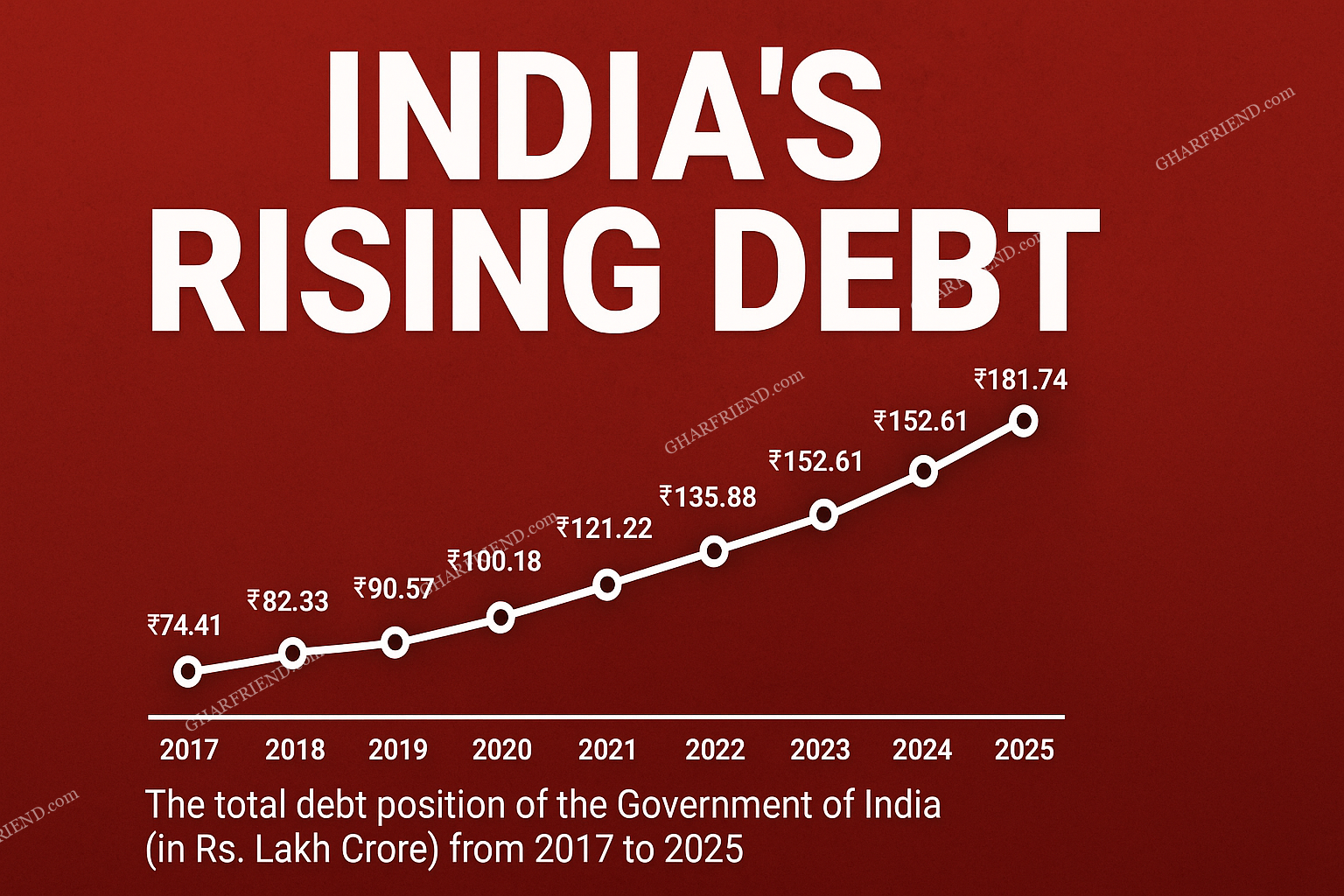
    3. The full-year estimates: Fiscal deficit calculated as the increment in debt is estimated at Rs 18.16 lakh crore, giving a fiscal deficit-to-Gross Domestic Product ratio of 4.6% on the new series, with the debt-to-Gross Domestic Product ratio at 55.8%.
    4. Three named slippage risks: A shortfall in tax revenues, an unbudgeted increase in revenue expenditure arising from additional subsidies, and a slightly higher external debt amid sustained pressure on the Indian rupee.
    5. The overriding risk: An escalation of the war in West Asia would deliver a major jolt to the economy and to central finances.
    6. The unwound measure: The reduction in excise duty on fuel must be restored at some suitable time, since it is a temporary relief carried at a permanent revenue cost.

    What challenges does the Centre’s fiscal consolidation path face?

    1. Rate rationalisation without base expansion: A tax cut delivers the revenue sacrifice immediately and the base expansion only over an uncertain horizon. Eg. Personal income tax delivered a buoyancy of zero in 2025-26, the year its rationalisation took effect.
    2. Subsidy exposure to imported energy prices: Subsidy outgo is set by global crude prices rather than by a domestic policy decision. Eg. Major subsidies rose 37.4% in the first quarter of 2026-27, putting the full year on course to overshoot its budgeted provision.
    3. Reliance on a single large non-tax transfer: A dividend from the central bank is a discretionary, year-specific receipt that cannot be assumed to repeat. Eg. 77% of the full year’s budgeted dividends and profits were covered in the first three months of 2026-27.
    4. Revenue relief that is politically hard to withdraw: An excise duty cut given when fuel prices rise is difficult to reverse when they fall. Eg. Union excise duties contracted 22.4% in the first quarter of 2026-27 following the cut.
    5. Deficit ratios improved by a denominator effect: A higher nominal Gross Domestic Product lowers the deficit ratio without any change in borrowing. Eg. Nominal growth running ahead of the budgeted 10.04% flatters the 4.6% fiscal deficit ratio.
    6. Interest burden crowding out capital spending: A debt-to-Gross Domestic Product ratio near 56% commits a large share of revenue receipts to interest before any programme is funded. Eg. Capital expenditure was front-loaded 23.7% in the first quarter after contracting 23.3% in the preceding quarter, a pattern that shifts rather than raises the annual total.
    7. Exchange rate pressure raising external liabilities: A weaker rupee raises the rupee cost of external debt service without any new borrowing. Eg. Sustained pressure on the rupee is named as one of the three sources of possible slippage from budgeted outcomes.

    Conclusion

    The Centre’s 2026-27 outcomes are likely to stay close to budgeted levels, and the reasons are a larger nominal Gross Domestic Product, front-loaded non-tax receipts and three new revenue measures, not a tax base that is delivering. Gross tax revenue growing at barely a third of the pace of nominal output is the number that has to change, since the rate rationalisations of 2025-26 were justified on the promise of base expansion that has not yet appeared. The immediate unresolved decisions are when the excise duty cut on fuel is restored and how far an escalation in West Asia pushes subsidies beyond the overshoot already projected.

    What is Fiscal Federalism?

    1. About: Fiscal federalism is the division of taxation powers, expenditure responsibilities and transfer arrangements between the Union and the States in a federal system.
    2. Rationale: Revenue-raising powers concentrate at the Centre because major tax bases are mobile, while expenditure responsibilities concentrate at the States because services are delivered locally. Transfers exist to close that gap.
    3. Vertical fiscal imbalance: The mismatch between the Union’s revenue capacity and the States’ expenditure responsibilities, addressed through devolution of a share of central taxes.
    4. Horizontal fiscal imbalance: The mismatch across States in revenue capacity and expenditure need, addressed through the Finance Commission’s distribution formula among States.
    5. Third tier imbalance: The mismatch between the functions devolved to panchayats and municipalities and the revenue sources available to them, addressed through State Finance Commissions and grants.
    6. The transfer instruments: Tax devolution from the divisible pool, Finance Commission grants, and centrally sponsored schemes with a matching State contribution.

    Key Concerns Regarding Fiscal Federalism

    1. Shrinking divisible pool through cesses and surcharges: Levies outside the divisible pool raise Union revenue without expanding what is shared, so the effective transfer falls below the headline share.
    2. Erosion of State taxation autonomy under the Goods and Services Tax: States surrendered independent rate-setting on most indirect taxes, and rate decisions now require a collective decision in a council.
    3. Weak third tier finances: Local bodies depend on transfers rather than own revenue, and State Finance Commissions are constituted irregularly in several States.
    4. Contested horizontal distribution criteria: Weighting population, income distance and demographic performance sets States that have controlled population growth against those with larger populations.
    5. Conditionality attached to central transfers: Centrally sponsored schemes tie State spending to Union priorities, reducing the discretion that devolution is meant to confer.
    6. Off-budget and contingent liabilities: Borrowing routed through State-owned entities and guarantees sits outside the headline deficit at both levels, obscuring the true fiscal position.

    Constitutional Framework Governing Union Finances

    1. Article 265: No tax shall be levied or collected except by authority of law.
    2. Article 266: Establishes the Consolidated Fund and the Public Account of India and of each State.
    3. Article 267: Provides for the Contingency Fund of India, placed at the disposal of the President for unforeseen expenditure.
    4. Article 112: Requires the annual financial statement of estimated receipts and expenditure to be laid before Parliament.
    5. Article 246 and the Seventh Schedule: Distribute legislative and taxation powers between the Union and the States through the Union, State and Concurrent Lists.
    6. Article 246A: Confers concurrent power on Parliament and State legislatures to make laws on the Goods and Services Tax.
    7. Article 269A: Provides for the levy and collection of the Goods and Services Tax on inter-State supply and its apportionment between the Union and the States.
    8. Article 270: Provides for the distribution of taxes levied and collected by the Union between the Union and the States, and excludes cesses and surcharges from that distribution.
    9. Article 271: Empowers Parliament to levy a surcharge on specified taxes for the purposes of the Union, the proceeds of which accrue wholly to the Union.
    10. Article 275: Provides for grants-in-aid from the Union to States in need of assistance.
    11. Article 279A: Provides for the constitution of the Goods and Services Tax Council.
    12. Article 280: Provides for the constitution of a Finance Commission every fifth year to recommend the distribution of taxes and the principles governing grants-in-aid.
    13. Article 282: Permits the Union or a State to make any grant for any public purpose, the provision under which centrally sponsored schemes are funded.
    14. Article 292 and Article 293: Govern borrowing by the Union and by the States, with State borrowing subject to Union consent where the State is indebted to the Union.
    15. Article 360: Provides for a proclamation of financial emergency.

    Laws Governing Government Budgeting in India

    1. Fiscal Responsibility and Budget Management Act, 2003: Requires the Centre to limit the fiscal deficit and to lay medium-term fiscal policy statements before Parliament.
    2. Amended in 2018 to shift the primary anchor from the revenue deficit to a debt-to-Gross Domestic Product target, with an escape clause for specified circumstances.
    3. Fiscal Responsibility and Budget Management Rules, 2004: Prescribe the form of the disclosure statements and the quarterly review requirement.
    4. Comptroller and Auditor General’s (Duties, Powers and Conditions of Service) Act, 1971: Provides the basis for audit of Union and State accounts and for the reports laid before the legislatures.
    5. State fiscal responsibility legislation: Every State has enacted its own fiscal responsibility law setting deficit and debt limits, complementing the Union statute.
    6. Appropriation and Finance Acts: The Appropriation Act authorises withdrawal from the Consolidated Fund, and the Finance Act gives effect to the taxation proposals for the year.

    Government Initiatives in Public Financial Management

    1. Public Financial Management System: An end-to-end platform tracking fund release and utilisation from the Union to the last implementing agency, reducing float in the system.
    2. Direct Benefit Transfer: Routes subsidy and benefit payments to bank accounts directly, cutting duplication and leakage in the transfer chain.
    3. Single Nodal Agency mechanism: Requires each centrally sponsored scheme in a State to operate through one designated account, so unspent balances are visible.
    4. Special Assistance to States for Capital Investment: Provides fifty-year interest free loans to States tied to capital expenditure and to specified reforms.
    5. National Monetisation Pipeline: Raises resources by leasing operating public assets while retaining ownership, supplementing tax revenue for capital spending.
    6. Goods and Services Tax Network: The common technology platform for registration, return filing and invoice matching that generates the data underlying indirect tax collections.

    Back2Basics: Sixteenth Finance Commission

    1. What it is: A constitutional body constituted under Article 280 to recommend the distribution of net tax proceeds between the Union and the States, the allocation among States, and the principles governing grants-in-aid.
    2. Constitution: Constituted in December 2023, chaired by a former Vice Chairman of NITI Aayog.
    3. Award period: Its recommendations cover the five years beginning 2026-27.
    4. Advisory Council: The Commission is assisted by an Advisory Council of economists and public finance specialists.
    5. Status of recommendations: Its report is laid before Parliament along with an explanatory memorandum on the action taken, and the recommendations are advisory rather than binding.
    6. Additional terms of reference: Beyond devolution, the Commission examines disaster management financing and the review of State fiscal positions.

    Challenges in India’s Public Finances

    1. A low tax-to-Gross Domestic Product ratio: India’s combined tax collection relative to output remains below that of comparable middle-income economies, which caps what can be spent without borrowing. Eg. Gross tax revenue in the first quarter of 2026-27 grew at less than a third of the nominal output growth expected for the year.
    2. Narrow direct tax base: A small share of the population files and pays income tax, so any rate change transmits through a thin base. Eg. Personal income tax raised no more in 2025-26 than in the year before, despite nominal output expanding through that year.
    3. Rigidity of committed expenditure: Interest, salaries, pensions and statutory transfers consume most revenue receipts before discretionary spending begins. Eg. The debt-to-Gross Domestic Product ratio is estimated at 55.8% for 2026-27.
    4. Exposure to imported commodity prices: Fuel and fertiliser subsidies move with global prices rather than with domestic policy. Eg. Major subsidies rose 37.4% in the first quarter of 2026-27 on the unexpected rise in global crude oil prices.
    5. Volatility of non-tax receipts: Dividends, disinvestment proceeds and spectrum receipts are lumpy and cannot be relied on across years. Eg. Non-tax revenues contributed 37% of net revenue receipts in the first quarter of 2026-27.
    6. State-level fiscal stress and guarantees: Contingent liabilities from State-owned distribution companies and guaranteed borrowings sit outside headline deficits. Eg. Tax devolution to the States contracted 19.5% in the first quarter, tightening State cash positions in the same period.
    7. Weak link between capital spending and outcomes: Front-loading capital expenditure raises the quarterly number without ensuring project completion. Eg. Capital expenditure grew 23.7% in the first quarter of 2026-27 after contracting 23.3% in the preceding quarter.

    Way Forward

    1. Restore the excise duty on fuel on a stated schedule: Announcing the timing in advance converts a politically difficult reversal into a pre-committed step, as the analysis itself recommends.
    2. Publish base expansion metrics alongside rate rationalisation: Reporting the change in the number of filers and in registered taxpayers would test the premise on which the 2025-26 rationalisation was justified.
    3. Cap the share of revenue raised through cesses and surcharges: A ceiling would stop the divisible pool narrowing through instruments that bypass Article 270.
    4. Insulate subsidy budgeting from a single price assumption: Building a price band and a contingency provision into the subsidy estimate would prevent an overshoot of this size appearing mid-year.
    5. Treat central bank dividends as a windfall, not a base receipt: Directing above-trend transfers to debt reduction rather than to recurring expenditure would stop a one-off receipt becoming a structural assumption.
    6. Smooth capital expenditure across quarters: Front-loading followed by contraction disrupts contractor payment cycles and project execution, so a steady release profile serves outcomes better than a strong first quarter.
    7. Bring off-budget and guaranteed borrowing into the disclosure statements: Consolidated reporting at both Union and State levels is the precondition for the debt path to mean what it states.

    “[2019, GS3, 10] The public expenditure management is a challenge to the Government of India in context of budget making during the post liberalization period. Clarify it.”

  • Govt. brings scheme to disclose foreign assets

    Why in the News

    The Central Board of Direct Taxes notified the Foreign Assets of Small Taxpayers Disclosure Scheme (FAST-DS), open from 16 August to 31 December 2026. The scheme offers immunity from penalty and prosecution under the black money law in exchange for an effective 60 per cent levy. The tension is between clearing a large stock of inadvertent non disclosure by salaried professionals and the moral hazard of repeated amnesty windows.

    What is FAST-DS?

    1. About: FAST-DS is a time bound voluntary disclosure window for undisclosed foreign income and assets held by small taxpayers.
    2. Category one: Previously untaxed foreign assets or income with an aggregate value up to Rs 1 crore, charged at 30 per cent tax plus 30 per cent in lieu of penalty, an effective 60 per cent.
    3. Category two: Foreign assets up to Rs 5 crore that were already offered to tax, or acquired while the holder was non resident, but were not reported in the return schedule, settled through a flat fee of Rs 1 lakh.
    4. Valuation date: Fair market value is determined as of 31 March 2026.
    5. Relief granted: Immunity from penalty and prosecution under the Black Money (Undisclosed Foreign Income and Assets) and Imposition of Tax Act, 2015.
    6. Exclusion: Immunity does not extend to proceedings under the Prevention of Money Laundering Act, 2002.

    Who is the scheme actually aimed at?

    1. Target group: Students, young technology professionals and returning non resident Indians who hold foreign equity awards.
    2. Typical asset: Restricted stock units and employee stock options vested while working for a foreign parent company.
    3. Nature of default: The default is usually a failure to fill the foreign asset schedule of the return, not concealment of income.
    4. Penalty exposure avoided: The 2015 Act prescribes a flat penalty of Rs 10 lakh for non disclosure of a foreign asset regardless of the asset’s size.

    Why is the government able to detect these assets now?

    1. Common Reporting Standard: Participating jurisdictions automatically exchange financial account information on each other’s residents.
    2. Foreign Account Tax Compliance Act: The bilateral arrangement with the United States requires reporting of accounts held by Indian residents.
    3. Effect on enforcement: Automatic exchange converts detection from an investigative exercise into a data matching exercise.
    4. Consequence for taxpayers: Non disclosure that once went unnoticed now surfaces as a mismatch in the department’s records.

    What does the design tell us about the government’s calculation?

    1. Rate choice: An effective 60 per cent rate is punitive against the 30 per cent maximum marginal rate, so the scheme is not priced as a concession.
    2. Threshold choice: The Rs 1 crore and Rs 5 crore ceilings exclude large scale offshore holdings, keeping the window away from serious evaders.
    3. Money laundering carve out: Retaining Prevention of Money Laundering Act exposure signals that the scheme buys relief from reporting failure, not from criminal conduct.
    4. Duration: A four and a half month window forces disclosure decisions inside one assessment cycle.

    Challenges to voluntary disclosure schemes

    1. Moral hazard: Repeated windows teach compliant taxpayers that waiting is rewarded. e.g. the Income Declaration Scheme of 2016 following earlier voluntary disclosure rounds.
    2. Modest collections: Disclosure schemes typically raise far less than projected. e.g. the 2015 black money compliance window collecting about Rs 2,428 crore in tax and penalty.
    3. Valuation disputes: Fair market value of unlisted foreign equity is contestable and invites later litigation. e.g. disputes over the valuation of unlisted shares under earlier disclosure rounds.
    4. Equity objection: Constitutional challenges have been mounted arguing amnesty discriminates against honest taxpayers. e.g. the Supreme Court’s observations in the challenge to the 1997 Voluntary Disclosure of Income Scheme.
    5. Residual exposure: Immunity under one statute does not close exposure under others, which suppresses participation. e.g. the explicit exclusion of Prevention of Money Laundering Act proceedings in this scheme.
    6. Data mismatch errors: Automatic exchange data carries identity and currency conversion errors that generate wrongful notices. e.g. duplicate reporting of joint accounts under the Common Reporting Standard.

    Conclusion

    FAST-DS is priced and capped so that it functions as a clean up of reporting failure by salaried professionals rather than as an amnesty for offshore concealment. Retaining money laundering exposure is what keeps the scheme distinguishable from a general pardon. The next milestone is the disclosure volume reported when the window closes on 31 December 2026.

    Back2Basics: Black Money (Undisclosed Foreign Income and Assets) and Imposition of Tax Act, 2015

    1. Enacted in 2015 to deal specifically with undisclosed foreign income and assets, separately from the Income-tax Act.
    2. Levies a flat tax of 30 per cent on undisclosed foreign income and assets, with no deductions or exemptions permitted.
    3. Prescribes a penalty of three times the tax on undisclosed foreign assets, and a flat penalty of Rs 10 lakh for failure to disclose a foreign asset in the return.
    4. Provides for rigorous imprisonment of three to ten years for wilful attempt to evade tax on foreign income or assets.
    5. Applies to persons resident in India, and covers assets held as a beneficial owner or beneficiary.

    Way Forward

    1. Make the disclosure schedule simpler: Redesign the foreign asset schedule so vested equity awards can be reported without professional assistance.
    2. Pre fill from exchanged data: Populate the return with information already received under automatic exchange, converting disclosure into confirmation.
    3. Separate reporting failure from evasion: Set a lower statutory penalty for a first time reporting lapse below a defined threshold, so an amnesty window is not needed to fix it.
    4. Publish outcome data: Report collections and participant counts after closure, so the case for or against future windows rests on evidence.
    5. Close the window credibly: State that no further disclosure window will follow, since the deterrent value of the 2015 Act depends on that expectation.

    Matching Previous Year Question

    “[2021] Which one of the following effects of the creation of black money in India has been the main cause of worry to the Government of India? (a) Diversion of resources to the purchase of real estate and investment in luxury housing (b) Investment in unproductive activities and purchase of precious stones, jewelry, gold, etc. (c) Large donations to political parties and the growth of regionalism (d) Loss of revenue to the State Exchequer due to tax evasion Answer: (d)”

  • Govt plans tax relief for offshore funds, electronics’ contract manufacturing

    Why in the News?

    The government has circulated the Taxation and Other Laws (Amendment) Bill, 2026, which relaxes the conditions under which offshore funds managed from India can claim tax exemption. The Bill also extends a tax exemption for foreign firms supplying equipment to electronics contract manufacturers and introduces a fresh tax holiday for rough-diamond trading in a notified zone. The measures respond to foreign outflows and to lobbying by manufacturers seeking tax certainty.

    What is the Taxation and Other Laws (Amendment) Bill 2026?

    1. Purpose: The Bill amends the Income-tax Act to promote fund management activity and provide tax certainty to specified foreign and offshore entities. It bundles relief for offshore funds, electronics contract manufacturing and rough-diamond trading.
    2. Replaces an Ordinance: The Bill replaces the Income-tax (Amendment) Ordinance, 2026 promulgated on 5 June, which had exempted foreign portfolio investors from capital gains and withholding taxes on government securities. The Ordinance was brought amid pressure on the rupee and foreign outflows.

    What is an Eligible Investment Fund (offshore fund)?

    1. Definition: An Eligible Investment Fund is an offshore pooled investment vehicle that can be managed by a fund manager based in India without the fund itself being treated as having a taxable business presence in India.
    2. Why the safe harbour matters: Without the exemption, the manager’s activity in India could create a business connection, exposing the fund’s global income to Indian tax at rates of up to 38%.

    Key Rules for an Eligible Investment Fund

    1. Outside Location: The fund must be created, registered, or incorporated outside the host country (for example, outside India).
    2. Non-Resident Status: The fund and its general members must live or reside outside the target country.
    3. Member Limits: It usually needs a minimum number of members (such as 25 non-connected investors) so that it is a true public or pooled vehicle and not controlled by a single family or small group.
    4. Diverse Ownership: No single member or direct group can hold a massive stake (usually restricted below 10% or 20% depending on precise tax codes) to prevent individual dominance

    How does the Bill ease conditions for offshore funds?

    1. Fewer conditions to qualify: The government proposes to remove 8 of the 13 conditions that offshore funds must meet so their activity does not constitute business income in India. Only five conditions would remain.
    2. Dropped thresholds: Removed conditions include a minimum of 25 investors, a maximum 10% interest for a single investor, a cap on investing more than 25% of the corpus in one entity, and a minimum monthly average corpus of Rs 100 crore.
    3. Remaining conditions: The fund must not be a resident of India and must not control or manage any business in India. Direct investment by Indian residents must not exceed 5% of the corpus on 1 April and 1 October of the tax year.
    4. Intended effect: Aligning safe-harbour rules with global fund structures aims to relocate offshore fund management activity to India and to unify the framework with the International Financial Services Centre (IFSC).

    What relief goes to electronics contract manufacturing?

    1. Extended exemption to FY41: Tax exemption for a foreign company that provides capital goods, equipment or tooling to a contract manufacturer of electronics in India is extended to tax year 2040-41, from the earlier 2030-31. The exemption was first introduced earlier in the year, valid only to 2031.
    2. Why it was sought: A major device maker lobbied for the change, fearing that ownership of high-end machinery supplied to contract manufacturers would be treated as a business connection and expose its profits to Indian tax, unlike in China.
    3. Scope of devices: The exemption applies to makers of mobile phones, tablets, laptops, hearing and wearable electronic devices. India is set to make 26% of the world’s iPhones in 2026, up from 6% four years earlier.
    4. Storage of components: Foreign firms’ income from storing and providing parts to contract manufacturers is exempt until 2041, applying to factories and warehouses in customs-bonded areas treated as outside the customs border.

    What is the rough-diamond tax holiday?

    1. Fifteen-year holiday: A new tax holiday of 15 years up to 31 March 2041 is proposed for specified foreign companies acting as mining companies, sightholders, brokers, aggregators and tender or auction entities. It exempts their income from the sale of rough diamonds in a notified special zone in India.
    2. Objective: The measure aims to bring rough-diamond trading, currently routed through overseas centres, into a notified Indian zone.

    What are the challenges to the tax-relief package?

    1. Revenue foregone: Long-dated exemptions to 2041 lock in a loss of tax revenue over more than a decade, with benefits concentrated among large foreign firms.
    2. Selective advantage: Relief tailored to a single dominant electronics buyer raises questions of a level playing field for smaller manufacturers.
    3. Uncertain relocation gains: Easing offshore-fund conditions may not by itself pull managers to India if enforcement and dispute practices remain aggressive.
    4. Base-erosion concern: Broad exemptions on cross-border income invite scrutiny over profit shifting through bonded zones and notified special zones.

    Conclusion

    The Bill uses targeted, long-dated tax exemptions to keep foreign capital and electronics manufacturing anchored in India while replacing a June Ordinance on government-securities taxation. Its success depends on whether removing safe-harbour conditions genuinely relocates fund management to India and whether the electronics concessions deepen domestic value addition rather than mere assembly. The Bill is expected to be introduced in Parliament during the week.

    Back2Basics

    1. Eligible Investment Fund: An offshore fund permitted to be managed from India without creating a taxable business connection, subject to safe-harbour conditions under the Income-tax Act.
    2. Foreign Portfolio Investor (FPI): An overseas investor registered with the Securities and Exchange Board of India to invest in Indian securities.
    3. International Financial Services Centre (IFSC): A jurisdiction, such as GIFT City in Gujarat, that provides financial services to non-residents in foreign currency under a distinct regulatory regime.
    4. Contract manufacturing: Production by a third-party manufacturer of goods for a brand owner, common in electronics assembly.
    5. Customs-bonded area: A warehouse or factory treated as outside India’s customs border, where import duty is deferred until goods enter the domestic market.

    PYQ Relevance

    [UPSC 2019] Which of the following is issued by registered foreign portfolio investors to overseas investors who want to be part of the Indian stock market without registering themselves directly?

    (a) Certificate of Deposit (b) Commercial Paper (c) Promissory Note (d) Participatory Note

    Answer: (d)

  • The public expenditure management is a challenge to the Government of India in context of budget making during the post liberalization period. Clarify it.

    Post-1991 liberalisation transformed India’s economy from a state-controlled to a more market-driven system. This expanded public spending needs while simultaneously demanding fiscal discipline.

    Need for Public Expenditure

    Provision of Public Goods – Eg- spending on health, education

    Social Welfare & Equity – Eg – Poshan 2.0, PM-Jan Arogya Yojana.

    Infrastructure Development – Eg – National Infrastructure Pipeline.

    Poverty Alleviation & Employment – Eg – MGNREGA wage payments.

    Reducing Regional Imbalances – Eg – Aspirational Districts Programme.

    Counter-cyclical spending during downturns. – Eg – Pandemic stimulus packages.

    Human Capital Development – Eg – PM Kaushal Vikas Yojana.

    Technological & R&D Support – Eg – Funding for ISRO, Digital India.

    Major challenges in Public Expenditure management

    Interest Payment obligations – The budgetary estimate for 2025-26 Rs 12.76 lakh crore on interest payments forming 25 % of the government’s total expenditure.

    Low Tax Buoyancy: The tax-to-GDP ratio in India is around 10-12%, lower, while for OECD its 33%.

    Expanding Welfare Commitments – Growth in health, education, pensions, MGNREGA raises recurring liabilities.

    FRBM Constraints – FRBM mandates FD of 4.4% of GDP, limiting fiscal space.

    Poor Budgetary Forecasting : Budgets often overstate revenue projections (15 out of 20 years since fiscal 1998) and understate expenditures (12 out of 20 years since fiscal 1998).

    Fiscal Populism eg loan waivers to farmers

    Rise in Off-Budget Expenditure – Eg: Food subsidy via FCI, UDAY bonds by states.

    Rise in Public Administration Costs – Eg: 8th Pay Commission can increase salary & pension burden.

    Need for Infrastructure Investment in transport, energy, and urbanisation, but fiscal space remained limited. Eg- As per WB, $2.2 trillion by 2030 is needed

    Public Sector Inefficiencies – Persistent losses in PSUs require budgetary support, reducing room for developmental expenditure.

    External Challenges

    Volatile Crude Oil Prices due to geopolitical instability. India imports 85% of its crude.

    Rising International Commitments under Paris Agreement, SDGs, Sendai Framework etc. Eg- Renewable energy targets.

    Rupee depreciation increases the cost of external debt servicing and capital imports.

    Rising Protectionism and Trade Wars have impacted exports. Eg- Trump H1B visa restrictions

    Increased Defence spending due to External Threat. Eg- 5% increase in defence spending in 2025 than 2024.

    Way Forward for Effective Fiscal Policy in India

    Establish an independent fiscal council to provide unbiased analysis of fiscal policy and enhance transparency and accountability. (15th FC Report)

    Scrutiny of Populist Policies and Outcome-Oriented Budgeting (NITI Aayog)

    Leveraging PPP for mobilizing private sector investment for infrastructure projects. (Economic Survey)

    Reforming Social Welfare Programs: Eg- Shanta Kumar Committee estimated that reforms in PDS could

    Cut down administrative costs by 10-15% through e-governance. (2nd ARC)

    Enhance Tax Buoyancy – to achieve a medium-term growth trajectory of 6.5-7.0% and realize Viksit Bharat vision, tax buoyancy needs to be in the 1.2-1.5 range. (EY Report)

    Improve Centre-State Fiscal Coordination – Encourage states through capex-linked incentives, as in Union Budget 2023-24’s 50-year interest-free loans.

    Strategic Disinvestment – Use proceeds to fund infrastructure, logistics, transport, not for recurring expenditure. (NITI Aayog)

    Efficient expenditure is critical for sustainable budgeting and Viksit Bharat 2047.

  • Distinguish between Capital Budget and Revenue Budget. Explain the components of both these Budgets.

    Under Article 112, the Budget comprises the Revenue Budget, which covers routine government income and expenditure, and the Capital Budget, which deals with asset creation and long-term liabilities.

    Difference Between Revenue Budget and Capital Budget

    Components of the Revenue Budget

    Revenue Receipts

    Tax Revenue – Income tax, corporate tax, GST, customs, excise, etc.

    Non-Tax Revenue – Dividends & profits from PSUs/RBI, fees, fines, interest receipts.

    Grants-in-Aid – External grants from other countries/institutions.

    Revenue Expenditure

    Salaries, Pensions & Administrative Costs

    Subsidies – food, fertiliser, petroleum.

    Interest Payments on past borrowings.

    Grants to States & UTs, grants for social services.

    Expenditure on Routine Government Operations – police, defence services (revenue), judiciary.

    Components of the Capital Budget

    Capital Receipts

    Borrowings – Market loans, external loans, treasury bills.

    Disinvestment Proceeds – Sale of government equity in PSUs.

    Recovery of Loans – Repayment from states, PSUs, and others.

    Small Savings & Provident Fund Collections

    Capital Expenditure

    Creation of Assets – Roads, railways, bridges, irrigation, defence capital.

    Loans and Advances – To states, UTs, PSUs, and financial institutions.

    Investment in PSUs and Infrastructure Projects

    A healthy fiscal structure requires containing revenue expenditure and prioritising capital expenditure to strengthen productivity and economic growth.