💥Join UPSC 2027,2028 Mentorship (August Batch) + XFactor Notes & Microthemes PDF

GS Paper: GS3-03.Government Budgeting

  • Centre approves terms of 8th Central Pay Commission

    Why in the News?

    The Govt. of India has officially constituted the 8th Central Pay Commission (CPC) to review and recommend revisions in the salaries, pensions, and service conditions of Central Government employees and pensioners.

    About the 8th Central Pay Commission (CPC):

    • Objective: To assess fiscal sustainability, pay parity with the private sector, cost of living, pension liabilities, and Centre–State financial impact.
    • Announcement: Its formation was first announced in January 2025, following Cabinet’s in-principle approval for the new pay revision cycle.
    • Composition:
      • ChairpersonJustice Ranjana Prakash Desai (Retd.)
      • Part-time MemberProf. Pulak Ghosh (IIM Bangalore)
      • Member-SecretaryPankaj Jain (Petroleum Secretary)
    • Mandate Duration: Expected to submit its report within 18 months of constitution, i.e., by mid-2026.
    • Scope: Covers over 50 lakh Central employees and 68 lakh pensioners, with consultations extending to State Governments and Public Sector Undertakings (PSUs).

    About Pay Commissions:

    • Overview: They are temporary expert bodies established roughly every 10 years to revise salary structures, allowances, and pensions of Central Government employees and defence personnel.
    • First Commission: Constituted in 1946, marking the beginning of India’s formal public service wage policy.
    • Frequency: Eight Commissions (1946–2025), each responding to economic, social, and inflationary shifts.
    • Composition: Typically includes retired judges, economists, and senior bureaucrats, ensuring multi-disciplinary expertise.
    • Implementation Process: Recommendations will be reviewed by the Finance Ministry and approved by the Union Cabinet, followed by phased rollout across departments.
    • Impact: Shapes public expenditure patterns, influencing State pay revisions, PSU wages, and defence outlays for the next decade.
    • Notable Reforms by Past Commissions:
      • 2nd CPC (1957)– Adjusted post-Independence wage inflation.
      • 3rd CPC (1970)– Introduced the Dearness Allowance (DA) mechanism.
      • 4th CPC (1983)– Standardised pay bands across cadres.
      • 5th CPC (1994) – Enhanced pensions and streamlined hierarchies.
      • 6th CPC (2006)– Introduced Pay Band + Grade Pay and MACP system.
      • 7th CPC (2014–2016)– Implemented Matrix Pay Structure and Fitment Factor (2.57).
    • 8th CPC (2025): Continues this decadal reform tradition, aligning pay structure with digital governance, modern workforce management, and inflation-linked fiscal stability.
  • Niti Aayog proposes Presumptive Taxation for Foreign Companies

    Why in the News?

    NITI Aayog has released a working paper recommending the introduction of an optional presumptive taxation scheme for foreign companies operating in India.

    What is Presumptive Taxation?

    • Overview: Presumptive taxation allows taxpayers to declare income at a fixed percentage (presumed rate) of total turnover or receipts without maintaining detailed books of accounts.
    • Purpose: Simplifies taxation for small businesses or specific sectors by reducing compliance and administrative burden.
    • Domestic Example: Under the Income Tax Act, Sections 44AD, 44ADA, and 44AE permit presumptive taxation for small businesses, professionals, and transporters.
    • Key Feature:
      • Tax is levied on deemed profits instead of actual income.
      • Taxpayers opting for this scheme are exempt from detailed audits or complex record-keeping.

    What has NITI Aayog Proposed?

    • Scope: Extend the presumptive taxation concept to foreign companies operating in India.
    • Objective: To reduce litigation related to Permanent Establishment (PE) status and profit attribution in cross-border taxation.
    • Main Features:
      • Optional Scheme: Foreign companies can either choose the presumptive scheme for certainty or file regular returns if actual profits are lower.
      • Sector-Specific Rates: Different deemed profit rates for sectors such as manufacturing, digital services, and logistics.
      • Safe Harbour Clause: Once a company opts in, tax authorities cannot separately litigate the PE existence for that activity.
      • Alignment with Global Norms: Codify PE and attribution principles in domestic law consistent with OECD standards.
      • Administrative Reforms: Training of tax officials to ensure consistent application in digital and cross-border cases.

    Significance:

    • Provides tax certainty and simplicity for foreign investors.
    • Reduces disputes and promotes ease of doing business.
    • Balances India’s sovereign tax rights with the need for a predictable, investor-friendly regime.
    • Positions India as a more attractive FDI destination, aligned with its economic and tax reform agenda.
    [UPSC 2020] With reference to India’s decision to levy an equalization tax of 6% on online advertisement services offered by non-resident entities, which of the following statements is/are correct?

    1. It is introduced as a part of the Income Tax Act.

    2. Non-resident entities that offer advertisement services in India can claim a tax credit in their home country under the “Double Taxation Avoidance Agreements”.

    Select the correct answer using the code given below:

    Options: (a) 1 only (b) 2 only (c) Both 1 and 2 (d) Neither 1 nor 2 *


  • GST Council approves two-rate tax slab effective September 22

    Why in the News?

    In its 56th meeting, the Goods and Services Tax (GST) Council approved a two-rate structure with special category rates, effective 22 September 2025.

    What is GST?

    • Overview: A comprehensive, multi-stage, destination-based indirect tax on goods and services.
    • Launch: Introduced 1 July 2017 via 101st Constitutional Amendment Act, 2016.
    • Objective: “One Nation, One Tax” to reduce cascading taxes, simplify compliance, and expand base.
    • Earlier Structure: Five slabs initially (0, 5, 12, 18, 28%) plus cess on luxury/sin goods.
    • Exemptions: Essential items like food grains, medicines, education; petroleum, alcohol, electricity remain outside GST.

    About GST Council:

    • Constitutional Basis: Created under Article 279A (inserted by the Constitution (One Hundred and First Amendment) Act, 2016).
    • Composition: Chaired by Union Finance Minister, with MoS Finance and all state finance/taxation ministers.
    • Voting: Centre – one-third weight, States – two-thirds; requires 75% weighted votes for decisions.
    • Meetings: Held quarterly; over 55 meetings so far.
    • Role: Decides on rates, exemptions, compliance, and dispute resolution, making it a key fiscal federal institution.

    GST Council approves two-rate tax slab effective September 22

    New GST Rate Structure:

    • Simplification: At the 56th GST Council meeting (Sept 2025), slabs reduced to two rates plus a special rate.
    • Main Slabs: 5% and 18% apply on most goods and services.
    • Special 40% Rate: Levied on sin goods (tobacco, pan masala, aerated drinks) and super-luxury items (large cars, yachts, private aircraft).
    • Rate Reductions:
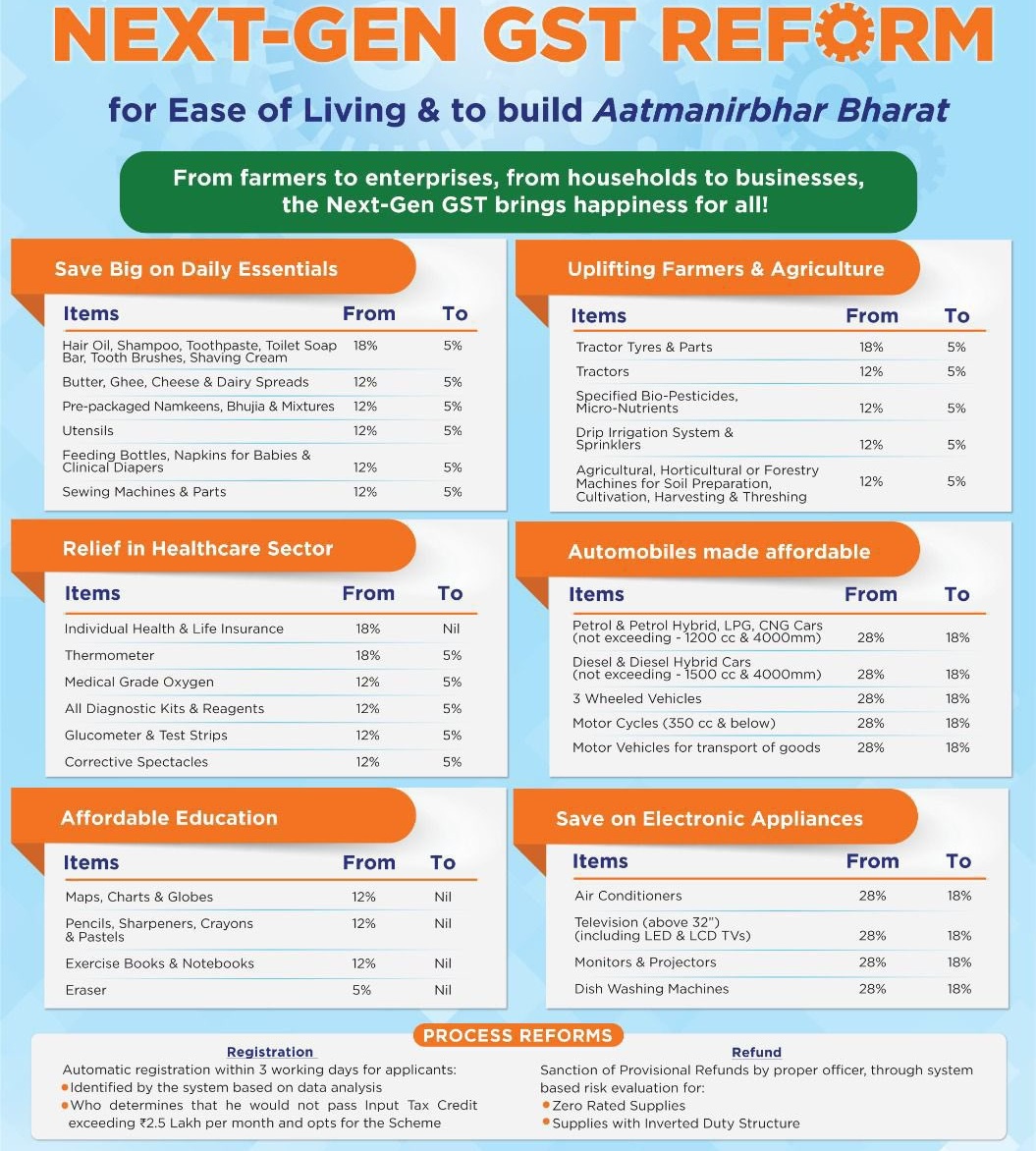
      • Daily-use items (soap, shampoo, toothpaste, bicycles, kitchenware) now at 5%.
      • Cement down from 28% to 18%.
      • Small cars, motorcycles <350cc, ACs, TVs, dishwashers shifted to 18%.
      • Food staples (milk, paneer, rotis, chapatis, parathas) at 0%.
      • Life-saving drugs, spectacles corrected to 0–5%.
    • Inverted Duty Fix: Man-made fibre, yarn, fertilizers, acids, ammonia cut to 5%.
    • Revenue Impact: Estimated loss of ₹48,000 crore, expected to be offset by higher compliance and buoyancy.
    [UPSC 2017] What is/are the most likely advantages of implementing ‘Goods and Services Tax (GST)’?

    1. It will replace multiple taxes collected by multiple authorities and will thus create a single market in India.

    2. It will drastically reduce the ‘Current Account Deficit’ of India and will enable it to increase its foreign exchange reserves.

    3. It will enormously increase the growth and size of the economy of India and will enable it to overtake China in the near future.

    Select the correct answer using the code given below:

    Options: (a) 1 only * (b) 2 and 3 only (c) 1 and 3 only (d) 1, 2 and 3


  • Government talks big on gender budget, delivers little

    Why in the News?

    The Union and State governments often express their commitment to women’s empowerment. One of the four main pillars of Viksit Bharat 2047 is women’s development.

    What are the three components of the gender budget?

    • Part A: Schemes with 100% allocation for women and girls. Example: Beti Bachao Beti Padhao – a scheme focused entirely on improving the welfare of girls.
    • Part B: Schemes with 30% to 99% allocation for women and girls. Example: National Rural Health Mission (NRHM) – where a significant portion is directed toward maternal and child healthcare.
    • Part C: Schemes with less than 30% allocation for women and girls (introduced in 2024-25). Example: Pradhan Mantri Kisan Samman Nidhi (PM-Kisan) – where a small portion benefits women, though the primary beneficiaries are land-owning farmers.

    Why is the agricultural sector’s allocation under the gender budget considered ineffective for women?

    • Land Ownership Inequality: Most agricultural schemes, like PM-Kisan, are land-linked, and since agricultural land is typically owned by men, women are excluded from direct benefits. Example: Pradhan Mantri Kisan Samman Nidhi (PM-Kisan) provides ₹6,000 per year to land-owning farmers, but women who work on the land without ownership do not qualify.
    • Limited Focus on Women Farmers: There is insufficient funding for programs addressing the specific needs of women farmers, such as access to credit, training, and technology. Example: Schemes like the Mahila Kisan Sashaktikaran Pariyojana (MKSP), which focus on empowering women in agriculture, receive a smaller share of the gender budget.
    • Exclusion from Decision-Making: Women in agriculture often lack legal and institutional representation, limiting their ability to influence policy decisions and resource allocation. Example: Despite women forming a significant share of the agricultural workforce, they are underrepresented in farmer producer organizations (FPOs) and cooperatives.

    Who benefits the most from the Pradhan Mantri Kisan Samman Nidhi (PM-Kisan) scheme?

    • Land-Owning Farmers: The primary beneficiaries of the PM-Kisan scheme are small and marginal land-owning farmers who receive ₹6,000 per year in three equal installments. Example: A male landowner with 2 hectares of cultivable land is eligible for the financial assistance under the scheme.
    • Male Family Members: Since land ownership in India is predominantly male, the male head of the household typically receives the direct cash transfer, even when women contribute equally to agricultural work. Example: In patriarchal households, the registered male family member receives the PM-Kisan payments, excluding women working on the same land.
    • Joint Landholders (Primarily Men): In cases of joint land ownership, the payment is usually disbursed to the registered owner, who is more often a man, rather than women co-owners. Example: If a piece of farmland is jointly owned by a husband and wife, the husband is more likely to be listed as the primary beneficiary.

    Why are women often excluded from its advantages?

    • Lack of Land Ownership: Women often do not hold legal ownership of agricultural land, making them ineligible for PM-Kisan benefits, as the scheme is limited to landowners. Example: A woman working on her family’s farmland cannot receive PM-Kisan payments if the land is registered in her husband’s name.
    • Patriarchal Inheritance Practices: Customary inheritance laws and patriarchal norms often prevent women from inheriting land, limiting their access to direct agricultural benefits. Example: In many rural areas, agricultural land is passed down to sons, excluding daughters from ownership and thus from PM-Kisan benefits.
    • Administrative and Documentation Barriers: Women face challenges in providing legal documents (such as land records or identity proof) required to register as beneficiaries under the scheme. Example: Widowed or single women who cultivate land but lack formal ownership documents are excluded from receiving financial assistance.

    Way forward: 

    • Ensure Gender-Inclusive Land Reforms: Promote joint land titles for spouses and simplify the land registration process to increase women’s eligibility for schemes like PM-Kisan.
    • Design Women-Centric Agricultural Programs: Introduce exclusive subsidies, credit access, and training for women farmers while increasing the allocation under gender-responsive schemes like Mahila Kisan Sashaktikaran Pariyojana (MKSP).

    Mains PYQ:

    Q Women empowerment in India needs gender budgeting. What are requirements and status of gender budgeting in the Indian context? (UPSC IAS/2016)

  • What has the Budget offered scientists?

    Why in the News?

    The Union Budget highlights science, technology, and innovation (STI) as important drivers of the country’s progress, supporting CSIR’s goal of making India more self-reliant and globally competitive.

    How will the 2025 budget impact scientific research funding?

    • Increased Funding for R&D: The Ministry of Science and Technology’s allocation sees a major boost due to a Rs 20,000 crore allocation for the R&D fund, increasing the total allocation from Rs 8,029 crore to Rs 28,508 crore.
    • Support for Deeptech Startups: An additional Rs 10,000 crore will be allocated to the Small Industries Development Bank of India Fund for Startups, aimed at enhancing the “deep tech ecosystem,” particularly for startups focusing on AI, biotech, and space technology.
    • Focus on Mission-Mode Projects: Funding is heavily directed towards specific mission-mode programs such as nuclear energy, AI, and the Jal Jeevan Mission, potentially at the expense of curiosity-driven research.
    • CSIR’s Role in National Missions: The budget aligns CSIR’s various missions (Aroma, Floriculture, Millets, Cotton, Green Hydrogen, etc.) with national initiatives, emphasizing value-added farming, self-reliance, and sustainable development.
    • Concerns Regarding Basic Science and Education: Concerns exist regarding reduced funding for institutions like IISc and IISERs, a lower percentage increase in funding for Central Universities compared to IITs, and the overall low allocation for education as a percentage of GDP.

    What specific allocations are being made for science and technology in the 2025 budget?

    • Ministry of Electronics and Information Technology (MeitY) Funding Increase: The budget for MeitY has been increased by 48%, totalling over ₹26,000 crores. This substantial boost is directed towards initiatives such as the IndiaAI Mission and expanded Production-Linked Incentive (PLI) schemes for semiconductors, large-scale electronics, and IT hardware.
    • IndiaAI Mission: The IndiaAI Mission has received an allocation of ₹2,000 crore for FY25, marking an almost 11-fold increase from the previous year’s revised estimate of ₹173 crore. This funding aims to enhance artificial intelligence research and development across various sectors.
    • Semiconductor and Electronics Manufacturing Support: Allocations for the modified scheme to establish compound semiconductors, silicon photonics, sensor fabs, and semiconductor assembly and testing facilities have risen from ₹2,500 crore to ₹3,900 crore. Additionally, the scheme for setting up semiconductor fabs has seen an increase from ₹1,200 crore to ₹2,499.96 crore.
    • Research and Development Fund: A dedicated fund of ₹20,000 crore has been established to promote research, development, and innovation, particularly supporting private-sector-led initiatives. This fund underscores the government’s commitment to advancing technological progress and fostering innovation.
    • Research Fellowships and Deep Tech Support: The government plans to offer 10,000 research fellowships over the next five years under the Prime Minister’s Research Fellowship scheme, focusing on advancing research in technology at premier institutions like IITs and IISc.

    Are there any new initiatives for scientific research in the 2025 budget?

    • Increased Focus on Health Research: There’s a greater emphasis on health research and biomedical devices, driven by concerns identified in the Economic Survey regarding the harms of ultra-processed foods. This suggests new initiatives and funding to address these health challenges through scientific research.
    • Deeptech Startup Boost: The expansion of the SIDBI Fund for Startups with an additional Rs 10,000 crore specifically targets deeptech startups in AI, biotech, and space technology. This indicates a new initiative to foster innovation and entrepreneurship in these advanced technology areas.
    • AI Education Push: The allocation of funds towards a Centre of Excellence in AI education signifies a new initiative to develop expertise and talent in artificial intelligence. The hope is that this center will also set benchmarks for the beneficial adoption of AI in Indian society.
    • Green Hydrogen Mission: Spearheaded by CSIR, this mission supports research and development towards clean energy transition.
    • Alignment of CSIR Missions: While not entirely new initiatives, the strategic alignment and emphasis on CSIR’s existing missions (like Aroma, Floriculture, Millets, Cotton, etc.) with national goals represents a renewed focus and coordinated effort that will likely drive scientific research in those specific areas.

    Way forward: 

    • Balanced Research Funding: Ensure a more balanced allocation between mission-driven projects and fundamental research to sustain long-term scientific innovation and discovery.
    • Strengthening Scientific Workforce: Expand research fellowships, enhance funding for premier institutions, and create stronger industry-academia collaborations to develop a skilled workforce in emerging technologies.
  • How has the Budget allocated funds for urban development?

    Why in the News?

    The 2025 Budget has set up a ₹1 lakh crore Urban Challenge Fund to help cities grow and develop.

    What was the allocation for urban India?

    • Increased Allocation but Underutilization: The Housing and Urban Affairs Ministry received ₹96,777 crore for FY 2025-26, a 17% increase from the previous year. However, the Revised Estimate for 2024-25 stood at ₹63,669.93 crore, indicating significant underutilization of funds.
    • Urban Challenge Fund and PMAY Focus: A ₹1 lakh crore Urban Challenge Fund has been proposed for city redevelopment and water & sanitation projects, with ₹10,000 crore allocated for FY 2025-26. Additionally, ₹78,126 crore has been allocated to both rural and urban PMAY for housing development.
    • Support for Urban Workers and Street Vendors: The government aims to uplift urban workers through PM SVANidhi, which has benefited 68 lakh street vendors. The scheme will be revamped with enhanced bank loans, UPI-linked credit cards (₹30,000 limit), and capacity-building support to reduce reliance on informal sector loans.

    How has the reduction happened?

    • Decline in Direct Transfers to Urban Local Bodies (ULBs): With the abolition of octroi and the implementation of GST, ULBs lost a key revenue source, expecting compensation through central devolution. However, the central share for ULBs declined from ₹26,653 crore (last year) to ₹26,158 crore in 2025-26, increasing financial pressure on local bodies.
    • Cuts in Key Centrally Sponsored Schemes (CSS):
      • PMAY (Urban) faced a drastic cut, with its allocation reduced from ₹30,170.61 crore to ₹13,670 crore in the Revised Estimate (RE) for 2024-25.
      • AMRUT and Smart Cities Mission allocations fell below ₹10,400 crore, with almost no new funds for the Smart Cities Mission.
      • Swachh Bharat Mission (Urban) retained ₹5,000 crore, but RE shows only ₹2,159 crore was spent—a 56% underutilization.
    • Shift in Priorities Toward Capital-Intensive Metro Projects: While many urban development schemes saw cuts, metro rail projects received increased funding.
      • Metro projects’ allocation rose from ₹21,335.98 crore to ₹24,691.47 crore in RE (2024-25) and is further proposed to increase by 46% to ₹31,239.28 crore in 2025-26.
      • This shift prioritizes large infrastructure over comprehensive urban mobility, employment generation, and local governance funding.

    Does the Union Budget focus on capital-intensive projects? 

    • Priority to Large Infrastructure Projects: The budget significantly increases funding for metro rail projects (₹31,239.28 crore, up 46%), while allocations for urban schemes like PMAY (Urban), AMRUT, and Smart Cities Mission have been reduced or underutilized.
    • Reliance on Private Investment for Urban Development: The ₹1 lakh crore Urban Challenge Fund requires 50% private sector participation, which may slow implementation, shifting focus from government-driven urban welfare programs to capital-intensive projects.

    What next?

    • Urban Challenge Fund Implementation Risks: The government has introduced a ₹1 lakh crore Urban Challenge Fund, but 50% of the funding is expected from private investments.
      • Given the limited private sector participation in past urban initiatives like the Smart Cities Mission, relying on private funding could slow implementation.
    • Balancing Infrastructure with Livability and Sustainability: The budget favors metro expansion but lacks a broader focus on comprehensive urban mobility, employment generation, and sustainable urban planning.
      • Future policies must integrate green jobs, affordable housing, and local governance empowerment to create more inclusive cities.
    • Strengthening Financial Autonomy for Urban Local Bodies (ULBs): The decline in direct transfers and devolution post-GST has weakened ULB finances, forcing cities to raise taxes or cut essential services.
      • Strengthening municipal revenue sources, revising property tax frameworks, and ensuring timely fund disbursal can help cities plan better for growth.

    Conclusion: Need to Strengthen municipal revenue sources through property tax reforms, land monetization, and timely fund transfers, reducing dependency on central allocations. The government should ensure equitable investment in metro expansion, affordable housing, sanitation, and employment generation, fostering livable, sustainable, and inclusive urban growth.

    Mains PYQ:

    Q What are ‘Smart Cities’? examine their relevance for urban development in India. Will it increase rural-urban differences? Give arguments for ‘Smart Villages’ in the light of PURA and RURBAN Mission. (UPSC IAS/2018)

  • [6th February 2025] The Hindu Op-ed: A Budget that is mostly good but with one wrong move

    PYQ Relevance:

    Q) Distinguish between Capital Budget and Revenue Budget. Explain the components of both these Budgets. (UPSC CSE 2021)


    Mentor’s Comment: UPSC mains have always focused on the Capital Budget and Revenue Budget (2021), and the objectives of Union-Budget (2017).

    The Union Budget’s forecast of 10.1% nominal GDP growth for 2025-26 seems reasonable, based on the Economic Survey’s prediction of 6.3%-6.8% real GDP growth. Although capital spending has gone up, it’s similar to last year’s budget. The Budget aims to drive growth towards becoming a developed nation, though some measures, like tax relief, could have come sooner.

    Today’s editorial talks about the measures taken in the Budget. This content would help in GS paper 3 in the economy section.

    _

    Let’s learn!

    Why in the News?

    Some measures in the Budget should have been introduced earlier and replacing ‘fiscal deficit’ as a key indicator is a wrong decision.

    How realistic are the government’s tax revenue growth assumptions?

    • Gross Tax Revenue (GTR) Trends: The growth in the Government of India’s GTR has been trending downwards in recent years. The buoyancy of GTR has fallen for three successive years from 1.4 in 2023-24 to 1.15 in 2024-25 (RE) and then to 1.07 in 2025-26 (BE). As a result, growth in the Government of India’s GTR has kept falling from 13.5% in 2023-24 to 11.2% in 2024-25 (RE), and to 10.8% in 2025-26 (BE). Within the government’s tax revenues, the growth rate of Goods and Services Tax (GST) has also fallen from 12.7% in 2023-24 to 10.9% in 2025-26 (BE).
    • Shift to Direct Taxes: The structure of the government’s taxation has moved from indirect to direct taxes, with the share of direct taxes in the government’s GTR increasing from 52% in 2021-22 to 59% in 2025-26 (BE).
    • Personal Income Tax: There has been a fall in growth from 25.4% in 2023-24 to 20.3% in 2024-25 (RE) and 14.4% in 2025-26 (BE). This fall in growth in 2025-26 (BE) is partly due to the announced income-tax concessions.
    • Corporate Income Tax: The growth in 2024-25 (RE) is quite low at 7.6%. This growth has been raised to 10.4% in 2025-26 (BE).

    Is the level of government expenditure appropriate, and is its composition efficient?

    • Overall Expenditure: The government is estimated to spend Rs 50,65,345 crore in 2025-26, 7.4% higher than the revised estimate of 2024-25. The size of government expenditure as a percentage of GDP has been reduced from 14.6% in 2024-25 (RE) to 14.2% in 2025-26 (BE). Growth in total expenditure, at 7.6% in 2025-26 (BE), is lower than the budgeted nominal GDP growth at 10.1%.
    • Capital Expenditure: Capital expenditure has been raised from 11.11 lakh crore rupees in the current fiscal year to 11.21 lakh crore rupees for the oncoming fiscal year1. There has been a steady improvement in the quality of government expenditure as the share of capital expenditure in total expenditure has been improving. This share has improved by 10% points over the period from 2020-21 to 2025-26 (BE).
    • Investment in Key Areas: Investment remains a central theme in the Budget, categorized into three key areas—people, economy, and innovation.
      • Investment in people: Includes the establishment of Atal Tinkering Labs, broadband connectivity for schools and health centers, Centers of Excellence for Skilling, and initiatives for Gig workers.
      • Investment in the economy: Focuses on infrastructure projects, interest-free loans to states for capital expenditure, asset monetization, and urban redevelopment projects.
      • Investment in innovation: Allocates funds to private sector-driven R&D initiatives and missions to support urban planning and knowledge systems.
    • AI Infrastructure: The Government of India has to build up large-scale Artificial Intelligence (AI) infrastructure in order to facilitate the adoption of emerging technologies.

    ⁠Is the shift away from using fiscal deficit as a primary indicator of fiscal prudence a positive step?

    • Change in Indicator: One measure introduced in the Budget is to move away from fiscal deficit as an indicator of fiscal prudence. The practice of giving a glide path in terms of fiscal deficit is being discontinued. It has been stated that from now on, the focus will be on reducing the debt-GDP ratio annually.
    • New Target: The central government aims to reduce its outstanding liabilities to around 50% of GDP by March 2031.
    • Debt-GDP Ratio: In the 2025-26 Budget, the practice of giving a glide path in terms of fiscal deficit is being discontinued. Alternative paths of the debt-GDP ratio with nominal GDP growth assumptions of 10.0%, 10.5% and 11.0% are given.
      • The glide paths are indicated in terms of alternative growth assumptions and alternative assumptions regarding mild, moderate, and high degrees of fiscal consolidation. This makes the whole exercise vague and non-transparent.
    • Fiscal Deficit Target: The fiscal deficit target for FY26 is set at 4.4% of GDP, revised down from 4.8% in the current financial year.

    Way forward: 

    • Restore Fiscal Deficit Transparency: Reintroduce clear fiscal deficit targets with specific timelines, instead of focusing solely on the debt-GDP ratio. This would ensure greater clarity and accountability in fiscal management.
    • Enhance Investment Efficiency: Prioritize strategic investments in key areas like AI infrastructure, R&D, and innovation, while ensuring these investments align with long-term growth goals and contribute to overall economic resilience.
  • [3rd February 2025] The Hindu Op-ed: Beyond tax cuts, a closer read of the Union Budget

    PYQ Relevance:

    Q) One of the intended objectives of Union-Budget 15-18 is to ‘transform, energize and clean India’. Analyze the measures proposed in the Budget 15-18 to achieve the objective. (UPSC CSE 2017)

    Q) Distinguish between Capital Budget and Revenue Budget. Explain the components of both these Budgets. (UPSC CSE 2021)


    Mentor’s Comment: UPSC mains have always focused on Sustainable Development (2016, 2017, 2018 and 2022), and Budget Initiatives (2017 and 2021).

    The Union Budget 2024-25 presents a strategic framework aimed at fostering economic growth while addressing the needs of various sectors, particularly the middle class, agriculture, and employment. While efforts to streamline tax structures and reduce compliance burdens are positive, they must be accompanied by robust strategies to ensure sustainable growth and equitable distribution of resources.

    The editorial emphasizes the urgent need for decisive and equitable action in addressing inclusive and sustained growth. This content can be used to present challenges/criticism for the present Budget 2025-26 in your Mains Answers for Economy and Infrastructure.

    _

    Let’s learn!

    Why in the News?

    The Union Finance Minister presented the Union Budget on February 1, addressing significant economic challenges while outlining an ambitious plan for ‘Viksit Bharat’ that focuses on various sectors, which although requires careful evaluation.


    What are the key highlights from Budget 2025 that would raise the questions?

    • Fiscal Consolidation Target: This target aims to reduce the fiscal deficit from the previous year’s estimate of 4.9% and reflects the government’s commitment to managing public debt while balancing necessary public expenditures and economic growth challenges.
      • The Budget sets a Fiscal Consolidation Target of 4.4% of GDP for FY26, relying on optimistic revenue projections, including 11.2% growth in total tax revenues and 14.4% in income tax revenues, despite significant tax cuts and economic challenges.
    • Second Asset Monetisation Plan (2025-30): This plan aims to generate ₹10 lakh crore by monetizing government-owned assets. The proceeds from this monetization will be reinvested into new infrastructure projects.
      • Success of Second Asset Monetisation Plan (2025-30) after previous underperformance raises concerns, and ₹11.54 lakh crore in net market borrowings may crowd out private capital amid weak credit demand.
      • Additionally, the government has proposed ₹1.5 lakh crore in interest-free loans to states to further support capital expenditure and infrastructure reforms.
    • Personal Income Tax: The revisions in income tax rates that exempt incomes up to ₹12 lakh can lead to a loss of ₹1 lakh crore in direct tax revenue due to the following reasons:
    • Increased Exemptions: By exempting incomes up to ₹12 lakh, more individuals will not be liable to pay income tax, significantly reducing the overall tax base.
    • Reduced Tax Rates: The new tax regime includes lower tax rates for various income brackets, which means that even those who do pay taxes will contribute less than they would under the previous regime.
    • Impact on Government Revenue: The expected loss of ₹1 lakh crore in direct tax revenue will limit the government’s financial resources, constraining its ability to fund developmental initiatives and public services.
    • Declining Household Savings: As the government foregoes this revenue, it may struggle to maintain or increase public investments, which could exacerbate the already declining household savings rate, impacting long-term economic stability.
    • India’s Manufacturing Sector: The Budget aims to bolster India’s manufacturing sector, which currently contributes only 17% to the GDP, through various initiatives. However, significant challenges remain that could hinder the sector’s growth and competitiveness.
      • Regulatory Inefficiencies: By enhancing access to credit for MSMEs, the government aims to foster growth, but the existing regulatory framework often hampers business operations, leading to delays and increased costs that undermine competitiveness.
      • Low Innovation Capacity: The government has introduced PLIs targeting various sectors to encourage domestic production and attract foreign investment. However, the investment in R&D is critically low, currently at just 0.64% of GDP. This lack of focus on innovation limits the ability of Indian manufacturers to compete effectively.
      • Structural Weaknesses: The manufacturing sector has been plagued by structural weaknesses such as high costs of raw materials and logistics, which make it less competitive compared to other nations.
      • For example, steel prices in India are reported to be 20-30% higher than those in China.

    What are the gaps highlighted by the budget that need to be recognized in the Agricultural Sector?

    Significant Agricultural Initiatives taken by the Government in Budget 2025-26:

    1. Prime Minister Dhan-Dhaanya Krishi Yojana:

    • Objective: To enhance agricultural productivity and promote sustainable farming practices in 100 districts characterized by low productivity, moderate crop intensity, and below-average credit access.
    • The initiative is expected to benefit approximately 1.7 crore farmers by providing them with better financial support and resources. The program will be executed in partnership with state governments, leveraging existing schemes and specialized measures to drive focused reforms.
    • Key Focus Areas:
      • Introduce advanced farming techniques and modern equipment.
      • Encourage farmers to grow a variety of crops instead of relying on a single crop.
      • Develop storage facilities at the panchayat and block levels to reduce crop wastage.
      • Enhance irrigation infrastructure to increase agricultural output.
      • Facilitate easier access to both short-term and long-term credit for farmers.

    2. National Mission on High-Yielding Seeds:

    • Objective: This mission aims to improve the availability and use of high-yielding seed varieties to boost agricultural productivity across the country.
    • The mission emphasizes research and development in seed technology, ensuring that farmers have access to superior quality seeds that can lead to better crop yields.
    • It will work in conjunction with other agricultural programs, such as the Dhan-Dhaanya Krishi Yojana, to maximize the impact on food security and farmer income.

    3. Increased Kisan Credit Card (KCC) Limit:

    • The loan limit for KCC has been raised from ₹3 lakh to ₹5 lakh, along with targeted support in 100 low-productivity districts, indicating a shift from blanket subsidies to more precise financial assistance for farmers.
    • Short-Term Loan Focus: The emphasis on credit enhancements primarily through short-term loans may perpetuate farmers’ dependency on debt without resolving underlying issues.
      • Systemic inefficiencies in agricultural markets remain unaddressed, particularly regarding price volatility and market access.
    • Missed Export Opportunities: The lack of concrete measures to promote agricultural exports, especially as India aims to lead in millets and natural farming, represents a significant missed opportunity.
      • Services exports, particularly in IT and business process outsourcing, are growing robustly at a 10.5% CAGR, but efforts to diversify the export portfolio are lacking.
      • While initiatives like Bharat Trade Net (BTN) and export credit support for MSMEs are positive, they lack the scale necessary to effectively address India’s ongoing trade deficits.
      • The depreciation of the rupee and declining foreign exchange reserves highlight the need for a more ambitious export strategy.
      • A fiscal push toward value-added sectors such as pharmaceuticals, electronics, renewable energy, and high-value agricultural products could enhance India’s position in global supply chains and improve export competitiveness.

    What are the questions raised on other transformative and sustainable pushes?

    • Lithium-Ion Battery Recycling: Ace Green Recycling plans to establish India’s largest lithium iron phosphate (LFP) battery recycling facility in Gujarat, with a capacity of 10,000 metric tons per year by 2026. 
    • Incentives for Clean Tech Manufacturing: The Budget introduces tax benefits and policy extensions aimed at supporting electric vehicle (EV) startups and clean tech manufacturing. This includes exemptions on cobalt powder and lithium-ion battery scrap from basic Customs Duty, which is expected to strengthen India’s battery recycling ecosystem.
    • Despite these initiatives, the transition to a low-carbon economy remains fragmented due to insufficient investment in essential areas like grid modernization and energy storage.
    • To achieve a successful transition to a low-carbon economy, India needs a more integrated approach that includes substantial investments in energy infrastructure alongside the current recycling initiatives.
      • For example, enhancing energy storage capabilities is crucial for managing the intermittent nature of renewable energy sources like solar and wind power.

    Way Forward:

    • While the Budget lays a promising foundation for economic progress, it requires a comprehensive approach that not only focuses on immediate tax relief but also addresses long-term challenges in productivity, innovation, and market access.
    • The success of these initiatives will be measured by their ability to create lasting benefits for all segments of society, driving India toward its vision of a prosperous and inclusive economy.
  • How can the Budget arrest growth decline?

    Why in the News?

    The growth rate is lower than what the government had expected. Looking at past trends, the 2004-2011 period had high growth and poverty reduction, supported by welfare programs and government interventions.

    Context: 

    • The World Bank forecasts India’s GDP growth to soften to 6.5% for the fiscal year 2024-25, down from previous expectations of 7%. This reflects a slowdown in investment and weak manufacturing growth.
    • The International Monetary Fund (IMF) has also revised its growth forecast for India to 7% for FY24 and 6.5% for FY25, citing robust domestic demand but acknowledging challenges ahead

    How did the period from 2004 to 2011 have a consistently high growth rate?

    • State Intervention and Welfare Programs: This period saw a revival of state interventions through rights-based legislation and welfare schemes, which contributed to economic growth and reduced absolute poverty.
      • Notably, programs like the National Rural Employment Guarantee Act (NREGA) provided jobs and set higher wage floors, benefiting the rural poor.
    • Rising Consumption Among Lower Income Groups: Despite increasing income inequality, the consumption share of the bottom 80% of the population grew faster than that of the richest 20%. This was facilitated by targeted fiscal policies that favoured lower-income groups, enhancing their consumption capacity.

    • Increased Fiscal Expenditure on Social Services: There was a significant rise in social services and developmental expenditures during this time, which directly impacted consumption patterns positively across various commodity categories for lower-income groups.

    Does the nature of fiscal expenditure also matter when it comes to private consumption? 

    • Capital Expenditure vs. Revenue Expenditure:
      • Capital Expenditure (Capex) (e.g., infrastructure projects) primarily benefits high-income groups and corporations, with a lower short-term impact on consumption.
      • Revenue Expenditure (e.g., social welfare, wages, and pensions) immediately boosts demand by increasing disposable income among lower-income groups.
    • Leakages in Capex: Large-scale projects often involve imports (e.g., heavy machinery), leading to capital outflows instead of stimulating the domestic economy.
    • Higher Consumption Propensity of Lower-Income Groups: Money spent on welfare programs reaches people with a higher tendency to spend, leading to a larger multiplier effect on domestic demand.

    How would an increase in revenue expenditure, particularly in the social sector, help? (Way forward)

    • Higher Incomes for Workers: By providing better wages and job opportunities through social programs, disposable income among lower-income populations would rise, thereby boosting overall consumption levels.
    • Stimulating Private Investment: Enhanced consumer demand can create a conducive environment for businesses to invest. As workers have more income to spend, businesses may respond by increasing production capacity, leading to a cycle of investment and growth.
    • Reversing Economic Slowdown: A strategic shift towards increasing revenue expenditure can help combat the current economic slowdown by fostering a more inclusive growth model that benefits a broader segment of society.

    Mains PYQ:

    Q “Industrial growth rate has lagged behind in the overall growth of Gross-Domestic-Product (GDP) in the post-reform period” Give reasons. How far the recent changes in Industrial Policy are capable of increasing the industrial growth rate? (UPSC IAS/2015)

  • [pib] Decline in Out-of-Pocket Expenditure (OOPE) in Health in India

    Why in the News?

    National Health Accounts (NHA) data for 2021-22 shows a decline in Out-of-Pocket Expenditure (OOPE) on healthcare due to increased government health expenditure (GHE) and an enhanced public healthcare framework.

    What are NHA estimates?

    • The NHA estimates are based on the globally accepted framework of ‘A System of Health Accounts (SHA), 2011’ which facilitates inter-country comparisons.
    • This report provides a systematic description of the financial flows in India’s health system by different sources, how the money is spent, how healthcare is provided, and the nature of healthcare services that are used.

    Key Observations from the NHA 2021-22 Data:

    Details
    Decline in Out-of-Pocket Expenditure (OOPE) OOPE has decreased due to increased government investment and improved public healthcare infrastructure, making healthcare more accessible and affordable.
    Rise in Government Health Expenditure (GHE) GHE as a percentage of GDP rose from 1.13% in 2014-15 to 1.84% in 2021-22. GHE’s share of overall government spending increased from 3.94% to 6.12%, reflecting the government’s commitment to public healthcare.
    Increase in Per Capita Health Spending Per capita health spending tripled from ₹1,108 in 2014-15 to ₹3,169 in 2021-22, allowing for more investment in infrastructure, workforce, and services.
    Expansion of Social Security Expenditure (SSE) SSE on healthcare grew from 5.7% to 8.7% of Total Health Expenditure (THE), helping protect individuals from catastrophic health expenses and reducing OOPE.
    Growth of Government-Funded Insurance Schemes Programs like Ayushman Bharat and state-level health insurance schemes increased healthcare access for economically vulnerable populations, reducing reliance on personal funds.
    Foundation for Universal Health Coverage (UHC) The decline in OOPE and increased public health spending are integral to achieving UHC, aiming for equitable healthcare access for all citizens.


    PYQ:

    [2021] “Besides being a moral imperative of a Welfare State, primary health structure is a necessary precondition for sustainable development.” Analyse.

    [2019] In India, the term “Public Key Infrastructure” is used in the context of:

    (a) Digital security infrastructure

    (b) Food security infrastructure

    (c) Health care and education infrastructure

    (d) Telecommunication and transportation infrastructure