💥Join UPSC 2027,2028 Mentorship (July Batch) + XFactor Notes & Microthemes PDF

GS Paper: GS2-11.Development processes and the development industry —the role of NGOs, SHGs, various groups and associations, donors, charities, institutional and other stakeholders.

  • Science thrives on a global outlook, an inclusive culture. FCRA makes it difficult

    Why in the News:

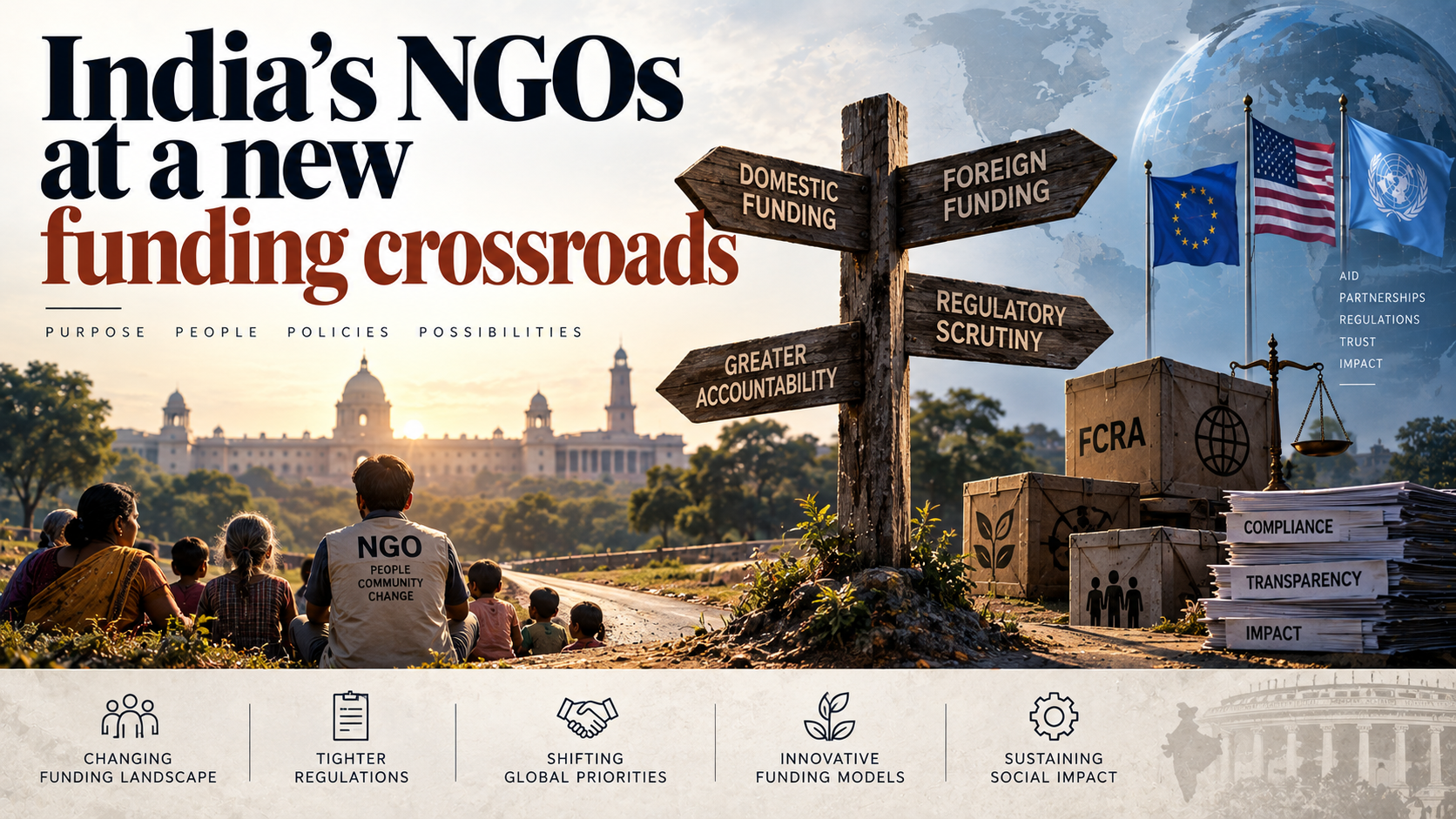
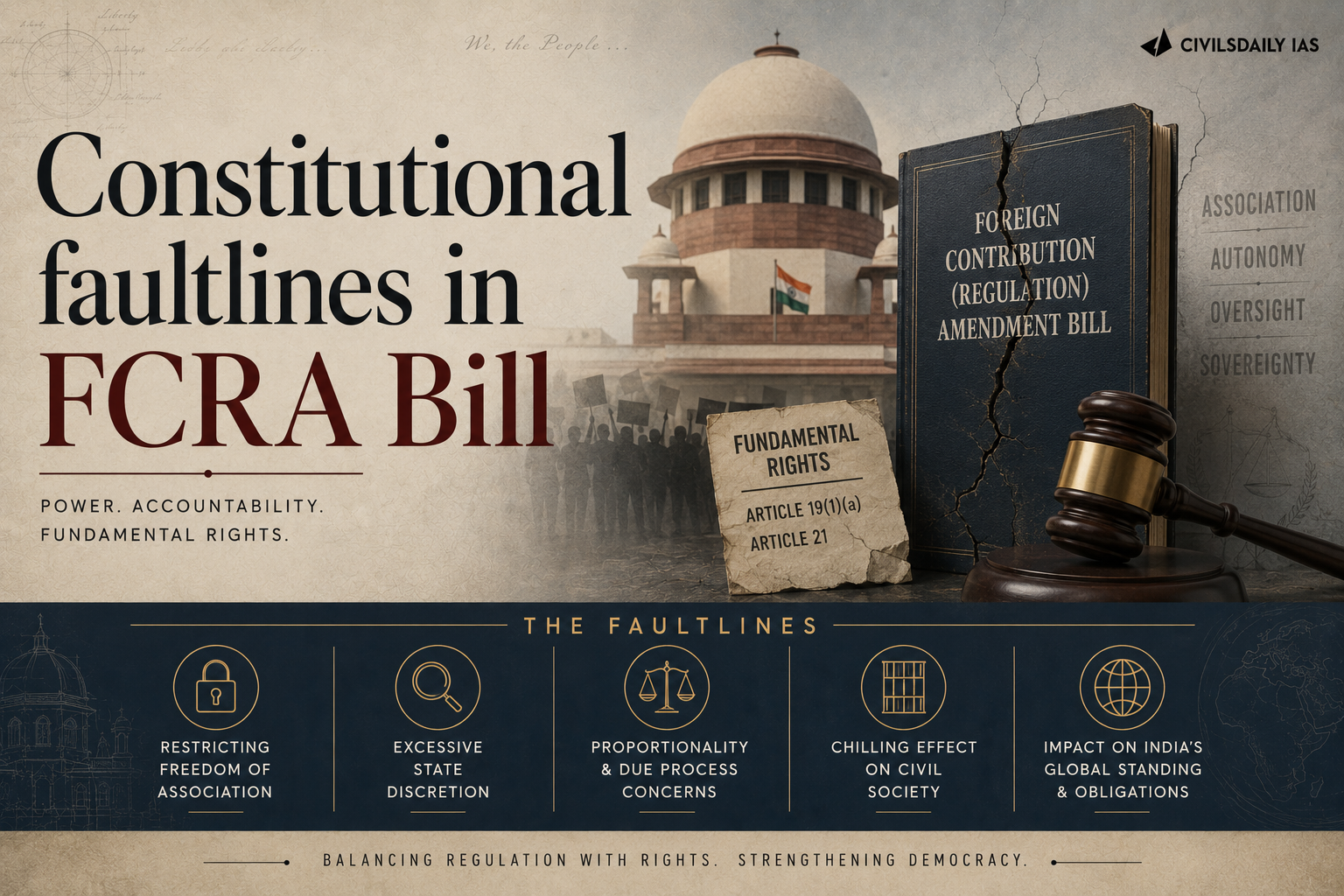
    The Foreign Contribution (Regulation) Act (FCRA), 1976, was designed to prevent foreign funds from covertly influencing India’s political and civil society space. Applied without distinction to research institutions registered as NGOs (Non-Governmental Organisations), the Act now blocks the international collaboration Indian science needs to compete globally.

    Why was the FCRA created, and what has changed in its scope since?

    1. Origins in 1969: The government suspected foreign agencies, such as the Central Intelligence Agency (CIA), of funding trade unions, student bodies, and political organisations to undermine India’s democracy, prompting the Home Minister to raise the issue in Parliament.
    2. Enactment in 1976: The FCRA came into force on 5 August 1976, aiming to ensure voluntary organisations functioned in a manner consistent with the values of a sovereign democratic republic.
    3. Progressive tightening: Successive amendments have expanded regulatory compliance requirements and the state’s power to terminate an organisation’s FCRA registration and seize its assets.

    How does FCRA treat scientific research institutions the same as advocacy NGOs?

    1. Research institutions classified as NGOs: Globally renowned institutions such as the Public Health Foundation of India, Christian Medical College (Vellore), St John’s Medical College, and Ashoka and KREA universities are legally categorised as NGOs and fall under FCRA.
    2. No distinction by activity type: FCRA rules do not distinguish a scientific research NGO from one engaged in political or rights-based advocacy, the category governments treat as most sensitive.
    3. Wide reach: The affected ecosystem spans mental health (Sangath, Schizophrenia Research Foundation), non-communicable disease (Centre for Chronic Disease Control, Dr Mohan’s Diabetes Centre), and biodiversity research (MS Swaminathan Research Foundation, Ashoka Trust for Research in Ecology and the Environment).

    What specific FCRA provisions actively obstruct scientific collaboration?

    1. Repatriation bar: Foreign funds received by an Indian NGO can never be sent back out of the country, conflicting with international funders’ standard requirement that unspent project funds be returned on completion.
    2. Lead institution lockout: Because of the repatriation bar, no Indian NGO can act as the lead institution in an international collaboration, since a lead institution must be able to transfer funds to foreign partners.
    3. 2020 sub-granting ban: A 2020 amendment stopped FCRA-registered NGOs from sharing foreign donations with any other Indian NGO, even one also legally registered to receive foreign funds, shutting down domestic collaboration.
    4. Effect on grassroots and community research: The sub-granting ban has hurt smaller, grassroots NGOs that relied on larger NGOs re-granting foreign funds, and has hindered research that requires direct community engagement.

    What does this cost India’s scientific standing?

    1. Suspicion instead of prestige: Grants from bodies such as the Wellcome Trust and the National Institutes of Health are won through globally competitive, peer-reviewed processes and are prized internationally as marks of research quality. In India, the same grants are treated with regulatory suspicion.
    2. Global ranking gap: No Indian institution features in the top 100 of any global research ranking.
    3. Continued brain drain: Many of India’s most talented researchers continue to seek opportunities abroad, strengthening the rankings of their adopted institutions instead.

    What would a workable fix look like?

    1. Nuanced classification: FCRA rules should distinguish between categories of NGOs rather than treating all foreign contribution risk as uniform.
    2. Existing verification mechanism: A genuine scientific research NGO can already be identified through existing recognition procedures, such as registration with the Department of Scientific and Industrial Research (DSIR).
    3. Preserving the regulatory objective: Tailoring FCRA compliance for the research sector would preserve the government’s oversight of political and advocacy funding without collateral damage to scientific collaboration.

    Conclusion:

    FCRA’s core problem is not its security objective but its refusal to distinguish a scientific research NGO from a political advocacy one. A tailored classification for research institutions, verified through mechanisms like Department of Scientific and Industrial Research (DSIR) recognition, would let India tighten oversight of foreign funds without continuing to cut off its own scientists from global collaboration.

  • [22nd July 2026] The Hindu OpED: Building an Atmanirbhar philanthropy ecosystem

    PYQ Relevance[UPSC 2015] Examine critically the recent changes in the rules governing foreign funding of NGOs under the Foreign Contribution (Regulation) Act (FCRA), 1976.
    Linkage: The PYQ asks the same theme of FCRA under different context. The present debate is about India’s necessary shift from foreign funding dependency toward a self-reliant domestic philanthropy ecosystem.

    Mentor’s Comment 

    Domestic private philanthropy in India, at over Rs 1.18 lakh crore a year, now exceeds foreign philanthropic inflows more than fivefold, even as FCRA compliance tightening disrupted a subset of NGOs. This reframes the FCRA debate from a dispute over foreign funding into a question of how to build a self reliant domestic philanthropy ecosystem.

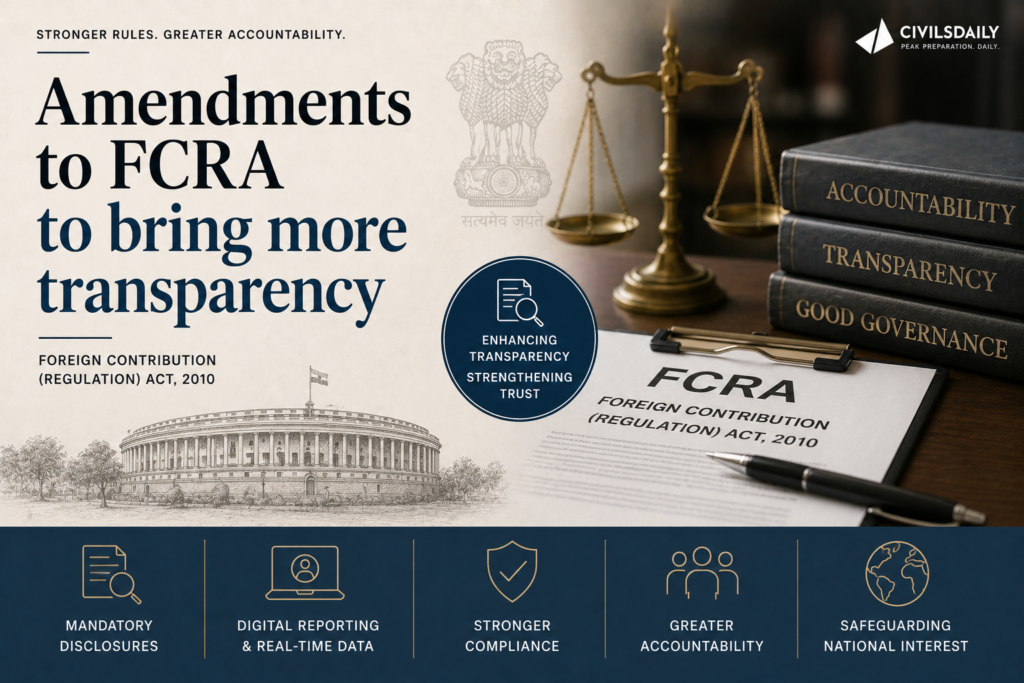
    What is Foreign Contribution (Regulation) Act, 2010?

    1. It regulates the acceptance and utilization of foreign funds by individuals, associations, and NGOs. 
    2. Enforced by the Union Ministry of Home Affairs, it ensures foreign donations do not adversely impact national security, internal politics, or public interest.
    3. The primary goal of FCRA is to maintain transparency and accountability for any money flowing into India from outside sources. It requires that foreign contributions be used strictly for their intended purposes (e.g., social, religious, educational, or cultural) and prevents foreign entities from influencing India’s internal socio-political landscape. 

    Has tighter FCRA regulation actually starved Indian civil society of foreign funds?

    1. Sovereign right: Every nation has the right and responsibility to regulate foreign capital flowing into organisations shaping public life; this is not unique to India nor illiberal.
    2. Reframed question: The real debate is not whether foreign funding should be regulated but whether regulation is proportionate, predictable and efficiently administered.
    3. Scale check: NITI Aayog’s NGO Darpan portal lists roughly six lakh voluntary organisations, of which only about 14,500 hold active FCRA registration.
    4. Inflows unshrunk: Foreign contributions have doubled over the decade, from about Rs 10,000 crore to around Rs 22,000 crore, showing the sector has not been starved of foreign money.

    Is FCRA’s problem the law itself or how it is administered?

    1. Real but narrow hardship: A small number of organisations faced delayed renewals, long processing times, or cancelled registrations, disrupting education, health, livelihood and rural development work, not true of the sector as a whole but real for those affected.
    2. Uneven governance exposed: Many NGOs operate with exemplary governance while others have gone dormant or lacked documentation matching rising compliance expectations.
    3. The SBI Account Bottleneck: Under the 2020 amendments, every NGO in India must open their FCRA account at this single specific branch. This created massive logistical bottlenecks, delayed approvals, and administrative chokepoints for small, rural NGOs located thousands of kilometers away from the capital.
    4. Corporate parallel: Indian companies underwent a similar governance reckoning over three decades, where stronger governance initially felt like a burden before it became what won investor confidence.
    5. Proposed reform: A structured compliance path, deficiency notices, defined correction windows, clarification opportunities, and an independent appellate body, would protect legal integrity while sparing genuine organisations avoidable disruption.
    6. FCRA 2.0: The newly launched FCRA 2.0 platform is framed as an opportunity to simplify compliance and move toward risk based supervision.

    What do international comparators show about regulating foreign funds and incentivising domestic giving?

    1. Regulatory comparators (limited detail): The US requires disclosure under its Foreign Agents Registration Act, and Australia and several European democracies run comparable disclosure regimes, though specific design features are not detailed.
    2. Singapore: Offers a 250% tax deduction for qualifying donations, a far larger incentive multiple than India’s.
    3. United Kingdom: Uses a Gift Aid top up mechanism, where the tax authority adds an amount to the donation based on the donor’s tax paid.
    4. United States: Allows carry forward provisions, letting donors carry unused deduction limits into future tax years.
    5. India’s proposed calibration: Raising the 80G deduction from 50% to 100% and lifting the income ceiling from 10% to 25% would signal similar intent without wholesale copying these regimes.

    Why has domestic giving overtaken foreign inflows as the sector’s main resource?

    1. Scale: Domestic private philanthropy now exceeds Rs 1.18 lakh crore a year, more than five times foreign inflows, per the Bain Dasra India Philanthropy Report 2026.
    2. Family philanthropy: Growing at double digit rates as a new generation of wealth creators treats giving as part of wealth stewardship.
    3. CSR channel: Corporate Social Responsibility now channels over Rs 40,000 crore a year into development, the second of three phases in India’s philanthropic evolution, after foreign reliance and before individual and family giving.
    4. Retail infrastructure: India’s over 220 million demat accounts, widespread SIP investing, and UPI penetration provide ready made rails for mass small ticket giving.

    What specific mechanisms could unlock India’s untapped domestic giving?

    1. HNI gap: High net worth individuals’ giving has lagged well behind their wealth growth, marking them as the largest pool of new domestic capital obtainable through policy.
    2. Tax deduction reform: Raising the 80G deduction to 100% and the ceiling to 25% of adjusted gross total income would cost the exchequer little while improving long term social capital flows.
    3. Equity donation route: A framework for donating appreciated listed shares to eligible charities, with a one to three year disposal window, could unlock wealth held in equity rather than cash.
    4. Mass small ticket giving: If even a fraction of households gave Rs 100 to Rs 1,000 a month through trusted digital platforms, millions of citizens could become active philanthropic partners.
    5. Social Stock Exchange: It is a trusted national platform linking credible organisations to ordinary citizens through disclosure and measurable impact. Social Stock Exchange (SSE) is already live under SEBI on the National Stock Exchange (NSE) and the Bombay Stock Exchange (BSE). SGBS Unnati Foundation, which became the first entity to list on the NSE Social Stock Exchange, raising funds transparently through Zero Courier Zero Principal (ZCZP) instruments.

    Conclusion: 

    Domestic philanthropy, not foreign funding, is now the dominant resource for India’s social sector, making the FCRA debate less about restricting inflows and more about building an accountable domestic ecosystem. What remains unresolved is calibrating regulation so genuine organisations are not treated like fraud cases, and converting proposed tax and market incentives, the 80G reform, the equity donation route, and the Social Stock Exchange, into actual growth in domestic giving. Foreign philanthropy is expected to keep mattering for research and innovation, but the goal is for it to complement rather than shape India’s social development.

  • Building an Atmanirbhar Philanthropy Ecosystem

    Why in the News

    Domestic private philanthropy in India, at over Rs 1.18 lakh crore a year, now exceeds foreign philanthropic inflows more than fivefold, even as FCRA compliance tightening disrupted a subset of NGOs. This reframes the FCRA debate from a dispute over foreign funding into a question of how to build a self reliant domestic philanthropy ecosystem.

    Has tighter FCRA regulation actually starved Indian civil society of foreign funds?

    1. Sovereign right: Every nation has the right and responsibility to regulate foreign capital flowing into organisations shaping public life; this is not unique to India nor illiberal.
    2. Reframed question: The real debate is not whether foreign funding should be regulated but whether regulation is proportionate, predictable and efficiently administered.
    3. Scale check: NITI Aayog’s NGO Darpan portal lists roughly six lakh voluntary organisations, of which only about 14,500 hold active FCRA registration.
    4. Inflows unshrunk: Foreign contributions have doubled over the decade, from about Rs 10,000 crore to around Rs 22,000 crore, showing the sector has not been starved of foreign money.

    Is FCRA’s problem the law itself or how it is administered?

    1. Real but narrow hardship: A small number of organisations faced delayed renewals, long processing times, or cancelled registrations, disrupting education, health, livelihood and rural development work. This is not true of the sector as a whole but is real for those affected.
    2. Uneven governance exposed: Many NGOs operate with exemplary governance while others had gone dormant or lacked documentation matching rising compliance expectations.
    3. Corporate parallel: Indian companies underwent a similar governance reckoning over three decades, where stronger governance initially felt like a burden before it became what won investor confidence.
    4. Proposed reform: A structured compliance path, deficiency notices, defined correction windows, clarification opportunities, and an independent appellate body would protect legal integrity while sparing genuine organisations avoidable disruption.
    5. FCRA 2.0: The newly launched FCRA 2.0 platform is framed as an opportunity to simplify compliance and move toward risk based supervision.

    What do international comparators show about regulating foreign funds and incentivising domestic giving?

    1. Regulatory comparators (limited detail): The US requires disclosure under its Foreign Agents Registration Act, and Australia and several European democracies run comparable disclosure regimes, though specific design features are not detailed.
    2. Singapore: Offers a 250% tax deduction for qualifying donations, a far larger incentive multiple than India’s.
    3. United Kingdom: Uses a Gift Aid top up mechanism, where the tax authority adds an amount to the donation based on the donor’s tax paid.
    4. United States: Allows carry forward provisions, letting donors carry unused deduction limits into future tax years.
    5. India’s proposed calibration: Raising the 80G deduction from 50% to 100% and lifting the income ceiling from 10% to 25% would signal similar intent without wholesale copying these regimes.

    Why has domestic giving overtaken foreign inflows as the sector’s main resource?

    1. Scale: Domestic private philanthropy now exceeds Rs 1.18 lakh crore a year, more than five times foreign inflows, per the Bain Dasra India Philanthropy Report 2026.
    2. Family philanthropy: Growing at double digit rates as a new generation of wealth creators treats giving as part of wealth stewardship.
    3. CSR channel: Corporate Social Responsibility now channels over Rs 40,000 crore a year into development, the second of three phases in India’s philanthropic evolution, after foreign reliance and before individual and family giving.
    4. Retail infrastructure: India’s over 220 million demat accounts, widespread SIP investing, and UPI penetration provide ready made rails for mass small ticket giving.

    What specific mechanisms could unlock India’s untapped domestic giving?

    1. HNI gap: High net worth individuals’ giving has lagged well behind their wealth growth, marking them as the largest pool of new domestic capital obtainable through policy.
    2. Tax deduction reform: Raising the 80G deduction to 100% and the ceiling to 25% of adjusted gross total income would cost the exchequer little while improving long term social capital flows.
    3. Equity donation route: A framework for donating appreciated listed shares to eligible charities, with a one to three year disposal window, could unlock wealth held in equity rather than cash.
    4. Mass small ticket giving: If even a fraction of households gave Rs 100 to Rs 1,000 a month through trusted digital platforms, millions of citizens could become active philanthropic partners.
    5. Social Stock Exchange: Proposed as a trusted national platform linking credible organisations to ordinary citizens through disclosure and measurable impact.

    Conclusion:

    Domestic philanthropy, not foreign funding, is now the dominant resource for India’s social sector, making the FCRA debate less about restricting inflows and more about building an accountable domestic ecosystem. What remains unresolved is calibrating regulation so genuine organisations are not treated like fraud cases, and converting proposed tax and market incentives, the 80G reform, the equity donation route, and the Social Stock Exchange, into actual growth in domestic giving. Foreign philanthropy is expected to keep mattering for research and innovation, but the goal is for it to complement rather than shape India’s social development.

  • Periodic Labour Force Survey (PLFS) Monthly Bulletin, June 2026

    Why in News?

    The National Statistical Office (NSO) under the Ministry of Statistics and Programme Implementation (MoSPI) released the PLFS Monthly Bulletin for June 2026, showing stable employment indicators with a marginal improvement in urban labour participation.

    Labour Market Indicators (15+ years)

    • Labour Force Participation Rate (LFPR): 54.4%, unchanged from May 2026 and slightly higher than 54.2% in June 2025.
    • Worker Population Ratio (WPR): 51.4%, unchanged from May 2026 and up from 51.2% a year earlier.
    • Unemployment Rate (UR): 5.5%, unchanged from both May 2026 and June 2025.

    Urban Trends

    • LFPR increased from 49.8% to 50.1%.
    • WPR improved from 46.6% to 46.8%.
    • UR rose slightly from 6.4% to 6.6%, but remained below 7.1% recorded in June 2025.

    Rural Trends

    • LFPR remained stable at 56.6%.
    • WPR remained stable at 53.8%.
    • UR declined marginally from 5.1% to 5.0%.

    Female Labour Force Participation

    • Overall female LFPR stood at 32.7%.
    • Rural female LFPR was 36.6%.
    • Urban female LFPR remained 24.8%.
    • Overall female participation was 0.7 percentage points higher than June 2025.

    About PLFS

    • Conducted by the National Statistical Office (NSO) under MoSPI.
    • India’s primary survey on employment and unemployment.
    • Since January 2025, it provides monthly and quarterly labour market estimates.
    • Monthly estimates follow the Current Weekly Status (CWS) approach.

    Key Terms

    • Labour Force Participation Rate (LFPR): Percentage of people who are employed or actively seeking employment.
    • Worker Population Ratio (WPR): Percentage of the population that is employed.
    • Unemployment Rate (UR): Percentage of unemployed persons in the labour force.

    Significance

    • Provides high-frequency employment data for policymaking.
    • Tracks labour market trends across rural and urban India.
    • Supports employment, skill development and social welfare planning.

    [2020] With reference to the Indian economy after the 1991 economic liberalization, consider the following statements:

    1.Worker productivity (Rs. per worker at 2004 — 05 prices) increased in urban areas while it decreased in rural areas.
    2.The percentage share of rural areas in the workforce steadily increased.
    3.In rural areas, the growth in non-farm economy increased.
    4.The growth rate in rural employment decreased.

    Which of the statements given above is/are Correct?
    a) 1 and 2 only
    b) 3 and 4 only
    c) 3 only
    d) 1, 2 and 4 only

  • LokOS: Digital Backbone for Rural Livelihoods

    Why in News?

    The Government highlighted LokOS, the digital platform under Deendayal Antyodaya Yojana – National Rural Livelihoods Mission (DAY-NRLM), for strengthening governance, transparency, and financial inclusion of Self-Help Groups (SHGs).

    What is LokOS?

    • LokOS (Lok = People, OS = Operating System) is a web and mobile platform for end-to-end digitisation of Self-Help Groups (SHGs) and their federations.
    • Implemented under DAY-NRLM of the Ministry of Rural Development.
    • Digitises member records, savings, loans, repayments, livelihoods, and convergence with government schemes.

    Key Features

    • End-to-end digital management of SHGs, Village Organizations (VOs), and Cluster Level Federations (CLFs).
    • Aadhaar and bank-linked digital IDs for members.
    • Real-time recording of savings, loans, and repayments.
    • Livelihood profiling and scheme convergence.
    • Role-based administration and real-time dashboards.
    • Digitally tracks nearly ₹2 lakh crore worth of SHG financial transactions annually.

    SHE-LEAPS

    • Self-Help Entrepreneur Livelihoods and Enterprise Application for Prosperity and Sustainability (SHE-LEAPS) launched on 29 June 2026.
    • Operates under LokOS.
    • Supports women SHG members in enterprise creation, business management, and performance tracking.

    Coverage

    • Covers 34 States/UTs, 762 districts, 7,241 blocks, 2.57 lakh Gram Panchayats, and 5.92 lakh villages.
    • Digitally integrates: 94.16 lakh SHGs, 5.62 lakh Village Organizations, 34,314 Cluster Level Federations, and 10.03 crore SHG members

    [2023] Consider the following statements:
    1. The Self-Help Group (SHG) programme was originally initiated by the State Bank of India by providing microcredit to the financially deprived.
    2. In an SHG, all members of a group take responsibility for a loan that an individual member takes.
    3. The Regional Rural Banks and Scheduled Commercial Banks support SHGs.
    How many of the above statements are correct?

    [A] Only one

    [B] Only two

    [C] All three

    [D] None

  • How temples deal with donations

    Why in the News?

    Allegations of embezzlement of offerings and donations at the Ram Janmabhoomi Temple in Ayodhya have brought temple donation-handling systems under scrutiny. The episode has revealed that the Ram Temple trust operates without the statutory audit and oversight structures that govern India’s other major temples. The Ram Temple Construction Committee has sought a professional CEO while the Vishwa Hindu Parishad has demanded that temples across India be freed from government control.

    Why has the Ram Temple donations controversy exposed a broader gap in temple financial oversight?

    1. Trigger: Allegations of embezzlement of offerings and donations surfaced at the Ram Janmabhoomi Temple in Ayodhya. The allegations brought the temple’s donation-handling process into public scrutiny.
    2. Scale of the sector: India has no official count of Hindu temples. Estimates put the number at around 10 lakh.
    3. Common donation chain: Most major temples follow a similar process. Offerings are removed from donation boxes. They are then moved to counting centres for segregation, counting, and recording. Verified collections are deposited into designated bank accounts under CCTV surveillance.
    4. Unaccounted donations: Most temples are small shrines maintained by local communities or hereditary priests. A large share of cash and in-kind donations at these temples remains unaccounted for.
    5. Scale of major temple donations: Tirupati received ₹1,880 crore in annual donations, followed by Vaishno Devi at ₹230 crore, the Ram Temple at ₹150 crore, Siddhivinayak at ₹100 crore, Kashi Vishwanath at ₹80 crore, and Puri Jagannath at ₹18 crore.

    How does the Ram Temple’s donation-handling and governance framework differ institutionally from India’s other major temples?

    1. Ram Temple: The Shri Ram Janmabhoomi Teerth Kshetra Trust manages donations through a trust deed, a private legal instrument creating and governing a trust, without dedicated statutory backing. No dedicated state statute governs the temple’s administration.
    2. Tirupati: The Tirumala Tirupati Devasthanams operates under the Andhra Pradesh Charitable and Hindu Religious Institutions and Endowments Act. Its ‘Parakamani‘ system segregates finance, vigilance, and banking functions among separate personnel groups.
    3. Puri Jagannath: The Shri Jagannath Temple Act governs the temple. Hundis are sealed before and after opening, and entries are recorded in statutory forms.
    4. Vaishno Devi: The Jammu and Kashmir Shri Mata Vaishno Devi Shrine Act governs the shrine. A Shrine Board, not individual trustees, opens donation boxes through dedicated finance and security departments.
    5. Siddhivinayak: A Maharashtra law governs the temple’s trust. The main hundi is opened weekly in the presence of an executive officer, a trustee, a bank representative, and an auditor.
    6. Kashi Vishwanath: The Uttar Pradesh Shri Kashi Vishwanath Temple Act governs the temple. A Sub-Divisional Magistrate supervises the opening of its 56 donation boxes.
    7. Key distinction: Unlike these temples, the Ram Temple trust is not subject to mandatory financial audit by the state or central government. Several of its key office-bearers have long-standing associations with the RSS or its affiliates.

    Does statutory governance guarantee that temple donations remain free of controversy?

    1. Tirupati: The temple has tightened access controls, vigilance, and surveillance over the years after instances of theft involving employees and volunteers.
    2. Puri Jagannath: The Ratna Bhandar dispute centred on the custody and inventory of temple valuables. It led to court-directed scrutiny and fresh inventories.
    3. Kashi Vishwanath: Efforts have increasingly focused on routing donations through official channels. This shifts donations away from direct offerings to priests.
    4. Siddhivinayak: The temple has periodically faced scrutiny over governance and financial management.
    5. Implication: Institutional safeguards at older temples were built over time, not overnight. The Ram Temple’s current gap reflects its early stage of institutional development, not a unique failure.

    What traditions of temple management operate independent of statutory government frameworks?

    1. Family management: Temples are often managed by hereditary priest lineages known as pandas or pujaris. Offerings, donations, and ritual responsibilities traditionally belong to these families. Control rotates when multiple families are involved.
    2. Family management example: The Udupi Sri Krishna Mutt in Karnataka is administered by eight monasteries called the Ashta Mathas, founded by the 13th-century saint Madhvacharya. Each matha manages the mutt for two years. The next cycle for a matha comes only after 16 years.
    3. Mahant system: A single spiritual head, called a mahant, a spiritual head holding administrative and successor-nominating authority over a math, holds prime authority over temple assets, offerings, and administration. He typically appoints or nominates his successor.
    4. Mahant system example: The Gorakhnath Math in Gorakhpur is headed by Chief Minister Yogi Adityanath. He was appointed by the late Mahant Avaidyanath. Similar successor-based systems operate in the Shankaracharya mathas.
    5. Akhada system: Akhadas are autonomous organisations of sadhus that function as collective bodies with elected or consensus-based heads. They are also called Panchayati Akhadas, self-governing collectives of sadhus functioning through elected or consensus-based heads.
    6. Akhada system role: Akhadas appoint priests, oversee rituals, and control donations. They are prioritised for the holy dip at the Mahakumbh according to their relative status.

    Why has the Ram Temple donations controversy revived the debate over the extent of state control over religious institutions?

    1. Colonial origin of state control: The British introduced the Religious Endowments Act in 1863. It handed control of temples to committees set up under the Act, but the government retained influence through other legal provisions.
    2. Statutory blueprint: The Madras Hindu Religious Endowments Act, 1925 empowered provincial governments to legislate on endowments. Its powers expanded over time to include oversight and takeover of temple management. It became the blueprint for later state laws after Independence.
    3. Constitutional basis: Article 25(2) (The constitutional provision allowing the state to regulate secular activities linked to religious practice) empowers the state to regulate or restrict any economic, financial, political, or other secular activity associated with religious practice. This provision is the basis for state legislation governing temple endowments.
    4. Asymmetry across religions: Muslim and Christian institutions are managed through community-run boards or trusts. Statutory government-linked frameworks of the kind that govern major Hindu temples do not apply to them in the same way.
    5. Rival demands: The Ram Temple Construction Committee has proposed appointing a CEO to manage trust affairs. The Vishwa Hindu Parishad has instead called for temples across the country to be freed from government control.

    Conclusion

    The Ram Temple donations controversy stems from a specific institutional gap. The temple is governed by a trust deed, not a dedicated statute, and is not subject to mandatory financial audit. Bringing it under a statutory or audit framework similar to other major temples would close this specific gap. It would not by itself guarantee immunity from future controversy, since statutorily governed temples such as Tirupati, Puri, Kashi Vishwanath, and Siddhivinayak have all faced their own governance disputes. The unresolved question is political: whether India moves toward greater statutory oversight of temples or toward the Vishwa Hindu Parishad’s demand to free them from government control altogether.

    PYQ Relevance

    [UPSC 2024] Public charitable trusts have the potential to make India’s development more inclusive as they relate to certain vital public issues. Comment.

    Relevance: The PYQ tests the role of religious and charitable trusts in governance, public welfare, accountability, and inclusive development. The article examines how major temple trusts manage donations, institutional governance, transparency mechanisms, and the extent of state regulation, making it a direct case study of public charitable trusts in India.

  • eSARAS: Digital Marketplace for Women Self-Help Groups

    Why in News?

    The Government highlighted the growing impact of eSARAS, the official digital marketplace for products made by Women Self Help Groups (SHGs) under DAY-NRLM, as a key initiative promoting rural livelihoods, women entrepreneurship and Digital India.

    What is eSARAS?

    • eSARAS (SARAS Aajeevika) is the official e-commerce platform of the Deendayal Antyodaya Yojana – National Rural Livelihoods Mission (DAY-NRLM).
    • Developed by the Ministry of Rural Development.
    • Provides women SHGs direct access to national online markets by eliminating intermediaries.
    • Supports marketing, branding, packaging and logistics.

    Key Features

    • Exclusive marketplace for SHG products.
    • Promotes One District One Product (ODOP) and traditional handicrafts.
    • Product categories include: Home & Living, Apparel & Accessories, Food Products, Personal Care, and Toys & Gifts
    • Integrated with ONDC (11+ buyer apps; 20+ crore potential buyers) and UMANG
    • Supported by eSARAS Mobile App, Fulfilment Centre, SARAS Aajeevika Gallery (New Delhi), and SARAS Shakti premium gift collection

    Key Statistics

    • 8.62 crore women SHG members have access to a digital storefront.
    • 85% linked directly to the Ministry of Rural Development network.
    • DAY-NRLM covers 7,627 blocks across India.
    • Supported by 1.51 crore community cadre members.
    • Over 800 handcrafted products listed on ONDC.

    Significance

    • Promotes women-led entrepreneurship.
    • Provides market access without intermediaries.
    • Preserves traditional crafts and cultural heritage.
    • Enhances rural incomes through digital commerce.
    • Supports Digital India, Atmanirbhar Bharat and inclusive rural development.
    • Encourages formalization of rural enterprises.

    About DAY-NRLM

    • Centrally Sponsored Scheme under the Ministry of Rural Development.
    • Aims to reduce rural poverty through: Women’s Self Help Groups, Financial inclusion, Skill development, and Sustainable livelihoods, and Enterprise promotion

    [2023] Consider the following statements:
    1. The Self-Help Group (SHG) programme was originally initiated by the State Bank of India by providing microcredit to the financially deprived.
    2. In an SHG, all members of a group take responsibility for a loan that an individual member takes.
    3. The Regional Rural Banks and Scheduled Commercial Banks support SHGs.
    How many of the above statements are correct?

    [A] Only one

    [B] Only two

    [C] All three

    [D] None