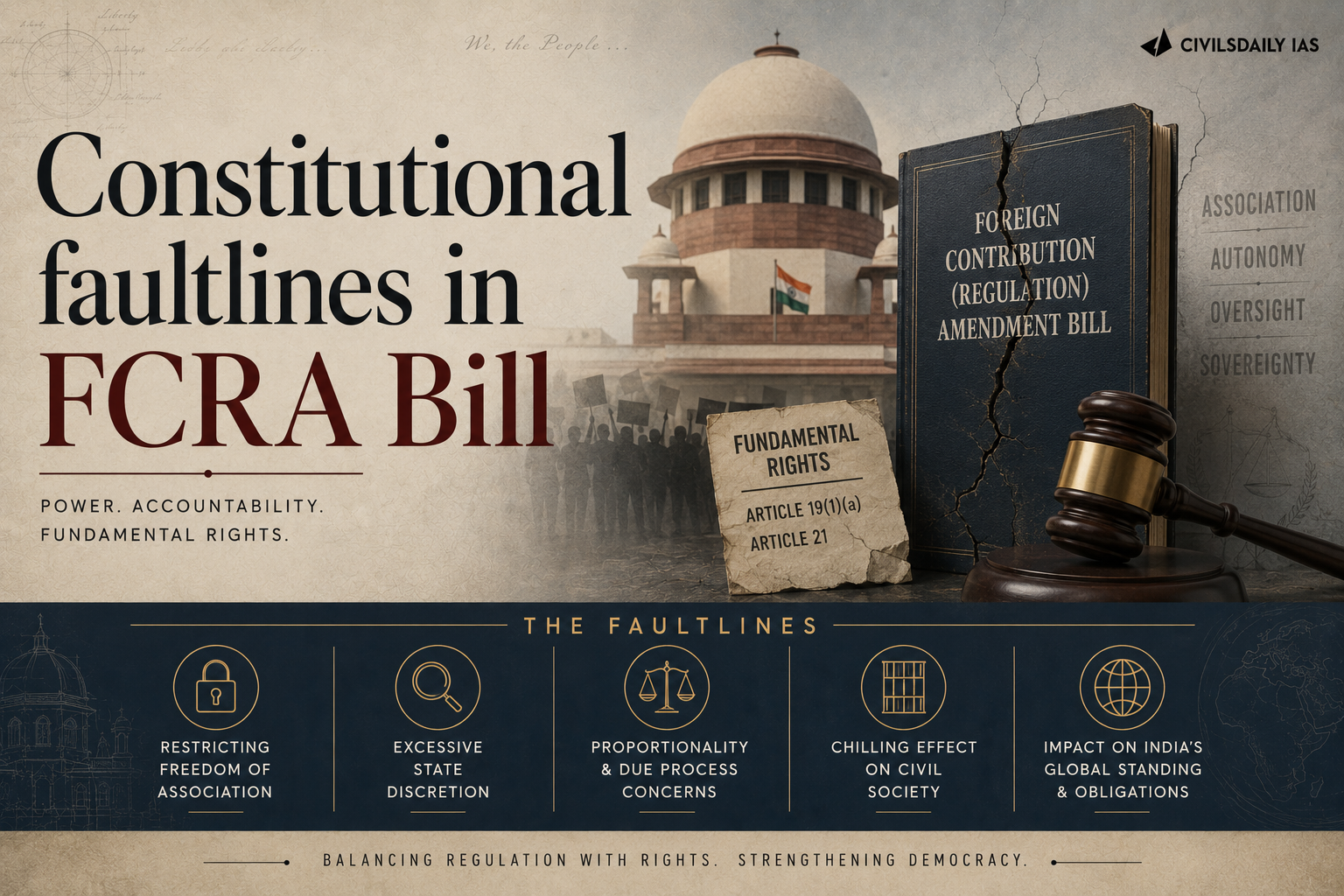
Why in the News
The Foreign Contribution (Regulation) Amendment Bill, 2026 creates a statutory framework for the vesting, supervision, management and disposal of foreign contributions and the assets built from them. Where an organisation’s certificate under the Foreign Contribution (Regulation) Act, 2010 is cancelled, surrendered or ceases to exist, including through non renewal, the Central government may appoint a Designated Authority in which those contributions and assets vest provisionally.
What is the Designated Authority?
- It is appointed by the Central government: The appointment is triggered where an organisation’s FCRA certificate is cancelled, surrendered or ceases to exist, including due to non renewal.
- Assets vest in it provisionally: The foreign contribution and the assets created from it may vest in the authority on a provisional basis.
- It may take possession and manage those assets: The government may, through the authority, take possession of and manage assets created from foreign contributions.
- It may also run the organisation’s activities: Where considered necessary or expedient in the public interest, it may undertake the management of the concerned organisation’s activities.
How far do the consequences of losing registration now travel?
- The existing consequences were financial and regulatory: Registrations could be withdrawn, cancellation could follow continuing non compliance, and penalties attached to the diversion or misappropriation of foreign contributions.
- A vesting provision already existed: The current law already contains a provision for vesting assets created from foreign funds upon cancellation.
- The Bill supplies the machinery that was missing: What is added is a detailed statutory framework for provisional vesting, possession, management, restoration and ultimately permanent vesting and disposal.
- The end point changes in kind, not in degree: What was previously limited to the loss of eligibility to receive foreign funds can now extend to provisional management and, where registration is not restored within the prescribed period, permanent vesting and disposal of assets.
Why does management control matter more than formal ownership?
- The ownership and custody distinction has limited practical force: The legal separation between owning an asset and holding custody of it does not change the practical consequence for the institution.
- Institutions run on continuity of management: An entity whose success depends on continuous administration places greater weight on control than on ownership.
- The relationship with the state changes: Ownership may remain formally undisturbed, and a change in management control still alters the relationship between the institution and the state.
- The affected entities are operating institutions: A hospital, a school or a laboratory is not made effective by ownership alone, and depends on its independence to administer for charitable ends what it owns.
Does the Bill satisfy constitutional proportionality?
- A legitimate objective is not sufficient by itself: The Supreme Court has repeatedly held that the state pursuing a legitimate objective does not settle the constitutional question.
- The means must fit the end: The means adopted must bear a reasonable connection to that objective and must maintain an appropriate balance between the public purpose and the burden imposed on rights.
- A heavier consequence demands heavier safeguards: Where losing registration can lead to provisional vesting and government appointed management, the safeguards attending that transfer must be commensurately robust.
- The Bill does provide safeguards: It provides for the restoration of assets where registration is obtained, renewed or restored within the prescribed period, and for mechanisms of revision and judicial appeal.
- The open question is their quality: What remains contested is whether those safeguards are sufficiently clear, timely and effective, and what standards govern decisions on possession, management and permanent vesting.
Why does the regulatory backdrop raise the stakes?
- Registrations have lapsed at scale: Over the past decade thousands of FCRA registrations have ceased to operate, for reasons ranging from non renewal to alleged statutory violations.
- An administrative lapse and a proven violation converge: Non renewal is not a finding of wrongdoing, and under the proposed framework it can attract the same asset consequence as a violation.
- The Bill has drawn parliamentary opposition: Opposition members of Parliament have protested in New Delhi demanding the withdrawal of the Bill.
Challenges to the FCRA Amendment Bill, 2026
- Renewal is a recurring administrative cliff: FCRA registration must be renewed every five years, and a delay in deciding a renewal application would now carry asset consequences rather than only a pause in funding. Eg. The Ministry of Home Affairs has repeatedly issued blanket extensions of FCRA validity as renewal deadlines approached, which shows the decision backlog is routine rather than exceptional.
The Fix: Provide by statute that registration continues in force until a renewal application is decided, so a pending file cannot trigger vesting. - The receiving channel is already a single point of failure: The 2020 amendment required every recipient to receive foreign contribution only in a designated account at one specified bank branch in New Delhi. Eg. Organisations working in every State had to open and operate that one account irrespective of where they function.
The Fix: Allow any scheduled bank branch to host the designated account with the same automated reporting feed to the Ministry. - The bar on onward granting cuts off the smallest organisations: The 2020 amendment prohibited the transfer of foreign contribution to any other person, ending the model in which a registered body funded unregistered grassroots groups. Eg. Community organisations that never held registration of their own lost their funding route entirely.
The Fix: Restore sub granting to registered entities under a reporting requirement rather than a blanket prohibition. - The administrative expense cap squeezes research and advocacy work: The 2020 amendment cut the share of foreign contribution usable for administrative expenses from 50 percent to 20 percent, and staff salaries are the principal cost of such work. Eg. A research institute’s main expenditure is staff time, which the cap treats as overhead rather than as programme cost.
The Fix: Define programme staff costs as programme expenditure rather than as administrative expenditure. - Remedies move slower than an operating institution can survive: Restoration and appeal run through the Ministry and then the courts, and a hospital or school under government appointed management cannot suspend operations while that runs. Eg. Writ challenges to FCRA cancellations have taken years to reach a hearing on merits.
The Fix: Fix an outer statutory time limit for deciding restoration, with automatic revesting in the organisation once that limit expires. - Freedom of association is engaged, not only property: Article 19(1)(c) protects the right to form associations, and control over an association’s assets and management directly affects its capacity to function. Eg. In Noel Harper v. Union of India (2022) the Supreme Court upheld the 2020 amendments and held that receiving foreign contribution is not an absolute right, which leaves the associational effect of asset control unsettled.
The Fix: Write into the Bill an express requirement that the least restrictive measure available be recorded in writing before management is assumed.
Conclusion
The Bill moves FCRA from policing money to holding institutions. That shift is not by itself unconstitutional, and it is what makes the safeguards the whole of the question. The unresolved tension is that the trigger for the heaviest consequence can be an expired file rather than a proved diversion, and the remedy for a wrong trigger runs slower than the institution it applies to. Whether the Bill survives a proportionality challenge will turn on how tightly Parliament defines the Designated Authority’s discretion, and on how fast restoration actually works in practice.
Back2Basics
- What it regulates: The Foreign Contribution (Regulation) Act, 2010 governs the acceptance and utilisation of foreign contribution and foreign hospitality by individuals, associations and companies in India.
- Who administers it: It is administered by the Ministry of Home Affairs, and it replaced the earlier Foreign Contribution (Regulation) Act, 1976.
- How access is granted: An association must hold either registration, valid for five years and renewable, or prior permission tied to a specific purpose and a specific foreign source.
- Who is barred outright: Election candidates, judges, government servants, members of the legislature, journalists and political parties are prohibited from accepting foreign contribution.
Matching Previous Year Question
“[2015, GS2, 12 marks] Examine critically the recent changes in the rules governing foreign funding of NGOs under the Foreign Contribution (Regulation) Act (FCRA), 1976.”
