The government’s DBT plan involves transferring the subsidy amount directly to the beneficiaries’ bank accounts.
- Here, the government does not have to fiddle around with differential pricing for the underprivileged.
- This method can effectively address the issue of leakages and go a long way in solving the mis-targeting problem.
The government has also linked DBT to Aadhaar. Efficient targeting, using Aadhaar-linked data, ensures that the intended beneficiary receives the money in his account, thus helping him as well as reducing the government’s subsidy burden. This has resulted in effectively solving the leakage and mis-targeting problems in some schemes.
- DBT in India
- Pre requisite of successful DBT
- Merits of DBT
- Demerits of DBT
- DBT in fertilizers
- Is India ready to implement DBT in all programmes?
- Suggestions for improvement
- Conclusion
DBT in India
Direct Benefit Transfer is a mechanism to transfer the subsidy amount directly to the bank account of beneficiaries. Main agendas for DBT is to prevent and address following
- Leakages
- Delays
- Reducing structural expenses in distributing the subsidies in hand
- Encouraging everyone to have bank account and achieve financial inclusion.
Right now it is applied to only 4 areas that too in selected districts:
- LPG subsidies
- Jnani Suraksha Yojana
- Old age pension
- Scholarships
Pre requisite of successful DBT

Merits of DBT (Direct Benefit Transfer)
- Leakage and delays are prevented.
- Reduces Corruptions and black money issue.
- Reduces economical inequalities in rural areas as everyone gets theire share rightfully.
- Reducing the government expense on PDS, Cooperative society, bureaucracy to distribute scholarships etc.
- Reduces time, energy and money of people to get their money/commodity.
- Encourage free and fair market structure. Earlier subsidised grains entering market through backdoor used to distort the price in market.
- More circulation of money in economy which will lead to at least 0.5% growth in GDP.
- Government can better focus on other issues and not engaging in distribution.
- Transportation charge for FCI and NABARD subsidies for warehouses will be reduced.
- Slowly importance of MSP will reduce while price a farmer would fetch will increase which is win-win situation for farmers, also non-food crops will get importance which is issue right now in India.
- Financial institutions will pay attention in rural area once people have cash in their hand.
- Health facility will get better with private hospital giving facilities once people will have money to get treatment.
Demerits of DBT
- Money in the hand of poor may get spent in something other than what is needed, a scholarship needed to be spent in education only, but how government can ensure that, once she has sent it to account
- Most accounts holder are males who have accessibility to banks, hence it will lead to usage by them only. Females may not get their share if they are the intended beneficiaries
- With lesser banks in rural parts of India, it will be another overhead for people to get their withdrawal
- Delay in transfer may create more turbulence as many will flock to banks to check on their balances
DBT in fertilisers
Government is embarked on rationalizing subsidies as has been seen in LPG subsidy which saved thousands of crores of government exchequer. Now it has proposed for rolling out DBT for fertilizers as has been mentioned in recent economic survey.
Pros of DBT in fertilizer –
- It would be beneficial for minimizing the use of fertilizer which would check degradation of soil nutrients and would prevent water contamination.
- Farmers would be free from moneylender’s debt trap as now they would have secure money in their bank accounts. It would be helpful for inculcating saving habits also in farmers.
- Released government control on the fertilization market would drive competition and would enhance productivity.
- Enhanced financial inclusion and financial literacy will give boost to digital India and skill India.
- No middlemen > no leakage > benefits to the needy > correct use of tax payer’s money (redistribution of wealth).
- Less burden on government exchequer > fiscal consolidation target >money transferred in job creation and infrastructure development
However there are some cons which need to be factored –
- More money in hand may lead to misuse like in drug, alcohol, unnecessary shopping or gambling etc.
- May further widen the gap between big farmers and small farmers.
- Bio-identification can be detrimental for the personal information of farmers if not properly handled.
Operational challenges –
- Management of data whether it may be of land, of status of farmer (landholder, tiller or tenant etc) or pertaining to agriculture practice is not up to the level in our country.
- Though crores of accounts are opened but still there is a good number of people who are unbanked.
- Some farmers have little knowledge about banking system so they can fall prey of undue interference.
Is India ready to implement DBT across all programmes?
The debate of implementing DBT in all subsidy programmes is discussed below. A proper implementation would helpful in following ways –
- Filling leakages: DBT will help in reducing malpractices like leakages, ultimately giving the beneficiary what he is entitled. Example: LPG subsidy.
- Increasing incomes: with large number of schemes which are implemented with an intention to increase incomes of the poor, but due to delay and other factors most of the time poor gets subsidy after a long time (like in wages of MNREGA). DBT can reduce these cases.
- Financial inclusion: with the provision of DBT, poor will get themselves included in financial system of the country, which will help them to get other benefits and will boost their saving.
Some of the downsides of the implementation –
- People may use money for other purposes rather than using it for what it is meant for like in case of PDS.
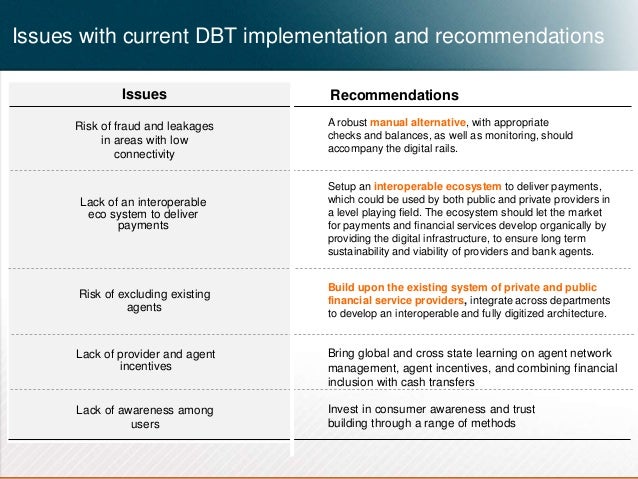
- Due to lack of education and financial literacy, poor will keep themselves outside the purview of banks.
- Inadequate development of the banking channel in rural areas is also a challenge.
- Lack of adequate documents also leads to exclusion of many poor from banking sector.
Conclusion
DBT revolutionized the banking sector by connecting low income segments of society with banks. There is no doubt that DBT has created a firm base for financial inclusion, which will include poor sections to the growth and development processes.
National Payment Corporation of India (NPCI) has successfully opened 150 million DBT accounts with Adhaar numbers and around 125 million accounts under Jan Dhan Yojana.
The government is fully relying on this scheme to plug leakages and save costs. It is estimated that over the time it could save up to 1.2% of GDP, which is currently lost in transit.
References: