Mains Ready By December. Smash Mains & Smash PYQ Admissions Open

GS Paper: GS2-01.Indian Constitution-Historical underpinnings & evolution; Features, amendments, significant provisions, basic structure of Constitution

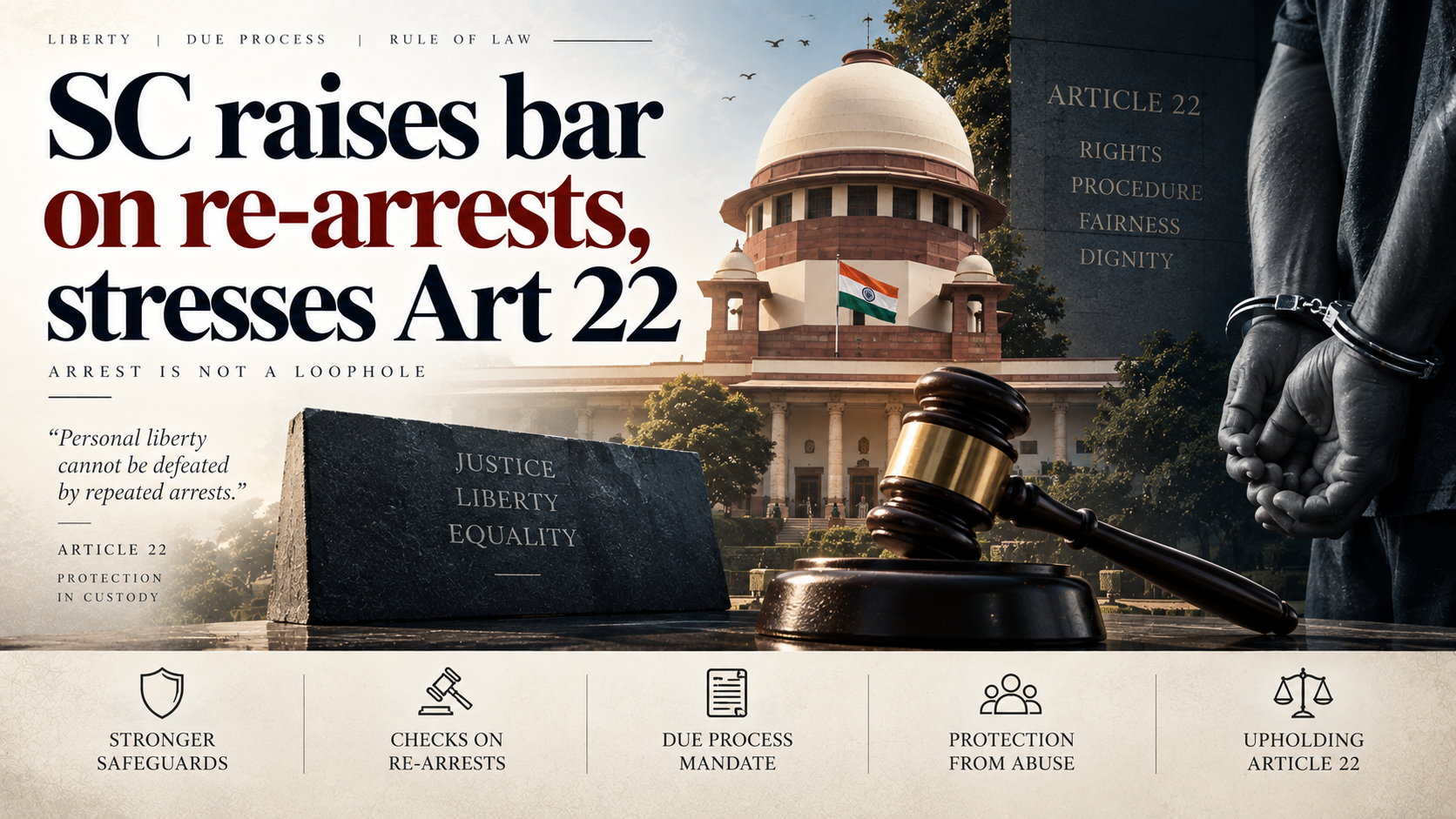
  • SC raises bar on re-arrests, stresses Art 22

    SC raises bar on re-arrests, stresses Art 22

    Why in the News

    The Supreme Court has held that the safeguards provided under Article 22 cannot be “tinkered with”, and has laid down strict guidelines for arresting a person again after an earlier release for failure to supply the grounds of arrest. A Bench of Justices Ujjal Bhuyan and Atul S. Chandurkar held in a 69 page ruling that an accused released for a violation of fundamental rights is not “enlarged on bail” but released from illegal and unconstitutional detention. The ruling answers Mihir Rajesh Shah v. State of Maharashtra (November 2025), which had settled that written grounds of arrest must be furnished across all offences and statutes in a language the arrestee understands. That judgment made the failure fatal to the arrest; this one decides what the State may do next. The tension is that the police now need a Magistrate’s prior sanction to correct their own constitutional lapse, in cases the State argues are too serious for the police to “face fetters”.

    What does Article 22 guarantee an arrested person?

    1. Production before a Magistrate: Article 22 requires an accused to be produced before a Magistrate within 24 hours of arrest.
    2. Grounds of arrest: Article 22(1) requires the accused to be informed of the grounds of arrest, and the settled position is that those grounds must be in writing and in a language the arrestee understands.
    3. Access to counsel: It provides the right to legal representation, meaning consultation with and defence by a legal practitioner of the person’s choice.
    4. The consequence of breach: Any breach or non compliance entails immediate release of the arrested person, because such an arrest is unconstitutional.

    Why did the Court treat the safeguard as constitutional rather than procedural?

    1. Not a formality: The Court held that Article 22(1) is not a mere formality or a matter of procedure, but a mandatory binding constitutional safeguard.
    2. No prejudice test: Where there is a violation of the Constitution, the question of prejudice or demonstrable prejudice does not arise, so an accused need not show that the lapse harmed the defence.
    3. Not statute specific: Article 22(1) applies across the spectrum, including offences under the Bharatiya Nyaya Sanhita (BNS) and under special enactments, and is not tied to any one statute.
    4. Gravity is irrelevant: The Court held that a violation of the Constitution cannot be countenanced and has to be dealt with strictly, and that the obligation does not depend on the nature or gravity of the offence.

    What procedure must the police now follow to arrest the person again?

    1. Written grounds first: The accused must first be provided written grounds of arrest, curing the original defect before any fresh step is taken.
    2. An application to the Magistrate: An application must be filed before a Magistrate explaining why a fresh arrest is necessary and why the grounds were not furnished the first time.
    3. Endorsement by the superior officer: To rule out foul play or collusion, the application must carry the endorsement of the immediate superior authority, so that authority knows the officer violated a constitutional provision.
    4. The Magistrate’s test: The Magistrate may allow a fresh arrest only on being satisfied that “for bona fide reasons” the grounds could not be furnished at the first instance but were furnished after release, and that the accused needs to be arrested again.
    5. A fixed decision window: The Magistrate must decide such an application within a week.
    6. The investigation changes hands: The superior officer giving the endorsement must hand over the investigation to another officer and direct a departmental enquiry into the lapse.
    7. Consequences for the officer: An adverse finding in that enquiry entails departmental action with an entry in the officer’s service book.
    8. Compensation as a remedy: High Courts across the country have been directed to grant “suitable mandatory compensation” where arrests violate procedural safeguards.

    Why did the Court refuse to leave the decision with the police?

    1. The violator cannot cure its own violation: The Court held that the power to arrest again must not be “left to the discretion of the very same authority who had violated the said provision of the Constitution”.
    2. Judicial sanction as the test: It held that the decision must have “the judicial imprimatur”, which converts an internal police call into an order a court records and can be reviewed against.
    3. Separating remedy from punishment: The release for breach and the departmental enquiry run together, so the individual’s liberty is restored while the officer’s conduct is examined separately.
    4. The State’s contrary case: The Punjab government argued that given the serious nature of the allegations the police “should not face fetters” while arresting an accused, and the Court rejected that as a ground for relaxing the safeguard.

    How did this case reach the Supreme Court?

    1. The underlying matter: The Bench was hearing an appeal by an accused in a case under the Protection of Children from Sexual Offences Act, 2012 (POCSO) in Punjab.
    2. The first release: The local Magistrate released the accused on the ground that he was not provided the reasons for his arrest, and then allowed the police to arrest him again on complying with procedural safeguards.
    3. The High Court stage: The accused challenged that permission before the Punjab and Haryana High Court, which on 29 May allowed the police to arrest him again.
    4. The appeal: The accused then moved the Supreme Court against that High Court order, which is the appeal this ruling decides.

    How has the Court’s position on grounds of arrest evolved?

    1. Pankaj Bansal v. Union of India, October 2023: The Court held that all arrests under the Prevention of Money Laundering Act (PMLA) require a written copy of the grounds of arrest to be furnished “as a matter of course and without exception”.
    2. Ram Kishor Arora v. Directorate of Enforcement, December 2023: A later order diluted the rule, holding that grounds need not always be supplied in writing, and treated the Pankaj Bansal ruling as prospective in nature.
    3. Prabir Purkayastha v. State (NCT of Delhi), May 2024: The Court reaffirmed that an arrested person must be provided the grounds of arrest in writing.
    4. Mihir Rajesh Shah v. State of Maharashtra, November 2025: The position was settled, with written grounds required across all offences and statutes in a language the arrestee understands, and failure rendering both the arrest and the subsequent remand illegal.

    Challenges to enforcing the Article 22 safeguards

    1. The remedy depends on the arrested person reaching a court: A safeguard enforced only on application benefits those who can retain counsel within the first 24 hours. Eg. Undertrials form the large majority of India’s prison population, and most are represented through legal aid rather than counsel of choice.
      The Fix: Make the legal services authority’s duty counsel present at the first remand hearing mandatory, so the grounds of arrest are checked by a lawyer before remand is granted.
    2. Written grounds can be reduced to a printed template: A requirement met by handing over a pre printed form with the section numbers filled in satisfies the letter of the rule and tells the arrestee nothing. Eg. Arrest memos under the D.K. Basu v. State of West Bengal (1997) directions became standardised forms within a few years of that judgment.
      The Fix: Require the grounds to state the specific allegation and the material relied on, and make the remand court record that it read them before authorising custody.
    3. Departmental enquiry rarely reaches an adverse finding: An enquiry ordered and conducted within the same force has weak incentives to record a finding that damages a colleague’s service record. Eg. Police complaints authorities recommended under Prakash Singh v. Union of India (2006) remain unconstituted or non functional in several States.
      The Fix: Route the enquiry into a constitutional lapse to the State Police Complaints Authority rather than the officer’s own superior, so the finding is recorded outside the chain of command.
    4. Compensation has no fixed measure: A direction to award mandatory compensation without a scale produces widely different awards for the same violation across High Courts. Eg. Compensation in custodial violation matters has ranged from token sums to several lakh rupees with no stated basis.
      The Fix: Notify a statutory schedule of minimum compensation by duration of unlawful detention, recoverable from the State with a right of recovery against the erring officer.
    5. The rule bites hardest where evidence is time sensitive: In offences against children and in organised crime, a week’s delay for a Magistrate’s sanction can allow interference with witnesses. Eg. The case that produced this ruling arose under POCSO, where the complainant is a child.
      The Fix: Allow the Magistrate to impose interim protective conditions on the released accused while the application for a fresh arrest is pending, so witness safety does not depend on custody.

    Conclusion

    The judgment shifts the cost of a defective arrest from the accused to the State and to the individual officer. Its practical weight rests on the Magistrate, who now decides whether a constitutional lapse was in good faith and whether custody should resume, on a record that can be tested on appeal. The marker to watch is whether High Courts settle a common scale for the mandatory compensation the ruling directs, since an unquantified remedy is the part of this line of cases that has consistently failed to hold.

    Back2Basics

    1. Bharatiya Nyaya Sanhita, 2023 (BNS): It is the general criminal code of India, replacing the Indian Penal Code, 1860, and it came into force on 1 July 2024.
    2. The companion statutes: It was enacted alongside the Bharatiya Nagarik Suraksha Sanhita, 2023, which replaced the Code of Criminal Procedure, 1973, and the Bharatiya Sakshya Adhiniyam, 2023, which replaced the Indian Evidence Act, 1872.
    3. Ministry and route: The three laws were piloted by the Ministry of Home Affairs and passed by Parliament in December 2023.
    4. Why it appears here: The Court held that the Article 22(1) obligation is not statute specific, so it binds arrests under the BNS and under special enactments alike.

    Matching Previous Year Question

    “[2023] Consider the following statements:

    1. According to the Constitution of India, the Central Government has a duty to protect States from internal disturbances.

    2. The Constitution of India exempts the States from providing legal counsel to person being held for preventive detention

    3. According to the Prevention of Terrorism Act, 2002, confession of the accused before the police cannot be used as evidence.

    How many of the above statements are correct?

    (a) Only one (b) Only two (c) All three (d) None

  • What is the Uniform Civil Code debate?

    Why in the News

    The Union Home Minister has indicated that the Uniform Civil Code (UCC) would be implemented in all 21 States ruled by the National Democratic Alliance (NDA) by 2029. The statement builds on enactment that has already begun. Uttarakhand has had a UCC in force since January 2025, and UCC bills passed by the legislatures of Assam, Gujarat and Madhya Pradesh are awaiting Presidential assent. The tension the debate turns on is between two constitutional claims. Article 44 directs the State to endeavour to secure a UCC, while Article 25 guarantees the right to practise a religion of one’s choice and Article 29 protects the right of any section of citizens to conserve its distinct culture.

    What is a Uniform Civil Code?

    1. What it does: A UCC would apply the same set of secular personal laws to all people, irrespective of religion, caste or tribe.
    2. Its constitutional basis: Article 44 provides that the State shall endeavour to secure a UCC for citizens throughout India.
    3. What is already uniform: India already has uniform criminal laws, and common civil laws covering matters such as taxation, contracts and negotiable instruments.
    4. What is not: Marriage, divorce and inheritance of property remain governed by personal laws based on religious doctrines.

    How are personal matters governed today?

    1. Hindus: Governed by laws such as the Hindu Marriage Act (1955) and the Hindu Succession Act (1956).
    2. Tribals within the Hindu religion: Many may follow customary family laws under constitutional exceptions rather than the codified Hindu statutes.
    3. Jains, Buddhists and Sikhs: Covered by Hindu laws, with Sikh marriages also registrable under the Anand Marriage Act (2012).
    4. Christians and Parsis: Each community has its own personal laws.
    5. Muslims: Governed by the Muslim Personal Law (Shariat) Application Act (1937).

    Why did the Constituent Assembly place the UCC in Part IV?

    1. The Assembly was divided: The framers did not reach agreement on whether a UCC belonged in the Constitution at all.
    2. The case for a Fundamental Right: Some members wanted it made a Fundamental Right, to ensure uniformity in civil laws and secure equal rights for women.
    3. The objection raised: Many members of the Muslim community opposed its inclusion, on the ground that a uniform civil code would violate the fundamental right to religion guaranteed in Part III.
    4. The settlement reached: The provision was placed in the non justiciable Part IV, the Directive Principles of State Policy, so it directs the State without being enforceable in a court.

    What are the arguments in favour of a UCC?

    1. Secularism in substance: Subjecting all citizens to the same personal laws would make India secular in the true sense, rather than leaving the State to administer a different law for each community.
    2. Gender justice: A UCC would ensure equal rights for women across religions in the matters governed by personal laws, which is described as the most vital argument for it.

    What are the arguments against a UCC?

    1. Conflict with the right to religion: Article 25 guarantees every person a fundamental right to practise a religion of one’s choice, and a UCC’s provisions on personal matters may run contrary to the scriptures of a religion.
    2. Conflict with cultural rights: Article 29 gives any section of citizens a fundamental right to conserve its distinct culture, which the codification of family matters may cut across.
    3. The tribal exemption: All four States that have enacted a UCC have exempted the tribal population from its ambit, on the grounds of constitutional safeguards protecting tribal culture and the belief that many tribal customs already provide adequate rights to women.
    4. Why that exemption is contested: Exempting one section of society while making the code compulsory for all other groups, including religious minorities, is discriminatory on its face.

    How have the courts and the Law Commission framed the way forward?

    1. Article 25 is not unqualified: The right to religion is subject to constitutional morality and to other fundamental rights, including equality.
    2. The Supreme Court on cultural protection: In the Section 6A of the Citizenship Act, 1955 (2024) case, the Court held that practices such as casteism and gender discrimination, which run against the spirit of the Constitution, would not receive protection under Article 29.
    3. Ambedkar’s voluntary route: In the Constituent Assembly, B.R. Ambedkar advocated a UCC but suggested it could remain voluntary, with Parliament providing for it to apply to citizens who declare they are willing to be bound by it.
    4. The Law Commission’s position: Its Consultation Paper on Reform of Family Law (2018) held that a UCC was neither necessary nor desirable at this stage, and argued instead for reforming discriminatory provisions across personal laws.
    5. The standard it proposed: The emphasis should be on achieving “equality within communities” between men and women, rather than “equality between communities”, through legislative reform of marriage, divorce, custody, adoption, maintenance, succession and inheritance.

    Challenges to a Uniform Civil Code

    1. No published draft to debate: The argument runs on positions rather than on text, because no model code has been placed in the public domain for the country as a whole. Eg. The 22nd Law Commission sought public views on the UCC in 2023 without circulating a draft code alongside the notice.
      The Fix: Publish a model draft code for consultation before further State enactments, so objections attach to clauses rather than to the idea.
    2. State by State enactment fragments uniformity: Personal law sits in the Concurrent List, so separate State codes can produce different rules on the same subject and defeat the uniformity the code is named for. Eg. Entry 5 of the Concurrent List covers marriage, divorce, infants and minors, adoption, wills and succession.
      The Fix: Anchor the State codes to a central framework law so the substantive rules converge even where each State enacts its own.
    3. Scope creep beyond family law: A code enacted to equalise rights in marriage and succession can extend into regulating private arrangements that no personal law governed. Eg. Uttarakhand’s code makes registration of a live in relationship compulsory, with a penalty for failure to register.
      The Fix: Confine the code to marriage, divorce, maintenance, adoption and succession, and drop registration duties that create fresh offences.
    4. Adjudication capacity: Codification moves disputes into family courts that already carry long pendency, so a new right delivers slowly in practice. Eg. Family courts constituted under the Family Courts Act, 1984 carry pendency running into lakhs of cases.
      The Fix: Expand family court benches and statutory mediation capacity before any commencement date is notified.

    Conclusion

    The debate is no longer only about Article 44 in the abstract, since four States have already legislated and the stated target is all 21 NDA ruled States by 2029. The unresolved question is whether equality in personal law is better reached by replacing the personal laws or by reforming the discriminatory provisions inside each of them, which is the choice between the State codes and the Law Commission’s 2018 position. The immediate marker is Presidential assent for the codes passed by the legislatures of Assam, Gujarat and Madhya Pradesh.

    Back2Basics: Directive Principles of State Policy (DPSP)

    1. Where they sit: Part IV of the Constitution, Articles 36 to 51, setting out goals the State is to pursue in making law and policy.
    2. Their legal force: Article 37 makes them non justiciable, so no court can enforce them, while declaring them fundamental in the governance of the country.
    3. Their source: The idea was drawn from the Irish Constitution, which in turn borrowed it from the Spanish Constitution.
    4. Their relationship with rights: They are read alongside the Fundamental Rights in Part III, and courts use them to interpret the scope of those rights rather than to override them.

    Matching Previous Year Question

    “[2015, GS2, 12] Discuss the possible factors that inhibit India from enacting for its citizens a uniform civil code as provided for in the Directive Principles of State Policy.”

  • Let’s curb misuse of a legal relic that elevates the mob over the individual

    Why in the News

    Section 295A of the Indian Penal Code, 1860, re-codified as Section 299 of the Bharatiya Nyaya Sanhita (BNS), is under fresh criticism for converting subjective offence into a cognisable, non-bailable criminal charge. The provision was introduced by the British in 1927 during the “Rangeela Rasool” controversy, after a provocative Urdu pamphlet satirising the Prophet Muhammad’s personal life sparked widespread communal riots. It survives in independent India under Article 19(2) of the Constitution, which permits speech restrictions in the interests of public order. The tension is between a criminal provision built to preserve public order and a constitutional guarantee of expression that the provision’s procedure defeats before any court examines malice.

    What does Section 299 of the Bharatiya Nyaya Sanhita cover?

    1. The offence: It penalises deliberate and malicious acts intended to outrage religious feelings, which was the stated purpose when Section 295A was enacted in 1927.
    2. Colonial rationale: It was born of a colonial urge to police Indian subjects deemed too volatile to handle the friction of free and provocative speech.
    3. Procedural character: The offence is cognisable and non-bailable, so the police may register a case and arrest without a magistrate’s prior direction and bail is not a matter of right.
    4. Constitutional validity: Ramji Lal Modi vs State of Uttar Pradesh (1957) upheld Section 295A, reading the words “deliberate and malicious” as the narrowing element that keeps it within Article 19(2).

    How does the provision create a heckler’s veto?

    1. Offence converted into an offence in law: Translating the subjective and volatile idea of “emotional hurt” into a criminal charge hands a permanent “heckler’s veto” to the most intolerant segments of society.
    2. Inverted hierarchy of rights: It creates a perverse incentive for outrage by elevating “the right to be offended” above the right to free speech.
    3. Low threshold to trigger the state: One aggrieved individual filing a First Information Report (FIR) in a remote corner of the country instantly triggers the machinery of the state.
    4. Who it is triggered against: Writers, filmmakers, stand-up comedians and publishers face it for speech that a court often finds, years later, was never malicious at all.
    5. Incentive for entrepreneurs of grievance: Political entrepreneurs, religious zealots and competitive vigilante groups find that claiming wounded sentiment is the easiest path to public relevance.

    What does the resulting self-censorship look like?

    1. Withdrawal of a published work: Penguin Books India withdrew distribution of Joe Sacco’s graphic novel on the Muzaffarnagar riots.
    2. Pulping of an academic work: The same publisher had earlier pulped copies of Wendy Doniger’s *The Hindus*.
    3. Pre-emptive editing: Cuts were sought to Sonia Gandhi’s memoirs that the publisher’s global arm had not considered necessary for the international edition.
    4. None of it was legally required: None of these texts was legally proscribed, so each was a pre-emptive surrender in which commercial risk aversion replaced constitutional principle.
    5. Spread beyond publishing: Galleries pull provocative paintings, studios quietly cancel scripts and academics choose safer research topics, leaving a public square reduced to bland conformity.

    Why is the process itself the punishment?

    1. Arrest precedes any finding: The law allows arrest before a trial can establish whether malice existed, so the element that makes the act criminal is tested last.
    2. Cost of defending the case: Multi-city court appearances, jail time and financial ruin break the spirit of an artist or author irrespective of the eventual verdict.
    3. Behavioural consequence: When the cost of creative expression is the potential loss of personal liberty, most creators choose to pull their punches.

    What did the 2008 Delhi High Court ruling on M F Husain establish?

    1. What the judgment did: It quashed criminal proceedings against the self-exiled painter M F Husain and set out a defence of artistic liberty against intolerance.
    2. How the charges were answered: The ruling dismantled the obscenity and blasphemy charges by placing Husain’s abstract nude depiction of Bharat Mata within India’s four-millennia-old heritage of sacred, pluralistic and erotic iconography, from Khajuraho to Konark.
    3. The warning it recorded: It critiqued the “new puritanism” pursued by self-appointed guardians of cultural purity and warned that such a society would push India backward.
    4. The principle it fixed: One disapproving viewer cannot hold the right to restrict free expression, which is the constitutional shield the ruling established for creative dissent.

    What reforms would reverse the incentive structure?

    1. Prior sanction before the FIR: Government sanction should be required before an FIR under BNS 299 is registered, rather than after the accused has already endured an investigation and a chargesheet.
    2. Consolidation of parallel FIRs: Multiple FIRs on the same subject lodged in different States should be consolidated immediately into a single proceeding.
    3. Fast-tracking of quashing petitions: BNS 299 cases should be fast-tracked so that frivolous proceedings are quashed early rather than after years.
    4. Costs on vexatious complainants: Vexatious complainants should face costs or other punitive consequences, so the incentive structure of the provision is reversed rather than reinforced.

    Conclusion

    Scrutiny of intent currently arrives at the end of the process, by which point the prosecution has already imposed the cost the provision was never meant to impose. Moving that scrutiny to the point before registration is what separates a public order safeguard from a licence for organised offence-taking. The unresolved conflict is between a constitutional test that turns on deliberate malice and a procedure that reaches arrest before malice is examined at all. Until the procedure is changed, the outcome of a case will continue to matter less than the fact of one.

    What is freedom of speech and expression under the Constitution?

    1. About: Article 19(1)(a) guarantees every citizen the right to freedom of speech and expression, read to include the right to receive and circulate information.
    2. Rationale: The guarantee protects the process by which citizens form and contest opinions, so it exists to shield unpopular expression rather than agreeable expression.
    3. The restriction clause: Article 19(2) permits reasonable restrictions on eight grounds, the sovereignty and integrity of India, the security of the State, friendly relations with foreign States, public order, decency or morality, contempt of court, defamation and incitement to an offence.
    4. The reasonableness test: A restriction must fall within one of those eight grounds and must be reasonable, which is why Shreya Singhal vs Union of India (2015) struck down Section 66A of the Information Technology Act, 2000 as vague and overbroad.

    Back2Basics: Bharatiya Nyaya Sanhita, 2023

    1. What it is: The statute that replaced the Indian Penal Code, 1860 as India’s principal criminal law.
    2. When it took effect: It came into force on 1 July 2024, alongside the Bharatiya Nagarik Suraksha Sanhita, 2023 and the Bharatiya Sakshya Adhiniyam, 2023.
    3. Structure: It carries 358 sections against the 511 of the Code it replaced, with several offences merged or renumbered.
    4. Relevance here: Section 295A of the Indian Penal Code is carried forward as Section 299, so the offence survives the recodification substantially unchanged.

    Matching Previous Year Question

    “What do you understand by the concept “freedom of speech and expression”? Does it cover hate speech also? Why do the films in India stand on a slightly different plane from other forms of expression? Discuss.”

  • Public trust & public approval not same; trust demands fairness: CJI

    Why in the News

    The Chief Justice of India has said that public trust in the judiciary is not the same thing as public approval, because trust is not earned by giving people the outcomes they want but by ensuring fairness of process. The remarks answered concerns raised at the same event by senior counsel about the administrative reforms the judiciary needs in order to deal with challenges such as the appointment of judges. The stated position was that reform must be the rule, and that no institution can survive or take pride in remaining static. The tension is that the same address defended two internal mechanisms, judicial appointments through the Collegium and the handling of complaints against judges, while grounding institutional confidence in a court’s willingness to be examined, questioned and, where necessary, criticised.

    What is the Collegium system?

    1. What it is: The Collegium is the mechanism by which judges of the Supreme Court and the High Courts are selected by judges themselves rather than by the executive.
    2. Where it comes from: It has no textual basis in the Constitution, and was created by judicial interpretation of Articles 124 and 217 across the three judges cases of 1981, 1993 and 1998.
    3. Composition: For a Supreme Court appointment it comprises the Chief Justice of India and the four senior most judges of the Court, whose recommendation then goes to the Union government for the warrant of appointment.
    4. The failed alternative: The National Judicial Appointments Commission, created by the Ninety ninth Constitutional Amendment Act, 2014, was struck down by a five judge Constitution Bench in 2015, which restored the Collegium.

    What does transparency mean for a court?

    1. Not only open doors: Transparency is not simply a matter of open doors and public hearings, though it certainly includes those things.
    2. The reasoning, not the result: It means the reasoning behind a decision, and not merely its result, can be examined by anyone who cares to look, including the very people the decision goes against.
    3. A verdict without reasoning is not transparency: A court that announces its verdicts but keeps its reasoning to itself has not really been transparent, whatever else it may have done.
    4. What the phrase demands: “Seen to be done” means a fair hearing conducted honestly in the open, and a system that remains willing to be examined on whether it has kept its own word.

    How is public trust different from public approval?

    1. The difference matters a great deal: A court does not earn trust by being liked, or by handing out the outcomes people wanted.
    2. The test is the losing party: Trust is earned when the people who lost, who wanted an entirely different result, still walk away believing that the process which decided against them was fair.
    3. Harder and more valuable: That is a far harder thing to earn than approval, and far more valuable than it.
    4. What trust is for: Public trust is not decoration for the judiciary, and is the only currency in which authority is ever paid.

    What was said on judicial appointments?

    1. Reform as the standing rule: No institution can survive or take pride in remaining static, so reform is treated as a welcome step rather than a concession.
    2. Limits of a public answer: Some questions may not be prudent to respond to from a public platform, and the answers to them are legal answers set in the historical background of how the Collegium developed and how successfully it has worked.
    3. The record of appointments: There is hardly any impediment between the appointments by the Union of India and the recommendations of the Collegium, which itself indicates the kind of deliberation that goes into a final recommendation.

    How are complaints against judges handled?

    1. The internal mechanism: The mechanism the Supreme Court and the High Courts have developed for complaints against judges is described as robust, responsive and very timely.
    2. The misuse risk: Given a choice, a judicial officer will invite a complaint at every stage, whether passing an interlocutory order, adjourning a case or passing a final decree.
    3. The open question: Whether every such complaint should be brought onto a public platform or a website, or whether a strong internal mechanism should deal with it with complete objectivity and a dispassionate approach, is treated as a seriously debatable issue.
    4. Not treated as settled: The mechanism is described as well established, and as always subject to reforms and qualitative improvements.

    Why is criticism treated as compatible with institutional confidence?

    1. Exposure keeps institutions clean: Recalling Justice Krishna Iyer, institutions do not stay clean by being shielded from scrutiny, and stay clean by being repeatedly exposed to it and repeatedly surviving that exposure.
    2. The textbook proceedings: Suo motu proceedings concerning a National Council of Educational Research and Training (NCERT) textbook, which carried a chapter on corruption in the judiciary, became an occasion to consider the relationship between legitimate criticism and public confidence in the institution.
    3. What the order said: The order reiterated that the judiciary, as an institution, is not and cannot be averse to criticism.
    4. Why that follows: A court cannot seek the confidence of the public by placing itself beyond scrutiny, and must remain willing to be examined, questioned and, where necessary, criticised.

    Challenges to public trust in the judiciary

    1. Opacity of the appointment process: The Collegium publishes its resolutions but not the material or the comparative assessment behind a name, so the standard of examinable reasoning is weaker for appointments than for judgments. Eg. Reiterated recommendations have been left unacted by the government, with no published reason recorded on either side.
      The Fix: Publish an anonymised assessment memorandum with every recommendation, recording seniority, disposal record and the ground for any supersession.
    2. The internal complaints procedure has no statutory footing: Complaints against judges are handled under a procedure the judiciary framed for itself, so its outcome rests on institutional discipline rather than on law. Eg. Removal remains the only statutory route, under the Judges (Inquiry) Act, 1968, and no Supreme Court judge has ever been removed through it.
      The Fix: Give the internal procedure statutory backing with defined timelines and a published outcome summary that names no complainant.
    3. Pendency erodes trust faster than any single verdict: A litigant who waits years for a hearing experiences the process as unfair regardless of how the case is eventually reasoned. Eg. Cases pending before the district judiciary are counted in crores on the National Judicial Data Grid.
      The Fix: Publish court wise disposal and case ageing data against listed targets, so delay is attributable to a court rather than to the system in general.
    4. Vacancies outrun appointments: A sanctioned strength that is never filled turns an appointment mechanism into a bottleneck whatever its design. Eg. High Court vacancies have run into hundreds of posts for years together.
      The Fix: Fix a time limit for each stage from High Court proposal to warrant of appointment, with any delay recorded against the stage that caused it.

    Conclusion

    The address settles nothing about how judges are appointed or how complaints against them are decided, and it was not meant to. What it does is state the standard the institution asks to be judged by, which is the fairness of the process rather than the popularity of the result. That standard is testable only against the things the judiciary itself controls and publishes. The concrete thing to watch is whether the two mechanisms defended here acquire published reasons and fixed timelines, since a standard of examinable reasoning applied everywhere except to the institution’s own administration is precisely the gap the criticism turns on.

    Matching Previous Year Question

    “[2025, GS2, 15 marks] “Constitutional morality is the fulcrum which acts as an essential check upon the high functionaries and citizens alike…” In view of the above observation of the Supreme Court, explain the concept of constitutional morality and its application to ensure balance between judicial independence and judicial accountability in India.”

  • BJP’s states route to UCC, over one central law

    Why in the News

    The Union Home Minister has said the Uniform Civil Code (UCC) will be introduced in all 21 Bharatiya Janata Party led National Democratic Alliance ruled states before the 2029 Lok Sabha elections. The abolition of triple talaq was cited in the same statement as part of the effort to provide equal rights to Muslim women. The commitment follows a settled preference within the Rashtriya Swayamsevak Sangh (RSS) since 2023 that states enact their own codes first, with the Centre considering an overarching law later, so what had been a state first strategy now carries a date. The tension is constitutional as much as political: Entry 5 of the Concurrent List lets every state legislate its own code, so a promise of uniformity is being delivered through four statutes that are similar but not identical, and none of which is literally universal.

    What is the Uniform Civil Code?

    1. Constitutional source: The promise stems from Article 44, which says the State shall endeavour to secure for the citizens a uniform civil code throughout the territory of India.
    2. Adoption: The Constituent Assembly adopted the Article on 23 November 1948 after a spirited debate, and had no consensus on what such a code would actually contain.
    3. Enforceability: The Article sits among the Directive Principles of State Policy, and under Article 37 those principles are fundamental to governance but are not enforceable by any court.

    Why is the code being legislated state by state rather than through one central law?

    1. Legislative competence: Marriage, divorce, adoption, wills, intestacy, succession and joint family matters fall under Entry 5 of the Concurrent List, giving both Parliament and state legislatures competence over them.
    2. Variation in personal law: A single national code would have to negotiate enormous variation in personal laws and customary practices, particularly among tribal communities and in the Northeast.
    3. Codification is not like criminal law: The recorded objection in 2023 was that a civil code could not simply be codified the way criminal law was, because a tribal community in Uttarakhand or Himachal Pradesh practises very differently from one in Chhattisgarh or the Northeast.
    4. Political utility of the state route: Legislating state by state allows different models to be tested, local customs to be accommodated and implementation to be demonstrated, without first confronting the full political and constitutional complexity of a nationwide law.
    5. The Sangh’s stated caution: The RSS position in 2023 was that the subject required deeper study and wider consultation because it affected every section of society. The RSS general secretary welcomed the Uttarakhand model in March 2024 and said it should be studied and implemented across the country.

    What do the four enacted state codes actually contain?

    1. Uttarakhand: The only code currently in force, implemented in January 2025, it provides common rules on marriage, divorce, inheritance and succession, prohibits polygamy and mandates marriage registration.
    2. Regulation of live in relationships: Its most distinctive feature requires couples to register the relationship and its termination, while recognising children born of such relationships as legitimate.
    3. Gujarat: The Assembly passed its Bill in March 2026, broadly following the Uttarakhand model on marriage, divorce, succession and live in relationships, and prohibiting bigamy.
    4. Assam: The Bill was passed in May, covering marriage, divorce, succession and live in relationships, prohibiting polygamy and making live in registration compulsory.
    5. Madhya Pradesh: The Bill was passed in July and additionally covers adoption, with provisions relating to triple talaq and nikah halala, alongside live in registration and a bar on polygamy.
    6. Scheduled Tribes are excluded: All four laws exclude Scheduled Tribes, and Uttarakhand also exempts certain communities protected by constitutional customary law provisions.

    What has the Law Commission said?

    1. The 2018 position: The 21st Law Commission, in its Consultation Paper on Reform of Family Law (2018), said a uniform civil code was “neither necessary nor desirable at this stage”.
    2. Equality within over equality between: Its emphasis was on achieving “equality within communities” between men and women rather than “equality between” communities, reforming discriminatory provisions across personal laws while preserving diversity.
    3. Piecemeal change over absolute uniformity: It preferred making piecemeal changes to imposing absolute uniformity, and flagged the constitutional protections enjoyed by tribal and northeastern communities as a complication.
    4. The issue reopened: The 22nd Law Commission reopened the matter in 2023, seeking fresh views from the public and from recognised religious organisations, on the ground that more than three years had elapsed since the 2018 consultation and that developments including court orders warranted fresh examination.

    Where do the Opposition and the NDA allies stand?

    1. The Opposition’s framing: Opposition parties have questioned whether the code is genuinely a gender equality reform or an attempt to alter the personal laws of minorities through a majoritarian framework.
    2. State level opposition: The Congress opposed the Gujarat Bill as directed against Muslims, and in Madhya Pradesh criticised the legislation as an RSS agenda.
    3. Assam’s Opposition: Opposition parties there sought wider consultation and raised concerns over the tribal exemption and the regulation of live in relationships.
    4. Janata Dal (United): The party has consistently said it is not opposed to a uniform code but wants it to emerge through consensus rather than imposition. Its president told the Law Commission that such a code should respect India’s “delicate balance” between different religious and ethnic groups.
    5. Telugu Desam Party: The party has called for discussion and consensus, and in 2024 said it would ensure that Muslim interests were protected.

    Challenges to the Uniform Civil Code

    1. Four codes do not produce one code: Legislating separately in each state produces similar but not identical statutes, so uniformity is not what the project delivers. Eg. Madhya Pradesh’s law covers adoption, triple talaq and nikah halala, while Uttarakhand’s does not.
      The Fix: Anchor state enactments to a model law drafted by the Law Commission, so the substantive rules converge even where the enacting legislature differs.
    2. Exclusion of Scheduled Tribes: A code that exempts Scheduled Tribes leaves the customary law of a large population outside the very uniformity it is named for. Eg. All four enacted codes carry the exclusion, and Uttarakhand exempts further protected communities.
      The Fix: State the constitutional basis of the exemption openly, in the Fifth and Sixth Schedule protections, rather than leaving it as a silent exception.
    3. Directive Principles create no claimable right: Article 44 gives a citizen nothing to enforce, so the pace and the content of the code are settled entirely by political choice. Eg. The Article has stood since the Constitution commenced without any central statute enacted under it.
      The Fix: Route the contested questions through parliamentary scrutiny of a draft bill, so the content is debated before it binds anyone.
    4. Registration of private relationships: Compulsory registration of a live in relationship and of its termination extends the state into conduct that was previously unregulated. Eg. Uttarakhand’s code requires both the registration and the recorded termination of such a relationship.
      The Fix: Limit registration to the consequences the state must settle, namely the legitimacy of children and maintenance, rather than the existence of the relationship itself.
    5. Federal friction on a Concurrent List subject: A later central law can override a state code on the same entry, so the states legislating first face the prospect of their statutes being displaced. Eg. Article 254 gives a central law precedence over a repugnant state law on a Concurrent List subject.
      The Fix: Reserve state codes for Presidential assent under Article 254(2), which protects them until Parliament legislates on the same matter.

    Conclusion

    The commitment now carries a date, and the instrument chosen to meet it remains the state legislature rather than Parliament. That choice buys the ability to work around customary law without arguing a national case, and it also guarantees the codes keep diverging as each state adds subjects of its own. What is unresolved is whether uniformity describes the outcome or only the ambition. The thing to watch is whether an overarching central law is eventually brought, because the moment it is, the enacted state codes become the question rather than the answer.

    Back2Basics

    1. What it is: The Law Commission of India is a non statutory executive body constituted by the Ministry of Law and Justice, and it is not created by any Act of Parliament.
    2. Term and composition: It is constituted afresh for a fixed term, normally three years, and is headed by a chairperson who is usually a retired judge, with full time and part time members.
    3. First Commission: The first Law Commission of independent India was constituted in 1955, chaired by the then Attorney General for India.
    4. Weight of its output: Its reports and consultation papers are recommendatory, so the government is free to act on them, to act against them, or to leave them unacted.

    Matching Previous Year Question

    “[2015, GS2, 12.5 marks] Discuss the possible factors that inhibit India from enacting for its citizens a uniform civil code as provided for in the Directive Principles of State Policy.”

  • Uniform Civil Code in all 21 NDA states before 2029: Shah

    Why in the News

    The Union Home Minister has stated that the Uniform Civil Code (UCC) will be implemented across all 21 NDA ruled states before the 2029 Lok Sabha elections. The announcement completes a shift the Sangh Parivar first expressed in 2022-23, away from a single national code enacted by Parliament and towards state by state legislation, with Uttarakhand’s code as the template. Gujarat and Assam have already followed with similar laws and Madhya Pradesh’s Bill awaits assent. The tension is that a code whose entire claim is uniformity is being built through separate state statutes that already differ from each other, and all of which exclude Scheduled Tribes.

    What is a Uniform Civil Code?

    1. The scope of a uniform civil code: A UCC is a single set of civil laws on marriage, divorce, maintenance, succession and adoption applying to all citizens, in place of the separate personal laws that currently apply by religious community.
    2. Where the Constitution places it: Article 44, a Directive Principle of State Policy, directs the State to endeavour to secure a uniform civil code for citizens throughout the territory of India. A Directive Principle is not enforceable by any court.
    3. Why a state can enact one: Marriage, divorce, succession and related civil matters fall under Entry 5 of the Concurrent List, so a state legislature is competent to legislate on them.

    What does the state led approach change?

    1. The route has changed, not the objective: The stated resolve is to enforce the UCC in all 21 alliance ruled states before the 2029 Lok Sabha polls, rather than to enact one national statute.
    2. The Sangh Parivar position of 2022-23: The shift from a national push to a state led approach is a position the Sangh Parivar expressed in 2022-23.
    3. The template already exists: Uttarakhand’s code has been in force since last year and is the model the other states have worked from.
    4. Three states have followed: Gujarat, Assam and Madhya Pradesh have brought similar legislation, and Madhya Pradesh’s Bill is awaiting assent.

    What do the four state codes have in common?

    1. Polygamy is prohibited: All four state laws ban polygamy.
    2. Marriage must be registered: All four require registration of marriage.
    3. Divorce and inheritance are standardised: The laws apply common rules for divorce and for inheritance across communities.
    4. Women get equal inheritance rights: All four grant women equal inheritance rights.
    5. Live in relationships must be registered: All four mandate registration of live in relationships.

    Where do the state codes diverge?

    1. Uttarakhand builds in an exit and a protection: Its code allows deregistration of a live in relationship and recognises children born from such a relationship.
    2. Assam attaches a penalty instead: Its code penalises non registration of a live in relationship.
    3. The consequence of divergent state codes: Two codes drawn from the same template already treat the same relationship differently, which is the outcome a national statute was meant to prevent.

    Why are Scheduled Tribes excluded?

    1. The exclusion is common to all four: All four state laws exclude Scheduled Tribes from their application.
    2. The Rashtriya Swayamsevak Sangh concerns behind the exclusion: The exclusion was written in response to concerns raised by the Rashtriya Swayamsevak Sangh.
    3. Two states go further: Uttarakhand and Assam add explicit protections for specific tribal customs.

    What else was placed on record as the government’s reform list?

    1. Personal law: The abolition of Triple Talaq is cited as having given equal rights to Muslim women.
    2. Constitutional change: The reading down of Article 370 is cited as having been done without violence.
    3. Criminal law: The Bharatiya Nyaya Sanhita (BNS) has been enforced, with a conviction rate of 30 per cent recorded in one year.
    4. Citizenship registration: The government is in discussion with alliance partners and various groups on implementing the National Register of Citizens (NRC) in Manipur.
    5. Enforcement drives: A drive to identify and deport illegal immigrants was reiterated, alongside a zero tolerance position on Naxalism and terrorism.

    Challenges to a state led Uniform Civil Code

    1. State by state enactment produces the opposite of uniformity: Each legislature settles its own definitions and penalties, so a citizen’s civil status changes at a state border. Eg. Uttarakhand permits deregistration of a live in relationship while Assam penalises failure to register one.
      The Fix: Enact a central model code under Entry 5 of the Concurrent List that states adopt with limited variation, so Article 254 resolves conflicts instead of leaving them to accumulate.
    2. A code that exempts a category is not uniform: Excluding Scheduled Tribes preserves exactly the community specific personal law regime the code was framed to end. Eg. All four enacted or pending state codes exclude Scheduled Tribes.
      The Fix: Convert the blanket exclusion into an opt in mechanism exercisable by an Autonomous District Council under the Sixth Schedule, so the exemption is a community’s decision rather than a permanent carve out.
    3. Compulsory registration of live in relationships raises a privacy question: Registration converts a private arrangement into a state record with penal consequences for failure to file. Eg. Justice K S Puttaswamy v. Union of India (2017), a nine judge Bench, held informational privacy and decisional autonomy to be part of the right to life under Article 21.
      The Fix: Make registration voluntary and tie the statutory benefits of maintenance and legitimacy of children to it, so the incentive to register replaces the penalty for not registering.
    4. Freedom of religion sits against the directive: Article 25 guarantees the freedom to profess, practise and propagate religion, and every personal law reform is contested on that ground. Eg. The Supreme Court in Shayara Bano v. Union of India (2017) set aside instant triple talaq by a majority, and the decision was argued through the religious practice test rather than through Article 44.
      The Fix: Legislate reform head by head, on succession, on registration, on the grounds of divorce, so each provision is defended on its own constitutional footing rather than as a single omnibus code.
    5. Enforcement capacity is assumed rather than built: Universal marriage and relationship registration requires a functioning registry down to the block level, and civil registration coverage is already uneven. Eg. Registration of marriage was made a general requirement only after Seema v. Ashwani Kumar (2006), and compliance still varies widely across states.
      The Fix: Fund a digital civil registry linked to the existing birth and death registration system before a registration mandate takes effect, so the obligation lands on a system that can receive it.

    Conclusion

    The position now on record converts a manifesto commitment into a dated legislative programme with a stated count of states and a stated deadline. Four codes exist or are pending, and their differences on live in relationships are already visible, so what is being built is a family of codes rather than one. The marker to watch is Madhya Pradesh’s Bill and the assent it awaits, followed by whether the remaining alliance ruled states legislate on the Uttarakhand template or draft their own variations.

    Back2Basics: Bharatiya Nyaya Sanhita, 2023

    1. Indian Penal Code, 1860: The Bharatiya Nyaya Sanhita, 2023 replaced the Indian Penal Code, 1860 as India’s substantive criminal law.
    2. When it took effect: It came into force on 1 July 2024.
    3. The three companion criminal statutes: It was enacted alongside the Bharatiya Nagarik Suraksha Sanhita, 2023, which replaced the Code of Criminal Procedure, 1973, and the Bharatiya Sakshya Adhiniyam, 2023, which replaced the Indian Evidence Act, 1872.
    4. New provisions added: It added community service as a form of punishment for specified minor offences and grouped offences against women and children into a dedicated chapter.

    Matching Previous Year Question

    “[2015, GS2, 12 marks] Discuss the possible factors that inhibit India from enacting for its citizens a uniform civil code as provided for in the Directive Principles of State Policy.”

  • Manipur’s demand for a 1951 baseline for NRC: Why the date is contentious

    Why in the News

    The State’s Home Minister has told the Manipur Assembly that 1951 will be the base year for updating the National Register of Citizens (NRC) in the State, a register of residents against which claims to belonging are tested. The State cannot implement an NRC without the Centre’s approval, and officials are tracing the records of the register prepared in 1951. The choice of year is not an administrative detail. Manipur’s own permit system controlling entry from outside lapsed in 1950, which is why valley based organisations treat 1951 as the point from which outsiders must be identified. The Kuki Zo Council has challenged the reliability of that baseline, since the hill districts were barely enumerated in that year. A baseline that one set of claimants treats as the earliest honest record is the same baseline another treats as a record of its own absence.

    Why does 1951 have a claim as Manipur’s baseline?

    1. The permit system lapsed just before it: The erstwhile princely State ran a permit system regulating the entry of people from outside, and that system was abolished in 1950.
    2. 1951 produced both a count and a register: The first Census of independent India was conducted in 1951, and an NRC was prepared alongside it carrying names, parentage and residence.
    3. The earliest available demographic baseline: The Joint Committee on Inner Line Permit System (JCILPS), the umbrella body that led the agitation for an Inner Line Permit, argues that 1951 is the earliest point against which later migration and population change can be measured.
    4. The growth figure it relies on: The same body cites recorded decadal population growth rising from 12.80% in 1951 to 35.04% in 1961. A rise of that size does not by itself establish illegal immigration as its cause.

    What earlier settlements already named 1951?

    1. The 1980 understanding: The “Proceedings of Understanding” between the State government and student organisations named 1951 as the baseline.
    2. The 1994 agreement: A further agreement between the Lieutenant Governor and student organisations, concluded under President’s Rule in the State, carried the same year.
    3. The 2018 Bill: The Manipur People’s Protection Bill, 2018 named 1951 and classified as “non Manipuris” those who were not Meitei, not Meitei Pangal, not members of the Scheduled Tribes, and not resident in Manipur before 1951.
    4. Passed but never law: The Assembly passed that Bill unanimously and it did not become law.

    Why did Assam settle on a 1971 cut off instead?

    1. A longer agitation produced it: Assam had a far longer and more intense history of agitation over illegal immigration, culminating in the Assam Movement of 1979 to 1985.
    2. The Accord fixed a base date: Under the Assam Accord, 1 January 1966 was fixed as the base date. Those who entered before it were to be regularised.
    3. Two further brackets followed: Entrants between 1 January 1966 and 24 March 1971 were to be detected and registered under the law. Those entering on or after 25 March 1971 were to be detected and expelled.
    4. The date came from a settlement, not a survey: The 1971 date emerged from that specific political settlement, shaped by migration from East Pakistan and the creation of Bangladesh.
    5. Manipur’s proponents distinguish their case: They argue their problem arises from the abolition of the permit system and later demographic change rather than from partition era migration.

    Why has the demand gained urgency now?

    1. It predates the current conflict: The demand existed before the ethnic violence that began in May 2023.
    2. A cross border influx added a security dimension: The movement of people from Myanmar after the 2021 military coup gave the demand a security framing it did not previously carry.
    3. Representation is the new stake: The 2027 Census and the prospect of delimitation have made the sequence of the two exercises politically significant.
    4. Valley organisations want the register first: Meitei and Naga organisations want the NRC completed before the Census, arguing that population figures should not influence future political representation until illegal immigration has been addressed.

    Why do the hill based organisations reject a 1951 baseline?

    1. The 1951 enumeration was incomplete in the hills: The Kuki Zo Council says most hill areas of Manipur had virtually no road connectivity in 1951, which made comprehensive population enumeration difficult.
    2. An incomplete record excludes rather than verifies: On that reading, a 1951 benchmark could exclude indigenous communities who were never fully counted in the first place.
    3. A community older than the boundary: Kuki, Zomi and Chin communities have historically lived on both sides of the India Myanmar border, so organisations representing them fear that a 75 year old baseline would fall hardest on them.

    Challenges to a 1951 baseline for the Manipur NRC

    1. The State has already reversed itself on the year: A shift in the proposed base year from 1971 to 1951 in 2018 triggered protests. Eg. In Jiribam, people from communities with longstanding links to neighbouring Assam feared exclusion, and the Bill was never brought into force.
      The Fix: Settle the base year through a published inquiry into record availability district by district before it is announced as policy.
    2. Its own operational choice was a different year: When the government had to operationalise the Inner Line Permit system, the Cabinet chose 1961 as the base year in 2022. Eg. The then Chief Minister said the choice followed consideration of the interests of the State’s 34 recognised tribes, and the 2024 recommendation of an NRC to the Centre also proposed 1961.
      The Fix: Align the NRC base year with the year already in force for the permit system, so one State does not operate two definitions of residence.
    3. Proof falls on those least able to furnish it: A baseline that old cannot distinguish a recent migrant from a long settled resident who simply cannot produce records. Eg. Assam’s own exercise left over 19 lakh applicants out of the final register published in 2019, largely on documentary grounds.
      The Fix: Accept a defined ladder of alternative proof, including school, land and ration records and village level certification, rather than a single documentary standard.
    4. The legal consequence of exclusion is undefined: The Centre would have to prescribe the evidentiary and appeals framework and clarify what exclusion means in law. Eg. Applicants excluded in Assam were left to Foreigners Tribunals, a forum whose orders have been criticised for inconsistent standards.
      The Fix: Publish the appeal forum, the time limit and the legal status of an excluded person before any enumeration begins.
    5. Displacement compounds verification: In a State where conflict has displaced thousands, documentary verification becomes harder still. Eg. Households moved into relief camps after the violence left property and identity records behind.
      The Fix: Treat a State certified displacement record as admissible proof of prior residence.

    Conclusion

    A base year is a political settlement presented as a date. Manipur’s valley and hill organisations both accept a register in principle and cannot agree on the year that defines belonging, because each candidate year redistributes the burden of proof. What to watch is the order of steps. If a base year is announced before the rules of evidence and appeal are written, the exercise will start producing exclusions before it has defined what exclusion means.

    Back2Basics: Inner Line Permit

    1. What it is: A travel document that an Indian citizen from another State must obtain to enter a protected State, valid for a limited period and purpose.
    2. Its legal source: It operates under the Bengal Eastern Frontier Regulation, 1873, which empowered the authorities to restrict entry into designated frontier areas.
    3. Where it applies: Arunachal Pradesh, Nagaland and Mizoram have long required it, and Manipur was brought under the regime in 2019.
    4. What it does not decide: It regulates entry and stay by citizens of other States and does not by itself determine citizenship or residence for any other purpose.

    Matching Previous Year Question

    “[2021] With reference to India, consider the following statements: 1.There is only one citizenship and one domicile. 2.A citizen by birth only can become the Head of State. 3.A foreigner, once granted citizenship, cannot be deprived of it under any circumstances. Which of the statements given above is/are correct? (a) 1 only (b) 2 only (c) 1 and 3 (d) 2 and 3 ANSWER: (a)”

  • Court protects space for protest, it needs to

    Why in the News

    The Chief Justice of India has rebuked a Greater Noida executive magistrate for issuing a notice to a student over his alleged participation in the Cockroach Janta Party led protests over examination paper leaks. The notice went out after the Supreme Court had already quashed cases against student protesters, other than those carrying a criminal history. It was revoked afterwards, and the Court has demanded accountability for its having been issued at all. Days earlier the Allahabad High Court quashed charges under the National Security Act, 1980 against another student arising from workers’ protests in Noida. Both orders grant relief to students and both uphold the right to protest. The space for protest is being preserved case by case through judicial relief, rather than by the state defining the limits on protest narrowly in the first place.

    What did the two court interventions actually decide?

    1. The earlier Supreme Court order: An order of 1 September quashed cases against student protesters, with an exception carved out for those carrying a criminal history.
    2. Accountability for a notice already withdrawn: Withdrawal of the magistrate’s notice was not treated as closing the matter, and an explanation for its issue was sought.
    3. The High Court’s characterisation: Invocation of the National Security Act, 1980 was described as “arbitrary and vague”, and the decision to invoke it as “worthy of derision”.
    4. Officials named in a chain: Responsibility was fixed on officials from the District Magistrate down to the Station House Officer.
    5. Compensation as the remedy: The student was ordered to be paid compensation for the “casual and cavalier exercise of authority by the state”.
    6. Why the wording matters: The order locates the failure in the application of an extraordinary law to ordinary protest, not in any dispute about the facts.

    Why does the right to protest need active protection?

    1. Protest is the channel for those outside institutions: In a democracy with a young population, the ability to speak and to talk back to power has to be protected and widened rather than merely tolerated.
    2. The protests produced a response: Student agitations at Jantar Mantar and beyond forced those in authority to listen, which is the function protest performs.
    3. Amplification changes the stakes on both sides: A young population with a voice and a phone to carry it makes suppression both more visible and more tempting.
    4. The record the courts are drawing on: Judicial review has been used to widen the constitutional promise of civil liberties, including the scope of the freedom of speech and expression.

    Where should the limits on protest be drawn?

    1. Limits exist and are not in dispute: Protest cannot extend to violence, vandalism or incitement to violence.
    2. The burden of definition sits with the state: Those restrictions must be framed reasonably, precisely and narrowly rather than at large.
    3. Overbreadth is the mechanism of abuse: Loose and wide definitions allow ordinary protest to be recast as an offence, which the use of a preventive detention law against a student illustrates.
    4. The stated risk: Abuse of power on that scale risks reducing a state to an “Orwellian dystopia”, a landscape denuded of freedom and marked by severe government control.

    Why is relief in individual cases not a sufficient answer?

    1. Relief arrives after the cost has been imposed: A notice or a detention order does its work in the interval before a court reaches it, through legal expense, interrupted study and the deterrent it sets for others.
    2. The incentive facing the official is unchanged: Where an overbroad order is set aside without consequence for the officer who signed it, the calculation that produced it survives intact.
    3. The guarantee has to travel downward: A constitutional promise is worth what it is worth at the police station and in the office of the local politician, not only in a constitutional court.
    4. Judicial capacity is finite: Intervention one case at a time cannot match the volume of orders a wide statute permits, so the remedy has to sit in the definition of the offence.

    Challenges to protecting the freedom to protest

    1. Preventive detention is constitutionally permitted: Detention without trial for a limited period is contemplated by the Constitution itself, so its use is a question of proportionality rather than of legality. Eg. Article 22 expressly provides for preventive detention laws and regulates only the procedure around them.
      The Fix: Require a written and reasoned satisfaction naming the specific apprehended act before a detention order takes effect, and make that record reviewable.
    2. Prohibitory orders substitute for a ban on protest: Standing orders against assembly convert a gathering into an offence without any judgment on what it is about. Eg. Orders under Section 163 of the Bharatiya Nagarik Suraksha Sanhita, 2023, which replaced Section 144 of the Code of Criminal Procedure, 1973, are renewed for long stretches in parts of the capital.
      The Fix: Cap the duration and the geographic extent of such orders and require publication of the reasons for every renewal.
    3. The process itself is the punishment: Bail applications, hearings and travel impose a cost that does not depend on any conviction. Eg. Undertrials make up the large majority of India’s prison population.
      The Fix: Provide for compensatory costs against the state as the default where a case against a protester is quashed for overbreadth.
    4. Space to assemble is shrinking: Where a city permits assembly at a single notified site, the state controls the audience a protest can reach. Eg. Ramlila Maidan and the Boat Club lawns in Delhi have progressively been closed to routine demonstrations.
      The Fix: Notify several protest sites in every city with a transparent and time bound permission process.
    5. Communication restrictions accompany protest policing: Suspension of mobile data around a protest site limits coordination and documentation together. Eg. India has recorded among the highest numbers of internet shutdowns of any country over the past decade.
      The Fix: Require every suspension order to be published with its duration and reasons, and to lapse automatically unless a review committee renews it.

    Conclusion

    The pattern in both orders is the same. An extraordinary power was turned on an ordinary protest, and a court had to say so. That is a working check and a poor system, because it places the burden of defending a constitutional guarantee on the person who was first denied it. The durable answer is a narrower statutory definition of what the state may prohibit, so that the question stops arriving in court at all.

    Back2Basics: National Security Act, 1980

    1. What it allows: It permits preventive detention of a person in order to stop an anticipated act, without charge or trial.
    2. Who may order it: The Central Government, a State Government, and a District Magistrate or Commissioner of Police so empowered may issue a detention order.
    3. Grounds: Detention may be ordered on grounds including the security of the State, the maintenance of public order, and the maintenance of supplies and services essential to the community.
    4. Duration and review: Detention may extend up to twelve months, and an advisory board must examine the order within a fixed period for it to continue.

    Matching Previous Year Question

    “[2025, GS2, 15 marks] “Constitutional morality is the fulcrum which acts as an essential check upon the high functionaries and citizens alike…” In view of the above observation of the Supreme Court, explain the concept of constitutional morality and its application to ensure balance between judicial independence and judicial accountability in India.”

  • No Statehood, Ladakh to get unique elected body, says Chief Secretary

    Why in the News

    The Ladakh Chief Secretary has stated that neither Statehood nor a Union Territory with a legislature is on offer for Ladakh. What is being offered instead is a *sui generis* body under the Constitution, carrying legislative, executive and financial powers. The proposal follows the reorganisation that made Ladakh a Union Territory without a legislature, and the sustained agitation since then for an elected tier with real powers. The Union Home Ministry has discussed the structure of the proposed Union Territory level body under Article 371 of the Constitution with the Leh Apex Body (LAB) and the Kargil Democratic Alliance (KDA). Both called the discussion disappointing and said the Union Territory administration and the Home Ministry are not on the same page. The nomenclature of the new body has not been settled, which is the immediate reason the talks remain open.

    What is the body being offered to Ladakh?

    1. Not Statehood: Ladakh was never a State, having been part of Jammu and Kashmir before becoming a Union Territory, so the proposal is not framed as a restoration.
    2. Not a Union Territory with a legislature: The model is stated to be neither Statehood nor the Union Territory with legislature form that already exists elsewhere in the country.
    3. What it is to carry: The body is to hold legislative, executive and financial powers, which the Centre describes as the aspiration it is answering.
    4. Direct election through constituencies: Members of the two Ladakh bodies recorded their consensus that the Union Territory level body should be filled by direct election through constituencies.

    Why is Article 371 the route being used?

    1. Special provisions as the vehicle: Article 371 carries special provisions for particular States and regions, and the proposed structure is being discussed under it.
    2. A constitutional amendment is required: Constitutional safeguards of this kind require a detailed and established legal and parliamentary process rather than an executive order.
    3. The stated preconditions: Any such amendment needs broad political consensus, consultation and parliamentary consideration.
    4. No imposition: The Centre’s stated position is that no framework will be imposed on Ladakh without due consultation with stakeholders.

    What is still unresolved between the new body and the existing councils?

    1. A list of questions to answer: The Ladakh representatives have been handed eight to nine questions to examine.
    2. The substance of those questions: They cover the structural relationship and the distribution of powers between the existing hill councils and the proposed Union Territory level body.
    3. The designation is undecided: Whether the head of the elected body will be called a Chief Minister has not been settled, and discussions continue for that reason.
    4. The next step: The next round of discussions is expected in October.

    Why do the Ladakh bodies call the process unsatisfactory?

    1. Two arms of government reading it differently: Both bodies said the Union Territory administration under the Lieutenant Governor and the Union Home Ministry were not on the same page.
    2. No agenda circulated in advance: A Leh Apex Body representative said the questions involve legal issues and cannot be answered on the spot, and that the agenda should have been shared beforehand.
    3. No concrete progress on core demands: A member of the delegation that met Ministry officials said no concrete progress has been made on the key demands.
    4. A threat to resume agitation: The same delegation cautioned that protests would resume if assurances were not provided within a week.
    5. A charge of divide and rule: The delegation also said efforts have been made to drive wedges between communities and regions and to tire the leadership out.

    Challenges to the proposed Ladakh elected body

    1. A body with no precedent has no settled template: A structure that exists nowhere else must define its relationship with Parliament, the Lieutenant Governor and the courts from the beginning. Eg. The Union Territory of Delhi has spent decades litigating the division of executive power between its elected government and the Centre.
      The Fix: Write the division of legislative and executive subjects into the enabling amendment itself rather than leaving it to rules framed later.
    2. Three tiers competing for the same functions: An elected Union Territory level body layered above the existing hill councils risks duplicating their subjects and their budgets. Eg. The councils already administer land allotment, local development planning and village level works in Leh and Kargil.
      The Fix: Fix a clear subject list for each tier, with the councils retaining village level administration and the new body taking Union Territory wide legislation.
    3. Financial powers without an assured revenue base: A legislature that cannot raise its own revenue depends on central allocation for every decision it takes. Eg. Ladakh has a small population, a short working season and almost no industrial tax base.
      The Fix: Attach a formula linked share of central transfers to the new body, so its budget is not an annual negotiation.
    4. Leh and Kargil press different core demands: A single settlement has to satisfy two regions that differ on representation and on the weight given to religious and ethnic composition. Eg. The two have separately pressed for reserved seats and for safeguards on land and employment.
      The Fix: Provide for guaranteed regional representation inside the new body rather than leaving the balance to constituency delimitation alone.
    5. An elected tier is not a land and jobs safeguard: Representation does not by itself restrict outside purchase of land or reserve employment for residents. Eg. Sixth Schedule status, which the Ladakh bodies have demanded, carries land and forest protections that an ordinary legislature does not.
      The Fix: Pair the new body with a statutory domicile rule and a restriction on land transfer, so representation and protection arrive together.

    Conclusion

    The offer settles one question and leaves the harder one open. The Centre has accepted that Ladakh will get an elected tier with real powers, and has ruled out both of the forms that already exist in the constitutional scheme. What has not been agreed is how much power that tier holds against the administration currently exercising it, and how it sits alongside the councils already in place. Those are the questions the next round has to answer, and the Ladakh leadership has tied its restraint to visible progress on them.

    Back2Basics: Ladakh Autonomous Hill Development Councils

    1. Statutory basis: They were created under the Ladakh Autonomous Hill Development Council Act, 1995, enacted by the Jammu and Kashmir legislature.
    2. Two councils: One functions for Leh, set up in 1995, and a second for Kargil, set up in 2003.
    3. What they do: Each council handles local development planning, allotment of land and execution of village level works within its district.
    4. Composition: Members are directly elected from territorial constituencies alongside a few nominated members, and the council is headed by a Chief Executive Councillor.

    Matching Previous Year Question

    “[2025, GS2, 10 marks] Discuss the nature of Jammu and Kashmir Legislative Assembly after the Jammu and Kashmir Reorganization Act, 2019. Briefly describe the powers and functions of the Assembly of the Union Territory of Jammu and Kashmir.”

  • MHA proposes new Chapter ‘K’ under Article 371 for Ladakh

    Why in the News

    The Union Ministry of Home Affairs has proposed an elected body for the Union Territory of Ladakh through a new constitutional provision under Article 371, in a proposed Chapter K. The proposal answers a demand pressed since 2019, when Ladakh was made a Union Territory without a legislative assembly after the erstwhile State of Jammu and Kashmir lost its special status under Article 370. Civil society representatives who attended the meeting with Ministry officials said they were shown a presentation naming Chapter K but were given no detailed draft proposal. The tension is that the Centre has named a constitutional route. The bodies representing Ladakh continue to demand Statehood and Sixth Schedule status, which the proposed route does not deliver.

    What is Article 371?

    1. Where it sits: Article 371 falls under Part XXI of the Constitution, which deals with temporary, transitional and special provisions.
    2. How it is structured: It currently carries chapters running from A to J, each inserted to give a named State a specific safeguard.
    3. Where it applies: It is currently applicable in 12 States, namely Nagaland, Assam, Manipur, Mizoram, Maharashtra, Gujarat, Andhra Pradesh, Telangana, Arunachal Pradesh, Goa, Sikkim and Karnataka.

    What has the Ministry of Home Affairs actually proposed?

    1. A directly elected body: The Ministry stated that the intended Union Territory level body would be elected by direct election.
    2. The subjects it would legislate on: The body would have legislative powers with respect to land, culture and language, forest, environment, natural resources, and any other subject matter reserved for the Union Territory under Article 240, which empowers the President to make regulations for certain Union Territories.
    3. The Centre’s characterisation of it: The Ladakh Chief Secretary, who attended the meeting, described the broad contours of a sui generis model of governance under Article 371 as having been discussed, with deepening democracy as the goal.

    Why are the Ladakh bodies dissatisfied?

    1. Nothing new was tabled: The Leh Apex Body (LAB) said the meeting was a reiteration of the earlier meeting held on 22 May.
    2. A presentation is not a text: The representatives were given a presentation mentioning Chapter K but were yet to receive a detailed draft proposal from the Ministry.
    3. The assurance sought was not given: A climate activist who was part of the delegation said the meeting was not a complete success, since no draft assuring protection under Article 371 was provided.

    What else did the two bodies ask for?

    1. A freeze on major administrative decisions: The LAB and the Kargil Democratic Alliance (KDA) asked that the Lieutenant-Governor of Ladakh take no major decisions on administration, bureaucracy or land until the proposed constitutional safeguards are in place.
    2. A legislative deadline: They pressed for the legislation to be passed in the upcoming Winter Session of Parliament.
    3. Compensation for the dead: They sought compensation for the families of the victims of the violence that broke out in Leh city on 24 September 2025, where four people were killed in police firing.
    4. Withdrawal of cases against protesters: They sought the withdrawal of criminal cases against 80 people, on the lines of the protection given to participants in the “Gen Z protest” at Delhi’s Jantar Mantar in July.

    How did Ladakh reach this point?

    1. The 2019 reorganisation: After Ladakh lost its special status under Article 370 as part of the erstwhile State of Jammu and Kashmir, it was turned into a Union Territory without a legislative assembly in 2019.
    2. The standing demands: The LAB and the KDA have since demanded Statehood and tribal status for Ladakh, the latter sought through inclusion in the Sixth Schedule, which provides for autonomous district councils with powers over land, forests and customary law.
    3. The substantive grievance: Both bodies have sought a larger role for local residents in decisions relating to land and infrastructure projects.
    4. The violence followed the demand: The Leh protest at which four people were killed had been called to demand constitutional safeguards.

    Challenges to a Chapter K arrangement for Ladakh

    1. The route requires a constitutional amendment the executive cannot enact alone: Each existing chapter of Article 371 was inserted by Parliament through an amendment, so a proposal remains a proposal until a Bill is passed. Eg. Article 371G for Mizoram was inserted by the Constitution (Fifty-third Amendment) Act, 1986.
      The Fix: Circulate a draft Bill text to the representative bodies before introduction, so the safeguard is negotiated on words rather than on assurances.
    2. Legislative power without financial power leaves the body dependent: An elected body that legislates on land and environment but draws its budget from the Centre can be constrained through the purse rather than through law. Eg. The Union Territory of Puducherry has a legislative assembly and still depends on central transfers for most capital spending.
      The Fix: Attach a defined statutory transfer to the Union Territory body, so its listed subjects carry the money to administer them.
    3. The reserved subjects are exactly the contested ones: Land, forest and natural resources are the subjects on which large central projects in Ladakh turn, so the overlap with Union Territory administration is immediate. Eg. Large renewable energy projects planned in Ladakh require substantial allocations of pasture land.
      The Fix: Specify in the chapter itself which land transactions require the elected body’s concurrence, rather than leaving the boundary to executive practice.
    4. A Union Territory model does not carry Sixth Schedule protections: Autonomous district councils under the Sixth Schedule hold defined powers over customary law and land alienation that a Union Territory legislature does not automatically acquire. Eg. The Bodoland Territorial Council draws its authority from the Sixth Schedule rather than from a State legislature’s delegation.
      The Fix: State expressly whether the new chapter forecloses or preserves the Sixth Schedule claim, so the two demands are not treated as interchangeable.

    Conclusion

    The Centre has moved from resisting a constitutional route to naming one, and that is the substantive shift here. What the two sides are negotiating is no longer whether Ladakh gets an elected body, but how much of land, environment and resources that body actually controls. Those subjects are also where the Union Territory administration’s own powers sit, and the proposal has not yet said which prevails. The marker to watch is whether a draft text reaches the representative bodies before a Bill is introduced, since a presentation cannot be negotiated.

    Matching Previous Year Question

    “[2013, GS2, 10.0 marks] Recent directives from Ministry of Petroleum and Natural Gas are perceived by the `Nagas’ as a threat to override the exceptional status enjoyed by the State. Discuss in light of Article 371A of the Indian Constitution.”