Mains Ready By December. Smash Mains & Smash PYQ Admissions Open

GS Paper: GS2-01.Indian Constitution-Historical underpinnings & evolution; Features, amendments, significant provisions, basic structure of Constitution

  • SIR violates promise made by Constituent Assembly

    Why in the News

    The Special Intensive Revision (SIR) of electoral rolls is being challenged as a constitutionally and legally flawed exercise that operates as an exclusion rather than a revision, on the ground that 13 crore citizens stand removed from the rolls. The argument rests on Article 326, on Article 14, and on the safeguards in Sections 16, 21 and 22 of the Representation of the People Act, 1950, which permit deletion only after inquiry and a hearing. The Supreme Court endorsed the exercise by its 27 May decision, and that endorsement is itself contested. The tension is between an electoral authority’s power to purify the roll and the citizen’s constitutional entitlement to remain on it until disqualified on a stated ground.

    What is the Special Intensive Revision?

    1. The exercise: SIR is a focused, time bound house to house enumeration in which Booth Level Officers physically visit households to verify every entry on the electoral roll.
    2. How it differs from the annual exercise: The routine summary revision updates the roll on the basis of claims received. SIR verifies each existing entry through door to door checking.
    3. What it is meant to remove: Its stated objectives are to confirm the residence of every registered voter, to remove deceased, duplicate and permanently shifted entries, and to register citizens who have newly turned 18.

    What is the constitutional entitlement the exercise is measured against?

    1. Adult suffrage is the constitutional foundation: Under Article 326, every person who is a citizen of India and not less than 21 years of age, now 18, is entitled to be registered as a voter.
    2. The grounds of exclusion are closed: Article 326 permits disqualification only on grounds of non residence, unsoundness of mind, crime or illegal practice, under the Constitution or a law made by the legislature.
    3. Voting is therefore not merely statutory: A right whose grounds of denial are fixed by the Constitution itself is not a right that an administrative process may extinguish.
    4. Equality applies to the process, not only the outcome: Equality guaranteed to “any person” under Article 14 makes an arbitrary and discriminatory exercise open to challenge, since those removed were electors already on the roll as per law.

    Which statutory safeguards are said to have been bypassed?

    1. The roll must be prepared under the Act: Part III of the Representation of the People Act, 1950 governs preparation of the electoral roll, and the Election Commission of India (ECI) must prepare it in accordance with that Act.
    2. Section 16 fixes the disqualifications: It bars registration where a person is not a citizen of India, is of unsound mind, or is disqualified for corrupt or other practices.
    3. Section 21 keys revision to the Census: Revision of rolls proceeds on the existing Census, the last available being that of 2011.
    4. Section 22 requires inquiry before deletion: The Electoral Registration Officer may correct an entry only if satisfied after such inquiry as he thinks fit, and only on finding the entry erroneous or defective.
    5. A hearing precedes removal: Section 22 gives the person the right to be heard before deletion, and deletion is available where a person is dead or has ceased to be a resident of the constituency.

    What is the claimed scale of exclusion, and who carries its cost?

    1. The headline number: 13 crore citizens are stated to have been excluded from the rolls.
    2. Two States account for a large share: 48 lakh electors were removed in Delhi and 2 crore in Maharashtra.
    3. The burden has shifted to the citizen: Booth Level Officers deleted names and the ECI put up lists, leaving the excluded person to establish the claim rather than the authority to establish the ground.
    4. Citizenship is not a plausible explanation: The ECI cannot maintain that 13 crore people are foreigners when they were not identified as non citizens over more than a decade.
    5. Exclusion travels beyond the ballot: Loss of entitlements such as passports, ration cards, free rations and other benefits follows from the uncertainty over status.
    6. Two elections have already been held: Elections to the Bihar and West Bengal assemblies took place in the interim, and the effect of the exclusions on those outcomes can be ascertained only by experts.

    What did the Constituent Assembly settle about the franchise?

    1. The question was debated directly: The Constituent Assembly took up the integrity of elections on 15 and 16 June 1949.
    2. Fairness was treated as beyond argument: R K Sidhwa said he did not think there were two opinions that elections should be fair, pure, honest and impartial.
    3. Corruption was not assumed to be a candidate’s monopoly: K M Munshi said the sovereign people must be able to elect their representatives in a manner above suspicion, and that corrupt practices may be committed by the government.
    4. Exclusion by official discretion was ruled out: B R Ambedkar said franchise is a most fundamental thing in a democracy, and no person entitled to be brought onto the rolls should be excluded merely by the prejudice of a local government or the whim of an officer.

    Challenges to the Special Intensive Revision

    1. Documentary proof falls hardest on those least likely to hold it: Requiring legacy documents or a birth certificate excludes citizens whose lives were never recorded in formal registers. Eg. Landless labourers and migrant workers frequently hold no document tying them to a single constituency.
      The Fix: Accept a wider range of residency proofs, including utility bills and community certificates, so absence of a specific document is not treated as absence of entitlement.
    2. Grievance redressal runs slower than the deletion it answers: Claims and objections are filed against a deadline the roll itself is racing, so an unresolved claim becomes a deletion by default. Eg. Only a fraction of about 60 lakh claims in West Bengal were resolved before the roll was frozen for polling.
      The Fix: Establish year round appellate tribunals for electoral rolls, so a claim is not extinguished by an election calendar.
    3. Field verification carries unreviewable discretion: A Booth Level Officer’s judgement that a household has shifted is recorded without a stated ground and is rarely revisited. Eg. Entries are marked “shifted” on a single visit at which no member of the household was present.
      The Fix: Require geo tagged verification with a recorded reason for each adverse marking, so an official decision is traceable to a place and a date.
    4. Fear of a citizenship test suppresses cooperation: Households that read the exercise as a screening of nationality withhold documents, which itself produces the deletion they feared. Eg. Residents in border districts have declined to submit papers on the view that the exercise is a stealth register of citizens.
      The Fix: State in the enumeration form itself that the exercise determines registration alone and creates no finding on citizenship.

    Conclusion

    The exercise and the Constitution are answering two different questions. The ECI is asking who can prove entitlement, and Article 326 asks who can be disqualified on a stated ground; those are not the same test. Until that is resolved, an administrative default operates as a disqualification the Constitution does not list. The marker to watch is whether the deletion process is required to record a ground and a hearing for each name, since that is where a revision separates from an exclusion.

    What is the current status of the right to vote in India?

    1. The age threshold: Universal adult suffrage applies at 18, lowered from 21 by the Constitution (Sixty-first Amendment) Act, 1988.
    2. The right is exercised through registration: Section 19 of the Representation of the People Act, 1950 conditions registration on being 18 or above and ordinarily resident in the constituency.
    3. Its legal character is settled: The right to vote is a constitutional and statutory right rather than a fundamental right, so it is enforced through the electoral law rather than under Article 32.
    4. Two categories sit outside the ordinary rule: Section 20A provides for overseas electors to be registered, and proxy voting is confined to classified service voters such as members of the armed and paramilitary forces.

    Constitutional Provisions Related to Elections and Electoral Rolls

    1. Article 324: Vests the superintendence, direction and control of elections to Parliament, the State legislatures and the offices of President and Vice-President in the ECI.
    2. Article 325: Mandates one general electoral roll for every constituency, and bars exclusion on grounds of religion, race, caste or sex.
    3. Article 327: Empowers Parliament to make laws on all matters relating to elections, which is the source of the Representation of the People Acts.
    4. Article 328: Empowers a State legislature to make election laws where Parliament has not provided for the matter.
    5. Article 329: Bars courts from interfering in electoral matters such as delimitation, except through an election petition.

    Major debates surrounding electoral roll revision

    1. The character of the right: Whether the right to vote should be read as a facet of Article 21 and Article 19(1)(a) rather than as a purely statutory entitlement remains contested in litigation.
    2. Whether the ECI may test citizenship: Article 324 confers plenary superintendence, and the question is whether that extends to determining nationality, which is otherwise decided under the Citizenship Act, 1955 and by tribunals.
    3. Where the burden of proof sits: One position treats an existing entry as presumptively valid until disproved, and the other treats every entry as unverified until re-established.
    4. The judicial review bar: Article 329(b) limits challenges once the election process has begun, which pushes disputes over the roll into the narrow window before notification.
    5. Timing relative to polls: An intensive revision immediately preceding an election compresses the claims and objections period, and whether such an exercise should be barred within a fixed period before polling is unsettled.

    Laws and Rules Governing Electoral Rolls

    1. Representation of the People Act, 1951: Governs the actual conduct of elections, the qualifications and disqualifications of candidates, corrupt practices and election petitions.
    2. Sections 80 and 81: An election may be questioned only by an election petition filed in the High Court within 45 days.
    3. Registration of Electors Rules, 1960: Lays down the procedural framework for house to house enumeration and verification, and is the subordinate legislation an intensive revision is conducted under.
    4. Section 31, Representation of the People Act, 1950: Penalises false declarations made in connection with electoral rolls.

    Matching Previous Year Question

    “[2017] Right to vote and to be elected in India is a (a) Fundamental Right (b) Natural Right (c) Constitutional Right (d) Legal Right ANSWER: (c)”
  • Courtroom dramas, clipped and shared

    Why in the News

    The Supreme Court has barred the use and circulation of audio and video clips of judicial proceedings on social media and other digital platforms without prior permission from court registrars.

    What does the interim order leave unsettled?

    1. The stated reason: A Bench led by the Chief Justice of India said “isolated excerpts” risked “trivialising” the administration of justice.
    2. The carve out: The Court later clarified that “recognised news outlets” may continue reporting on proceedings, but may not “utilise” audio or video clips.
    3. The undefined term: The Court did not define “recognised news outlets”, which leaves independent journalists unable to tell whether they are covered.
    4. Who has been added to the case: High Courts and social media intermediaries, including Meta, LinkedIn and X Corp, have been brought into the proceedings while the Court considers a broader protocol.

    How was live streaming established as a right?

    1. The barrier that prompted the petition: Interns were allowed inside Supreme Court courtrooms only on certain days to prevent overcrowding, and litigants travelling from remote parts of the country often could not enter the courtroom hearing their own case.
    2. The ruling: In September 2018 the petition in Swapnil Tripathi v. Supreme Court of India culminated in a ruling recognising live streaming as part of the right to access justice under Article 21 of the Constitution.
    3. The reasoning: The public’s right to know how justice is administered is integral to a functioning democracy, on the principle that sunlight is the best disinfectant.
    4. The direction to High Courts: The Court urged High Courts to introduce live streaming gradually while framing rules to govern its use.
    5. The safeguards built in from the start: Matrimonial cases, sexual assault cases and proceedings involving children and juveniles were excluded from live streaming.

    How far has live streaming actually spread?

    1. The Supreme Court’s start: The Court began live streaming proceedings before its Constitution Benches in 2022. These Benches comprise five or more judges deciding substantial questions concerning the interpretation of the Constitution.
    2. The limit on coverage: The Court has 17 functioning courtrooms and largely streams only Constitution Bench hearings, which sit intermittently.
    3. The audience: The Court’s official YouTube channel has amassed over 2.67 lakh subscribers.
    4. A rare exception: A video of the suo motu hearing in the R.G. Kar rape and murder case, uploaded in September 2024, has been viewed nearly 48,000 times, and is one of the few instances of a rape case streamed on the channel.
    5. The High Courts: Live streaming was operational in 11 High Courts as of March 2026, per a statement to the Lok Sabha. Gujarat, Karnataka and Calcutta stream daily from a majority of their courtrooms.
    6. The first mover: The Gujarat High Court became the first to formally go live on YouTube in July 2021, and its channel now has nearly 1.97 lakh subscribers.

    Where does unauthorised courtroom footage actually come from?

    1. Virtual hearing access: The Supreme Court and the High Courts allow lawyers and litigants to join hearings virtually through platforms such as Cisco Webex, with links often published in the daily cause lists.
    2. How the links spread: Links are shared indiscriminately beyond litigants and lawyers, so anyone logged in can record the proceeding.
    3. Why the exclusion list does not hold: A High Court can pause streaming for a sensitive case while the virtual hearing continues, so footage from sexual offence, matrimonial and child custody matters has reached social media.
    4. The rule that already covers this: The Supreme Court e-Committee’s Model Rules of 2021 prohibit unauthorised dissemination of courtroom footage and its use for commercial, promotional or advertising purposes.

    Why is a permission regime contested?

    1. The shift it marks: Requiring an ordinary citizen to seek a registrar’s permission to share a proceeding that is already being live streamed converts open access into a permission regime.
    2. The procedural gap: There is no stated method for seeking permission, no ground on which it is to be granted or refused, and no recourse where it is refused.
    3. Who the exemption favours: An exemption confined to “recognised news outlets” advantages established media organisations over citizen journalists and smaller newsrooms.
    4. The inconsistency: A written account of a courtroom exchange remains permitted while a video clip faithfully reproducing the same exchange does not.
    5. The alternative safeguard proposed: Expanding live streaming and archiving on authorised platforms would let a complete official record expose a manipulated clip, which a circulation ban does not.
    6. Where a line is accepted: Artificially generated or doctored video should be prohibited, and faithful reporting permitted whatever the medium.

    What does the case for reporting oral remarks rest on?

    1. What an oral remark is: Judges use oral observations to test arguments, and a prima facie view expressed at the outset can change as arguments unfold. Such remarks do not necessarily reflect the reasoning recorded in the final order.
    2. Why they are still reported: Oral observations offer insight into judicial thinking and hold a mirror to the institution, which is the ground on which they are treated as reportable despite carrying no binding value.
    3. The precedent: Chief Election Commissioner vs M.R. Vijayabhaskar (2021) protected the reporting of oral remarks. The Supreme Court there stressed the role of public scrutiny in ensuring institutional accountability.
    4. The cost feared on the Bench: The prospect of being quoted out of context could make judges more circumspect and less willing to engage freely with counsel, and the litigant bears the consequence.
    5. The risk predates the medium: Oral remarks were misquoted in print long before social media, which locates the problem in reporting quality rather than in the format.
    6. What that implies for reporting: Court proceedings are technical, so an accurate account depends on journalists trained to follow what is happening.

    What has clipping already exposed about judicial conduct?

    1. The Karnataka episode: In September 2024 videos of a Karnataka High Court judge circulated online. He was seen referring to a Muslim dominated locality in west Bengaluru as “Pakistan” in one video, and making a sexist remark to a woman lawyer in another.
    2. The response to it: A Supreme Court Bench took suo motu cognisance within days and cautioned judges against “casual observations” reflecting communal bias or misogyny. The judge apologised and the proceedings were closed.
    3. A more recent instance: A reported reference to “cockroaches” by the Chief Justice of India during a hearing on fake law degrees drew widespread criticism and gave rise to the Cockroach Janta Party, which went on to lead protests against examination paper leaks. The remark was later said to have been misquoted.
    4. What draws an audience: Matrimonial and custody cases attract the most attention, with controversial matters drawing over one lakh views.
    5. The effect on the Bar: Lawyers use a judge’s remark to build a social media following, and a client who can watch the hearing is less willing to accept an unnecessary adjournment.

    How have the Bar and legal media responded?

    1. The Bar Council circular: In July 2026 the Bar Council of India prohibited reels and promotional content from court premises.
    2. The enforcement machinery it created: State Bar Councils were directed to designate social media ethics nodal officers to handle complaints. Lawyers were directed to submit a signed undertaking on professional social media conduct at the time of enrolment.
    3. The change in legal media: A legal news portal has largely shifted to explanatory videos without courtroom footage since the interim order, having earlier limited its edits to trimming pauses and removing litigants’ personal details.
    4. The editorial line already being drawn: Heated exchanges between the Bench and the Bar were withheld where, viewed in isolation, they could misrepresent what actually happened in court.

    What should a permanent protocol take into account?

    1. How news is consumed: People aged 18 to 24 citing social media as their main source of news rose from 21 per cent in 2015 to 39 per cent in 2025, overtaking news websites and apps, per a March 2026 Reuters Institute report.
    2. The nature of that consumption: Young audiences are increasingly “social first”, with much of their news reaching them incidentally rather than through a deliberate search.
    3. What that means for a video bar: Permitting an oral exchange to be reported in print while restricting its circulation as video sits at odds with how that audience actually receives news.
    4. The process objection: An institutional reform of this kind should involve all High Courts and other stakeholders rather than proceed as a unilateral decision.

    Challenges to regulating the circulation of courtroom footage

    1. A registrar is not a speech regulator: Prior permission to publish places a restriction on speech in the hands of an administrative officer, while Article 19(2) permits restriction only on stated grounds and by a law that is clear. Eg. In Shreya Singhal v. Union of India (2015) the Supreme Court struck down Section 66A of the Information Technology Act, 2000 for vagueness about what speech it punished.
      The Fix: Specify the classes of proceeding from which clips may not be circulated at all, so the restriction operates by defined category rather than by case by case permission.
    2. Enforcement begins only after publication: A clip that has circulated cannot be recalled, and removal depends on intermediaries acting on a notice. Eg. Blocking and takedown under Section 69A of the Information Technology Act, 2000 and the Information Technology Rules, 2021 operate after the content is already public.
      The Fix: Route the registry’s removal requests through the intermediary grievance officer channel with a fixed response time, and record each outcome on the case file.
    3. There is no authoritative record to check a disputed clip against: Most hearings are neither streamed nor archived, so a viewer cannot compare an excerpt with the full proceeding it came from. Eg. Transcripts of Supreme Court hearings were introduced only as a pilot for Constitution Bench matters in 2023.
      The Fix: Publish an official transcript and full recording for every streamed hearing, and treat that record as the reference against which a disputed clip is judged.
    4. Contempt is an uncertain remedy: Action against a distorted clip would rest on criminal contempt, which is discretionary and slow, and using it against reportage carries its own cost to free speech. Eg. The Contempt of Courts Act, 1971 makes fair and accurate reporting of proceedings a defence, so a distortion case turns entirely on interpretation.
      The Fix: Handle distortion through a fast correction and right of reply mechanism at the registry, and reserve contempt for deliberate fabrication.
    5. An exclusion list does not protect identity: A case outside the excluded categories can still identify a vulnerable party, since names, addresses and medical details are read out in open court. Eg. Bail and quashing matters routinely disclose a complainant’s identity in offences whose reporting is otherwise restricted by law.
      The Fix: Mask party identifiers in the streamed audio and in the published record, as judgments in sexual offence cases already do.

    Conclusion

    The order changes the default rather than the rules on any single case. The Court has not yet drawn the line between publishers who may use footage and those who may not, and the reach of the restriction turns entirely on where that line falls. The case returns to the Bench on 18 September, with the High Courts and the platforms now on record. The test of whatever protocol emerges is whether it separates a distorted clip from a faithful one, or merely separates one publisher from another.

    Back2Basics: The Supreme Court e-Committee

    1. What it is: A body of the Supreme Court that oversees the computerisation of the Indian judiciary.
    2. When it was set up: It was constituted in 2004 to advise on a national policy for information and communication technology in the courts.
    3. What it runs: It steers the eCourts Mission Mode Project, covering case information systems, electronic filing and virtual hearing infrastructure across district courts and High Courts.
    4. What it issues: It frames model rules on court technology for adoption by individual High Courts, which are free to modify them.

    [2014, GS2, 12 marks] What do you understand by the concept “freedom of speech and expression”? Does it cover hate speech also? Why do the films in India stand on a slightly different plane from other forms of expression? Discuss.

  • CJP condition, Govt request: SC quashes student protest FIRs

    Why in the News

    The Supreme Court has quashed every FIR registered across the country against students who took part in the Jantar Mantar protests over exam paper leaks, invoking its power under Article 142 of the Constitution to pass any order needed for “complete justice” in a matter before it.

    How far does the quashing reach?

    1. Five applicants, one order: A three judge Bench headed by the Chief Justice of India allowed applications by the Delhi Police and the States of Maharashtra, Bihar, Assam and West Bengal.
    2. States that never asked are covered too: The Bench was told that Madhya Pradesh and Uttar Pradesh had registered FIRs without approaching the court. It directed that any FIR on the protests of July 20 to 25, 2026 in any State or Union Territory not brought to its notice shall not be pursued or investigated and is to be treated as closed.
    3. No fresh FIRs anywhere: No State or Union Territory may register a new FIR over those protest incidents.
    4. The reason given is the protesters’ future: The Bench said it invoked Article 142 keeping in view the future of young protesters who came to protest in good faith.

    Who stays outside the protection?

    1. A fresh FIR against 2,873 named individuals: The Centre and the Delhi Police may register a new FIR in respect of 2,873 people with criminal records who were allegedly present at the protest sites.
    2. The charges the police cited: The Delhi Police had told the court those individuals faced serious charges including murder, attempt to murder, dacoity, rape and offences under the Protection of Children from Sexual Offences Act, 2012.
    3. Rights are preserved on both sides: The fresh FIR is to be registered without prejudice to the rights of the parties to take lawful recourse.

    What did each side commit to in exchange?

    1. The Centre asked for the widest quashing: The Solicitor General recalled the discussions that ended the July protests and the assurances given to the protesters. He urged the court to quash FIRs even in States and Union Territories that had not approached it, since the protesters doubted the assurances would be honoured.
    2. The Centre asked for time on compensation: The Solicitor General sought time to work out the modalities for compensating the families of students who took their lives after the paper leak, and said the government remained committed to its assurances.
    3. The CJP withdrew its march: Its spokesperson told the Bench that the positive assurances of the Government and the judicial sanctity now given to them made the march unnecessary, and that the party looks forward to compliance with the order.
    4. The order is conditional on both sides: The Bench recorded that both sides shall abide by the statements and commitments made before it, and made the Article 142 order subject to that understanding.
    5. It is not a precedent: The directions were issued in the peculiar facts and circumstances of the case and shall not be treated as a precedent.
    6. The Chief Justice framed it as mutual gesture: The CJI said that if both sides show a good gesture every issue can be resolved one by one, and credited both sides for creating a constructive environment for youngsters.

    What compensation framework did the Court direct?

    1. A pan India model policy: The Central government is to formulate the modalities and a policy for compensation on a pan India basis. The model policy is to be circulated to all States and Union Territories in consultation with them and adopted as a regular mechanism of compensatory measures.
    2. NEET 2026 families are paid first: For students who died by suicide in connection with NEET 2026, the Centre is to pay compensation to the affected families within three months of framing the policy.

    Challenges to settling protest FIRs through Article 142

    1. Article 142 bypasses the statutory quashing route: Section 528 of the Bharatiya Nagarik Suraksha Sanhita, 2023 vests the power to quash an FIR in the High Court of the State concerned, and a single Supreme Court order displaces that forum for every State at once. Eg. In Supreme Court Bar Association v Union of India (1998) a Constitution Bench held that Article 142 cannot be used to supplant substantive law or ignore a statute’s express provisions.
      The Fix: Have non-applicant States file compromise petitions in their own High Courts with the settlement terms annexed, so each quashing rests on a statutory order.
    2. Executive withdrawal was available and unused: The prosecution can withdraw a case with the court’s consent under Section 360 of the Bharatiya Nagarik Suraksha Sanhita, 2023, and that route keeps the accountability for dropping cases on the government that registered them. Eg. After the farm laws were repealed in December 2021, cases against protesting farmers were withdrawn by the Union and State governments through executive decisions, not a court order.
      The Fix: Record in the order that the Centre and the States remain responsible for withdrawing any residual proceedings, so the government’s assurance is enforceable against it rather than delegated to the court.
    3. A pending charge is treated as a record: The carve out uses pendency of serious charges, not conviction, as the ground for a fresh FIR, so presence at a protest becomes an offence for one class of citizens. Eg. In Amanatullah Khan v Commissioner of Police, Delhi (2024) the Supreme Court directed the Delhi Police to revisit its rules on history sheets after finding that persons were being listed mechanically.
      The Fix: Register any fresh FIR only on individual evidence of an overt act at the site, not on a police list of those present.
    4. Court directed compensation has no statutory anchor: A model policy the Centre drafts and States adopt by consultation binds no State that declines, so relief becomes uneven across the country. Eg. Victim compensation under Section 357A of the Code of Criminal Procedure, inserted in 2009, produced uneven State schemes until the Supreme Court in Nipun Saxena v Union of India (2018) had the National Legal Services Authority frame a uniform scheme.
      The Fix: Add a victim relief chapter to the Public Examinations (Prevention of Unfair Means) Act, 2024 so compensation for leak affected candidates binds every State by statute.

    Conclusion

    The order closes the confrontation between the government and the protesters, not the paper leak problem that produced it. Its force rests on a promise from each side rather than on any finding of law. The marker to watch is the Centre’s model compensation policy and whether the States that never came to court treat their FIRs as closed.

    Back2Basics: Article 142 of the Constitution

    1. Text: Article 142(1) lets the Supreme Court pass any decree or order necessary for doing complete justice in any cause or matter pending before it, enforceable throughout India.
    2. Supporting power: Article 142(2) lets the Court secure the attendance of any person, order the discovery of documents, and punish for contempt of itself.
    3. Nature: The power is discretionary and curative, used to fill gaps where no statutory remedy fits the case before the Court.
    4. Landmark uses: The Bhopal gas settlement of 1989 and the allotment of land to the Sunni Waqf Board in M Siddiq v Mahant Suresh Das (2019), the Ayodhya title case, both rested on Article 142.

    “[2022] Consider the following statements :

    1. Pursuant to the report of H.N. Sanyal Committee, the Contempt of Courts Act, 1971 was passed.

    2. The Constitution of India empowers the Supreme Court and the High Courts to punish for contempt of themselves.

    3. The Constitution of India defines Civil Contempt and Criminal Contempt.

    4. In India, the Parliament is vested with the powers to make laws on Contempt of Court.

    Which of the statements given above is/are correct ?

    (a) 1 and 2 only

    (b) 1, 2 and 4

    (c) 3 and 4 only

    (d) 3 only

  • Political demography, the future of democracy

    Why in the News

    Census 2027 operations are under way in India, and delimitation of Lok Sabha constituencies is to follow the first Census after 2026. Political and religious leaders across parties and across countries are separately urging their own communities to have more children.

    Who is making the pronatalist call, and what are they asking for?

    1. A technology entrepreneur frames it as civilisational: Elon Musk describes falling birth rates as a major threat to civilisation, particularly western civilisation.
    2. The Andhra Pradesh appeal is addressed to Telugu families: The president of the Telugu Desam Party, who is also Chief Minister of Andhra Pradesh, has urged Telugu families to have more children.
    3. The Tamil appeal was made rhetorically: The president of the Dravida Munnetra Kazhagam and former Chief Minister of Tamil Nadu invoked the idea of having “16 children” for Tamils.
    4. The Sangh call names a number: The Rashtriya Swayamsevak Sangh (RSS) chief has explicitly called for Indian, and specifically Hindu, families to have three children.
    5. A religious institution makes the same ask: The Catholic Church asks its members to have bigger families.
    6. Tamil Nadu has converted rhetoric into an entitlement: The State government has extended one year maternity leave to women government employees who have a third child.
    7. A demographic remark drew censure from within: A Trinamool Congress Minister in West Bengal remarked in 2024 that Muslims could soon become a majority in the State, and the party distanced itself from the comment and condemned it.

    Why is political demography a thin field of study?

    1. The field treats population change as a political variable: Political demography studies how births, deaths, ageing and migration affect government policies, political power and international security.
    2. Two opposite pressures suppress the scholarship: Conspiracy theorists seeking political capital and demographic sceptics who read any discussion as nativism both crowd out serious work.
    3. It is marginal within both parent disciplines: The subject sits at the edge of political science and of demography rather than at the centre of either.
    4. Federal structure raises the stakes: In countries such as the United States and India, federalism interacts with demography and the economy at the same time.

    What does India’s fertility data actually show?

    1. The total fertility rate has fallen to 2.0: India is below replacement level at 2.0 children per woman according to the National Family Health Survey (NFHS)-5.
    2. Every major religious community has seen decline: Fertility fell across all of them, and the gap between communities is narrowing.
    3. Muslim fertility nearly halved in three decades: Pew Research using NFHS data found it fell from 4.4 children per woman in 1992 to 2.4 in 2019-21.
    4. The pace of decline is uneven: Regions and communities moved through the transition at different speeds even as the endpoint converged.

    Why is ageing, not fertility, the variable that separates States?

    1. Kerala is the oldest State: Its median age is estimated at 37 years in 2026 and projected to reach 47 years by 2051.
    2. Uttar Pradesh is among the youngest: Its median age is approximately 26.9 years.
    3. The national figure sits between the two: India’s projected median age is about 29.2 years in 2026.
    4. The gap will not close within a decade: Uttar Pradesh is projected to reach a median age of only 31.7 years even by 2036.
    5. Early success brings early ageing: Southern States achieved fertility decline earlier and face the possibility of ageing faster than States with younger populations.

    What does the international record show about reversing fertility decline?

    1. No country has reversed a sustained decline: Japan, South Korea, China and Italy introduced financial incentives, childcare support and parental leave, and none restored fertility to the levels seen in earlier decades.
    2. South Korea shows the limit of policy generosity: It continues to record extraordinarily low fertility despite extensive family policies.
    3. Italy repeats the result in Europe: Births have continued to decline there despite financial incentives and family support measures.
    4. Money is not the binding constraint: Fertility is tied to housing, employment, education, gender relations, the cost of raising children and people’s expectations about the future.

    How does the movement of people complicate representation?

    1. Internal migration is on a very large scale: The 2011 Census recorded about 45 crore internal migrants in India.
    2. Emigration is steady at the top end: Around two lakh Indians have given up Indian citizenship on average each year in recent years.
    3. The poor move for opportunity: Movement runs from places with fewer opportunities to places with greater opportunities, and the rich move for their own reasons.
    4. Vote value is not applied blindly: The principle of one person, one vote, one value operates in consonance with group rights of representation, so social federalism and political federalism are both part of India’s democratic design.

    What do demographic differences do to planning and politics?

    1. Larger groups will claim greater power: Groups whose numbers rise will press for a bigger share of political authority.
    2. Shrinking groups will feel insecure: A group losing share experiences that change as a threat to its standing.
    3. Care of the old becomes a fiscal claim: As the number of older and retired people grows relative to the working age population, their care requires a higher commitment of national resources.
    4. Movement of people and resources creates friction between States: Both flow from regions where there is more to regions where there is less.
    5. The disputes surface as fiscal and electoral questions: Regional demographic differences generate disputes over taxation, fiscal transfers, development and political representation.

    Why is the problem not that groups exist?

    1. Recognition of group identity is integral to democracy: Democratic practice already accommodates group identity rather than treating it as alien to itself.
    2. The political question is not who has more people: It is who has invested in development, who has fewer young people entering the workforce, who needs resources, and how representation should respond to those differences.
    3. The risk is permanence, not difference: Demographic difference becomes a democratic problem only when institutions convert it into permanent political antagonism.

    Challenges to pronatalism as a response to fertility decline

    1. Incentives do not reach the decision they target: Cash transfers and leave entitlements address the cost of a birth rather than the conditions that make raising a child feasible. Eg. Hungary exempted mothers of four children from personal income tax for life, and its fertility rate has stayed below replacement level.
      The Fix: Move spending from birth linked bonuses to childcare places, housing supply and secure employment, which are what the decision actually turns on.
    2. Pronatalist rhetoric attaches fertility to group identity: A call addressed to one’s own community converts a household decision into a demographic contest between communities. Eg. Replacement theory has moved from fringe forums into mainstream electoral campaigning in Europe and the United States.
      The Fix: Publish community wise fertility trends from official surveys at fixed intervals, so contested claims are settled against data rather than assertion.
    3. A higher birth rate cannot fix an ageing ratio in time: A child born today enters the workforce two decades later, and the care burden of an ageing population is immediate. Eg. Japan’s working age population began shrinking in the 1990s, and three decades of family policy have not altered its dependency trajectory.
      The Fix: Build long term care financing and raise participation by women and older workers, which change the ratio within the same decade.
    4. The cost of pronatalism falls on women: Higher birth targets translate into unpaid care time that reduces women’s participation in paid work. Eg. Domestic duties are recorded as the main reason women in India remain outside the labour force.
      The Fix: Tie any natalist entitlement to matched investment in creches, safe transport and paid paternity leave, so the time cost is shared.
    5. Population based seat allocation penalises the State that succeeded: A State that reduced fertility earlier ends with a smaller share of seats under any strictly population based formula. Eg. Tamil Nadu’s share of Lok Sabha seats would fall relative to its 1971 based share if seats were reallocated purely on current population.
      The Fix: Weight seat allocation with development and demographic performance indicators alongside population, rather than on population alone.

    Conclusion

    Demographic change in India is real, uneven and slow to reverse, and no political appeal has altered that pattern anywhere it has been tried. The democratic problem it creates is not that groups exist. It is how seats and money are divided between them at the moment the next redistribution falls due. What must change is that the formula be agreed before the population count is in hand, since every State’s position hardens the day its own number becomes public.

    Current Status of Delimitation in India

    1. Seat allocation is frozen on the 1971 Census: The 42nd Amendment, 1976 froze the allocation of Lok Sabha seats among States on 1971 population figures until 2000.
    2. The freeze was extended to the first Census after 2026: The 84th Amendment, 2001 carried it forward, which is why the next Census is the trigger for the exercise.
    3. Four Delimitation Commissions have been constituted: They were set up in 1952, 1963, 1973 and 2002.
    4. The 2002 exercise changed boundaries, not State shares: Constituency boundaries within States were readjusted while each State’s total number of seats stayed at its 1971 based level.

    Constitutional Framework Governing Delimitation

    1. Article 81: Fixes the composition of the Lok Sabha and the principle that seats are allotted to States in proportion to population.
    2. Article 82: Requires Parliament to enact a Delimitation Act after every Census for readjustment of Lok Sabha seats.
    3. Article 170: Provides for readjustment of seats in State Legislative Assemblies after every Census.
    4. Article 327: Empowers Parliament to make provisions on all matters relating to elections, including delimitation.
    5. Article 329: Bars courts from interfering in electoral matters, including a delimitation order, except through an election petition.

    Major debates surrounding delimitation

    1. The value of a vote is unequal across States: A member from a populous State represents several times the electorate of a member from a small one, and correcting that is the case for revision.
    2. Federal balance sits against numerical parity: A revision keyed to current population moves weight towards States with slower fertility decline, which raises the question of what weight the Council of States should carry to offset it.
    3. The size of the House is contested: A substantially larger Lok Sabha raises questions about the quality of deliberation and the recurring cost of the institution.
    4. The women’s quota is linked to the exercise: The Constitution (One Hundred and Sixth Amendment) Act, 2023 makes the 33 per cent reservation for women in the Lok Sabha and State Assemblies operative only after the next Census and delimitation.
    5. Boundary drawing is itself disputed: Redrawing constituencies invites gerrymandering allegations, and in the Northeast it runs into ethnic tension over tribal and non-tribal representation.

    [2024] How many Delimitation Commissions have been constituted by the Government of India till December 2023?

    (a) One

    (b) Two

    (c) Three

    (d) Four

  • OBC creamy layer and the income test

    Why in the News

    The Supreme Court will consider setting up a Bench to hear the Centre’s application seeking clarification on its judgment on the income test used to identify the creamy layer among the Other Backward Classes (OBC). The judgment, Union of India vs Rohith Nathan, was delivered by a Division Bench on 11 March. It held that salary income cannot be used to exclude OBC candidates whose parents work in public sector undertakings or in private employment where the equivalence of those posts with government service has not been established. The Centre says implementing that reading retrospectively is “extremely difficult” and would have a “cascading effect” on services settled from 2012 onwards, with the impact extending to all categories including the Unreserved category. The contest has therefore moved from what the income test means to how far back the corrected meaning reaches.

    What is the creamy layer income and wealth test?

    1. Origin: The creamy layer concept among OBCs emerged from the Supreme Court’s 1992 ruling in the Indra Sawhney case, which paved the way for OBC reservations, and was meant to exclude families that had accumulated social and economic privilege.
    2. The governing instrument: The Department of Personnel and Training (DoPT) issued an Office Memorandum in September 1993 laying down the exclusion categories, including children of senior constitutional, judicial, government and armed forces officers.
    3. The test itself: A candidate falls in the creamy layer if the parents’ gross family income exceeds the prescribed limit for three consecutive years, or if the family holds wealth above the exemption limit under the Wealth Tax Act, 1957.
    4. What the 1993 Memorandum left out: Income from salaries and from agricultural land was consciously excluded from the calculation, with income from property, business or capital gains counted instead. The income limit was Rs 1 lakh in 1993 and now stands at Rs 8 lakh, last revised in 2017.

    What did the Court hold in Union of India vs Rohith Nathan?

    1. Parity across employment categories: OBC candidates whose parents work in public sector undertakings or the private sector, where post equivalence with government service is not established, cannot be treated differently from OBC candidates in other categories.
    2. The income test is a residual filter: The income and wealth component of the exclusion exercise must be seen and operated as a “residual filter”, not as the primary basis for exclusion.
    3. The test applies equally until equivalence exists: Until the government establishes equivalence between public sector undertaking posts and government service posts, the income and wealth test must continue to apply equally to both.
    4. A specific remedy was ordered: The Centre was directed to implement this reading within six months by creating supernumerary posts for the petitioners and allotting them services according to their ranks in their respective Civil Services Examination years.

    How did the discrimination arise between the 1993 Memorandum and the 2004 letter?

    1. The 2004 letter reopened a settled exclusion: The DoPT issued a letter in October 2004 to clarify interpretive issues, and paragraph 9 of it dealt with OBCs whose parents held posts in Central or State public sector undertakings without established equivalence.
    2. It appeared to reverse the salary exclusion: The letter suggested that salary income was to be counted in testing whether the family crossed the threshold for three consecutive years, in circumstances the letter did not clearly specify.
    3. Two identically placed groups were tested differently: Children of government servants were tested without salary income. Children of public sector and private employees were tested with it, which the Court called “hostile discrimination”.
    4. The Court stated the equality failure directly: Excluding children of public sector or private employees on the basis of salary income alone, without reference to whether the post was Group A or B or Group C or D, amounted to equals being treated unequally.

    Who was affected by the old reading?

    1. The petitioners were serving aspirants: At least 50 OBC candidates who had appeared in the Civil Services Examination since 2015 were excluded from consideration for OBC reserved posts.
    2. The exclusion turned on one variable: They were classified as creamy layer solely on the basis of their parents’ income, with the parents working in public sector undertakings or the private sector.
    3. The dispute is not recent: The batch of cases had been pending for close to a decade before judgment.

    Why does the Centre call retrospective implementation extremely difficult?

    1. The reach extends beyond the reserved category: Reopening allocations settled from 2012 onwards would affect all categories, including the Unreserved category.
    2. Adjustment generates its own claims: The DoPT reports an increasing number of claims for adjustment and consequent disputes over seniority.
    3. The remedy could produce fresh unfairness: The Centre argues the supernumerary posts exercise could itself be unfair to a different category of OBC candidates.
    4. The precedent has already multiplied: 22 other judgments have applied the principles laid down in the ruling, and 12 new cases have been filed by candidates who had not previously approached the courts, seeking reconsideration of their non creamy layer status.

    What has the government actually done since the ruling?

    1. The file moved between ministries: The Ministry of Personnel, Public Grievances and Pensions wrote to the Ministry of Social Justice and Empowerment on 3 June seeking advice on implementing the directions.
    2. The referral rested on a rules point: The Personnel Ministry cited the Allocation of Business Rules, under which the Social Justice Ministry formulates policy on reservations, and sought advice on the instructions the DoPT should notify.
    3. The stated position changed within days: As of 19 August the Centre told the Central Administrative Tribunal, in an identical matter, that it was in the process of implementing the judgment. The DoPT then filed an application setting out why the directions were not workable retrospectively.
    4. A parallel application seeks an interim carve out: The Centre has asked to continue allotting services on the old reading of the income test for Civil Services Examination 2025 candidates, since more than 950 of them were recommended on that basis and were about to begin their Foundation Course.

    What is contested about the Centre’s position?

    1. The timing of the objection is questioned: The affected candidates ask why the DoPT did not raise these implementation difficulties earlier in a litigation that ran for close to a decade.
    2. The scope of the old practice is disputed: The candidates say the reading the Court found discriminatory was applied only by the DoPT, and applied arbitrarily at that.
    3. The Centre defends salary as a distinguishing factor: It argues that salary income may in some cases be the “sole intelligible differentia” between two OBC candidates from similar social backgrounds.
    4. It raises an outer limit case: Without salary consideration, candidates whose parents earn up to Rs 1 crore could be treated as non creamy layer.

    Challenges to the creamy layer exclusion

    1. Post equivalence has never been completed: The entire dispute exists because the government has not established which public sector undertaking posts correspond to which government service grades, decades after the requirement was written in. Eg. The 1993 Office Memorandum itself made the income test conditional on equivalence, and the 2004 letter was issued precisely because equivalence was still absent. Fix. Set a statutory deadline for the Department of Public Enterprises to notify a grade to grade equivalence table, after which the income test lapses for unequated posts.
    2. The income ceiling is revised by discretion, not by rule: With no indexation formula, the threshold stays static through years of inflation and then jumps, so the excluded population changes for reasons unrelated to backwardness. Eg. The ceiling moved from Rs 1 lakh in 1993 to Rs 8 lakh in 2017 through irregular administrative revisions. Fix. Link the ceiling to a published price or income index with automatic annual revision.
    3. Verification of income claims is weak: Certificates rest on self declaration and local revenue verification, which produces both wrongful exclusion and wrongful inclusion. Eg. Recruitment bodies routinely cancel candidatures years after selection on the ground of a defective non creamy layer certificate. Fix. Validate income declarations against the income tax database at the certificate issuing stage rather than at the appointment stage.
    4. There is no data on who captures the benefit: Without caste and sub caste wise data on selections, the argument that a small set of OBC families corners reserved posts cannot be tested either way. Eg. The Rohini Commission on sub categorisation of OBCs worked without a comprehensive survey of the actual distribution of benefits across OBC communities. Fix. Publish anonymised, sub caste wise selection data for central services on a fixed annual cycle.
    5. Central and State lists diverge: A community treated as OBC by a State may not be on the central list, and the income test is administered differently across the two. Eg. Candidates have been denied central reservation benefits despite holding a State issued OBC certificate. Fix. Publish a reconciled concordance between the central list and each State list, updated whenever either changes.

    Conclusion

    An equality finding that identifies discrimination and then applies only prospectively leaves the identified wrong unremedied for everyone it already hit, and that is the contradiction the clarification application asks the Court to resolve. What to watch is whether a Bench is constituted, and whether it permits the interim carve out for the 2025 examination cohort until the wider question of reach is decided.

    Back2Basics

    1. Constitutional basis: It was established under Article 323A, which permits Parliament to provide for adjudication of service disputes of public servants by tribunals.
    2. Governing statute: It functions under the Administrative Tribunals Act, 1985, and began working in 1985.
    3. Jurisdiction: It hears recruitment and service matters of persons appointed to All India Services, central civil services and posts under the Union.
    4. Appeals: Its orders are challengeable before the High Court, following the Supreme Court’s ruling in L. Chandra Kumar vs Union of India (1997).

    Matching Previous Year Question

    “[2023] Consider the following statements : Statement-I: The Supreme Court of India has held in some judgements that the reservation policies made under Article 16(4) of the Constitution of India would be limited by Article 335 for maintenance of efficiency of administration. Statement-II : Article 335 of the Constitution of India defines the term ‘efficiency of administration’. Which one of the following is correct in respect of the above statements? (a) Both Statement-I and Statement-II are correct and Statement-II is the correct explanation for Statement-I (b) Both Statement-I and Statement-II are correct and Statement-II is not the correct explanation for Statement-I (c) Statement-I is correct but Statement-II is incorrect (d) Statement-I is incorrect but Statement-II is correct ANSWER: (c)”

  • A law that could criminalise compassion

    Why in the News

    A former Mumbai college principal has criticised Maharashtra’s new Freedom of Religion Act, commonly called the anti-conversion law, arguing it makes the offence non-bailable and places the burden of proving innocence on the accused, provisions the writer compares to the anti-terror Unlawful Activities (Prevention) Act (UAPA). The piece argues the law threatens not only an individual’s freedom to choose a religion but also humanitarian activities, including education, healthcare and social services, run by religious institutions for disadvantaged communities.

    What does the new Maharashtra law provide, and why does the writer call it disproportionate?

    1. A reversed burden of proof: The law makes the offence of unlawful conversion non-bailable and places the onus on the accused to prove innocence, a standard the writer likens to the UAPA, rather than the ordinary criminal law principle that the prosecution must prove guilt.
    2. No demonstrated evidence of large-scale forced conversion: The writer states that no data has been provided anywhere in the country establishing large-scale conversions by force, fraud or inducement, the harm the law is intended to address.
    3. Existing criminal law already covers illegal conversion: The writer notes the Bharatiya Nyaya Sanhita, 2023 can already address criminal acts of conversion carried out through illegal means, without a separate non-bailable, reverse-onus law.
    4. Third-party complaints and an undefined “inducement”: Accusations under the law can be filed by third parties or family members, and the law does not clearly define “inducement,” which the writer argues could bring ordinary educational, medical or social services within its scope.

    What activities does the writer say the law could criminalise?

    1. Education, healthcare and welfare run by religious institutions: The writer cites decades of Catholic Church-run education, certified by bodies such as the University Grants Commission (UGC), medical facilities and social services extended without religious restriction, and financial aid to students and patients regardless of faith.
    2. Inter-religious marriages: The writer notes 30 to 40 percent of marriages recorded by the Catholic Church in parts of the country are inter-religious and do not require the non-Catholic partner to convert; the new law’s requirement of a public declaration weeks before such a marriage could invite false allegations of attempted conversion.
    3. Prayer and healing practices: The writer describes prayers for healing, including the practice of laying hands on a person in need, as normal Christian worship that the new law could bring under suspicion if extended to people of other faiths who request it.

    Challenges in India’s anti-conversion legal framework

    1. Absence of a safeguard against false complaints: The law does not penalise complainants whose allegations are later found false, allowing accusers to act without consequence. Eg. The writer notes attacks by non-state actors on prayer meetings in private halls or homes, after which police have filed FIRs mainly against the persons attacked rather than the attackers. Fix. Insert a provision imposing penalties, including a jail term, on complainants whose allegations are established as false, to deter misuse of the reverse-onus provision.
    2. Reverse onus enabling prolonged pre-trial detention: Making the offence non-bailable while shifting the burden of proof to the accused risks turning the judicial process itself into the punishment. Eg. The writer draws a parallel with the Prevention of Money Laundering Act (PMLA), under which persons have allegedly remained in jail for years without anything being proved against them. Fix. Restore the ordinary bail standard and the prosecution’s burden of proof for conversion offences that do not involve demonstrated force or fraud.

    Conclusion

    The writer argues that Maharashtra’s anti-conversion law, by combining a non-bailable offence with a reversed burden of proof and an undefined threshold for inducement, risks criminalising ordinary humanitarian and educational work as well as inter-religious marriage, without any demonstrated evidence of the large-scale forced conversion the law claims to address.

    What is Article 25 of the Constitution?

    1. Freedom of conscience and religion: Article 25 guarantees all persons freedom of conscience and the right to freely profess, practise and propagate religion, subject to public order, morality, health and other fundamental rights.
    2. Subject to state regulation: The Article allows the state to regulate secular activities associated with religious practice and to provide for social welfare and reform, the constitutional basis states cite when enacting anti-conversion legislation.
  • Before SC Collegium: Can Acting CJs of HCs send names for judge appointments?

    Why in the News

    A controversy over the conduct of Rajasthan High Court’s Acting Chief Justice, Justice Sanjeev Prakash Sharma, has revived a recurring question before the Supreme Court Collegium: whether recommendations for High Court judge appointments sent by an Acting Chief Justice should be treated on the same footing as those sent by a permanent Chief Justice. The Collegium, headed by CJI Surya Kant and comprising Justices Vikram Nath, B.V. Nagarathna, M.M. Sundresh and P.S. Narasimha, must now consider at least four names recommended by Justice Sharma, who has held the acting post for almost a year. Supreme Court judge Justice Sandeep Mehta, a former Rajasthan High Court judge, has written three letters to the CJI seeking Sharma’s replacement by a chief justice from outside the state, alleging manipulation of case listings and misuse of administrative powers, allegations the CJI has said must go through institutional channels rather than the media.

    Why does an Acting Chief Justice’s recommendation raise a genuine question for the Collegium?

    1. Convention discourages it, but does not bar it: Acting Chief Justices conventionally do not make recommendations for judicial appointments because of their typically short tenures, though the Collegium has in the past accepted such recommendations in exceptional cases.
    2. One view favours considering recommendations on merit: Sources say part of the Collegium holds that names sent by an Acting Chief Justice should not be returned solely because of the official’s title, and should instead be assessed on merit.
    3. A competing view warns against normalising long acting tenures: The opposing view cautions that accepting names from Acting Chief Justices removes the pressure to appoint a permanent Chief Justice promptly, since there would be no apparent urgency.
    4. Justice Sharma’s tenure and lineage make this case unusual: Justice Sharma has been Acting Chief Justice of Rajasthan High Court for almost a year since September 2025, and Rajasthan is also his parent High Court, factors cited in support of considering his recommendations.

    What precedent exists for how the Collegium has handled Acting Chief Justice recommendations?

    1. The Bombay High Court precedent split the Collegium’s consultees: When Justice Dharmadhikari was Acting Chief Justice of Bombay High Court in 2020, he prepared a list of 22 names; two consultee judges objected in writing that no Acting Chief Justice could properly vet 22 candidates in so short a tenure, while a third consultee judge disagreed, noting Dharmadhikari’s long service on that High Court.
    2. The Collegium still forwarded most of the list: Despite the objections, the Collegium headed by then CJI S.A. Bobde sent 18 of the 22 recommended names to the Centre, relying on the third consultee’s affirmative response.
    3. A comparable case arose in Rajasthan in 2022: The Centre raised objections to at least 12 names sent by then Rajasthan High Court Chief Justice Akil Kureshi on the ground that they were made at the fag end of his tenure, and the Collegium headed by then CJI D.Y. Chandrachud ultimately cleared 8 of the 12 names after the Centre did not specify objections to particular candidates.

    What does the present Rajasthan controversy add to the recurring question?

    1. The dispute is no longer only about tenure length: Justice Mehta’s letters to the CJI allege manipulation of case listings and threats to fellow judges citing closeness to the CJI, extending the question from whether an Acting Chief Justice’s recommendations should count to whether the officeholder’s conduct in the post is itself compromised.
    2. Justice Sharma’s career path preceded his return to Rajasthan: He served as a Rajasthan High Court judge from 2016, moved to Patna High Court in 2022, was sent to Punjab and Haryana High Court after the Collegium declined his 2023 request to return to Rajasthan on health grounds, and was brought back to Rajasthan under a 2025 resolution.
    3. The Collegium has so far deferred adjudication: CJI Surya Kant responded to the allegations by stating that claims against a sitting judge cannot be adjudicated through the media and must go through institutional channels, leaving the underlying question of Justice Sharma’s four recommended names still pending.

    Conclusion

    The Supreme Court Collegium must now decide, in the specific case of Justice Sharma’s four recommendations, a question it has answered inconsistently in the past: whether an Acting Chief Justice’s nominations for High Court judgeships carry the same weight as a permanent Chief Justice’s. How it resolves this, against the backdrop of allegations against Justice Sharma’s own conduct in office, will shape whether prolonged acting tenures continue to carry recommending power in future.

    Back2Basics

    1. Supreme Court Collegium: An extra-constitutional, judicially evolved mechanism comprising the Chief Justice of India and the four senior-most Supreme Court judges, which recommends appointments and transfers of judges to the higher judiciary.
    2. Acting Chief Justice: Appointed under Article 223 of the Constitution by the President when a High Court’s Chief Justice post falls vacant or the incumbent is unable to perform duties, distinct from a permanent Chief Justice appointment.
    3. Consultee judges: Sitting or former judges, typically with prior experience of the High Court concerned, whom the Collegium consults on the suitability of recommended names before finalising a list.

    (GS2-05, 2025) Discuss the evolution of collegium system in India. Critically examine the advantages and disadvantages of the system on appointment of the Judges of the Supreme Court of India and that of the USA.

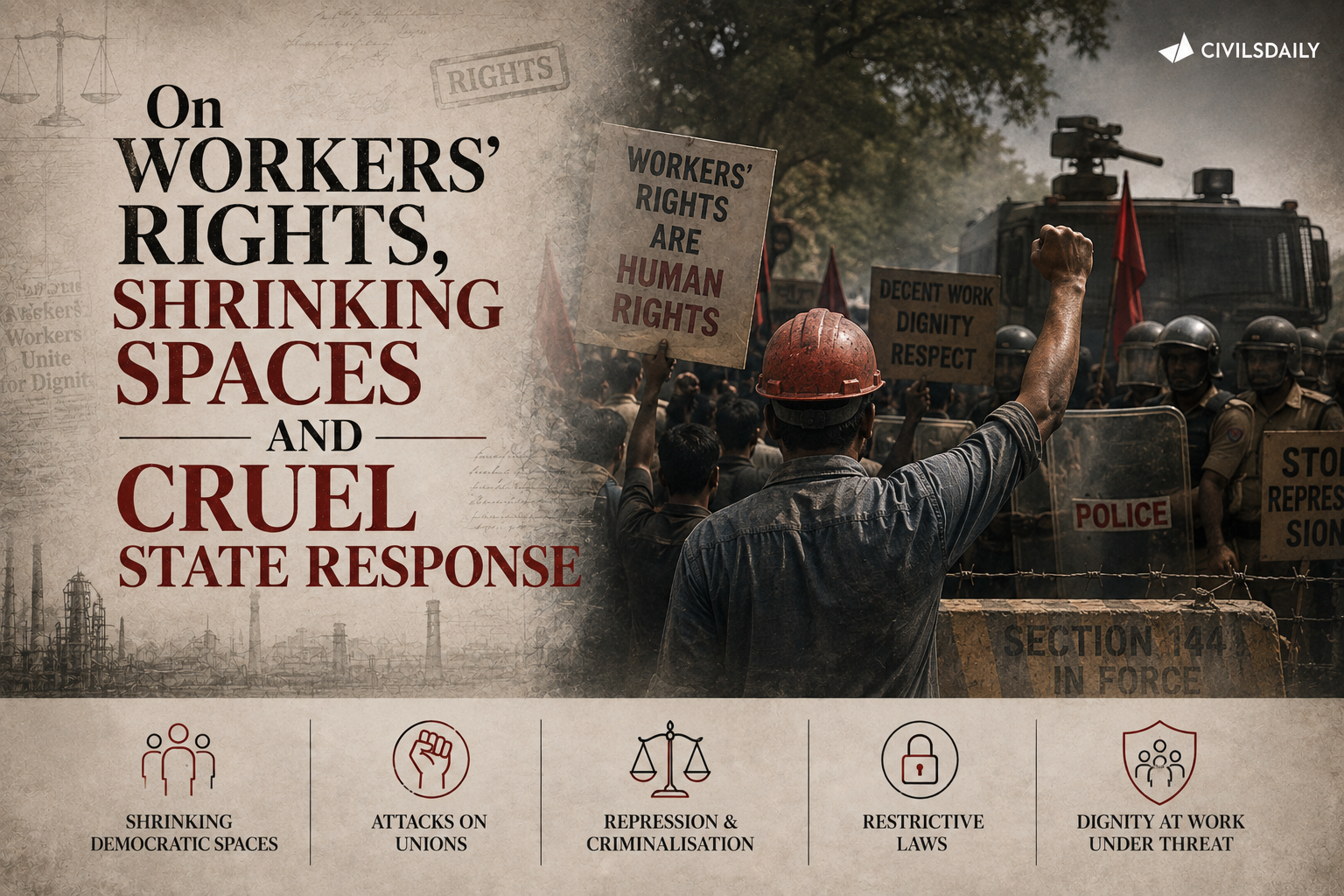
  • On workers rights, shrinking spaces and cruel state response

    On workers rights, shrinking spaces and cruel state response

    Why in the News

    An opinion piece has linked the invocation of the National Security Act, 1980 (NSA) against wage protesters in Noida and Ghaziabad to a longer decline in trade unionism and a spread of casual, contract based labour across India’s unorganised sector. The piece follows a wage protest by thousands of workers on 13 April, after which the Noida police floated a theory that the agitation was sponsored by “Pakistan based handlers” and radical leftists, and about 200 people were arrested, two of them booked under the NSA. The piece argues that the same law once reserved for genuine threats to State security is now being used against ordinary economic protest and ideological dissent.

    What is the National Security Act, 1980?

    1. Preventive detention power: The Act lets the Union or a State government detain a person without trial for up to twelve months where it is satisfied that the person’s activities are prejudicial to the defence of India, State security, public order or the maintenance of essential supplies.
    2. Subjective satisfaction standard: Detention rests on the detaining authority’s own assessment of a future risk rather than on a proven criminal act, so no conviction or specific offence needs to be established beforehand.
    3. Limited disclosure of grounds: The grounds for detention must ordinarily be communicated to the detainee within days of the order, but can be withheld where disclosure is considered against the public interest.
    4. Advisory Board review: An Advisory Board that includes sitting or former High Court judges reviews each detention within a set period, though its proceedings are not equivalent to a full trial.

    How did the state respond to the Noida and Ghaziabad wage protest?

    1. A wage protest turned into a security case: Thousands of workers in Noida and Ghaziabad took to the streets on 13 April demanding higher wages. The Noida police, caught off guard, floated a theory that the agitation was sponsored by “Pakistan based handlers” and radical leftists.
    2. Mass arrests followed: About 200 people were arrested on charges of inciting violence.
    3. Two individuals were booked under the NSA: Journalist Satyam Verma and Delhi University student Akriti Chaudhary were held under the NSA, for their ideological leanings rather than for any specific act.
    4. The underlying wage demand was met, but the case was not withdrawn: The Uttar Pradesh government announced higher wages for the workers, while those arrested fought a difficult legal battle and continue to face its aftermath even after coming out of jail.

    Why has India’s unorganised workforce lost the power to resist such treatment?

    1. A largely unrecorded toll: Forty thousand to fifty thousand casual workers die every year from occupational hazards in India’s unorganised sector, according to numerous research studies, and many more deaths go unrecorded in official data altogether.
    2. A sector too large to protect through informal goodwill alone: The unorganised sector employs nearly 80 percent of India’s workforce, so lapses in protection affect the majority of working people rather than a small margin.
    3. Trade unionism has receded since liberalisation: The movement that once produced leaders such as George Fernandes has weakened sharply as India’s economy has liberalised.
    4. Casualisation spread from the media into government itself: From the 1990s, news organisations began hiring staff on contract rather than on the payroll, part of a wider trend already under way in other sectors. The Centre and State governments, the country’s largest employers, eventually adopted the same contract based hiring as a way to save cost, entrenching the casualisation of labour.
    5. The result is a workforce with no leverage: Workers and employees today have little means to demand better conditions or resist injustice.
    6. Left parties have lost political weight: The Left is losing political strength and relevance, and the term “leftist” is now used as a pejorative in social media discourse.

    What historical precedent of ideological accommodation has been abandoned?

    1. Trade unions once worked across ideological lines: In Kanpur in 1985, leaders of the CITU (Centre of Indian Trade Unions), the AITUC (All India Trade Union Congress), the INTUC (Indian National Trade Union Congress) and the BMS (Bharatiya Mazdoor Sangh) shared a camaraderie and jointly took up the cause of labour despite their ideological differences.
    2. Workers won rights through sustained struggle, not political patronage: Workers in textile mills and in the defence sector earned their rights through consistent struggles against management.
    3. A trade unionist held a Brahmin dominated seat for two decades: Kanpur, despite being a predominantly Brahmin constituency, was represented in the Lok Sabha by S M Banerjee, a veteran trade union leader, from 1957 to 1977.
    4. Political rivals once mourned an ideological opponent: In 1997, the BJP’s national executive passed a resolution mourning the assassination of AISA (All India Students Association) leader and former JNU (Jawaharlal Nehru University) Students Union president Chandrashekhar, killed by Mohammed Shahabuddin in Siwan. Chandrashekhar belonged to a Naxal aligned ideological stream.
    5. That same accommodation would now be treated as suspect: The piece argues that the 1997 BJP resolution, if found in someone’s possession today, would itself risk being treated as seditious material by the Uttar Pradesh Police.

    What tension does criminalising ideological material expose?

    1. Possession of a book is being treated as an offence: A book on Marxism, or on Gaza or the Palestinian struggle, is being categorised as criminal material when found in an individual’s possession.
    2. Marxist ideology sits within India’s constitutional mainstream: Marxist ideology is as much a part of India’s political mainstream as the Congress or the BJP, and every political party that swears loyalty to the Constitution is allowed to grow and function in the country.

    Challenges to invoking the National Security Act against protest and dissent

    1. Vague and subjective grounds for invocation: The Act permits detention on the executive’s own subjective satisfaction that a person’s activities are prejudicial to public order, without a defined evidentiary threshold. Eg. In 2020, the National Security Act was invoked against a doctor in Uttar Pradesh over a public speech, and the Allahabad High Court quashed the detention in 2021 for lacking any evidence of an actual threat to public order. Fix. Require a documented, judicially reviewable threshold of imminent public order harm before invocation, rather than the detaining authority’s subjective satisfaction alone.
    2. Weak disclosure of the case against the detainee: Grounds for detention can be withheld where disclosure is considered against the public interest, leaving the detainee unable to mount a full challenge. Eg. Detainees under the Act have often learned the specific allegations against them only after approaching High Courts through habeas corpus petitions. Fix. Mandate disclosure of detention grounds within a fixed period, with any exception reviewed by a judicial officer rather than decided by the detaining authority itself.
    3. The Advisory Board functions as an executive check rather than a judicial one: The Board that reviews detention orders has historically confirmed most of the orders referred to it, and its proceedings offer limited scope for legal representation. Fix. Allow legal representation before the Advisory Board and require it to publish reasoned orders, so its review carries genuine weight.
    4. A chilling effect on journalists and students: Using a preventive security law against people over their reading material or ideological leanings, rather than any proven act, discourages lawful reporting and dissent. Eg. A Manipur journalist was detained under the Act in 2018 over a social media post criticising the state’s Chief Minister. Fix. Confine invocation of the Act to demonstrable threats to public order, with judicial pre screening required in cases involving journalists and students.

    Conclusion

    The Noida episode shows that as trade union protections have eroded and labour has been casualised, the state has increasingly reached for security legislation such as the National Security Act to answer a wage protest, extending a pattern of criminalising political dissent that earlier generations of political rivals once resisted. Whether the arrested journalist and student receive a fair hearing, and whether India’s civil liberties framework is reformed to prevent such recourse to preventive detention against economic protest, remains unresolved.

    Current Status of Personal Liberty in India

    1. A broad but conditional guarantee: Personal liberty covers freedom of speech, assembly, association, and movement under Article 19(1)(a) to (e), and the right to life and personal liberty under Article 21, all subject to reasonable restrictions the state may impose by law.
    2. A carved out exception for preventive detention: Article 22 protects against arbitrary arrest and detention, but specifically permits preventive detention laws such as the National Security Act, 1980 and the Unlawful Activities (Prevention) Act, 1967, under which a person can be held without a trial.
    3. Judicial reading has widened even as detention powers remain broad: Courts have steadily expanded what Article 21 protects, yet the power to preventively detain still rests largely on the executive’s own satisfaction rather than on prior judicial approval.

    Constitutional Provisions Related to Personal Liberty

    1. Article 19(1)(a): Guarantees freedom of speech and expression.
    2. Article 19(1)(b): Guarantees freedom of peaceful assembly.
    3. Article 19(1)(c): Guarantees freedom of association.
    4. Article 21: Guarantees the right to life and personal liberty, protecting against arbitrary state action.
    5. Article 22: Protects against arbitrary arrest and detention, while permitting preventive detention laws as a specific exception.

    Major debates surrounding Personal Liberty

    1. Security law versus proportionality: Whether preventive detention laws such as the National Security Act curtail personal liberty beyond what public order genuinely requires.
    2. Dissent versus disorder: Whether vague grounds such as public order or prejudicial activity are being used to criminalise lawful dissent rather than address genuine security threats.
    3. Judicial expansion versus executive discretion: The gap between the judiciary’s expansive reading of Article 21 protections and the limited judicial oversight available at the point of preventive arrest itself.

    Laws and Rules Governing Personal Liberty and Preventive Detention

    1. Unlawful Activities (Prevention) Act, 1967: Allows the government to designate organisations and individuals as unlawful or as terrorists, and permits prolonged detention before trial in cases involving alleged threats to India’s sovereignty and integrity.
    2. Bharatiya Nyaya Sanhita, 2023, Section 152: Replaced the sedition offence earlier defined under Section 124A of the Indian Penal Code, 1860, penalising acts that excite secession, armed rebellion, or subversive activity.
    3. Bharatiya Nagarik Suraksha Sanhita, 2023: Governs the ordinary process of arrest, remand and bail that a preventive detention law such as the National Security Act bypasses.

    [2024] Right to privacy is intrinsic to life and personal liberty and is inherently protected under Article 21 of the Constitution. Explain. In this reference discuss the law relating to D.N.A. testing of a child in the womb to establish its paternity.”

  • Vande Mataram and the right to dissent

    Why in the News

    Parliament has given Vande Mataram the same criminal-law protection long enjoyed by the national anthem, through the Prevention of Insults to National Honour (Amendment) Bill, 2026. The amendment follows the government’s push, since late 2025 and around the song’s 150th anniversary, to popularise and even mandate all six stanzas at official functions. The amended text does neither of those things: it does not compel any citizen to sing, and it does not prescribe which stanzas of the song attract its protection. The contest is between that narrow statutory text and the political framing around it, with Bijoe Emmanuel & Ors. v. State of Kerala (1986) standing as the controlling precedent on whether a citizen can be compelled to join a patriotic recitation against conscience.

    What is the Prevention of Insults to National Honour (Amendment) Bill, 2026?

    1. What it amends: It substitutes Section 3 of the Prevention of Insults to National Honour Act, 1971, the statute that already protected the national anthem from disrespect.
    2. What it punishes: It punishes two things and only two things, in relation to both the national anthem and the national song: intentionally preventing their singing, and causing disturbance to an assembly engaged in singing them.
    3. The punishment: Up to three years’ imprisonment, a fine, or both. A mandatory minimum of one year applies to repeat offenders.
    4. What it equalises: That punishment is now common to both compositions, so the national song carries the same criminal protection as the anthem.

    Why was Vande Mataram never made the national anthem?

    1. The question was left open almost to the end: India’s national anthem was left unsettled for nearly the entire life of the Constituent Assembly.
    2. It was settled by a statement, not a vote: The matter was resolved by a presidential statement on 24 January 1950, at the Assembly’s last sitting, declaring Jana Gana Mana the National Anthem of India.
    3. Vande Mataram was given equal status, not anthem status: The same statement said the song, “which has played a historic part in the struggle for Indian freedom, shall be honoured equally with Jana Gana Mana and shall have equal status with it.” It did not make it the anthem or a co-anthem.
    4. The Constitution is silent on a national song: The Constitution, which came into force two days later, contains no reference whatsoever to a “national song”, so the song’s status rests entirely on the 1950 statement and on subsequent convention.
    5. The restraint came from a 1937 decision: Objections from the Muslim League and others led the Congress Working Committee, in October 1937, to resolve that only the first two stanzas, pastoral, secular in imagery and free of any reference to a deity, would be sung at official gatherings.
    6. The objection was to the song’s source text: The later stanzas invoke the motherland in explicitly devotional, goddess-centred terms, and in the context of the 1882 novel Anandamath, from which the song is drawn, some verses were read as casting Muslims as adversaries.

    How was the Amendment passed?

    1. Introduction and passage: The Bill was introduced in the Rajya Sabha on 24 July 2026 and cleared both Houses within a week.
    2. The House dates: The Rajya Sabha cleared it on 29 July and the Lok Sabha on 30 July, each after only a brief discussion.
    3. The Opposition’s objection: The Dravida Munnetra Kazhagam (DMK) and the Congress raised strong objections that the Bill was being used to advance a particular cultural agenda, and objected to its timing amid unrelated protests in the House.
    4. Assent: It received Presidential assent shortly after passage in both Houses.
    5. The scrutiny it received: It was one of 12 Bills passed in a Monsoon Session in which, by Parliament’s own record, most legislation went through with barely any discussion. For a law touching religious sentiment, free expression and criminal liability at once, that is remarkably little parliamentary scrutiny.

    What does the Amendment not do?

    1. It prescribes no version: Nowhere does the amended Act say which stanzas of Vande Mataram must be sung, or that all six stanzas must be sung, for the law’s protection to apply.
    2. It does not compel singing: The statute does not compel singing in the first place, by anyone, of any stanza.
    3. The obligation is conditional and negative: All the amended Section 3 requires is that if the national song is being sung, at whatever length and in whatever form, that rendition must not be intentionally prevented or disturbed.
    4. It is narrower than the framing around it: That is a materially narrower obligation than the political framing around the Bill, including the push since late 2025 to mandate all six stanzas at official functions, would lead the public to believe.
    5. What it actually penalises: The law penalises disrespect and disruption of a performance. On its text it does not mandate participation in one, and it does not fix which version of the song is entitled to protection.

    Why do the later stanzas raise a constitutional difficulty?

    1. The opening stanzas are pastoral: The commonly sung opening stanzas describe the motherland in pastoral terms: her waters, her fruit, her cooling breezes, her fields.
    2. The later stanzas change register entirely: In substance, and in every available English rendering, they describe the motherland as embodied in the Hindu goddesses Durga, Lakshmi and Saraswati, goddesses of power, wealth and learning.
    3. They read as prayer, not patriotic verse: They speak of her as an object of worship enshrined in temples, with “crores” of arms raised in her defence. On a plain reading this is a devotional address to a deity, structured in the grammar of prayer.
    4. Two fundamental rights are engaged: Article 25 guarantees freedom of conscience and the free profession, practice and propagation of religion. Article 26 guarantees a denomination the right to manage its own religious affairs without State interference.
    5. Coercive pressure is enough to raise the difficulty: For adherents of monotheistic faiths, being required to stand through an extended recitation addressed to Hindu goddesses, whether by direct compulsion or by a criminal statute looming over the assembly, raises a serious constitutional difficulty. That discomfort is exactly the conscientious objection Articles 25 and 26 exist to protect.
    6. An ordinary law cannot override a fundamental right: No ordinary legislation, however patriotically framed or however large its parliamentary majority, can override a fundamental right, so a law pressuring citizens into a devotional performance contrary to their faith would not survive Part III scrutiny.

    What did Bijoe Emmanuel hold?

    1. The facts: Three siblings, practising Jehovah’s Witnesses, stood respectfully and silently while their schoolmates sang Jana Gana Mana during morning assembly, since their faith forbade joining in what they understood as an act of worship of anyone or anything other than god. They were expelled for this.
    2. The High Court position: The Kerala High Court upheld the expulsion, holding that the Article 51A fundamental duty to respect the national anthem overrode any claim under Articles 25 and 26.
    3. The reversal: A Division Bench of the Supreme Court reversed the High Court in emphatic terms in 1986.
    4. The two rights engaged: The Bench held that compelling a person to join in singing despite a genuine, conscientiously held religious objection contravenes Article 19(1)(a), freedom of expression, which the Court held extends to the freedom to remain silent, and Article 25(1), the guarantee of freedom of conscience.
    5. Duties cannot cut down rights: The Court held that the fundamental duties enumerated under Article 51A cannot be used to cut down or override the fundamental rights guaranteed under Part III. A duty to respect national symbols cannot in law be turned into a licence to punish sincere religious dissent.
    6. The 1971 Act was read narrowly: The Court read the 1971 Act itself as requiring nothing more than respectful conduct, not active participation from anyone present. It closed by observing that the country’s tradition, philosophy and Constitution alike “practise tolerance”.

    What is the settled legal position now?

    1. The precedent stands: The 1986 ruling has never been overturned, and its logic transfers with full force to the national song.
    2. It applies with greater force here: The song’s later verses are, unlike the anthem, addressed to specific deities, so a citizen objecting to reciting them stands on stronger ground than the objector in the 1986 case did.
    3. Official recognition was always confined: The Constituent Assembly and the founding leadership deliberately confined official recognition to the first two, secular stanzas, which is precisely why the fuller devotional version was never made compulsory.
    4. No textual obligation to sing exists: The 2026 Amendment imposes no textual obligation on any citizen to sing any particular version of the song, let alone all six stanzas.
    5. Silent respect is not an offence: Standing respectfully, in silence, without disrupting others, is not an offence under the amended Act, was not an offence under the original 1971 Act, and cannot be made one merely by extending the statute to a new composition.

    Challenges to the Prevention of Insults to National Honour (Amendment) Bill, 2026

    1. “Disturbance” is left undefined: The offence turns on causing disturbance to an assembly, a term the statute does not define, which leaves its scope to the complainant and the investigating officer. Eg. A citizen who remains seated or silent during a recitation may be read as disturbing it, which is precisely what the 1986 ruling forbids. Fix. Insert a statutory explanation excluding silent non-participation and peaceful abstention from the meaning of disturbance.
    2. The political framing exceeds the text: Official messaging around the law suggests a duty to sing all six stanzas, so citizens act on the framing rather than on the statute. Eg. The Ministry of Home Affairs’ Orders relating to the National Anthem of India are executive instructions carrying no penal force, yet schools and public institutions routinely enforce them as though they were binding law. Fix. Issue an advisory to State governments and school authorities recording that the Act creates no obligation to participate in a rendition.
    3. It was passed without scrutiny: A law touching religious sentiment, free expression and criminal liability at once cleared both Houses within a week on brief discussion. Eg. It was one of 12 Bills passed in a Monsoon Session where most legislation passed with barely any debate. Fix. Refer any Bill creating or extending a criminal offence to a Standing Committee as a default rule of procedure.
    4. Cognisance risks vexatious complaint: A criminal provision available to any complainant against a person present at a public assembly invites use as a tool of local pressure. Eg. Cinema hall anthem prosecutions after 2016 produced repeated complaints against individuals who stayed seated for medical or conscientious reasons. Fix. Require prior sanction from a district level authority before a court takes cognisance of an offence under Section 3.
    5. A mandatory minimum removes judicial discretion: The one year minimum for repeat offenders forecloses proportionality in cases where the conduct is trivial or conscientious. Eg. A repeat conscientious abstainer wrongly booked twice would face the same floor as a deliberate disruptor. Fix. Replace the mandatory minimum with a graded sentencing guideline keyed to intent and to actual disruption caused.
    6. Enforcement asymmetry across compositions: Extending equal protection to a composition whose later verses are devotional creates unequal burdens on citizens of different faiths at the same public event. Eg. A monotheistic believer at a school function faces a choice the same statute does not impose on others present. Fix. Confine the protected rendition at State functions to the first two stanzas, as the 1937 Congress resolution and the 1950 statement already did.

    Conclusion

    The Amendment extends the anthem’s criminal protection to the national song without compelling anyone to sing it and without fixing which stanzas count. The three strands, the founding decision to recognise only the first two secular stanzas, the narrow text of the new Section 3, and the 1986 precedent on freedom of conscience, converge on a single conclusion: a citizen who declines to join in on grounds of conscience is under no legal obligation to participate, and needs no court to say so. The measure has received Presidential assent and is now in force, and the source records no further legislative milestone attached to it. What remains unresolved is application rather than text, since the danger lies in how a statute framed narrowly is enforced against those who exercise the silence the Constitution protects.

    “[2025] Consider the following pairs: Provision in the Constitution of India: Stated under

    I. Separation of Judiciary from the Executive in the public services of the State The Directive Principles of the State Policy

    II. Valuing and preserving of the rich heritage of our composite culture The Fundamental Duties

    III. Prohibition of employment of children below the age of 14 years in factories The Fundamental Rights

    How many of the above pairs are correctly matched?

    (a) Only one

    (b) Only two

    (c) All the three

    (d) None

  • Routine data or citizenship check? Why Census questionnaire sparked concern

    Why in the News

    The questionnaire for the population enumeration phase of Census 2027 has triggered a political controversy. The principal Opposition party has alleged that detailed questions about respondents and their parents could facilitate surveillance and serve a “deeper nefarious purpose”, and the Left has raised the same objection. The controversy follows a report of 15 August 2026 that several new or modified questions in the Census questionnaire were also part of the National Population Register (NPR) schedule notified in 2020. That schedule became contentious during protests over the Citizenship (Amendment) Act, 2019 and fears of a nationwide National Register of Citizens. Two things are now contested: whether a statistical exercise should collect identifiers that link a person across government databases, and whether a register of residents can stay separate from a register of citizens when the law connects the two.

    What is the National Population Register?

    1. A register of usual residents, not of citizens: The NPR records every person ordinarily resident in a local area, and it makes no finding on anyone’s nationality.
    2. Usual resident, defined: A usual resident is a person who has lived in a local area for at least six months, or who intends to stay there for the next six months.
    3. Foreigners can be on it: A foreign national who meets the six month residence test is a usual resident and is entered in the register.
    4. It is not a new exercise: The NPR was first prepared in 2010 alongside the houselisting phase of the 2011 Census, and it was updated through a door to door exercise in 2015.

    What is the National Register of Citizens?

    1. A register of verified citizens: The National Register of Citizens (NRC) is a list of persons established to be Indian citizens, prepared by verifying claims against documentary proof of descent or residence.
    2. It has been compiled only in one State: The single updated NRC exercise so far was the Supreme Court monitored update in Assam, completed in 2019.

    What exactly has changed in the Census 2027 questionnaire?

    1. Scale of the change: The schedule carries 40 questions, of which 14 are new or modified compared with the 2011 Census.
    2. Eight questions carried over from the 2020 NPR schedule: These are nationality as declared, father’s particulars, mother’s particulars, mobile number, Aadhaar, voter identity card, passport and driving licence.
    3. The parental fields are the most contested: The NPR schedule sought the date and place of birth of a person’s father and mother, down to the district and the State.
    4. A foreign birthplace had to be named: Where a parent was born outside India, the country of birth had to be recorded. These parental questions were at the centre of the political opposition to the NPR.

    Why is the privacy objection different from earlier Census rounds?

    1. The stated purpose has always been aggregate: Census data has traditionally been collected for population statistics and planning, not for identifying a named individual.
    2. The new schedule collects identifiers, not just attributes: It seeks a much wider range of personal information, including details that can identify a person or link that person to other government databases.
    3. The real question is downstream, not upstream: The issue is not how much data the government collects. It is how that data is stored, protected and used once collected.

    How is the Population Register linked in law to the citizens’ register?

    1. A statutory chain exists between the two: The Citizenship (Registration of Citizens and Issue of National Identity Cards) Rules, 2003 provide for the preparation of a Population Register and for its verification for the preparation of the citizens’ register.
    2. The Rules create a category of doubt: They also provide for individuals whose citizenship is considered doubtful to be marked for further inquiry.
    3. The link is legal, not political: The connection sits in subordinate legislation, so it survives any assurance given by a government of the day.

    Why did that legal link become politically explosive in 2019-20?

    1. The sequencing was the problem: The NPR was revived soon after the Citizenship (Amendment) Act, 2019 was passed by Parliament.
    2. Assam supplied the precedent: The NRC exercise in Assam had excluded around 19 lakh people, giving a concrete picture of what a documentation based citizenship test produces.
    3. The Union executive named the sequence itself: The Union Home Minister repeatedly spoke of a nationwide NRC and asked people to understand the “chronology”. That chronology placed the Act first and the register after it.
    4. Perception overtook the instrument: A previously uncontroversial statistical exercise came to be read as one associated with the possibility of citizenship being questioned.

    What did the government say in 2020, and why did the assurance not settle the issue?

    1. The contested fields were declared optional: The government stated that the questions on parents’ date and place of birth need not be answered.
    2. The stated purpose was welfare delivery: The NPR was described as primarily a database of residents intended to improve policy formulation and the delivery of welfare schemes.
    3. The administrative case was demographic: Knowing the demographic composition of an area was said to help governments plan services and identify beneficiaries.
    4. The assurance contradicted the record: In December 2019 the Union Home Minister said NPR data would never be used for an NRC and that the two exercises were governed by different laws. Earlier government statements in Parliament had taken the opposite position, as the statutory link set out above already did.

    Does the government have a legitimate case for collecting this data?

    1. Detailed demographic data has real administrative value: A comprehensive database of residents helps the government formulate policy, plan public services, identify beneficiaries and improve national security.
    2. Linkage cuts duplication: Information drawn from different government databases reduces duplication and discrepancies in records, and cuts paperwork for citizens.
    3. The identifiers were the design, not an add on: The NPR was envisaged as a way of bringing basic demographic information together with mobile numbers and identity documents, so that government services run more efficiently.
    4. The objectives are not unreasonable in themselves: Neither the resident register nor the citizens’ register is inherently improper as an exercise in public administration.

    Is the objection to the questions themselves or to the trust deficit around them?

    1. The questions are ordinary in isolation: A field asking for a parent’s place of birth is a standard demographic variable in statistical systems worldwide.
    2. Timing converted them into a citizenship test: The 2019-20 difficulty was that the register was revived at a moment of dented public trust, and the assurances offered failed to restore it.
    3. Trust, once lost, redefines the instrument: Questions that would otherwise read as routine are now read through the prism of citizenship and surveillance.

    Challenges to the Census 2027 data collection exercise

    1. No purpose limitation on identifier fields: Nothing in the notified schedule bars the linkage of Census records to other identity databases at a later date. Eg. The Aadhaar number was originally described as voluntary proof of residence and later became a precondition for a range of subsidies. Fix. Notify a purpose limitation clause under the Census Act, 1948 barring individual level linkage of Census records with any other database.
    2. Digital collection widens the breach surface: A mobile application based enumeration of over 1.4 billion people stores personally identifiable data in a way a paper schedule never did. Eg. The Bharat Sanchar Nigam Limited breach of May 2024 leaked 278 gigabytes of subscriber data from a public sector network. Fix. Designate the Census data centres as Critical Information Infrastructure and mandate independent security audits before the enumeration window opens.
    3. Self enumeration depends on digital capability: The self enumeration option assumes a smartphone, connectivity and the literacy to complete a 40 question schedule unaided. Eg. Rural self response rates in comparable digital surveys run far below urban rates. Fix. Fund assisted self enumeration desks at common service centres and panchayat offices for the duration of the window.
    4. Fear of citizenship scrutiny corrupts the data: Households that suspect the schedule feeds a citizenship check give incomplete or inaccurate answers, which damages the statistics the exercise exists to produce. Eg. Enumerators in Assam faced sustained non cooperation during the NRC update. Fix. Issue a public statement in the enumeration instructions that no Census response will be used in any individual citizenship or law enforcement proceeding.
    5. Caste enumeration invites organised inflation: Recording caste for the first time since 1931 creates an incentive for groups to coordinate responses in pursuit of quota gains. Eg. The Socio Economic and Caste Census of 2011 recorded over 46 lakh distinct caste and sub caste entries, which made the data unusable for policy. Fix. Publish a pre coded, State specific list of jatis drawn from State Backward Classes Commission records before enumeration begins.
    6. State capacity is stretched across two exercises: The same district administration runs the Census and the electoral roll work in the same period, which raises error rates in both. Eg. Booth level staff across several States have been simultaneously assigned roll revision and enumeration duties. Fix. Ring fence enumeration staff from all other duty assignments for the notified Census period.

    Conclusion

    The dispute is not really about how many questions the schedule carries. It rests on the statutory link set out above, which is why a statistical instrument can be read as the first step of an eligibility test. The government’s administrative case for richer data is sound on its own terms, and the downstream safeguard on that data remains unpublished. Until it is published, every additional field in the schedule will be argued over as a citizenship question rather than a statistical one.

    “[2021] With reference to India, consider the following statements:

    1. There is only one citizenship and one domicile.

    2. A citizen by birth only can become the Head of State.

    3. A foreigner, once granted citizenship, cannot be deprived of it under any circumstances.

    Which of the statements given above is/are correct?

    (a) 1 only

    (b) 2 only

    (c) 1 and 3

    (d) 2 and 3