Why in the News
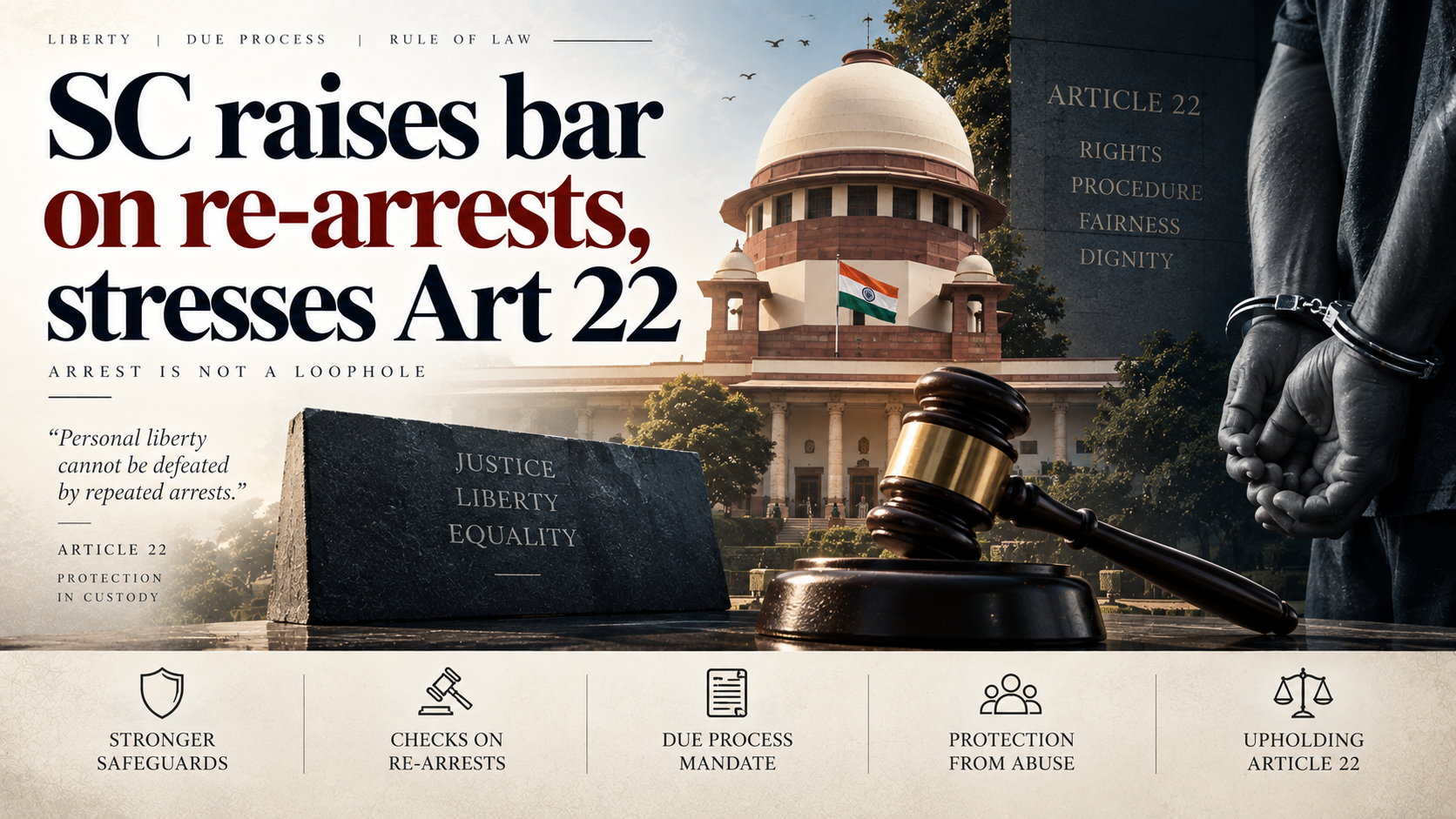
The Supreme Court has held that the safeguards provided under Article 22 cannot be “tinkered with”, and has laid down strict guidelines for arresting a person again after an earlier release for failure to supply the grounds of arrest. A Bench of Justices Ujjal Bhuyan and Atul S. Chandurkar held in a 69 page ruling that an accused released for a violation of fundamental rights is not “enlarged on bail” but released from illegal and unconstitutional detention. The ruling answers Mihir Rajesh Shah v. State of Maharashtra (November 2025), which had settled that written grounds of arrest must be furnished across all offences and statutes in a language the arrestee understands. That judgment made the failure fatal to the arrest; this one decides what the State may do next. The tension is that the police now need a Magistrate’s prior sanction to correct their own constitutional lapse, in cases the State argues are too serious for the police to “face fetters”.
What does Article 22 guarantee an arrested person?
- Production before a Magistrate: Article 22 requires an accused to be produced before a Magistrate within 24 hours of arrest.
- Grounds of arrest: Article 22(1) requires the accused to be informed of the grounds of arrest, and the settled position is that those grounds must be in writing and in a language the arrestee understands.
- Access to counsel: It provides the right to legal representation, meaning consultation with and defence by a legal practitioner of the person’s choice.
- The consequence of breach: Any breach or non compliance entails immediate release of the arrested person, because such an arrest is unconstitutional.
Why did the Court treat the safeguard as constitutional rather than procedural?
- Not a formality: The Court held that Article 22(1) is not a mere formality or a matter of procedure, but a mandatory binding constitutional safeguard.
- No prejudice test: Where there is a violation of the Constitution, the question of prejudice or demonstrable prejudice does not arise, so an accused need not show that the lapse harmed the defence.
- Not statute specific: Article 22(1) applies across the spectrum, including offences under the Bharatiya Nyaya Sanhita (BNS) and under special enactments, and is not tied to any one statute.
- Gravity is irrelevant: The Court held that a violation of the Constitution cannot be countenanced and has to be dealt with strictly, and that the obligation does not depend on the nature or gravity of the offence.
What procedure must the police now follow to arrest the person again?
- Written grounds first: The accused must first be provided written grounds of arrest, curing the original defect before any fresh step is taken.
- An application to the Magistrate: An application must be filed before a Magistrate explaining why a fresh arrest is necessary and why the grounds were not furnished the first time.
- Endorsement by the superior officer: To rule out foul play or collusion, the application must carry the endorsement of the immediate superior authority, so that authority knows the officer violated a constitutional provision.
- The Magistrate’s test: The Magistrate may allow a fresh arrest only on being satisfied that “for bona fide reasons” the grounds could not be furnished at the first instance but were furnished after release, and that the accused needs to be arrested again.
- A fixed decision window: The Magistrate must decide such an application within a week.
- The investigation changes hands: The superior officer giving the endorsement must hand over the investigation to another officer and direct a departmental enquiry into the lapse.
- Consequences for the officer: An adverse finding in that enquiry entails departmental action with an entry in the officer’s service book.
- Compensation as a remedy: High Courts across the country have been directed to grant “suitable mandatory compensation” where arrests violate procedural safeguards.
Why did the Court refuse to leave the decision with the police?
- The violator cannot cure its own violation: The Court held that the power to arrest again must not be “left to the discretion of the very same authority who had violated the said provision of the Constitution”.
- Judicial sanction as the test: It held that the decision must have “the judicial imprimatur”, which converts an internal police call into an order a court records and can be reviewed against.
- Separating remedy from punishment: The release for breach and the departmental enquiry run together, so the individual’s liberty is restored while the officer’s conduct is examined separately.
- The State’s contrary case: The Punjab government argued that given the serious nature of the allegations the police “should not face fetters” while arresting an accused, and the Court rejected that as a ground for relaxing the safeguard.
How did this case reach the Supreme Court?
- The underlying matter: The Bench was hearing an appeal by an accused in a case under the Protection of Children from Sexual Offences Act, 2012 (POCSO) in Punjab.
- The first release: The local Magistrate released the accused on the ground that he was not provided the reasons for his arrest, and then allowed the police to arrest him again on complying with procedural safeguards.
- The High Court stage: The accused challenged that permission before the Punjab and Haryana High Court, which on 29 May allowed the police to arrest him again.
- The appeal: The accused then moved the Supreme Court against that High Court order, which is the appeal this ruling decides.
How has the Court’s position on grounds of arrest evolved?
- Pankaj Bansal v. Union of India, October 2023: The Court held that all arrests under the Prevention of Money Laundering Act (PMLA) require a written copy of the grounds of arrest to be furnished “as a matter of course and without exception”.
- Ram Kishor Arora v. Directorate of Enforcement, December 2023: A later order diluted the rule, holding that grounds need not always be supplied in writing, and treated the Pankaj Bansal ruling as prospective in nature.
- Prabir Purkayastha v. State (NCT of Delhi), May 2024: The Court reaffirmed that an arrested person must be provided the grounds of arrest in writing.
- Mihir Rajesh Shah v. State of Maharashtra, November 2025: The position was settled, with written grounds required across all offences and statutes in a language the arrestee understands, and failure rendering both the arrest and the subsequent remand illegal.
Challenges to enforcing the Article 22 safeguards
- The remedy depends on the arrested person reaching a court: A safeguard enforced only on application benefits those who can retain counsel within the first 24 hours. Eg. Undertrials form the large majority of India’s prison population, and most are represented through legal aid rather than counsel of choice.
The Fix: Make the legal services authority’s duty counsel present at the first remand hearing mandatory, so the grounds of arrest are checked by a lawyer before remand is granted. - Written grounds can be reduced to a printed template: A requirement met by handing over a pre printed form with the section numbers filled in satisfies the letter of the rule and tells the arrestee nothing. Eg. Arrest memos under the D.K. Basu v. State of West Bengal (1997) directions became standardised forms within a few years of that judgment.
The Fix: Require the grounds to state the specific allegation and the material relied on, and make the remand court record that it read them before authorising custody. - Departmental enquiry rarely reaches an adverse finding: An enquiry ordered and conducted within the same force has weak incentives to record a finding that damages a colleague’s service record. Eg. Police complaints authorities recommended under Prakash Singh v. Union of India (2006) remain unconstituted or non functional in several States.
The Fix: Route the enquiry into a constitutional lapse to the State Police Complaints Authority rather than the officer’s own superior, so the finding is recorded outside the chain of command. - Compensation has no fixed measure: A direction to award mandatory compensation without a scale produces widely different awards for the same violation across High Courts. Eg. Compensation in custodial violation matters has ranged from token sums to several lakh rupees with no stated basis.
The Fix: Notify a statutory schedule of minimum compensation by duration of unlawful detention, recoverable from the State with a right of recovery against the erring officer. - The rule bites hardest where evidence is time sensitive: In offences against children and in organised crime, a week’s delay for a Magistrate’s sanction can allow interference with witnesses. Eg. The case that produced this ruling arose under POCSO, where the complainant is a child.
The Fix: Allow the Magistrate to impose interim protective conditions on the released accused while the application for a fresh arrest is pending, so witness safety does not depend on custody.
Conclusion
The judgment shifts the cost of a defective arrest from the accused to the State and to the individual officer. Its practical weight rests on the Magistrate, who now decides whether a constitutional lapse was in good faith and whether custody should resume, on a record that can be tested on appeal. The marker to watch is whether High Courts settle a common scale for the mandatory compensation the ruling directs, since an unquantified remedy is the part of this line of cases that has consistently failed to hold.
Back2Basics
- Bharatiya Nyaya Sanhita, 2023 (BNS): It is the general criminal code of India, replacing the Indian Penal Code, 1860, and it came into force on 1 July 2024.
- The companion statutes: It was enacted alongside the Bharatiya Nagarik Suraksha Sanhita, 2023, which replaced the Code of Criminal Procedure, 1973, and the Bharatiya Sakshya Adhiniyam, 2023, which replaced the Indian Evidence Act, 1872.
- Ministry and route: The three laws were piloted by the Ministry of Home Affairs and passed by Parliament in December 2023.
- Why it appears here: The Court held that the Article 22(1) obligation is not statute specific, so it binds arrests under the BNS and under special enactments alike.
Matching Previous Year Question
“[2023] Consider the following statements:
1. According to the Constitution of India, the Central Government has a duty to protect States from internal disturbances.
2. The Constitution of India exempts the States from providing legal counsel to person being held for preventive detention
3. According to the Prevention of Terrorism Act, 2002, confession of the accused before the police cannot be used as evidence.
How many of the above statements are correct?
(a) Only one (b) Only two (c) All three (d) None
