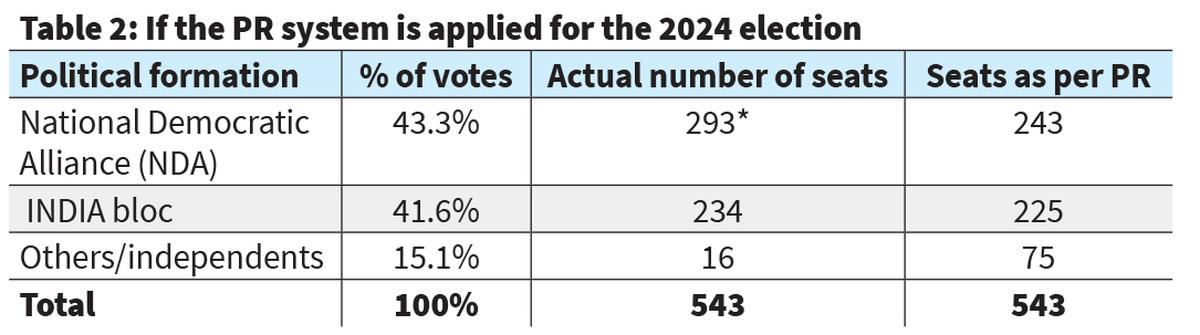
India should contemplate proportional representation to ensure fairer political outcomes, given NDA’s 293 seats (43.3%) compared to INDIA bloc’s 234 seats (41.6%).
First Past the Post (FPTP) System
First Past the Post (FPTP) is a voting system where the candidate with the most votes in each constituency wins, regardless of whether they achieve an absolute majority.
Simple and feasible method used in large democracies like India, the U.S., the U.K., and Canada.
Provides stability to the executive as the ruling party/coalition can enjoy a majority in the legislature without obtaining a majority of the votes across constituencies.
Criticized for potentially resulting in over or under-representation of political parties compared to their vote share.
Proportional Representation (PR) System:
Ensures representation of all parties based on their vote share. Commonly implemented through party list PR, where voters vote for parties rather than individual candidates. PR system applied at each State/Union Territory (UT) level in federal countries like India.
Cons: Disproportionate representation, underrepresentation of minorities, many wasted votes.
Proportional Representation (PR):
Pros: Fairer representation, inclusivity of smaller parties, fewer wasted votes.
Cons: Complex, potential for unstable coalitions, weaker direct constituency representation.
International Practices:
The PR system is used in presidential democracies like Brazil and Argentina, as well as parliamentary democracies like South Africa, the Netherlands, Belgium, and Spain.
Mixed Member Proportional Representation (MMPR) system employed in Germany and New Zealand.
Germany: Germany uses MMPR for elections to the Bundestag. Half of the seats are filled through FPTP constituencies, and the other half are allocated to ensure proportional representation based on party votes, provided parties receive at least 5% of the vote.
New Zealand: New Zealand’s House of Representatives is elected using MMPR, with 60% of seats filled through constituency elections and 40% allocated proportionally based on party votes.
The Mixed Member Proportional Representation (MMPR) system is a hybrid electoral system that combines elements of First Past the Post (FPTP) and Proportional Representation (PR) to ensure both local representation and proportionality in election results.
Way Forward:
The Law Commission, in its 170th report titled ‘Reform of the Electoral Laws’ (1999), recommended the experimental introduction of the Mixed Member Proportional Representation (MMPR) system. It suggested that 25% of seats in the Lok Sabha could be filled using a Proportional Representation (PR) system by increasing the total number of seats.
Incremental implementation of MMPR system for additional seats during delimitation exercises to address population disparities while ensuring fair representation for all regions.
After the swearing-in ceremony of PM Modi, he is set to share the four big portfolios of Home, Defence, Finance, and External Affairs with its alliance partners.
What are the Cabinet Committees?
Cabinet committees in India are groups of ministers formed by the Prime Minister to handle specific tasks or issues more efficiently.
The PM sets up these committees with selected members of the Cabinet and assigns specific functions to these committees.
The PM may changethe number of committees, and modify the functions assigned to them.
Usually, only Cabinet ministers are members of these committees. However, non-Cabinet ministers are not unheard of to be members or special invitees to committees.
If the PM himself is a member of any such committee, he acts as the head of that committee.
Evolution of Cabinet Committees in India’s Governance
Cabinet committees operate under the Government of India Transaction of Business Rules, 1961.
These committees are categorized as Standing (Permanent) or Ad-Hoc (Temporary).
They are established based on Article 77(3) of the Constitution, allowing the President to make rules for efficient transaction of government business and allocation among ministers.
Membership varies from three to eight, predominantly comprising Cabinet ministers, with the Prime Minister often presiding.
The number, terminology, and composition may change over time.
Note: All Cabinet Committees except the Cabinet Committee on Accommodation and the Cabinet Committee on Parliamentary Affairs are headed by the Prime Minister.
There are 8 Cabinet committees at present —
Appointments Committee of the Cabinet (composed of the PM (ex-officio Chairman) and the Minister of Home Affairs),
Cabinet Committee on Economic Affairs (headed by the PM himself),
Cabinet Committee on Political Affairs (headed by the PM),
Cabinet Committee on Investment and Growth,
Cabinet Committee on Parliamentary Affairs,
Cabinet Committee on Employment & Skill Development,
Cabinet Committee on Accommodation, and
Cabinet Committee on Security.
The Committees on Investment and Employment were innovations introduced in 2019 by the Modi government.
About Cabinet Committee on Security
Head of the Committee: The Prime Minister assumes the role of the committee’s head.
Membership: Cabinet ministers of Finance, Defense, Home Affairs, and External Affairs serve as members.
Key Responsibilities: The committee addresses issues related to law and order, internal security, and foreign affairs policy with security implications, including matters concerning atomic energy.
Economic and Political Considerations: It also examines economic and political issues relevant to national security.
Financial Oversight: The CCS reviews cases involving capital defence expenditure exceeding Rs 1,000 crore.
Departmental Considerations: Additionally, it evaluates matters concerning the Department of Defence Production, Department of Defence Research and Development, Services Capital Acquisition plans, and procurement of security-related equipment.
Why is CCS so important?
The CCS, led by the Prime Minister, includes key ministers overseeing finance, defence, home affairs, and external affairs, playing a pivotal role in national security discussions and appointments.
It makes major decisions regarding significant appointments, national security issues, and defence expenditure, indicating its crucial role in India’s security framework.
Apart from defence matters, the CCS addresses law and order, internal security, foreign policy on security issues, and matters related to atomic energy, showcasing its broad spectrum of responsibilities.
Alliance Partners in the Cabinet Committee on Security (CCS)
1996 Government Transition: A notable instance was during the 1996 H.D. Deve Gowda government, following Atal Bihari Vajpayee’s resignation as Prime Minister. Deve Gowda, then CM of Karnataka, took office as Prime Minister on June 1. Mulayam Singh Yadav from the Samajwadi Party served as Defence Minister, P. Chidambaram, founder of the Tamil Manila Congress earlier that year, became Finance Minister, and Indrajit Gupta of CPI assumed the role of Home Minister.
2001 Appointment: During Vajpayee’s tenure leading the NDA government in 2001, George Fernandes, founder of the Samata Party, was appointed Defence Minister, holding the position for three years. Notably, during his tenure as Defence Minister in Vajpayee’s second and third ministries (1998–2004), Fernandes oversaw critical events such as the Kargil War and nuclear tests at Pokhran.
Party Distribution: However, during the UPA government, the Congress retained all CCS positions, whereas in the Modi government, the BJP held all four positions.
PYQ:
[2014] The size of the cabinet should be as big as governmental work justifies and as big as the Prime Minister can manage as a team. How far the efficacy of a government then is inversely related to the size of the cabinet? Discuss.
[2017] Out of the following statements, choose the one that brings out the principle underlying the Cabinet form of Government:
(a) An arrangement for minimizing the criticism against the Government whose responsibilities are complex and hard to carry out to the satisfaction of all.
(b) A mechanism for speeding up the activities of the Government whose responsibilities are increasing day by day.
(c) A mechanism of parliamentary democracy for ensuring collective responsibility of the Government to the people.
(d) A device for strengthening the hands of the head of the Government whose hold over the people is in a state of decline.
Narendra Modi will take the oath as the Prime Minister for a third consecutive term, following an invitation from President Droupadi Murmu to form the government.
Constitutional Provisions for PM Post
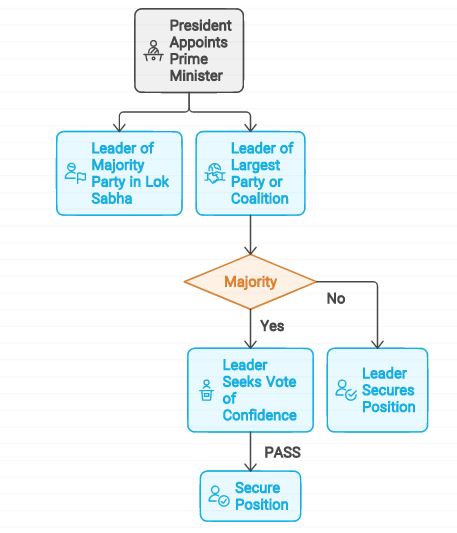
Article 75: It states that the President shall appoint the Prime Minister, who is usually the leader of the majority party in the Lok Sabha (House of the People).
Article 74: The Prime Minister is the head of the Council of Ministers and provides advice to the President on matters of governance.
Appointment of the Prime Minister
The appointment of the Prime Minister of India involves specific constitutional provisions supervised by the President. Key features related to the appointment of the Prime Minister as mentioned in the Constitution of India include:
The Prime Minister is appointed permanently by the President of India.
The President invites the leader of the majority party in the Lok Sabha to form the government.
If no political party holds a majority, the President can use discretionary powers to appoint the Prime Minister.
The President may invite the leader of the largest party or coalition to seek a vote of confidence from the Lok Sabha, with a tenure of about a month to secure this vote.
Position of Prime Minister in India’s Democratic set-up
Head of Government: The Prime Minister is the chief executive authority in the country, responsible for leading the government and overseeing the functioning of various ministries and departments.
Leader of the Council of Ministers: The Prime Minister is the leader of the Council of Ministers, which comprises cabinet ministers, ministers of state, and deputy ministers. They coordinate the activities of the government and guide policy decisions.
Advisor to the President: While the President of India is the head of state, the Prime Minister acts as the president’s chief advisor and assists in exercising executive powers.
Principal Link between President and Parliament: The Prime Minister communicates the decisions of the Council of Ministers to the President and represents the government in Parliament.
Symbol of Unity and Stability: The Prime Minister symbolizes the unity and stability of the country’s governance. They provide leadership and direction to the nation, fostering a sense of unity and purpose among the citizens.
International Representation: The Prime Minister represents India on the international stage and plays a significant role in foreign policy formulation. They engage in diplomatic relations, attend international summits, and represent India’s interests globally.
Crisis Management: During times of crisis, such as natural disasters, security threats, or economic challenges, the Prime Minister takes charge of crisis management efforts and leads the government’s response to address the situation.
Powers and Functions of the Prime Minister
The Indian Constitution outlines the powers and functions of the Prime Minister, who is appointed by the President and holds significant authority over the President, Council of Ministers, and parliamentary houses. These powers include:
Function Relative to the President: The Prime Minister serves as the main channel of communication between the President and the Council of Ministers, overseeing the administration of Union affairs and appointing key administrative officials.
Functions Relative to the Council of Ministers: The Prime Minister advises on the nomination and selection of Council Ministers, can allocate and shuffle ministerial departments, and has the authority to demand resignations from ministers. The resignation of the Prime Minister leads to the dissolution of the Council of Ministers.
Parliamentary Functions: The Prime Minister leads the lower parliamentary house (Lok Sabha), can suggest the dissolution of the Lok Sabha, and is responsible for announcing and introducing government policies in parliamentary sessions.
Miscellaneous Functions: The Prime Minister holds additional roles such as chairman of the National Water Resource Council, NITI Aayog, National Integration Council, Inter-State Council, and NDA, among others.
Appointment, Tenure, and Removal
Eligibility: According to Articles 84 and 75 of the Constitution of India, the Prime Minister must:
Be a citizen of India.
Be a member of the Lok Sabha or the Rajya Sabha, or become a member within six months of selection.
Be above 25 years of age if a Lok Sabha member, or above 30 years if a Rajya Sabha member.
Not hold any office of profit under the government of India or any state government.
Oaths of Office and Secrecy:
Before entering office, the Prime Minister must take an oath of office and secrecy in the presence of the President of India, as per the Third Schedule of the Constitution.
Tenure and Removal from Office:
The Prime Minister serves at the “pleasure of the President,” but must maintain the confidence of the Lok Sabha.
The term can end if a simple majority of Lok Sabha members no longer have confidence in the Prime Minister, known as a vote of no-confidence.
A Prime Minister can also resign from office. Morarji Desai was the first to do so while in office.
Additionally, ceasing to meet the qualifications under the Representation of the People Act, 1951, can lead to removal from office.
PYQ:
[2015] Consider the following statements:
The Executive Power of the union of India is vested in the Prime Minister.
The Prime Minister is the ex officio Chairman of the Civil Services Board.
Which of the statements given above is/are correct?
(a) 1 only
(b) 2 only
(c) Both 1 and 2
(d) Neither 1 nor 2
[2019] Consider the following statements:
The 44th Amendment to the Constitution of India introduced an Article placing the election of the Prime Minister beyond judicial review.
The Supreme Court of India struck down the 99th Amendment to the Constitution of India as being violative of the independence of judiciary.
Which of the statements given above is/are correct?
Q) Starting from inventing the ‘basic structure’ doctrine, the judiciary has played a highly proactive role in ensuring that India develops into a thriving democracy. In light of the statement, evaluate the role played by judicial activism in achieving the ideals of democracy. (UPSC IAS/2014)
Q) The Supreme Court of India keeps a check on the arbitrary power of the Parliament in amending the Constitution. Discuss critically. (UPSC IAS/2013)
Note4Students:
Prelims: Article 300-A;
Mains: The decision of the Supreme Court in Kolkata Municipal Corporation;
Mentor comments: A frequently cited maxim regarding property rights is that of President John Adams, who stated, “Property is surely a right of mankind as real as liberty.” This notion of property as a fundamental right has undergone significant developments in the post-colonial era, with the right to property being fiercely contested between courts and the legislature.
Let’s learn
—
Why in the News?
The recent Supreme Court decision in “Kolkata Municipal Corporation & Anr. v. Bimal Kumar Shah & Ors” has clarified that Article 300-A of the Indian Constitution, which guarantees that no person shall be deprived of their property except by authority of law, encompasses seven essential procedural sub-rights that must be protected during land acquisition.
Background
Origin: The genesis of the power struggle over the right to property in India dates back to the case of Bela Banerjee, which involved the interpretation of Articles 19(1)(f) and 31(2) of the Constitution before the amendment. The Supreme Court held that the word “compensation” in Article 31(2) implied a just equivalent of what the owner had been deprived of. To undo this interpretation, the Constitution (Fourth) Amendment was passed in 1955, amending Article 31(2) to explicitly state that courts could not question the adequacy of compensation.
Substituting the word “compensation” with “amount,”: they held that although the final compensation was non-justiciable, the principles fixed by the legislature to determine such compensation were open to scrutiny. Parliament realised that the word “compensation” in Article 31(2) was the source of the problem. The Constitution (Twenty-Fifth) Amendment Act, 1971, substituted the word “compensation” with “amount,” effectively keeping the courts from interpreting the adequacy of such “amount” through judicial review.
Supreme Court response: The validity of the Constitution (Twenty-Fifth) Amendment Act, 1971, was upheld in Kesavananda Bharati, but the Supreme Court watered down the intended effect of the amended Article 31(2) through an interpretive process. The majority in Kesavananda Bharati held that though the adequacy of the amount paid was not justiciable, the courts could still examine whether the principles fixed for determining such compensation were relevant, effectively reinstating what Justice Shah had said in the Bank Nationalisation Case. After this decision, Parliament was convinced that the Right to Property remained a thorn in the goal of achieving a socialist state, as it was seen as a citadel of the bourgeoisie.
Major changes:
Constitution (44th Amendment) Act, 1978: The Janata Party, which came to power after the 1977 general election, passed the Constitution (44th Amendment) Act, 1978. This amendment deleted Article 19(1)(f) and Article 31 from Part III of the Constitution and rehabilitated the right to property as a constitutional right under Article 300-A.
Right to property is not absolute: Article 300-A states that “no person shall be deprived of his property save by authority of law.” This provision emphasizes that the property right is not absolute and can be regulated by law.
Impact on the Right to Property: The deletion of Article 19(1)(f) and Article 31 led to a significant change in the Right to Property. The Right to Property was no longer a fundamental right, but a constitutional right that could be regulated by law.
The arguments in the favour of Right to property
Justice K.K. Mathew’s Observation: Justice K.K. Mathew, a dissenting judge in Kesavananda Bharati, believed that the right to own and acquire property was a fundamental right and should not have been excluded from the basic features of the Constitution.
Professor P.K. Tripathi’s Views: Professor P.K. Tripathi argued that the deletion of Article 31 was a mistake and that the Right to Property was still protected by Article 300-A. He believed that “compensation” in Article 300-A meant the market value of the property at the time of acquisition.
Supreme Court Interpretations: The Supreme Court has held that the Right to Property is not only a constitutional right but also a human right. In cases like M.C. Mehta and B.K. Ravichandra, the Court emphasized that laws depriving individuals of their property must be just, fair, and reasonable and that Article 300-A’s guarantee cannot be read down
The recent decision of the Supreme Court in Kolkata Municipal Corporation has fleshed out seven different facets which are protected under Article 300-A-
Seven Facets Protected:
The right to notice
The right to be heard
The right to a reasoned decision
The duty to acquire only for public purpose
The right of restitution or fair compensation
The right to an efficient and expeditious process
The right of conclusion
Right to Restitution or Fair Compensation: The Supreme Court has reiterated that a person deprived of land by the state in the exercise of its power of eminent domain is entitled to be paid compensation which is just and reasonable.
Position in the Bela Banerjee Case: The Court has judicially affirmed the position prevailing when the unamended Article 31 was in force, and the interpretation expounded in the Bela Banerjee case on the aspect of payment of compensation.
Protection of Property: The decision in Kolkata Municipal Corporation vindicates the prophetic words of Prof. P.K. Tripathi, that in enacting the Forty-Fourth Amendment and deleting Articles 19(1)(f) and 31, Parliament has unwittingly given the property of a citizen the kind of protection it has never enjoyed before either in British or in independent India
Way forward:
Ensure that the acquisition process is transparent and follows the prescribed procedures outlined in the Land Acquisition Act, 1894, and the Right to Fair Compensation and Transparency in Land Acquisition, Rehabilitation and Resettlement Act, 2013.
Ensure that the procedures are documented and easily accessible to all stakeholders.
Q. Discuss each adjective attached to the word ‘Republic’ in the preamble. Are they defendable in the present circumstances stances? (UPSC IAS/2016) Q. ‘Constitutional Morality’ is rooted in the Constitution itself and is founded on its essential facets. Explain the doctrine of ‘Constitutional Morality’ with the help of relevant judicial decisions. (UPSC IAS/2021)
Prelims: Which one of the following objectives is not embodied in the Preamble to the Constitution of India? (UPSC IAS/2017) (a) Liberty of thought (b) Economic liberty (c) Liberty of expression (d) Liberty of belief
Note4Students:
Prelims: Preamble; Constitutional Values;
Mains: Democratic Political System;
Mentor comment: Do you know what is the meaning of the word, ‘values’? You may immediately say that truth, non-violence, peace, cooperation, honesty, respect, and kindness are values, and you may continue to count many such values. In fact, in a layman’s understanding, value is that which is very essential or ‘worth having and observing’ for the existence of human society as an entity. The Indian Constitution contains all such values, the values that are universal, human, and democratic of the modern age. The constitutional values are reflected in the entire Constitution of India, but its Preamble embodies ‘the fundamental values and the philosophy on which the Constitution is based’. Political Democracy contributes to stability and continuous progress in society and it secures peaceful political change. But, during the recent General Elections, the interplay between the Constitution and political mobilization has fundamentally shaped the trajectory of democratic politics.
Let’s learn.
–
Why in the News?
The General Elections of 2024 have established larger concerns over the Constitution constraint and the democratic legitimacy of the government, regardless of the election’s outcome.
The silences around secularism and the focus on caste-based discrimination and reservations reveal critical fault lines.
The Constitution as a Battleground in the 2024 Indian Election:
Political Tussle: The BJP’s declaration of winning 400+ seats and remarks about changing the Constitution if they achieve electoral dominance.
Opposition leaders portray this election as a battle to “save the Constitution” and it resonates with voters on the ground.
Constitutional Principles vs Ordinary Laws: Ordinary laws in India are often seen as discriminating and are used coercively by the state to undermine freedoms and disempower citizens. However, the Constitutional values provide the basis for challenging discriminatory laws.
The Constitution’s commitment to secure Liberty, Equality, and Dignity:
Liberty: The Preamble prescribes liberty of thought, expression, belief, faith and worship as one of the core values. These have to be assured to every member of all the communities.
Equality: Inequality based on the concept of rulers/caste/gender is to be eliminated. All citizens of India should be treated equally.
Similarly, equal opportunities imply that regardless of the socioeconomic situation, he/she will have the same chance as everybody else to develop his/her talents and choose a means of livelihood.
Dignity: The promotion of ‘Fraternity’ is essential to realize the dignity of the individual. It is essential to secure the dignity of every individual without which democracy cannot function.
It ensures equal participation of every individual in all the processes of democratic governance.
Although the word ‘dignity’ has no textual mention in the Constitution, the Supreme Court has held dignity to be the “founding faith” of the Constitution and the “core of Fundamental Rights.”
Other core Constitutional values are expressed in the Preamble as objectives of the Constitution. Some of these are as follows:
Sovereignty: Being sovereign means having complete political freedom and being the supreme authority. It implies that India is internally all-powerful and externally free. It is free to determine for itself without any external interference (either by any country or individual) and nobody is there within to challenge its authority.
Socialism: Our Constitution directs the governments and the people to ensure the prevention of the concentration of wealth and power in a few hands. The Constitution has specific provisions that deal with inequalities in the chapters of Fundamental Rights and Directive Principles of State Policy.
Secularism: India is home to almost all major religions in the world. In the context of this plurality, secularism is seen as a great Constitutional value. The Constitution strictly prohibits any discrimination on the grounds of religion.
Democracy: The people elect the rulers of the country and the elected representatives remain accountable to the people. It allows dissent and encourages tolerance. More importantly, it is based on the principles of the rule of law, independence of the judiciary, free and fair elections, and freedom of the press.
Contradictions in Contemporary Indian Politics:
Secularism vs Equality: Dalit voters emphasize the Constitution’s principles of Right to equality, while Muslim voters primarily express concerns about Secularism.
Secularism vs Equity: Ordinary young citizens have mobilized around Constitutional principles throughout India’s history to secure their Rights and challenge Socioeconomic deprivation.
For much of this decade, the logic of caste-based mobilization seemed to have receded in the background, for example, the introduction and passage of the 103rd Amendment to the Constitution mandated 10% reservations for economically weaker sections (EWS) amongst unreserved ( upper caste) categories.
A young BJP supporter fears that a “Hindu Rashtra” would lead to discrimination, while a Yadav farmer believes the Constitution protects them and gives them reservations.
Conclusion: If the 2024 election is indeed a battle for the Constitution, the silences around secularism and the focus on caste-based discrimination and reservations reveal critical fault lines that the polity must confront. However, the heightened concerns over the Constitution also constrain the democratic legitimacy of the government, regardless of the election’s outcome.
The Election Commission of India (ECI) told the Supreme Court that there is no legal mandate to provide Form 17C (account of votes recorded) to any other person other than the candidate or his agent.
What does Article 329(b) say?
It specifically bars courts from intervening in any disputes related to the electoral processduring the active phase of an election—from its notification to the final declaration of results.
This is to prevent any potential delays or disruptions caused by litigation during the election.
About Forms 17A and 17C
As per the Conduct of Elections Rules, 1961, there are two forms that have data on the number of electors and voters — Forms 17A and 17C.
Form 17A: This document, compiled by the Returning Officer for each constituency, lists contesting candidates and registers voter information, including names and symbols.
Form 17C: Form 17C contains the account of votes recorded at each polling station during the election. It is prepared by the Presiding Officer of the polling station after the conclusion of polling. It includes:
EVM identification numbers.
Total number of electors and voters at the polling station.
Number of voters who did not record their votes after signing the register.
Number of voters not allowed to vote.
Total number of votes recorded per EVM.
Part-II of Form 17C: It carries counting results entered on counting day. This form is crucial for any legal challenges to the election results and for candidates to verify results on counting day.
Why is there a Demand to Make Form 17C Data Public?
Activists advocate for greater transparency in election processes.
The high number of polling stations makes it hard for candidates to compile all data.
The Election Commission of India (ECI) is not legally required to publish aggregate voter turnout data.
The ECI ensures that all statutory requirements, including providing Form 17C to candidates, are met.
Discrepancies noted in Form 17C can be contested to maintain election integrity.
Back2Basics: Conduct of Election Rules, 1961
The Conduct of Election Rules, 1961, commonly referred to as the 1961Rules, outline the procedural framework governing various aspects of the electoral process in India.
These rules were formulated under the authority of the Representation of the People Act, 1951.
It serves as the foundational legislation for conducting elections in the country.
Activities covered: Preparation of electoral rolls, the nomination of candidates, the conduct of polling, counting of votes, and the declaration of results.
Regulatory Function: The 1961 Rules incorporate provisions for addressing electoral malpractices, disputes, and grievances, thereby safeguarding the sanctity of elections.
PYQ:
[2017] For election to the Lok Sabha, a nomination paper can be filed by
(a) Anyone residing in India.
(b) A resident of the constituency from which the election is to be contested.
(c) Any citizen of India whose name appears in the electoral roll of a constituency.
Mains: Q) What was held in the Coelho case? In this context, can you say that judicial review is of key importance amongst the basic features of the Constitution? (UPSC CSE 2016)
Q) The Supreme Court of India keeps a check on arbitrary power of the Parliament in amending the Constitution. Discuss critically. (UPSC CSE 2013)
Prelims:
In India, Judicial Review implies (UPSC IAS/2017): (a) the power of the Judiciary to pronounce upon the constitutionality of laws and executive orders. (b) the power of the Judiciary to question the wisdom of the laws enacted by the Legislatures. (c) the power of the Judiciary to review all the legislative enactments before they are assented to by the President. (d) the power of the Judiciary to review its own judgements given earlier in similar or different cases.
Note4Students:
Prelims: Judicial Review;
Mains: Judicial Review and Judicial Activism;
Mentor comment: The Indian constituent assembly adopted judicial review to ensure the effective functioning of the constitutional democracy in India. Judicial review allows the judiciary to protect the fundamental rights of citizens enshrined in the Constitution. It serves as a mechanism to ensure that laws and actions of the government do not violate these rights. It also ensures the successful operation of constitutional democracy in India. It allows for the protection of democratic principles, the separation of powers, and the independence of the judiciary.
Let’s learn.
–
Why in the News?
Concerns have arisen due to the ambiguity in the CAA Rules regarding the status of applicants denied citizenship, raising fears of detention center placements.
Petitioners have expressed worries about dual citizenship for foreign applicants, potentially leading to citizenship uncertainty and conflicting with the Parent Act.
Background: The Supreme Court of India will assess the constitutionality of the Citizenship (Amendment) Act (CAA) and its associated rules shortly. Constitutional courts rarely intervene to invalidate legislation, presuming laws passed by Parliament are valid unless proven to violate constitutional provisions.
The lack of interdiction in the Judiciary:
Manish Kumar vs Union Of India, 2021: The Legislation is generally assumed to be free of malice.The Supreme Court said that there can be no estoppel against the Legislature, and the concept of transferred malice is alien in the field of legislation
Gurudevdatta Maryadit and Ors. vs State Of Maharashtra and Ors (2001): The Supreme Court, in this case, has stated that legislative malice falls outside the jurisdiction of law courts. It also held that it is not appropriate to attribute malice to the legislative process.
Case of Anoop Baranwal vs Union of India (2023): This case called for an independent body to select the Election Commission of India (ECI) to avoid executive dominance.
The Chief ElectionCommissioner and other Election Commissioners Act, 2023 reinstated the Prime Minister’s Committee’s role in ECI appointments.
Jaya Thakur vs Union of India (2024) challenged the Act, highlighting its unconstitutional nature threatening democratic foundations.
The Court’s refusal to prevent the Act’s implementation based on presumed validity raises concerns about safeguarding democracy and free elections.
Impacts of Lack of Interdiction in Critical Times:
Conventional wisdom falls short in addressing challenges posed by populist regimes using motivated legislation.
Obsolete presumptions of law validity hinder constitutional courts from playing a counter-majoritarian role effectively.
Impact of Political Statements: Legislation reflects political ideologies, especially in regimes undermining constitutional democracy. Judicial reluctance to interdict laws based on presumed validity can lead to irreversible consequences, as seen in cases like demonetization and the dilution of Kashmir’s special status.
Way Forward:
Strengthen Judicial Review: Judicial review should be strengthened to effectively check legislative actions that manipulate Electoral processes or undermine Constitutional Democracy.
Courts need to adopt a more assertive approach in critical times to fulfill their counter-majoritarian role.
Prioritize Urgent Cases: Urgent cases challenging unconstitutional laws should be prioritized to prevent irreversible consequences. Delays in deciding such cases can make the litigation almost a fait accompli, as seen in the dilution of Kashmir’s special status.
Ensure Effective Implementation of Judgments: Courts should ensure the effective implementation of their judgments by preventing the legislature from overriding them through motivated legislation.
Enhance Judicial Infrastructure: Improving judicial infrastructure, such as increasing the number of judges and courts, can help expedite the hearing of urgent cases. Adequate resources and efficient case management systems are crucial for the timely delivery of justice.
BACK2BASICS:
What is Judicial Review?
The term “judicial review” refers to the power of the courts to examine the actions of the legislative, executive, and administrative branches of government to determine if they are consistent with the Constitution.
Article 372 (1) establishes the judicial review of the pre-constitution legislation.
Article 13 declares that any law which contravenes any of the provisions of the part of Fundamental Rights shall be void. The primary purpose is to uphold the rule of law and protect the Constitution by striking down unconstitutional laws or actions. It is based on the Constitution and existing legal precedents.
What is Judicial Activism?
Judicial activism occurs when judges take an active role in shaping policies by broadly interpreting the Constitution and laws to achieve what they consider just outcomes. According to Articles 32 and 226 of the Indian Constitution, the higher judiciary has the power to consider any legislative, executive, or administrative action as unconstitutional and void if it does so. Judicial activism often involves mechanisms like suo-moto cases and public interest litigation that have no explicit constitutional backing.
To protect the rights of village landowners in Haryana, the Supreme Court has permitted a review of a 2022 judgment by Justices Hemant Gupta and V Ramasubramanian that allowed gram panchayats to acquire ‘shamlat deh’ land.
Context:
What is ‘Shamlat deh’?
It refers to common land in the village, formed by multiple landowners each contributing an equal portion of their holdings to serve the “common purposes” of the village community. It is kept aside for common use in villages, as part of the Punjab Land Revenue Act of 1887.
Article 31A was inserted by the First Amendment Act of 1951 in the Indian Constitution. It aimed to protect laws related to agrarian reforms and the acquisition of estates.
According to the Supreme Court (April 2022), such land should be utilized by panchayats only for the needs of villagers. No part of the land can be re-partitioned amongst the proprietors, and such land would not be available for sale.
A Bench of Justices B R Gavai and Sandeep Mehta reopened the challenge to the 1992 amendment on May 17, 2024, after observing that the 2022 decision disregarded an important and relevant Constitution Bench decision in the case of Bhagat Ram vs State of Punjab (1967).
Bhagat Ram: Clarifying the Meaning of Land Acquisition under Article 31A:
In 1967, a five-judge Bench reviewed a land consolidation scheme for the village of Dolike Sunderpur that reserved lands for common purposes and diverted the income to the panchayat.
Landowners’ Argument: The scheme violated the second provision of Article 31A, which prevents acquiring land below the ceiling limit without compensation at market value.
State’s Argument: The reservation for the panchayat was not land acquisition since the income would benefit the village.
Ajit Singh v State of Punjab (1967): Distinguished land acquisition from modification or extinguishment of land rights.
SC Decision: The panchayat was effectively acquiring land by reserving its income, making the state the beneficiary. The court ruled that the second provision of Article 31A applied. Punjab argued the acquisition predated the 17th amendment, but the SC noted the scheme’s implementation was stayed, hence possession and control had not been transferred.
Does Shamlat Land Belong to the Landowners or the Panchayat?
In 2003, the Punjab and Haryana High Court reviewed a challenge to the 1992 amendment to the Punjab Act that vested control of ‘shamlat deh’ land in Haryana with the gram panchayat.
Petitioners’ Argument: The Landowners however argued that the amendment did not allow panchayats to control the land for common purposes without compensation, violating Article 31A.
High Court Decision: The court distinguished between land reserved for common purposes under the Consolidation Act (vested with the gram panchayat) and land contributed by proprietors but not reserved under the consolidation scheme (which could not vest with the panchayat without compensation).
The decision relied on the SC’s Bhagat Ram ruling that acquiring land without compensation violates the second proviso of Article 31A.
SC Allows Review of 2022 Judgment:
The 2022 Supreme Court decision by Justices Gupta and Ramasubramanian overruled the 2003 High Court decision, finding no need for compensation as Article 31 had been omitted. The court ruled that the panchayat merely managed the land on behalf of landholders and that control was vested in the panchayat upon assignment.
Karnail Singh Review: Justices Gavai and Mehta reopened the challenge, noting the 2022 decision’s cursory reference to Bhagat Ram without addressing why the High Court’s reliance on it was wrong.
The court found that ignoring a Constitution Bench decision was a manifest error, justifying a review.
Recalled the 2022 SC decision: The 2022 decision was recalled, and the challenge to the 2003 High Court decision was set to be reheard, starting on August 7, 2024.
Way Forward:
Need Comprehensive Judicial Reviews: Conduct detailed reviews of prior relevant judgments to provide clear, well-founded reasoning in court decisions.
Need Clear Compensation Guidelines: Establish explicit guidelines for compensation in land acquisition cases, particularly those involving common land like ‘shamlat deh’, to protect landowners’ rights.
Mains PYQ:
Q The Right to Fair Compensation and Transparency in Land Acquisition, Rehabilitation and Resettlement Act, 2013 has come into effect from Ist January 2014. What are the key issues which would get addressed with the Act in place? What implications would it have on industrialization and agriculture in India? (UPSC IAS/2014)
The Supreme Court’s ruling safeguards landowners from arbitrary government acquisition, emphasizing adherence to Article 300A, ensuring the constitutional right to property and sub-rights compliance.
Procedural Sub-Rights under Right to Property
These seven rights are foundational components of a law that is in tune with Article 300A, and the absence of one of these or some of them would render the law susceptible to challenge:
Right to Notice: Individuals must be informed about the intention to acquire their property.
Right to Be Heard: Affected individuals have the right to voice objections.
Right to a Reasoned Decision: The government must justify the acquisition with a reasoned decision.
Public Purpose Justification: Acquisitions must serve a demonstrable public purpose.
Right of Restitution or Fair Compensation: Landowners are entitled to fair compensation for their property.
Right to An Efficient and Expeditious Process: Acquisition procedures should be efficient and adhere to set timelines.
Right of Conclusion: The process concludes with the physical transfer of property; failure to take possession renders the acquisition incomplete.
Back2Basics:Right to Property in India
The Right to Property was initially a fundamental right under the Constitution of India, included in Part III (Articles 19 and 31).
Through the 44th Amendment Act of 1978, this right was removed from the list of fundamental rights. It was reclassified as a constitutional right under Article 300A.
About Article 300A:
Article 300A was introduced to the Constitution, stating that “No person shall be deprived of his property save by authority of law.”
Legal Framework: This implies that the government can still acquire private property, but this acquisition must be done through a law that justifies the acquisition and provides for fair compensation to the affected parties.
Current Legal Status
Not a Fundamental Right: The Right to Property is no longer a fundamental right, which means it cannot be directly enforced through the Supreme Court or High Court under Article 32 or Article 226. However, it remains a constitutional right.
Protection under Law: Any person deprived of his property under any state enactment can approach a High Court challenging the legality of the act under Article 300A.
Legal Recourse: Affected individuals have the right to legal recourse if they believe that the acquisition was not justified or that the compensation was inadequate.
Recent Judgment: Human Rights
Case Background: The judgment supported a Calcutta High Court decision that dismissed an appeal by the Kolkata Municipal Corporation regarding the acquisition of private land.
Court’s Order: The Corporation was ordered to compensate with ₹5 lakh for costs within 60 days.
Human Rights Perspective: The right to property is not only protected as a constitutional right but has also been recognized as a human right by a “Bench of Justices P.S. Narasimha and Aravind Kumar”.
Legal Interpretations and Clarifications
Justice Narasimha clarified that the phrase ‘authority of law’ in Article 300Aextends beyond the state’s power of eminent domain.
It necessitates a proper legal framework for property acquisition.
The ruling underscored that mere possession of eminent domain power and the provision of compensation do not justify compulsory acquisition if due processes are not followed.
PYQ:
[2021] What is the position of the Right to Property in India?
Mains PYQ Relevance: Q) Discuss the possible factors that inhibit India from enacting for its citizen a uniform civil code as provided for in the Directive Principles of State Policy. (UPSC IAS/2015) Q) Examine the scope of Fundamental Rights in the light of the latest judgement of the Supreme Court on Right to Privacy. (UPSC IAS/2017)
Note4Students:
Prelims: Fundamental Right and DPSP;
Mains: Relation between FR and DPSP;
Mentor comments: The Constitution expressly makes Fundamental Rights enforceable, while DPSPs are regarded as goals that the state is expected to work towards. The tension between these parts has simmered through India’s history, reaching a boiling point in the 1970s when the Constitution was routinely amended, primarily to make certain kinds of legislation exempt from Judicial Review.
Let’s learn
—
Why in the News?
The recent case of Property Owners Association vs State of Maharashtra scrutinises two key questions: the meaning of “material resources of the community” in Article 39(b) and whether laws support the “common good”.
Present Dilemma before the Judiciary:
Supreme Court is presently considering a challenge to Chapter VIII-A of the Maharashtra Housing and Area Development Act, 1976. This chapter was added in 1986, which allowed the government to acquire “cessed” properties in Mumbai under Article 39(b).
In 1991, the Bombay High Court upheld the amendment, citing Article 31C’s protection for laws related to Article 39(b).
The appeal reached the Supreme Court in 1992, focusing on whether “material resources of the community” in Article 39(b) encompass private resources like cessed properties.
The conflict between Fundamental Rights (Part III) and Directive Principles of State Policy (DPSP) (Part IV):
Ongoing Conflict: Despite attempts by the Supreme Court to clarify, the conflict between fundamental rights and DPSP has persisted since the landmark Kesavananda Bharati case in 1973. Uneasy Relationship between FR and DPSP: The relationship between fundamental rights and DPSP is described as uneasy, indicating tension between their implementation and interpretation. Importance of Property Owners Case: The resolution of this conflict in the Property Owners case is expected to have a significant impact on the future trajectory of constitutional interpretation and governance. Clarity in Constitution: Initially, the Constitution seemed clear on the matter, with Article 13 declaring laws violating fundamental rights as void and Article 37 stating that DPSPs are not enforceable by courts but should guide state action. Treatment of DPSPs: Despite not being legally enforceable, DPSPs are considered fundamental principles for governance, and the state is obligated to apply them in legislation, as stated in the Constitution. Hierarchy of Rights: Early court judgments, such as Chief Justice S.R. Das’s remarks in Mohd. Hanif Quareshi vs State of Bihar (1958), emphasised the importance of implementing DPSPs without infringing upon fundamental rights, highlighting the delicate balance required between the two parts of the Constitution.
Evolution of Article 31C:
25th Amendment(1971): The 25th Amendment to the Constitution introduced Article 31C, aimed at placing certain laws beyond Judicial Review, particularly those related to Article 39(b) and (c).
This amendment curtailed the Fundamental Right to Property. It provided that any law made to give effect to the Directive principle contained in Article 39(b)or 39(c) cannot challenged on the grounds of violation of Rights guaranteed under Articles 14,19 and 31, ensuring exemption from judicial scrutiny.
This provision had significant implications. For instance, Parliament could nationalise the media under the pretext of securing the common good, without facing challenges related to freedom of expression.
Kesavananda Bharati Case (1973): A narrow majority (6:7) found that amendments conflicting with the Constitution’s Basic Structure would be void, partially questioning the validity of the 25th Amendment.
Judicial Review Principle: Justice H.R. Khanna’s opinion highlighted that the 25th Amendment limiting examination of laws regarding Article 39(b) and (c) infringed upon the principle of judicial review, although it upheld the exemption from challenges based on Articles 14 and 19.
Ambiguity in Kesavananda Verdict: Despite some aspects being found void, the Kesavananda case didn’t provide a clear stance on whether the amendment, regarding exemption from fundamental rights challenges, violated the Constitution’s basic features.
Changes to Article 31C and subsequent legal Interpretations:
42nd Amendment (1976): The 42nd Amendment expanded the scope of Article 31C to encompass laws made in furtherance of any Directive Principle of State Policy (DPSP), not just Articles 39(b) and (c), granting broader immunity to such laws from judicial review.
Minerva Mills Case (1980): In Minerva Mills vs Union of India, the Supreme Court declared the 42nd Amendment unconstitutional.
The ruling raised questions about the status of Article 31C. Does it revert to its original form from the 25th Amendment, minus the parts invalidated by Kesavananda Bharati? Or does its validity remain uncertain?
Presently, Chief Justice Y.V. Chandrachud emphasized that Fundamental Rights, such as Articles 14, 19, and 21, serve as essential safeguards against unrestricted state power.
Waman Rao Case (1981): In Waman Rao vs Union of India, Justice Y.V. Chandrachud, while acknowledging his own opinion in Minerva Mills, upheld the validity of the unamended Article 31C. This judgment contradicts the stance taken in Minerva Mills.
Validity of Article 31C:
The conflicting interpretations of Article 31C’s validity add complexity to its legal status. While some argue for its reinstatement in its original form, others question its compatibility with fundamental rights.
In Property Owners, the Court will assess the validity of a law allowing a State government board to control dilapidated buildings. Even if it aligns with Article 39(b), the question remains whether the law can be challenged under Articles 14 and 19.
Conclusion: Despite rulings like Waman Rao and Sanjeev Coke vs Bharat Coking Coal, the Supreme Court still needs to conclusively analyze Article 31C’s compatibility with the Constitution’s basic structure. Property Owner’s case offers a chance for resolution.
![[4th June 2024] The Hindu Op-ed: Property is real, and so should the ‘compensation’](https://www.civilsdaily.com/wp-content/uploads/2024/06/4june-June-1568x882.jpg)
![[29 May 2024] The Hindu Op-ed: The Constitution, a surprise entrant in poll battlefield](https://www.civilsdaily.com/wp-content/uploads/2024/05/29-may-1568x882.jpg)