Mains Ready By December. Smash Mains & Smash PYQ Admissions Open

GS Paper: GS2-01.Indian Constitution-Historical underpinnings & evolution; Features, amendments, significant provisions, basic structure of Constitution

  • The problems with sub-caste reservations

    Why in the News?

    The Supreme Court has reserved its decision on sub-caste reservations for SC/STs. Any ruling on this matter must be substantiated not only legally but also academically.

    What is the Sub-categorization of castes?

    It refers to the practice of further dividing larger caste categories into smaller groups or sub-groups based on specific criteria such as socio-economic status, geographical location, historical background, or specific needs for policy implementation.

    Background of the Case:

    • The case involves the validity of sub-classification within the SC and ST categories for providing reservations in government jobs and education.
    • In 2004 Supreme Court strikes down Andhra Pradesh Scheduled Castes (Rationalisation of Reservations) Act, 2000, citing violation of the right to equality in the E.V. Chinnaiah v State of Andhra Pradesh case and emphasised that the SC list should be treated as a single, homogeneous group
      • Only Parliament has the power to sub-classify SCs and STs for reservations
      • The Supreme Court is now considering whether states have the power to create sub-classifications within these reserved categories.
    • The case stems from a 1975 Punjab government notification that divided its 25% reservation for SCs into two categories: half for Balmikis (Valmikis) and Mazhabi Sikhs, and the other half for the remaining groups within the SC category.

    Objectives behind the implementation of reservations and present SC scenario:

    • Objective of Reservations: The primary objective of reservations, as advocated by Dr. B.R. Ambedkar, is to ensure equitable representation and opportunities for historically marginalized communities, particularly Scheduled Castes (SCs).
    • Present SC scenario: Despite reservations, certain sub-castes within SCs continue to face challenges in securing adequate representation in jobs and education. This under-representation is often attributed to factors such as inadequate educational opportunities, economic disparities, and historical discrimination.

    The policy of economic empowerment in India and its associated challenges:

    • Policies for Economic Empowerment: These policies complement reservations by focusing on enhancing the ownership of capital assets (like land and businesses) and improving educational attainment among SC individuals
      • For example, Self-Employment Scheme for Rehabilitation of Manual Scavengers (SRMS), National Scheduled Castes Finance & Development Corporation (NSFDC) and National Safai Karamcharis Finance & Development Corporation (NSKFDC).
      • These policies are aimed at building capabilities and enabling greater participation in economic activities.
    • Challenges: There are challenges in implementing economic empowerment policies including inadequate access to credit and financial resources, lack of skill development initiatives, and persistent socio-economic barriers that hinder the upward mobility of SC communities.
      • Intersection with Reservations: Integrating economic empowerment with reservations is crucial to ensure that individuals from SC backgrounds not only secure reserved positions but also have the necessary skills and resources to thrive in competitive environments.

    What must be our focus? (Way Forward)

    • Holistic Approach: There is a need for a holistic approach that combines reservations with targeted economic and educational interventions. This approach should address both systemic discrimination and socio-economic barriers faced by SC communities.
    • Capacity Building: There should be emphasis on enhancing the educational infrastructure and skill development programs tailored to the needs of SC individuals.
    • Data-Driven Policy: The policy decisions related to sub-caste reservations should be informed by empirical data that assesses the actual impact of discrimination versus socio-economic factors on under-representation.

    Mains PYQ: 

    Q Whether National Commission for Scheduled Castes (NCSC) can enforce the implementation of constitutional reservation for the Scheduled Castes in the religious minority institutions? Examine (UPSC IAS/2018)
  • Karnataka State Employment of Local Candidates in the Industries, Factories and Other Establishments Bill, 2024

    Why in the News?

    The Karnataka Cabinet has approved a bill mandating that industries, factories, and other establishments appoint local candidates in 50% of management positions and 75% in non-management positions.

    • The bill was cleared in a Cabinet meeting chaired by the Chief Minister.

    Key features of the Bill:

    • Definition of a Local Candidate:
      • Born in Karnataka
      • Domiciled in Karnataka for 15 years
      • Proficient in speaking, reading, and writing Kannada
      • Passed a required test by the nodal agency
    • Educational Requirements:
      • Must have a secondary school certificate with Kannada as a language, or
      • Pass a Kannada proficiency test specified by the nodal agency
    • Training and Relaxation Provisions:
      • Industries and establishments must train local candidates within three years if qualified locals are unavailable
      • Establishments can apply for relaxation if local candidates are insufficient
      • The government’s decision on relaxation applications is final
      • Local candidates must constitute at least 25% in management and 50% in non-management positions
      • Non-compliance penalties range from ₹10,000 to ₹25,000

    Do you know?

    • The Punjab and Haryana High Court earlier quashed the Haryana State Employment of Local Candidates Act, 2020, which mandated 75% reservation for state domiciles in the private sector jobs.
    • This decision was made because the State had overstepped its legislative authority and imposed undue restrictions on private employers.

    Background and Rationale:

    • Long-pending Demand:
      • The bill has been passed in response to longstanding demands for 100% job reservation for Kannadigas.
      • Earlier in July, Kannada organizations organized rallies in parts of the State, demanding immediate implementation of the Sarojini Mahishi Report.
    • Sarojini Mahishi Report:
      • The Sarojini Mahishi report, submitted in 1984 by Mahishi, former Union Minister and the first woman MP from Karnataka, included 58 recommendations.
      • The report recommended 100% reservation for locals in group C and D jobs in Central government departments and public sector undertakings (PSUs) in Karnataka.

    Reservation for Locals in Jobs: Constitutionality Check 

    Provision Potential Violation
    Article 14 Guarantees equality before the law and equal protection of the laws. Reservation for locals could create unequal opportunities for non-locals, violating the principle of equality.
    Article 15 Prohibits discrimination on grounds of religion, race, caste, sex, or place of birth. Reserving jobs for locals based on place of birth or domicile status may constitute discrimination against non-locals.
    Article 16 Ensures equality of opportunity for all citizens in matters relating to employment or appointment to any office under the State. Though it allows reservation for backward classes, it does not explicitly extend this provision to private employment, making mandatory quotas for locals potentially unconstitutional.
    Article 19 Guarantees the freedom to move freely throughout the territory of India. Imposing local reservations could restrict the free movement of people seeking employment opportunities across states, infringing upon their freedom of movement and residence.


    PYQ:

    [2017] One of the implications of equality in society is the absence of:

    (a) Privileges

    (b) Restraints

    (c) Competition

    (d) Ideology

  • SC to look into the use of ‘Money Bills’ to pass laws   

    Why in the News? 

    CJI D.Y. Chandrachud has accepted the plea to list petitions challenging the passage of contentious legislation in Parliament as Money Bills.

    • This has given rise to the expectation that the matter could be heard and decided before Chandrachud demits office in November this year.

    Presently, the three key issues are referred to the 7-judge bench in the Supreme Court:

    • Amendments made post-2015, like the Prevention of Money Laundering Act (PMLA) through Money Bills, giving the Enforcement Directorate wide powers, were valid or not.
    • Whether the passage of the Finance Act of 2017 as a Money Bill to alter appointments to 19 key judicial tribunals was valid or not
    • In the Aadhaar case, the Supreme Court had in 2018 upheld the Aadhaar Act as a valid Money Bill.
      • However, in 2021, Justice D.Y. Chandrachud (who was then a part of the bench) had dissented, saying the larger questions on Money Bills should be decided first before reviewing the Aadhaar judgment.
    • Now, the current Chief Justice D.Y. Chandrachud has agreed to list the petitions challenging the use of the Money Bill route by the Centre to pass contentious amendments, indicating he will constitute a 7-judge Constitution Bench to hear this matter.

    What is a Money Bill?

    • A Money Bill is a specific type of financial legislation that exclusively deals with matters related to taxes, government revenues, or expenditures.
      • It is defined under Article 110 of the Indian Constitution.
    • Every Money Bill is a Finance Bill but every Financial Bill is not a Money Bill: A Financial Bill can cover a broader range of financial issues, whereas a Money Bill is specifically limited to the matters mentioned in Article 110 of the Constitution. Therefore, while every Money Bill is a Financial Bill, not every Financial Bill is a Money Bill.

    Key provisions of the Money Bill: 

    • Article 110(1)(a): Imposition, abolition, remission, alteration, or regulation of any tax
    • Article 110(1)(b): The regulation of borrowing by the government or giving of any guarantee by the government or the amendment of the law for any financial obligations undertaken by the government
    • Article 110(1)(c): Custody of the Consolidated Fund or the Contingency Fund of India, the payment of money into or the withdrawal of money from any such Fund. 
    • Article 110(1)(d): Appropriation of money out of the Consolidated Fund of India
    • Article 110(1)(e): Declaration of any expenditure to be expenditure charged on the Consolidated Fund of India or the increase of the amount of any such expenditure
    • Article 110(1)(f): Receipt of money on account of the Consolidated Fund of India or the public account of India or the custody or issue of such money or the audit of the accounts of the Union or of a State
    • Article 110(1)(g): Any matter incidental to any of the matters specified in sub-clauses (a) to (f).

    What are the present challenges associated with the Parliament?

    • Circumvention of the Rajya Sabha:  The government is accused of misusing the Money Bill provision to evade scrutiny of the Bill by the Rajya Sabha where it was numerically weaker as compared to the Lok Sabha where it enjoyed pre-eminence.
    • Contentious Amendments passed as the Money Bill: Aadhaar Act, 2016; amendments to the Prevention of Money Laundering Act, 2002; amendments to the Foreign Contributions Regulations Act, 2010; Finance Act, 2017 which brought about changes in the mode of appointment of judicial tribunals; electoral bonds scheme brought through Finance Act, 2017.
      • For example, the Finance Act of 2017, passed as a Money Bill, altered the appointment processes for judicial tribunals, which was seen as an attempt to extend executive control over these institutions.
      • The Supreme Court has been involved in multiple such cases questioning the classification of certain bills as Money Bills. For instance, the Rojer Mathew case and the Aadhaar case (K. Puttaswamy case)
    • Finality of the Speaker’s Decision: The Lok Sabha Speaker’s decision to certify a bill as a Money Bill has been contested. The judiciary has debated whether this decision is final or subject to judicial review.

    Way forward: 

    • Need for strengthening Judicial Oversight: Establish clear guidelines and criteria for the classification of bills as Money Bills, ensuring they strictly adhere to the provisions outlined in Article 110 of the Constitution.
    • Requires the Reinforcement of Legislative Procedures: Enhance the role of the Rajya Sabha in the legislative process by ensuring that all significant amendments, especially those affecting governance structures or individual rights, undergo thorough scrutiny in both houses of Parliament.

    Mains PYQ: 

    Q The Indian Constitution has provisions for holding joint session of the two houses of the Parliament. Enumerate the occasions when this would normally happen and also the occasions when it cannot, with reasons thereof. (UPSC IAS/2017)

  • [pib] Samvidhaan Hatya Diwas’ on 25th June Every Year

    Why in the News?

    The Government of India has decided to observe 25th June every year as ‘Samvidhaan Hatya Diwas.’ 

    National Emergency imposition in India

    • June 25, 2025, will mark fifty years since the imposition of the Emergency.
    • The Emergency lasted from June 25, 1975, to March 21, 1977.
    • It was characterized by the suspension of civil liberties, press freedom, mass arrests, the cancellation of elections, and rule by decree.

    What was the Emergency?

    • PM Indira Gandhi’s government used constitutional provisions to impose sweeping executive and legislative control.
    • Opposition leaders were jailed, and fundamental rights, including freedom of speech and expression, were curtailed, leading to press censorship.
    • The federal structure was effectively converted into a unitary one, with the Union controlling state governments.
    • Parliament extended its term, made laws on state subjects, and extended the Union’s executive powers to the states.

    Legal and Constitutional Sanction

    • Article 352 allowed the President to proclaim an emergency if India’s security was threatened by war, external aggression, or armed rebellion.
    • In 1975, “internal disturbance” was used as grounds for the Emergency, citing incitements against the police and armed forces.
    • This was the only instance of emergency due to “internal disturbance,” later removed by the 44th Amendment in 1978.
      • Article 358 suspended limitations on Article 19 (“Right to freedom”).
      • Article 359 allowed the President to suspend the right to court enforcement of rights during an emergency.

    Political and Social Circumstances: A Timeline 

    • In 1974, the Navnirman movement against corruption in Gujarat led to President’s Rule.
    • Inspired by Navnirman, a student movement in Bihar, led by Jayaprakash Narayan (JP), aimed to cleanse the country of corruption and misgovernance.
    • In May 1974, George Fernandes led a massive railway workers’ strike.
    • On June 5, 1974, JP called for “Sampoorna Kranti” (total revolution).
    • On June 12, 1975, Justice Jagmohanlal Sinha of the Allahabad High Court convicted Indira Gandhi of electoral malpractice.
    • On June 25, 1975, President Fakhruddin Ali Ahmed signed the Proclamation of Emergency, cutting power to major newspapers and informing the Cabinet the next morning.

    Impact on Opposition Leaders, Media, and Political Dissenters

    • Almost all opposition leaders, including JP, were detained under the Maintenance of Internal Security Act (MISA).
    • Newspapers faced pre-censorship, with UNI and PTI merged into a state-controlled agency, Samachar.
    • More than 250 journalists were jailed, and The Indian Express resisted by printing blank spaces when stories were censored.
    • Sanjay Gandhi’s “five-point programme” included forced family planning and slum clearance, leading to forced sterilizations and violent clashes.

    Sanjay Gandhi’s “Five-Point Programme”

    Sanjay Gandhi, the younger son of then PM, Mrs. Indira Gandhi had come forward with a programme to ‘improve’ the condition of the poor people.

    His programme can be divided under five Headings, i.e.

    1. Adult Education.
    2. To abolish Dowry.
    3. To Grow more trees.
    4. Family planning – only two children.
    5. Eradication of caste system.

    Legal Changes during the Emergency

    • With opposition leaders in jail, Parliament passed amendments barring judicial review of the Emergency and securing the Prime Minister’s election.
    • The 42nd Amendment expanded Union authority over states and gave Parliament unbridled power to amend the Constitution.
    • In ADM Jabalpur vs. Shivkant Shukla (1976), the Supreme Court ruled that detention without trial was legal during an emergency, with Justice H.R. Khanna dissenting.

    Lifting the Emergency and Aftermath

    • Indira Gandhi lifted the Emergency in early 1977, leading to her defeat in the elections.
    • The Janata Party emerged victorious, with Morarji Desai becoming India’s first non-Congress Prime Minister.
    • The Janata government reversed many constitutional changes from the 42nd Amendment, made judicial review of emergency proclamations possible, and removed “internal disturbance” as grounds for emergency imposition.

    PYQ:

    [2022] Which of the following is/are the exclusive power(s) of Lok Sabha?

    1. To ratify the declaration of Emergency
    2. To pass a motion of no-confidence against the Council of Ministers
    3. To impeach the President of India

    Select the correct answer using the code given below:

    (a) 1 and 2

    (b) 2 only

    (c) 1 and 3

    (d) 3 only

  • Muslim Women entitled to seek Alimony, says SC

    PC: Hindustan Times

    Why in the News?

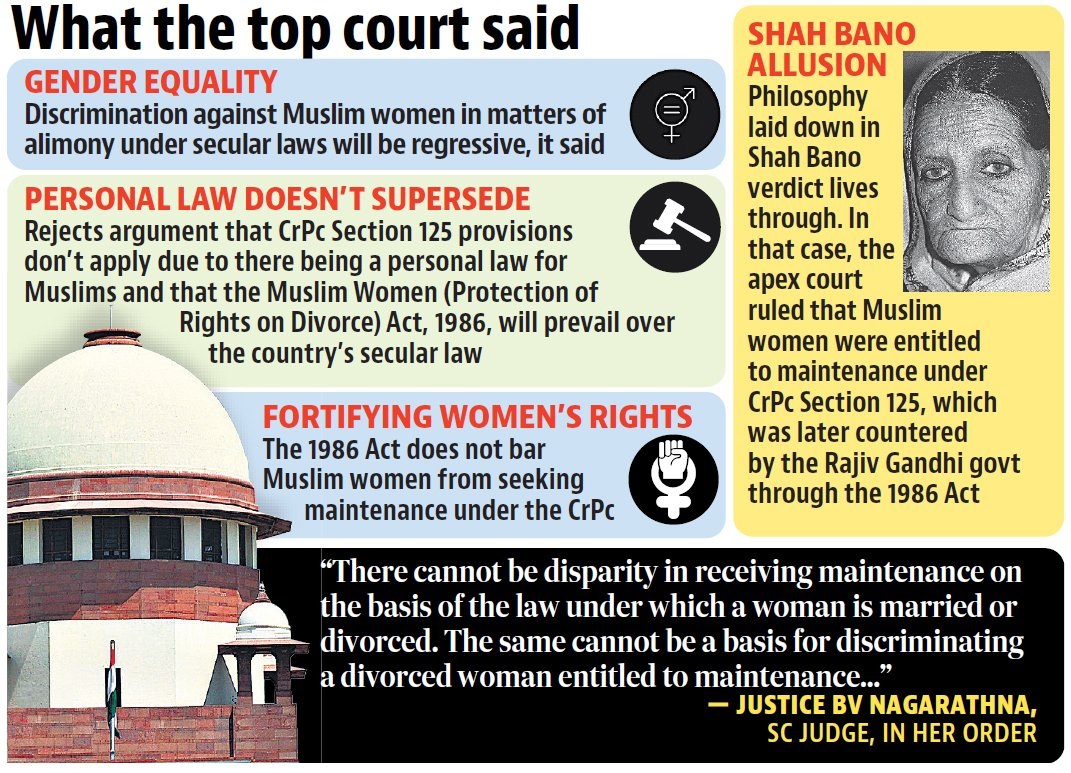
    • The Supreme Court has ruled that a divorced Muslim woman is entitled to seek maintenance from her husband under Section 125 of the Criminal Procedure Code (CrPC).
      • The court asserted that any discrimination against Muslim women in matters of alimony under the secular laws of the country would be regressive and against gender justice, equality.

    Story so far:

    • The Supreme Court bench rejected the argument that Section 125 of the CrPC does not apply to Muslims because they have their own personal law.
    • The court ruled that the Muslim Women (Protection of Rights on Divorce) Act, 1986, does not override the secular law.

    Key Points of the Judgment

    • Legal Standing: “There cannot be the disparity in receiving maintenance on the basis of the law under which a woman is married or divorced.”
    • Application of Section 125: Justice Nagarathna emphasized, “Section 125 of the CrPC cannot be excluded from its application to a divorced Muslim woman irrespective of the law under which she is divorced.”
    • Role of the 1986 Act: The judgment underscored that rights granted under the 1986 Act to receive maintenance during ‘iddat’ are in addition to, not in derogation of, those under Section 125 of the CrPC.

    Muslim Women (Protection of Rights on Divorce) Act, 1986:

    Purpose:

    • To protect the rights of Muslim women who have been divorced by, or have obtained a divorce from, their husbands.
    • To provide for matters connected with or incidental to their divorce.

    Key Provisions:

    • Maintenance:
      • During Iddat Period: A Muslim woman is entitled to a reasonable and fair provision and maintenance from her husband during the iddat period (a waiting period after divorce).
      • Post-Iddat Maintenance: If she cannot maintain herself after the iddat period, she can claim maintenance from her relatives who would inherit her property on her death. If no relatives are available, the State Wakf Board is responsible for her maintenance.
    • Mehr (Dower): The woman is entitled to the payment of mehr (dower) that was agreed upon at the time of marriage.
    • Return of Property: The woman is entitled to all the properties given to her before or at the time of marriage or after the marriage by her relatives, friends, husband, or any other person.
    • Rights of Children: The Act also provides for the maintenance of children born out of the marriage until they reach the age of two years.
    • Application to Magistrate:
      • A divorced woman, or someone acting on her behalf, can apply to a Magistrate for an order under the Act.
      • The Magistrate has the authority to make orders for payment of maintenance, mehr, and return of property.

    Criticisms and Issues:

    • Limited Scope: Critics argue that the Act’s provisions are limited to the iddat period and do not ensure long-term maintenance.
    • Dependence on Relatives: Post-iddat maintenance depends on relatives, which might not always be practical or feasible.
    • Role of Wakf Board: The effectiveness of the Wakf Board in providing maintenance has been questioned due to administrative and financial constraints.
    • Violation of Right to Equality: The MWPRD Act has been criticized for creating discriminatory practices by limiting the maintenance period for Muslim women compared to women of other communities, thus violating the Right to Equality under Article 14 of the Constitution.

    Context and Historical Perspective:

    • Shah Bano Case (1985): The court referenced the landmark Shah Bano case, which affirmed Muslim women’s right to maintenance under Section 125 of the CrPC.
    • Danial Latifi Case (2001): It highlighted subsequent interpretations ensuring that the 1986 Act does not deprive Muslim women of rights under Section 125.
    • Rejection of Restrictions: The court rejected restrictive interpretations that could hinder gender justice and emphasized the importance of providing adequate maintenance, not minimal amounts, to destitute Muslim women.
    • Continuation of Section 144: The judgment noted that the Bharatiya Nagarik Suraksha Sanhita, 2023, which has replaced the CrPC, retains the older provision on alimony under Section 144.

    Section 125 of the Criminal Procedure Code (CrPC)

    Purpose:

    • Maintenance Orders: Section 125 of the CrPC provides for the maintenance of wives, children, and parents who are unable to maintain themselves.

    Key Provisions:

    • Eligible Persons:
      • Wife: Includes a divorced wife who has not remarried.
      • Legitimate and illegitimate minor children.
      • Adult children are unable to maintain themselves due to physical or mental abnormalities.
      • Parents: Includes both father and mother who are unable to maintain themselves.
    • Conditions:
      • The person liable to pay maintenance has sufficient means.
      • The person liable has neglected or refused to maintain the eligible person.
    • Order: The Magistrate can order a monthly allowance for the maintenance of the eligible person.
    • Maximum Amount: There is no fixed maximum amount; it is determined by the Magistrate based on the circumstances.

    Significance:

    • Social Justice: It aims to prevent vagrancy and destitution by ensuring that dependents are provided for.
    • Secular Applicability: It applies to all religions and is not specific to any particular religion.

    Implications and Legal Precedent

    • Equality under Law: The judgment reinforces the principle that Muslim women have the same legal recourse as women of other faiths under Section 125 of the CrPC.
    • Additional Remedies: It affirmed that provisions like the Muslim Women (Protection of Rights on Marriage) Act, 2019, do not exclude rights under Section 125.


    PYQ:

    [2020] Customs and traditions suppress reason leading to obscurantism. Do you agree?

    [2019] Which Article of the Constitution of India safeguards one’s right to marry the person of one’s choice?

    (a) Article 19
    (b) Article 21
    (c) Article 25
    (d) Article 29

  • [29th June 2024] The Hindu Op-ed: Preaching consensus, provoking confrontation

    [29th June 2024] The Hindu Op-ed: Preaching consensus, provoking confrontation

    PYQ Relevance: 

    Q Simultaneous election to the Lok Sabha and the State Assemblies will limit the amount of time and money spent in electioneering but it will reduce the government’s accountability to the people’ Discuss. (UPSC IAS/2017)

    Q Individual Parliamentarian’s role as the national lawmaker is on a decline, which in turn, has adversely impacted the quality of debates and their outcome. Discuss. (UPSC IAS/2019)

    Mentors’ comment: In India, the opposition plays a crucial role in democracy by providing checks and balances to the ruling government. It holds the government accountable, scrutinizes policies, ensures diverse perspectives are considered, and represents alternative viewpoints to foster balanced decision-making. Through debates, criticism, and proposing alternative policies, the opposition helps uphold democratic principles, safeguard citizen interests, and contribute to the overall governance and development of the country.

    Let’s learn!

    Why in the News?

    On June 4, 2024, the electorate decisively delivered its verdict, marking a significant personal, political, and moral setback for the Prime Minister, who had portrayed himself with near-divine status throughout the campaign.

    The Fading of Accommodation

    • Confrontational Approach: Despite the clear message from the voters, Prime Minister Modi continues with his confrontational approach, ignoring the need for consensus.
    • Unchanged Attitude: The initial days of the 18th Lok Sabha showed no signs of a changed attitude, with hopes for mutual respect and accommodation being dashed.
    • Speaker and Deputy Speaker Controversy: The INDIA bloc parties had agreed to support the government’s choice for Speaker but expected the Deputy Speaker position to go to the Opposition, a request denied by the regime.
    • Diversion Tactics: The Prime Minister and his party dredged up the Emergency, diverting attention from current constitutional and institutional issues.

    Issues That Need Extensive Debate

    • Suspension of MPs: The unprecedented suspension of 146 MPs demanding a discussion on Parliament’s security breach was a tactic to pass criminal justice laws without debate.
    • Concerns over New Laws: Legal experts have raised concerns about these criminal justice laws, suggesting they should undergo fuller parliamentary scrutiny.
    • Environmental and Educational Issues: Amendments to forest conservation and biological diversity laws were pushed through without debate, risking ecological and humanitarian disasters. The NEET scandal, affecting lakhs of students, was downplayed by the Education Minister, with the Prime Minister remaining silent.
    • Violence against Minorities: Increasing violence against minorities, with allegations of arbitrary demolitions and collective punishment in BJP-ruled states, points to a broader issue of human rights and the rule of law. The communal rhetoric during elections and subsequent actions undermines social harmony and requires careful deliberation on safeguarding minority rights and upholding constitutional values.
    •  Manipur Crisis: The unrest in Manipur post-elections and the subsequent handling by authorities highlight governance challenges in sensitive regions. The Prime Minister’s absence and the political fallout underscore the need for inclusive dialogue and effective crisis management to restore social harmony and address grievances.
    • Issues related to Leadership and Accountability: Criticism of the Prime Minister’s leadership during these crises raises questions about governance style and accountability. 

    Role of INDIA bloc as Opposition: 

    • Non-confrontational Approach: The INDIA bloc parties, led by Rahul Gandhi, emphasize cooperation over confrontation in Parliament. This approach aims to foster productive discussions and ensure impartial conduct of proceedings.
    • Commitment to Productivity: Opposition leaders are committed to restoring balance and productivity in Parliament. They seek to amplify the concerns and voices of millions of citizens who elected them, ensuring their representation is meaningful and impactful.
    • Democratic Duties: The Opposition’s role is to raise and address the concerns of the people they represent. They aim to hold the government accountable and advocate for policies that reflect the needs and aspirations of diverse Indian communities.
    • Hopes for Positive Response: While initial interactions with the government may not have been promising, the Opposition remains hopeful for a positive response from the Treasury benches. This optimism is rooted in the democratic process and the belief that constructive engagement can lead to effective governance.
    • Unity for National Interest: Leaders within the INDIA bloc emphasize unity for national interest. By advocating for balanced parliamentary proceedings and cooperation across party lines, they aim to ensure that legislative decisions reflect broader consensus and benefit the nation as a whole.

    Conclusion: The recent election results are a clear mandate for change, urging the Prime Minister and his government to reflect on their approach and governance style. Engaging in Dialogue is essential for the government to heed the electorate’s message, engage in meaningful dialogue, and address the critical issues facing the country.

    https://www.thehindu.com/opinion/lead/preaching-consensus-provoking-confrontation/article68343827.ece

  • Time for a Census, come what may

    Why in the news?

    Why has the 2021 Census been delayed for so long? One plausible explanation is that the Bharatiya Janata Party (BJP) is postponing the Census to expedite the “delimitation” process in preparation for the 2029 Lok Sabha elections.

    The 84th Amendment of the Constitution

    • Delimitation Based on Census: The 84th Amendment specifies that the next delimitation exercise must be based on the first census conducted after 2026.
    • Timing for Delimitation: If the next census occurs before 2026, delimitation would be delayed until after the subsequent census in the 2030s.
    • Impact on State Representation: Delimitation aims to adjust the shares of different states in Lok Sabha seats to match their population shares, and ensure similar population sizes across constituencies.
    • Shift in Seat Balance: The upcoming delimitation is expected to favour northern states with faster population growth since 1973, potentially at the expense of southern states.

    About the 106th Amendment

    • Women’s Reservation: Passed in September 2023, this amendment provides for one-third reservation of seats for women in the Lok Sabha and State Assemblies.
    • Implementation: The reservation is to come into effect “after an exercise of delimitation is undertaken for this purpose after the relevant figures for the first census taken after [2023] have been published.”
    • Separate Delimitation for Women: The phrase “for this purpose” suggests that women’s reservation could be implemented through its own delimitation exercise, separate from the broader delimitation mandated by the 84th Amendment.
    • Interpretation: This allows for the possibility of initiating women’s reservation based on an early census, without waiting for the larger delimitation exercise.

    Overall Implications

    Impact on the Southern States:

    • Seat Redistribution: Delimitation is expected to shift more Lok Sabha seats to northern states with higher population growth, potentially reducing the representation of southern states.
    • Political Backlash: Southern states may react negatively to losing representation, which could lead to increased regional tensions and opposition to the BJP in these areas.

    Women’s Reservation:

    • Implementation Delay: Postponing the census could delay the implementation of the 106th amendment, which mandates one-third reservation for women in the Lok Sabha and State Assemblies.
    • Separate Delimitation: There is a possibility of initiating women’s reservation through a separate delimitation exercise, independent of the broader delimitation mandated by the 84th Amendment.

    Welfare and Entitlements:

    • Updated Data Needs: Census data are crucial for implementing welfare schemes and ensuring that resources are allocated based on the most recent population figures.
    • Impact on Beneficiaries: Delaying the census deprives millions of people of updated entitlements, such as food rations under the National Food Security Act, affecting their access to essential services.

    Way forward: 

    • Timely Census Completion: Ensure the 2021 Census is conducted promptly to provide accurate data for welfare schemes and fair resource allocation, benefiting millions of citizens who rely on updated population figures for essential services.
    • Separate Delimitation for Women’s Reservation: Implement women’s reservation through a separate delimitation exercise as allowed by the 106th Amendment, enabling the reservation to take effect without waiting for the broader delimitation mandated by the 84th Amendment.

    Mains PYQ:

    Q Empowering women is the key to controlling the population growth.” Discuss. (UPSC IAS/2019)

  • [19th June 2024] The Hindu Op-ed: The boomerang effect in this general election, and how

    [19th June 2024] The Hindu Op-ed: The boomerang effect in this general election, and how

    PYQ Relevance:

    Q. Discuss the role of the Election Commission of India in the light of the evolution of the Model Code of Conduct. (UPSC IAS/2022)

    Q. To enhance the quality of democracy in India the Election Commission of India has proposed electoral reforms in 2016. What are the suggested reforms and how far are they significant to make democracy successful? (UPSC IAS/2017)

    Mentors Comment: The 2024 general election verdict has various interpretations. Some believe it has expanded the space for dissent and democracy, while others see it as a check on Prime Minister Modi’s perceived authoritarianism. Philosophically, it signifies a civilisational response against the BJP’s Hindutva project, which has polarized Hindus rather than uniting them, proving counterproductive.

    Let’s Learn!

    Why in the News?

    • Interpreting the Outcome: The 2024 general election outcome has sparked diverse interpretations, portraying it either as a resurgence of dissent and democracy or as a check on what critics label as Prime Minister Narendra Modi’s authoritarian rule.
    • Deeper Philosophical Narrative: Beyond surface impacts, the election outcome reflects underlying philosophical shifts in Indian politics.

    Philosophical Underpinnings of the Verdict

    • Resurgence of Civilizational Ethos: The verdict can be interpreted as a revival of India’s civilizational ethos, countering the BJP’s Hindutva agenda.
    • Polarization within Hindu Society: Hindutva’s attempt to unite Hindus against perceived threats has instead deepened divisions within Hindu communities.

    Constitutional Significance

    • Central Theme of the Election: The Constitution emerged prominently in the election discourse amid concerns over potential amendments that could impact affirmative action for backward castes and tribes.
    • Critique by RSS and Allies: Historically, the RSS and its allies have critiqued the Constitution, seeking to undermine its provisions despite assertions of commitment to secularism.

    The Role of the Constitution

    • Symbol of Corrective Justice: The Constitution symbolizes corrective justice for historical injustices within Hindu society and stands against efforts to glorify a selective Hindu past that marginalizes minorities.
    • Hypocrisy of Right-Wing Rhetoric: While proponents claim secularism as inherent to Hindu ethos, their rhetoric often targets and demonizes minorities, undermining their claims of upholding constitutional values.

    Political Repercussions

    • BJP’s Electoral Setback: The BJP’s setback in the 2024 elections signals public rejection of attempts to manipulate the Constitution and exploit anti-minority sentiments.
    • Ayodhya Defeat: The electoral defeat in Ayodhya, where a Dalit candidate prevailed, underscores voters’ prioritization of social justice over religious symbolism, challenging BJP’s political strategies.

    Future Trajectory of Hindutva

    • Coalition Governance Dynamics: With a coalition government necessitating broader consensus, the focus on amending the Constitution may diminish temporarily.
    • Vigilance of the Opposition: The Opposition must remain vigilant against future attempts to amend the Constitution for partisan gains, ensuring its resilience against divisive agendas.

    Conclusion: The 2024 election marks a pivotal moment where the Constitution emerged as a safeguard against attempts to reshape India’s socio-political fabric. The BJP’s electoral setbacks underscore the enduring significance of constitutional values in upholding inclusive democracy. Upholding social justice and preventing the exploitation of marginalized communities should remain paramount, ensuring unity amidst India’s diversity.

    https://www.thehindu.com/opinion/lead/the-boomerang-effect-in-this-general-election-and-how/article68304575.ece

  • [18th June 2024] The Hindu Op-ed: Constitutional respect should not be reduced to optics

    [18th June 2024] The Hindu Op-ed: Constitutional respect should not be reduced to optics

    PYQ Relevance:

    Q The size of the cabinet should be as big as governmental work justifies and as big as the Prime Minister can manage as a team. How far is the efficacy of a government then inversely related to the size of the cabinet? Discuss.(UPSC IAS/2014)

    Q To what extent, in your view, the Parliament is able to ensure accountability of the executive in India? (UPSC IAS/2021)

    Mentor comment: In a parliamentary democracy, the Prime Minister (PM) is the head of government, responsible for running the country and implementing policies. Chosen from the majority party in parliament, the PM leads the executive branch, oversees the cabinet, and represents the government domestically and internationally. The PM must maintain the confidence of the parliament to remain in power.

    Why in the News?

    • On June 7, 2024, Prime Minister Narendra Modi surprised the nation by paying his respects to the Constitution of India at the Alliance meeting.
    • This move was probably in response to the accusations by the opposition who alleged the threat of ‘changing’ the constitution.

    Role of the Prime Minister in a Parliamentary Democracy

    • Head of the Council of Ministers: The Prime Minister is the head of the Council of Ministers.
    • Constitutional Mandate: Article 74 of the Constitution mandates that the Prime Minister advises the President in their functions.
    • Choice of System: B.R. Ambedkar and the framers chose the parliamentary system over the presidential system to ensure greater responsibility of the executive to the Legislature and the electorate.

    Row over Immediate Actions

    • Oath of Office: On June 9, 2024, Mr Modi and his Cabinet Ministers took the oath of office administered by the President of India.
    • Pre-emptive Financial Sanction: On June 10, the Prime Minister pre-emptively cleared a significant financial sanction of PM-KISAN without the formal allocation of ministerial portfolios, raising questions about the constitutional validity of such actions.

    Optics over Procedure

    • Cabinet Meeting Decisions: The first cabinet meeting, without allocated portfolios, approved significant welfare measures like the Pradhan Mantri Awas Yojana.
    • Procedural Concerns: Questions arise about the initiation, circulation, and approval process of these decisions, suggesting a focus on optics rather than constitutional procedure.
    • Extended Tenures: Mr. Modi extended the tenures of key officials without reconstituting the Cabinet Committee, relying on the old Appointments Committee, raising further procedural concerns.

    Coalition Dharma and Constitutional Morality

    • Disregard for Norms: These actions reflect a disregard for coalition principles and constitutional norms.
    • Dr. Ambedkar’s Emphasis: B.R. Ambedkar emphasized the need for constitutional morality and the cultivation of democratic sentiments, which appear to be lacking in the current scenario.
    • Article 77: It provides for the President to make rules for government business transactions, ensuring ministerial accountability, which seems undermined by the centralization of power in the PMO.

    Current Government’s functioning

    • Shift in Power: There is a noticeable shift towards an extraordinary accumulation of power in the Prime Minister’s Office, contrary to the principles of collective responsibility.
    • Business Rules: The Government of India (Allocation of Business) Rules designate business to specific ministries and departments, not the PMO.
    • Cabinet Secretariat: The Cabinet Secretariat’s role is to provide secretarial assistance, but recent actions suggest a breakdown of this framework.

    Role of opposition in parliamentary democracy

    • Accountability and Oversight: The opposition scrutinizes government actions and policies, ensuring transparency and preventing abuses of power.
    • Alternative Policies: It offers constructive criticism and proposes alternative solutions to address national issues and improve legislation.
    • Representation of Diverse Interests: The opposition voices the concerns and interests of various segments of society, ensuring a balanced and inclusive democratic process.

    Way forward

    • Strengthen Institutional Checks: Implement stricter enforcement of constitutional mandates and parliamentary procedures to ensure balanced power distribution and prevent centralization in the PMO.
    • Enhance Opposition Collaboration: Foster a cooperative environment where the opposition can effectively scrutinize government actions, propose constructive alternatives, and represent diverse societal interests, promoting a more transparent and accountable government.

    https://www.thehindu.com/opinion/lead/constitutional-respect-should-not-be-reduced-to-optics/article68301227.ece

  • What are the standards for awarding death sentence, the President’s ‘Mercy’ power?

    Why in the News?

    • The President of India has rejected a Mercy Petition to pardon a Pakistani terrorist.
      • The accused was one among the Lashkar-e-Tayyeba terrorists who attacked the Red Fort in 2000, killing two soldiers and a civilian guard.

    What is the process of Mercy Petition?

    • Step 1: The convict facing a death sentence can file a mercy petition within 7 days of the Supreme Court dismissing their appeal.
    • Step 2: The convict or their relative submits a written petition to the President or governor, citing grounds such as sole breadwinner, physical/mental health, perceived harshness of the law, or judicial errors.
    • Step 3: The petition is forwarded to the Ministry of Home Affairs for assessment and recommendations, including consultation with the relevant State government.
    • Step 4: Based on Home Ministry recommendations and the Council of Ministers’ advice, the President can accept or reject the mercy plea without a specified time limit.
    • Step 5: While governors cannot pardon death sentences, they can commute, remit, or reprieve sentences under their state’s executive powers for offences against state laws.

    Judiciary on Mercy Petitions:

      • Bachan Singh v. State of Punjab (1980): The Supreme Court, upheld the death penalty but set the stringent criteria. It emphasized that the death penalty should be awarded only in the “rarest of rare” cases when all mitigating circumstances are considered.
      • In Maru Ram v. Union of India (1981), the Supreme Court ruled that the power to grant pardons under Article 72 of the Constitution must be exercised based on the advice of the Council of Ministers.
      • In Kehar Singh vs Union of India (1989) case, the court asserted that presidential pardon is an act of grace, not a right that can be claimed. The exercise of this power is purely administrative and not subject to judicial review.
      • In the Dhananjoy Chatterjee vs State of West Bengal (1994) case, the Supreme Court clarified that the pardoning powers under Articles 72 and 161 of the Constitution can only be exercised by the Central and State Governments, respectively, and not autonomously by the President or Governor.
      • In Epuru Sudhakar & Anr. v. Government of Andhra Pradesh (2006), the Supreme Court ruled that the clemency powers of the President and Governor under Article 72 and Article 161 are subject to judicial review.
      • In Shatrugan Chauhan v. State of U.P. (2014), the appex court has also commuted the death sentence in cases of inordinate delay in deciding mercy petitions. The court commuted the sentence of one Gurmeet Singh after he spent 27 years in custody (and 21 years on death row). 
      • In Mohd. Afzal Guru vs State of Delhi (2014) case, the court-mandated a minimum 14-day gap between the rejection of a mercy petition and the execution of a death penalty, ensuring adequate time for legal recourse.
      • Report of the 262nd Law Commission (2015): Recommended abolishing the death penalty for all crimes except terrorism-related offenses and waging war.
      • In April 2023, the Supreme Court upheld the Mumbai High Court’s decision to commute the death sentence of a woman and her sister due to significant delays in deciding their mercy petitions.

    About Presidents’ Pardoning Powers under Article 72

    • According to Article 72, the President of India has the power to grant pardons, reprieves, respites, or remissions of punishment or to suspend, remit, or commute the sentence of any person convicted of any offense: In cases where the punishment or sentence is by a Court Martial;
      • According to Article 161, the Governor of a State has the power to grant pardons, reprieves, respites, or remissions of punishment or to suspend, remit, or commute the sentence of any person convicted of any offence against any law relating to matters under the executive power of the State.
    • In the recent Supreme Court Ruling of 2021, the apex court held that the Governor of a state can pardon prisoners, including those on death row, even before they have served a minimum of 14 years of their prison sentence.

    Did you know?

    1. Pardon means completely absolving the person of the crime and letting him go free. The pardoned criminal will be like a normal citizen.
    2. Commutation means changing the type of punishment given to the guilty into a less harsh one, for example, a death penalty commuted to a life sentence.
    3. Reprieve means a delay allowed in the execution of a sentence, usually a death sentence, for a guilty person to allow him some time to apply for a Presidential Pardon or some other legal remedy to prove his innocence or successful rehabilitation.
    4. Respite means reducing the quantum or degree of the punishment to a criminal in view of some special circumstances, like pregnancy, mental condition etc.
    5. Remission means changing the time period of the punishment without changing its nature, for example reducing twenty years of rigorous imprisonment to ten years.

    Cases as specified by Art. 72

    In all cases where the punishment or sentence:

    1. is by a court-martial.
    2. is for an offence against any law relating to a matter to which the executive power of the Union extends.
    3. is a sentence of death.

    Nature of the Pardoning Power

    • The pardoning power of the president is not absolute.
    • At a procedural level, the apex court in Epuru Sudhakar & Anr. v. Government of Andhra Pradesh (2006) has held that the President’s power must be exercised based on the aid and advice of the Council of Ministers and can be challenged on multiple grounds including that relevant material was not considered, the power was exercised based on political considerations, or there was no application of mind.
    • This has not been discussed by the Constitution but is the practical truth. Further, the constitution does not provide for any mechanism to question the legality of decisions of presidents or governors exercising mercy jurisdiction.


    PYQ:

    [2014] Instances of President’s delay in commuting death sentences have come under public debate as denial of justice. Should there be a time specified for the President to accept/reject such petitions? Analyse.