Mains Ready By December. Smash Mains & Smash PYQ Admissions Open

GS Paper: GS2-01.Indian Constitution-Historical underpinnings & evolution; Features, amendments, significant provisions, basic structure of Constitution

  • India press freedom score falls, says Reporters sans Frontieres

    Why in the news?

    India’s score in the World Press Freedom Index fell over the last year, from 36.62 to 31.28, according to Reporters Without Borders. In South Asia, India finds itself ranked at 159th, while its neighbor Pakistan stands marginally higher at 152.

    Key Highlights of the Report:

    • Deterioration Since 2014: Press freedom in India has significantly deteriorated since 2014.
    • Government vs Media Nexus: The government is criticized for maintaining a close relationship with big media families, leading to a lack of independence and critical journalism being labeled as “anti-national and anti-India“.
    • Self-Censorship: Fear of political backlash has forced journalists to censor themselves, as Modi’s supporters aggressively target critical reporting of the government.
    • Corporatization of Media: There’s an increasing trend of wealthy businessmen close to Modi owning a majority of mainstream media outlets, which undermines media independence and diversity.
    • BBC Raids: Recent raids on the BBC offices in India have drawn international criticism and contributed to India’s declining press freedom ranking.
    • Comparative Analysis: While India’s press freedom declines, neighboring countries like Pakistan and Sri Lanka have improved, although they still lag behind global leaders in press freedom rankings.

    India’s Initiative of “Index Monitoring Cell”:

    • Purpose of the Cell: The Index Monitoring Cell has been set up to work on improving India’s press freedom ranking. It will consist of representatives from various government agencies and credible journalists suggested by the Press Council of India.
    • Ranking Parameters: The cell will engage with agencies publishing the World Press Freedom Index, like Reporters Without Borders, for a better understanding of the parameters and methodology used for the rankings. This will help formulate an action plan to address the issues identified.
    • Coordination with State Governments: The cell will coordinate with state governments to appoint nodal officers who can provide regular updates on the state of press freedom and any issues faced by journalists at the local level.
    • Engagement with Stakeholders: This aims to improve communication and visibility of steps taken to support press freedom and address concerns raised by global media watchdogs.
    • Reporting Mechanisms: Setting up proper reporting mechanisms is crucial to ensure that the data and information provided to ranking agencies are up-to-date and accurate. This will help in portraying a clearer picture of the press freedom landscape in India.

    Conclusion: India needs to enact and strengthen laws to protect the freedom of the Press and ensure journalists’ safety. This includes legislation to prevent harassment, attacks, and threats against journalists, as well as provisions for swift and effective legal recourse in cases of censorship or intimidation.

    Mains PYQ 

    Q What do understand by the concept “freedom of speech and expression”? Does it cover hate speech also? Why do the films in India stand on a slightly different plane from other forms of expression? Discuss. (UPSC IAS/2014)

  • [6 May 2024] The Hindu Op-ed: The PM’s speeches fall foul of the Model Code of Conduct

    Mains PYQ Relevance: 

    Q) Discuss the role of the Election Commission of India in light of the evolution of the Model Code of Conduct. (UPSC IAS/2022)

    Q) ‘Simultaneous election to the Lok Sabha and the State Assemblies will limit the amount of time and money spent in electioneering but it will reduce the government’s accountability to the people’ Discuss. (UPSC IAS/2017)

    Prelims:
    We adopted parliamentary democracy based on the British model, but how does our model differ from that model?​ (UPSC IAS/2021)
    1. As regards legislation, the British Parliament is supreme or sovereign but in India, the power of the Parliament to legislate is limited.​
    2. In India, matters related to the constitutionality of the Amendment of an Act of Parliament are referred to the Constitution Bench by the Supreme Court.​
    Select the correct answer using the code given below.​
    (a) 1 only 
    (b) 2 only​
    (c) Both 1 and 2 ​
    (d) Neither 1 nor 2

    Note4Students: 

    Prelims: Model Code of Conduct (MCC);

    Mains: Issues around Elections and Parliamentary Representation;

    Mentor comments:The ongoing Lok Sabha elections spotlight manifesto deficiencies. The Prime Minister’s false claims against the Congress indicate a narrative lacking factual basis. The absence of a law governing manifestos and weak enforcement of electoral regulations contribute to the erosion of democratic principles and the malaise persists despite constitutional mandates.

    Let’s learn

    —

    Why in the News?

    The Prime Minister’s recent statement about the opposition’s intentions through their manifestos ( including gold and mangalsutra) has stirred controversy. Leaders must uphold factual accuracy and responsible discourse during this critical time.

    The contents of the two Manifestos

    • Congress Manifesto (‘Nyay Patra’):
      • Wealth Creation: The manifesto emphasizes rapid growth and wealth generation, setting a target of doubling the GDP in the next 10 years.
      • Welfare: Prioritizes the welfare of the poor as the first charge on government resources, aiming for a fair, just, and equal-opportunity economy under the Nav Sankalp Economic Policy.
      • Equity: Acknowledges the disparity among marginalized communities (SC, ST, OBC) and proposes a nation-wide Socio-Economic and Caste Census to strengthen affirmative action based on data.
    • Constitutional References:
      • Preamble: The manifesto echoes the principles of the Preamble of the Indian Constitution, aiming to secure justice, social, economic, and political; liberty of thought, expression, belief, faith, and worship; and equality of status and opportunity for all citizens.
      • Directive Principles of State Policy (Articles 39, 38, 46): Highlights the constitutional mandate for the state to ensure adequate means of livelihood, equitable distribution of resources, promotion of welfare, minimization of income inequalities, and promotion of educational and economic interests of weaker sections, especially Scheduled Castes and Scheduled Tribes.
    • BJP’s Manifesto:
      • Uniform Civil Code: Criticizes the BJP’s aggressive push for a uniform civil code, suggesting that the BJP’s actions contradict its own manifesto’s commitments to the principles of the Constitution.
      • Comparison with BJP’s Manifesto: Contrasts the BJP’s manifesto promises with those of the Congress, highlighting initiatives like free rations, health insurance, and housing provided by the BJP.
      • Accusation of Misguidance: Accuses the BJP of misguiding the nation by turning a serious document (the Congress manifesto) upside down.

    Major Challenge: No law to govern the Manifesto

    • S. Subramaniam Balaji v. Government of Tamil Nadu & Ors. (2013): Supreme Court highlighted the absence of legislation governing election manifestos. Consequently, the Court directed the Election Commission of India (ECI) to collaborate with political parties to formulate guidelines.
      • The ECI, following a meeting with political parties on August 12, 2013, issued ‘Instructions to political parties on manifestos’ on April 24, 2015. These guidelines, acknowledging that election manifesto promises are not considered corrupt practices under Section 123 of the Representation of the People Act, underscored the influence of freebies on voters and the importance of fair elections.
    • Violation of Model Code of Conduct (MCC): The Prime Minister’s statements against the opposition and minority communities are cited as violations of the MCC, particularly regarding the prohibition on appealing to caste or communal feelings for securing votes. This indicates a challenge in ensuring compliance with the MCC by political leaders and parties.
    • Corruption in Electoral Practices: The Supreme Court’s rulings identify speeches of a religious nature aimed at influencing voters as corrupt practices. However, the passage suggests that such appeals continue to occur, indicating a challenge in effectively combating corruption in electoral practices.
    • Weak Enforcement of Rule of Law: Despite regulations and legal provisions prohibiting certain activities during elections, such as appeals based on religion, caste, or community, there are challenges in enforcing these laws effectively. The passage criticizes the weak rule of law, indicating a broader challenge in ensuring adherence to electoral regulations and upholding democratic principles.
    • Composition and Functioning of the Election Commission of India (ECI): The passage suggests dissatisfaction with the ECI’s performance and its failure to ensure free and fair elections. This raises concerns about the composition and functioning of the ECI, indicating a challenge in maintaining the independence and effectiveness of electoral authorities.

    Way Forward:

    • Legislation on Manifestos: Introduce legislation to regulate election manifestos, outlining guidelines for their content, transparency, and accountability. This law can be based on the guidelines formulated by the ECI, ensuring that manifestos align with democratic principles and do not incite communal or divisive sentiments.
    • Strengthening the Model Code of Conduct (MCC): Enhance the MCC to include stricter provisions against appeals to caste, religion, or community for securing votes. Ensure that violations of the MCC are swiftly addressed and penalties are imposed on erring political parties or candidates.
    • Improved Enforcement Mechanisms: Strengthen enforcement mechanisms to ensure compliance with electoral laws and regulations. This may involve empowering the Election Commission with greater authority and resources to monitor election campaigns, investigate violations, and take prompt action against offenders.
  • National Commission for Backward Classes (NCBC) and the Dynamics of OBC Inclusion

    Why in the news?

    • The National Commission for Backward Classes (NCBC) has begun a comprehensive review of State OBC Lists to reassess the inclusion of communities benefiting from prolonged advantages.
    • The NCBC’s scrutiny has led to questioning the overrepresentation of Muslim communities in State OBC lists, particularly in Karnataka and West Bengal.

    NCBC’s contention over Over-representation:

    • Despite repeated requests, states like West Bengal and Karnataka lack current socio-economic data on OBCs, hindering the NCBC’s assessment.
    • The absence of data complicates the task of justifying continued inclusion in OBC lists.
    • The NCBC plans to extend its review to Kerala, Odisha, Bihar, Maharashtra, and other states to ensure maximum OBC reservation within the 50% limit.

    Who are the Other Backward Classes (OBCs)?

    • Other Backward Class is a collective term used to classify castes which are educationally or socially disadvantaged. 
    • It is one of several official classifications of the population of India, along with General Class, Scheduled Castes and Scheduled Tribes (SCs and STs).
    • The OBCs were found to comprise 55% of the country’s population by the Mandal Commission report of 1980, and were determined to be 41% in 2006.

    About National Commission for Backward Classes (NCBC)

    Established Constitution Amendment Act, 2018 (also known as 102nd Amendment Act, 2018) under Article 338B of the Indian Constitution
    Jurisdiction Ministry of Social Justice and Empowerment, Government of India
    Purpose
    • Active participation and advisory role in the socio-economic development of socially backward classes (OBCs).
    • Evaluating the progress of their development.
    Statutory Backing The outcome of the Indra Sawhney & Others v. Union of India case (16.11.1992)
    Composition
    • Chairperson (MoSJ), Vice-Chairperson, and three other members appointed by the President.
    • Conditions of service and tenure determined by the President.
    Functions and Powers
    • Inclusions and exclusions in the lists of backward communities for job reservations.
    • Providing advice to the Central Government.
    • Investigating and monitoring safeguards for backward classes.
    • Inquiring into specific complaints related to their rights and safeguards.
    • Participating in socio-economic development and evaluating progress.
    Reports and Recommendations
    • Annual reports to the President and recommendations for effective implementation of safeguards.
    • Recommendations for measures to protect, welfare, and socio-economic development of backward classes.
    Other Functions Discharging functions specified by the President and subject to parliamentary laws
    Constitutional Amendment 102nd Constitutional Amendment Act (2018) empowered NCBC to address grievances of Other Backward Classes


    PYQ:

    [2022] Discuss the role of the National Commission for Backward Classes in the wake of its transformation from a statutory body to a constitutional body.

    [2016] Why are the tribals in India referred to as ‘the Scheduled Tribes’? Indicate the major provisions enshrined in the Constitution of India for their upliftment.

  • A look at how Article 361 provides immunity.

    Why in the News? 

    Even as a complaint alleging sexual harassment has been filed in Kolkata against West Bengal Governor C V Ananda Bose, Constitutional immunity bars the police from naming the Governor as an accused or even investigating the case.

    What is Article 361? 

    Article 361 of the Constitution that deals with immunity to the President and the Governors states that they “shall not be answerable to any court for the exercise and performance of the powers and duties of his office or for any act done or purporting to be done by him in the exercise and performance of those powers and duties”.

    The provision also has two crucial sub-clauses: 

    (1) that no criminal proceedings whatsoever shall be initiated or continued against the President, or the Governor of a State, in any court during the term of his office.

    (2) No process for the arrest or imprisonment of the President, or the Governor of a State, shall issue from any court during his term of office.

    Immunity power of the Governor:

    • Ceases to be in office: The police can act only after the Governor ceases to be in office, which is when either the Governor resigns or no longer enjoys the confidence of the President.” 
    • Rameshwar Prasad v Union of India: In the landmark 2006 ruling in Rameshwar Prasad v Union of India, that outlined the immunity enjoyed by the Governor “even on allegation of personal malafides,” the Supreme Court held that “the position in law, is that the Governor enjoys complete immunity.”
    • In 2017, criminal conspiracy in the 1992 demolition of the Babri Masjid case: The trial did not take place for former UP Chief Minister Kalyan Singh since he was then the Governor of Rajasthan.

    Constitutional Provisions:

    • Appointment: The Governor is appointed by the President of India and holds office during the pleasure of the President (Article 155).
    • Qualifications: The Governor must be a citizen of India, must be at least 35 years old, and must not hold any office of profit (Article 157).
    • Powers and Functions: The Governor is the constitutional head of a state and performs various functions including:
      • Executive Functions: The Governor appoints the Chief Minister and other Council of Ministers, and allocates portfolios among them (Article 164).
      • Legislative Functions: The Governor summons and prorogues the state legislature, addresses it, and lays down its policy. He/she also has the power to dissolve the Legislative Assembly (Article 174).
      • Financial Functions: The Governor causes to be laid before the State Legislature the Annual Financial Statement (budget) and has powers related to money bills (Article 202).
    • Discretionary Powers: The Governor has discretionary powers in certain matters, such as appointing the Chief Minister when no party has a clear majority after elections (Article 164).
    • Relation with the Union: The Governor is appointed by the President and acts as a link between the state and the Union. He/she can send reports to the President regarding the administration of the state (Article 356).
    • Oath or Affirmation: Before entering office, the Governor must take an oath or affirmation according to the form set out in the Third Schedule of the Constitution (Article 159).

    Conclusion: 

    Article 361 of the Indian Constitution provides immunity to the President and Governors from court proceedings and arrest during their term. Police action against a Governor can only occur after they cease office.

    Mains PYQ 

    Q Discuss the essential conditions for exercise of the legislative powers by the Governor. Discuss the legality of re-promulgation of ordinances by the Governor without placing them before the Legislature.

  • Madras High Court Ruling on Waqf Properties

    Why in the news?

    • The Madras High Court ruled the Tamil Nadu Public Premises (Eviction of Unauthorised Occupants) Amendment Act of 2010 as repugnant and unconstitutional.
    • The amendment conferred authority on the Tamil Nadu Waqf Board CEO to order evictions, contradicting with the Central legislation, the Waqf Act of 1995.

    Madras HC Verdict:

    • Parliament’s 2013 amendment to Waqf Act prevails over Tamil Nadu’s legislation.
    • It already provides uniform and effective mechanisms for possession recovery.

    Arguments made by TN:

    • Lawyers argue 2010 amendment exercised power under Concurrent List, required Presidential assent.
    • State law and Central law cannot co-exist, Parliament’s 2013 amendment prevails.
    • Original provisions of Waqf Act not sufficient to deal with encroachments.
    • Tamil Nadu enacted 2010 amendment based on Sachar Committee recommendation.

    Sachar Committee:

    A seven-member high-level committee headed by former Chief Justice of Delhi High Court Rajinder Sachar to study the social, economic, and educational condition of Muslims in March 2005.


    What is Doctrine of Repugnancy?

    • The doctrine of repugnancy arises when two laws conflict and produce different outcomes when applied to the same situation.
    • It occurs when the provisions of two laws are so contradictory that complying with one law would mean violating the other.
    • Article 254 of the Indian Constitution establishes the Doctrine of Repugnancy in India, providing a framework for resolving conflicts between Central and State laws.
    • It resolves conflicts between Central and State laws.

    Key Provisions of Article 254:

    1.    Article 254(1):

    • Declares that if a law passed by a State Legislature contradicts a law passed by Parliament, the State law will be deemed void.
    • The law enacted by Parliament will take precedence over the State law.

    2.    Article 254(2):

    • Allows States to enforce legislation that contradicts Parliament’s laws if they receive assent from the President.


    PYQ:

    [2016]  The Parliament of India acquires the power to legislate on any item in the State List in the national interest if a resolution to that effect is passed by the:

    (a) Lok Sabha by a simple majority of its total membership

    (b) Lok Sabha by a majority of not less than two-thirds of its total membership

    (c) Rajya Sabha by a simple majority of its total membership

    (d) Rajya Sabha by a majority of not less than two-thirds of its members present and voting


    Back2Basics: What is Waqf property and what does the Waqf Act state?

    Details
    Enactment
    • Enacted by Jawaharlal Nehru in 1954 to centralize Waqf properties.
    • Led to the formation of the Central Waqf Council in 1964.
    • Amended in 1995 under the Congress government of PV Narasimha Rao, granting extensive powers to Waqf Boards.
    Key Provisions
    • Section 3(R) of the 1995 amendment designates properties as Waqf if deemed sacred, religious, or charitable according to Muslim law.
    • Article 40 mandates the Waqf Surveyor and Board to determine property ownership.
    • 2013 amendments require State Waqf Boards to appoint Survey Commissioners to manage properties and settle disputes.
    Legal Status Property declared as Waqf cannot be contested in court; appeals must be made to the Waqf Board.
    Chairmanship
    • Union Minority Welfare Minister serves as ex-officio chairman of the Central Waqf Council.
    • State Waqf Boards consist of seven Muslim members.

    Waqf Property

    Details
    Definition
    • Property donated for charitable purposes in the name of Allah.
    • Donated by individuals for public benefit; no individual ownership rights.
    Donation Criteria Must be donated by Muslims above the age of 18.
    Ownership
    • Upon donation, property becomes Allah’s possession;
    • Family members have no claim after donor’s demise.
    Types Includes movable or immovable property donated for charitable purposes.
    Management Overseen by the Waqf Board, responsible for legal matters and property administration.
    Total Properties
    • Over 8,65,646 properties registered with the Waqf Board in India.
    • Estimated to cover 8 lakh acres of land with a market value of approximately Rs 1.20 lakh crore.
    • State-wide Share:
    1. West Bengal: More than 80,000 properties registered.
    2. Punjab: 70,994 properties under Waqf Board.
    3. Tamil Nadu: 65,945 properties managed.
    4. Karnataka: 61,195 properties overseen.
  • Easement Rights and Recent Supreme Court Ruling

    Why in the news?

    • The Supreme Court observed that a claimant of an Easementary Right cannot claim an Easement by necessity if there exists an alternative way to access the property owned by the claimant, known as the ‘Dominant Heritage‘.
      • The court referred to Section 13 of the Indian Easements Act, of 1882, which deals with easementary rights by necessity.

    What is Easement Right?

    • An Easement is a legal right to use someone else’s property for a specific purpose without possessing it.
    • Essentially, it’s a permission or privilege granted by the owner of one property (the servient land) to someone else (the dominant land) to use the servient land in a particular way.

    Legal backing for Easement Rights

    • Section 13 of the Indian Easements Act, 1882, serves as the cornerstone in adjudicating easementary rights disputes.
    • It mandates that such rights can only be claimed if no alternative access to the Dominant Heritage exists, providing clarity in legal proceedings.
    • Understanding terms like ‘Dominant Heritage’ (represents the property for enjoyment) and ‘Servient Heritage‘ (property over which rights are sought) is crucial in comprehending easementary rights disputes.

    Features of the Indian Easements Act, 1882:

    • Definition of Easements: The law defines what an easement is and the different types, like rights of way (to pass through someone’s land), rights to light and air, and rights to use water.
    • Acquisition of Easements: It explains how easements can be created. For example, by agreement between the parties or through long-time use.
    • Rights and Liabilities: It outlines the rights and responsibilities of both the person who has the easement (the beneficiary) and the person who owns the land over which the easement exists (the servient owner). For instance, the beneficiary must not do anything to increase the burden of the easement, and the servient owner must not obstruct the use of the easement.
    • Termination of Easements: It describes the circumstances under which an easement can come to an end. For example, if the purpose for which the easement was created ceases to exist, or if the beneficiary expressly gives up their right.
    • Customary Easements: It recognizes certain easements that arise due to local customs or traditions.

    Back2Basics: Fundamental Rights vs. Legal Rights

    Fundamental Rights Legal Rights
    Source Enshrined in the Indian Constitution, specifically Part III Derived from various sources such as Legislation, contracts, Judicial decisions, etc.
    Enforcement Directly enforceable against the state through constitutional remedies like writ petitions under Article 32 Enforceable through the legal system, but may vary in enforceability depending on the nature of the right and available legal mechanisms
    Scope Typically includes rights essential for the Protection of Individual Liberty, Equality, and dignity, such as the Right to Equality, Freedom of Speech, Right to Life and Personal Liberty, etc. Encompasses a wide range of rights recognized by law, including Property Rights, Contractual Rights, Tort Rights, Family Law Rights, Labor Rights, Consumer Rights, etc.
    Nature Paramount and inviolable, subject to limited exceptions as prescribed by the Constitution Subject to limitations or restrictions imposed by law, and may be subject to changes or modifications through Legislative action or Judicial Interpretation
    Examples Right to Equality, Right to Freedom of Speech, Right to Life and Personal Liberty, etc. Right to Property, Right to Contract, Right to sue for damages, Right to Vote, etc.


    PYQ:

    [2018] What is the position of Right to Property in India?

    (a) Legal right available to citizens only.

    (b) Legal right available to Persons only.

    (c) Fundamental Right available to citizens only

    (d) Neither Fundamental Right nor Legal Right

  • The citizen’s ‘climate rights’

    Why in the news? 

    The Supreme Court recently held that people have a fundamental right to be free from the adverse effects of climate change while emphasizing that countries like India must uphold their international obligations for healthy and sustainable development [M K Ranjitsinh & Ors. vs Union of India].


    Background of M K Ranjitsinh & Ors. vs Union of India Case:

      • The case was related to the conservation of the critically endangered Great Indian Bustard (GIB).
      • In 2021, a writ petition was filed by retired government official and conservationist M K Ranjitsinh, seeking protection for the GIB and the Lesser Florican, which are on the verge of extinction.
      • On April 19, 2021 order by SC was imposed restricting the setting up of overhead transmission lines in a territory of about 99,000 sq km in the GIB habitat in Rajasthan and Gujarat.
    • The Supreme Court has ruled that people have a “right to be free from the adverse effects of climate change”, which should be recognized by Articles 14 and 21 of the Constitution.
    • This judgment was by a three-judge Bench of Chief Justice of India (CJI) D Y Chandrachud and Justices J B Pardiwala and Manoj Misra.

    The Recent Modification over Earlier Judgement given by the SC:

    Who applied for modification of an earlier case?

    • The Ministry of Power, the Ministry of Environment, Forest and Climate Change, and the Ministry of New and Renewable Energy had applied to modify the 2021 order on grounds that
    • It had adverse implications for India’s power sector, and undergrounding power lines was not possible
    • The Paris Climate Treaty (2015) is one of the key grounds for seeking a modification of the 2021 order.

    What SC did say in this case?

    • Underground powerlines: The apex court modified its April 2021 order giving directions for underground high-voltage and low-voltage power lines, and directed experts to assess the feasibility of undergrounding power lines in specific areas after considering factors such as terrain, population density, and infrastructure requirements
    • The earlier direction was not feasible: The ruling acknowledged that its earlier directions, “besides not being feasible to implement, would also not result in achieving its stated purpose, i.e., the conservation of the GIB”.
    • Suitable relationship between FR and DPSP: The court emphasized that when addressing environmental concerns outlined in the Directive Principles of State Policy, they must be interpreted in conjunction with the right to life and personal liberty as enshrined in Article 21.

    How have the Courts interpreted Article 21 earlier?

    • Article 21 as the Heart of Fundamental Rights: The Supreme Court (SC) recognizes Article 21 of the Constitution as central to fundamental rights, emphasizing that the right to life encompasses more than mere existence but includes all rights necessary for a meaningful and dignified life.
    • Inclusion of Environmental Rights within Article 21: In the 1980s, the SC expanded Article 21 to include the right to a clean environment, along with various other rights such as education, shelter, clean air, livelihood, and medical care.
    • Actualizing New Rights: Despite the recognition of these new rights, citizens often face challenges in exercising them, particularly in cases concerning environmental issues like clean air.


    What are the implications of the judgment for environmental jurisprudence?

    • Strengthening Environmental and Climate Justice: The judgment emphasizes bolstering environmental and climate justice by recognizing the multifaceted impacts of climate change on various communities.
    • Expansion of Article 14 and Right to Life: The judgment expands the scope of Article 14 of the Constitution, which guarantees equality before the law, to encompass environmental concerns.
    • Influence on Public Discourse and Government Policies: The judgment is expected to influence public discourse on environmental issues, shaping perceptions and priorities regarding environmental protection.
    • Establishment of Legal Precedent: By acknowledging the “right against adverse effects of climate change,” the judgment establishes a significant legal precedent.

    Conclusion: The Supreme Court’s recognition of citizens’ “right to be free from adverse effects of climate change” expands constitutional protections, strengthens environmental justice, influences policy discourse, and sets a crucial legal precedent.

    Mains PYQ 

    Q Does the right to clean environment entail legal regulation on burning crackers during Diwali? Discus in the light of Article 21 of Indian Constitution and judgements of the apex in this regard.(UPSC IAS/2015) 

    Q The most significant achievement of modern law in India is the constitutionalization of environmental problems by the Supreme Court.” Discuss this statement with the help of relevant case laws. (UPSC IAS/2022) 

  • [6 April 2024] The Hindu Op-ed: Parliaments past, a mirror to changing dynamics

    [6 April 2024] The Hindu Op-ed: Parliaments past, a mirror to changing dynamics

    PYQ Relevance:

    Mains: 

    Q. The role of individual MPs (Members of Parliament) has diminished over the years and as a result healthy constructive debates on policy issues are not usually witnessed. How far can this be attributed to the anti-defection law, which was legislated but with a different intention? (UPSC CSE 2013)
    Q. To what extent, in your view, the Parliament can ensure accountability of the executive in India? (UPSC CSE 2021)

    Prelims:

    We adopted parliamentary democracy based on the British model, but how does our model differ from that model?​ (UPSC CSE 2021)

    1. As regards legislation, the British Parliament is supreme or sovereign but in India, the power of the Parliament to legislate is limited.
    ​2. In India, matters related to the constitutionality of the Amendment of an Act of Parliament are referred to the Constitution Bench by the Supreme Court.​

    Select the correct answer using the code given below.​

    (a) 1 only ​(b) 2 only​(c) Both 1 and 2 ​(d) Neither 1 nor 2

    Note4Students: 

    Mains: Parliamentary Democracy; 

    Mentors Comment: We Indians have been through ‘thick and thin’ as our Democracy has evolved. Since the 16th and 17th Loksabha, all have been doubts relating to the accountability of people’s Representation in Parliament due to the reduced Debates and discussions in Parliamentary sessions. Now, as we move towards the general election of 2024, the question arises: will history repeat itself? Or, will a new precedent be set? This prompts us, as citizens of India, to reflect on the performance of our Parliament as we wait to usher in the 18th Lok Sabha.

    Let’s learn. 

    —

    Why in the News?

    The present conduct of business in both Houses of Parliament points out the need for a revitalization of legislative engagement in a more constructive manner.

    • The 17th Lok Sabha (2019-2024) concluded its proceedings marking the culmination of a journey with unexpected twists and turns.

    How did Ministries fare during the 17th Loksabha?

    • Decline in Executive Accountability: The PMO found itself flooded with 1,146 questions from Rajya Sabha Members of Parliament, of which only 28 were answered. Similarly, the House of the People also witnessed a sharp decline, from 5,000 during the 15th and 16th Lok Sabhas to a mere 1,700 in the 17th Lok Sabha.
      • Ministry of Finance tasked with steering the nation’s fiscal destiny, has witnessed a gradual erosion of parliamentary interest, declining to the fourth and fifth position in the Parliament.
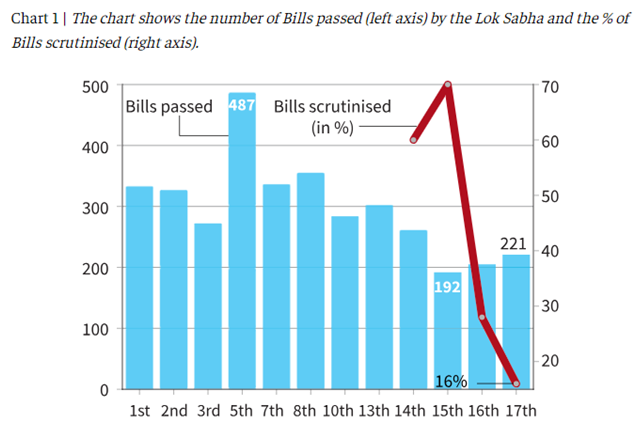
    • Decline in Legislative Process: The annual average of Bills passed declined from 65 in the 1952-1990 period to 48 in 1991-2023. The number of Bills sent to committees for scrutiny also dwindled consistently, with the 17th Lok Sabha sending only 16% of Bills for scrutiny, the lowest in the past four Lok Sabhas.
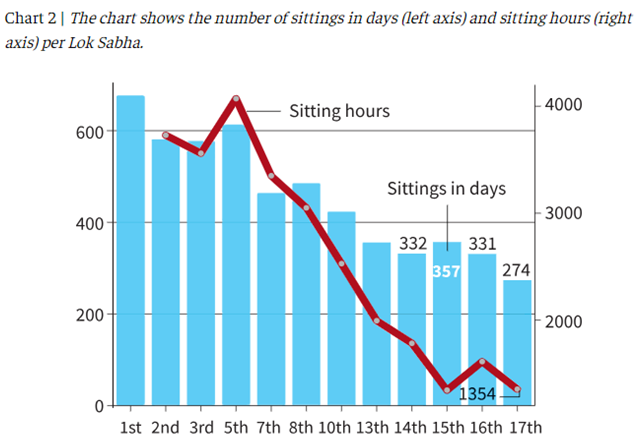
    • A decline in Debates and Discussions: Before 1990, each Lok Sabha typically convened for over 550 days on average, spanning 3,500 hours. The 17th Lok Sabha had the least number of sittings, only 274 days on average.
      • The Ministry of Home Affairs, which was the Ministry with the second most number of questions directed towards it till the 15th Lok Sabha, has now faded. This shift raises questions about the nation’s priorities.
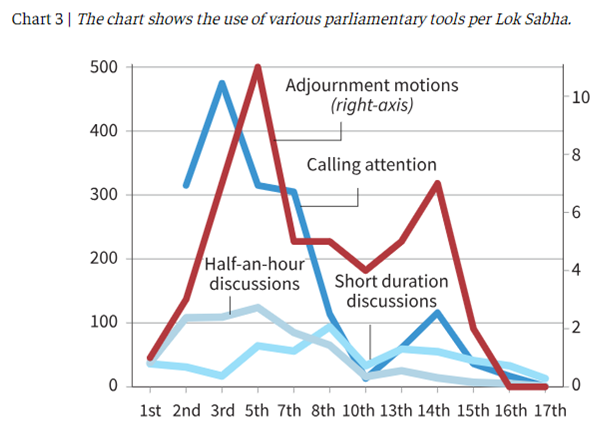
    • Decline in the use of various parliamentary tools:
      • Calling Attention Motion: It is a vital tool allowing MPs to draw attention to issues and elicit responses from ministers was extensively used between 1957 and 1990, with an average of 300 notices allowed per Lok Sabha. Post-1990, only 40 notices have been allowed per Lok Sabha. The 17th Lok Sabha allowed only one such discussion.
      • For example, the Winter Session, 2023 of the Rajya Sabha missed a crucial discussion on the sensitive and key issue of ‘Suicides among students due to competitive exams’.
    • The Adjournment Motion: It is employed to address urgent issues with a subsequent vote, and serves as an expression of disagreement with the government’s policies. Pre-1990, the Lok Sabha permitted discussion and voting on four such motions on average. Post-1990, this number decreased to three. The 16th and 17th Lok Sabha allowed no adjournment motions.
    • Ministries such as Health and Family Welfare, Home Affairs, Defence, Agriculture and Farmers’ Welfare, and Finance, made up 36.6% of all disallowed questions in Rajya Sabha. In contrast, in the Lok Sabha, they made up 37.8% of the disallowed questions, underscoring systemic challenges.

     Way Forward:

    • Need for 15-point Reform: As recommended by the Vice President, it is required to make the Charter function effectively and efficiently by ensuring that the members of the committee are nominated based on domain knowledge and for a longer assured term.
    • Need to work on Democratic Principles: To maximize the Parliament’s ability to hold the executive accountable, it is crucial to promote a conducive environment for constructive debate, scrutiny, and oversight.

    https://www.thehindu.com/opinion/lead/parliaments-past-a-mirror-to-changing-dynamics/article68033393.ece

    https://www.thehindu.com/data/the-many-lows-of-the-17th-lok-sabha-data/article67852889.ece

  • [30 March 2024] The Hindu Op-ed: Bonds, big money, and an imperfect democracy

    [30 March 2024] The Hindu Op-ed: Bonds, big money, and an imperfect democracy

    PYQ Relevance:Mains: 

    Q) ‘Simultaneous election to the Lok Sabha and the State Assemblies will limit the amount of time and money spent in electioneering but it will reduce the government’s accountability to the people’ Discuss. (UPSC CSE 2017) 

    Q) In light of the recent controversy regarding the use of Electronic Voting Machines (EVM), what are the challenges before the Election Commission of India to ensure the trustworthiness of elections in India?  (UPSC CSE 2018) 

    Prelims:

    Q) Under the Constitution of India, which one of the following is not a fundamental duty? (UPSC CSE 2011) 

    a) To vote in public elections
    b) To develop the scientific temper
    c) To safeguard public property
    d) To abide by the Constitution and respect its ideals

    Note4Students: 

    Prelims: Polity; Elections;  Electoral Bonds Scheme;

    Mains: Polity; Elections; Judicial Interventions;  Electoral Bonds Scheme;

    Mentors Comment: Representative democracy is a political system in which citizens of a country vote for representatives to handle legislation on their behalf. But perhaps India too is in some doubtful situation when the debate revolves around the Election 2024 or our version of present democracy. Recently, we have been through various news discussions on the Electoral Bonds Scheme which was introduced to cut down illegal funds in Party Politics, and its Campaigning pillared on black money. However, beyond curbing the wrong actions, the Electoral Bond Scheme also has another side which is a threat to our Democratic principles. Today’s Editorial also works on the same topic.

    Let’s learn. 

    —

    Why in the News?

    The Recent Judgement passed by our Supreme Court on the Electoral Bonds Scheme needs to be revisited in the Political domain too. 

    • If this picture is seen from a broader perspective, in a well-functioning democracy, fighting an election would need neither extravagant funding nor Electoral Bonds to be bought in secrecy.

    Context:

    • Elections continue to be fought with an increasingly larger amount of illegal funds being spent by political parties and candidates.
    • According to the SC the Electoral Bonds Scheme violates the Right to Information and Freedom of Speech and Expression under Article 19(1)(a) of the Constitution. It can lead to quid pro quo. The court ruled that the amendment to the Companies Act which allows blanket corporate political funding is unconstitutional.
    • This was supposed to end the financing of elections with black money. If this had happened, Indian politics would have been transformed with great benefit to the nation. After all, illegal finance results in the control of politics subverting our Democracy. 

    The gaps between the professed and the actual scenario of Indian politics:

    • Faraway from Democratic values: Elected leaders, usually serve the interests of those who finance their elections, and hardly represent the interests of their constituency. This gap between the professed and the actual undermines democracy since the government is no longer an entity ‘of the people, by the people, and for the people’. 
    • Vested interests as national interests: The vested interests corner most of the gains from development. It is in the design of the policies the packaging is cleverly done to make policies appear to be in the national interest. 
    • Widening of the Rich-poor Gap: Concessions are granted to private businesses to provide basic services like Health and Education through the market which results in the inability of the poor to afford them while simultaneously leading to growing disparities. This also reduces the availability of resources to the public sector.

    The Challenge of Money and the Election:

    • Representation issue: Voting is often not based on a candidate’s performance but on attributes such as caste, community, and region. Hence, political parties slice and dice the electorate along these lines. Vote banks are cultivated and the constituents are bribed just before an election.
    • Campaigning through illegal funds: Campaigning is conducted by paid workers and crowds are mobilized to attend rallies and meetings using money, transportation, and food. All this requires a lot of money far more than the permitted election expenditure limit of ₹95 lakh for a big parliamentary constituency. 
    • An issue with the Electoral Bonds Scheme: It enabled a bribe to be given in white for favors done. Since, only big businesses could contribute for big sums, their influence and manipulations were increased.
      • Secondly, the party obtaining funds could use them for all kinds of purposes and not necessarily for elections, such as setting up offices or destabilizing Opposition-led governments. Thus, the name electoral bonds was inappropriate.
    • Cronyism uncovered: The data show that funds were given to political parties for favors from policymakers; to escape prosecution for wrongdoing, and as an investment for the future. The data provided by the State Bank of India shows the quid pro quo in the case of some of the donations made. 

    Way Forward:

    • Need for a level-playing field: The political parties should not discriminate based on their vote share popularity or religion. This will enable the smaller and regional parties to compete with the ruling party and the major opposition parties on an equal footing and offer a genuine choice to the voters.
    • Need to reduce Money Influence: There is a need to curb the influence of money and corporate power in politics. The donors should no longer be able to hide their identity and agenda behind the veil of anonymity.

    Conclusion: The Electoral Bonds Scheme only highlights the growing weakness of Indian democracy. In a well-functioning democracy, where the political leadership is accountable, fighting an election would need neither big funding nor electoral bonds to be bought in secrecy. 

    https://www.thehindu.com/opinion/lead/bonds-big-money-and-an-imperfect-democracy/article68006688.ece

  • Charting women’s trajectory in parliaments globally

    Why in the news? 

    The year 2024 is being hailed as the biggest year for democracy, with 45% of the global population preparing to exercise their voting rights or having already cast their ballots

    Context:

    • Women’s representation in political spheres improved in the latter half of the 20th century, with significant progress made in many nations in securing voting rights and parliamentary seats, and in climbing to the highest political offices.
    • Despite substantial gains, women continue to constitute a minority in most parliamentary bodies and are rarely seen in top political leadership positions.

    Major two observations in recent times:

    1) The share of countries with universal Right to Vote: Initially, there was a significant gap between men and women regarding political participation, with men gaining voting rights while women were excluded in many nations.

    • New Zealand’s Role: New Zealand stands out as a pioneer in breaking this pattern by granting universal suffrage to women in 1893, thus allowing them to vote alongside men.
    • Widening Gap: Despite women gaining suffrage in more countries, the gap between male and female political participation widened in the early 20th century. Men’s voting rights continued to expand while women remained excluded in many places.
    • World War II: By the onset of World War II, men had voting rights in a higher proportion of countries compared to women. The disparity was stark, with men having voting rights in one out of three countries, while women had them in only one out of six countries.
    • Rapid Closure of the Gap: The gap between male and female political participation rapidly closed after the discrimination against women in voting rights ended in many countries. Both men and women gained the right to vote in many nations, leading to greater equality in political participation.

    2) Gender gap in the Chief-executive roles: “Chief-executive” refers to the head of state or head of government, depending on who holds more power within the political system. While women’s representation in parliament is crucial, it’s equally important for women to hold the highest political office in a country.

    • Gender Disparity in Political Chief Executives: Data from the V-Dem project indicates a significant gender gap in political chief executives. At any given time, the vast majority of political chief executives have been men.
    • Limited Increase in Female Leadership: Over the last three decades, there has been a slight increase in the proportion of countries led by women. However, the overall share of countries where women occupy the post of chief executive remains low, accounting for less than 10%.
    • Persistent Gender Disparity: Despite some progress, the data underscores the persistent gender disparity in holding the highest political office globally. Women continue to be underrepresented in top political leadership positions.

    Global Scenario for women’s share as a Parliamentarian:

    • Absence of Women in National Parliaments: In the early 20th century, women were largely absent from national parliaments across the globe.
      • Norway marked a significant milestone in 1907 when women first entered parliament. Nearly 10% of the parliamentary seats were occupied by women, indicating progress in political representation.
    • Surge in Women Entering Parliament: The latter half of the 20th century witnessed a notable increase in the number of women entering parliaments worldwide.
      • This trend of increasing female representation in parliaments accelerated notably in the late 20th and early 21st centuries.
    • Rwanda’s Remarkable Achievement: Rwanda stands out as a remarkable example, with its parliamentary composition surpassing the 50% mark for women’s representation in 2008. This achievement set a notable precedent for gender equality in political representation.
    • Other Countries’ Progress: In 2008, several other countries, including Argentina, Cuba, Finland, and Sweden, had significant proportions of women parliamentarians, ranging between 40% and 50%. This indicates a global trend toward greater gender parity in political representation.

    Recent Trend since 2022:


    • Low Representation in Many Countries: Despite advancements, women’s political representation remains constrained and inconsistent globally. Women constitute approximately half of the population but are significantly underrepresented in parliaments worldwide.
    • Persistent Gender Gap: Only a few countries have achieved gender parity in political representation, where women make up about half of all representatives. In the majority of countries, the share of women in parliament remains low. As of 2022, in nearly 60 countries, women’s representation in parliament was 20% or less.
    • Extreme Cases: In three countries, no women are represented in parliament, indicating extreme gender disparities in political participation and representation.

    Suggestive Measures to improve Women’s representation in Parliament:

    • Implement Quotas for Female Representation: Setting quotas for the number of women parliamentarians has proven effective in increasing female representation. Countries with quotas have significantly higher percentages of women in parliament compared to those without quotas
    • End Violence Against Women in Politics: Gender-based violence, including physical, sexual, and psychological violence, is a significant barrier for women in politics. Establishing measures to combat violence, harassment, and hate speech is crucial to creating a safer environment for women parliamentarians
    • Increase Women’s Participation in Media: Addressing gender stereotypes perpetuated by the media is essential. Media coverage often focuses on irrelevant aspects of women politicians’ lives, reinforcing stereotypes. Educating journalists and monitoring media coverage can help combat gender bias and promote a more balanced portrayal of women in politics
    • Expand Participation through Women’s Caucuses: Women’s parliamentary caucuses provide a platform for women to amplify their voices and influence in parliament. Supporting these caucuses with resources, leadership, and organizational backing can empower women to promote legal reforms and advocate for gender equality in politics

    Significant steps taken to improve women’s participation in parliament

    • Gender Quota Legislation: India has approved a landmark bill reserving 33% of seats in parliament for women. This quota is expected to lead to the promotion of women-friendly policies related to health, education, and jobs.  
    • Political Will and Proactive Measures: Despite challenges and slow progress, there is a growing recognition of the importance of women’s representation in Indian politics. Some political parties are taking proactive measures to nominate more women for assembly and parliament elections. However, there is a need for greater political will to address gender disparities and ensure a more inclusive political landscape
    • Empowerment through Representation: Increasing women’s representation in political parties and building a pipeline of female leaders are crucial steps to enhance women’s political participation.

    Conclusion: Despite strides, global women’s political representation remains low. Quotas, combatting violence, media reform, and supporting women’s caucuses are vital to enhancing female participation in parliaments and fostering inclusive democracy.

    Practice questions for the Mains

    Q) Discuss the trajectory of women’s representation in global parliaments, highlighting persistent gender disparities and measures to enhance female participation. (250 words)