Mains Ready By December. Smash Mains & Smash PYQ Admissions Open

GS Paper: GS2-01.Indian Constitution-Historical underpinnings & evolution; Features, amendments, significant provisions, basic structure of Constitution

  • Explainer traces the constitutional mechanics of delimitation as the Article 81 freeze lapses with the first census after 2026 and the Tamil Nadu Assembly seeks a permanent 543 seat cap

    Why in the News

    The Tamil Nadu Legislative Assembly has passed a resolution asking the Centre to permanently freeze Lok Sabha seats at 543, retain the present State wise distribution, preserve the 2.2 to 1 ratio between the two Houses, and grant one third reservation for women from the 2029 election without linking it to any census. The seat freeze under Article 81 lapses with the first census after 2026, which forces a choice between equal vote value across citizens and equal treatment of States that controlled their population.

    What is delimitation?

    1. About: Delimitation is the process of fixing the number of seats and the boundaries of territorial constituencies in each State for the Lok Sabha and the State Legislative Assemblies.
    2. Who performs it: It is carried out by a Delimitation Commission set up under an Act of Parliament, not by the Election Commission.
    3. Governing principle: Article 81(2) requires the ratio between the number of seats and the population of a State to be, as far as practicable, the same for all States.
    4. Present basis: The number of seats was last determined on the 1971 census population.
    5. Democratic test it serves: The exercise operationalises the standard of one citizen, one vote, one value, under which every vote should carry equal weight in the House.

    What is MPLADS?

    1. About: The Members of Parliament Local Area Development Scheme (MPLADS) is a central scheme allowing each Member of Parliament to recommend works of a developmental nature in their constituency.
    2. Fiscal relevance: Each member carries an annual allocation, so any increase in the size of the House raises the scheme’s total outlay proportionately.

    What is a joint sitting of Parliament?

    1. About: A joint sitting is a combined meeting of the Lok Sabha and the Rajya Sabha convened by the President under Article 108 to resolve a deadlock over an ordinary Bill.
    2. How it decides: The Bill is passed by a majority of the total number of members of both Houses present and voting, so the numerically larger House determines the outcome.

    What is the current status of Lok Sabha seat allocation in India?

    1. Seat number and its base: The Lok Sabha has 543 elected seats, fixed on the 1971 census, when the population stood at 54.8 crore. That translated to an average of 10.1 lakh people per constituency.
    2. Constitutional ceiling: Article 81 caps the elected strength at 550, comprising not more than 530 members from States and not more than 20 from Union Territories.
    3. The freeze and its purpose: Seat allocation was frozen on the 1971 census so that States with faster population growth would not gain seats, which would have penalised effective population control.
    4. Amendment trail: The 42nd Amendment Act froze the allocation until the year 2000. The 84th Amendment Act extended the freeze until the first census taken after 2026.
    5. The trigger now due: The 2027 census is the first census after 2026, so it becomes the basis for readjustment.
    6. Women’s reservation: The 106th Constitutional Amendment Act, 2023 provides one third reservation of seats for women in the Lok Sabha and State Assemblies, operative through a delimitation based on the 2027 census.
    7. Bicameral ratio: The Rajya Sabha’s current strength is 245, producing a ratio of 2.2 to 1 between the two Houses.

    Constitutional Provisions Related to Delimitation and Seat Allocation

    1. Article 81: Fixes the composition of the Lok Sabha and the ceiling of 530 members from States and 20 from Union Territories.
    2. Article 81(2)(a): Requires each State’s allocation to keep the seat to population ratio as far as practicable uniform across States.
    3. Article 81(2)(b): Requires each State to be divided into constituencies of broadly uniform population.
    4. Article 82: Mandates readjustment of seat allocation and constituency boundaries after every census, by an authority determined by Parliament through law.
    5. Article 170: Governs the composition of State Legislative Assemblies, with a maximum of 500 and a minimum of 60 seats, and readjustment after each census.
    6. Article 330: Reserves seats for Scheduled Castes and Scheduled Tribes in the Lok Sabha in proportion to their population.
    7. Article 332: Reserves seats for Scheduled Castes and Scheduled Tribes in State Legislative Assemblies.
    8. Article 329(a): Bars courts from questioning the validity of any law relating to delimitation or the allotment of seats.
    9. Article 108: Provides the joint sitting mechanism to resolve a disagreement between the two Houses on a Bill.
    10. 42nd Amendment Act, 1976: Froze State wise seat allocation on the 1971 census until 2000.
    11. 84th Amendment Act, 2001: Extended the freeze to the first census after 2026 and permitted boundary readjustment within States.
    12. 87th Amendment Act, 2003: Shifted the basis for redrawing constituency boundaries to the 2001 census, while leaving seat numbers frozen.
    13. 106th Amendment Act, 2023: Inserted Articles 330A, 332A and 334A providing one third reservation for women, operative after a delimitation following the relevant census.

    Why does the present seat distribution violate one person, one vote, one value?

    1. The measure used: Vote value falls as projected population per seat rises, and Kerala is set at a value of 1 with 20 seats for a projected 3.6 crore people and 18 lakh per seat.
    2. Uttar Pradesh and Bihar: Uttar Pradesh has 80 seats for a projected 25.7 crore, that is 32.1 lakh per seat and a vote value of 0.56. Bihar has 40 seats for 13.5 crore, that is 33.8 lakh per seat and 0.53.
    3. Rajasthan and Madhya Pradesh: Rajasthan has 25 seats for 8.4 crore, that is 33.6 lakh per seat and 0.54. Madhya Pradesh has 29 seats for 9.1 crore, that is 31.4 lakh per seat and 0.57.
    4. Tamil Nadu and the Telugu States: Tamil Nadu has 39 seats for 7.8 crore, that is 20 lakh per seat and 0.9. Andhra Pradesh with Telangana has 42 seats for 8.3 crore, that is 22.4 lakh per seat and 0.81.
    5. Karnataka and Punjab: Karnataka has 28 seats for 6.9 crore, that is 24.6 lakh per seat and 0.73. Punjab has 13 seats for 3.2 crore, also 24.6 lakh per seat and 0.73.
    6. The hill States: Himachal Pradesh has 4 seats for 0.8 crore, that is 20 lakh per seat and 0.9. Uttarakhand has 5 seats for 1.2 crore, that is 24 lakh per seat and 0.75.
    7. What the spread shows: A Bihar elector’s vote carries close to half the weight of a Kerala elector’s vote, which is the arithmetic case for readjustment.

    What would an 848 seat House based on 2026 population do to State shares?

    1. Source of the projection: The redistribution is drawn from a Carnegie Endowment research paper by Milan Vaishnav and Jamie Hintson, applied to an enlarged House of 848 seats.
    2. Uttar Pradesh: Seats rise from 80 to 143, and its share of the House rises from 14.7 percent to 16.9 percent.
    3. Bihar: Seats rise from 40 to 79, and its share rises from 7.4 percent to 9.3 percent.
    4. Rajasthan and Madhya Pradesh: Rajasthan rises from 25 to 50 seats and from 4.6 percent to 5.9 percent. Madhya Pradesh rises from 29 to 52 seats and from 5.3 percent to 6.1 percent.
    5. Tamil Nadu: Seats rise from 39 to 49, while its share falls from 7.2 percent to 5.8 percent.
    6. Andhra Pradesh with Telangana: Seats rise from 42 to 54, while the combined share falls from 7.7 percent to 6.4 percent.
    7. Kerala: The seat count stays at 20, and the share falls from 3.7 percent to 2.4 percent.
    8. Karnataka and Punjab: Karnataka rises from 28 to 41 seats but falls from 5.2 percent to 4.8 percent. Punjab rises from 13 to 18 seats but falls from 2.4 percent to 2.1 percent.
    9. Himachal Pradesh and Uttarakhand: Himachal Pradesh stays at 4 seats and falls from 0.7 percent to 0.5 percent. Uttarakhand rises from 5 to 7 seats and falls from 0.9 percent to 0.8 percent.
    10. The pattern: Southern States, smaller northern States and the North Eastern States lose share to the large northern States even where their absolute seat count rises, which cuts against the federal principle.

    What is the Centre’s current proposal?

    1. The Bill: The Constitution 131st Amendment Bill was introduced in April 2026 to raise the maximum number of Lok Sabha seats from 550 to 850.
    2. The assurance: The Union Home Minister gave an oral assurance in Parliament that every State and Union Territory would gain 50 percent more seats on a pro rata basis.
    3. Outcome: The Bill was defeated in the Lok Sabha.
    4. Expected reintroduction: The government is expected to bring the Bill again with explicit provisions for a uniform 50 percent increase for all States and Union Territories.
    5. Why the text matters: An oral assurance binds no future House and creates no enforceable entitlement, which is why the pro rata guarantee is sought inside the amendment itself.

    What is the case for a 50 percent pro rata increase?

    1. Proportions held constant: A uniform 50 percent rise leaves the existing proportion of representation of every State and Union Territory in the Lok Sabha unaltered.
    2. Women’s reservation made seamless: An enlarged House of around 816 seats would carry 272 seats reserved for women, so the one third reservation displaces no existing constituency.
    3. Absolute democratic gain: Electors per member fall in every State, which improves access to a representative everywhere.
    4. Avoids a zero sum contest: No State surrenders a seat, which removes the political impossibility of asking any State to accept a reduction.

    What institutional costs would a larger Lok Sabha impose?

    1. The bicameral ratio skews: With the Rajya Sabha held at 245, a 50 percent larger Lok Sabha moves the ratio from 2.2 to 1 to 3.3 to 1.
    2. Joint sittings become easier to win: A joint sitting under Article 108 has been used only three times since Independence, and a wider numerical gap makes it a more attractive route to push through Bills.
    3. The Upper House weakens as a check: More frequent joint sittings reduce the Rajya Sabha’s value as a revising chamber and as a check on the Lower House.
    4. Deliberative time shrinks: The Lok Sabha sits for only around 60 days a year, so adding members without adding sitting days cuts the floor time available to each member.
    5. Representation becomes numerical: The House risks being reduced to a count of members rather than a forum for meaningful deliberation.
    6. Cost to the exchequer: Additional members carry salaries, allowances and MPLADS allocations, and this fiscal load has to be reckoned with.

    How can the democratic and federal principles be reconciled?

    1. What a Member of Parliament actually does: The core work is legislating on Union List subjects such as defence, external affairs, railways, telecommunication and taxation, and holding the Union government accountable.
    2. Where delivery sits: A majority of central government schemes are implemented by State governments, so delivery accountability belongs at the State legislature.
    3. Freeze the Lok Sabha at 543: Retaining the present number causes no disruption to current State representation and upholds the federal principle.
    4. Women’s reservation inside 543: One third reservation can be provided out of the existing 543 seats without enlarging the House.
    5. Expand the Assemblies instead: The number of Members of the Legislative Assembly in each State can be raised in line with current population, which answers the democratic representation claim at the tier where schemes are executed.

    Major debates surrounding delimitation

    1. Democratic equality against federal parity: Equal vote value demands reallocation by population. Federal parity demands protection for States that limited population growth, and the two cannot be satisfied simultaneously inside a fixed House.
    2. Penalising policy success: States that reached replacement level fertility earliest would lose relative weight, which reverses the incentive the 1971 freeze created.
    3. Whether a uniform increase settles anything: A pro rata rise preserves proportions but widens absolute gaps, since a 50 percent increase applied to a 40 seat gap between two blocs produces a 60 seat gap.
    4. Rebalancing the Upper House: One proposal is to offset a larger Lower House by restructuring the Rajya Sabha, though Rajya Sabha seats in India are themselves allotted broadly by State population.
    5. Timing of the women’s quota: One position ties the one third reservation to the post census delimitation, another seeks it from the 2029 election within the existing 543 seats.
    6. Finality of the Commission’s orders: Delimitation Commission orders have the force of law and cannot be questioned before any court, so the terms of reference effectively decide the outcome.
    7. The data question: The exercise depends on the 2027 census, and the present argument runs on projections rather than enumerated figures.
    8. Assembly delimitation runs alongside: Article 170 readjustment and the Scheduled Caste and Scheduled Tribe reserved seat map under Articles 330 and 332 move with the same census, widening the political stakes.

    Challenges to the delimitation exercise

    1. No inter regional political consensus: e.g. the Tamil Nadu Assembly resolution seeking a permanent 543 seat cap follows the Joint Action Committee of southern States convened at Chennai in March 2025 on fair delimitation.
    2. The amendment threshold is severe: Raising the ceiling above 550 needs a two thirds majority, and whether ratification by half the States is required under the Article 368 proviso on representation of States in Parliament is itself contested. e.g. the Constitution 131st Amendment Bill was defeated in the Lok Sabha in 2026.
    3. Delimitation outcomes are largely beyond judicial review: e.g. the Supreme Court declined to interfere with the Jammu and Kashmir Delimitation Commission’s order in Haji Abdul Gani Khan v. Union of India, 2023, holding that Article 329(a) barred the challenge.
    4. Census timing controls everything: e.g. the decennial census due in 2021 was deferred and population enumeration is now scheduled for February 2027, so the entire readjustment calendar is derivative.
    5. Internal migration is invisible to the exercise: e.g. Delhi, Mumbai and Bengaluru absorb migrants who stay enrolled in their home States, so destination cities remain structurally under represented.
    6. Reserved seat maps shift with every redistribution: e.g. Scheduled Caste seats are rotated between constituencies at each delimitation, which unsettles sitting members and creates resistance within States as well as between them.
    7. Physical and institutional capacity: e.g. the new Parliament building’s Lok Sabha chamber was designed to seat about 888 members, which sets a practical outer limit on any expansion.

    Conclusion

    The freeze lapses with the first census after 2026, so the readjustment Article 82 requires can no longer be postponed. Equal vote value and federal parity cannot both be met by redistributing a House, since a proportional increase preserves shares while widening the absolute gap between regional blocs. The unresolved choice is whether the settlement is sought by enlarging the Lok Sabha, or by freezing it at 543 and moving the representation gain to State Assemblies and to a restructured Rajya Sabha.

    What is Federalism?

    1. About: Federalism is a system in which constitutional authority is divided between a central government and constituent units, with each deriving its powers from the Constitution rather than from the other.
    2. Rationale: It reconciles the need for a common national authority over defence, currency and external relations with the need for regional self government in a territorially and linguistically diverse polity.
    3. Coming together federalism: Independent units pool sovereignty to form a union, and the units retain substantial residual authority.
    4. Holding together federalism: A large unitary polity devolves power to constituent units to accommodate diversity, with residuary powers retained by the Centre. India follows this model.
    5. Legislative federalism: Powers are distributed through the Union, State and Concurrent Lists in the Seventh Schedule under Article 246.
    6. Administrative federalism: The Union directs States under Articles 256 and 257, and All India Services staff both levels.
    7. Fiscal federalism: Taxation powers and transfers are divided under Articles 268 to 293, with the Finance Commission and the Goods and Services Tax Council as the balancing institutions.

    Key Concerns Regarding Indian Federalism

    1. Representation asymmetry: Population based seat allocation transfers political weight to faster growing States, and the delimitation freeze was itself a federal compromise rather than a settled principle.
    2. The office of the Governor: Withholding assent to State Bills and discretionary reporting under Article 356 have been repeated sources of Centre State friction.
    3. Shrinking divisible pool: Cesses and surcharges are not shareable with States under Article 270, so the States’ effective share falls below the Finance Commission’s headline percentage.
    4. Loss of State tax autonomy under the Goods and Services Tax: States surrendered independent indirect tax powers, and the Council’s voting structure gives the Union a decisive third of the weighted votes.
    5. Weak third tier finances: Panchayats and municipalities depend on State Finance Commission awards that are frequently delayed or not acted upon.
    6. Central agencies and concurrent subjects: Expanding central legislation on Concurrent List items narrows the space for State level policy variation.

    Constitutional Framework Governing Parliament and Its Composition

    1. Article 79: Constitutes Parliament as the President, the Council of States and the House of the People.
    2. Article 80: Fixes the composition of the Rajya Sabha, with up to 238 representatives of States and Union Territories and 12 nominated members.
    3. Article 83: Fixes the duration of the Houses, five years for the Lok Sabha and a permanent Rajya Sabha with one third retiring every two years.
    4. Article 84: Prescribes the qualifications for membership of Parliament.
    5. Article 85: Requires the President to summon Parliament so that not more than six months separate two sessions.
    6. Article 100: Fixes the quorum at one tenth of the total membership of the House.
    7. Article 108: Provides for a joint sitting to resolve a deadlock between the Houses on an ordinary Bill.
    8. Article 327: Empowers Parliament to legislate on all matters relating to elections to the legislatures.
    9. Fourth Schedule read with Article 4: Allots Rajya Sabha seats to each State and Union Territory, and can be altered by ordinary law.

    Back2Basics: Delimitation Commission

    1. A statutory body constituted by the Union government under a Delimitation Commission Act passed by Parliament for each exercise.
    2. Four Delimitation Commissions have been constituted so far, in 1952, 1963, 1973 and 2002.
    3. Composition: a serving or retired Supreme Court judge as Chairperson, the Chief Election Commissioner or an Election Commissioner nominated by him, and the State Election Commissioner of the State concerned.
    4. Associate members are drawn from Lok Sabha members and State Assembly members of the State concerned, and they have no right to vote and do not sign the final order.
    5. Its orders have the force of law and cannot be called in question before any court, under Article 329(a).
    6. Orders are laid before the Lok Sabha and the concerned State Assembly, which may discuss but cannot modify them.
    7. A separate Delimitation Commission for Jammu and Kashmir was constituted in 2020 under the Jammu and Kashmir Reorganisation Act, 2019, and its 2022 order raised Assembly seats from 83 to 90.

    Government Initiatives and Institutional Measures

    1. Constitution (106th Amendment) Act, 2023, the Nari Shakti Vandan Adhiniyam: Provides one third reservation for women in the Lok Sabha, State Assemblies and the Delhi Assembly, to take effect after a post census delimitation.
    2. Constitution 131st Amendment Bill, 2026: Proposed raising the ceiling on Lok Sabha strength from 550 to 850, and was defeated in the Lok Sabha.
    3. Census 2027: Notified as a two phase digital census, with house listing followed by population enumeration, and it supplies the statutory trigger for readjustment under Article 82.
    4. Jammu and Kashmir Delimitation Commission, 2020: The most recent delimitation body, which redrew Assembly constituencies and reserved seats for Scheduled Castes and Scheduled Tribes in the Union Territory for the first time.
    5. 84th and 87th Amendment Acts: The statutory instruments through which the freeze was extended and boundary readjustment on the 2001 census was permitted.

    Key Facts about Delimitation

    1. Seat numbers currently rest on the 1971 census, with boundaries last redrawn on the 2001 census under the 87th Amendment.
    2. The 2002 Delimitation Commission completed its work in 2008, redrawing boundaries without changing State wise seat totals.
    3. Article 170 caps a State Assembly at 500 seats and sets a floor of 60 seats, with exceptions for Sikkim, Goa, Mizoram and Arunachal Pradesh.
    4. Anglo Indian nomination to the Lok Sabha and State Assemblies under Articles 331 and 333 lapsed after the 104th Amendment Act, 2019.
    5. The 106th Amendment inserted Articles 330A, 332A and 334A.
    6. The proposed enlarged House of around 816 to 848 seats would carry roughly 272 seats reserved for women at one third.
    7. A joint sitting has been convened only three times, for the Dowry Prohibition Bill, the Banking Service Commission Repeal Bill and the Prevention of Terrorism Bill.

    Challenges in Political Representation in India

    1. Rising elector to member ratio: e.g. the average Lok Sabha constituency has moved from about 10.1 lakh people in 1971 to well over 25 lakh today, which is among the highest in any democracy.
    2. Declining legislative scrutiny: e.g. Bills are increasingly passed without reference to Departmentally Related Standing Committees, and several Budget sessions have seen the Demands for Grants guillotined without discussion.
    3. Criminalisation of politics: e.g. the Supreme Court in Public Interest Foundation v. Union of India, 2018 directed candidates and parties to publish criminal antecedents in newspapers and on television.
    4. Weak anti defection enforcement: e.g. Tenth Schedule disqualification petitions have remained undecided by Speakers for years, prompting the Court in Keisham Meghachandra Singh v. Speaker, Manipur, 2020 to suggest a three month outer limit.
    5. Under representation of women: e.g. women constitute under 15 percent of the Lok Sabha, and the one third reservation remains contingent on a future delimitation.
    6. Money power in elections: e.g. the Supreme Court struck down the Electoral Bond Scheme in Association for Democratic Reforms v. Union of India, 2024 for violating the voter’s right to information.
    7. Urban local representation deficit: e.g. municipal elections in several States have been postponed for years pending ward delimitation and other backward class reservation determination.

    Way Forward

    1. Legislate the pro rata guarantee: Write any uniform increase in seats into the text of the amendment rather than leaving it to an assurance on the floor of the House.
    2. Pair any Lok Sabha expansion with Rajya Sabha reform: Restore the Upper House’s checking capacity by revisiting seat allotment, so the joint sitting route does not become a default.
    3. Increase State Assembly strength first: Raise Assembly seats under Article 170 in line with current population, which addresses representation at the tier where central schemes are delivered.
    4. Fix a calendar for the readjustment: Publish the terms of reference and timeline of the next Delimitation Commission before the census results, so States can prepare rather than react.
    5. Expand parliamentary sitting days: Adopt a statutory minimum number of sitting days so that a larger House translates into more deliberation rather than less floor time per member.
    6. Institutionalise inter State consultation: Route the readjustment question through the Inter State Council under Article 263, so the federal objection has a constitutional forum.
    7. Decouple the women’s quota from delimitation: Provide the one third reservation within the existing 543 seats so it is not contingent on a contested exercise.

    Matching Previous Year Question

    “[2024] How many Delimitation Commissions have been constituted by the Government of India till December 2023?
    (a) One
    (b) Two
    (c) Three
    (d) Four
    Answer: (d)”
  • Jammu and Kashmir Cabinet proposal to cap reservation at 50 percent stays pending with the Lieutenant Governor after the 2024 amendment raised the quota from 43 to 70 percent

    Why in the News

    The Chief Minister of Jammu and Kashmir has warned of youth led protests if the Cabinet’s proposal to cap reservation at 50 percent, sent to the Lieutenant Governor in November 2025, is not acted upon. Reservation in the Union Territory stands at 70 percent after a 2024 amendment made by the administration when no elected Assembly existed. An elected Cabinet is therefore seeking to reverse a quota that only the same executive channel can now undo.

    What is the Jammu and Kashmir Reservation Act, 2004?

    1. About: The Jammu and Kashmir Reservation Act, 2004 governs reservation in government appointments, admission to professional institutions and promotions in the Union Territory.
    2. Categories covered: It provides for Scheduled Castes, Scheduled Tribes, Other Backward Classes, residents of backward areas, residents of areas along the Actual Line of Control and the International Border, persons with disabilities and former service personnel.
    3. Distinctive feature: Reservation on the basis of residence in border and backward areas is specific to this Union Territory and has no direct parallel in most States.
    4. How percentages change: Category wise percentages are fixed through rules and amendments issued by the administration, so the quota can be altered without a fresh statute from an elected legislature.
    5. Post 2019 status: The Act continued to apply after the reorganisation of the State, and was amended by Parliament in 2023 to replace the earlier expression for backward classes with Other Backward Classes.

    What is the Actual Line of Control category?

    1. About: The Actual Line of Control (ALC) category covers residents of villages lying along the line dividing Indian and Pakistani held territory, who face shelling, restricted cultivation and displacement.
    2. Why it exists: The reservation compensates for the loss of education and employment opportunity caused by proximity to the line, and a parallel category exists for residents along the International Border (IB) in the Jammu plains.

    Who is an Agniveer?

    1. About: An Agniveer is a soldier recruited under the Agnipath scheme of 2022 for a four year term in the armed forces, after which 25 percent of each batch is retained in regular service.
    2. Why reservation is promised: The remaining personnel leave service in their twenties, so the Centre and several States have announced quotas for them in police and paramilitary recruitment.

    What is the current status of reservation in Jammu and Kashmir?

    1. Before August 2019: 43 percent of posts in government jobs were reserved across all categories, before the abrogation of the erstwhile State’s special status on 5 August 2019.
    2. After the 2024 amendment: Total reservation stands at 70 percent, leaving 30 percent of posts for open competition.
    3. The Scheduled Tribe share: The Scheduled Tribe quota was raised from 10 percent to 20 percent.
    4. The pending proposal: A Cabinet sub committee report of October 2025 recommended capping reservation at 50 percent, the Cabinet accepted it, and the file went to the Lieutenant Governor in November 2025.
    5. National baseline for comparison: At the Union level, Scheduled Castes hold 15 percent, Scheduled Tribes 7.5 percent, Other Backward Classes 27 percent for the non creamy layer, and the economically weaker sections 10 percent.
    6. The ceiling position: Indra Sawhney v. Union of India, 1992 fixed a 50 percent ceiling on reservation, relaxable only in extraordinary situations. The economically weaker sections quota sits outside that ceiling after Janhit Abhiyan v. Union of India, 2022.

    Constitutional Provisions Related to Reservation

    1. Article 15(4): Permits special provision for the advancement of socially and educationally backward classes, Scheduled Castes and Scheduled Tribes.
    2. Article 15(5): Permits reservation in admission to educational institutions, including private unaided institutions, excluding minority institutions.
    3. Article 15(6) and Article 16(6): Inserted by the 103rd Amendment Act, 2019, permitting up to 10 percent reservation for economically weaker sections in education and public employment.
    4. Article 16(1) and Article 16(2): Guarantee equality of opportunity in public employment and bar discrimination on grounds of religion, race, caste, sex, descent, place of birth or residence.
    5. Article 16(4): Permits reservation in appointments for any backward class not adequately represented in the services of the State.
    6. Article 16(4A): Permits reservation in promotion with consequential seniority for Scheduled Castes and Scheduled Tribes.
    7. Article 16(4B): Allows carry forward of unfilled reserved vacancies without counting them against the ceiling of the succeeding year.
    8. Article 335: Requires claims of Scheduled Castes and Scheduled Tribes to be considered consistently with the maintenance of efficiency of administration, a term the Constitution does not define.
    9. Article 338, 338A and 338B: Establish the National Commissions for Scheduled Castes, Scheduled Tribes and Backward Classes.
    10. Article 340: Empowers the President to appoint a commission to investigate the conditions of backward classes, the provision under which the Mandal Commission was set up.
    11. Article 341 and Article 342: Empower the President to specify the Scheduled Castes and Scheduled Tribes for a State or Union Territory, with any change requiring an Act of Parliament.
    12. Article 342A: Inserted by the 102nd Amendment and modified by the 105th Amendment Act, 2021, restoring the power of States and Union Territories to prepare their own list of socially and educationally backward classes.
    13. Article 46: Directs the State to promote the educational and economic interests of the weaker sections, particularly Scheduled Castes and Scheduled Tribes.

    How did the quota rise from 43 percent to 70 percent?

    1. The instrument: In 2024 the Lieutenant Governor announced an amendment to the Jammu and Kashmir Reservation Act, 2004, raising total reservation from 43 percent to 70 percent in government jobs.
    2. The timing: The amendment came barely a month before the 2024 parliamentary elections.
    3. The driver: Scheduled Tribe status was granted to the Pahari community, which sharply enlarged the population drawing on the Scheduled Tribe quota.
    4. The countervailing move: Gujjars and Bakerwals, who already held Scheduled Tribe status, had consistently opposed Pahari inclusion. The Scheduled Tribe quota was raised from 10 percent to 20 percent so that existing beneficiaries were not diluted.
    5. The residual pool: Candidates outside every reserved category were left competing for 30 percent of posts, which drew sharp criticism from unreserved applicants.

    Why is the elected government under pressure?

    1. Data placed on the floor of the Assembly: In February the government answered a motion by a People’s Conference legislator with figures showing significantly more reserved category certificates issued in Jammu than in Kashmir.
    2. Dissent from within the ruling party: In October 2025 a Member of Parliament from the Chief Minister’s own party sat on protest with unreserved category candidates outside the Chief Minister’s residence.
    3. Manifesto commitments: The National Conference and the Peoples Democratic Party both promised in their 2024 Assembly manifestos to revisit the policy, framing it cautiously as rationalisation of reservation.
    4. A competing promise: The Bharatiya Janata Party promised additional reservation for Agniveers and reservation in promotions for employees from reserved groups.
    5. The street risk: The Chief Minister has warned that youth led agitation of the kind seen elsewhere could follow if the Cabinet decision continues to go unanswered.

    Why has the proposal not moved?

    1. What the Cabinet did: The Cabinet accepted the sub committee’s recommendation of a 50 percent cap and sent the file to the Lieutenant Governor’s residence for clearance in November 2025.
    2. What followed: Queries were raised on the report, the government responded to them, and there has been no movement since.
    3. Why clearance is required: Jammu and Kashmir is a Union Territory with a legislature, where the Council of Ministers aids and advises the Lieutenant Governor and any difference of opinion is referred to the President.
    4. Limits on the elected tier: Under the Jammu and Kashmir Reorganisation Act, 2019 the Assembly cannot legislate on public order and police, and the administration retains substantial executive authority.
    5. The transparency objection: The stated grievance is that Cabinet approvals are held without any communicated decision, which leaves the elected government publicly answerable for an outcome it cannot deliver.

    Major debates surrounding reservation

    1. The 50 percent ceiling: Indra Sawhney fixed the limit, and States have breached it repeatedly. Tamil Nadu’s 69 percent reservation survives because it was placed in the Ninth Schedule in 1994.
    2. The economically weaker sections carve out: Janhit Abhiyan upheld the 10 percent quota by a 3 to 2 majority, which unsettled the ceiling as a firm rule and reopened the question of economic criteria.
    3. Social exclusion against economic upliftment: One position treats reservation as a remedy for historical exclusion from representation, another treats it as an instrument against poverty.
    4. Sub classification within categories: State of Punjab v. Davinder Singh, 2024 permitted States to sub classify Scheduled Castes for more targeted quotas, overruling E V Chinnaiah, 2004.
    5. Efficiency of administration: Article 335 conditions reservation on efficiency, and the absence of a definition leaves the balance to be argued case by case.
    6. Reservation in promotions: M Nagaraj, 2006 and Jarnail Singh, 2018 require quantifiable data on inadequacy of representation before promotion quotas, and the sufficiency of that data is routinely litigated.
    7. Who is listed as a Scheduled Tribe: Inclusion in the Article 342 list follows a Presidential order amended by Parliament, and the criteria applied for the Pahari inclusion are disputed by communities already on the list.
    8. Absence of current backward class data: Quota shares are set without an enumerated count of backward classes, which is the core of the demand for a caste census.

    Challenges to the reservation framework in Jammu and Kashmir

    1. The reserved pool exceeds the open pool: At 70 percent, unreserved candidates compete for less than a third of posts. e.g. general category aspirants in the Union Territory contest 30 percent of vacancies against roughly 50 percent available in most other States.
    2. Certification depends on revenue records: Residence based categories require boundary determinations that are open to error and manipulation. e.g. villages that straddle the notified Actual Line of Control belt generate contested certificates for the same locality.
    3. Contest within Scheduled Tribes: Existing tribes argue that a linguistic and geographic grouping does not meet the listing criteria. e.g. Gujjars and Bakerwals opposed Pahari inclusion on the argument that it dilutes a quota meant for pastoral communities with distinct traits and isolation.
    4. The formal employment base is narrow: Government service is the principal source of secure employment, so quota changes carry outsized political weight. e.g. private sector job creation in the Union Territory remains limited, which turns every recruitment notification into a political event.
    5. Litigation risk on the ceiling: Any quota above 50 percent must justify an extraordinary situation. e.g. the Supreme Court struck down Maharashtra’s Maratha reservation in Jaishri Laxmanrao Patil v. Chief Minister, 2021 for breaching the limit without such justification.
    6. Quota fixed by executive route: The increase was made by the administration when no elected Assembly existed, so accountability for it sits with neither the present Cabinet nor a legislature. e.g. the 2024 amendment was announced by the Lieutenant Governor a month before a national election.
    7. Regional perception of unequal benefit: Certificate issuance patterns feed a Jammu against Kashmir framing of the whole policy. e.g. the figures tabled in the Assembly in February became the basis for a protest by unreserved category aspirants.

    Conclusion

    Reservation in Jammu and Kashmir stands at 70 percent, set by an executive amendment made when no elected Assembly existed, and it can be reduced only through the same executive channel. The Cabinet’s recommendation of a 50 percent cap has been with the Lieutenant Governor since November 2025 without a decision, so a social justice dispute has become a question of who governs the Union Territory. The next milestone is the Lieutenant Governor’s decision on the file, or a reference to the President if the difference of opinion persists.

    What is Reservation?

    1. About: Reservation is a form of positive discrimination that sets aside a fixed proportion of public posts, legislative seats and educational places for groups identified as socially and educationally backward or inadequately represented.
    2. Rationale: Formal equality under Article 16(1) leaves historically excluded groups competing from unequal starting positions, and reservation supplies the substantive equality that Article 16(4) permits as a facet of, not an exception to, equality.
    3. Vertical reservation: Quotas for Scheduled Castes, Scheduled Tribes, Other Backward Classes and economically weaker sections, which are mutually exclusive categories.
    4. Horizontal reservation: Quotas for women, persons with disabilities and ex servicemen, which cut across every vertical category rather than forming a separate block.
    5. Creamy layer: The filter excluding the economically advanced within a backward class, applied to Other Backward Classes since Indra Sawhney and extended to promotion quotas for Scheduled Castes and Scheduled Tribes in Jarnail Singh, 2018.
    6. Reservation in legislatures: Distinct from employment quotas, provided under Articles 330 and 332 for Scheduled Castes and Scheduled Tribes and under the 106th Amendment for women.

    Key Concerns Regarding Reservation

    1. Benefit capture within categories: Dominant sub groups absorb a disproportionate share of reserved posts, which is what prompted the sub classification question in Davinder Singh.
    2. Absence of current data: Quota shares rest on the 1931 caste enumeration and on estimates, with no current count of backward class population.
    3. Erosion of the ceiling: Successive carve outs and State enactments above 50 percent have made the Indra Sawhney limit a contested rather than settled rule.
    4. Shrinking public sector: The reserved pool shrinks as government recruitment falls and contractual hiring rises, so quotas apply to a diminishing base.
    5. Backlog vacancies: Reserved posts remain unfilled and are carried forward or converted, which defeats the adequacy of representation the quota exists to secure.
    6. No coverage of the private sector or the higher judiciary: Reservation does not extend to private employment or to appointments to the higher judiciary, which limits its reach in the fastest growing segments.

    Constitutional and Statutory Framework Governing the Union Territory of Jammu and Kashmir

    1. Article 239: Provides for administration of Union Territories by the President through an Administrator, designated in this case as the Lieutenant Governor.
    2. Article 239A: Permits Parliament to create a legislature and a Council of Ministers for a Union Territory, the provision extended to Jammu and Kashmir.
    3. Article 240: Empowers the President to make regulations for specified Union Territories.
    4. Article 246(4): Empowers Parliament to legislate for a Union Territory on any matter, including matters in the State List.
    5. Article 370: Rendered inoperative in 2019, with the abrogation upheld in In Re Article 370 of the Constitution, 2023, which also directed restoration of statehood at the earliest.
    6. Jammu and Kashmir Reorganisation Act, 2019: Reorganised the State into the Union Territories of Jammu and Kashmir and of Ladakh, and defined the legislative and executive scheme for the former.
    7. The Assembly may legislate on State List and Concurrent List subjects, excluding public order and police, which remain with the Union.
    8. Section 53: The Council of Ministers aids and advises the Lieutenant Governor on matters within the Assembly’s competence, and a difference of opinion is referred to the President for decision.

    Laws and Rules Governing Reservation in Jammu and Kashmir

    1. Jammu and Kashmir Reservation Act, 2004: The parent statute governing reservation in appointments, promotions and admissions in the Union Territory.
    2. It recognises reservation on the basis of residence in areas adjoining the Actual Line of Control and the International Border, a category unique to this territory.
    3. Jammu and Kashmir Reservation Rules, 2005: Prescribe the category wise percentages and the procedure for issuing category certificates.
    4. Jammu and Kashmir Reservation (Amendment) Act, 2023: Enacted by Parliament, replacing the earlier expression for weak and under privileged classes with Other Backward Classes.
    5. Constitution (Jammu and Kashmir) Scheduled Tribes Order (Amendment) Act, 2024: Added the Pahari Ethnic Group, Paddari Tribe, Koli and Gadda Brahmin to the Scheduled Tribe list for the Union Territory.
    6. Jammu and Kashmir Reorganisation Act, 2019: Supplies the constitutional framework within which reservation rules are amended by the administration.
    7. Constitution (One Hundred and Third Amendment) Act, 2019: Introduced the 10 percent economically weaker sections quota, which applies in the Union Territory as elsewhere.

    Back2Basics: Gujjars, Bakerwals and Paharis

    1. Gujjars and Bakerwals together form the third largest community in Jammu and Kashmir and are the largest Scheduled Tribe group in the Union Territory.
    2. They are transhumant pastoralists, moving seasonally with livestock between the Pir Panjal foothills in winter and high altitude meadows in summer.
    3. Gujjars are primarily buffalo and cattle herders, while Bakerwals are goat and sheep herders who undertake the longer migration.
    4. Their language is Gojri, and both communities were granted Scheduled Tribe status in 1991 along with the Gaddi and Sippi.
    5. Paharis are a linguistic and cultural grouping, not a single caste, spread across Rajouri, Poonch, Baramulla, Kupwara and Anantnag, and include Hindus, Muslims and Sikhs.
    6. The Justice G D Sharma Commission, constituted in 2020 to examine socially and educationally backward classes in the Union Territory, recommended Scheduled Tribe status for the Pahari speaking people.
    7. Their inclusion in the Scheduled Tribe list took effect through an Act of Parliament in 2024, since Article 342(2) requires parliamentary law to amend a Presidential order.

    Government Initiatives

    1. Pradhan Mantri Anusuchit Jaati Abhyuday Yojana (PM-AJAY): Merges village development, grants in aid and hostel construction schemes for Scheduled Caste welfare.
    2. Eklavya Model Residential Schools: Residential schools for Scheduled Tribe students in blocks with a significant tribal population.
    3. Pradhan Mantri Janjati Adivasi Nyaya Maha Abhiyan (PM-JANMAN): Saturation coverage of basic services for Particularly Vulnerable Tribal Groups.
    4. Dharti Aaba Janjatiya Gram Utkarsh Abhiyan: Convergence mission covering tribal majority villages across housing, water, electricity, health and skilling.
    5. Post Matric Scholarship and National Overseas Scholarship: Educational support for Scheduled Caste, Scheduled Tribe and Other Backward Class students, including for study abroad.
    6. Stand Up India: Bank loans for greenfield enterprises by Scheduled Caste, Scheduled Tribe and women entrepreneurs.
    7. National Commissions for Scheduled Castes, Scheduled Tribes and Backward Classes: Constitutional bodies investigating denial of safeguards and advising on socio economic development.
    8. Van Dhan Vikas Kendras: Value addition and market linkage for minor forest produce collected by tribal households, run under the Ministry of Tribal Affairs.

    Key Facts about Reservation

    1. The first formal reservation in India was introduced in the princely State of Kolhapur in 1902.
    2. The Mandal Commission was appointed in 1979, submitted its report in 1980, and its 27 percent Other Backward Class quota was implemented from 1990 and upheld in 1992.
    3. Indra Sawhney v. Union of India, 1992 fixed the 50 percent ceiling, applied the creamy layer filter to Other Backward Classes, and barred reservation in promotions.
    4. The 77th Amendment Act, 1995 restored reservation in promotions, the 81st Amendment Act, 2000 dealt with backlog vacancies, the 82nd Amendment Act, 2000 allowed relaxation in qualifying marks, and the 85th Amendment Act, 2001 provided consequential seniority.
    5. Tamil Nadu retains 69 percent reservation, protected by placement in the Ninth Schedule in 1994.
    6. The 103rd Amendment Act, 2019 introduced the 10 percent economically weaker sections quota, upheld in Janhit Abhiyan, 2022.
    7. The 105th Amendment Act, 2021 restored the power of States to identify their own socially and educationally backward classes.
    8. The 106th Amendment Act, 2023 provides one third reservation for women in the Lok Sabha and State Assemblies.

    Challenges in Implementing Reservation

    1. Absence of enumerated data: Quota design rests on estimates rather than a current count of backward class population. e.g. the last caste wise enumeration of the full population dates to 1931, and the Socio Economic and Caste Census of 2011 caste data was never fully released.
    2. Creamy layer capture: The advanced within a backward class corner a disproportionate share of reserved seats. e.g. the Other Backward Class creamy layer income limit was last revised to 8 lakh rupees a year in 2017, and its revision has been repeatedly deferred.
    3. Unfilled reserved vacancies: Posts notified as reserved remain vacant and are carried forward or lapse. e.g. successive parliamentary replies have shown large backlogs of reserved Group A posts in central ministries and public sector undertakings.
    4. Litigation over promotion quotas: Every promotion quota requires fresh quantifiable data, which States struggle to produce. e.g. promotions in several State services stalled for years after M Nagaraj until the data requirement was clarified in Jarnail Singh, 2018.
    5. Fraudulent category certificates: Verification systems are weak and detection comes long after appointment. e.g. States have periodically cancelled appointments made on forged Scheduled Tribe certificates after scrutiny committee findings.
    6. Shrinking public employment base: Contractual and outsourced hiring falls outside the reservation framework altogether. e.g. large parts of State health and education recruitment now run through contractual posts to which roster rules do not apply.
    7. Exclusion of the private sector: Reservation does not extend to private employment, which now generates most new jobs. e.g. proposals for private sector reservation have remained at the level of voluntary affirmative action codes.
    8. Intra category conflict: Adding a new group to an existing list without enlarging the quota sets beneficiaries against each other. e.g. the Pahari inclusion in Jammu and Kashmir required raising the Scheduled Tribe quota from 10 percent to 20 percent to prevent dilution.

    Way Forward

    1. Complete a caste enumeration: Publish backward class population data so quota shares rest on counted figures rather than estimates, and revise category shares on that basis.
    2. Legislate the ceiling position clearly: Settle whether and on what evidence a State may cross 50 percent, so the question stops being resolved case by case in court.
    3. Enforce the creamy layer with periodic revision: Index the income threshold and apply the filter uniformly, so benefits reach the least advantaged within each category.
    4. Fill backlog vacancies through special recruitment drives: Run time bound drives with a public roster audit for every ministry and State department.
    5. Extend roster rules to contractual posts: Apply reservation to contractual and outsourced public employment so the shrinking regular cadre does not hollow out the entitlement.
    6. Build a verifiable certificate system: Digitise category and residence certificates with a single verification database to reduce forgery and duplicate issuance.
    7. Settle the Jammu and Kashmir file with a reasoned decision: Require the Lieutenant Governor to communicate a decision on the Cabinet’s 50 percent recommendation, or refer the difference to the President as the statute contemplates.
    8. Invest in the pre entry stage: Expand scholarships, coaching and school quality in backward areas, since reservation cannot compensate for the absence of a qualifying candidate pool.

    Matching Previous Year Question

    “[2023] Consider the following statements:
    Statement-I: The Supreme Court of India has held in some judgements that the reservation policies made under Article 16(4) of the Constitution of India would be limited by Article 335 for maintenance of efficiency of administration.
    Statement-II: Article 335 of the Constitution of India defines the term ‘efficiency of administration’.
    Which one of the following is correct in respect of the above statements?
    (a) Both Statement-I and Statement-II are correct and Statement-II is the correct explanation for Statement-I
    (b) Both Statement-I and Statement-II are correct and Statement-II is not the correct explanation for Statement-I
    (c) Statement-I is correct but Statement-II is incorrect
    (d) Statement-I is incorrect but Statement-II is correct
    Answer: (c)”

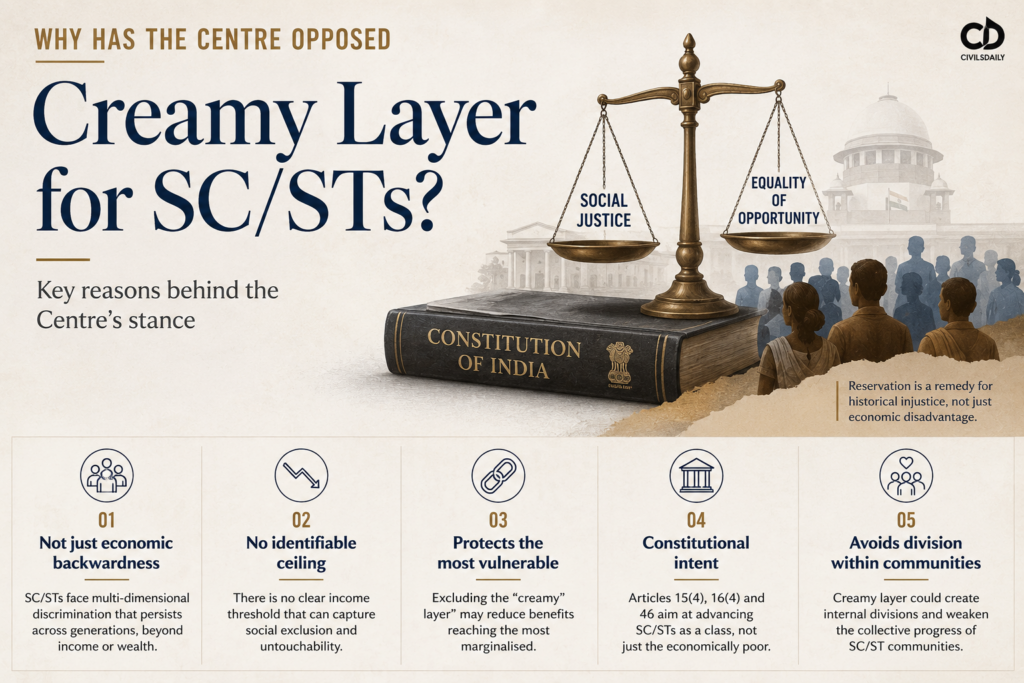
  • Why has the Centre opposed creamy layer for SC/STs?

    Why in the News

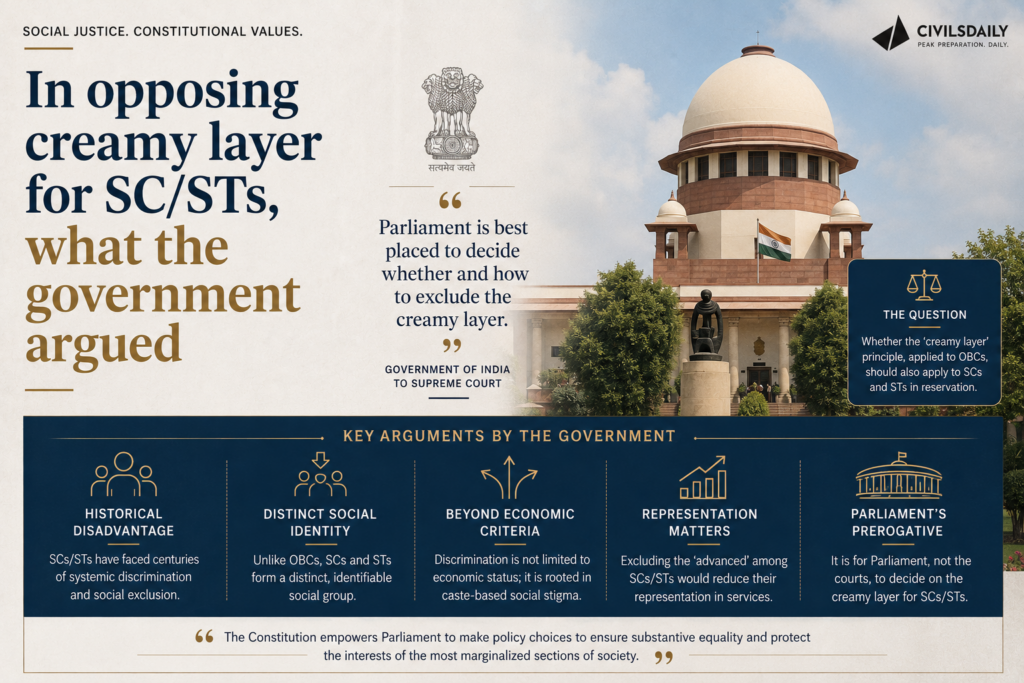
    The Union government reiterated before the Supreme Court that the creamy layer exclusion does not apply to Scheduled Caste and Scheduled Tribe classification. The position runs against a separate opinion in the 2024 sub categorisation ruling that urged the Court to consider extending the exclusion. The tension is between the constitutional premise that Scheduled Caste and Scheduled Tribe disadvantage is social rather than economic, and evidence that reservation benefits concentrate within a few advanced sub groups.

    What is the creamy layer?

    1. About: The creamy layer is the economically and socially advanced section within a reserved category, excluded from reservation benefits so that the quota reaches the genuinely disadvantaged.
    2. Origin: The exclusion was mandated for Other Backward Classes in Indra Sawhney vs Union of India (1992).
    3. Mechanism: Exclusion operates through an income and status ceiling, currently Rs 8 lakh of annual family income for Other Backward Classes, alongside constitutional post and service rank criteria.
    4. Point of dispute: The doctrine has never been extended to Scheduled Castes and Scheduled Tribes, whose identification rests on untouchability and social exclusion rather than income.

    Current Status of Reservation in India

    1. Category shares: Scheduled Castes hold 15 per cent, Scheduled Tribes 7.5 per cent, and Other Backward Classes 27 per cent subject to the creamy layer exclusion.
    2. Economically Weaker Sections: A further 10 per cent applies to those outside the reserved categories, introduced by the 103rd Constitutional Amendment.
    3. Ceiling position: The 50 per cent ceiling set in Indra Sawhney stands, and the Economically Weaker Sections quota was upheld in 2022 as sitting outside it.
    4. Sub categorisation: States may sub categorise within the Scheduled Caste and Scheduled Tribe lists after the 2024 ruling, but exclusion of individuals remains barred.
    5. Central practice: The only central use of sub categorisation within the Scheduled Tribe quota is in Eklavya Model Residential Schools, which reserve minimum representation for Particularly Vulnerable Tribal Groups.

    Constitutional Provisions Related to Reservation

    1. Article 15(4) and 15(5): Permit special provisions for the advancement of socially and educationally backward classes, Scheduled Castes and Scheduled Tribes, including in educational institutions.
    2. Article 16(4): Permits reservation in appointments for any backward class not adequately represented in state services.
    3. Article 16(4A): Permits reservation in promotion with consequential seniority for Scheduled Castes and Scheduled Tribes.
    4. Article 335: Requires that claims of Scheduled Castes and Scheduled Tribes be considered consistently with the maintenance of administrative efficiency.
    5. Article 341 and Article 342: Empower the President to specify the Scheduled Castes and Scheduled Tribes for each state, with Parliament alone able to include or exclude from the list.
    6. 103rd Constitutional Amendment, 2019: Inserted Articles 15(6) and 16(6) creating the Economically Weaker Sections quota.

    What did the Davinder Singh ruling actually decide?

    1. Sub categorisation permitted: A seven judge Bench in August 2024 held that states may sub categorise within the Scheduled Caste and Scheduled Tribe lists to give preference to the most backward within them.
    2. Homogeneity rejected: The Bench held that Scheduled Castes are not a homogeneous class, which is the premise sub categorisation rests on.
    3. The separate opinion: One judge wrote separately that the creamy layer principle applied to Other Backward Classes in Indra Sawhney should be considered for Scheduled Castes and Scheduled Tribes.
    4. Status of that view: The separate opinion did not create a binding direction, which is the gap the current litigation is testing.

    What is the government’s stated objection?

    1. Parliamentary competence: The power to include or exclude any community or individual from the Scheduled Caste and Scheduled Tribe lists rests solely with Parliament under Articles 341 and 342.
    2. Precedent claim: No binding judicial precedent has ever mandated a creamy layer for Scheduled Castes and Scheduled Tribes.
    3. Process objection: Any change should follow a holistic review and an empirical study, and should not arrive through judicial direction.
    4. Basis of identification: Scheduled Caste status derives from the disability of untouchability, which income does not extinguish.

    Major debates surrounding creamy layer extension

    1. Social versus economic disadvantage: Whether caste based exclusion persists after income rises is the empirical question the entire dispute turns on.
    2. Benefit capture: Sub categorisation was permitted precisely because a few advanced sub groups were found to be capturing a disproportionate share of the quota.
    3. Consistency argument: The Economically Weaker Sections quota already applies an income exclusion, which is the same logic being resisted for Scheduled Castes.
    4. Institutional route: Whether the change should come from Parliament under Article 341, from the executive, or from judicial interpretation.
    5. Empirical gap: The Justice G Rohini Commission, set up in 2017 to examine Other Backward Classes sub categorisation, submitted its report three years ago and it remains unpublished.
    6. Political mobilisation: The Reservation Hatao Andolan, an online movement with over five million followers, demands replacing caste based reservation with income based reservation.

    Challenges to reservation policy design

    1. Absence of current data: Caste wise socio economic data has not been published in usable form since 1931 for most categories. e.g. the Socio Economic and Caste Census of 2011 whose caste data was never released.
    2. Ceiling pressure: State legislations repeatedly breach the 50 per cent ceiling and are struck down. e.g. the Maratha reservation law set aside by the Supreme Court in 2021.
    3. Backlog vacancies: Reserved posts remain unfilled while the quota is nominally in force. e.g. the recurring backlog vacancies reported in central government establishments.
    4. Promotion quota litigation: The requirement to demonstrate inadequacy of representation before reserving in promotion generates continuous litigation. e.g. the Jarnail Singh line of cases refining the M Nagaraj test.
    5. Sub categorisation without data: States may now sub categorise but lack the empirical base to defend a specific split. e.g. the unpublished Rohini Commission report on Other Backward Classes sub categorisation.
    6. Private sector exclusion: Reservation does not extend to private employment, which now accounts for most new job creation. e.g. the repeated but unlegislated demand for reservation in the private sector.

    Conclusion

    The dispute is not about whether advanced sub groups capture a disproportionate share of the Scheduled Caste quota, which the 2024 ruling accepted, but about who may act on that finding and on what evidence. The government’s position keeps the exclusion power with Parliament under Article 341 and makes the missing empirical study the precondition for any change. The next milestone is the Supreme Court’s decision on whether the creamy layer question survives as a live issue after the government’s stand.

    Back2Basics: Justice G Rohini Commission

    1. Constituted in October 2017 under Article 340 to examine sub categorisation of Other Backward Classes.
    2. Mandated to examine the uneven distribution of reservation benefits among castes within the central Other Backward Classes list.
    3. Also tasked with working out a scientific approach for sub categorisation and correcting errors in the central list.
    4. Received repeated extensions and submitted its report to the President in July 2023.
    5. The report has not been made public or acted upon, which is central to the current debate on evidence.

    Way Forward

    1. Publish the empirical base: Release caste wise socio economic data and the Rohini Commission report so any exclusion rests on evidence rather than assertion.
    2. Legislate rather than litigate: Settle the exclusion question through Parliament under Article 341, which the government itself identifies as the competent authority.
    3. Complete sub categorisation frameworks: Give states a model methodology for defensible sub categorisation after the 2024 ruling.
    4. Fill backlog vacancies: Address unfilled reserved posts, since unused quota undercuts arguments on both sides of the debate.
    5. Track outcomes, not intake: Report reservation performance through completion, retention and promotion data, not through admission and appointment counts alone.

    “[2026] Consider the following statements about provisions pertaining to SC/STs in India:

    1. Provisions for Tribal Areas in Assam, Meghalaya, Tripura and Mizoram are in the Fifth Schedule.

    2. Some tribes of India are entitled to exemption from paying Income Tax on certain incomes.

    3. The Constitution provides for reservation of seats in Panchayats for women belonging to SCs and STs.

    (a) There are two correct statements, that include statement 2

    (b) There are two correct statements, that are statements 1 and 3

    (c) There is only one correct statement

    (d) All three statements are correct

  • Section 79(3)(b) of the IT Act as a takedown route that bypasses judicial scrutiny

    The Union government summoned senior staff of Meta, the parent company of Facebook and Instagram, and reprimanded them over the brief removal in India of a video message by the Prime Minister. The confrontation exposed a takedown route under Section 79(3)(b) of the Information Technology Act, 2000, which allows an agency to declare content unlawful without a court ever examining the claim. Content from the Jantar Mantar protests has already been erased or suppressed through a barrage of such notices.

    What is Section 79(3)(b) of the Information Technology Act, 2000?

    1. About: Section 79 grants an intermediary immunity from liability for content that its users post, and Section 79(3)(b) is the condition on which that immunity is lost.
    2. How it operates: The immunity ends if the intermediary fails to remove the content expeditiously after receiving actual knowledge or a notification from the appropriate government or its agency.
    3. What the notice contains: It records only that the reporting agency considers the content referred to it illegal.
    4. No judicial step: No court order and no reasoned adjudication is required before such a notice is issued.
    5. The incentive it creates: An intermediary that refuses risks losing safe harbour across its entire platform, so compliance is cheaper than contest.
    6. Distinction from Section 69A: Section 69A is a formal blocking power with a designated committee and recorded reasons, while Section 79(3)(b) carries none of that structure.

    What is an intermediary under the Information Technology Act, 2000?

    1. Definition: Any person who receives, stores or transmits an electronic record on behalf of another person, or provides any service in relation to that record.
    2. Coverage: The term includes telecom and network service providers, search engines, online marketplaces, payment sites, cyber cafes and social media platforms.

    What is safe harbour?

    1. About: It is a statutory immunity that protects a platform from liability for third party content that it did not create, initiate or modify.
    2. Conditions: The platform must remain a passive conduit, must not select the receiver or alter the transmission, and must observe the due diligence and removal requirements the law imposes.

    What is Section 69A of the Information Technology Act, 2000?

    1. About: It empowers the Central Government to direct any agency or intermediary to block public access to information through any computer resource.
    2. Grounds and safeguards: Blocking is confined to the grounds in Article 19(2), the reasons must be recorded in writing, and the procedure is set by the Information Technology (Procedure and Safeguards for Blocking for Access of Information by Public) Rules, 2009.

    What did the Supreme Court hold in Shreya Singhal v. Union of India (2015)?

    1. Section 66A struck down: The provision punishing grossly offensive or menacing online messages was held void for vagueness and for travelling beyond Article 19(2).
    2. Section 79(3)(b) read down: Actual knowledge was confined to a court order or a government notification, so a private complaint alone cannot trigger a takedown obligation.
    3. Section 69A upheld: The blocking power survived because it is tied to the Article 19(2) grounds and requires written reasons.
    4. The governing test: A restriction on speech must have a proximate connection to public order, and advocacy or discussion remains protected.

    What is the current status of free speech online in India?

    1. The right: Article 19(1)(a) covers online expression, and Anuradha Bhasin v. Union of India (2020) held that expression and trade through the Internet are constitutionally protected.
    2. The limits: A restriction must fall within the eight grounds in Article 19(2) and must satisfy the proportionality test.
    3. The blocking regime: Section 69A survives with recorded reasons and a review committee, and blocking orders are treated as confidential under the 2009 Rules.
    4. The takedown regime: Section 79(3)(b) as read down requires a court order or a government notification, which agencies now issue at scale.
    5. The compliance layer: The Information Technology (Intermediary Guidelines and Digital Media Ethics Code) Rules, 2021 require removal within 36 hours of a court order or government notice, and significant platforms must appoint a chief compliance officer, a nodal contact person and a resident grievance officer.
    6. The live dispute: The Karnataka High Court in 2025 rejected a platform’s challenge to the Sahyog portal, which lets authorised officers across States issue takedown notices, and the question remains under appeal.

    Which constitutional provisions govern freedom of speech and its restriction?

    1. Article 19(1)(a): Guarantees freedom of speech and expression to citizens.
    2. Article 19(2): Permits reasonable restrictions only on the grounds of sovereignty and integrity of India, security of the State, friendly relations with foreign States, public order, decency, morality, contempt of court, defamation and incitement to an offence.
    3. Articles 19(1)(g) and 19(6): Protect the right to carry on a business, which platforms invoke against arbitrary compliance burdens.
    4. Article 21: Covers privacy and the right to receive information, recognised in K.S. Puttaswamy v. Union of India (2017).
    5. Article 14: Requires that any classification of content or of speakers be reasonable and not arbitrary.
    6. Article 13(2): Voids any law that abridges a fundamental right, which is the basis on which takedown provisions are challenged.
    7. Articles 32 and 226: Provide the remedy against an unconstitutional restriction on speech.

    What triggered the confrontation between the government and the platform?

    1. The summons: The Union government called in senior staff of Meta, the parent company of Facebook and Instagram, and reprimanded them.
    2. The stated reason: The brief removal in India of a video message by the Prime Minister.
    3. The unstated objective: Pressure on the platform to suppress posts from protests such as the demonstration at Jantar Mantar.
    4. The scale of removal: A barrage of takedown notices has already erased or suppressed the more emblematic forms of those protests.
    5. Why the platform matters: Instagram Reels shows users automatically recommended posts from creators they do not follow, which has made it one of the most influential mass media formats in the country.

    Why does Section 79(3)(b) work as a censorship route without judicial scrutiny?

    1. The notice is an assertion, not a finding: It merely records that the reporting agency feels the content referred to is illegal.
    2. No court tests it: Posts taken down under this section almost never go to court, so the assertion is never examined.
    3. The platform bears the risk: Refusal exposes the intermediary’s safe harbour, while compliance costs it nothing.
    4. Volume replaces reasoning: A route that requires no order can be used at a scale that a blocking committee could never process.
    5. The speaker is not heard: The user whose content is removed is not a party to the notice and receives no reasons.
    6. No precedent is built: Because nothing is adjudicated, the boundary of lawful online speech is never judicially clarified.

    What do the Pakistani and Chinese examples show about where this path leads?

    1. Pakistan: TikTok was banned for a period in 2021 and restored only after the platform agreed to control content described as immoral or indecent, which made market access conditional on an editorial concession.
    2. China: A single party system with a stated ideological commitment to centralised control wipes out nearly all dissent within minutes of posting.
    3. The Chinese precondition: The conditions that enabled that level of censorship were fostered over the decades preceding the Internet’s growth, not built after it.
    4. What the comparison establishes: Seeking suppression of political speech on a recommendation driven platform would place India in the company of these two systems rather than that of open democracies.
    5. The limit of the comparison: Neither example carries a constitutional court that can strike down a restriction, which is the one structural difference India retains.

    Is the platform a target of state pressure or a participant in censorship?

    1. The case for target: The company was summoned and given a dressing down, and its safe harbour is the leverage being used against it.
    2. The case for participant: For months it has taken down every post referred to it under Section 79(3)(b) without contesting a single one.
    3. Compliance as a choice: The section requires expeditious removal on a valid notification, not uniform removal of everything referred.
    4. What the pattern created: Consistent automatic compliance established that pressure works, which set the stage for the current arm twisting.
    5. The central site problem: The platform was also the main venue for the mobilisations, so its compliance decisions determined what the protests looked like in public memory.
    6. The unresolved point: A platform that never litigates a takedown converts a contestable statutory condition into an unreviewable administrative power.

    Why does the absence of Chinese preconditions not make Indian speech safe?

    1. The structural argument: Without decades of conditioning before the Internet grew, and without a single party system committed to centralising control, the Internet cannot be tamed.
    2. The capacity gap: What currently limits Indian censorship is the inability to check posts in real time, which is a capacity constraint and not a legal safeguard.
    3. The technology that closes the gap: Automated screening supplies exactly the real time capacity that is missing, which makes it a destructive solution to that gap.
    4. The cultural harm: Warping the public’s cultural self perception damages society regardless of whether full control is ever achieved.
    5. The successor problem: A draconian power created without checks passes intact to every government that follows.
    6. The wrong lesson: Mass mobilisation is being treated as an aberration to be prevented, when it is the lifeblood of a democracy.

    What are the major debates surrounding online speech regulation in India?

    1. Actual knowledge after Shreya Singhal: Whether an executive notification under Section 79(3)(b) can carry the same force as a court order.
    2. Formal against informal blocking: Section 69A carries safeguards and Section 79(3)(b) carries none, and agencies prefer the route without safeguards.
    3. Confidentiality of blocking orders: Rule 16 of the 2009 Rules keeps blocking orders secret, which prevents the affected user from challenging them.
    4. Traceability and encryption: Rule 4(2) of the 2021 Rules requires significant messaging platforms to identify the first originator of a message, which is challenged as incompatible with end to end encryption and privacy.
    5. The Sahyog portal: Whether large numbers of authorised officers across States may issue takedown notices without a central record or a reasoned order.
    6. Government fact checking: The Bombay High Court struck down the 2023 amendment creating a government fact check unit for online content about government business in Kunal Kamra v. Union of India (2024).
    7. Proportionality in practice: Whether the least restrictive means test laid down in Anuradha Bhasin is actually applied to content removal.
    8. The future of safe harbour: Whether narrowing or removing intermediary immunity would increase platform accountability or simply increase over removal.

    Challenges to the Section 79(3)(b) takedown framework

    1. Absence of a reasoned order: The notice states a conclusion without disclosing the legal ground, e.g. the removal of posts and reels documenting the Jantar Mantar protests, where users were given no ground for takedown.
    2. No hearing for the speaker: The person whose content is removed is never a party, e.g. Rule 16 of the 2009 Blocking Rules keeps orders confidential, so users blocked during the 2021 farm protest removals were never served the reasons.
    3. Over removal by platforms: The safe harbour risk pushes a platform to remove first and assess later, e.g. Meta’s uniform compliance with every referral made to it under this section over recent months.
    4. Decentralised issuing authority: A large number of officers can issue notices without a common standard, e.g. the Sahyog portal, whose challenge by X Corp was rejected by the Karnataka High Court in 2025.
    5. Automation risk: Machine screening at scale extends removal to lawful speech without human review, e.g. algorithmic suppression of Reels cuts reach without a formal takedown, leaving nothing for the user to challenge.
    6. Chilling effect on creators: Repeat removals lower a creator’s distribution, so creators censor themselves, e.g. accounts covering the protests reduced posting after the most emblematic footage was suppressed.
    7. Misuse after invalidation: An unchecked power outlives the government and even the statute that created it, e.g. arrests under Section 66A continued for years after it was struck down in 2015, until the Supreme Court issued fresh directions in People’s Union for Civil Liberties v. Union of India (2021).

    Conclusion

    Section 79(3)(b) has become the preferred route for removing online speech precisely because it needs no court, no reasons and no hearing, and a platform that complies with every referral has converted a contestable statutory condition into an unreviewable administrative power. The outcome is not Chinese style control, which India lacks the political architecture to build, but a censorship practice that is invisible, unaccounted and inheritable by every future government. What must change is the trigger itself: a notification under this section must carry a reasoned order, a record open to the user, and a route of appeal.

    What is Intermediary Liability?

    1. About: It is the legal question of when a platform is answerable for content that its users create and publish.
    2. Rationale: Platforms cannot screen the volume of user content in advance, so the law exempts them from liability in exchange for cooperation with lawful removal.
    3. Conditional immunity: The exemption applies only while the platform remains a passive conduit and acts on a qualifying notice.
    4. Notice and takedown: The standard model requires removal on receipt of a qualifying notice, and jurisdictions differ on who may issue that notice.
    5. Due diligence obligations: The platform must publish rules, appoint officers, run a grievance process and file compliance reports to retain the immunity.
    6. Significant platforms: Larger platforms carry heavier obligations, which in India begin above a threshold of 50 lakh registered users.

    Key Concerns Regarding Intermediary Liability

    1. Privatised adjudication: A company decides what is unlawful, without the procedure and reasoning a court would apply.
    2. Asymmetric incentives: The cost of wrongful removal falls on the user, while the cost of wrongful retention falls on the platform, so removal is always the safer choice.
    3. Opaque enforcement: Neither the volume nor the grounds of removals are systematically disclosed to the public.
    4. Immunity as leverage: The threat of losing safe harbour can be used to obtain compliance on matters unconnected to the notice.
    5. Automated moderation: Scale forces machine decisions on speech whose legality depends entirely on context.
    6. Jurisdictional conflict: A global platform faces contradictory removal orders from different countries over the same content.

    Constitutional and Statutory Framework Governing Online Speech

    1. Article 19(1)(a): Guarantees freedom of speech and expression, which extends to expression on the Internet.
    2. Article 19(2): Permits reasonable restrictions on that freedom only on the eight enumerated grounds.
    3. Section 69, Information Technology Act, 2000: Allows interception, monitoring and decryption of information through a computer resource in specified circumstances.
    4. Section 69A, Information Technology Act, 2000: Empowers the Central Government to block public access to information, with reasons recorded in writing.
    5. Section 79, Information Technology Act, 2000: Grants intermediaries immunity from liability for third party content.
    6. Section 79(3)(b), Information Technology Act, 2000: Withdraws that immunity if the intermediary does not expeditiously remove content after actual knowledge or a government notification.
    7. Information Technology (Intermediary Guidelines and Digital Media Ethics Code) Rules, 2021: Prescribe due diligence, a 36 hour removal timeline, grievance officers and a traceability requirement for significant messaging platforms.
    8. Information Technology (Procedure and Safeguards for Blocking for Access of Information by Public) Rules, 2009: Set the committee procedure, the hearing stage and the confidentiality of blocking orders.

    Laws, Acts and Rules Governing Online Content Regulation in India

    1. Information Technology Act, 2000: The parent statute covering electronic records, cyber offences, intermediary liability and blocking of information.
    2. Information Technology (Amendment) Act, 2008: Inserted Section 66A, Section 69A and the present safe harbour scheme in Section 79.
    3. Information Technology (Intermediary Guidelines and Digital Media Ethics Code) Rules, 2021: Created the due diligence, grievance redress and digital media ethics framework for intermediaries and online publishers.
    4. Information Technology Amendment Rules, 2023: Created a government fact check unit for content about government business, struck down by the Bombay High Court in 2024.
    5. Information Technology (Procedure and Safeguards for Blocking for Access of Information by Public) Rules, 2009: Govern the process for orders under Section 69A.
    6. Digital Personal Data Protection Act, 2023: Regulates processing of digital personal data and creates the Data Protection Board of India.
    7. Bharatiya Nyaya Sanhita, 2023: Replaced the Indian Penal Code and carries the offences of promoting enmity between groups and of statements prejudicial to national integration that are routinely invoked against online speech.
    8. Telecommunications Act, 2023: Allows suspension of telecom services and interception of messages on public emergency grounds, replacing the corresponding power in the Indian Telegraph Act, 1885.
    9. Cable Television Networks (Regulation) Act, 1995 and the Cinematograph Act, 1952: The older content regulation model on which the digital ethics code was patterned.

    Back2Basics: Information Technology Act, 2000

    1. Enacted: 2000, modelled on the UNCITRAL Model Law on Electronic Commerce, 1996.
    2. Purpose: Gave legal recognition to electronic records and digital signatures and created a framework for cyber offences.
    3. Major amendment: The 2008 amendment, brought after the Mumbai attacks, added Sections 66A and 69A and rewrote the safe harbour provision.
    4. Bodies under it: The Indian Computer Emergency Response Team (CERT-In) under Section 70B and the Controller of Certifying Authorities.
    5. Appellate route: The Cyber Appellate Tribunal’s functions were merged into the Telecom Disputes Settlement and Appellate Tribunal in 2017.
    6. Judicial history: Section 66A was struck down in Shreya Singhal v. Union of India (2015).
    7. Extraterritorial reach: Section 75 applies the Act to offences committed outside India where a computer or computer network located in India is involved.

    Government Initiatives for Digital Content and Cyber Governance

    1. Sahyog portal: A central platform through which authorised officers of States and central agencies issue notices to intermediaries under Section 79(3)(b).
    2. Indian Cyber Crime Coordination Centre (I4C): Coordinates action against cybercrime across States and runs the national cybercrime reporting portal and helpline 1930.
    3. Indian Computer Emergency Response Team (CERT-In): The national agency for cyber incident response, advisories and coordination under Section 70B.
    4. Grievance Appellate Committees: Constituted in 2023 under the 2021 Rules to hear user appeals against a platform’s content decision.
    5. Information Security Education and Awareness programme: Builds capacity and public awareness on safe digital practices.
    6. Digital India programme: The umbrella mission for digital infrastructure, services and literacy under which the intermediary framework operates.

    Key Facts about Online Speech Regulation in India

    1. Significant social media intermediary: A platform with more than 50 lakh registered users in India, which carries the additional obligations under the 2021 Rules.
    2. Removal timelines: 36 hours for a court order or government notice, 24 hours for non consensual intimate imagery, and 72 hours for information sought by an authorised agency.
    3. Compliance officers: A chief compliance officer, a nodal contact person and a resident grievance officer must be appointed by significant platforms.
    4. Landmark ruling: Shreya Singhal v. Union of India (2015) struck down Section 66A and read down Section 79(3)(b).
    5. Follow up ruling: People’s Union for Civil Liberties v. Union of India (2021) directed States to stop registering cases under the struck down Section 66A.
    6. Internet shutdowns: India records among the highest numbers of Internet shutdowns in the world, and Anuradha Bhasin v. Union of India (2020) required shutdown orders to be published and periodically reviewed.
    7. Fact check unit: The government fact check unit under the 2023 amendment was struck down by the Bombay High Court in 2024.

    Challenges in Regulating Online Speech in India

    1. No independent oversight of removals: The executive is the issuing authority, the reviewing authority and the beneficiary of a takedown, e.g. review committees under the 2009 Blocking Rules are composed entirely of government officers.
    2. Scale of misinformation: Removal cannot keep pace with coordinated falsehood on closed messaging groups, e.g. the lynchings triggered by forwarded rumours in 2018, after which a limit on message forwards was introduced.
    3. Vague statutory grounds: Terms such as public order and decency are applied without a defined test, e.g. Section 66A was struck down in 2015 precisely for that vagueness, yet similar phrasing survives in the 2021 Rules.
    4. Encryption against traceability: A traceability mandate cannot be met without weakening security for every user, e.g. the challenge by WhatsApp to Rule 4(2) of the 2021 Rules pending before the Delhi High Court.
    5. Capacity of enforcement agencies: Police and prosecutors lack the technical training to distinguish unlawful speech from lawful criticism, e.g. arrests for social media posts continued under Section 66A for six years after it ceased to exist.
    6. Economic dependence of platforms: A large user market gives the state leverage that no legal safeguard offsets, e.g. TikTok’s restoration in Pakistan in 2021 only after it accepted content conditions.
    7. Absence of transparency data: Neither the number nor the grounds of Section 79(3)(b) notices are published, e.g. platform transparency reports record aggregate requests without disclosing the legal basis of each.

    Way Forward

    1. Require a reasoned order: Mandate that every notification under Section 79(3)(b) record the specific Article 19(2) ground and the material relied on.
    2. Notify the user: Require the intermediary to serve the ground of removal on the person who posted the content, so that a challenge becomes possible.
    3. Publish takedown statistics: Require the government and platforms to publish the number, source and legal ground of takedown notices at fixed intervals.
    4. Independent review: Reconstitute the review committee under the blocking rules with non official members, including a retired judge and a technical expert.
    5. Centralise issuing authority: Restrict the power to issue notices to a designated senior officer, ending the dispersal created by portal based issuance.
    6. Statutory appeal: Provide a time bound appeal against a takedown to a tribunal, rather than leaving writ jurisdiction as the only route.
    7. Codify proportionality: Write the least restrictive means test from Anuradha Bhasin into the rules, so that suspension of reach or a geographic block is preferred to full removal.

    Matching Previous Year Question

    “[2013, GS2, 10 marks] Discuss Section 66A of IT Act, with reference to its alleged violation of Article 19 of the Constitution.”

  • The constitutional limits on arrest, reaffirmed

    Why in the News

    An explainer revisits the constitutional limits on arrest after a 2025 Supreme Court ruling. It reaffirms that an arrested person must be meaningfully informed of the grounds of arrest.

    What does Article 22 guarantee on arrest?

    1. Grounds of arrest: Article 22(1) requires that grounds be communicated meaningfully, not as a formality.
    2. Legal counsel: The arrested person has the right to consult a lawyer of choice.
    3. Production before magistrate: Article 22(2) requires production within 24 hours of arrest.
    4. No prolonged custody: Continued detention beyond 24 hours requires Magistrate’s authorisation.
    5. Exception: These safeguards under Article 22(1) and 22(2) do not apply to enemy aliens and persons detained under preventive detention laws under Article 22(3).

    What did the recent ruling and precedents establish?

    1. Vihaan Kumar (2025): The Court held that failure to communicate grounds vitiates the arrest.
    2. Arnesh Kumar (2014): Arrest must be the exception for offences carrying up to seven years, not routine.
    3. D.K. Basu (1997): The Court prescribed safeguards including an arrest memo, informing relatives and medical examination to prevent custodial abuse.
    4. Arrest memo: Procedural safeguards require a documented arrest memo.

    What did the Supreme Court Rule in Vihaan Kumar Case?

    The judgment of the Supreme Court of India (Supreme Court) in the case of Vihan Kumar vs. State of Haryana (2025) marked a crucial milestone in protecting the fundamental rights of arrested persons.

    1. Mandatory information about the reasons for arrest: The Supreme Court has made it clear that the person arrested must be informed of the reasons for his arrest immediately. This is
      a fundamental right guaranteed under Article 22(1) of the Constitution.
    2. Arrest is invalid: If the accused is not informed of the reasons for the arrest, the arrest becomes illegal and unconstitutional.
    3. Cancellation of further proceedings: If fundamental rights are violated during the arrest process itself, subsequent remand orders issued by the courts or charge sheets filed by the police cannot rectify that mistake (Vitiated).
    4. Language awareness: The reasons for the arrest should be communicated in a language that the accused understands, and should not be a mere formality.

    Human rights and dignity (Article 21)

    1. Ban on shackles in hospitals: The Supreme Court has strongly condemned the practice of shackles and chains on Vihan Kumar when he was admitted to the hospital due to medical reasons.
    2. Right to Life: The court held that the right to live with dignity is part of Article 21 , and chaining the accused to a hospital bed falls under the category of human rights violation.

    How is preventive detention different?

    1. Without trial: Preventive detention permits custody without a charge to prevent an anticipated act.
    2. Advisory Board: Detention beyond three months requires review by an Advisory Board.
    3. Narrow safeguards: Several ordinary arrest protections under Article 22 do not apply to preventive detention.
    4. Preventive: Unlike ordinary detention, it is not punitive. It is intended to prevent an anticipated act prejudicial to specified interests.
    5. No 24-hour Magistrate requirement under Article 22(3).
    6. Grounds of detention must generally be communicated, subject to non-disclosure in public interest.

    What is the “Golden Triangle”?

    1. Articles 14, 19, 21: Together they form the core of personal liberty jurisprudence.
    2. Maneka Gandhi (1978): Established that a law depriving personal liberty must prescribe a procedure that is just, fair and reasonable.
    3. Article 22: Provides specific procedural safeguards against arbitrary arrest and detention, complementing the broader protection under Article 21.

    Conclusion

    The ruling restates settled safeguards and closes an enforcement gap on communicating arrest grounds. It sharpens the line between lawful arrest and arbitrary detention.

    PYQ Relevance

    [UPSC 2023] “The Constitution of India is a living instrument with capabilities of enormous dynamism. It is a constitution made for a progressive society.” Illustrate with special reference to the expanding horizons of the right to life and personal liberty.

    Linkage: The PYQ examines the expanding scope of the right to life and personal liberty under Article 21. Arrest safeguards and preventive-detention limits show how judicial interpretation strengthens protection against arbitrary deprivation of liberty.

  • Parliament passes Kerala (Alteration of Name) Bill, 2026 renaming State Keralam

    Why in the news?

    Parliament passed the Kerala (Alteration of Name) Bill, 2026, renaming the State Keralam and amending the First Schedule of the Constitution. The Rajya Sabha cleared the Bill by voice vote, over two years after the State Assembly unanimously resolved for the change. The measure has surfaced pending name change proposals from other States, including West Bengal’s request to become Bangla.

    How is a State renamed under the Constitution?

    1. Article 3 power: Parliament may by law alter the name of a State, and such a bill can be introduced only on the recommendation of the President.
    2. State legislature reference: The President must refer the bill to the concerned State legislature for its views within a specified period, though those views are not binding.
    3. First Schedule amendment: Renaming requires an amendment to the First Schedule, which lists the States and Union Territories, effected under Article 4 as an ordinary law.

    What is the Kerala (Alteration of Name) Bill, 2026?

    1. Core change: The Bill changes the name of the State from Kerala to Keralam and makes the consequential amendment to the First Schedule.
    2. Origin: It continues the Kerala Assembly’s 2024 resolution urging the Union government to rename the State Keralam.
    3. Passage: The Lok Sabha passed it on Tuesday and the Rajya Sabha by voice vote on Wednesday, with all MPs supporting the rename.

    What is the current status of State name changes in India?

    1. Precedents: Madras became Tamil Nadu, and several States and cities have been renamed over the decades.
    2. Pending proposals: West Bengal’s proposal to become Bangla has been pending for eight years, and members sought renaming of other States, cities and railway stations.
    3. Ordinary majority: A First Schedule amendment for renaming is passed as an ordinary law, not requiring the special majority reserved for other constitutional amendments.
    4. Linguistic basis: Keralam is the Malayalam name of the State, and the change reflects respect for regional language identity.

    Constitutional provisions related to State renaming:

    1. Article 3: Empowers Parliament to form new States and to alter areas, boundaries or names of existing States.
    2. Article 4: Provides that laws under Articles 2 and 3, including consequential First Schedule and Fourth Schedule amendments, are not deemed constitutional amendments under Article 368.
    3. First Schedule: Lists the States and Union Territories and their territories, amended to record the new name.
    4. Article 3 proviso: Requires presidential recommendation and reference to the State legislature before introduction.

    What does the Bill do procedurally?

    1. Amends the First Schedule: Substitutes Keralam for Kerala in the constitutional list of States.
    2. Consequential amendments: Makes the necessary changes so that references in law read as Keralam.
    3. Voice vote clearance: Passed in the Upper House by voice vote with cross party support during the Monsoon Session.

    How does renaming differ from creating or altering a State?

    1. Name only: Renaming changes only the label, leaving territory, boundaries and administrative structure intact.
    2. Same Article, different effect: Article 3 covers both renaming and territorial reorganisation, but renaming carries no boundary or population change.
    3. No special majority: Both are enacted by simple majority under Article 4, unlike amendments under Article 368.

    What are the major debates surrounding State renaming?

    1. Federal courtesy: Members urged that the Union work closely with States and respect regional languages, framing the change within cooperative federalism.
    2. Pending parity: The eight year delay on West Bengal’s Bangla proposal raised the question of consistent and timely treatment of State requests.
    3. Symbolic versus substantive: One member argued the Centre should change its behaviour on disaster funding, not just the name, contrasting symbolic recognition with substantive support.

    Conclusion: Parliament has passed the Kerala (Alteration of Name) Bill, 2026, renaming the State Keralam and amending the First Schedule under Article 3. The change gives effect to the Kerala Assembly’s 2024 resolution and reflects the State’s Malayalam identity. The next step is presidential assent, after which the First Schedule stands amended.

    Back2Basics: First Schedule and States reorganisation

    1. First Schedule: Lists the 28 States and 8 Union Territories with their territorial extents.
    2. States Reorganisation Act, 1956: Reorganised State boundaries largely on linguistic lines, the framework within which Kerala was formed.
    3. Renaming precedents: Madras to Tamil Nadu (1969), Mysore to Karnataka (1973), Uttaranchal to Uttarakhand (2007), and Orissa to Odisha (2011).
    4. Process anchor: Article 3 read with Article 4 governs formation, alteration and renaming of States.
  • Citizens, not just daughters in need of forgiveness

    Why in the news?

    A remark by the Prime Minister offering “forgiveness” to young women who protested over examination irregularities has reopened a basic constitutional question. The framing casts the state as a benevolent patriarch and the women as daughters to be corrected, rather than as citizens exercising a right. The dispute is whether women who protest are treated as rights bearing citizens or as wards whose speech must first be polite.

    What does the right to free speech under Article 19 protect?

    1. Scope: Article 19(1)(a) of the Constitution guarantees the freedom of speech and expression to every citizen, and this includes the right to protest and to dissent.
    2. Provocative speech included: The right covers expression that is impolite, provocative, or even offensive, not only measured or agreeable speech.
    3. Only reasonable restrictions: The right is limited solely by the reasonable restrictions in Article 19(2), such as public order, decency or morality, and defamation, incitement to an offence and not by a general demand for civility.

    Why is the “forgiveness” framing seen as paternalistic?

    1. State as patriarch: Offering forgiveness positions the state as a merciful patriarch dispensing pardon, rather than an authority answerable to its citizens.
    2. Infantilising women: Describing protesting women as “daughters” who spoke wrongly reduces them to misguided children in need of correction.
    3. Agency denied: It treats a woman’s political grievance as an error of conduct, shifting attention from the demand to the manner of its expression.

    How does the double standard operate?

    1. Men’s anger normalised: Aggressive language by men in protests, rallies, and legislatures is read as conviction and rarely becomes a national debate.
    2. Women’s anger moralised: The same expression by women is recast as a question of morality and cultural shock, which invalidates the underlying political claim.
    3. Burden shifts to the woman: The pattern mirrors sexual violence cases, where a woman’s character is examined before the offence itself is addressed.

    Can free speech protect angry dissent?

    1. Protest is born of frustration: Dissent by its nature arises from anger at the prevailing system, so citizens cannot be required to soften their anger before being heard.
    2. Civility is not a legal test: Politeness is a social norm, not one of the grounds on which Article 19(2) permits the state to restrict speech.
    3. The real offence was elsewhere: At the protests the demonstrable wrong was the assault, doxxing, and harassment of students, not the words some of them used.

    What is the current Status of the freedom of speech and expression in India

    1. Who it protects: Article 19(1)(a) extends to all citizens, and its protection of protest and criticism has been repeatedly affirmed by the judiciary.
    2. Settled limits: Speech may be restricted only under the eight grounds in Article 19(2), including the sovereignty and integrity of India, security of the State, public order, decency or morality, defamation, contempt of court, friendly relations with foreign states and incitement to an offence.
    3. Recognised expansions: Courts have read the right to include the right to know, the right to protest peacefully, and expression through diverse media.

    What are the constitutional Provisions related to speech, agency, and equality

    1. Article 19(1)(a): Guarantees the freedom of speech and expression.
    2. Article 19(2): Lists the reasonable restrictions that alone may limit that freedom.
    3. Article 21: Protects personal liberty and autonomy, the basis on which courts uphold a woman’s right to choose her partner, faith, and way of life.
    4. Articles 14 and 15: Guarantee equality before the law and bar discrimination on the ground of sex, underpinning equal citizenship for women.

    What are the major debates surrounding free speech and women’s agency

    1. Civility versus liberty: Whether provocative or offensive protest speech can be curbed in the name of decorum, or only under Article 19(2).
    2. Paternalism versus autonomy: Whether the state and courts may protect women in ways that override their own choices, as critiqued through the Hadiya case.
    3. Unequal citizenship: The argument, drawn from political theorist Carole Pateman, that the formal citizenship of men counts for more than that of women because of patriarchal privilege.

    Conclusion

    The central claim is that women who protest are citizens exercising a right, not daughters awaiting pardon. Treating their speech as a question of civility, while men’s aggression passes as conviction, denies them equal citizenship and misreads a right that protects even uncomfortable expression. The remedy is to treat women as full rights bearing individuals and to judge protest speech only against the limits the Constitution actually sets.

    Back2Basics:

    Hadiya case (2018)

    1. What it was: The Kerala High Court annulled the marriage of an adult woman on the assumption that she was weak and vulnerable.
    2. What the Supreme Court held: It set aside the annulment and restored her fundamental right to make choices about her life, faith, and partner.
    3. Why it matters: It is a leading illustration of courts correcting a paternalistic denial of a woman’s autonomy under Article 21.

    Fundamental Rights in India (Foundational Context)

    1. About: Fundamental Rights in Part III of the Constitution are justiciable guarantees that an individual can enforce against the state.
    2. Rationale: They protect individual liberty and dignity and place limits on state power, and form part of the basic structure.
    3. Key concerns: Recurring tensions include balancing liberty against public order, the scope of reasonable restrictions, and the unequal enjoyment of rights across gender and class.

    Way Forward

    1. Judge speech by Article 19(2) alone: Restrict protest speech only on the constitutional grounds, not on norms of politeness.
    2. Protect protestors from harassment: Act against the doxxing, assault, and vilification of demonstrators rather than policing their tone.
    3. Recognise women’s agency: Frame women in public life as citizens with political and personal autonomy, not as dependents to be protected.

    PYQ Relevance

    [UPSC 2014] What do you understand by the concept “freedom of speech and expression”? Does it cover hate speech also? Why do the films in India stand on a slightly different plane from other forms of expression? Discuss.

    Linkage: The PYQ is directly relates to the constitutional scope of freedom of speech and expression under Article 19(1)(a). The article extends this debate to angry dissent, provocative speech, reasonable restrictions and women’s right to political expression.

  • Vande Mataram Bill gets President’s assent, becomes law

    Why in the News

    The President gave assent to the Prevention of Insults to National Honour (Amendment) Bill, 2026, making it law. The amendment criminalises intentional disruption or prevention of the singing of the National Song Vande Mataram, extending to it the legal protection currently accorded to the National Anthem.

    What is the Prevention of Insults to National Honour (Amendment) Bill, 2026?

    1. Core provision: The Prevention of Insults to National Honour (Amendment) Bill, 2026, criminalises intentional disruption or prevention of the singing of the National Song Vande Mataram.
    2. Parent statute: It amends the Prevention of Insults to National Honour Act, 1971, which already penalises insults to the National Flag, the Constitution, and the National Anthem.
    3. Equal status: The legislation grants Vande Mataram the same legal protection as the National Anthem, Jana Gana Mana.
    4. Legislative passage: The Lok Sabha passed the Bill on 30 July and the Rajya Sabha cleared it a day earlier, with Presidential assent completing enactment.

    What are the concerns raised on implementation?

    1. Practicality of enforcement: A senior Opposition member questioned whether respect and patience for the song can be legislated.
    2. Duration burden: A full rendition of Vande Mataram lasts about three minutes and ten seconds, against roughly 52 seconds for Jana Gana Mana.
    3. Standing time: Where a State Song precedes both, audiences could be expected to stand for nearly six minutes before and after every official function.
    4. Counterproductive risk: The stated concern is that mandating full rendition could reduce rather than promote respect for the National Song.

    About National Symbols in India

    1. National Anthem: Jana Gana Mana, adopted by the Constituent Assembly on 24 January 1950, protected under the Prevention of Insults to National Honour Act, 1971.
    2. National Song: Vande Mataram, composed by Bankim Chandra Chatterjee, given equal status with the National Anthem by the Constituent Assembly on 24 January 1950.
    3. National Flag: The Tiranga, governed by the Flag Code of India, 2002, and the Prevention of Insults to National Honour Act, 1971.
    4. Legal duty: Article 51A(a) makes it a fundamental duty of every citizen to respect the Constitution, the National Flag, and the National Anthem.

    Statutory Framework Governing National Honour

    1. Prevention of Insults to National Honour Act, 1971: Penalises insults to the National Flag, the Constitution, and the National Anthem.
    2. 2026 Amendment: Extends protection to the National Song Vande Mataram against intentional disruption.
    3. Flag Code of India, 2002: Consolidates conventions and instructions on display and use of the National Flag.
    4. Emblems and Names (Prevention of Improper Use) Act, 1950: Restricts improper use of national emblems and names.

    Back2Basics: Vande Mataram

    1. Author: Bankim Chandra Chatterjee, who composed it and later included it in the novel Anandamath.
    2. Historical role: It became a rallying song of the freedom movement, first sung at the 1896 session of the Indian National Congress.
    3. Constitutional status: The Constituent Assembly resolved on 24 January 1950 that it shall have equal honour with the National Anthem, Jana Gana Mana.
    4. Original language: Composed largely in Sanskritised Bengali.
    5. Full rendition: A complete rendition runs about three minutes and ten seconds.
  • Parliament passes Tribunals Reforms Bill; National Tribunals Commission set up

    Why in the News?

    Parliament passed the Tribunals Reforms Bill, 2026, which establishes a National Tribunals Commission to oversee the selection and administration of tribunals. The Bill responds to a Supreme Court direction, yet it retains executive control over the commission’s appointments and finances. This exposes the tension between insulating tribunals from the ministries they review and preserving the government’s grip over the same bodies.

    What is the National Tribunals Commission (NTC)?

    1. Definition: The National Tribunals Commission (NTC) is a proposed statutory body to oversee the appointment, service conditions, and administration of tribunals under a common framework covering 16 tribunals.
    2. Composition: It is to be headed by a former Supreme Court judge or a former chief justice of a High Court, supported by two judicial members and two technical members.
    3. Selection method: Appointments to member tribunals are to be made through a search cum selection system run by the commission, supported by a dedicated NTC Secretariat.
    4. Origin: The Supreme Court first recommended an independent statutory commission of this kind in the Rojer Mathew judgment of 2019.

    Why were tribunals created in the first place?

    1. Speed and specialisation: Tribunals allow specialists to settle technical disputes faster than regular courts, in areas such as taxation, company law, securities, and the environment.
    2. Complementary role: They do not replace constitutional courts but supplement the judicial system with specialised adjudication.
    3. Economic stake: Timely resolution frees locked capital and restores investor confidence, linking ease of justice to ease of doing business.
    4. Constitutional basis: Articles 323A and 323B provide for administrative tribunals on service matters and tribunals on specified subjects respectively.

    How has tribunal jurisprudence developed?

    1. S.P. Sampath Kumar, 1987: Upheld tribunals but held that their decisions remain subject to review by constitutional courts.
    2. L. Chandra Kumar, 1997: Held that judicial review by High Courts under Article 226 is part of the basic structure and cannot be ousted by tribunals.
    3. Rojer Mathew, 2019: Recommended an independent statutory National Tribunals Commission and held that defining who is qualified to exercise judicial power is an essential legislative function that cannot be left to executive rulemaking.
    4. Madras Bar Association, 2025: Struck down provisions Parliament had reenacted, restored the earlier framework, and gave the government four months to establish the commission.
    5. Structural flaw addressed: Tribunals had historically been administered by the same ministries whose decisions they were meant to review.

    What are the other major changes the Bill introduces?

    1. Five year terms: Restores five year terms for tribunal members in place of shorter tenures the courts had rejected.
    2. Uniform service conditions: Introduces uniform service conditions across tribunals to end variation between ministries.
    3. National Tribunals Data Grid: Provides for a data grid to track pendency and disposal across tribunals.
    4. Pending appointments protected: Does not disturb appointments already in the pipeline.
    5. Rationalisation retained: Follows the earlier reduction of tribunals from 26 to 19 and then to 16.

    Where does the genuine tension in the Bill lie?

    1. Autonomy versus executive control: The commission is meant to insulate tribunals from executive control, yet the Centre still appoints its members and retains substantial influence over its finances and administration.
    2. Delegation to executive rules under Section 14: Qualifications, manner of selection, salaries, and service conditions of members are left to future executive rules, the very delegation the Rojer Mathew reasoning had resisted.
    3. Ministerial screening under Section 16: A ministry first screens a complaint against a member before it passes to the commission for inquiry.
    4. Consultation, not concurrence: The Centre consults the Chief Justice of India only for the chairperson and judicial members, retaining the decisive voice.
    5. Representation gap: Members flagged that very few tribunal members come from Scheduled Caste and Scheduled Tribe communities, with only one tribal judge recorded so far.

    What are the challenges to the tribunal system?

    1. Executive dependence: Funding, staffing, and infrastructure of many tribunals still flow from the parent ministry whose orders they review.
    2. Vacancies and pendency: Delayed appointments leave benches vacant and cases pending, defeating the promise of speedy justice.
    3. Inconsistent service conditions: Divergent tenures and salaries across tribunals weaken independence and deter qualified members.
    4. Access barriers: Concentration of benches in a few cities makes tribunals hard to reach for litigants from distant areas.
    5. Weak enforcement: Tribunal orders are sometimes not implemented, as seen in inter State water sharing disputes.

    Conclusion

    The Tribunals Reforms Bill, 2026, creates the long directed National Tribunals Commission and restores protections the Supreme Court had earlier upheld. The central weakness is that a body designed to insulate tribunals from executive control remains subject to executive appointment, removal, and finance. Genuine autonomy will require the government to surrender its power to appoint or remove members at will, a change the current text does not make.

    Back2Basics

    What is Judicial Review?

    1. About: Judicial review is the power of constitutional courts to examine the validity of legislative and executive action against the Constitution.
    2. Rationale: It protects fundamental rights and the separation of powers by preventing any organ from exceeding constitutional limits.
    3. Basic structure: In L. Chandra Kumar, the Supreme Court held that judicial review by the High Courts and the Supreme Court is part of the basic structure and cannot be excluded, including over tribunal decisions.

    Constitutional Framework Governing Tribunals

    1. Article 323A: Empowers Parliament to establish administrative tribunals for disputes over recruitment and service conditions of public servants.
    2. Article 323B: Empowers appropriate legislatures to set up tribunals for specified matters such as taxation, industrial and labour disputes, and elections.
    3. Article 226: Preserves the High Courts’ writ jurisdiction, which tribunals cannot oust.
    4. Article 227: Preserves the High Courts’ power of superintendence over tribunals within their territory.
    5. Article 136: Preserves the Supreme Court’s discretionary appellate jurisdiction over tribunal decisions.

    Way Forward

    1. Full commission autonomy: Vest appointment, removal, and finance of the commission in an independent process free of executive dominance.
    2. Statutory qualifications: Fix member qualifications and service conditions in the parent statute rather than delegated rules.
    3. Timely appointments: Ensure a search cum selection cycle that fills vacancies before benches fall idle.
    4. Inclusive representation: Widen the pool so that Scheduled Caste, Scheduled Tribe, and other under represented groups are considered for tribunal membership.
    5. Enforcement mechanism: Provide a clear route to enforce tribunal orders, including in inter State disputes.

    PYQ Relevance

    [UPSC 2025] Comment on the need for administrative tribunals as compared to the court system. Assess the impact of the recent tribal reforms through rationalisation of tribunals made in 2021.

    Linkage: The PYQ directly relates to the need, role and rationalisation of tribunals as an alternative to regular courts. The NTC debate highlights concerns of tribunal independence, executive control, vacancies and effective administration of justice.

  • In opposing creamy layer for SC/STs, what the government argued

    Why in the News

    The Centre has filed an affidavit in the Supreme Court opposing the introduction of a “creamy layer” income filter within reservations for Scheduled Castes (SCs) and Scheduled Tribes (STs). It has argued that the historical disadvantage faced by these communities is rooted in untouchability and social exclusion, not economic backwardness, and that any change to reservation policy is for Parliament to decide, not the courts.

    What is the creamy layer concept?

    1. Definition: The creamy layer is an income and status filter that excludes the socially and economically advanced members of a backward class from reservation benefits. Its purpose is to ensure quota benefits reach the genuinely disadvantaged within a group rather than its better-off sections.
    2. Origin and current scope: It was introduced by the 1992 Indra Sawhney judgment as a test for Other Backward Classes (OBCs). It has never been applied to SCs and STs.

    Who does reservation currently apply to in India?

    1. Category-wise quota: Central reservation stands at 15 percent for SCs, 7.5 percent for STs, and 27 percent for OBCs on the non-creamy-layer principle.
    2. Economically Weaker Sections: A 10 percent quota for Economically Weaker Sections (EWS) applies to those outside the SC, ST, and OBC categories.
    3. The ceiling: The Indra Sawhney judgment fixed a 50 percent ceiling on total reservations, though the EWS quota and some State laws now exceed it.
    4. Creamy layer coverage: The creamy layer income exclusion currently applies only to OBCs, not to SCs or STs.

    Which constitutional provisions govern reservation?

    1. Article 15(4): Allows the State to make special provisions for the advancement of socially and educationally backward classes, SCs, and STs.
    2. Article 16(4): Permits reservation in public appointments for any backward class inadequately represented in State services.
    3. Article 16(4A) and 16(4B): Enable reservation in promotions for SCs and STs and the carry-forward of unfilled reserved vacancies.
    4. Articles 341 and 342: Empower the President to notify the initial lists of SCs and STs; once notified, inclusion or exclusion can be made only by an Act of Parliament.
    5. Article 335: Requires that reservation claims be balanced with the maintenance of administrative efficiency.
    6. Articles 338 and 338A: Establish the National Commission for Scheduled Castes and the National Commission for Scheduled Tribes.
    7. 103rd Constitutional Amendment, 2019: Inserted Articles 15(6) and 16(6) to provide the 10 percent EWS reservation.

    What did the petition seek?

    1. Income-based preferences: The Public Interest Litigation (PIL), filed by a politician and advocate, sought income-based preferences across all reserved categories, including OBCs and EWS.
    2. Elite capture argument: It argued that affluent families within the SC and ST categories monopolise reservation benefits, depriving the most marginalised of access to education and public employment.
    3. Reliance on the 2024 ruling: It relied on the 2024 Supreme Court judgment permitting sub-classification of SCs and STs, in which four of the seven Constitution Bench judges suggested extending the creamy layer principle to these groups.

    What is sub-classification of Scheduled Castes?

    1. Definition: Sub-classification allows a State to divide the single SC list into sub-groups and reserve a portion of the SC quota for the most backward castes within it. The 2024 judgment upheld this power, holding SCs are not a socially homogeneous class.

    Why does the government distinguish SC/ST identification from OBC identification?

    1. Basis of SC status: SCs face historical disadvantage stemming from the practice of untouchability, a form of social exclusion not tied to income.
    2. Basis of ST status: STs are identified by their distinct cultures, geographical isolation, and backwardness.
    3. Basis of OBC status: OBCs are identified primarily through a combination of social, educational, and economic disadvantages, which makes an economic filter relevant to them.
    4. Objective of SC/ST quotas: The stated aim is social equality, overcoming historical discrimination, and inclusive participation in public life, since discrimination against these groups does not occur on the basis of economic conditions.

    What legal precedents did the Centre cite?

    1. Indra Sawhney (1992): Upheld the Mandal Commission report on OBC reservation and introduced the creamy layer test, expressly confining it to OBCs and holding it has no relevance for SCs and STs.
    2. E V Chinnaiah (2005): Held that even if a situation ever required excluding a creamy layer from SCs, only Parliament could take the necessary legislative steps.
    3. Separation of powers: The affidavit argued courts cannot direct the executive to adopt a particular policy merely because a fairer or wiser alternative exists, and the judiciary cannot substitute for the legislature in framing public policy.

    Why is the demand for a creamy layer contested?

    1. The case for it: Affluent SC and ST families capturing quota benefits leaves the poorest within these groups without access, which undercuts the stated goal of reaching the most marginalised.
    2. The case against it: Caste-based discrimination and untouchability persist regardless of a family’s income, so an economic filter would exclude people who still face social stigma.
    3. The judicial split: The 2024 Bench itself divided, with a minority favouring the extension of the creamy layer to SCs and STs, which keeps the question legally open.

    What are the major debates surrounding reservation?

    1. Social justice versus economic upliftment: Whether reservation is a remedy for historical social injustice or a tool for economic advancement, which decides if income can ever be a valid filter.
    2. The 50 percent ceiling: The Indra Sawhney cap is under pressure from State laws and the EWS quota, raising whether the ceiling is still binding.
    3. Sub-classification and creamy layer for SC/ST: The 2024 ruling reopened whether SCs form a homogeneous class and whether the better-off within them should be excluded.
    4. The empirical gap: The absence of updated caste and income data on quota beneficiaries weakens both the elite-capture claim and its rebuttal.
    5. EWS and reserved categories: The exclusion of SCs, STs, and OBCs from the EWS quota is debated as either fair balancing or fresh discrimination.

    What are the challenges to applying a creamy layer to SC/STs?

    1. Persistence of untouchability: Social exclusion continues irrespective of income, so an economic test may exclude those still facing discrimination.
    2. Absence of reliable data: No comprehensive dataset tracks the income profile of SC and ST beneficiaries, making a fair income threshold hard to set.
    3. Constitutional bar on judicial rewriting: Under Articles 341 and 342, only Parliament can alter SC and ST entitlements, limiting judicial intervention.
    4. Risk of under-representation: An income filter could shrink the eligible pool and leave reserved seats unfilled where few qualify.
    5. Definitional complexity: Fixing who counts as advanced within a socially stigmatised group is contested and administratively difficult.

    Conclusion

    The Centre’s position is that SC and ST reservation addresses caste-based social exclusion, not poverty, so the creamy layer test built for OBCs cannot be transposed onto them, and any change is a matter for Parliament. The dispute turns on an unresolved question of whether reservation is fundamentally a social-justice remedy or an economic one. Until Parliament acts or the Supreme Court settles the 2024 split, the creamy layer will not apply to SCs and STs.

    Back2Basics:

    Indra Sawhney v. Union of India (1992)

    1. What it decided: A nine-judge Supreme Court bench upheld 27 percent OBC reservation based on the Mandal Commission report.
    2. Creamy layer: It introduced the creamy layer exclusion for OBCs and confined it to them.
    3. The ceiling: It capped total reservation at 50 percent, except in extraordinary circumstances.
    4. Promotions: It barred reservation in promotions, a bar later addressed through the 77th Constitutional Amendment and Article 16(4A).

    Reservations in India

    1. About: Reservation is a form of protective discrimination that sets aside seats in education, public employment, and legislatures for historically disadvantaged groups.
    2. Scale: It covers SCs, STs, OBCs, and EWS across central and State institutions, with categories and percentages varying by State.
    3. Constitutional anchor: It flows from the equality code in Articles 14 to 16 read with the Directive Principle in Article 46, which directs the State to promote the interests of weaker sections.

    Way Forward

    1. Generate quota data: Collect updated caste-wise and income-wise data on beneficiaries to ground policy in evidence rather than assertion.
    2. Respect the legislative domain: Leave changes to SC and ST entitlements to Parliament as required by Articles 341 and 342.
    3. Target the most backward: Use the 2024 sub-classification power to reach the poorest castes within the SC list without diluting the social-justice basis.
    4. Strengthen non-quota support: Expand scholarships, coaching, and infrastructure so advancement does not depend on reservation alone.