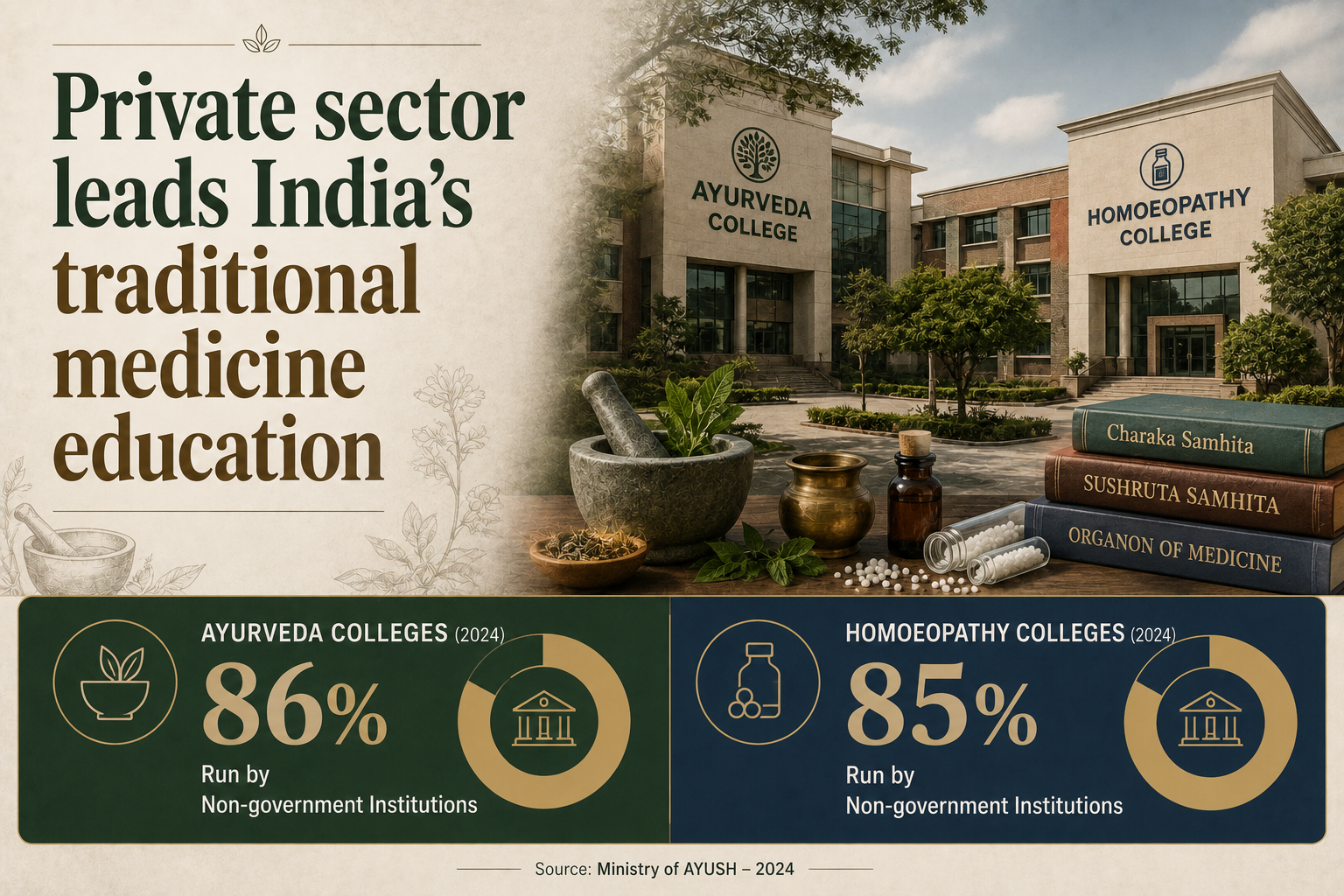
| Question (2024, GS2 – 15 Marks): “In a crucial domain like the public healthcare system, the Indian State should play a vital role to contain the adverse impact of marketisation of the system. Suggest some measures through which the State can enhance the reach of public healthcare at the grassroots level.” Linkage: The fact that non-government institutions account for 85–86% of AYUSH colleges is a stark example of the “marketisation” of healthcare education. The incentive of private players to “maximise student intake without matching increases in faculty and laboratory infrastructure” illustrates the precise “adverse impacts” of market-led growth that the state must step in to regulate. |
Mentor Comment
Non-government institutions accounted for 86 per cent of Ayurveda colleges and 85 per cent of homoeopathy colleges in 2024, according to government data. Permitted seats rose by 43 per cent and total admission capacity by 25 per cent between 2021 and 2024. The Centre’s AYURGYAN allocation for AYUSH education, training, research, innovation and capacity building increased nearly sixfold over the same period, AYUSH being the group of systems covering Ayurveda, Yoga and Naturopathy, Unani, Siddha and Homoeopathy. Through that expansion the sector’s regulators have been denying permissions and grading colleges poorly. The tension is that private led growth carries an incentive to maximise student intake without matching increases in faculty and laboratory infrastructure, and the regulatory answer to it arrives one inspection at a time.
How fast has AYUSH education expanded, and who is running it?
- The private sector runs the great majority of colleges: Non-government institutions accounted for 86 per cent of Ayurveda and 85 per cent of homoeopathy colleges in 2024.
- Seats grew faster than institutions: Permitted seats rose by 43 per cent and total admission capacity by 25 per cent between 2021 and 2024.
- Public funding rose alongside private capacity: The AYURGYAN allocation increased nearly sixfold over the same period.
- The private sector is leading the build out: The expansion of AYUSH medical education infrastructure is being driven by non-government institutions rather than by State run colleges.
Why do the quality questions differ from those in allopathic education?
- The allopathic concern is narrower: Debate there has been confined to whether institutions adequately prepare students for evidence-based practice.
- AYUSH raises two questions at once: The first is the quality of training delivered, and the second is what students are being trained to practise.
- The evidence base is itself in question: Tougher quality control does not settle the separate question of the evidence backing AYUSH medicinal systems.
Do the quality problems predate the current expansion?
- A 2005 audit found widespread deficiencies: The Comptroller and Auditor General found insufficient hospital beds, outpatient services or staff to be widespread among homoeopathy colleges.
- Bed occupancy ranged from 1 per cent to 71 per cent: The same audit recorded that spread across the colleges it examined.
- Faculty shortfalls exceeded half the requirement: A 2020 article in the Journal of Ayurveda and Integrative Medicine reported that many institutions fell short by more than 50 per cent of the teaching staff required by the standards then in force.
What are the regulators finding now?
- The Ayurveda regulator has denied 17 permissions: As of 21 August the National Commission for Indian System of Medicine (NCISM) had listed 17 Ayurveda colleges, all private, whose permissions it had denied.
- Several denials were for obstructing the process itself: The stated reason in several cases was non-compliance with the inspection process.
- The homoeopathy regulator graded 41 per cent of colleges lowest: The National Commission for Homoeopathy placed that share at the bottom grade, including nearly half of all private institutions.
- The recorded failures are specific and repeated: They include inadequate or disputed faculty strength, failures in inspection requirements and student intake numbers, and allegations of fictitious faculty.
What incentive does private led expansion create?
- Intake is the revenue lever: Expansion led by private institutions is accompanied by an incentive to maximise student intake while holding faculty size and laboratory infrastructure at existing levels.
- A court has recorded the practice: The Karnataka High Court in Hillside Ayurveda Medical College (2023) acknowledged that educational institutions are often guilty of admitting excess students for financial gains.
- The regulatory response is retrospective: Permission withheld after an inspection corrects a college that has already been built and has already admitted students.
- Causation is not yet established: It is premature to infer that the rapid expansion has amplified these problems, and the persistent non-compliance is established on its own.
Challenges to regulating AYUSH medical education
- Faculty can be produced on paper: A college can satisfy a faculty norm on inspection day by listing teachers who do not actually teach there. Eg. Aadhaar linked biometric attendance was introduced in allopathic medical colleges precisely because faculty were being shown only for inspections.
The Fix: Extend biometric and payroll linked faculty verification to every AYUSH college and publish the verified roll monthly. - Approval and assessment sit with the same body: A regulator that grants permission to a college also rates it, so a poor rating is a verdict on its own earlier approval. Eg. Allopathic regulation separated the two, creating a distinct Medical Assessment and Rating Board under the National Medical Commission.
The Fix: Split permission and rating into separate boards with published criteria, on the model already used in allopathic regulation. - Seats are cheaper to add than laboratories: Where fees are capped, a college raises revenue by raising intake rather than by improving what it teaches with. Eg. Private professional education in India has produced capitation fee litigation running from T.M.A. Pai Foundation (2002) onward.
The Fix: Link seat sanction to an audited per student cost of teaching and clinical infrastructure rather than to floor space and declared faculty strength. - Clinical exposure is measured by beds, not patients: An attached hospital can meet a bed norm without meeting an occupancy norm, so a student can qualify with very little clinical contact. Eg. Minimum standard requirements for AYUSH colleges specify bed numbers, which a college can satisfy with wards that stay largely empty.
The Fix: Make verified average bed occupancy and outpatient footfall a condition of annual permission renewal. - Efficacy sits outside the regulator’s remit: A regulator can enforce faculty and infrastructure norms without settling whether the therapy being taught works. Eg. Research on Ayurvedic medicine is largely funded and evaluated by the Central Council for Research in Ayurvedic Sciences, a body under the same ministry that promotes the system.
The Fix: Route efficacy trials for AYUSH therapies through independently assessed, pre-registered protocols outside the promoting ministry.
Conclusion
AYUSH education can expand meaningfully only when capacity growth is matched by quality assurance. Stronger faculty verification, independent assessment, outcome based accreditation and evidence based research can ensure that expansion delivers credible, high quality healthcare education.
Back2Basics: National Commission for Indian System of Medicine
- Governing Act: Established under the National Commission for Indian System of Medicine Act, 2020 as the statutory regulator for Indian systems of medicine.
- Predecessor: It replaced the Central Council of Indian Medicine, which had regulated the sector since 1970.
- Jurisdiction: It covers education and practice in Ayurveda, Unani, Siddha and Sowa-Rigpa.
- Structure: It works through autonomous boards handling education standards, assessment and rating of institutions, and ethics and registration of practitioners.
