Mains Ready By December. Smash Mains & Smash PYQ Admissions Open

GS Paper: GS2-01.Indian Constitution-Historical underpinnings & evolution; Features, amendments, significant provisions, basic structure of Constitution

  • Enforcement of the Fundamental Duties

    The Supreme Court has asked the Union and the State governments to respond to a petition to enforce the fundamental duties of citizens, including patriotism and unity of the nation, through comprehensive, well-defined laws.

    What did the plea say?

    • The plea emphasized- the need to enforce FD arises from a new illegal trend of protest by protesters in the garb of freedom of speech and expression.
    • This has been increasingly done by way of blocking of road and rail routes in order to compel the government to meet their demands.

    What are Fundamental Duties?

    • The fundamental duties of citizens were added to the constitution by the 42nd Amendment in 1976, upon the recommendations of the Swaran Singh Committee.
    • It basically imply the moral obligations of all citizens of a country and today, there are 11 fundamental duties in India, which are written in Part IV-A of the Constitution, to promote patriotism and strengthen the unity of India.
    • The FDs obligate all citizens to respect the national symbols of India, including the constitution, to cherish its heritage, preserve its composite culture and assist in its defence.
    • They also obligate all Indians to promote the spirit of common brotherhood, protect the environment and public property, develop scientific temper, abjure violence, and strive towards excellence in all spheres of life.

    Judicial interpretation of FDs

    • The Supreme Court has held that FDs are not enforceable in any Court of Law.
    • It ruled that these fundamental duties can also help the court to decide the constitutionality of a law passed by the legislature.
    • There is a reference to such duties in international instruments such as the Universal Declaration of Human Rights and International Covenant on Civil and Political Rights, and Article 51A brings the Indian constitution into conformity with these treaties.

    Total FDs

    • Originally ten in number, the fundamental duties were increased to eleven by the 86th Amendment in 2002.

    The 10 fundamental duties are as follows:

    1. To oblige with the Indian Constitution and respect the National Anthem and Flag
    2. To cherish and follow the noble ideas that inspired the national struggle for freedom
    3. To protect the integrity, sovereignty, and unity of India
    4. To defend the country and perform national services if and when the country requires
    5. To promote the spirit of harmony and brotherhood amongst all the people of India and renounce any practices that are derogatory to women
    6. To cherish and preserve the rich national heritage of our composite culture
    7. To protect and improve the natural environment including lakes, wildlife, rivers, forests, etc.
    8. To develop scientific temper, humanism, and spirit of inquiry
    9. To safeguard all public property
    10. To strive towards excellence in all genres of individual and collective activities

    The 11th fundamental duty which was added to this list is:

    1. To provide opportunities for education to children between 6-14 years of age, and duty as parents to ensure that such opportunities are being awarded to their child. (86th Amendment, 2002)


    UPSC 2022 countdown has begun! Get your personal guidance plan now! (Click here)
  • Back in debate: Uniform Civil Code

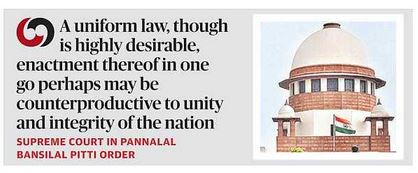
    Poll-bound Uttarakhand CM’s announcement to prepare a draft of the Uniform Civil Code (UCC) in the State, raises questions over whether an individual State can bring its own family law code.

    What is a Uniform Civil Code?

    • A Uniform Civil Code is one that would provide for one law for the entire country, applicable to all religious communities in their personal matters such as marriage, divorce, inheritance, adoption, etc.
    • Article 44, one of the directive principles of the Constitution lays down that the state shall endeavor to secure a Uniform Civil Code for the citizens throughout the territory of India.
    • These, as defined in Article 37, are not justiciable (not enforceable by any court) but the principles laid down therein are fundamental in governance.

    Why need UCC?

    • UCC would provide equal status to all citizens
    • It would promote gender parity in Indian society.
    • UCC would accommodate the aspirations of the young population who imbibe liberal ideology.
    • Its implementation would thus support the national integration.

    Hurdles to UCC implementation

    • There are practical difficulties due to religious and cultural diversity in India.
    • The UCC is often perceived by the minorities as an encroachment on religious freedom.
    • It is often regarded as interference of the state in personal matters of the minorities.
    • Experts often argue that the time is not ripe for Indian society to embrace such UCC.

     UCC vs. Right to Freedom of Religion

    • Article 25 lays down an individual’s fundamental right to religion;
    • Article 26(b) upholds the right of each religious denomination or any section thereof to “manage its own affairs in matters of religion”;
    • Article 29 defines the right to conserve distinctive culture.
    • An individual’s freedom of religion under Article 25 is subject to “public order, health, morality” and other provisions relating to FRs, but a group’s freedom under Article 26 has not been subjected to other FRs.
    • In the Constituent Assembly, there was division on the issue of putting UCC in the fundamental rights chapter. The matter was settled by a vote.
    • By a 5:4 majority, the fundamental rights sub-committee headed by Sardar Patel held that the provision was outside the scope of FRs and therefore the UCC was made less important.

    Enacting and Enforcing UCC: A reality check

    • Fundamental rights are enforceable in a court of law.
    • While Article 44 uses the words “the state shall endeavor”, other Articles in the ‘Directive Principles’ chapter use words such as “in particular strive”; “shall, in particular, direct its policy”; “shall be an obligation of the state” etc.
    • Article 43 mentions “state shall endeavor by suitable legislation” while the phrase “by suitable legislation” is absent in Article 44.
    • All this implies that the duty of the state is greater in other directive principles than in Article 44.

    What are more important — fundamental rights or directive principles?

    • There is no doubt that fundamental rights are more important.
    • The Supreme Court held in Minerva Mills (1980): Indian Constitution is founded on the bedrock of the balance between Parts III (Fundamental Rights) and IV (Directive Principles).
    • To give absolute primacy to one over the other is to disturb the harmony of the Constitution.
    • Article 31C inserted by the 42nd Amendment in 1976, however, lays down that if a law is made to implement any directive principle, it cannot be challenged on the ground of being violative of the FRs under Articles 14 and 19.

    What about Personal Laws?

    • Citizens belonging to different religions and denominations follow different property and matrimonial laws which are an affront to the nation’s unity.
    • If the framers of the Constitution had intended to have a UCC, they would have given exclusive jurisdiction to Parliament in respect of personal laws, by including this subject in the Union List.
    • But “personal laws” are mentioned in the Concurrent List.

    Various customary laws

    • All Hindus of the country are not governed by one law, nor are all Muslims or all Christians.
    • Muslims of Kashmir were governed by a customary law, which in many ways was at variance with Muslim Personal Law in the rest of the country and was, in fact, closer to Hindu law.
    • Even on registration of marriage among Muslims, laws differ from place to place.
    • In the Northeast, there are more than 200 tribes with their own varied customary laws.
    • The Constitution itself protects local customs in Nagaland. Similar protections are enjoyed by Meghalaya and Mizoram.
    • Even reformed Hindu law, in spite of codification, protects customary practices.

    Minority opinion in the Constituent Assembly

    • Some members sought to immunize Muslim Personal Law from state regulation.
    • Mohammed Ismail, who thrice tried unsuccessfully to get Muslim Personal Law exempted from Article 44, said a secular state should not interfere with the personal law of people.
    • B Pocker Saheb said he had received representations against a common civil code from various organizations, including Hindu organizations.
    • Hussain Imam questioned whether there could ever be uniformity of personal laws in a diverse country like India.
    • B R Ambedkar said, “no government can use its provisions in a way that would force the Muslims to revolt”.
    • Alladi Krishnaswami, who was in favor of a UCC, conceded that it would be unwise to enact UCC ignoring strong opposition from any community.
    • Gender justice was never discussed in these debates.

     Conclusion

    • Article 44 of the Constitution creates an obligation upon the State to endeavour to secure for citizens a Uniform Civil Code throughout the country.
    • The purpose behind UCC is to strengthen the object of “Secular Democratic Republic” as enshrined in the Preamble of the Constitution.
    • This provision is provided to effect the integration of India by bringing communities on the common platform on matters which are at present governed by diverse personal laws.
    • Hence UCC should be enforced taking into confidence all the sections of Indian society.
    • Goa’s Portuguese Civil Code of 1867 is an example of a common family law existing in harmony.


    UPSC 2022 countdown has begun! Get your personal guidance plan now! (Click here)

  • What is Habeas Corpus?

    The Supreme Court has decided to examine a habeas corpus plea made by the children of a Pakistan national who they believe has been unlawfully detained for seven years.

    What is Habeas Corpus?

    • Habeas corpus is a recourse in law through which a person can report an unlawful detention or imprisonment to a court.
    • He/she can request that the court order the custodian of the person, usually a prison official, to bring the prisoner to court, to determine whether the detention is lawful.
    • In India the power to issue a writ of habeas corpus is vested only in the Supreme Court and the High Court.
    • Habeas corpus is the writ which was visualized as an effective means to provide a quick remedy to a person who has lost his personal liberty without any legal justification.

    What is Article 32?

    • Article 32 deals with the ‘Right to Constitutional Remedies’, or affirms the right to move the Supreme Court by appropriate proceedings for the enforcement of the rights conferred in Part III of the Constitution.
    • It is one of the fundamental rights listed in the Constitution that each citizen is entitled.
    • It states that the Supreme Court “shall have the power to issue directions or orders or writs for the enforcement of any of the rights conferred by this Part”.
    • The right guaranteed by this Article “shall not be suspended except as otherwise provided for by this Constitution”.
    • Dr B R Ambedkar has called it the very soul and heart of the Constitution. It cannot be suspended except during the period of Emergency.

    Rights protected by A32

    • The article is included in Part III of the Constitution with other fundamental rights including to Equality, Freedom of Speech and Expression, Life and Personal Liberty, and Freedom of Religion.
    • Only if any of these fundamental rights is violated can a person can approach the Supreme Court directly under Article 32.

    Types of Writs under it

    Both the High Courts and the Supreme Court can be approached for violation or enactment of fundamental rights through five kinds of writs:

    1. Habeas corpus (related to personal liberty in cases of illegal detentions and wrongful arrests)
    2. Mandamus — directing public officials, governments, courts to perform a statutory duty;
    3. Quo Warranto — to show by what warrant is a person holding public office;
    4. Prohibition — directing judicial or quasi-judicial authorities to stop proceedings which it has no jurisdiction for; and
    5. Certiorari — re-examination of an order given by judicial, quasi-judicial or administrative authorities.
    • In civil or criminal matters, the first remedy available to an aggrieved person is that of trial courts, followed by an appeal in the High Court and then the Supreme Court.
    • When it comes to violation of fundamental rights, an individual can approach the High Court under Article 226 or the Supreme Court directly under Article 32.


    Try this PYQ:

    Q.Which of the following is included in the original jurisdiction of the Supreme Court?

    1. Dispute between the Government of India and one or more States
    2. A dispute regarding elections to either House of the parliament or that of Legislature of a State
    3. A dispute between the Government of India and Union Territory
    4. A dispute between two or more States.

    Select the correct answer using the codes given below:

    (a) 1 and 2

    (b) 2 and 3

    (c) 1 and 4

    (d) 3 and 4


    [wpdiscuz-feedback id=”51sls4efy5″ question=”Please leave a feedback on this” opened=”1″]Post your answers here.[/wpdiscuz-feedback]


    UPSC 2022 countdown has begun! Get your personal guidance plan now! (Click here)

  • Central Media Accreditation Guidelines 2022

    The Centre has issued a new policy on the accreditation of journalists, introducing an entire section about reasons that can result in the suspension of the accreditation.

    What is the Policy for Accreditation?

    • The new policy lays down guidelines on how PIB accreditation will be granted to eligible journalists.
    • It is prepared by the Ministry of Information and Broadcasting (I&B) and issued by the Press Information Bureau.
    • At the moment there are 2,457 PIB-accredited journalists in the country.

    Conditions laid

    • For the first time, it specifies conditions that can result in the journalist losing accreditation.
    • The new policy has ten points that may result in the accreditation being canceled, including if a journalist is charged with a “serious cognizable offense”.
    • If a journalist acts in a manner that is prejudicial to the following conditions, his/ her accreditation can be canceled:
    1. Sovereignty and integrity of India
    2. Security of the nation
    3. Friendly relations with foreign states
    4. Public order
    5. Decency or morality or
    6. Defamation or incitement of an offense
    7. In relation to Contempt of Court
    • Accreditation is also liable to be withdrawn/suspended if it is found to have been misused.

    Who is eligible for accreditation?

    • Applications for accreditation are vetted by a Central Press Accreditation Committee headed by the DG, PIB.
    • After a journalist applies, a mandatory security check is conducted by the Home Ministry, which includes police verification of the journalist’s residence.

    (1) Journalists

    • But a journalist needs to have a minimum of five years of professional experience as a full-time working journalist or a cameraperson in a news organization, or a minimum of 15 years as a freelancer to become eligible.
    • Veteran journalists, with over 30 years of experience, and who are older than 65 years of age, too are eligible.
    • Accreditation is only available for journalists living in the Delhi NCR region.
    • Similar rules apply to foreign news organizations and foreign journalists.

    (2) Newspapers

    • A newspaper or a periodical needs to have a minimum daily circulation of 10,000, and news agencies must have at least 100 subscribers.

    (3) Digital platforms and others

    • The policy has introduced a provision that journalists working with digital news platforms are also eligible, provided the website has a minimum of 10 lakh unique visitors per month.

    How does accreditation help?

    • Professional status: The policy mentions that the accreditation does not “confer any official or special status” on the journalists, but only recognizes them as “professional working journalists”.
    • Reporting important offices: In certain events where VVIPs or dignitaries such as the President, the Vice President, or the Prime Minister are present, only accredited journalists are allowed to report from the premises.
    • Source Identity: Accreditation ensures that a journalist is able to protect the identity of his or her sources.
    • Authencity: An accredited journalist does not have to disclose who he or she intends to meet when entering offices of union ministries, as the accreditation card is valid for entry.
    • Perks and benefits: Accreditation brings certain benefits for the journalist and his or her family, like being included in the Central Government Health Scheme, and some concessions on railway tickets.

    What concerns does this raise?

    • Intimidation: This could result, at times, in such powers trying to intimidate journalists or to block information from coming out.
    • Alleged defamation: A common tool used by powerful people is filing of defamation cases against journalists and media platforms.
    • Prevents constructive criticism: Journalists often report on issues and policy decisions that the government may not like.
    • Subjectivity of criteria: The new policy’s provision about acting “in manner which is prejudicial to the sovereignty and integrity of India can be subjective.
    • No watchdog: The policy is silent on who will decide if a journalist’s conduct violates any of these conditions.
    • Media trials: Any investigative story on sensitive issues could be held to be in violation of any of these provisions.


    UPSC 2022 countdown has begun! Get your personal guidance plan now! (Click here)

  • India Press Freedom Report, 2021

    The India Press Freedom Report, 2021was recently released by the Rights and Risks Analysis Group (RRAG).

    India Press Freedom Report, 2021: Key Highlights

    • Jammu and Kashmir, Uttar Pradesh, Madhya Pradesh and Tripura topped the list of States and Union Territories where journalists and media houses were targeted in 2021.
    • It is followed by Delhi (8), Bihar (6), Assam (5), Haryana and Maharashtra (4 each), Goa and Manipur (3 each), Karnataka, Tamil Nadu and West Bengal (2 each), and Andhra Pradesh, Chhattisgarh and Kerala (1each).
    • While J&K recorded the maximum attacks by State actors, Tripura had the most cases of attacks by non-State actors, the analysis of data showed.

    Significance of the report

    • The widespread attacks on the press freedom are an indicator of the continuing deterioration of civic space in the country.
    • It represents the status of free speech exercised in our country.


    UPSC 2022 countdown has begun! Get your personal guidance plan now! (Click here)

  • States must decide on SC/ST quota in promotions: Supreme Court

    The Supreme Court has refused to lay down the criteria for determining the inadequacy of representation for granting reservation in promotions for Scheduled Caste and Scheduled Tribe candidates in government jobs.

    What did the court held?

    • The court stuck firm by the decisions of its Constitution Benches in the Jarnail Singh and M. Nagaraj case that the question of adequate representation of SC/ST communities ought to be left to the respective States to determine.
    • It held ‘cadre’, and not class or group or the entire service, as the unit for the purpose of collection of quantifiable data for giving promotion quotas.

    Why such decision?

    • Determination of inadequate representation depends upon myriad factors of states which this Court cannot envisage.
    • Laying down of criteria for determining the inadequacy of representation would result in curtailing the discretion given to the State governments.

    Quota in Promotions: A timeline

    What was the case?

    • The Union government has been pressing for reservation in promotion proportionate to the population of SCs and STs as per a 1995 judgment by the top court in the RK Sabharwal case.
    • It wants it to be left open to the Centre and states to decide on promotional avenues for SCs and STs.
    • It claims that the condition regarding the collection of quantifiable data to show the inadequacy of representation of SCs/STs is “vague”.
    • Advocates representing the general category have contended that the reservation cannot be for an indefinite period and that it must stop as soon as the upper ceiling has been reached.
    • Further, they have emphasized that reservation in promotion should be cadre-based only after quantifiable data is collected and the creamy layer has been excluded.

    Defying the need for quantifiable data

    • Attorney General sought to convince the court that the roster system, based on the proportionate population of SCs/STs, has been working quite well in all government departments.
    • The condition of collecting quantifiable data on inadequacy of representation of SCs/STs may not be required at all.
    • He urged that there is no need to verify any further or collect quantifiable data after the roster system.

    What is the Nagraj Case?

    • Article 16(4A) of Indian Constitution allows reservations to SCs and STs in promotions, as long as the government believes that they are not adequately represented in government services.
    • In 2006, a Constitution bench’s ruling in the M Nagaraj case made it incumbent upon the state to collect quantifiable data showing inadequacy of representation in public employment.
    • This was to be done in addition to maintaining overall administrative efficiency.

    Related amendments

    • 77th Amendment: It introduced Clause 4A to the Constitution, empowering the state to make provisions for reservation in matters of promotion to SC/ST employees if the state feels they are not adequately represented.
    • 81st Amendment: It introduced Clause 4B, which says unfilled SC/ST quota of a particular year, when carried forward to the next year, will be treated separately and not clubbed with the regular vacancies of that year to find out whether the total quota has breached the 50% limit set by the Supreme Court.
    • 82nd Amendment: It inserted a proviso at the end of Article 335 to enable the state to make any provision for SC/STs “for relaxation in qualifying marks in any examination or lowering the standards of evaluation, for reservation in matters of promotion to any class or classes of services or posts in connection with the affairs of the Union or of a State”.
    • 85th Amendment: It said reservation in the promotion can be applied with consequential seniority for the SC/ST employee.

    Why such demand for quotas in promotion?

    • The Attorney General has said that it is tough for a member of the SC/ST to reach the ‘Group A’ category jobs.
    • The time has come for the apex court to firm up and draw the basis for reservation in promotions for SC/ST candidates to fill up vacancies in top jobs.
    • The Bench referred to records filed before it to note that there was low representation of SC/ST category in Group A jobs.
    • Instead of improving the situation in the Group A ranks, the court said, efforts are on to ensure adequate representation in Groups B and C.
    • This was not fair, it remarked.


    UPSC 2022 countdown has begun! Get your personal guidance plan now! (Click here)

  • Govt tweaks spending norms for Contingency Fund of India

    The government has tweaked spending norms for Contingency Fund of India, allowing 40% of the total corpus to be placed at disposal of the Expenditure Secretary.

    What are the proposed changes?

    • Budget 2021-22 proposed to enhance the Contingency Fund of India from ₹500 crore to ₹30,000 crore through Finance Bill.
    • An amount equivalent to 40 per cent of the Fund corpus shall be placed at the disposal of the Secretary, Ministry of Finance, Department of Expenditure.
    • This would serve the purpose of meeting unforeseen expenditure.

    What is Contingency Fund of India?

    • Contingency is a negative event which may occur in future, like recession or pandemic.
    • The Constitution has a provision for a contingency fund. Its corpus is always kept intact.
    • Article 267 of the Constitution mandates formation of a corpus under Contingency Fund of India to deal with any emergency situation.
    • It is placed at the disposal of the President of India.
    • Government cannot withdraw funds from it without authorization of the Parliament.
    • And the corpus has to be replenished with the same amount later.

    Management of the fund

    • The fund is held by the Department of Economic Affairs on behalf of the President of India and it can be operated by executive action.
    • The fund can be increased through a Finance Bill when Parliament is in the session.
    • Or through Ordinance if the House is not in session and situation warrants.
    • Withdrawal from the fund takes place with the approval of the Secretary of Department of Economic Affairs, in terms of the Contingency Fund of India Act, 1950.
    • An amount equivalent to 40% of the corpus has now been placed at the disposal of the Expenditure Secretary.
    • All further Contingency Fund releases beyond this limit will require the approval of the Expenditure Secretary in addition to the Economic Affairs Secretary’s approval.

    Back2Basics:

    Consolidated Funds of India

    • The provision for this fund is given in Article 266(1) of the Constitution of India.
    • The government meets all its expenditure from this CFI.
    • It receives money from:
    1. Direct and indirect taxes Loans taken by the Indian government
    2. Returning of loans/interests of loans to the government by anyone/agency that has taken it
    • The government needs parliamentary approval to withdraw money from this fund.
    • Each state has its own Consolidated Fund of the state with similar provisions.
    • The Comptroller and Auditor General of India audits these funds and reports to the relevant legislatures on their management.

    Public Account of India

    • All other public money (other than those covered under the Consolidated Fund of India) received by or on behalf of the Indian Government are credited to this account/fund.
    • It is constituted under Article 266(2) of the Constitution.
    • This is made up of:
      1. Bank savings account of the various ministries/departments
      2. National small savings fund, defense fund
      3. National Investment Fund (money earned from disinvestment)
      4. National Calamity & Contingency Fund (NCCF) (for Disaster Management)
      5. Provident fund, Postal insurance, etc.
      6. Similar funds
    • The government does not need permission to take advances from this account.
    • Each state can have its own similar accounts.
    • CAG makes audit of all the expenditure from the Public Account of India.


    UPSC 2022 countdown has begun! Get your personal guidance plan now! (Click here)

  • The strength of our republic

    Context

    A republic is made robust and kept alive by its people. In its current form, the Indian republic marks 73 years of maintaining a dynamic balance.

    Directly elected representation

    •  It is to the credit of our people that today we have a pyramidal three-layered elected representative system that governs us.
    • This system today has over 3 million elected representatives (a million of them women), over 4,000 elected to the state legislatures and over 500 in the Parliament.
    • This scale of directly elected representation, perhaps, can be seen nowhere else in the world.

    Moral and spiritual basis of the Constitution

    • In Pilgrimage to Freedom, K M Munshi writes, “our Constitution has a moral background — to secure justice for every section of our society; as also a spiritual basis — to preserve and protect all religions in the exercise of their functions”.
    • The challenges continue in securing justice for every section of our society.
    • The Backward Classes, the Scheduled Castes and the Scheduled Tribes and the poor across all categories clamour for better opportunities and affordable justice.
    • What Munshi calls the spiritual basis of our Constitution in having to preserve and protect all religions is also seen under stress.
    • When the right to practise one’s religion is denied or threatened, the silence of the thinking public or the media weakens that constitutionally embedded protection.

    Challenges posed by social media

    • Through the power of technology and its capacity to broadcast at mass scale, an otherwise useful tool, social media, has become a challenge and sometimes a threat to one or several of the rights enshrined in our Constitution.
    • Curtailing them to protect the rights of citizens is seen as trampling upon the right to free speech.
    • Without any action, the damage caused to social harmony by such rampant false news can result in people losing faith in the Constitution itself.

    Constitution as a living, dynamic process

    • Our Constitution is the most amended of all constitutions in the world.
    • If there are more than 100 amendments made to the Constitution, there are more than 1,500 laws that have been repealed because they have outlived their times.
    • These deadwood laws, by remaining on paper, occasionally became a weapon in the hands of rent-seekers.
    • Their removal, as a part of administrative reform, has kept the role of the executive transparent and accountable.
    • That the Constitution is always evolving is best exemplified by the 101st amendment which rolled out the Goods and Services Tax.
    • his amendment brought in a unified indirect tax regime by subsuming most of the indirect taxes of the Centre and the states.
    • Yet to complete five full years, the GST Council has stood the test of challenging times even in its initial years.
    • It augurs well for cooperative federalism.

    Conclusion

    Our Constitution has served us well in these seven decades. Several republics in the post-imperial era have rejected their earlier constitutions and tested new ones. It is the people who can keep the republic robust and alive.

    UPSC 2022 countdown has begun! Get your personal guidance plan now! (Click here)

  • The Question of OBC Reservation in Local Bodies

    The latest order in Rahul Ramesh Wagh v. State of Maharashtra &Ors makes it mandatory that the principles laid down by the Supreme Court for providing reservation to OBCs in local bodies shall be followed across the country.

    Let us understand the Case

    • Maharashtra had constituted a Commission to ascertain the backwardness of OBCs in June 2021.
    • But without waiting for an empirical report, an ordinance was promulgated to amend the Maharashtra Zilla Parishads Act, Panchayat Samitis Act and the Maharashtra Village Panchayat Act.
    • They were aimed to conduct local body elections with OBC reservation.
    • This was struck down by the Supreme Court.

    The latest case arose out of the challenge made to the ordinance promulgated on the teeth of the Supreme Court judgments by the Governor of Maharashtra to conduct the local body elections by providing 27% reservation to OBCs.

    What did the SC observe now?

    • Reservation to OBCs in local body elections without empirical base can no more be sustainable in law.
    • The latest order in RR Wagh v. State of Maharashtra & others makes it mandatory that the principles laid down by the Supreme Court for providing reservation to OBCs in local bodies shall be scrupulously followed across the country.

    Which principles is the apex court talking about?

    • A five-judge Constitution Bench in the K. Krishnamurthy (Dr.) v. Union of India (2010) judgment said that barriers to political participation are not the same as barriers to education and employment.
    • Though reservation to local bodies is permissible, the top court declared that the same is subject to three conditions:
    1. to set up a dedicated Commission to conduct empirical inquiry into the nature of the backwardness in local bodies
    2. to specify the proportion of reservation required to be provisioned local body-wise
    3. such reservation shall not exceed aggregate of 50% cap of the total seats reserved for SCs/STs/OBCs taken together
    • This is famously referred as ‘Triplet Test’.

    Major takeaways of K. Krishnamurthy Case

    In this case, the Supreme Court had interpreted Article 243D(6) and Article 243T(6), which permit reservation by enactment of law for backward classes in local bodies respectively.

    • It held that barriers to political participation are not the same as that of the barriers that limit access to education and employment.
    • However, for creating a level playing field, reservation may be desirable as mandated by the aforementioned conditions.
    • Above articles provide a separate constitutional basis for reservation, as distinct from what are conceived under Article 15 (4) and Article 16 (4) which form the basis for reservation in education and employment.

    Reception of the Krishnamurthy Judgment

    • The Indian political class usually displays apathy to the law declared by the courts as contrary to the enacted law.
    • The 2010 judgment was not acted upon and the constitutionality of the enacted reservation was challenged.
    • This resulted in the 2021 judgment of a three-judge Bench of the Supreme Court.

    What can be concluded from the aspirant’s perspective?

    • Maharashtra Legislative Assembly passed a resolution to stall the local body elections in the wake of the judicial interference.
    • Elections, undoubtedly, must be held on time.
    • Since Judiciary does not usually interfere into Elections, States often seek to bypass the OBC reservation issues.

    Conclusion

    • Had the governments stuck to the law as mandated by Article 141 of the Constitution, this quandary wouldn’t have arisen.
    • Much of the judiciary’s time could have been saved.
    • Rule of law is not just a set of letters, but it has to be followed in spirit.

    Back2Basics: Article 141 of the Constitution

    • It stipulates that the law declared by the Supreme Court shall be binding on all Courts within the territory of India.
    • Thus, the general principles laid down, by the Supreme Court are binding on each individual including those who are not a party to an order.


    UPSC 2022 countdown has begun! Get your personal guidance plan now! (Click here)

  • How the Seventh Schedule affects delivery of public goods

    Context

    Without delegation of funds, functions and functionaries, local governments are unable to respond to pressure from citizens who demand greater efficiency.

    Background of the Seventh Schedule

    •  Article 246 of the Constitution mentions three lists in the Seventh Schedule — union, state and concurrent lists.
    • The present Seventh Schedule and union (at that time Federal) list, state (at that time Provincial) list and concurrent lists are inherited from that 1935 piece of legislation.
    • It states that “Notwithstanding anything in the two next succeeding subsections, the Federal Legislature has, and a Provincial Legislature has not, power to make laws with respect to any of the matters enumerated in List I in the Seventh Schedule to this Act.”

    Delivery of public goods

    • Ignoring that narrow and technical definition of public good, loosely, we understand “public good” as something that must be delivered by the government.
    • It cannot, or should not, be delivered by the private sector.
    • Notwithstanding the use of private security guards, most people will agree “law and order” is a public good.
    • Most public goods people will think of are efficiently delivered at the local government level, not Union or state level.
    •  There is a Seventh Schedule issue that is thus linked to the insertion of a local body list.
    • Countervailing pressure by citizens increasingly demands efficient delivery of such public goods.
    • But without delegation of funds, functions and functionaries, presently left to the whims of state governments, local governments are unable to respond.

    Need for the review of the Seventh Schedule Lists

    • No local body list: Most public goods people will think of are efficiently delivered at the local government level, not Union or state level.
    • There is a Seventh Schedule issue that is thus linked to the insertion of a local body list.
    •  But without delegation of funds, functions and functionaries, presently left to the whims of state governments, local governments are unable to respond.
    • The Rajamannar Committee — formally known as Centre-State Relations Inquiry Committee suggested constitution of a High Power Commission to examine the entries of Lists I and III in the Seventh Schedule to the Constitution and suggest redistribution of the entries,”.
    • Changes in the past led to greater centralisation: Items have moved from the state list to the concurrent list and from the concurrent list to the union list.
    • Such limited movements have reflected greater centralisation, such as in 1976.
    •  N K Singh, Chairman of 15th Finance Commission has also often made this point, in addition to scrutiny of Article 282.

    Conclusion

    For the sake of better governance, it’s not an issue that should be ducked and the basic structure doctrine doesn’t stand in the way.

    UPSC 2022 countdown has begun! Get your personal guidance plan now! (Click here)