Mains Ready By December. Smash Mains & Smash PYQ Admissions Open

GS Paper: GS2-01.Indian Constitution-Historical underpinnings & evolution; Features, amendments, significant provisions, basic structure of Constitution

  • President has no role to play in Perarivalan’s plea: SC

    The Supreme Court has disagreed with the Central government’s suggestion that the court should wait till the President took a call on former PM’s assassination case convict A.G. Perarivalan’s mercy plea referred to him by the Tamil Nadu Governor for a decision.

    Why in news now?

    • The Bench of the Supreme Court said that the Centre had missed the obvious question posed by the court by a mile.
    • The pertinent question was whether the Governor had, in the first place, the authority to refer the mercy plea to the President.
    • Under Article 161 of the Constitution, the Governor was bound by the aid and advice given by the TN Council of Ministers in September 2018.
    • The Governor prima facie had no authority to transfer the mercy plea to the President.

    What does Pardon mean?

    • A pardon is a government/executive decision to allow a person to be absolved of guilt for an alleged crime or other legal offense as if the act never occurred.

    Why need a Pardon?

    • Pardons can be granted when individuals are deemed to have demonstrated that they have “paid their debt to society”, or are otherwise considered to be deserving of them.
    • Pardons are sometimes offered to persons who were either wrongfully convicted or who claim that they were wrongfully convicted.
    • Pardons are sometimes seen as a mechanism for combating corruption, allowing a particular authority to circumvent a flawed judicial process to free someone that is seen as wrongly convicted.

    What does Article 161 say?

    • Article 161 of the Constitution provides the Governor with the power to remit or commute the sentence of any prisoner.
    • The Governor’s decision will be subject to judicial review by the constitutional courts.

    Supreme court’s observations

    • The Constitution Bench in 2015, in a majority decision, had held that the States cannot unilaterally remit the sentences of life convicts in cases investigated by a Central agency under a Central law.
    • The assassination case was probed by the CBI.
    • In compliance with the 2015 verdict, the Tamil Nadu government wrote to the Centre in 2016, proposing the grant of remission to the convicts. The State wanted the Centre to concur.
    • After a wait of over two years, the Centre rejected the State’s proposal, saying this was an unparalleled act in the annals of crimes committed in this country.

    Arguments in Perarivalan’s petition seeking pardon

    • Perarivalan had been pleading for release citing that he was 19 when he was arrested.
    • He was the only male child of his parents, there were no records of criminal antecedents, and that he had excellent conduct in his entire prison life.
    • His petition also cited UG and PG degrees, and that he was the university topper, Gold medalist in diploma in DTP, and that he completed more than eight diploma and certificate courses during his prison term.
    • His probation officer gave a report about lapses in recording his confession statement that handed out maximum punishment in his case.

    Basis of his innocence

    • Perarivalan cannot be called innocent before the law as he continues to be a convicted prisoner serving imprisonment.
    • He was accused of having bought two battery cells for the LTTE man who masterminded the conspiracy.
    • He was sentenced to death based on this crucial confession statement.

    Significance of the convicts’ release

    • The release of seven convicts is a demand raised by not only the ruling party of TN but the main opposition too.
    • All TN politicians voiced that the judiciary should be able to reform and let them live as good citizens to uphold the high values of reformatory justice and restitution.

    Back2Basics: Pardoning Powers in India

    • Under the Constitution of India (Article 72), the President of India can grant a pardon or reduce the sentence of a convicted person, particularly in cases involving capital punishment.
    • A similar and parallel power vests in the governors of each state under Article 161.

    (1) President

    • Article 72 says that the president shall have the power to grant pardons, reprieves, respites or remissions of punishment or to suspend, remit or commute the sentence of any person convicted of any offence.
    • The pardoning powers of the Indian President are elucidated in Art 72 of the Indian Constitution. There are five different types of pardoning which are mandated by law.
    1. Pardon: means completely absolving the person of the crime and letting him go free. The pardoned criminal will be like a normal citizen.
    2. Commutation: means changing the type of punishment given to the guilty into a less harsh one, for example, a death penalty commuted to a life sentence.
    3. Reprieve: means a delay allowed in the execution of a sentence, usually a death sentence, for a guilty person to allow him some time to apply for a Presidential Pardon or some other legal remedy to prove his innocence or successful rehabilitation.
    4. Respite: means reducing the quantum or degree of the punishment to a criminal in view of some special circumstances, like pregnancy, mental condition etc.
    5. Remission: means changing the quantum of the punishment without changing its nature, for example reducing twenty-year rigorous imprisonment to ten years.

    (2) Governor

    • As per Article 161, the Governor of a State has the power to grant pardons, reprieves, respites or remissions of punishment or to suspend, remit or commute the sentence of any person convicted of any offence against any law.
    • It must be relating to a matter to which the executive power of the state extends.
    • Please note that President can grant pardon to a person awarded death sentence. But a governor of a state does not enjoy this power.


    UPSC 2023 countdown has begun! Get your personal guidance plan now! (Click here)
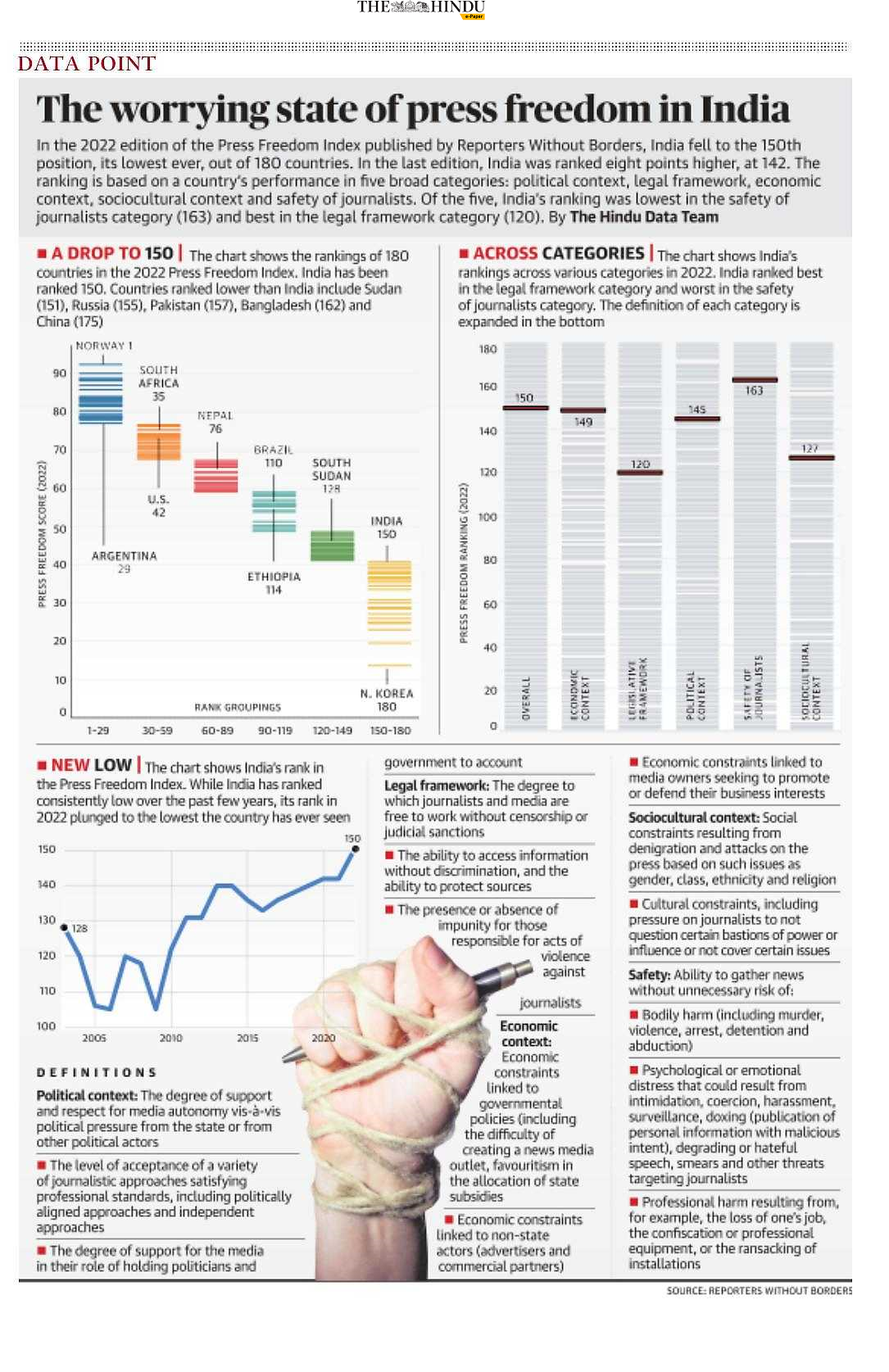
  • India slips to 150 in Press Freedom Index

    India has reached 150th position in the World Press Freedom Index, dropping further from its last year’s 142nd rank out of 180 countries.

    What is Press Freedom Index?

    • The PFI is an annual ranking of countries compiled and published by Reporters Without Borders since 2002.
    • It is based upon the organisation’s own assessment of the countries’ press freedom records in the previous year.
    • It intends to reflect the degree of freedom that journalists, news organisations, and netizens have in each country, and the efforts made by authorities to respect this freedom.
    • It does not measure the quality of journalism in the countries it assesses, nor does it look at human rights violations in general.

    Highlights of the 2022 report

    (a) Best performing countries

    • Norway– 1st
    • Denmark– 2nd
    • Sweden– 3rd
    • Estonia– 4th
    • Finland– 5th

    (b) Worst performers

    • North Korea remained at the bottom of the list, while Russia was placed at 155th position, slipping from 150th last year.
    • As per the global media watchdog, China climbed up by two positions ranking at 175th position, as compared to 177th position last year.

     (c) Performance in our neighbourhood

    • Besides India, its neighbours except Nepal have also slid down.
    • While Pakistan is at 157th position, Sri Lanka ranks at 146th, Bangladesh at 162nd and Maynmar at 176th position.

    Back2Basics: Freedom of Press and Constitutional Provisions

    • The Supreme Court in Romesh Thappar v. the State of Madras, 1950 observed that freedom of the press lay at the foundation of all democratic organisations.
    • It is guaranteed under the freedom of speech and expression under Article 19, which deals with ‘Protection of certain rights regarding freedom of speech, etc.
    • Freedom of the press is not expressly protected by the Indian legal system but it is impliedly protected under article 19(1) (a) of the constitution.
    • The freedom of the press is also not absolute.

    Reasonable restrictions

    • A law could impose only those restrictions on the exercise of this right, it faces certain restrictions under article 19(2), which is as follows:
    1. Sovereignty and integrity of India
    2. Security of the State,
    3. Friendly relations with foreign States
    4. Public order, decency or morality
    5. Contempt of court
    6. Defamation
    7. Incitement to an offence


    UPSC 2023 countdown has begun! Get your personal guidance plan now! (Click here)

  • The Debate on National Language

    Remarks by a Hindi actor to the effect that Hindi is the national language of India has sparked controversy recently over the status of the language under the Constitution.

    What is the status of Hindi?

    • Under Article 343 of the Constitution, the official language of the Union shall be Hindi in Devanagari script.
    • The international form of Indian numerals will be used for official purposes.

    The debate

    • Inherent opposition to Hindi: The Constituent Assembly was bitterly divided on the question, with members from States that did not speak Hindi initially opposing the declaration of Hindi as a national language.
    • Colonial footprints of English: Proponents of Hindi were insistent that English was the language of enslavement and that it should be eliminated as early as possible.
    • Fear of Hindi imposition: Opponents were against English being done away with, fearing that it may lead to Hindi domination in regions that did not speak the language.
    • Inefficacy of Sanskrit: There were demands to make Sanskrit the official language, while some argued in favour of ‘Hindustani’.
    • Issue over Script: There were differences of opinion over the script too. When opinion veered towards accepting Hindi, proponents of the language wanted the ‘Devanagari’ script to be adopted both for words and numerals.

    Major outcome: No national language

    • It was decided that the Constitution will only speak of an ‘official language’.
    • And that English would continue to be used for a period of 15 years.
    • The Constitution said that after 15 years, Parliament may by law decide on the use of English and the use of the Devanagari form of numbers for specified purposes.

    What is the Eighth Schedule?

    • The Eighth Schedule contains a list of languages in the country. Initially, there were 14 languages in the schedule, but now there are 22 languages.
    • There is no description of the sort of languages that are included or will be included in the Eighth Schedule.

    Constitutional position of Eighth Schedule

    There are only two references to these languages in the text of the Constitution.

    (i) Article 344(1):

    • It provides for the formation of a Commission by the President, which should have a Chairman and members representing these scheduled languages.
    • The purpose of the Commission is to make recommendations for the progressive use of Hindi for official purposes of the Union and for restricting the use of English.

    (ii) Article 351:

    • It says it is the Union government’s duty to promote the spread of Hindi so that it becomes “a medium of expression for all elements of the composite culture of India”.
    • It also aims to assimilate elements of forms and expressions from Hindustani and languages listed in the Eighth Schedule.

    What were the 1965 protests about?

    • The Official Languages Act, 1963 was passed in anticipation of the expiry of the 15-year period during which the Constitution originally allowed the use of English for official purposes.
    • Its operative section provided for the continuing use of English, notwithstanding the expiry of the 15-year period.
    • Jawaharlal Nehru had given an assurance in 1959 that English would remain in official use and as the language of communication between the Centre and the States.
    • The Official Languages Act, 1963, did not explicitly incorporate this assurance, causing apprehensions in some States as the January 1965 deadline neared.
    • At that time, PM Lal Bahadur Shastri reiterated the government’s commitment to move towards making Hindi the official language for all purposes.

    TN loops in the agitation

    • In Tamil Nadu, then known as Madras, the prospect of the use of Hindi as the medium of examination came due to recruitment examination of union.
    • It created an apprehension that Hindi would be imposed in such a way that the future employment prospects of those who do not speak Hindi will be bleak.

    Creating an exception for Tamil Nadu

    • With the Congress government in the State taking the view that the people had nothing to fear about, protests broke out in January 1965.
    • It took a violent turn after more and more student activists joined the protest, and continued even after key Dravida Munnetra Kazhagam (DMK) leaders were arrested.
    • More than 60 people died in police firing and other incidents as the protests went on for days.
    • The agitation died down later, but by then the Congress at the Centre realised the sensitivity of the language issue among Tamil-speaking people.
    • When the Official Language Rules were framed in 1976, it was made clear that the Rules apply to the whole of India, except Tamil Nadu.

    What is the three-language formula?

    • Since the 1960s, the Centre’s education policy documents speak of teaching three languages — Hindi, English and one regional language in Hindi-speaking States, and Hindi, English and the official regional language in other States.
    • In practice, however, only some States teach both their predominant language and Hindi, besides English.
    • In States where Hindi is the official language, a third language is rarely taught as a compulsory subject.
    • Tamil Nadu has been steadfastly opposing the three-language formula and sticks to teaching Tamil and English.
    • It argues that those who need to know Hindi can learn on their own.


    UPSC 2023 countdown has begun! Get your personal guidance plan now! (Click here)

  • Quasi-Federalism in India

    This newscard is an excerpt from the original article published in the TH.

    Why in news?

    • The contemporary discourse on federalism in India is moving on a discursive across multiple dimensions, be it economic, political and cultural,
    • It is argued that India is at an inflection point vis-a-vis Centre-State relations owing to increasing asymmetry.

    What is Federalism?

    • Federalism is a system of government in which the power is divided between a central authority and various constituent units of the country.
    • This vertical division of power among different levels of governments is referred to as federalism.
    • Federalism is one of the major forms of power-sharing in modem democracies.

    Indian case: Federal, quasi-federal or hybrid?

    • India consciously adopted a version of federalism that made the Union government and State governments interdependent on each other (latter more vis-a-vis the former).

    The federal features of the Constitution of India are:

    • Written Constitution: Features of the Indian Constitution is not only a written document but also the longest constitution in the world. Originally, it included a Preamble, 395 articles (22 parts), and 8 schedules.
    • Dual Polity: The constitution establishes a dual polity that includes the union at the periphery. Each is endowed with sovereign powers to be exercised in the field assigned to them respectively by the Constitution.
    • Bicameralism: The constitution provides for a bicameral legislature in which an upper house (Rajya Sabha) and a lower house (Lok Sabha). Rajya Sabha represents the states of the Indian Union, whereas The Lok Sabha represents the people of India as a whole.
    • Division of Powers: The Constitution divided the powers between the Center and the states in terms of the Union List, State List, and Concurrent List in the Seventh Schedule.
    • Supremacy of the Constitution: The Constitution is the supreme law of the country. The laws made by the Center and the states should be in conformity with Provision. Otherwise, they may be declared invalid by the Supreme or High Court through its power of judicial review.
    • Rigid Constitution: The division of powers established by the Constitution as well as supremacy of the constitution can be maintained only if the method of its amendment is rigid. It is necessary for both houses to agree to amend the constitution.
    • Independent judiciary: The constitution establishes an independent judiciary headed by the Supreme Court for two purposes: one, to protect the supremacy of the constitution, and two, to settle the disputes between the Centre and states or between the states.

    Besides the above federal features, the Indian constitution also possesses the following unitary features:

    • Strong Centre: The division of powers is in favour of the centre and unequal from a federal point of view. Firstly, the Union list contains more subjects than the state list, secondly, the more important subjects have been included in the union list and the Centre has overriding authority over the concurrent list.
    • Single constitution: The constitution of India embodies not only the constitution of the Centre but also those of the states. Both the Centre and the States must operate within this single frame.
    • Destructible nature of states: Unlike in other federations, the states in India have no right to territorial integrity. The parliament can change the area, boundaries, or name of any state.
    • Emergency provisions: The emergency provisions are contained in Part XVIII of the Constitution of India, from Articles 352 to 360. In the emergency provisions, the central government becomes all-powerful and the states go into total control of the Centre.
    • Single citizenship: Single citizenship means one person is the citizenship of the whole country. The constitution deals with citizenship from Articles 5 and 11 under Part 2.
    • All India services: In India, there are all India services (IAS, IPS and IFS) which are common to both the Centre and the states. These services violate the principle of federalism under the constitution.
    • Appointment of governor: The governor is appointed by the president. He also acts as an agent of the Centre. Through him, the Centre exercises control over the states.
    • Integrated election machinery: The election commission conducts elections for central and state legislatures. But the Election commission is constituted by the president and the states have no say in this matter.
    • Equality (= Equity) of representation: The states are given representation in the upper house on the basis of population. Hence, the membership varies from 1 to 31.
    • Integrated Judiciary: The term Integrated Judiciary refers to the fact that rulings made by higher courts bind lower courts. The Supreme Court of India incorporates all lower courts, from the Gram Panchayat to the High Courts. The Supreme Court is at the very top.
    • Union veto over State Bills:  The governor has the authority to hold certain sorts of laws passed by the state legislature for presidential consideration. The President has the authority to refuse to sign such bills not only in the first instance but also in the second.

    Reasons for a centralised federal structure

    There are at following reasons that informed India’s choice of a centralised federal structure.

    1. Partition of India and the concomitant concerns: The 1946 Objectives Resolution introduced by Nehru in the Assembly were inclined towards a decentralised federal structure wherein States would wield residuary powers.
    2. Reconstitution of social relations in a highly hierarchical and discriminatory society: The centralised structure would unsettle prevalent trends of social dominance, help fight poverty better and therefore yield liberating outcomes.
    3. Building of a welfare state: In a decentralised federal setup, redistributive policies could be structurally thwarted by organised (small and dominant) groups. Instead, a centralised federal set-up can prevent such issues and further a universal rights-based system.
    4. Alleviation of inter-regional economic inequality: Provincial interventions seemed to exacerbate inequalities. India’s membership in the International Labour Organization, the Nehru Report (1928), and the Bombay Plan (1944) pushed for a centralised system to foster socio-economic rights and safeguards for the working and entrepreneurial classes.
    5. Linguistic reorganization: It would not have been possible if India followed a rigid or conventional federal system. In other words, the current form of federalism in the Indian context is largely a function of the intent of the government of the day and the objectives it seeks to achieve.
    • From the above, it is clear that India has deviated from the traditional federal systems like the USA   and incorporated a large number of unitary features, tilting the balance of power in favor of the Centre.
    • Hence K C Wheare described the constitution of India as “quasi-federal”.

    Conclusion

    • The majoritarian tendencies sometimes are subverting the unique and indigenised set-up into an asymmetrical one.
    • Inter alia, delayed disbursal of resources and tax proceeds, bias towards electorally unfavourable States, evasion of accountability, imposition of language, weakening institutions, proliferation of political ideologies all signal towards the diminishing of India’s plurality or regionalisation of the nation.
    • While it would be safe to argue that our federal set-up is a conscious choice, its furthering or undoing, will depend on the collective will of the citizenry and the representatives they vote to power.


    UPSC 2023 countdown has begun! Get your personal guidance plan now! (Click here)

  • What is Office-of-Profit?

    The Election Commission (EC) has sent a notice to Jharkhand CM over an office-of-profit charge against him for allotment of a mining lease in his name last year.

    Why in news?

    • Under Section 9A of the Representation of the People Act, 1951, the CM could face disqualification for entering into a government contract.
    • The Constitution of India does not define the Office of Profit. It has only mentioned it under Article 102 (1) and Article 191 (1).

    What is ‘Office of Profit’?

    • MPs and MLAs, as members of the legislature, hold the government accountable for its work.
    • The essence of disqualification is if legislators hold an ‘office of profit’ under the government, they might be susceptible to government influence, and may not discharge their constitutional mandate fairly.
    • The intent is that there should be no conflict between the duties and interests of an elected member.
    • Hence, the office of profit law simply seeks to enforce a basic feature of the Constitution- the principle of separation of power between the legislature and the executive.

    What governs the term?

    • At present, the Parliament (Prevention of Disqualification) Act, 1959, bars an MP, MLA or an MLC from holding any office of profit under the central or state government unless it is exempted.
    • However, it does not clearly define what constitutes an office of profit.
    • Legislators can face disqualification for holding such positions, which bring them financial or other benefits.
    • Under the provisions of Article 102 (1) and Article 191 (1) of the Constitution, an MP or an MLA (or an MLC) is barred from holding any office of profit under the Central or State government.

    An undefined term

    • The officials of the law ministry are of the view that defining an office of profit could lead to the filing of a number of cases with the Election Commission and the courts.
    • Also, once the definition is changed, one will also have to amend various provisions in the Constitution including Article 102 (1) (a) and Article 109 (1) (a) that deal with the office of profit.
    • It will have an overarching effect on all the other sections of the Constitution.

    Factors constituting an ‘office of profit’

    • The 1959 law does not clearly define what constitutes an office of profit but the definition has evolved over the years with interpretations made in various court judgments.
    • An office of profit has been interpreted to be a position that brings to the office-holder some financial gain, or advantage, or benefit. The amount of such profit is immaterial.
    • In 1964, the Supreme Court ruled that the test for determining whether a person holds an office of profit is the test of appointment.

    What is the ‘test of appointment’?

    Several factors are considered in this determination including factors such as:

    1. whether the government is the appointing authority,
    2. whether the government has the power to terminate the appointment,
    3. whether the government determines the remuneration,
    4. what is the source of remuneration, and
    5. the power that comes with the position.


  • No one can be forced to get vaccinated: SC

    The Supreme Court has upheld the right of an individual against forcible vaccination and the government’s COVID-19 vaccination policy to protect communitarian health.

    What is the news?

    • Vaccine hesitancy has been on rise these days.
    • The SC has found certain vaccine mandates imposed by the State governments and Union Territory administrations disproportionate.
    • They tend to deny access to basic welfare measures and freedom of movement to unvaccinated individuals.

    Right not to get vaccinated

    • The bench upheld the right to bodily integrity and personal autonomy of an individual in the light of vaccines and other public health measures.
    • Bodily integrity is protected under Article 21 (right to life) of the Constitution and no individual can be forced to be vaccinated.
    • The court struck a balance between individual right to bodily integrity and refuse treatment with the government’s concern for public health.

    Subject to scrutiny

    • When the issue is extended to “communitarian health”, the government was indeed “entitled to regulate issues”.
    • But its right to regulate by imposing limits to individual rights was open to judicial scrutiny.

    What is Vaccine Hesitancy?

    • The reluctance of people to receive safe and recommended available vaccines is known as ‘vaccine hesitancy’.
    • This was already a growing concern before the COVID-19 pandemic.
    • A framework developed from research done in high-income countries, called ‘the 5C model of the drivers of vaccine hesitancy’, provides five main individual person–level determinants for vaccine hesitancy:
    1. Confidence
    2. Complacency
    3. Convenience (or constraints)
    4. Risk calculation
    5. Collective responsibility

    Questions raised by vaccine hesitancy

    1. To end the pandemic, wherein no one is safe until everyone is safe, how relevant and strong are the arguments on freedom of choice?
    2. How is the fight against this global crisis impacted when prominent personalities assert on making a choice contrary to global good?
    3. Amid the raging pandemic and the persistent threat of future waves, how can vaccine scepticism and hesitancy be addressed worldwide?

    Why is it a cause of concern?

    • Re-surging of covid cases: Amid the ongoing Omicron surge, there have been reports pointing to the unvaccinated population driving the current surge in COVID-19 cases in Europe and US.
    • Risk of future waves and danger mutations: Large scale vaccine hesitancy could drag the pandemic longer by ensuring sustained continuance of the COVID-19 diseases and emergence of newer and deadlier variants.

    Various causes for vaccine hesitancy

    • Scepticism: There are many reasons for vaccine scepticism. Vaccine hesitancy is complex and context specific varying across time, place and vaccines.
    • Fake news: The conspiracy theories on social media have brought negative publicity for vaccination. These seem to have created propaganda against the vaccines.
    • Malfunctions: The sensational highlighting of vaccine fatalities event by the media is driving vaccine hesitancy to some extent.
    • Myths and beliefs: In some places radical religious factors have driven vaccine hesitancy resulting in myth against vaccines. This is also a leading factor of prevalence of Polio in Pakistan and Afghanistan.
    • Policy fluctuations: The frequent flip-flops by governments on the vaccination issue have resulted in a low trust among the general populace regarding vaccination.
    • Public trust: Vaccine hesitancy is also influenced by factors such as complacency, convenience and confidence.

    Way forward

    With no “one-size-fits-all” solution to vaccine hesitancy, contextualised and curated approaches are crucial.

    • Dispelling misinformation: There is the need to dispel all misinformation – unscientific, incorrect and unsubstantiated.
    • Counselling: WHO has put forth the BeSD (behavioural and social drivers) vaccination model, which emphasises “motivation” as the vanguard of human psychology during a vaccination drive.
    • Standard safeguards: The fact that vaccines meet the necessary safety standards set by the various organizations needs to be highlighted.
    • Vaccine equality: There is the need to ensure access of affordable, quality and timely vaccines to all.
    • Highlighting success: Countries must highlight the success observed due to the vaccination programmes, wherein despite rapid rise in cases the hospitalization and death rates remain within controllable limits.


    UPSC 2023 countdown has begun! Get your personal guidance plan now! (Click here)

  • Tribes in news: Hattis of Himachal Pradesh

    The Centre is set to consider the Himachal Pradesh government’s request for inclusion of the Hatti community in the list of Scheduled Tribes in the state.

    Who are the Hattis?

    • The Hattis are a close-knit community who got their name from their tradition of selling homegrown vegetables, crops, meat and wool etc. at small markets called ‘haat’ in towns.
    • The Hatti community, whose men generally don a distinctive white headgear during ceremonies, is cut off from Sirmaur by two rivers called Giri and Tons.
    • Tons divides it from the Jaunsar Bawar area of Uttarakhand.
    • The Hattis who live in the trans-Giri area and Jaunsar Bawar in Uttarakhand were once part of the royal estate of Sirmaur until Jaunsar Bawar’s separation in 1815.
    • Due to topographical disadvantages, the Hattis living in the Kamrau, Sangrah, and Shilliai areas lag behind in education and employment.

    Societal norms of Hattis

    • The Hattis are governed by a traditional council called Khumbli, which like the khaps of Haryana, decide community matters.
    • The Khumbli’s power has remained unchallenged despite the establishment of the panchayati raj system.
    • The two clans have similar traditions, and inter-marriages are commonplace.
    • There is a fairly rigid caste system among the Hattis — the Bhat and Khash are the upper castes, while the Badhois are below them.
    • Inter-caste marriages have traditionally remained a strict no-no.

    Who are Paharis?

    • The proposal called for the inclusion of the “Paddari tribe”, “Koli” and “Gadda Brahman” communities to be included on the ST list of J&K.
    • The suggestion for the inclusion had come from the commission set up for socially and educationally backward classes in the UT.
    • The J&K delimitation commission has reserved six of the nine Assembly segments in the Pir Panjal Valley for STs.

    Back2Basics: Scheduled Tribes

    The above Article also provides for listing of scheduled tribes State/Union Territory wise and not on an all India basis.

    • The term ‘Scheduled Tribes’ first appeared in the Constitution of India.
    • Article 366 (25) defined scheduled tribes as “such tribes or tribal communities or parts of or groups within such tribes or tribal communities as are deemed under Article 342 to be Scheduled Tribes for the purposes of this constitution”.
    • Article 342 prescribes procedure to be followed in the matter of specification of scheduled tribes.

    How are STs notified?

    • As per the current procedure, each proposal for the scheduling of a new community as ST has to originate from the relevant State Government.
    • It is then sent to the Ministry of Tribal Affairs, which sends it to the Office of the Registrar General of India (RGI).
    • Once approved by the Office of the RGI, it is sent to the National Commission for Scheduled Tribes (NCST), and only after its approval is it sent to the Cabinet.

    Status of STs in India

    • The Census 2011 has revealed that there are said to be 705 ethnic groups notified as Scheduled Tribes (STs).
    • Over 10 crore Indians are notified as STs, of which 1.04 crore live in urban areas.
    • The STs constitute 8.6% of the population and 11.3% of the rural population.

    UPSC 2023 countdown has begun! Get your personal guidance plan now! (Click here)

  • SC Ruling on Sedition Law

    The Supreme Court has fixed May 5 for final hearing of the petitions challenging the constitutionality of the sedition law and made it clear that it will not brook any delay in the form of requests for adjournment.

    What is the Sedition Law?

    • Section 124A of the Indian Penal Code lays down the punishment for sedition. The IPC was enacted in 1860, under the British Raj.
    • The then British government in India feared that religious preachers on the Indian subcontinent would wage a war against the government.
    • Particularly after the successful suppression of the Wahabi/Waliullah Movement by the British, the need was felt for such law.
    • Throughout the Raj, this section was used to suppress activists in favor of national independence, including Tilak and Mahatma Gandhi, both of whom were found guilty and imprisoned.

    What is Sedition?

    • The Section 124A defines sedition as:

    An offence committed when “any person by words, either spoken or written, or by signs, or by visible representation, or otherwise, brings or attempts to bring into hatred or contempt, or excites or attempts to excite disaffection towards the government established by law in India”.

    • Disaffection includes disloyalty and all feelings of enmity.
    • However, comments without exciting or attempting to excite hatred, contempt or disaffection, will not constitute an offense.
    • Sedition is a non-bailable offense.
    • Punishment under Section 124A ranges from imprisonment up to three years to a life term with/without a fine.

    Sedition as a cognizable offense

    • Sedition was made a cognizable offense for the first time in history in India during the tenure of Prime Minister Indira Gandhi in 1973, that is, arrest without a warrant was now permissible.
    • In 1962 the Supreme Court of India interpreted the section to apply only if there is, say, “incitement to violence” or “overthrowing a democratically elected government through violent means”.

    Is it constitutionally valid?

    • Violative of FRs: Two high courts had found it unconstitutional after Independence, as it violated the freedom of speech and expression.
    • Reasonable restrictions: The Constitution was amended to include ‘public order’ as one of the ‘reasonable restrictions’ on which free speech could be abridged by law.
    • Kedar Nath Case: Thereafter, the Supreme Court, in Kedar Nath Singh v. State of Bihar (1962) upheld its validity.
    • Limited use: At the same time, it limited its application to acts that involve “intention or tendency to create disorder” or incitement to violence.
    • Strong criticism doesn’t amount to sedition: Thus, even strongly worded remarks, as long as they do not excite disloyalty and enmity, or incite violence, are not an offence under this section.

    Why the controversy now?

    • Frequent use: In recent times, the resort to this section is seen as disturbingly frequent.
    • Curbing dissent: Activists, cartoonists and intellectuals have been arrested under this section, drawing criticism from liberals that it is being used to suppress dissent and silence critics.
    • Misuse for propaganda: Authorities and the police who invoke this section defend the measure as a necessary step to prevent public disorder and anti-national activities.
    • Irrelevance: Many of them have also been detained under the National Security Act and UAPA.

    What is being debated about it?

    • Demand for its scrapping: Liberals and rights activists have been demanding the scrapping of Section 124A.
    • Provision is outdated: It is argued that the provision is “overbroad”, i.e., it defines the offence in wide terms threatening the liberty of citizens.
    • Various calls for its reconsideration: The Law Commission has also called for a reconsideration of the section.
    • Tyranny of the law: It has pointed that Britain abolished it more than a decade ago and raised the question of whether a provision introduced by the British to put down the freedom struggle should continue to be law in India.
    • Doctrine of severability: Some argue that a presumption of constitutionality does not apply to pre-constitutional laws as those laws have been made by foreign legislature or bodies.

    Way forward

    • India is the largest democracy in the world and the right to free speech and expression is an essential ingredient of democracy.
    • The sedition law should not be abolished as some measures are needed to check communal violence & insurgency activities like Naxals.
    • The definition of sedition should be narrowed down, to include only the issues pertaining to the territorial integrity of India as well as the sovereignty of the country.
    • Section 124A should not be misused as a tool to curb free speech.


    Try answering this PYQ:

    Q.With reference to Rowlatt Satyagraha, which of the following statements is/are correct?

    1. The Rowlatt Act was based on the recommendations of the ‘Sedition Committee’.
    2. In Rowlatt Satyagraha, Gandhiji tried to utilize the Home Rule League.
    3. Demonstrations against the arrival of Simon Commission coincided with Rowlatt Satyagraha.

    Select the correct answer using the code given below:

    (a) 1 only

    (b) 1 and 2 only

    (c) 2 and 3 only

    (d) 1, 2 and 3


    [wpdiscuz-feedback id=”kvzwyjlonz” question=”Please leave a feedback on this” opened=”1″]Post your answers here.[/wpdiscuz-feedback]


    Also read

    [Burning Issue] Should sedition law be scrapped?

    UPSC 2023 countdown has begun! Get your personal guidance plan now! (Click here)

  • Goan politician accorded Lifetime Rank of Cabinet Minister

    Recently a politician in Goa was accorded the lifetime status of the rank of Cabinet Minister who was, a six-time Chief Minister of Goa and a legislator for a full 50 years. Hence a PIL has been filed in the High Court of Bombay at Goa.

    What is the “Lifetime Status of the rank of Cabinet minister”?

    • The former Chief Minister and former Speaker (of the Goa Legislative Assembly) had completed 50 years as a legislator.
    • The Cabinet decided that in future also, those who complete 50 years and hold posts like CM and Speaker will be given the Cabinet status even after their retirement.

    What is the PIL against this designation?

    • The PIL has urged the High Court to quash the notification of the government under which the person was conferred with the “lifetime status”.
    • It has contended that Goa has a 12-member Cabinet, and the conferment of Cabinet status results in the number of Cabinet ranks rising to 13, which exceeds the ceiling mandated by the Constitution.
    • This ceiling was mandated by the 91st Amendment which aimed to prevent jumbo Cabinets and the resultant drain on the public exchequer.

    How the 91st Amendment Act does relates here?

    • The Constitution (91st Amendment) Act, 2003 inserted clause 1A in Article 164.
    • It says the total number of Ministers, including the Chief Minister, in the Council of Ministers in a State shall not exceed 15% of the total number of members of the Legislative Assembly of that State.
    • It provided a condition that the number of Ministers, including the Chief Minister in a State shall not be less than twelve.
    • There are 40 seats in the unicameral Goa Assembly.

    Why is the designation problematic?

    • A cabinet minister for life would be entitled to 12 staff members – OSDs, support staff, peons, driver – which would cost the exchequer Rs 90 lakh a year.
    • The ‘Cabinet’ rank would also entitle him to government accommodation, vehicle and unlimited free travel for him and his spouse.
    • This is just none other case but political self-appeasement.

    Back2Basics: 91st Constitutional Amendment Act, 2003

    • It made the provisions to limit the size of Council of Ministers, to debar defectors from holding public offices, and to strengthen the anti-defection law.
    • The total number of ministers, including the Prime Minister, in the Central Council of Ministers shall not exceed 15% of the total strength of the Lok Sabha.
    • A member of either house of Parliament belonging to any political party who is disqualified on the ground of defection shall also be disqualified to be appointed as a minister.
    • The total number of ministers, including the Chief Minister, in the Council of Ministers in a state shall not exceed 15% of the total strength of the legislative Assembly of that state.
    • But, the number of ministers, including the Chief Minister, in a state shall not be less than 12.
    • A member of either House of a state legislature belonging to any political party who is disqualified on the ground of defection shall also be disqualified to be appointed as a minister.
    • The provision of the Tenth Schedule (anti-defection law) pertaining to exemption from disqualification in case of split by one-third members of legislature party has been deleted.
    • It means that the defectors have no more protection on grounds of splits.

    UPSC 2023 countdown has begun! Get your personal guidance plan now! (Click here)

  • TN clips Governor’s power to appoint VCs

    The Tamil Nadu Assembly has adopted two Bills that seek to empower the government to appoint Vice-Chancellors (VCs) to 13 State universities under the aegis of the Higher Education Department by amending the respective Acts.

    Role of Governors in State Universities

    • In most cases, the Governor of the state is the ex-officio chancellor of the universities in that state.
    • Its powers and functions as the Chancellor are laid out in the statutes that govern the universities under a particular state government.
    • Their role in appointing the Vice-Chancellors has often triggered disputes with the political executive.

    Who is a Chancellor of a University?

    • In India, almost all universities have a chancellor as their titular head whose function is largely ceremonial.
    • The governor of the state, appointed as the union’s representative of state by the president, is the honorary chancellor of all State owned universities.
    • The de facto head of any government university is the vice-chancellor.
    • In private non-profit universities, normally the head of the foundation who has established the university is the chancellor of the university and is the head of the university.

    What about Central Universities?

    • Under the Central Universities Act, 2009, and other statutes, the President of India shall be the Visitor of a central university.
    • With their role limited to presiding over convocations, Chancellors in central universities are titular heads, who are appointed by the President in his capacity as Visitor.
    • The VCs too are appointed by the Visitor from panels of names picked by search and selection committees formed by the Union government.
    • The Act adds that the President, as Visitor, shall have the right to authorize inspections of academic and non-academic aspects of the universities and also to institute inquiries.

    What are the highlights of the TN Bills?

    • The Bills passed in Tamil Nadu stress that “every appointment of the Vice-Chancellor shall be made by the Government from out of a panel of three names” recommended by a search-cum-selection committee.
    • Currently, the Governor, in his capacity as the Chancellor of state universities, has the power to pick a VC from the shortlisted names.
    • The Bills also seek to empower the state government to have the final word on the removal of VCs, if needed.
    • Removal will be carried out based on inquiries by a retired High Court judge or a bureaucrat who has served at least as a Chief Secretary, according to one of the Bills.

    Are other states trying to curtail the Governor’s role in appointing VCs?

    • In December, the Maharashtra Assembly passed a Bill amending the Maharashtra Public Universities Act, 2016.
    • Under the original Act, the Maharashtra government had no say in the appointment of VCs.
    • If the changes take effect, the Governor will be given two names to choose from by the state government.
    • In 2019, the West Bengal government took away the Governor’s authority in appointing VCs to state universities.
    • It has also hinted at removing the Governor as the Chancellor of the universities.
    • But all such motives have been challenged by the University Grants Commission (UGC).

    What is at the root of the differences?

    • In West Bengal, Maharashtra and Tamil Nadu, the elected governments have repeatedly accused the Governors of acting at the behest of the Centre on various subjects, including education.
    • The regulations, which differ from state to state, are often open to interpretation and disputes are routine.
    • In fact, the TN Bills make a case for giving the state government the upper hand in the VC appointment process by citing the examples of Gujarat and Telangana.
    • In Karnataka, Jharkhand and Rajasthan, state laws underline the need for concurrence between the state and the Governor.
    • The terms “concurrence” or “consultation” are absent from state legislation in most cases.

    What is the UGC’s role in this?

    • Education comes under the Concurrent List.
    • But entry 66 of the Union List states — “coordination and determination of standards in institutions for higher education or research and scientific and technical institutions”.
    • This gives the Centre substantial authority over higher education.
    • The UGC plays that standard-setting role, even in the case of appointments in universities and colleges.
    • According to the UGC Regulations, 2018, the “Visitor/Chancellor” — mostly the Governor in states — shall appoint the VC out of the panel of names recommended by search-cum-selection committees.
    • Higher educational institutions, particularly those that get UGC funds, are mandated to follow its regulations.
    • These are usually followed without friction in the case of central universities, but are sometimes resisted by the states in the case of state universities.

    Judicial observations in this regard

    • A Bench of Justices M R Shah and B V Nagarathna said “any appointment as a VC contrary to the provisions of the UGC Regulations can be said to be in violation of the statutory provisions, warranting a writ of quo warranto”.
    • It said every subordinate legislation of the UGC, in this case the one on minimum standards on appointments, flows from the parent UGC Act, 1956.
    • Therefore, being a subordinate legislation, UGC Regulations become part of the Act.
    • In case of any conflict between state legislation and central legislation, central legislation shall prevail by applying the rule/principle of repugnancy as enunciated in Article 254 of the Constitution.
    • It reiterated that the subject ‘education’ is in the Concurrent List of the Seventh Schedule of the Constitution.


    UPSC 2023 countdown has begun! Get your personal guidance plan now! (Click here)