Mains Ready By December. Smash Mains & Smash PYQ Admissions Open

GS Paper: GS2-01.Indian Constitution-Historical underpinnings & evolution; Features, amendments, significant provisions, basic structure of Constitution

  • Central Vigilance Commission (CVC)

    The CVC has modified the guidelines pertaining to the transfer and posting of officials in the vigilance units of government organisations, restricting their tenure to three years at one place.

    Revise all statutory and constitutional bodies from your Polity Book at least 2-3 times before the prelims.

    Central Vigilance Commission (CVC)

    • CVC is an apex governmental body created in 1964 to address governmental corruption.
    • In 2003, the Parliament enacted a law conferring statutory status on the CVC.
    • It has the status of an autonomous body, free of control from any executive authority, charged with monitoring all vigilance activity under the Central Government of India.
    • It advises various authorities in central Government organizations in planning, executing, reviewing and reforming their vigilance work.

    Its establishment

    • It was set up by the Government Resolution on 11 February 1964, on the recommendations of the Committee on Prevention of Corruption, headed by Shri K. Santhanam.
    • N Srinivasa Rau was selected as the first Chief Vigilance Commissioner of India.

    Composition

    • The Commission shall consist of:
    1. A Central Vigilance Commissioner – Chairperson;
    2. Not more than two Vigilance Commissioners – Members.
    • The CVC and other VCs shall be appointed by the President on the recommendation of a Committee consisting of the PM (Chairperson), the Minister of Home Affairs (Member) and the Leader of the Opposition in the House of the People (Lok Sabha).
  • Sixth Schedule areas of Assam

    The Ministry of Home Affairs (MHA) has informed the Lok Sabha that presently, there is no proposal to implement the Panchayat system in the Sixth Schedule areas of Assam.

    Try this question from CSP 2015:

    Q.The provisions in Fifth Schedule and Sixth Schedule in the Constitution of India are made in order to-

    (a) protect the interests of Scheduled Tribes

    (b) determine the boundaries between States

    (c) determine the powers, authority and responsibilities of Panchayats

    (d) protect the interests of all the border States

    What is the Sixth Schedule?

    • The Sixth Schedule consists of provisions for the administration of tribal areas in Assam, Meghalaya, Tripura and Mizoram, according to Article 244 of the Indian Constitution.
    • Passed by the Constituent Assembly in 1949, it seeks to safeguard the rights of the tribal population through the formation of Autonomous District Councils (ADC).
    • ADCs are bodies representing a district to which the Constitution has given varying degrees of autonomy within the state legislature.
    • The governors of these states are empowered to reorganize the boundaries of the tribal areas.
    • In simpler terms, she or he can choose to include or exclude any area, increase or decrease the boundaries and unite two or more autonomous districts into one.
    • They can also alter or change the names of autonomous regions without separate legislation.

    Autonomous districts and regional councils

    • The ADCs are empowered with civil and judicial powers can constitute village courts within their jurisdiction to hear the trial of cases involving the tribes.
    • Governors of states that fall under the Sixth Schedule specify the jurisdiction of high courts for each of these cases.
    • Along with ADCs, the Sixth Schedule also provides for separate Regional Councils for each area constituted as an autonomous region.
    • In all, there are 10 areas in the Northeast that are registered as autonomous districts – three in Assam, Meghalaya and Mizoram and one in Tripura.

    The specified tribal areas are the North Cachar Hills, Karbi Anglong and the Bodoland Territorial Area in Assam, Khasi Hills, Jaintiya Hills and Garo Hills in Meghalaya, Tribal Areas in Tripura, Chakma, Mara and Lai districts in Mizoram.

    • These regions are named as district council of (name of district) and regional council of (name of region).
    • Each autonomous district and regional council consists of not more than 30 members, of which four are nominated by the governor and the rest via elections. All of them remain in power for a term of five years.
  • Mandal 2.0 Moment: SC seeks States’ views on 50% Cap on Quota

    The Supreme Court sought responses from all states on whether the 50% ceiling limit on reservation needs to be reconsidered.

    Debate: The 50% Cap

    • The ceiling was imposed by a nine-judge Constitution Bench in the Indira Sawhney case in 1992, wherein the court strictly held that reservation cannot exceed 50%.
    • However, the bench did indicate that in exceptional circumstances, reservation could be extended.

    A case for Maratha Reservation

    • The court is set to examine whether the Maharashtra State Backward Classes Commission had made up a case of “extraordinary circumstances” of deprivation suffered by the Maratha community.
    • In fact, the Bombay High Court had, in June 2019, reduced the quantum of reservation for Marathas from the 16% recommended by the Gaikwad Commission to 12% in education and 13% in employment.
    • The ruling was challenged before a Supreme Court Bench, which referred it to a larger Constitution Bench.

    Challenges to the Maratha quota

    There are two main constitutional questions for the court to consider in the challenge to the Martha quota law.

    1. The first is whether states can declare a particular caste to be a socially and educationally backward class.
    2. The second is whether states can breach the 50% ceiling for “vertical quotas” set by the Supreme Court.

    What is the Indra Sawhney Case?

    • In 1979, the Second Backward Classes Commission (Mandal Commission) was set up to determine the criteria for defining the socially and educationally backward classes.
    • The Mandal report identified 52% of the population at that time as “Socially and Economically Backward Classes” (SEBCs) and recommended 27% reservation for SEBCs in addition to the previously existing 22.5% reservation for SC/STs.
    • In 1990, when the V P Singh led-government set out to implement the Mandal report, it was challenged in court amidst widespread protests against the move.
    • The case came up before a nine-judge Bench and a 6:3 verdict was delivered in 1992.

    What did the verdict say?

    • The court upheld the office memorandums that essentially implemented the Mandal report.
    • The majority opinion said the executive orders mandating 27% reservation for backward castes were valid.
    • It held that the reservation was made not just on the basis of caste, even if it appears so, but on the basis of objective evaluation of social and educational backwardness of classes.
    • The inclusion in the list of Backward Classes is very much warranted by Article 15(4).

    Precedents set by the judgment

    The landmark Indra Sawhney ruling set two important precedents.

    1. The court said that the criteria for a group to qualify for reservation are “social and educational backwardness”.
    2. It also reiterated the 50% limit to vertical quotas it had set out earlier. The court said this 50% limit will apply — unless in “exceptional circumstances”.

    How does the Maratha reservation relate to the Indra Sawhney case?

    • Based on the 102nd Amendment to the Constitution, which gives the President powers to notify backward classes, the court will have to look into whether states have similar powers.
    • Also, since this power flows from the Constitution, whether the President is still required to comply with the criteria set by the Supreme Court in the Mandal case.
    • The relevance of the Indra Sawhney criteria is also under question in another case in which the validity of the 103rd Amendment has been challenged.
    • The 103rd Amendment, passed in 2019, provides for 10% reservation in government jobs and educational institutions for the economically weaker section in the unreserved category.
    • Since the Indra Sawhney verdict gives a pass to a breach of the 50% quota rule only in exceptional circumstances, the court will have to test if the Maharashtra law qualifies to be an exception.

    Rising aspirations for backwardness!

    Similar to the Maratha issue are the cases of Patels in Gujarat, Jats in Haryana, and Kapus in Andhra Pradesh.

    Have any other states breached the 50% ceiling before?

    • States have breached the 50% ceiling before and intend to bring more reservation. A notable example is in Tamil Nadu.
    • Its Act of 1993, reserves 69% of the seats in colleges and jobs in the state government.
    • However, this was done by amending the Constitution, to place the law in the Ninth Schedule after the Indra Sawhney judgment.

    How does the Ninth Schedule come to the picture?

    • The Ninth Schedule provides the law with a “safe harbour” from judicial review under Article 31B of the Constitution.
    • Laws placed in the Ninth Schedule cannot be challenged for reasons of violating any fundamental right protected under the Constitution.
    • However, when the Tamil Nadu law was challenged in 2007 (I R Coelho v State of Tamil Nadu), the Supreme Court ruled that while laws placed under Ninth Schedule cannot be challenged on the grounds of violation of fundamental rights.
    • However, they can be challenged on the ground that it violates the basic structure of the Constitution.
    • A later Bench was to decide whether the Tamil Nadu law itself (breaching the 50% ceiling) violates basic structure, based on the I R Coelho verdict. The Bench has not yet been set up.
  • [pib] India’s rebuttal to Freedom House Report

    The Freedom House report titled “Democracy under Siege” in which it has been claimed that India’s status as a free country has declined to “partly free”, is misleading, incorrect, and misplaced.

    The US who claims to be the champion of Human Rights has turned another sermon to India through its Freedom House Report. This report presents an inherently flawed and biased analysis of Indian democracy.

    Rebuttal to specific points

    (1) Discriminatory policies against Minorities

    • The GoI treats all its citizens with equality as enshrined under the Constitution of the country and all laws are applied without discrimination.
    • Due process of law is followed in matters relating to law and order, irrespective of the identity of the alleged instigator.
    • With specific reference to the North East Delhi riots in February 2020, the law enforcement machinery acted swiftly in an impartial and fair manner.
    • Proportionate and appropriate actions were taken to control the situation.
    • Necessary legal and preventive actions were taken by the law enforcement machinery on all complaints/calls received, as per law and procedures.

    (2) Use of Sedition Law

    • “Public Order’ and ‘Police’ are State subjects under India’s federal structure of governance.
    • The responsibility of maintaining law and order, including investigation, registration, and prosecution of crimes, protection of life and property, etc., rests primarily with the concerned State governments.
    • Therefore, measures as deemed fit are taken by law enforcement authorities to preserve public order.

    (3) Government response to COVID-19 through Lockdown

    • Between March 16 to 23, most State governments/UT resorted to partial or full Lockdown in their respective State/ UT based on their assessment of the COVID-19 situation.
    • Any mass movement of people would have spread the disease rapidly throughout the country.
    • The government was fully conscious that during the period of an inevitable Lockdown, people should not face undue distress.
    • India has, on a per capita basis, registered one of the lowest rates of active COVID-19 cases and COVID-19 related deaths globally.

    (4) Government response on human rights organizations

    • The Indian Constitution provides for adequate safeguards under various statutes, including the Protection of Human Rights Act 1993 for ensuring the protection of human rights.
    • This Act provides for the constitution of an NHRC and SHRC in the States for better protection of human rights and for matters connected to this subject.

    (5) Intimidation of academics and journalists and crackdown on expressions of dissent by media

    • The Indian Constitution provides for freedom of expression under Article 19. Discussion, debate, and dissent are a part of Indian democracy.
    • The GoI attaches the highest importance to the safety and security of all residents of the country, including journalists.
    • It has issued a special advisory to States and UTs on the safety of journalists requesting them to strictly enforce the law to ensure the safety and security of media persons.

    (6) Internet shutdowns

    • Temporary suspension of the telecom services, including the internet, is governed under the provisions of the Temporary Suspension of Telecom Services (Public Emergency or Public Safety) Rules, 2017.
    • Hence, the temporary suspension of telecom/internet services is resorted to with the over-arching objective of maintaining law and order under strict safeguards.

    (7) FCRA amendment leading to freezing of Amnesty International’s assets has led to declining in ranking

    • Amnesty International had received permission under the FCRA Act only once and that too 20 years ago.
    • Since then Amnesty International, despite its repeated applications, has been denied FCRA approval by successive governments since as per law it is not eligible to get such approval.
    • However, in order to circumvent the FCRA regulations, Amnesty U.K. remitted large amounts of money to four entities registered in India, by misclassifying the remittance as FDI.
    • A significant amount of foreign money was also remitted to Amnesty India without MHA’s approval under FCRA.
    • This malafide rerouting of money was in contravention of extant legal provisions.
    • Owing to these illegal practices of Amnesty, the previous government had also rejected the repeated applications of Amnesty to receive funds from overseas.
  • The perils of domicile-based preferential policies

    The Haryana government is considering a Bill that provides for 75 per cent reservation to the residents of the state. This article discusses the challenge such policies poses.

    Domicile-based preferential policies on rise

    • The Haryana government’s State Employment of Local Candidates Bill 2020 reserves 75 per cent of new jobs in private establishments for Haryana residents.
    • Andhra Pradesh has mandated 75 per cent reservation for locals.
    • Karnataka is considering reserving all blue-collar jobs for locals.
    • Madhya Pradesh has announced that public employment in the state be reserved for state residents.

    Constitutionality of such policies

    • The Constitution prohibits discrimination based on place of birth.
    • The right to move freely in the country and reside and settle in any part of it, the right to carry out any trade or profession, are all established rights.
    • Article 16(3) does, in principle, enable Parliament [ not state legislature] to provide for domicile-based preferential treatment in public employment.

    Judicial scrutiny

    • The constitutionality of domicile-based employment preferences (unlike preferences in education) has never been frontally tested.
    • But almost all the existing case law that impinges on the matter clearly indicates such laws are unconstitutional.
    • In Pradeep Jain vs Union of India, the court had indicated this direction; in Kailash Chandra Sharma vs State of Rajasthan, the court had warned against parochialism.
    • The Andhra Pradesh Bill is sub judice in the high court.

    Issues with the policies

    • The Supreme Court will hopefully rule on the constitutionality of the  Haryana government’s Bill.
    • But the Bill has ramifications beyond constitutionality.
    • First, because this kind of constitutional cynicism is now not an exception but has become a contagion.
    • Second, even if the Bill is struck down, such a high wire act is meant to fuel the flames of localism.
    • Third, the Bill now exposes the bad faith of political parties on private sector reservation more generally.
    • Fourth, these bills will open up a new form of competitive ethnic politics.
    • It is odd that a state like Haryana which has benefitted from being part of a cosmopolitan zone like NCR should unilaterally impose reservations.
    • Fifth, there is patent class discrimination: If you are rich, privileged or highly skilled, there are no entry barriers in accessing any labour market.
    • But we shall put entry barriers on lower skilled migrants; our own internal version of an H-1B visa.
    • The greatest damage the Bill does is to increase the discretionary power of the state, almost taking us back to a license permit raj, where companies will have to bargain, or worse, bribe the state for exemptions.
    • This is the antithesis of regulatory reform.

    Consider the question “There have been growing tendencies among the states to pursue domicile-based preferential policies. What are the issues related to such policies?”

    Conclusion

    But the fact that states feel the need to enact these bills is an indictment of the economy as a whole: They suggest a pessimism about both education and job creation. So we have returned to a world of zero sum thinking.

  • Haryana’s new Job Quota Rule

    The Haryana government has notified a new law that requires 75% of private-sector jobs in the state, up to a specified salary slab, reserved for a local candidate.

    Haryana’s move has renewed the debate on whether the government force should private companies to adopt its reservation policy in jobs. While constitutional guarantees for reservation have been limited to public employment, attempts to extend it to private sector are not new either.

    Haryana Quota Rule

    • The Haryana State Employment of Local Candidates Bill, 2020 requires private companies to set aside for domiciles 75% of jobs up to a monthly salary of Rs 50,000 or as may be notified by the government.
    • The law is applicable to all companies, societies, trusts, limited liability partnership firms, partnership firms and any person employing 10 or more persons.

    Other states with such laws

    • In July 2019, the Andhra Pradesh government had passed a similar law, which was challenged in court.
    • The Andhra Pradesh High Court had made a prima facie observation that the move might be unconstitutional, but the challenge is yet to be heard on merits.

    What are the legal issues in such laws?

    Two big legal questions come up.

    (1) Question of domicile reservation

    • While domicile quotas in education are fairly common, courts have been reluctant in expanding this to public employment.
    • Last year, the MP government decided to reserve all government jobs for “children of the state”, raising questions relating to the fundamental right to equality of citizens.

    (2) Right to Equality

    • The second question, which is more contentious, is the issue of forcing the private sector to comply with reservations in employment.
    • For mandating reservation in public employment, the state draws its power from Article 16(4) of the Constitution.
    • It says that the right to equality in public employment does not prevent the state from “making any provision for the reservation of appointments or posts in favour of any backward class of citizens which is not adequately represented in the services under the State.
    • The Constitution has no manifest provision for private employment from which the state draws the power to make laws mandating reservation.

    Rationale in bringing such laws

    Providing reservation in public employment is one of the many ways through which the state endeavours to ensure equal opportunity for all citizens.

    • With public sector jobs constituting only a minuscule proportion of all jobs, legislators have talked about extending the legal protections to the private sector.
    • They aim to really achieve the constitutional mandate of equality for all citizens.
    • One argument often made in favour of reservation for private jobs is that private industries use public infrastructure in many ways.
    • A similar argument was made in requiring private schools to comply with the Right to Education Act, which the Supreme Court also upheld.

    Global precedences

    • Affirmative action is adopted in many countries in the context of race and gender.
    • In the US, there is no statutory requirement for employers to have quotas.
    • Courts can order monetary damages and injunctive relief, including “such affirmative action as may be appropriate”, for victims of discrimination.
    • The Employment Equity Act in Canada also protects minority groups, especially aboriginals from discrimination in federally regulated industries, even in the private sector.

    Talk to senior mentors from Civilsdaily: Fill Samanvaya form for IAS 2021 and IAS 2022. We’ll call you within 24 hours for a detailed in-depth discussion.

    Civilsdaily Samanvaya 1-On-1 Mentorship Form

    Field will not be visible to web visitor

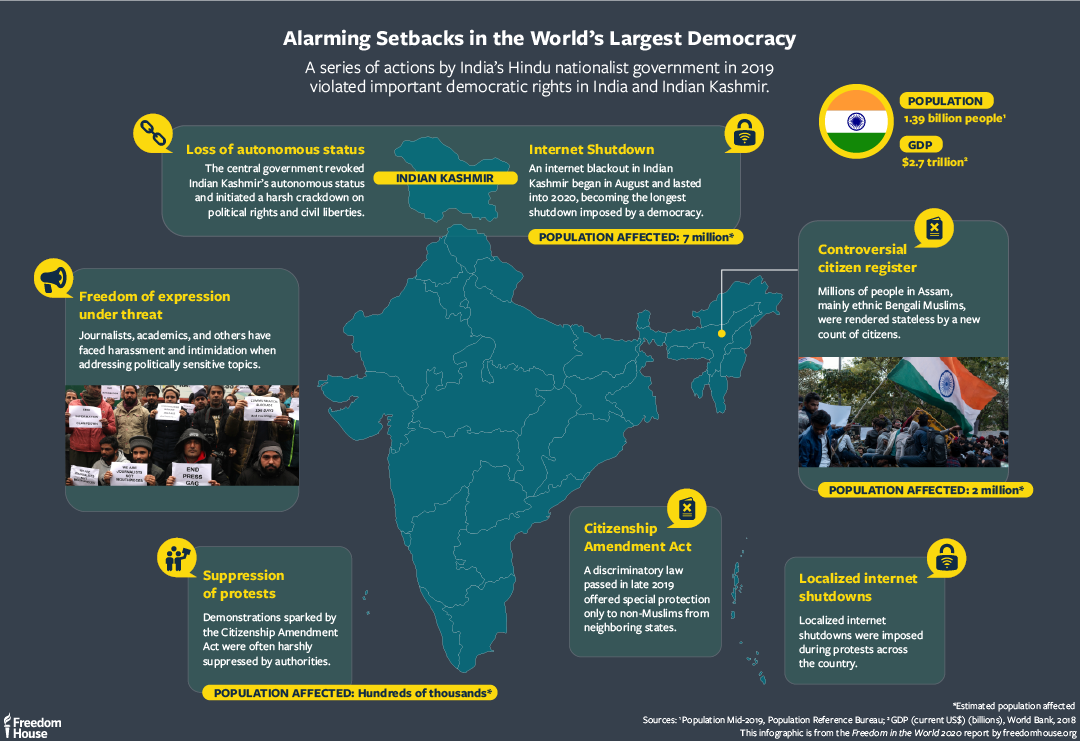
  • Freedom in the World Report, 2021

    Freedom in the World 2020: A Leaderless Struggle for Democracy

    US-based human rights watchdog Freedom House has accused the present government of driving India toward authoritarianism with a lockdown scapegoating of minorities and a crackdown on critics, and downgraded India’s status from ‘Free’ to ‘Partly Free’, in its annual report.

    Freedom in the World Report

    • It is Freedom House’s flagship annual report, assessing the condition of political rights and civil liberties around the world.
    • It is composed of numerical ratings and supporting descriptive texts for 195 countries and 15 territories.
    • The report has been published since 1973, allowing Freedom House to track global trends in freedom over more than 40 years.
    • Freedom House, which is largely funded through U.S. government grants, has been tracking the course of democracy since 1941.

    What did the report say?

    Political and civil rights

    • India’s freedom score, calculated using indicators of political rights and civil liberties, dropped four points to 67 this year, pulling the country down into the ‘Partly Free’ category.
    • India appears to have abandoned its potential to serve as a global democratic leader, elevating narrow nationalist interests at the expense of its founding values of inclusion and equal rights for all.

    Reference to Kashmir

    • In a year when social media censorship has been hotly seated, while the government shut down Internet connectivity in Kashmir as well as on Delhi’s borders, India’s Internet freedom score dropped to just 51.

    Crackdown on protesters

    • Last year, the government intensified its crackdown on protesters opposed to a discriminatory citizenship law and arrested dozens of journalists who aired criticism of the official pandemic response.

    Judicial Independence

    • It noted that judicial independence had also come under strain.
    • It pointed to the case of a Delhi HC judge who was transferred immediately after reprimanding the police for taking no action during riots in the capital that leftover 50 people dead.

    Religious freedom

    • Minorities were disproportionately blamed for the spread of the virus and faced attacks by vigilante mobs.
    • Uttar Pradesh’s law prohibiting forced religious conversion through interfaith marriage was also listed as a concern.

    Rising Authoritarianism

    • Rather than serving as a champion of democratic practice and a counterweight to authoritarian influence from countries such as China, the government is tragically driving India itself toward authoritarianism, the report stated.
  • President’s Rule in Puducherry

    The Union Cabinet has approved a proposal by the Home Ministry to dissolve the Puducherry Assembly and impose President’s Rule in the Union Territory.

    Try this question from CSP 2017:

    Q.Which of the following is not necessarily the consequences of the proclamation of the President’s Rule in a State?

    1. Dissolution of the State Legislative Assembly
    2. Removal of the Council of Ministers in the State
    3. Dissolution of the local bodies

    Select the correct answer using the code given below

    (a) 1 & 2 only

    (b) 1 & 3 only

    (c) 2 & 3 only

    (d) 1, 2 & 3

    What is President’s Rule?

    • President’s rule is the suspension of state government and imposition of direct central government rule in a state.
    • This is achieved through the invocation of Article 356 of the Constitution by the President on the advice of the Union Council of Ministers.
    • Under Article 356, this move can be taken “(1) If the President, on receipt of the report from the Governor of the State or otherwise, is satisfied that a situation has arisen in which the government of the State cannot be carried on in accordance with the provisions of this Constitution…”

    How long President’s Rule can last?

    • A proclamation of President’s Rule can be revoked through a subsequent proclamation in case the leader of a party produces letters of support from a majority of members of the Assembly and stakes his claim to form a government.
    • The revocation does not need the approval of Parliament.
    • Any proclamation under Article 356 —which stands for six months — has to be approved by both Houses in the Parliament session following it.
    • This six-month time-frame can be extended in phases, up to three years.

    Conditions for Prez Rule

    • Where after general elections to the assembly, no party secures a majority, that is, Hung Assembly.
    • Where the party having a majority in the assembly declines to form a ministry and the governor cannot find a coalition ministry commanding a majority in the assembly.
    • Where a ministry resigns after its defeat in the assembly and no other party is willing or able to form a ministry commanding a majority in the assembly.
    • Where a constitutional direction of the Central government is disregarded by the state government.
    • Internal subversion where, for example, a government is deliberately acting against the Constitution and the law or is fomenting a violent revolt.
    • Physical breakdown where the government willfully refuses to discharge its constitutional obligations endangering the security of the state.

    Notable judgements: The S.R. Bommai Case

    Bommai v. Union of India (1994) was a landmark judgment of the Supreme Court of India, where the Court discussed at length provisions of Article 356 of the Constitution of India and related issues.

    • The judgement attempted to curb blatant misuse of Article 356 of the Constitution of India, which allowed the President’s rule to be imposed over state governments.
    • Article 356 (1) has been deliberately drafted in a narrow language by the Founding Fathers so that political parties in the Centre does not misuse it to subvert federalism, it had noted.
    • The President has to be convinced of or should have sufficient proof of information with regard to or has to be free from doubt or uncertainty about the state of things indicating that the situation in question has arisen.
    • The court had stated that although the sufficiency or otherwise of the material cannot be questioned, the legitimacy of inference drawn from such material is “certainly open to judicial review”.

    What was its verdict?

    • The judgment had explained that in a multi-party political system, chances are high that the political parties in the Centre and the State concerned may not be the same.
    • Article 356 cannot be used for the purpose of political one-upmanship by the Centre.
    • Hence there is a need to confine the exercise of power under Article 356[1] strictly to the situation mentioned therein which is a condition precedent to the said exercise,” the court had said.

    Fouling factors

    The imposition of President’s Rule in a state would be improper under the following situations:

    • Where a ministry resigns or is dismissed on losing majority support in the assembly and the governor recommends imposition of President’s Rule without probing the possibility of forming an alternative ministry.
    • Where the governor recommends imposition of President’s Rule without allowing the ministry to prove its majority on the floor of the Assembly.
    • Maladministration in the state or allegations of corruption against the ministry or stringent financial exigencies of the state.
    • Where the state government is not given prior warning to rectify itself except in case of extreme urgency leading to disastrous consequences.
    • Where the power is used to sort out intra-party problems of the ruling party.

    Back2Basics: Puducherry

    • Puducherry is a union territory formed out of four territories of former French India, namely Pondichéry (Pondicherry; now Puducherry), Karikal (Karaikal), Mahé and Yanaon (Yanam), excluding Chandannagar.
    • It is named after the largest district, Puducherry.
    • The areas of Puducherry district and Karaikal district are bound by the state of Tamil Nadu, while Yanam district and Mahé district are enclosed by the states of Andhra Pradesh and Kerala, respectively.
    • It is entitled by a special constitutional amendment act of 1962 to have an elected legislative assembly and a cabinet of ministers, thereby conveying partial statehood similar to the UT of Delhi.
    • It is administered by a Lieutenant Governor.
  • No role in State’s quota decisions: Centre tells SC

    The Centre has told the Supreme Court that it has no role in the choices made by the Tamil Nadu government with regard to the provision of reservation for specific castes or communities in state government jobs and admissions.

    Reservation being an all-time contested issue is a less inevitable topic for mains. However, we can expect some of the thought triggering questions such as – “Reservation is hardly capable of striking a balance between social inclusion and merit. Critically comment. (250 W)”

    OR

    Essay topic like- “Meritocracy is unrealized without an egalitarian society” are ready to raid your mind.

    Issue over 69%

    • The Centre was responding to a petition challenging the constitutionality of the Tamil Nadu Backward Classes, SCs and STs Act of 1993, which provides 69% reservation in the State.
    • The petitioner contends that the TN has acted “outside its competence” by identifying and classifying socially and educationally backward classes (SEBCs).
    • It is too far in excess of the 50% limit on quota laid down by a nine-judge Bench of the Supreme Court in its judgment in the Indira Sawhney Case (1992).

    Indira Sawhney Case

    In the famous Mandal case (Indra Sawhney Case, 1992), the scope and extent of Article 16(4), which provides for reservation of jobs in favour of backward classes, has been examined thoroughly by the Supreme Court.

    • Though the Court has rejected the additional reservation of 10% for poorer sections of higher castes, it upheld the constitutional validity of a 27% reservation for the OBCs with certain conditions.
    • The advanced sections among the OBCs (the creamy layer) should be excluded from the list of beneficiaries of reservation.
    • No reservation in promotions; reservation should be confined to initial appointments only. Any existing reservation in promotions can continue for five years only (i.e., upto 1997).
    • The total reserved quota should not exceed 50% except in some extraordinary situations. This rule should be applied every year.
    • The ‘carry forward rule’ in case of unfilled (backlog) vacancies is valid. But it should not violate the 50% rule.

    What did the Centre say in the TN case?

    • The inclusion or exclusion of any caste/community in the State List of SEBCs is the subject matter of the State government, and the Government of India has no role in the matter.
    • It referred to the Constitution (102nd Amendment) Act of 2018, which details the difference in the procedure for inclusion or exclusion of castes and communities in the State List for SEBCs and the Central List.

    Identifying SEBC

    • The power to identify and specify SEBCs lies with Parliament only with reference to the Central List.
    • The State governments may have separate State Lists of SEBCs for providing reservation for recruitment to State services or admissions in State government educational institutions.
    • Under the newly-inserted Article 342A of the 102nd Amendment Act of 2018, the President notifies the SEBCs in a State after consultation with the Governor.
    • The castes or communities included in such State Lists may differ from those included in the Central List.

    A case for TN

    The senior advocate appearing for Tamil Nadu said the State’s case should be heard separately. The filed affidavit said:

    • India is an amalgam of States with varied population, size, history, culture and social fabric.
    • The circumstances and facts prevailing in Tamil Nadu are not the same or similar to those in any other State.
    • Tamil Nadu is a pioneer in the implementation of reservation in public employment and education. The policy of reservation has been in practice since 1921 in this State.
    • Factual variations contributing to the grant of reservation need to be reckoned with differently for different States while deciding the question on its validity.
    • The State argued that its law was protected under the Ninth Schedule of the Constitution from judicial review.
    • Section 4 of the 1993 Act provides 30% reservation to the Backward Classes, 20% for the Most Backward Classes and de-notified communities, 18% for the SCs and 1% for the STs.
  • Prevention of Insults to National Honour Act

    Police have booked several under The Prevention of Insults to National Honour Act, 1971, for the alleged insult of the National Flag in farmers protest on Republic Day.

    Prevention of Insults to National Honour Act

    • The law, enacted on December 23, 1971, penalizes the desecration of or insult to Indian national symbols, such as the National Flag, the Constitution, the National Anthem, and the Indian map, as well as contempt of the Constitution of India.
    • Section 2 of the Act deals with insults to Indian National Flag and Constitution of India.

    Do you know?

    Article 51 ‘A’ contained in Part IV A i.e. Fundamental Duties asks:

    To abide by the constitution and respect its ideals and institutions, the National Flag and the National Anthem in clause (a).

    Other provisions

    • Section 3.22 of The Flag Code of India, 2002 deals with laws, practices and conventions that apply to the display of the national flag.
    • Section 3.58 says: On occasions of State/Military/Central Paramilitary Forces funerals, the flag shall be draped over the bier or coffin with the saffron towards the head of the bier or coffin.
    • The Flag shall not be lowered into the grave or burnt in the pyre.

    Try this PYQ:

    Q.The national motto of India, ‘Satyameva Jayate’ inscribed below the Emblem of India is taken from:

    (a) Katha Upanishad

    (b) Chandogya Upanishad

    (c) Aitareya Upanishad

    (d) Mundaka Upanishad

    Use of flag in funerals

    • The flag can only be used during a funeral if it is accorded the status of a state funeral.
    • Apart from police and armed forces, state funerals are held when people who are holding or have held the office of President, Vice-President, PM, Cabinet Minister, or state CM pass away.
    • The status of a state funeral can be accorded in case of death of people not belonging to the armed forces, police or the above-mentioned categories by the state government.
    • Then too, the national flag can be used.