💥Join UPSC 2027,2028 Mentorship (July Batch) + XFactor Notes & Microthemes PDF

GS Paper: GS3-13.Infrastructure: Energy, Ports, Roads, Airports, Railways etc:

  • Chips to Start up (C2S) Programme

    Why in the News?

    The Chips to Start up (C2S) Programme has reported strong outcomes, including 56 student designed chips fabricated, 75 plus patents filed, and large scale national training in chip design, reflecting India’s growing indigenous semiconductor design capability.

    About Chips to Start up (C2S) Programme

    • The Chips to Start up (C2S) Programme is a national capacity building and innovation initiative to develop industry ready chip design talent and strengthen India’s indigenous semiconductor ecosystem through hands on training, research and fabrication exposure.
    • Launched in: 2022
    • Implemented by: Ministry of Electronics and Information Technology

    Aim

    • Create a strong pipeline of skilled chip designers
    • Enable hands on chip fabrication for students
    • Promote start ups, patents and IP creation
    • Support technological self reliance in semiconductors

    Key Features

    • Financial outlay: ₹250 crore for 5 years
    • Infrastructure and tools: Access to shared EDA tools, High Performance Computing (HPC), FPGA boards, and SMART laboratories across institutions
    • Hands on fabrication: Shared wafer runs provided through Semi Conductor Laboratory.
    • Chip design enablement: National ChipIN Centre and Operated by Centre for Development of Advanced Computing, Bengaluru
    • Innovation outcomes: Student designed ASICs and SoCs, Start up incubation, Patents, IP cores and chip prototypes
    • Industry collaboration: Training partnerships with global EDA and semiconductor firms

    Significance

    • Addresses the global semiconductor skill gap
    • Democratises chip design by providing nationwide access to advanced tools and fabrication
    • Reduces dependence on foreign design ecosystems
    • Strengthens Atmanirbhar Bharat in a strategic and security sensitive sector
    • Complements India’s broader semiconductor manufacturing and design policy

    Prelims Takeaways

    • C2S Programme launched in 2022
    • Implemented by MeitY
    • Focus on chip design plus fabrication exposure
    • Uses SCL Mohali for wafer runs
    • ChipIN Centre operated by C DAC Bengaluru
    • Key pillar of India’s indigenous semiconductor capability building
    [2025] Consider the following statements: 

    1. It is expected that Majorana 1 chip will enable quantum computing

    2. Majorana 1 chip has been introduced by Amazon Web Services (AWS)

    3. Deep learning is a subset of machine learning

    Which of the statements given above are correct? 

    (a) I and only I (b) II and III only (c) I and III only (d) I, II and III

  • India must focus on AI and its environmental impact

    Why in the News?

    Artificial Intelligence is expanding rapidly across sectors. However, its environmental costs remain largely ignored in policy discussions. The global ICT sector contributes 1.8-2.8% of global greenhouse gas emissions, with estimates rising to 2.1-3.9%. For the first time, clear data is available on the energy, water, and carbon footprint of AI systems, including Large Language Models (LLMs).

    A clear gap exists between perceived digital efficiency and actual environmental impact. A single ChatGPT query consumes 10 times more energy than a Google search. Training one LLM can emit up to 3,00,000 kg of carbon dioxide. Despite these costs, India has no formal system to measure or disclose AI’s environmental impact. This contrasts with the EU and the US, highlighting a major governance gap.

    What is the scale of AI’s environmental footprint?

    1. Global ICT emissions: Accounts for 1.8-2.8% of global GHG emissions, with upper estimates reaching 3.9%.
    2. Carbon-intensive training: Training a single LLM can emit ~3,00,000 kg of carbon dioxide.
    3. Comparative impact: Emissions from one deep learning model equal emissions from five cars over their lifetime.
    4. Data gap: Carbon footprint data of AI models and users remains fragmented and inconsistent.

    How does AI affect energy consumption patterns?

    1. High energy intensity: Each ChatGPT query consumes 10× more energy than a Google search.
    2. Hidden electricity demand: AI workloads rely on energy-intensive data centres and specialised hardware.
    3. Misleading averages: Claims such as 0.24 watt-hours per AI query underestimate system-wide consumption.

    Why is water consumption emerging as a major concern?

    1. UNEP projection: AI data centres may consume 4.2-6.6 billion cubic metres of water by 2027.
    2. Cooling requirements: Water is extensively used to cool AI servers.
    3. Water security risks: High freshwater withdrawal threatens water-stressed regions.

    What global governance responses are emerging?

    1. UNESCO framework (2021): Recognises negative environmental impacts of AI; adopted by ~190 countries.
    2. European Union leadership:
      1. AI Act, 2024: Introduces environmental accountability in AI governance.
      2. Harmonised AI rules: Address sustainability alongside ethics and safety.
    3. United States approach: Sector-specific regulations addressing AI’s environmental externalities.

    Why does India need a regulatory shift?

    1. Unaccounted externalities: Environmental costs of AI development remain outside policy evaluation.
    2. Regulatory vacuum: No mandatory assessment of AI’s environmental impact.
    3. Climate obligations: AI expansion risks undermining India’s climate mitigation commitments.
    4. Policy imbalance: Focus on innovation without parallel sustainability safeguards.

    How can Environmental Impact Assessment be extended to AI?

    1. EIA framework: India’s EIA Notification, 2006 mandates environmental assessment for infrastructure projects.
    2. Proposed extension: Inclusion of AI development and deployment within EIA scope.
    3. Lifecycle evaluation: Assessment of energy use, water consumption, and emissions across AI lifespans.

    What role can disclosure standards play?

    1. ESG integration: Environmental impact of AI included under ESG disclosure norms.
    2. SEBI alignment: Disclosure of emissions from data centres and computing activities.
    3. EU precedent: Corporate Sustainability Reporting Directive (CSRD) mandates emission disclosure, including AI training.
    4. Transparency outcome: Enables informed policymaking and accountability.

    Which sustainable practices can mitigate AI’s impact?

    1. Pre-trained models: Reduces repeated energy-intensive training.
    2. Renewable energy: Powering data centres through clean energy sources.
    3. Efficiency reporting: Disclosure of AI-specific environmental metrics.
    4. Resource optimisation: Minimising water and energy intensity of AI infrastructure.

    Conclusion

    India’s AI ambitions must align with environmental sustainability. Institutionalising environmental assessment, disclosure norms, and sustainable practices is essential to prevent AI-driven ecological externalities. A regulatory framework that integrates innovation with environmental accountability will ensure AI remains a tool for inclusive and sustainable development.

    PYQ Relevance

    [UPSC 2023] How can Artificial Intelligence help clinical diagnosis? Do you perceive any threat to privacy of the individual in the use of AI in healthcare?

    Linkage: Earlier, UPSC focused on how AI helps healthcare and affects patient privacy. Now, as AI use expands, questions are likely to include its environmental impact, especially energy- and data-intensive AI systems.

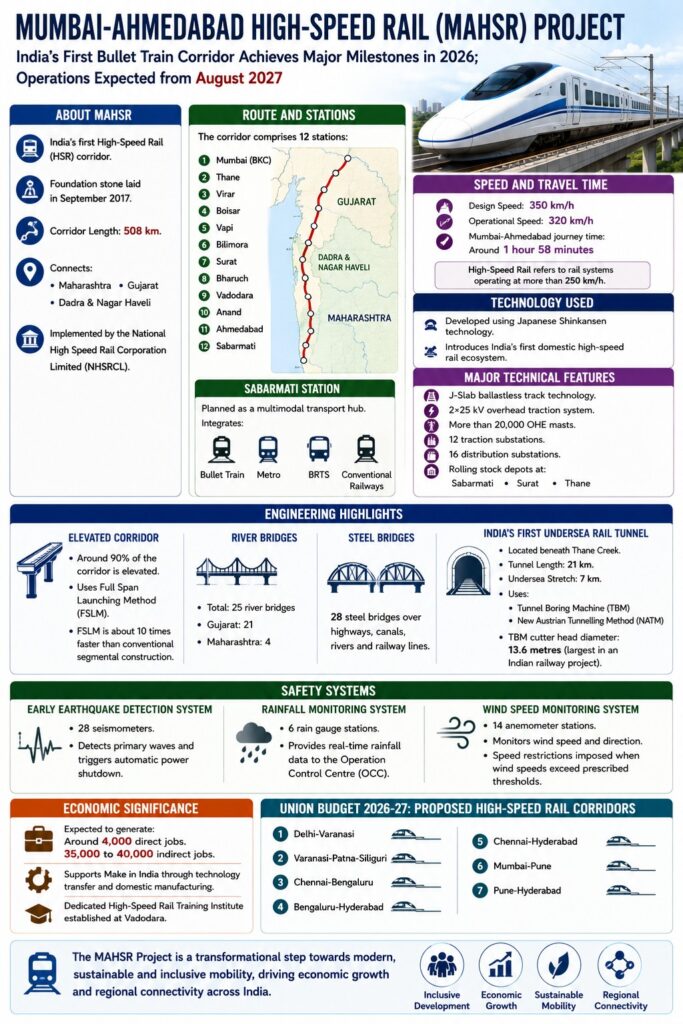
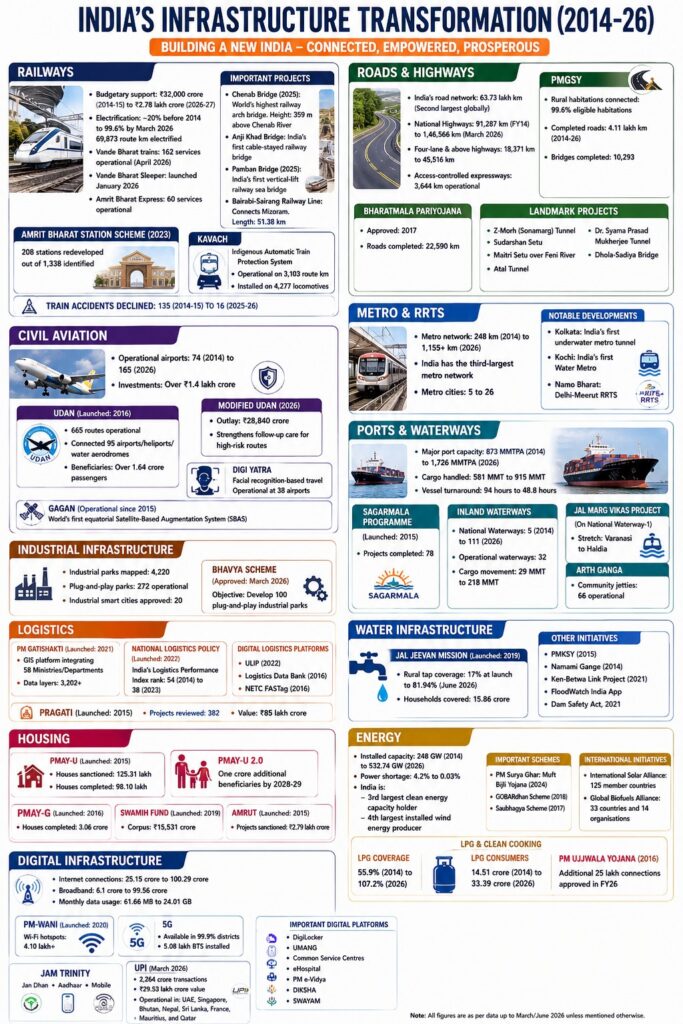
  • Indian Railways Becomes World’s Largest Electrified Rail

    Why in the News?

    Indian Railways has become the largest electrified rail network in the world, with about 99.2 percent of its broad gauge network electrified as of November 2025.

    About Indian Railways Electrification Achievement

    • Indian Railways is India’s national transporter and one of the world’s largest railway networks
    • It has achieved near complete electrification of its broad gauge routes
    • The milestone was achieved under Mission 100 percent Railway Electrification

    Background

    • Railway electrification in India began in 1925
    • Mission mode acceleration started after 2014

    Objectives of Mission 100 percent Railway Electrification

    • Eliminate diesel traction
    • Shift to clean electric traction
    • Reduce carbon emissions and air pollution
    • Lower fuel import dependence
    • Improve speed, reliability, and operational efficiency

    Key Features and Data

    • About 99.2 percent of nearly 70,000 route kilometres electrified
    • Electrification speed increased from
      1.42 km per day during 2004 to 2014
      More than 15 km per day during 2019 to 2025
    • 25 States and Union Territories fully electrified
    • Only around 0.8 percent network remains non electrified

    Renewable Energy Integration

    • Solar capacity increased from 3.68 MW in 2014 to about 898 MW in 2025
    • Supports cleaner traction and lower operational emissions
    • Aligns with India’s renewable energy and climate goals

    Technological Advancements

    • Use of Automatic Wiring Trains
    • Mechanised Overhead Equipment foundation systems
    • Faster and safer electrification with reduced manual intervention
    [2025] Consider the following statements: 

    I. Indian Railways have prepared a National Rail Plan (NRP) to create a future ready railway system by 2028

    II. ‘Kavach’ is an Automatic Train Protection system developed in collaboration with Germany. 

    III. ‘Kavach’ system consists of RFID tags fitted on track in station section. 

    Which of the statements given above are not correct? 

    (a) I and II only (b) II and III only (c) I and III only (d) I, II and III

  • India Inaugurates Global Standard Environmental and Solar Calibration Facilities  

    Why in the News?

    India has inaugurated the world’s second National Environmental Standard Laboratory and the world’s fifth National Primary Standard Facility for Solar Cell Calibration at CSIR National Physical Laboratory, New Delhi.

    National Environmental Standard Laboratory NESL

    • An apex national facility for testing, calibration and certification of air pollution monitoring instruments
    • Designed specifically for Indian climatic and environmental conditions

    Location

    • CSIR National Physical Laboratory, New Delhi

    Institutions Involved

    • Council of Scientific and Industrial Research
    • CSIR National Physical Laboratory

    Objectives

    • Establish India specific environmental measurement standards
    • Improve accuracy and reliability of air quality data
    • Support implementation of National Clean Air Programme

    Key Features

    • Calibration under Indian conditions such as temperature, humidity and dust load
    • Provides traceable and standardised pollution data
    • Supports regulators, startups, MSMEs and domestic manufacturers
    • Only UK and India currently have such national level facilities

    Significance

    • Strengthens pollution governance
    • Reduces dependence on foreign calibration labs
    • Improves credibility of air quality monitoring across India

    National Primary Standard Facility for Solar Cell Calibration

    • A high precision metrology facility for calibration of solar cells
    • Ensures globally comparable photovoltaic measurements

    Location

    • CSIR National Physical Laboratory, New Delhi

    Key Features

    • Uses Laser based Differential Spectral Responsivity system
    • Achieves world leading uncertainty of 0.35 percent (k=2)
    • Developed in collaboration with Physikalisch-Technische Bundesanstalt
    • Only the fifth such facility worldwide

    Importance

    • Supports solar manufacturing and R and D
    • Enhances trust in Indian photovoltaic performance data
    • Boosts renewable energy transition and exports

     Significance

    • Positions India as a global leader in environmental and energy metrology
    • Strengthens Make in India and Atmanirbhar Bharat
    • Supports climate action, clean energy goals and evidence based policymaking

    Prelims Pointers

    • NESL is linked to air pollution monitoring
    • Solar calibration facility ensures international PV measurement standards
    • CSIR NPL is India’s national metrology institute
    • Only five countries globally have national primary solar calibration facilities
    [2014] With reference to technology for solar power production, consider the following statements: 

    1. ‘Photovoltaics’ is a technology that generates electricity by direct conversion of light into electricity, while ‘Solar Thermal’ is a technology that utilizes the Sun’s rays to generate heat which is further used in electricity generation process. 

    2. Photovoltaics generates Alternating Current (AC), while Solar Thermal generates Direct Current (DC). 

    3. India has manufacturing base for Solar Thermal technology, but not for photovoltaics. 

    Which of the statements given above is/are correct? 

    (a) 1 only (b) 2 and 3 only (c) 1, 2 and 3 only (d) None of the above

  • Indian aviation safety, its dangerous credibility deficit

    Why in the News?

    Indian aviation safety has come under scrutiny following the AI-171 crash (June 2025) and the subsequent handling of its investigation. The article highlights a sharp contrast between India’s stated compliance with International Civil Aviation Organization (ICAO) norms and actual investigative practices.

    Introduction

    India is a signatory to the Chicago Convention and follows ICAO Annex 13, which mandates transparent, independent, and timely aircraft accident investigations. However, recent aviation incidents reveal a widening gap between formal compliance and institutional practice. The handling of the AI-171 crash reflects structural weaknesses in investigation autonomy, regulatory enforcement, and safety oversight, undermining public confidence and international credibility.

    What triggered concerns about India’s aviation safety credibility?

    1. AI-171 Crash (June 12, 2025): Aircraft crashed shortly after take-off from Ahmedabad; 242 passengers onboard, only one survivor, 19 deaths on the ground.
    2. Immediate Institutional Response: Cockpit Voice Recorder (CVR) and Digital Flight Data Recorder (DFDR) recovered within days, yet findings delayed.
    3. Contrast with Norms: ICAO requires timely disclosure and independent investigation; delays contradict this principle.
    4. Pattern Recognition: This incident can be linked with earlier aviation safety lapses, indicating a systemic issue rather than an aberration.

    How does the investigation process reveal institutional weaknesses?

    1. Delayed Preliminary Report: Released one month later, despite early data recovery.
    2. Flight Control Anomalies: Report acknowledged engine power loss and control switches moving to “cut-off” within seconds.
    3. Pilot Testimony Ignored: Cockpit voice recordings indicated the pilot denied manually cutting fuel.
    4. Opaque Disclosure: Only selective information released; full datasets not shared with public or independent bodies.

    Why is exclusion of international investigators a serious concern?

    1. NTSB Role Marginalised: Despite early participation, the US National Transportation Safety Board limited to technical assistance.
    2. Breakdown in Trust: Reported friction between Indian authorities and international experts.
    3. Global Best Practice: Major aviation investigations rely on multi-national expert participation to ensure neutrality.
    4. Credibility Impact: Isolationism weakens confidence in findings and raises suspicion of narrative control.

    What does the article reveal about regulatory failure and enforcement gaps?

    1. Repeated Safety Violations: India recorded three fatal aviation accidents in 15 years, including Mangalore (2010) and Kozhikode (2020).
    2. Unimplemented Recommendations: Court of Inquiry findings and ICAO standards not fully enforced.
    3. DGCA Dilution: Aviation regulations modified under airline pressure, weakening oversight.
    4. IndiGo Example: Rapid expansion despite unresolved safety concerns highlighted regulatory accommodation.

    How does digital opacity worsen aviation safety accountability?

    1. Encrypted Communication Systems: Airlines using WhatsApp-based safety apps restrict audit trails.
    2. Data Access Control: Safety data accessible only to company and regulator, excluding public scrutiny.
    3. Delayed Emergency Directives: DGCA issued Emergency Airworthiness Directive months after earlier crashes.
    4. Outcome: Reduced traceability, weakened whistleblower protection, and compromised safety culture.

    Why is India’s approach diplomatically and strategically damaging?

    1. ICAO Standing: India’s credibility as a compliant aviation state weakened.
    2. Soft Power Impact: Aviation safety failures affect India’s reputation as a reliable global transport hub.
    3. Precedent Risk: Normalisation of opaque investigations threatens long-term passenger safety.

    Conclusion

    India’s aviation safety challenge is not rooted in absence of laws or expertise, but in erosion of investigative credibility, regulatory accommodation, and transparency deficits. Restoring trust requires institutional independence, international cooperation, and strict adherence to ICAO norms. Without these, aviation safety risks becoming procedurally compliant but substantively compromised.

    PYQ Relevance

    [UPSC 2024] What is the need for expanding the regional air connectivity in India? In this context, discuss the government’s UDAN Scheme and its achievements.

    Linkage: The expansion of regional air connectivity under the UDAN Scheme strengthens GS Paper III (Infrastructure-Airports) by promoting balanced regional development and economic integration. However, as highlighted by recent aviation safety concerns, rapid airport expansion must be accompanied by robust regulatory oversight and safety governance, linking infrastructure growth with institutional accountability.

  • Land Acquisition and Infrastructure Development 

     Why in the News?

    At the 50th meeting of PRAGATI, the Cabinet Secretary highlighted land acquisition as a major bottleneck in infrastructure development. The meeting was chaired by Narendra Modi.

    About PRAGATI (Pro Active Governance and Timely Implementation)

    • A digital and institutional mechanism for monitoring major infrastructure projects
    • Chaired by the Prime Minister
    • Ensures coordination among Central Ministries, State governments and local authorities
    • Focuses on expediting project implementation and resolving bottlenecks

    Key Data from 50th PRAGATI Meeting

    • Total projects reviewed Over 3,300
    • Total project value Approximately ₹85 lakh crore
    • Issues raised 7,735
    • Issues resolved 7,156

    Major Causes of Project Delays

    • Land acquisition 35 percent
    • Forest, wildlife and environment clearances 20 percent
    • Right of use or right of way 18 percent
    • Other causes Law and order issues, construction delays, power utility approvals and financial constraints

    Important Observations

    • Several long pending projects initiated as early as the 1990s were completed after PRAGATI was introduced
    • Government has not quantified financial savings from timely monitoring
    • States across political lines have cooperated in resolving issues
    • Complex issues are escalated from Ministry level to PRAGATI for final resolution

    Prelims Pointers

    • PRAGATI is a Prime Minister chaired project monitoring platform
    • Land acquisition is the single largest cause of infrastructure delays in India
    • Environmental and forest clearances are the second biggest bottleneck
    • PRAGATI promotes inter ministerial and Centre State coordination
    [2019] With reference to land reforms in independent India, which one of the following statements is correct? 

    (a) The ceiling laws were aimed at family holdings and not individual holdings. 

    (b) The major aim of land reforms was providing agricultural land to all the landless. 

    (c) It resulted in cultivation of cash crops as a predominant form of cultivation. 

    (d) Land reforms permitted no exemptions to the ceiling limits.

  • Energy transition will need more than chasing the sun or the wind

    Introduction

    India’s renewable energy transition has reached a critical inflection point. While solar and wind installations have expanded rapidly, the electricity system was originally designed for centralised, predictable, fossil-based generation. Without parallel reforms in distribution companies, tariff structures, demand-side management, and wholesale power markets, the energy transition risks becoming fiscally unsustainable and operationally inefficient.

    Why in the News?

    India has crossed 180 GW of renewable energy capacity, positioning itself as a global leader in clean energy expansion. Yet, despite rapid capacity addition, there remains a systemic bottleneck: electricity distribution and market design remain unreformed. This marks a sharp contrast with earlier phases where generation capacity was the primary constraint. The problem is large in scale, state-owned DISCOMs remain financially stressed, demand response remains underutilised, and wholesale markets are fragmented, threatening grid stability as renewable penetration rises. A key success noted is the installation of nearly 40 million smart meters, but the failure lies in inadequate institutional and pricing reforms to leverage them effectively.

    Why is renewable capacity expansion no longer sufficient?

    1. Structural mismatch: The electricity grid is optimised for stable baseload power, not intermittent solar and wind generation.
    2. System constraints: Distribution networks and market rules have not evolved to manage variability and decentralised generation.
    3. Outcome: Renewable energy risks curtailment and inefficiency despite surplus capacity.

    Why are DISCOMs the central bottleneck in India’s energy transition?

    1. Financial stress: State-owned DISCOMs face persistent losses due to high fixed costs and inadequate tariff recovery.
    2. Cross-subsidisation: Agricultural and household consumers pay low tariffs, shifting the burden to commercial users.
    3. Distorted incentives: High-paying consumers invest in rooftop solar or efficiency measures, eroding DISCOM revenues further.
    4. Outcome: A feedback loop of declining revenues and rising financial risk.

    How do current tariff structures limit system efficiency?

    1. Flat and time-invariant tariffs: Consumers face no price signals to shift usage away from peak demand.
    2. Limited demand response: Consumers lack incentives to reduce or reschedule consumption during stress periods.
    3. Outcome: Peak demand continues to drive costly capacity additions instead of behavioural adjustment.

    What role do smart meters play, and why is their impact limited?

    1. Infrastructure success: Around 40 million smart meters installed, with rapid scaling underway.
    2. Unrealised potential: Absence of complementary tariff reforms limits their effectiveness.
    3. Operational constraint: Manual coordination persists despite availability of real-time data.
    4. Outcome: Smart meters remain underutilised as instruments of system flexibility.

    Why is demand-side management critical for renewable integration?

    1. Cost-effectiveness: Demand response lowers peak demand at lower cost than building new generation.
    2. System flexibility: Enables balancing of short-duration renewable fluctuations.
    3. Equity challenge: Requires protection for low-income consumers from price volatility.
    4. Outcome: Essential but politically and institutionally underdeveloped.

    What weaknesses exist in India’s wholesale power markets?

    1. Fragmentation: Majority of power procured through long-term contracts.
    2. Limited spot markets: Constrains efficient price discovery.
    3. Regulatory gaps: Centralised dispatch and market coupling remain incomplete.
    4. Outcome: Renewable power cannot flow seamlessly across regions.

    How does captive power generation affect market efficiency?

    1. Rising trend: Industries invest in captive plants to bypass high grid tariffs.
    2. Revenue erosion: Reduces DISCOM demand base.
    3. Market distortion: Limits competition in wholesale markets.
    4. Outcome: Weakens grid integration and increases system costs.

    Conclusion

    India’s clean energy transition has outgrown a generation-centric approach. The editorial underscores that distribution reform, cost-reflective pricing, demand responsiveness, and integrated power markets are no longer optional but foundational. Without these, renewable energy risks becoming economically and operationally fragile rather than transformative.

    PYQ Relevance

    [UPSC 2022] Do you think India will meet 50 percent of its energy needs from renewable energy by 2030? Justify your answer. How will the shift of subsidies from fossil fuels to renewables help achieve the above objective?

    Linkage: This question is directly relevant to GS Paper III (Energy Infrastructure and Sustainable Development) as it assesses India’s ability to translate renewable capacity targets into reliable, affordable, and inclusive energy supply.

  • Passenger Assistance Control Room (PACR)  

    Why in the News?

    • To ensure faster grievance redressal for air passengers, the government has operationalised the Passenger Assistance Control Room (PACR).

    About PACR

    • Launched by the Ministry of Civil Aviation, Government of India
    • Objective: Prompt, effective and coordinated resolution of air traveller grievances

    Key Features

    • Functions as an integrated control hub at Udaan Bhawan, New Delhi
    • Brings together officials from:
      • Directorate General of Civil Aviation (DGCA)
      • Airports Authority of India (AAI)
      • Airline operators and other aviation stakeholders
    • Operates 24×7
      • Continuous monitoring of aviation operations
      • Real time passenger assistance
      • On the spot grievance coordination
    Consider the following airports: (2024) 

    1. Donyi Polo Airport 

    2. Kushinagar International Airport 

    3. Vijayawada International Airport. 

    In the recent past, which of the above have been constructed as Greenfield projects? 

    (a) 1 and 2 only (b) 2 and 3 only (c) 1 and 3 only (d) 1, 2 and 3

  • Shipbuilding Financial Assistance Scheme and Shipbuilding Development Scheme  

    Why in the News?

    The Ministry of Ports Shipping and Waterways notified operational guidelines for the Shipbuilding Financial Assistance Scheme (SBFAS) and the Shipbuilding Development Scheme (SbDS).

    Shipbuilding Financial Assistance Scheme (SBFAS)

    • Objective Strengthen domestic shipbuilding and global competitiveness
      • Valid till 31 March 2036
      • Financial assistance 15 to 25 percent per vessel based on vessel category
      • Graded support for small normal large normal and specialised vessels
      • Stage wise disbursement linked to milestones
      Shipbreaking Credit Note provides 40 percent of scrap value for vessels scrapped in Indian yards
      • Provision for National Shipbuilding Mission

    Shipbuilding Development Scheme (SbDS)

    • Focus on long term capacity and capability creation
      • Greenfield shipbuilding clusters and brownfield yard expansion
      India Ship Technology Centre under Indian Maritime University
      • Greenfield clusters get 100 percent capital support via 50 50 Centre State SPV
      • Brownfield projects get 25 percent capital assistance
      • Includes Credit Risk Coverage Framework for pre shipment post shipment and vendor default risks
    Consider the following pairs: [2023]

    1. Kamarajar Port: First major port in India registered as a company. 

    2. Mundra Port: Largest privately owned port in India. 

    3. Visakhapatnam Port: Largest container port in India. 

    How many of the above pairs are correctly matched? 

    (a) Only one pair 

    (b) Only two pairs 

    (c) All three pairs 

    (d) None of the pairs

  • Revamped Distribution Sector Scheme (RDSS) 

    Why in the News?

    Installation of rooftop solar power plants is being expedited in Rajasthan under the Revamped Distribution Sector Scheme (RDSS) to reduce transmission and distribution losses and improve power supply quality.

    About Revamped Distribution Sector Scheme

    • Launched in July 2021
      • Implemented by the Ministry of Power
      • A reforms based and results linked scheme
      • Time period FY 2021 22 to FY 2025 26
      • Total outlay Rs. 3,03,758 crore
      • Objective is to transform the electricity distribution sector

    Key Objectives

    • Reduce Aggregate Technical and Commercial (AT and C) losses to 12 to 15 percent at pan India level
      • Reduce ACS ARR gap to zero by 2024 25
      • Ensure financially sustainable and operationally efficient DISCOMs
      • Improve quality, reliability, and affordability of power supply

    Prelims Pointers

    • RDSS replaced earlier distribution sector schemes
      • Focuses on smart metering and digitalisation
      • Links financial support with reform performance
      • Rooftop solar under RDSS helps reduce AT and C losses by local generation
    Which one of the following is a purpose of ‘UDAY’, a scheme of the Government? [2016]

    (a) Providing technical and financial assistance to start-up entrepreneurs in the field of renewable sources of energy 

    (b) Providing electricity to every household in the countries by 2018 

    (c) Replacing the coal-based power plants with natural gas, nuclear, solar, wind and tidal power plants over a period of time 

    (d) Providing for financial turnaround and revival of power distribution companies