Why in the news?
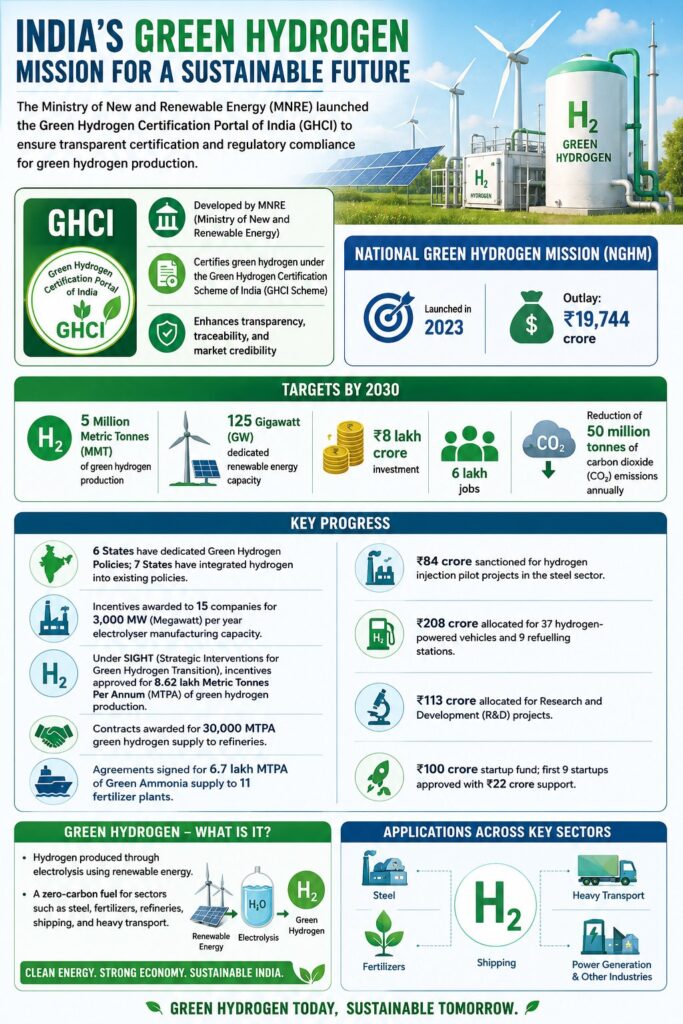
The Ministry of New and Renewable Energy (MNRE) launched the Green Hydrogen Certification Portal of India (GHCI) to ensure transparent certification and regulatory compliance for green hydrogen production.
GHCI
- Developed by MNRE (Ministry of New and Renewable Energy).
- Certifies green hydrogen under the Green Hydrogen Certification Scheme of India (GHCI Scheme).
- Enhances transparency, traceability, and market credibility.
National Green Hydrogen Mission (NGHM)
- Launched in 2023.
- Outlay: ₹19,744 crore.
Targets by 2030
- 5 Million Metric Tonnes (MMT) of green hydrogen production.
- 125 Gigawatt (GW) dedicated renewable energy capacity.
- ₹8 lakh crore investment.
- 6 lakh jobs.
- Reduction of 50 million tonnes of carbon dioxide (CO₂) emissions annually.
Key Progress
- 6 States have dedicated Green Hydrogen Policies; 7 States have integrated hydrogen into existing policies.
- Incentives awarded to 15 companies for 3,000 MW (Megawatt) per year electrolyser manufacturing capacity.
- Under SIGHT (Strategic Interventions for Green Hydrogen Transition), incentives approved for 8.62 lakh Metric Tonnes Per Annum (MTPA) of green hydrogen production.
- Contracts awarded for 30,000 MTPA green hydrogen supply to refineries.
- Agreements signed for 6.7 lakh MTPA of Green Ammonia supply to 11 fertilizer plants.
- ₹84 crore sanctioned for hydrogen injection pilot projects in the steel sector.
- ₹208 crore allocated for 37 hydrogen-powered vehicles and 9 refuelling stations.
- ₹113 crore allocated for Research and Development (R&D) projects.
- ₹100 crore startup fund; first 9 startups approved with ₹22 crore support.
Green Hydrogen
- Hydrogen produced through electrolysis using renewable energy.
- A zero-carbon fuel for sectors such as steel, fertilizers, refineries, shipping, and heavy transport.
[2023] With reference to green hydrogen, consider the following statements:
1. It can be used directly as a fuel for internal combustion.
2. It can be blended with natural gas and used as fuel for heat or power generation.
3. It can be used in the hydrogen fuel cell to run vehicles.
How many of the above statements are correct?
[A] Only one
[B] Only two
[C] All three
[D] None
