💥Join UPSC 2027,2028 Mentorship (July Batch) + XFactor Notes & Microthemes PDF

GS Paper: GS3-13.Infrastructure: Energy, Ports, Roads, Airports, Railways etc:

  • India may expand LNG storage to manage future supply crisis

    Why in the News?

    The disruption of Liquefied Natural Gas (LNG) supplies due to tensions in the Strait of Hormuz has revived concerns about India’s energy security. India, which depends heavily on LNG imports for nearly half its gas requirements, lacks adequate storage infrastructure. This has prompted discussions on expanding LNG storage capacity to cushion future supply shocks.

    Why is India considering expanding LNG storage capacity now?

    1. Geopolitical Disruption: Closure of the Strait of Hormuz halted LNG cargo flows; no shipment reached India for over two months.
    2. Critical Dependence: Around 50% of India’s natural gas demand is met through LNG imports.
    3. Chokepoint Vulnerability: Nearly 60% of LNG imports pass through the Strait of Hormuz, exposing supply chains to geopolitical risks.
    4. First Major Shock: This disruption was earlier considered “extremely improbable” but has now materialised.
    5. Policy Shift: Moves away from minimal storage model toward strategic reserves, similar to crude oil reserves.

    What is the current status of LNG storage infrastructure in India?

    1. Limited Storage Capacity: India has only 23 LNG tanks across terminals.
    2. Company Share: Petronet LNG accounts for 10 tanks, indicating concentrated capacity.
    3. Terminal Distribution: Dahej terminal (Gujarat) has 8 tanks; Kochi has 2 tanks.
    4. Operational Limitation: Tanks designed for regasification operations, not long-term storage.
    5. Consumption Ratio: One LNG tank holds approximately one LNG shipment, while daily consumption equals 1.25 tanks/day.

    Why is LNG storage expansion challenging in India?

    1. Cryogenic Requirement: LNG must be stored at extremely low temperatures (-162°C), increasing complexity.
    2. High Capital Cost: Construction is significantly more expensive than conventional fuel storage.
    3. Time-Intensive Projects: New tanks require at least 3 years for completion.
    4. Land Constraints: Coastal land availability limits expansion of terminals.
    5. Regulatory Delays: Multiple approvals slow down infrastructure development.

    How does LNG storage compare with India’s crude oil reserves?

    1. Strategic Oil Reserves: India maintains strategic petroleum reserves (SPR) for crude oil.
    2. LNG Gap: No equivalent strategic LNG reserves exist.
    3. Policy Asymmetry: Oil security planning is institutionalised; gas security remains market-driven.
    4. Operational Focus: LNG storage currently supports continuous supply, not emergency buffering.
    5. Need for Transition: Shift required toward strategic LNG stockpiling model.

    What are the economic and sectoral implications of LNG disruptions?

    1. Supply Prioritisation: Gas diverted to transportation and households, industries faced rationing.
    2. Industrial Impact: Reduced gas availability affected manufacturing output.
    3. Price Volatility: LNG shortages lead to increased global spot prices.
    4. Import Diversification Limits: India attempted alternative sourcing but faced constraints.
    5. Energy Transition Risk: Gas-based economy plans disrupted due to unreliable supply.

    What role are key institutions like Petronet LNG playing?

    1. Capacity Expansion Plans: Petronet LNG plans to increase storage capacity by ~70%.
    2. New Infrastructure: Proposal to add two additional tanks at Dahej terminal.
    3. Land Assessment: Ongoing feasibility checks for expansion.
    4. Strategic Awareness: Industry stakeholders acknowledging need for resilience.
    5. Execution Timeline: Projects remain in planning phase; timelines uncertain.

    Conclusion

    India’s LNG vulnerability highlights a structural gap in energy security architecture. Expanding LNG storage capacity is essential to reduce exposure to geopolitical disruptions, ensure industrial stability, and support long-term energy transition goals. A strategic shift toward integrated gas security planning is required.

    PYQ Relevance

    [UPSC 2018] Access to affordable, reliable, sustainable and modern energy is the sine qua non to achieve Sustainable Development Goals (SDGs). Comment on the progress made in India in this regard.

    Linkage: LNG storage gaps highlight India’s vulnerability in ensuring reliable and affordable energy access, a core component of SDG-linked energy security. Expanding LNG storage strengthens energy infrastructure resilience, directly aligning with UPSC focus on energy security and sustainable growth.

  • DAE, Power Ministry at odds over civil nuclear projects’ supervision

    Why in the News?

    India’s civil nuclear sector is undergoing a structural transition after the passage of the Sustainable Harnessing and Advancement of Nuclear Energy for Transforming India (SHANTI) Act, 2025, which for the first time permits private participation in a strategically controlled domain. This shift has triggered a sharp institutional divergence between the Department of Atomic Energy (DAE) and the Ministry of Power over supervisory control. This exposes concerns of conflict of interest arising from DAE’s end-to-end dominance of the nuclear supply chain. The issue assumes significance as India plans to expand nuclear capacity from 8.7 gigawatt electric (GWe) to 100 GWe by 2047. This makes regulatory clarity essential for energy security and climate commitments.

    What is the SHANTI Act and how does it transform India’s nuclear sector?

    1. Legislative Reform: Establishes a legal framework enabling private sector participation in civil nuclear energy, breaking the exclusive state control under the Department of Atomic Energy (DAE).
    2. Regulatory Strengthening: Grants statutory status to the Atomic Energy Regulatory Board (AERB), thereby enhancing its legal authority and institutional autonomy.
    3. Administrative Reconfiguration: Recognises DAE as the nodal technical authority while opening space for other ministries to play administrative roles.
    4. Investment Facilitation: Removes key barriers for private investment, including easing operational restrictions in nuclear power generation.
    5. Liability Modification: Omits the supplier liability clause present earlier, reducing long-term liability risks for equipment vendors and encouraging foreign and domestic participation.

    Why has the SHANTI Act triggered institutional conflict between the Department of Atomic Energy (DAE) and Ministry of Power?

    1. Jurisdictional Ambiguity: Creates overlap between DAE’s technical authority and Ministry of Power’s administrative jurisdiction over electricity generation.
    2. Shift in Sectoral Control: Challenges the traditional monopoly of DAE by introducing multi-agency governance in nuclear power.
    3. Private Sector Inclusion: Raises the question of whether private nuclear projects should fall under the broader power sector administered by the Ministry of Power.
    4. Policy Divergence: Reflects differing institutional perspectives on whether nuclear energy should remain a strategic domain or be integrated with commercial energy markets.
    5. Lack of Clear Framework: Absence of a clearly defined administrative structure for private projects has intensified inter-ministerial tensions.

    How does the Department of Atomic Energy’s (DAE) structure raise concerns of conflict of interest?

    1. End-to-End Control: Exercises authority over research, reactor development, fuel supply, plant operations, and waste management, creating concentration of power.
    2. Regulatory Dependence: Atomic Energy Regulatory Board (AERB) historically relied on DAE for budgetary and administrative support, limiting independence.
    3. Comptroller and Auditor General (CAG) Observation (2012): Highlighted institutional conflict as AERB leadership reported to the Atomic Energy Commission, closely linked to DAE.
    4. Dual Role Issue: DAE functions both as operator and overseer, leading to potential regulatory capture.
    5. Accountability Deficit: Weak separation between promoter and regulator reduces transparency and credibility in safety oversight.

    What institutional changes have been introduced to address regulatory concerns?

    1. Statutory Empowerment: Converts Atomic Energy Regulatory Board (AERB) into a statutory body, enhancing legal independence.
    2. Expanded Oversight: Strengthens regulatory jurisdiction over nuclear power plants, including those developed by private entities.
    3. Defined Technical Authority: Retains Department of Atomic Energy (DAE) as nodal agency for technical expertise and institutional knowledge.
    4. Separation Attempt: Initiates partial separation between regulatory and operational functions to reduce conflict of interest.
    5. Governance Modernisation: Aligns India’s nuclear governance structure with international best practices of independent regulation.

    Should the Ministry of Power be given administrative control over private nuclear projects?

    1. Sectoral Integration: Aligns nuclear power with broader electricity sector planning under the Ministry of Power.
    2. Technology-Based Allocation: Suggests division where Light Water Reactors (LWR) and Pressurised Water Reactors (PWR) fall under Ministry of Power, while Pressurised Heavy Water Reactors (PHWR) remain under DAE.
    3. Efficiency Consideration: Enhances administrative efficiency by integrating nuclear energy with grid management and distribution systems.
    4. Expertise Constraint: Recognises DAE’s specialised knowledge in nuclear technology, limiting full transfer of control.
    5. Hybrid Governance Model: Indicates a possible dual framework combining technical oversight by DAE and administrative supervision by the Ministry of Power.

    What are the strategic and capacity implications of expanding nuclear energy in India?

    1. Current Capacity: India’s installed nuclear capacity stands at approximately 8.7 gigawatt electric (GWe), constituting about 1.65% of total installed capacity.
    2. Under Construction Projects: Around 6,600 megawatt electric (MWe) capacity is currently under construction.
    3. Pipeline Projects: Additional 7,000 MWe capacity is in planning and approval stages.
    4. Long-Term Target: Aims to achieve 100 GWe nuclear capacity by 2047 to support energy transition goals.
    5. Role of Nuclear Power Corporation of India Limited (NPCIL): Expected to develop more than half of the targeted capacity expansion.

    Why does the government retain control over critical nuclear activities despite private participation?

    1. Strategic Sensitivity: Nuclear energy is closely linked to national security and non-proliferation commitments.
    2. Fuel Cycle Control: Retains authority over enrichment, isotopic separation, and reprocessing of spent fuel.
    3. Waste Management: Ensures safe handling and disposal of high-level radioactive waste under government supervision.
    4. Heavy Water Production: Maintains control over heavy water, a critical input for indigenous reactor technology.
    5. International Obligations: Aligns with global nuclear safety norms and safeguards under international agreements.

    Conclusion

    The SHANTI Act introduces a structural transformation in India’s nuclear sector but simultaneously exposes institutional gaps in governance. Establishing a clear separation between regulatory and operational roles, along with a coherent administrative framework, remains essential for achieving safe and scalable nuclear expansion.

    PYQ Relevance

    [UPSC 2018] With growing energy needs should India keep on expanding its nuclear energy programme? Discuss the facts and fears associated with nuclear energy.

    Linkage: The PYQ directly links to nuclear expansion targets (100 GWe by 2047) and policy shift towards private participation under SHANTI Act. It captures core debate of governance, safety, regulatory independence, and strategic control highlighted in the DAE vs Ministry of Power conflict.

  • India’s Power Demand, Solar Push and Coal Use amid El Niño 

    Why in the News

    India is preparing to meet rising summer power demand and possible El Niño conditions by relying on a mix of augmented solar capacity and coal based thermal power.

    Key Highlights

    • Peak power demand reached around 256 GW (April 2026)
    • Thermal power share: about 66.9 percent
    • Solar contribution increased to about 21.5 percent
    • Record addition of 44.61 GW solar capacity in 2025–26

    Role of Solar Energy

    • Rapid increase in installed capacity
    • Solar share in generation rising steadily:
      • Around 5.6 percent (2022)
      • Around 9 percent (2025)
    • Limitations:
      • Intermittent nature
      • Lack of sufficient battery storage
      • Grid stability concerns

    Role of Coal Based Thermal Power

    • Continues to be dominant source of electricity
    • Ensures base load supply during peak demand
    • Current coal stock: ~200 million tonnes
    • Sufficient for about 80 plus days

    What is El Niño?

    • A climate phenomenon involving warming of Pacific Ocean waters
    • Leads to:
      • Weaker monsoon in India
      • Longer dry spells and heatwaves
    [2023] Consider the following statements: 
    Statement-IIndia, despite having Uranium deposits, depends on coal for most of its electricity production. 
    Statement-II:Uranium, enriched to the extent of at least 60%, is required for the production of electricity. 
    Which one of the following is correct in respect of the above statements 
    [A] Both Statement-I and Statement – II are correct and Statement- II is the correct explanation for Statement- I 
    [B] Both Statement I and Statement II are correct and Statement-II is not the correct explanation for Statement-I. 
    [C] Statement- I is Correct but Statement-II is incorrect. 
    [D] Statement-I incorrect but Statement-II is correct.
  • India’s First Green Methanol Plant 

    Why in the News

    India is set to establish its first green methanol plant at Kandla using the invasive plant Prosopis juliflora as feedstock. The project aims to produce clean marine fuel and support India’s transition to green shipping.

    About Prosopis juliflora

    • A Mexican-origin invasive species
    • Known locally as:
      • Vilayati Keekar (North India)
      • Gando Baval (Gujarat)
    • Introduced in India:
      • 1920s by British
      • Later in 1961 in Gujarat to check desertification
    • Problem:
      • Replaces native grasses
      • Harms biodiversity in Banni grasslands (Kutch)

    About Green Methanol

    • Methanol produced using renewable biomass instead of fossil fuels
    • Used as marine fuel replacing bunker oil
    • Helps reduce emissions significantly

    Key Features of the Project

    • Location: Deendayal Port Authority
    • Production capacity: 5 tonnes per day
    • Developed by: Thermax and Ankur Scientific
    • Feedstock:
      • Prosopis juliflora
      • Other biomass like bagasse and cotton stalk
    [2018] Why is a plant called Prosopis juliflora often mentioned in news? 
    (a) Its extract is widely used in cosmetics. 
    (b) It tends to reduce the biodiversity in the area in which it grows. 
    (c) Its extract is used in the synthesis of pesticides. 
    (d) None of the above.
  • Industrial Output Growth Hits 5 Month Low 

    Why in the News

    India’s Industrial Output Growth, measured by the Index of Industrial Production (IIP), slowed to 4.1 percent in March 2026, marking a five month low. The slowdown is linked to weak performance in construction and consumer sectors and the emerging impact of the West Asia crisis.

    What is Index of Industrial Production (IIP)?

    • A composite indicator measuring short term changes in industrial output
    • Released by the Ministry of Statistics and Programme Implementation
    • Base year: 2011 to 12
    • Published monthly

    Components of IIP

    • Primary Goods
    • Capital Goods
    • Intermediate Goods
    • Infrastructure and Construction Goods
    • Consumer Durables
    • Consumer Non Durables

    Key Highlights from Data

    • IIP Growth (March 2026): 4.1 percent
    • Manufacturing Growth: 4.3 percent
    • Capital Goods Growth: 14.6 percent (29 month high)
    • Infrastructure and Construction: 6.7 percent (slowed)
    • Consumer Non Durables: 1.1 percent (weak demand)
    • Core Sector Growth: -0.4 percent (contraction)

    About Core Industries

    • Eight core sectors account for about 40 percent of IIP
    • Includes: Coal, Crude Oil, Natural Gas, Refinery Products, Fertilizers, Steel, Cement, and Electricity.
    [2015] In the ‘Index of Eight Core Industries’, which one of the following is given the highest weight? 
    (a) Coal Production 
    (b) Electricity generation 
    (c) Fertilizer production 
    (d) Steel production
  • Google AI Data Centre Hub in Andhra Pradesh

    Why in the News

    A major Artificial Intelligence Data Centre Hub is being launched by Google in Andhra Pradesh, with the foundation stone laid by Chief Minister N. Chandrababu Naidu at Tarluvada near Visakhapatnam on April 28, 2026. It is one of the largest Foreign Direct Investment (FDI) projects in India’s digital infrastructure sector.

    Key Facts

    • Total Investment: 15 billion dollars (1.35 lakh crore rupees)
    • Implemented by Raiden Infotech in partnership with Adani Group
    • Total Land Area: 601.4 acres
    • Locations:
      • Rambilli (Anakapalli district)
      • Adavivaram and Tarluvada (Visakhapatnam district)

    Technical Features

    • Initial Power Capacity: 1 Gigawatt (GW)
    • Scalability: Up to 5 Gigawatt (GW)
    • Key infrastructure:
      • Submarine Cable Landing Stations
      • Dedicated Fibre Networks
    • Purpose: Low Latency Global Connectivity for AI and data operations
    [2020] With reference to Foreign Direct Investment in India, which one of the following is considered its major characteristic? 
    (a) It is the investment through capital instruments essentially in a listed company. 
    (b) It is a largely non-debt creating capital flow. 
    (c) It is the investment which involves debt-servicing. 
    (d) It is the investment made by foreign institutional investors in the Government securities.
  • India’s Nuclear & Wind Energy Progress  

    Why in the News?

    • Prime Minister Narendra Modi highlighted:
      • Fast Breeder Reactor (FBR) achieving criticality
      • India becoming 4th largest in wind energy capacity
      • Call for participation in Census 2027

    Fast Breeder Reactor (FBR) 

    • Location: Kalpakkam, Tamil Nadu
    • Achievement: Criticality attained

    What is Criticality?

    • Stage where: Self-sustaining nuclear chain reaction begins
    • Indicates: Reactor becomes operational

    Significance of FBR

    • Uses: Plutonium-based fuel
    • Converts: Fertile material → Fissile fuel
    • Advantages:
      • Efficient fuel use
      • Supports India’s 3-stage nuclear programme
    • Built with: Indigenous technology

    Wind Energy  

    • Installed capacity: 56 GW+
    • Global rank: 4th in world

    Leading States

    • Gujarat, Tamil Nadu, Maharashtra, and Rajasthan
    [2023] Consider the following statements: 
    Statement-I: India, despite having uranium deposits, depends on coal for most of its electricity production. 
    Statement-II: Uranium, enriched to the extent of at least 60%, is required for the production of electricity. 
    Which one of the following is correct in respect of the above statements? 
    (a) Both Statement-I and Statement-II are correct and Statement-II is the correct explanation for Statement-I 
    (b) Both Statement-I and Statement-II are correct and Statement-II is not the correct explanation for Statement-I 
    (c) Statement-I is correct but Statement-II is incorrect 
    (d) Statement-I is incorrect but Statement-II is correct
  • BHAVYA Scheme  

    Why in the News

    • The Union Cabinet has approved the Bharat Audyogik Vikas Yojana (BHAVYA) with an outlay of ₹33,660 crore to develop 100 plug-and-play industrial parks by 2032.
    • The National Industrial Corridor Development Programme (NICDP) framework is the foundation for the BHAVYA (Bharat Audyogik Vikas Yojna) scheme. Approved on March 18, 2026, with a ₹33,660 crore outlay,

    What is BHAVYA?

    • A government scheme to create future-ready industrial parks across India
    • Designed to provide:
      • Ready infrastructure
      • Seamless connectivity
    • Focus on: Manufacturing competitiveness and investment

    Key Features

    1. Scale and Timeline

    • Total parks: 100
    • Duration: 6 years (starting 2026–27)
    • First phase: 50 parks

    2. Land Requirement

    • Minimum:
      • 100 acres (general)
      • 25 acres (hilly and North Eastern states)
    • Maximum: 1,000 acres

    3. Funding Pattern

    • Central Government:
      • Up to ₹1 crore per acre
    • Implementation:
      • Joint effort of: Central government, State governments, and Private sector

    4. Plug-and-Play Model

    • Industrial units get:
      • Pre-developed land
      • Power, water, roads
      • Logistics connectivity

    5. Integration with National Infrastructure

    • Linked with: PM GatiShakti
    • Benefits:
      • Multimodal connectivity (road, rail, ports)
      • Efficient logistics
      • Last-mile connectivity

    6. Ease of Doing Business

    • Features include:
      • Single-window clearance systems
      • Simplified approvals
      • Investor-friendly policies
      • State-led reforms
    • Primary beneficiaries: Manufacturing units, MSMEs, startups, and global investors seeking ready-to-use industrial infrastructure
    [2016] Recently, India’s first ‘National Investment and Manufacturing Zone’ was proposed to be set up in:
    (a) Andhra Pradesh
    (b) Gujarat
    (c) Maharashtra
    (d) Uttar Pradesh
  • Technology Development and Investment Promotion (TDIP) Scheme 

    Why in the News?

    • Revised guidelines of the Technology Development and Investment Promotion (TDIP) Scheme released by Jyotiraditya M. Scindia
    • Aim: Strengthen India’s global telecom presence and boost next-gen technologies

    What is the TDIP Scheme?

    • A Department of Telecommunications (DoT) initiative
    • Focus:
      • Promote indigenous telecom technologies
      • Enhance India’s role in global telecom standards

    Key Features

    • Financial Outlay
      • Total allocation: ₹203 crore
      • Period: 2026 to 2031
    • Focus Areas
      • Participation in: Global standard-setting bodies
      • Promotion of: Innovation and R&D
      • Development of: 5G Advanced and 6G ecosystem
    [2019] With reference to communication technologies, what is/are the difference/differences between LTE (Long-Term Evolution) and VoLTE (Voice over Long-Term Evolution)? 
    1. LTE is commonly marketed as 3G and VoLTE is commonly marketed as advanced 3G. 
    2. LTE is data-only technology and VoLTE is voice-only technology. 
    Select the correct answer using the code given below. 
    a) 1 only b) 2 only c) Both 1 and 2  d) Neither 1 nor 2
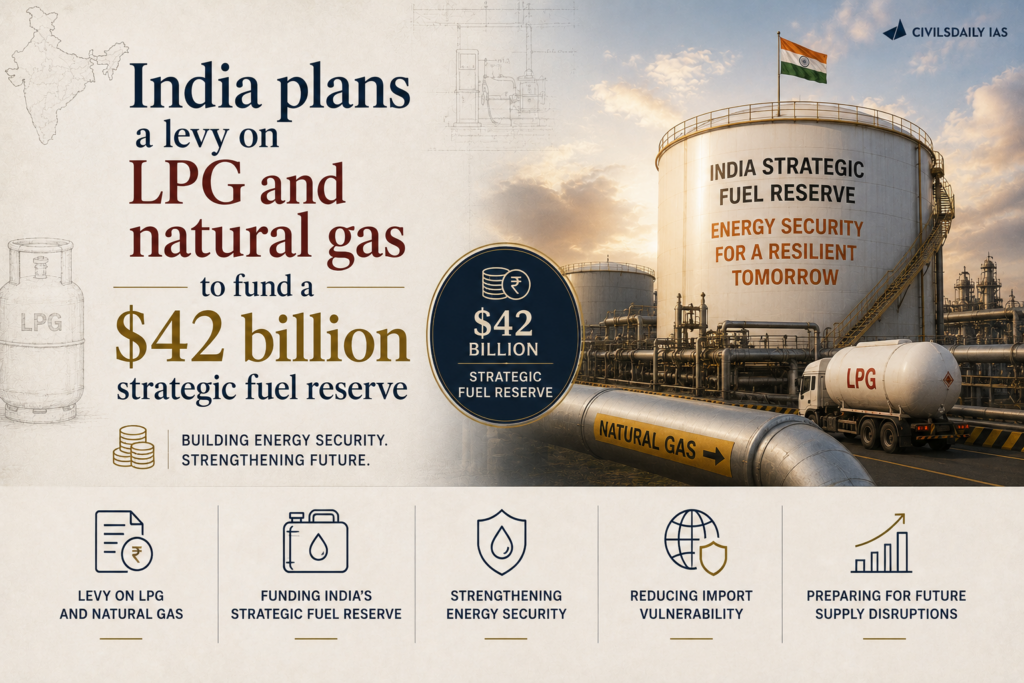
  • The strategic vulnerability in India’s LPG supply model

    Why in the News?

    India’s LPG vulnerability has come into focus due to heightened geopolitical risks in the Strait of Hormuz, a corridor handling ~90% of India’s LPG imports. Unlike earlier assumptions of stable supply, the crisis highlights a shift from routine dependence to strategic vulnerability. The issue is significant because LPG is not an industrial input but a household necessity, meaning disruptions directly affect millions of kitchens.

    Why does India’s LPG demand structure increase vulnerability?

    While India has achieved high, clean-cooking access, this success has created a “just-in-time” supply model that is fragile during global disruptions.

    1. Household Dependence: LPG is primarily used for cooking; commercial use <10%, leaving limited flexibility to reduce demand during crisis.
    2. Rigid Consumption Pattern: Household kitchens cannot switch fuels easily, ensuring inelastic demand.
    3. Mismatch in Production vs Consumption: LPG demand at 250% of domestic production, indicating structural dependence.

    How does import concentration amplify supply risk?

    1. Import Dependence: Approximately 60% LPG is imported, reflecting high external reliance.
    2. Geographical Concentration: Around 90% imports pass through the Strait of Hormuz, creating a single choke-point risk.
    3. Global Market Constraint: Exportable LPG pool is limited and pre-committed, reducing diversion flexibility.

    Why is India’s LPG storage capacity inadequate?

    1. Low Strategic Reserves: While India is the world’s second-largest LPG consumer, its strategic underground storage is limited to roughly 140,000 tonnes (60 TMT at Vizag and 80 TMT at Mangalore), covering only about 1.5 to 2 days of national consumption
    2. Insufficient Buffer Target: Proposed 2-3 weeks buffer of about 1.3-1.9 MMT, far above current capacity.
    3. Operational Fragility: Limited reserves reduce crisis response capability and increase exposure to supply shocks.

    How does India compare with other major LPG consumers?

    1. Japan’s Model(High Resilience):
      1. 108.3 days storage, ensuring strong resilience
      2. LPG covers only about 40% households, lowering dependency
    2. China’s Model(Flexible Demand): China is the world’s largest consumer, but its demand is driven heavily by the petrochemical sector, not solely residential cooking.
    3. South Korea’s Model(Diversified Portfolio): South Korea utilizes a robust mix of city gas and electricity, reducing its reliance on LPG for residential heating and cooking. It also maintains substantial storage capacity (50-60 days)
    4. India’s Position(Maximum Vulnerability): High household dependence combined with low storage, resulting in maximum vulnerability

    Why is treating LPG as a unified pool problematic?

    Treating LPG as a unified pool means managing the entire supply of Liquid Petroleum Gas, whether domestically produced or imported, as a single, undifferentiated resource that simultaneously feeds household cooking, commercial establishments (hotels, restaurants), and industrial users (petrochemical plants). 

    1. Demand-Supply Mismatch: A single LPG pool serves households, petrochemicals, and industry simultaneously.
    2. Asymmetric Demand: While demand for household cooking is inflexible (people cannot stop cooking), demand from industrial sectors is often flexible (plants can slow down or switch fuel).
    3. The Pool Dilemma: When the “single pool” faces shortages, the supply chain cannot easily differentiate between a family needing gas to cook and a factory needing it for production. This causes widespread supply anxiety and long waiting periods
    4. Shortage Management: During recent supply shortages, the government was forced to ration supplies to commercial and industrial users, causing a 48% drop in supply to those sectors to keep household supplies running. 
    5. Critical Sector Exposure: Household demand competes with industrial demand, increasing supply risk.
    6. Policy Gap: Lack of prioritization mechanisms weakens energy security planning.

    What structural reforms are required to reduce vulnerability?

    Structural reforms to reduce vulnerability in the liquefied petroleum gas (LPG) sector require a strategic shift from relying on a single, imported fuel to building a resilient, diversified energy ecosystem. Based on current policy discussions and supply chain issues, key structural reforms include: 

    1. Demand Segmentation: Separates household LPG from industrial consumption, ensuring protected supply.
    2. Targeted Subsidies: Reforming the subsidy structure to use Direct Benefit Transfer (DBT) specifically for vulnerable households, while allowing commercial prices to reflect market realities to prevent diversion. 
    3. Underground Caverns: Investing in deep underground rock cavern storage, like those in Visakhapatnam and Mangalore, to provide safe, high-volume, long-term strategic reserves.
    4. Fuel diversification
      1. Promoting Alternatives: Actively promoting electric cooking (induction stoves) and Piped Natural Gas (PNG) to reduce structural dependence on LPG cylinders.
      2. Biogas Integration: Developing community-level, family-scale biogas plants, utilizing organic waste to provide an alternative, local clean fuel source. 
    5. Import Diversification:
      1. Reducing Gulf Dependence: Actively expanding LPG sourcing beyond the Persian Gulf to reduce risks associated with geopolitical chokepoints like the Strait of Hormuz.
      2. Long-Term Contracts: Securing long-term contracts from alternative suppliers (e.g., US-sourced LPG), with a target to bring down Middle East import concentration below 70%.

    Conclusion

    India’s LPG vulnerability is structural, driven by high household dependence, concentrated imports, and weak storage capacity. Strengthening resilience requires segmented demand management, diversified supply sources, expanded storage infrastructure, and gradual transition to alternative cooking fuels.

    PYQ Relevance

    [UPSC 2022] Do you think India will meet 50 percent of its energy needs from renewable energy by 2030? Justify your answer. How will the shift of subsidies from fossil fuels to renewables help achieve the above objectives? Explain.

    Linkage: The PYQ highlights the need for reducing fossil fuel dependence like LPG, addressing import vulnerability and energy insecurity. It supports transition towards renewables and subsidy shift, aligning with long-term structural solutions to India’s LPG supply risks.