Why in the News
A public campaign claiming that E20 petrol wrecks engines and empties fuel tanks faster has been answered with test evidence showing no increased engine wear. The rebuttal has exposed the question the blending debate has avoided, which is whether pushing the blend beyond 20 percent moves land and water from food to fuel.
What is the Ethanol Blended Petrol Programme?
- About: The programme mandates the blending of ethanol, an alcohol produced from crops, into petrol sold by oil marketing companies. E20 denotes a fuel that is 20 percent ethanol by volume and 80 percent petrol.
- Origin: It was rolled out nationally from 2003 and expanded through the National Policy on Biofuels, 2018.
- Feedstock routes: Ethanol is produced from sugarcane juice, B heavy and C heavy molasses, maize, damaged food grains and surplus rice.
- Stated objectives: It aims to cut the crude oil import bill, reduce tailpipe emissions and give cane and grain growers an assured market.
- Price setting: Oil marketing companies buy ethanol at administered prices that differ by feedstock route rather than at a single market price.
What is the distinction between green water and blue water?
- Green water: This is rainfall held in the soil and taken up by the crop, water the field would have received in any case.
- Blue water: This is water drawn from rivers, canals, groundwater pumps and wells. It is the scarce component, because withdrawing it denies the same unit to another user.
What are Distillers Dried Grains with Solubles?
- About: These are the residual grain solids left over after ethanol is distilled from maize or rice.
- Where they go: They are sold as protein rich animal feed and compete directly with soybean meal in the same market.
Why does the charge that E20 damages engines not hold up?
- Lower energy density is real: Ethanol carries about two thirds the energy of petrol. A litre of E20 therefore takes a vehicle slightly less far.
- The size of the penalty is small: Ethanol is only a fifth of the blend, so the energy loss is around 6 to 7 percent. The 30 percent figure circulating online is wrong.
- Emissions improve: Carbon monoxide and unburnt hydrocarbons fall on E20, which is an environmental gain.
- Domestic durability testing agrees: Testing by the Automotive Research Association of India (ARAI), the petroleum institute and Indian Oil found no increased wear attributable to the blend.
- The fear is misplaced, the concern is not: Loss of range is not a malfunction. The genuine problem lies elsewhere in the fleet.
Which vehicles are the genuine exception to that record?
- Scale of the exposed fleet: India has roughly 75 million to 80 million two wheelers built before the BS4 norms that run on carburettors.
- Why a carburettor cannot adjust: A carburettor cannot sense the extra oxygen the blend carries. The engine then draws too little fuel for the air it takes in and runs hot.
- Seal degradation is a separate defect: Older rubber seals not rated for ethanol degrade on contact with the fuel. This happens irrespective of engine temperature.
- Retrofitting is cheap but slow: Replacing seals with ethanol compatible ones costs little. Covering 75 million to 80 million two wheelers happens one vehicle at a time and will take years.
- The protection fuel went missing: The original roadmap asked that a lower blend stay on sale for these vehicles. That fuel quietly vanished from the pumps.
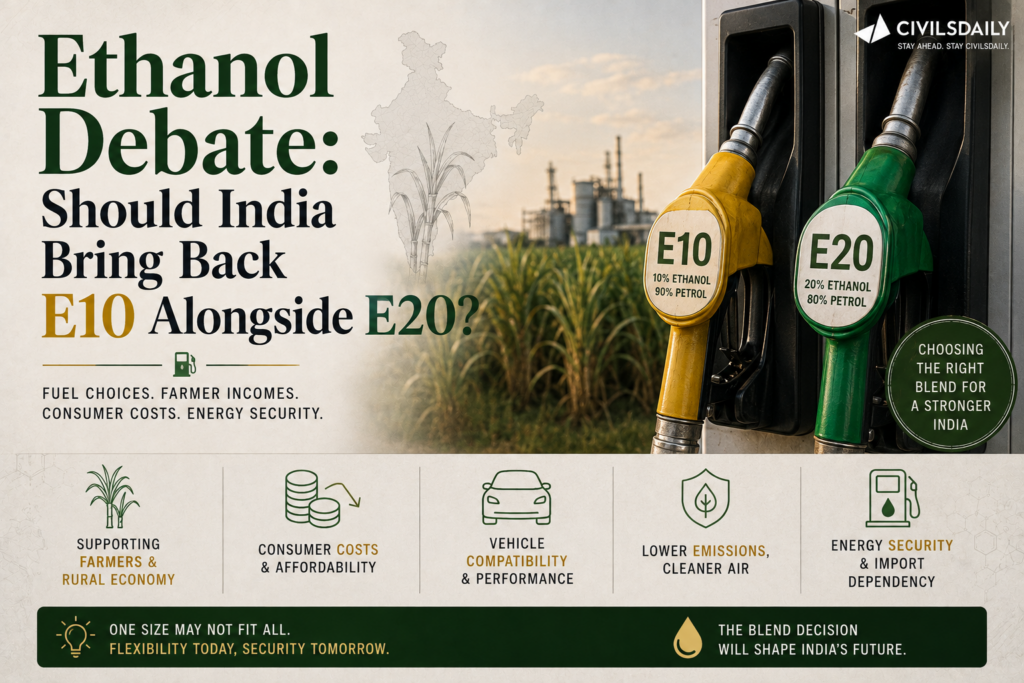
- What restoring E10 would achieve: Selling E10 alongside E20 would protect the legacy fleet while the retrofit programme catches up. It would also lower total ethanol use rather than raise it.
Why is the edible oil import gap a better target than the crude oil bill?
- Scale of the crude bill: India’s crude oil import bill runs at around Rs 11 lakh crore to Rs 12 lakh crore a year.
- Scale of the edible oil bill: The edible oil import bill is far smaller, at roughly Rs 1.6 lakh crore to Rs 1.75 lakh crore.
- What E20 actually saves: Ethanol at E20 trims only 3 to 4 percent of the crude bill.
- The edible oil gap is closeable: India already produces about 40 percent of its cooking oil and aims to reach 72 percent by financial year 2031.
- The test of a good target: A gap the government can close fully and then stop subsidising is worth more than one it can only reduce at the margin forever.
How has the shift in feedstock turned a distant trade off into a direct one?
- Grain now dominates the feedstock mix: Maize supplies about half of India’s ethanol. Grains together supply nearly 67 percent.
- Direct competition for the same fields: Maize competes with soybean, groundnut and mustard for identical acreage.
- First pull, the administered price: Ethanol from maize is procured at a fixed price well above the sugarcane route. That keeps maize attractive whatever the open market pays.
- Second pull, the feed by product: The leftover grain from distillation is sold as animal feed and undercuts soybean meal.
- The oilseed farmer loses twice: Weaker meal prices drag down soybean prices. The grower loses on acreage and then again on price.
Why do the water and climate claims not settle the case for a higher blend?
- The headline figure mixes two things: Quoted totals of thousands of litres of water per litre of ethanol combine green water and blue water into one alarming number.
- Only the blue component is scarce: Rain the crop would have received anyway does not represent a withdrawal from a contested source.
- Where the pressure actually falls: Cane in Maharashtra and Karnataka draws heavily on already stressed rivers, canals and groundwater.
- What the rule should measure: A water norm for ethanol should target blue water use, not the frightening aggregate.
- The climate evidence is unsettled: Indian life cycle studies do not agree on whether grain ethanol is cleaner than the alternatives once cultivation and processing are counted.
- Consequence for the green case: The environmental argument for going beyond E20 does not survive close scientific scrutiny.
What does experience abroad show about the limits of high ethanol blends?
- United States, Oak Ridge National Laboratory: The laboratory ran 86 vehicles for a cumulative 10 million kilometres on blends up to E20 and found no increased wear in cars not rated for E20.
- United States, multiple blends at the pump: American pumps sell E10 and E15 side by side, so owners of older vehicles retain a compatible option. This is the design India’s roadmap intended and then lost.
- United States, Renewable Fuel Standard: The mandate fixes volumes of renewable fuel in transport fuel. Its corn ethanol component drew sustained criticism for raising feed and food grain prices.
- Brazil, the Proalcool programme: Brazil built blending on sugarcane and on flex fuel vehicles able to run on any blend up to pure ethanol. The fleet, rather than the fuel specification, absorbs changes in the blend.
Why is holding at E20 not a costless option either?
- Cane arrears were cleared: Ethanol demand gave sugar mills the cash flow to settle sugarcane dues owed to farmers.
- Rural incomes rose: The programme lifted incomes and built an assured market for cane and grain growers.
- Distillery capacity was built for more: Capacity now in place was created on the expectation of blends above E20.
- Loans were taken against expected demand: Those investments carry debt to be serviced against demand a freeze would not deliver.
- The sugar surplus needs an outlet: Ethanol absorbs a structural sugar surplus that would otherwise depress domestic prices.
- Both sides belong in the reckoning: The honest course weighs the cost of holding against the cost of advancing, rather than assuming either away.
Why should reversibility decide the sequence of policy moves?
- Instruments that can change within a season: The ethanol procurement price, the protection fuel at the pump, the water rules and the import duty on edible oil can all be altered and reversed if evidence turns.
- The one instrument that cannot: The blend level is not reversible on the same timescale.
- Why the blend locks in: Once land and water are committed to fuel, cropping patterns and distillery investment are built around that commitment.
- The sequencing principle: Prudence says to move the reversible instruments first and hold off on the irreversible one until a thorough cost benefit analysis is complete.
- What the recommendation amounts to: Restore E10 for the older fleet, correct the price and water distortions favouring maize, revisit the edible oil import duty, and hold at E20.
Challenges to the Ethanol Blended Petrol Programme
- Feedstock concentration in water intensive crops: Cane and maize both carry heavy irrigation demand in already stressed basins. e.g. Latur in Maharashtra received drinking water by train during the 2016 Marathwada drought while cane crushing continued in the region.
- Diversion of food grain to fuel: Grain routed to distilleries competes with the public distribution and feed markets. e.g. the release of surplus rice by the Food Corporation of India to distilleries was repeatedly started and stopped between 2023 and 2024 as open market rice prices rose.
- Material compatibility in the legacy fleet: Older engines and fuel lines were never certified for a 20 percent blend. e.g. two wheelers manufactured before the BS4 norms of 2017 use carburettors and non compliant elastomer seals.
- Blending logistics and evacuation: Ethanol absorbs water and cannot move through existing multiproduct petroleum pipelines. e.g. supply moves by road tanker from distillery clusters in Uttar Pradesh and Maharashtra to deficit states in the south and the east.
- Second generation ethanol has not scaled: Cellulosic ethanol from crop residue remains commercially fragile. e.g. the Panipat second generation bioethanol refinery based on paddy straw has struggled with feedstock aggregation since its commissioning in 2022.
- Administered price distortion across routes: A fixed price above the cane route pulls acreage towards maize regardless of demand. e.g. maize acreage has expanded in Bihar and Madhya Pradesh at the expense of oilseeds.
- Consumer trust and labelling: Buyers cannot easily tell which blend they are purchasing or whether their vehicle is rated for it. e.g. the 2026 online campaign over E20 mileage produced public demands for a lower blend option at pumps.
Conclusion
The engine controversy was never the real argument. The decision that matters is the blend level itself, because procurement prices, water rules, the protection fuel and import duties can be reversed within a season while committed land, cropping patterns and distillery capacity cannot. Restoring E10 for the older fleet and holding at E20 until the food versus fuel trade off is properly costed keeps every reversible option open. The unresolved question is what India chooses to grow, and what it will not be able to take back.
Biofuels and Ethanol Blending in India
- About: Biofuels are liquid or gaseous fuels produced from biomass and used to substitute petroleum products in transport.
- Categories: They run from first generation fuels made from food crops, to second generation fuels from agricultural residue, third generation fuels from algae and fourth generation fuels using carbon capture.
- Blending record: Average ethanol blending rose from 1.53 percent in financial year 2014 to 20 percent in 2025, achieved five years ahead of the 2030 target.
- Global standing: India is among the largest ethanol producers and consumers in the world, after the United States and Brazil.
- Scale of the fuel base: India consumes roughly 40 million tonnes of petrol a year, which sets the size of the ethanol requirement at any given blend.
- Claimed gains: Official statements place foreign exchange savings from ethanol blending at over Rs 1 lakh crore since 2014.
- Structural feature: Ethanol is the only large scale biofuel India has commercialised, while biodiesel and compressed biogas remain far below their targets.
Laws and Rules Governing Biofuels in India
- National Policy on Biofuels, 2018: Categorises biofuels, widens the permitted feedstock list and sets indicative blending targets.
- 2022 amendment: Advanced the 20 percent ethanol blending target to the 2025 26 ethanol supply year and permitted additional feedstocks.
- Industries (Development and Regulation) Act, 1951: Provides the regulatory basis for distilleries and for the Centre’s control over industrial and denatured alcohol.
- Judicial position: A nine judge Bench of the Supreme Court held in October 2024 that “intoxicating liquor” under Entry 8 of the State List covers industrial alcohol, preserving State regulatory power.
- Essential Commodities Act, 1955: Enables control over the movement, storage and pricing of molasses and ethanol.
- Environment (Protection) Act, 1986: Governs distillery effluent standards, including zero liquid discharge norms for molasses based units.
- Motor Vehicles Act, 1988 and Central Motor Vehicles Rules, 1989: Set emission norms and material compatibility requirements for vehicles rated to run on E20.
- Bureau of Indian Standards specifications: IS 2796 governs motor gasoline and IS 15464 governs anhydrous ethanol, with a separate notified specification for E20 fuel.
Back2Basics: National Policy on Biofuels, 2018
- Nodal ministry: Ministry of Petroleum and Natural Gas.
- Approval and revision: Approved by the Union Cabinet in 2018 and amended in 2022.
- Categorisation: Divides biofuels into Basic Biofuels, meaning first generation bioethanol and biodiesel, and Advanced Biofuels, meaning second generation ethanol, municipal solid waste to drop in fuels, third generation biofuels and bio compressed natural gas.
- Permitted raw materials for ethanol: Sugarcane juice, sugar beet, sweet sorghum, corn, cassava, damaged food grains such as wheat and broken rice, and rotten potatoes unfit for human consumption.
- Blending targets: 20 percent ethanol in petrol and 5 percent biodiesel in diesel by 2030, with the ethanol target later advanced to the 2025 26 supply year.
- Surplus grain clause: Allows use of surplus food grains for ethanol production with the approval of the National Biofuel Coordination Committee, chaired by the Minister of Petroleum and Natural Gas.
- Financial support: Provides viability gap funding for second generation ethanol refineries and additional incentives for advanced biofuels.
Government Initiatives for Biofuels and Ethanol
- Ethanol Blended Petrol Programme, 2003: Mandates blending of ethanol in petrol supplied by oil marketing companies across notified states and Union Territories.
- Pradhan Mantri JI-VAN Yojana, 2019: Provides viability gap funding to commercial and demonstration second generation bioethanol projects using lignocellulosic biomass.
- SATAT initiative, 2018: Sustainable Alternative Towards Affordable Transportation invites entrepreneurs to set up compressed biogas plants and sell the output to oil marketing companies.
- GOBARdhan scheme: Converts cattle dung and agricultural waste into biogas and organic manure, targeted at rural households and dairy clusters.
- Ethanol Interest Subvention Scheme: Subsidises interest on loans taken by sugar mills and standalone distilleries to expand ethanol capacity.
- Global Biofuels Alliance: Launched at the G20 New Delhi Summit in September 2023 with India, the United States and Brazil as founding members, to accelerate global biofuel trade and technology transfer.
- National Mission on Edible Oils, Oil Palm, 2021, and the Oilseeds Mission: Target domestic self sufficiency in cooking oil, which is the competing claim on the same land the ethanol programme draws from.
Key Facts about Ethanol Blending
- World Biofuel Day is observed on 10 August, marking the day in 1893 an engine was run on peanut oil by Rudolf Diesel.
- The Ethanol Supply Year runs from 1 November to 31 October, not the financial year.
- E20 is 20 percent ethanol by volume, E85 is 85 percent, and E100 denotes ethanol used as a standalone fuel.
- India achieved 20 percent average blending in 2025, five years ahead of the 2030 target set in the 2018 policy.
- Flex fuel vehicles are engineered to run on any blend up to E85 or E100 without modification.
- Ethanol procurement uses differential administered prices by feedstock route, with the sugarcane juice route priced highest among cane routes.
- The National Biofuel Coordination Committee clears the use of surplus food grains for ethanol.
Challenges in the Biofuel Sector
- Biodiesel blending has barely moved: Against a 5 percent target, biodiesel blending has remained close to negligible. e.g. used cooking oil collection under the Repurpose Used Cooking Oil initiative covers only a fraction of India’s restaurant and hotel supply chain.
- Sugar cycle volatility disrupts contracts: Ethanol supply from cane is hostage to sugar availability decisions taken mid season. e.g. the 2023 restriction on diverting cane juice to ethanol was imposed to protect domestic sugar supply and stranded distillery offtake plans.
- Centre and State conflict over alcohol regulation: Regulatory authority over industrial alcohol is contested and affects distillery licensing. e.g. the Supreme Court’s nine judge ruling of October 2024 held that States retain power over industrial alcohol under Entry 8 of the State List.
- Compressed biogas offtake and evacuation: Plant commissioning lags the announced targets because feedstock aggregation and gas evacuation are unresolved. e.g. SATAT set a target of 5,000 compressed biogas plants and actual commissioning has run far behind.
- Water footprint of the feedstock base: Blending demand is concentrated in crops grown in drought prone tracts. e.g. Maharashtra’s cane belt draws on stressed groundwater in districts that carry recurring drought declarations.
- Vehicle fleet compatibility lag: Only recent vehicles are certified for the mandated blend. e.g. only vehicles manufactured from April 2023 are E20 material compliant, leaving the older fleet dependent on a lower blend that is no longer sold.
- Absence of a settled national life cycle assessment: Without an agreed carbon accounting method, the climate benefit claimed for each blend level cannot be verified. e.g. Indian studies differ on whether maize ethanol lowers emissions once fertiliser and processing energy are counted.
Way Forward
- Restore a lower blend at the pump: Sell E10 alongside E20 nationally until the retrofit of pre BS4 two wheelers is substantially complete.
- Correct the administered price: Reprice ethanol by feedstock so that maize does not carry an artificial advantage over oilseeds.
- Regulate blue water, not aggregate water: Set distillery and feedstock water norms on measured groundwater and canal withdrawal, with metering at the distillery gate.
- Fund oilseed self sufficiency: Direct the incentive structure towards closing the edible oil import gap, which is smaller and fully closeable.
- Scale second generation ethanol: Build residue aggregation networks so that paddy straw and bagasse substitute for grain feedstock.
- Mandate flex fuel capability: Require new vehicles to be flex fuel rated so that future blend changes are absorbed by the fleet rather than by the fuel specification.
- Publish a national cost benefit study: Complete a transparent food versus fuel accounting, covering land, blue water and life cycle emissions, before any move to E27 or E30.
“[2020] According to India’s National Policy on Biofuels, which of the following can be used as raw materials for the production of biofuels?
1. Cassava
2. Damaged wheat grains
3. Groundnut seeds
4. Horse gram
5. Rotten potatoes
6. Sugar beet
Select the correct answer using the code given below:
(a) 1, 2, 5 and 6 only
(b) 1, 3, 4 and 6 only
(c) 2, 3, 4 and 5 only
(d) 1, 2, 3, 4, 5 and 6
