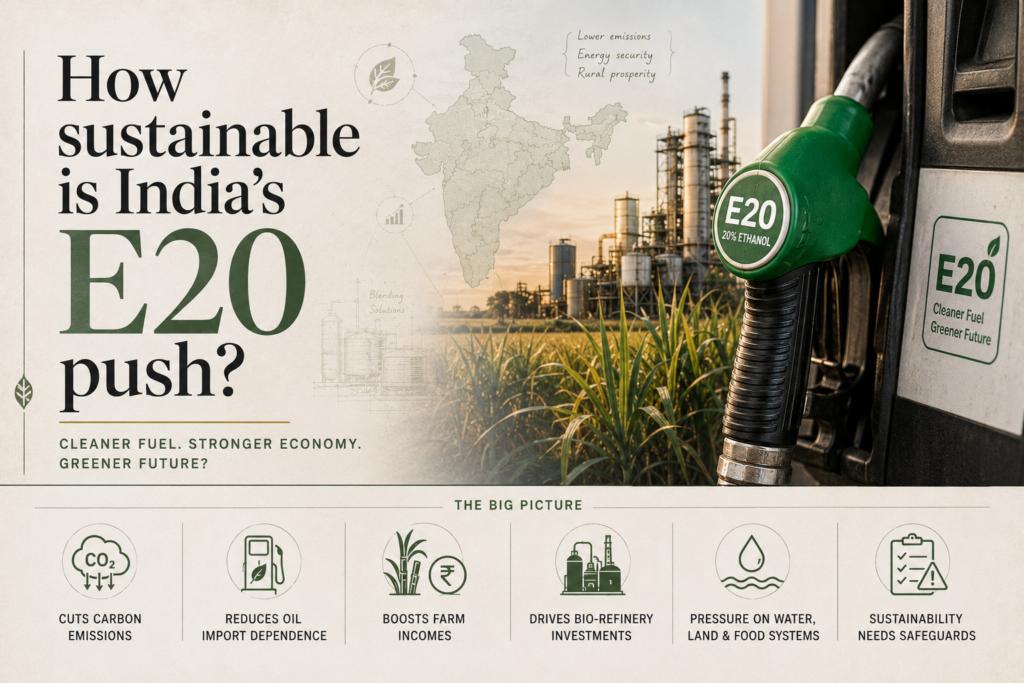
Why in the news?
The government has told Parliament that its ethanol blending programme has saved large sums of foreign exchange, while Opposition leaders have launched campaigns arguing that E20 harms vehicles and is being forced on people. The debate exposes a tension between the energy security and forex gains of blending 20 per cent ethanol into petrol and the costs it imposes on the country’s large legacy vehicle fleet and, potentially, on food security. The dispute now runs through disputed damage studies and feedstock diversion.
What is E20?
- About: E20 is petrol blended with 20 per cent ethanol, meant to replace a fifth of transport petrol with domestically produced ethanol.
- Objective: The government targeted 10 to 11 billion litres of ethanol so that the money stays in the Indian economy rather than flowing out as a foreign exchange outgo on crude oil imports.
What is ethanol and why does it affect engines?
- Polar solvent: Ethanol is a polar solvent that degrades older rubber compounds and plastics, hardening and cracking fuel hoses over time.
- Hygroscopic behaviour: Ethanol absorbs atmospheric moisture, and in parked vehicles the ethanol-water mixture separates and forms an acidic layer that corrodes tanks, damages fuel pumps, and clogs filters with sludge.
What is the status of ethanol production?
- Capacity ramp-up: India’s distillery capacity now can produce some 18 to 20 billion litres from around 500 distilleries.
- Procurement contracted: For this ethanol year, which runs November to October, oil companies have contracted to procure some 10.5 billion litres of ethanol.
- Feedstock mix: Government figures show 45 per cent of ethanol for petrol blending will come from maize, Food Corporation of India (FCI) rice about 22 per cent, sugarcane juice 16 per cent, B-heavy molasses about 10 per cent, damaged foodgrains around 4.5 per cent, and C-heavy molasses 1.1 per cent.
- Maize expansion: India’s maize output grew 45 per cent in three years to 55 million tonnes in 2025-26, with more than 20 per cent of it going into ethanol.
Will E20 spur corn imports from the United States?
- No import surge: There is no evidence of a surge in ethanol or maize imports in Ministry of Commerce statistics.
- Import ban: Direct ethanol import for petroleum blending is banned, even as the US corn lobby pushes India to increase corn imports.
- Sugar stocks stable: The closing stock of sugar was around 5 million tonnes and is expected to hold, indicating diversion to ethanol has not affected sugar availability.
- Conditional risk: In the event of monsoon failure, crop losses, and foodgrain shortages, diversion of FCI rice, sugarcane juice, and B-heavy molasses will come under stress. This raises the possibility of corn imports.
Which vehicles are affected, and which are not?
- Newer fleet safe: Vehicles bought after April 2023, when the Bharat Stage 6 Phase 2 mandate took effect, were factory-engineered for E20 with ethanol-resistant elastomers, fluorinated fuel lines, upgraded pump seals, and recalibrated engine control units.
- Scale of newer fleet: These roughly 70 million vehicles are about 23 per cent of India’s active petrol fleet and face little cause for concern.
- Legacy fleet at risk: The remaining 77 per cent, nearly 240 million legacy two-wheelers and cars built for E5 or E10, are the genuine worry.
Do the damage claims hold up? (the central tension)
- Consumer complaints: Consumer surveys by LocalCircles found 66 per cent of pre-2023 owners reporting mileage losses exceeding 10 per cent, and 55 per cent reporting increased maintenance.
- Institutional defence: IIT Kanpur’s Engine Research Laboratory maintains E20 causes no notable damage, with efficiency loss under 5 per cent, attributing most complaints to driving habits and traffic conditions.
- Field disputes: Independent mechanics and automotive communities dispute this, citing real-world fuel pump and injector failures traced to ethanol’s solvent and low-lubricity properties.
- Manufacturer data: The government told Parliament that one manufacturer serviced 2.84 crore vehicles in FY 2025-26, including about 1.5 crore legacy vehicles, without finding E20-linked engine damage, and reported an efficiency penalty of about 2 to 6 per cent in some E10-designed vehicles.
Why has the rollout drawn criticism?
- Speed of transition: India reached the 10 per cent milestone in 2022 and ramped up to 20 per cent within three years, with very little information and advisories from manufacturers.
- Contrast with Brazil: Brazil’s transition to high ethanol levels happened over several decades in a stable manner, alongside vehicle modifications, taking the public into confidence.
- Information gap: The compressed rollout left legacy vehicle owners without clear guidance on effects and maintenance.
Has ethanol blending eased the oil supply burden?
- Forex saving: The government said the programme has saved around 2 lakh crore rupees of foreign exchange and substituted some 32 million tonnes of crude oil imports.
- Import substitution: Substituting 10 billion litres of petrol with ethanol amounts to dispensing with about a month of crude imports.
- Price shielding claim: The government said that while crude prices rose 70 per cent during the war in West Asia, pump petrol prices rose only 7 to 8 per cent, though under-recoveries also increased.
- Cost ambiguity: Oil companies procure ethanol at around 70 rupees per litre, and with the base price of petrol at 55 to 60 per cent of the pump price, it is difficult to conclude independently that ethanol has kept prices down.
Conclusion
The central idea is that E20 delivers real forex and energy-security gains but shifts costs onto a legacy fleet of nearly 240 million vehicles whose damage claims remain contested between consumer surveys and institutional studies. What remains unresolved is a transparent, phased communication of effects and maintenance, and a food-security cushion if monsoon failure forces feedstock diversion. A Brazil-style stable transition would have taken the public into confidence.
National Biofuel Policy: About
- About: The National Policy on Biofuels sets targets for blending ethanol in petrol and biodiesel in diesel to cut import dependence.
- Feedstock scope: It permits multiple feedstocks including sugarcane, damaged foodgrains, maize, and other surplus grains.
- Blending target: The policy advanced the 20 per cent ethanol blending target, which India pursued aggressively from 2022.
Government Initiatives for Biofuels
- Ethanol Blended Petrol (EBP) Programme: Mandates blending of ethanol with petrol and drives procurement by oil companies.
- Pradhan Mantri JI-VAN Yojana: Supports second-generation ethanol from agricultural residues.
- SATAT initiative: Promotes compressed biogas as a transport fuel from waste and biomass.
Key Facts about Ethanol Blending
- Ethanol year: Runs from November to October.
- Grades of molasses: B-heavy and C-heavy molasses are distinct sugar-industry by-products used as feedstock.
- BS6 Phase 2: Took effect in April 2023 and coincided with factory engineering of vehicles for E20.
Challenges to the E20 push
- Legacy fleet damage: Corrosion, hose degradation, and pump failures in pre-2023 vehicles.
- Efficiency loss: Lower energy density reduces mileage, disputed in magnitude.
- Food-fuel conflict: Diversion of rice, maize, and sugar feedstock risks food security in a bad monsoon.
- Water intensity: Sugarcane and maize cultivation for ethanol strains groundwater.
- Consumer information deficit: Rapid rollout without adequate advisories.
- Cost transparency: Different tax and costing regimes obscure whether ethanol lowers pump prices.
Way Forward
- Phased communication: Issue clear manufacturer advisories on effects and maintenance for legacy vehicles.
- Feedstock diversification: Expand second-generation ethanol from residues to reduce grain diversion.
- Food-security buffer: Build safeguards to pause grain diversion during monsoon failure.
- Independent testing: Commission transparent, independent studies on legacy-vehicle impacts.
- Consumer redress: Provide guidance and support for owners of affected pre-2023 vehicles.
PYQ Relevance
“[2020] According to India’s National Policy on Biofuels, which of the following can be used as raw materials for the production of biofuels?
1. Cassava
2. Damaged wheat grains
3. Groundnut seeds
4. Horse gram
5. Rotten potatoes
6. Sugar beet
(a) 1, 2, 5 and 6 only
(b) 1, 3, 4 and 6 only
(c) 2, 3, 4 and 5 only
(d) 1, 2, 3, 4, 5 and 6
