Why in the News
India’s ethanol blending has reached 20%, ahead of the 2030 target. It has displaced 310 lakh tonnes of imported crude, saved over ₹1.90 lakh crore in foreign exchange and transferred over ₹1.6 lakh crore to farmers.
What is the Ethanol Blended Petrol (EBP) Programme?
- EBP: Ethanol Blended Petrol Programme blends ethanol, mainly produced from sugarcane and grains, with petrol.
- E20: 20% ethanol blending has been achieved ahead of schedule.
- Benefits: Reduces crude imports, supports farmers and lowers emissions.
What are Strategic Petroleum Reserves (SPR)?
- SPR: Strategic Petroleum Reserves are underground crude oil storage facilities used as an insurance against supply disruptions.
- They provide a temporary buffer and must eventually be replenished.
What has Ethanol Blending Achieved?
- 20% blending achieved.
- 310 lakh tonnes of crude imports displaced.
- ₹1.90 lakh crore+ foreign exchange saved.
- ₹1.6 lakh crore+ transferred to farmers.
- 930 lakh tonnes+ CO₂ emissions avoided.
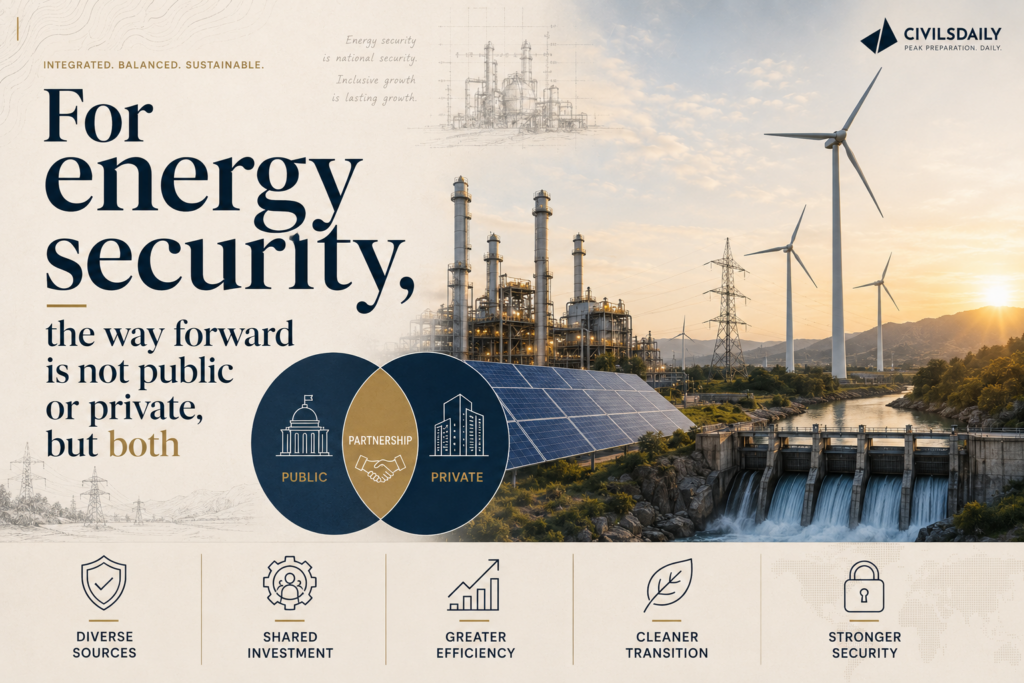
Why Both Public and Private Players?
- ONGC: Oil and Natural Gas Corporation, a major state-owned upstream producer.
- OIL: Oil India Limited, another major state-owned upstream producer.
- Public sector: Provides strategic control and supports national energy security.
- Private sector: Brings capital, technology and efficiency into exploration, production and storage.
- Balanced approach: India needs both strategic public capacity and competitive private participation.
How Do Reserves and Domestic Production Complement Each Other?
- SPR: Protects against sudden supply shocks.
- Domestic production: Reduces imports over the life of an oil field.
- Overseas stocks: Long-term suppliers could maintain crude stocks earmarked for India.
- Exploration: Opening more offshore areas can expand domestic resources.
Energy Security in India
- Energy security means reliable and affordable energy supply with resilience against disruptions.
- Four pillars:
- Domestic production
- Strategic reserves
- Import diversification
- Alternative fuels
India’s high crude import dependence exposes it to global price shocks and disruptions in chokepoints such as the Strait of Hormuz and Bab el-Mandeb.
Key Government Initiatives
- EBP: Ethanol Blended Petrol Programme.
- NBP: National Policy on Biofuels, 2018.
- PM JI-VAN: Pradhan Mantri JI-VAN Yojana, promoting 2G (second-generation) ethanol from agricultural residues.
- SATAT: Sustainable Alternative Towards Affordable Transportation, promoting compressed biogas.
- SPR Programme: Strategic Petroleum Reserves Programme for crude oil security.
[2025] Consider the following statements:
Statement I: Of the two major ethanol producers in the world, i.e., Brazil and the United States of America, the former produces more ethanol than the latter.
Statement II: Unlike in the United States of America, where corn is the principal feedstock for ethanol production, sugarcane is the principal feedstock for ethanol production in Brazil.
Which one of the following is correct in respect of the above statements?
(a) Both Statement I and Statement II are correct and Statement II is the correct explanation for Statement I
(b) Both Statement I and Statement II are correct and Statement II is not the correct explanation for Statement I
(c) Statement I is correct but Statement II is incorrect
(d) Statement I is incorrect but Statement II is correct
