💥Mains Ready By December. Smash Mains & Smash PYQ Admissions Open

GS Paper: GS3

  • PAN, Aadhaar made mandatory for high-value cash deposits & withdrawals

    The government has made requirement of a Permanent Account Number (PAN) or Aadhaar number for depositing or withdrawing Rs 20 lakh or more in a financial year or for opening a current account mandatory.

    Regulating high-value transactions

    • The Central Board of Direct Taxes, in a notification, said furnishing PAN or biometric Aadhaar will be mandatory for such high-value cash deposits or withdrawals from banks in a financial year.
    • The same will be applied for opening of a current account or cash credit account with a bank or post office.
    • Banks, post offices and co-operative societies would be required to report the transactions of deposits and withdrawals aggregating to Rs 20 lakh or more in a financial year.
    • As of now, PAN is required to be furnished for cash deposits of Rs 50,000 or more in a day.
    • With these rules, a threshold of Rs 20 lakh has been defined for the full financial year.

    How will this help tax department?

    • This move will help the government in tracing the movement of cash in the financial system.
    • It is expected to help the income tax department monitor deposits/withdrawals where tax would not be getting paid by the individual otherwise on his or her income.

    Why PAN-Aadhaar interoperability?

    • The PAN-Aadhaar interoperability will help banks to record details for those who don’t have PAN.
    • The interchangeable provision in the rules would allow a bank or financial institution to ask for Aadhaar in case an individual states that he or she doesn’t have PAN.
    • The Finance Act, 2019, has provided for the interchangeability of PAN with Aadhaar.
    • It has been provided that every person who is required to furnish or intimate or quote his PAN under the Income-tax Act.
    • Those who, has not been allotted a PAN but possesses the Aadhaar number, may furnish or intimate or quote his Aadhaar in lieu of PAN.


    UPSC 2023 countdown has begun! Get your personal guidance plan now! (Click here)

  • Green Manure and its productivity benefits

    The Punjab agriculture department is promoting the cultivation of green manure these days.

    What is the news?

    • Punjab Agro is providing subsidy on the seed at the rate of Rs 2,000 per quintal, which costs Rs 6,300 per quintal without subsidy
    • The farmers can avail its seed from the block level offices of the agriculture department as limited stock is available.

    What is Green Manure?

    • Green manures are crops grown specifically for maintaining soil fertility and structure.
    • It is done by leaving uprooted or sown crops parts, allowing them to wither onto the field and serve as mulch and soil fertilizers.
    • They are normally incorporated back into the soil, either directly, or after removal and composting.
    • There are three main varieties of green manure, including
    1. Dhaincha
    2. Cowpea
    3. Sunhemp
    • Also some crops such as summer moong, mash pulses and guar act as green manure.
    • They can be sown after wheat cultivation

    Characteristics of green manure

    • Green manure must be leguminous in nature
    • They must bear maximum nodules on its roots to fix large amount of atmospheric nitrogen in the soil.

    Various policy initiatives

    • Under Sub- Mission on Seed and Planting Material (SMSP), the govt. provides 50% cost assistance for the distribution of green manure required for a one-acre area per farmer.
    • The Paramparagat Krishi Vikas Yojana (PKVY) promotes cluster-based organic farming with PGS (Participatory Guarantee System) certification.


  • Places in news: Pantanal Wetlands

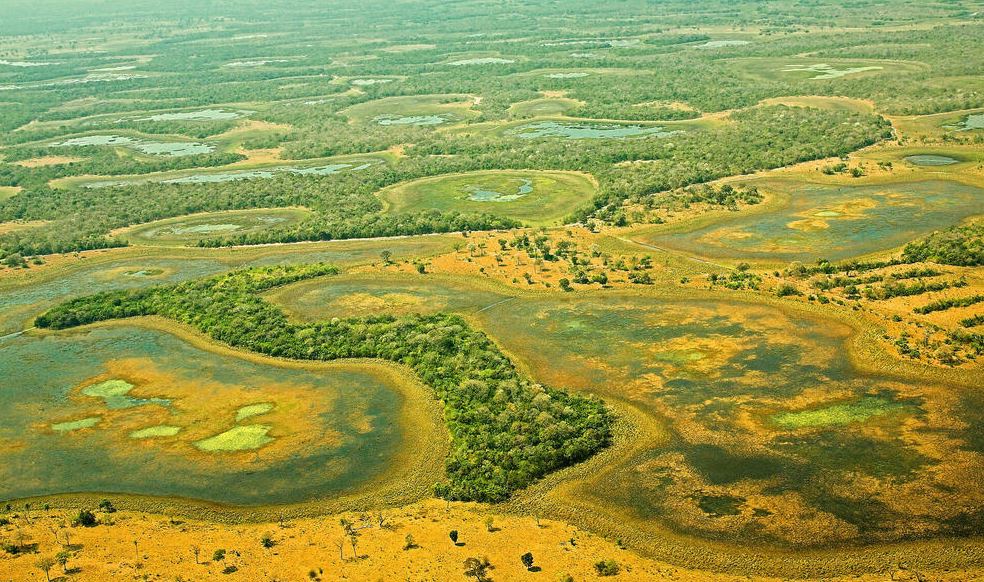
    The world’s largest wetland, the Pantanal in South America, is at the risk of collapse due to legal land-use decisions and proposals.

    About Pantanal

    • The Pantanal is a natural region encompassing the world’s largest tropical wetland area, and the world’s largest flooded grasslands.
    • It is located mostly within the Brazilian state of Mato Grosso do Sul, but it extends into Mato Grosso and portions of Bolivia and Paraguay.
    • It sprawls over an area estimated at between 140,000 and 195,000 square kilometres.
    • Various subregional ecosystems exist, each with distinct hydrological, geological and ecological characteristics; up to 12 of them have been defined.
    • Roughly 80% of the Pantanal floodplains are submerged during the rainy seasons, nurturing a biologically diverse collection of aquatic plants and helping to support a dense array of animal species.

    Significance of Pantanal

    • The Pantanal is a refuge for iconic wildlife. This massive wetland has the largest concentration of crocodiles in the world, with approximately 10 million caimans.
    • Jaguars, the largest feline in the Americas, hunt caiman in the Pantanal, which has one of the highest density of jaguars anywhere the world.

    Threats

    • Around 95% of the Pantanal is under private ownership, the majority of which is used for cattle grazing.


    UPSC 2023 countdown has begun! Get your personal guidance plan now! (Click here)

  • Power crisis in India

    Context

    The power crisis has taken us by surprise. The question in everyone’s mind is: where did we go wrong? And who slipped up?

    Responsibilities in supply chain

    • Under the Electricity Act, it is the responsibility of the Distribution Licensee/Company (Discom) to provide reliable quality and round-the-clock electricity to all consumers to meet full demand.
    • To do so, they enter into contracts with a number of generating companies in order to ensure adequate supply.
    • These Discoms work under the oversight of the State Electricity Regulatory Commissions.

    Suggestions

    1] Dealing with the challenge of demand prediction

    • Qualitative transformation in demand: With higher incomes and the consequent increase in the use of air-conditioners and other electrical appliances, the nature of electricity demand is undergoing a qualitative transformation with rising daily and seasonal peaks, and spikes on very hot or cold days.
    • While demand prediction is inherently uncertain, the questions to ask are whether Discoms have been making and updating their demand growth projections and scenarios over the medium term with adequate supply arrangements in a robust manner.
    • This needs to become central to the regulatory process.
    • Ensuring reliable supply to meet unanticipated peaks, as have occurred now, requires making supply arrangements with reserve margins that are adequate.
    • The Regulatory Commissions need to provide for such expensive peaking power arrangements in the tariffs they approve.
    • It is also time to move towards separate peaking power procurement contracts in addition to the present system of long-term thermal power contracts.

    2] Demand-based time of day rates of electricity

    • A transition to demand-based time of day rates of electricity for generators as well as consumers would help.
    • These should be brought in by the Regulatory Commissions.
    • Flattening of demand curve: Peak demand moderation and flattening of the demand curve through a change in consumer behaviour is feasible with smart meters.
    • But this would take place only with a strong price signal, a large differential in peak and off-peak rates.

    3] Subsidies and politics

    • Free supply of electricity to farmers and households up to a specified level is not a problem as long as State governments pay for it as provided in the Act, and the Regulatory Commissions do not at the same time act from a political point of view and shy away from determining cost-reflective tariffs.
    • While the problem of delayed payments by Discoms is getting highlighted and needs to be resolved with a sense of urgency, the coal supply problem is not due to this.
    • Coal India needs to create capacities to rapidly ramp up production; and the Railways need to carry larger quantities of coal when demand surges, as has happened now.
    • Imported coal and gas generated electricity: There is idle but expensive generating capacity available — about 15-20 GW of gas-based power plants which can run on imported liquefied natural gas, and 6 GW-8 GW of thermal plants which can run on imported coal.
    • Consumers who are willing to pay more could be kept free of power cuts with purchase and supply of more expensive electricity generated from imported coal and gas.
    • To improve reliability, Discoms, with the approval of the Regulatory Commissions, need to go in for bids for storage.

    Conclusion

    A lesson is that demand growth projections and supply arrangements need to become central to the regulatory process.

    UPSC 2023 countdown has begun! Get your personal guidance plan now! (Click here)

  • Control inflation by acting on liquidity

    Context

    The recent action of the Reserve Bank of India (RBI) to raise the repo rate by 40 basis points and cash reserve ratio (CRR) by 50 basis points is a recognition of the serious situation with respect to inflation in our country and the resolve to tackle inflation.

    Inflation in India and role of government expenditure

    • India’s CPI inflation has been fluctuating around a high level.
    • As early as October 2020, it had hit a peak of 7.61%.
    • It had remained at a high level of over 6% since April 2020.
    • It did come down after December 2020 but has started rising significantly from January 2022.
    • On the other hand, the Wholesale Price Index (WPI) inflation had remained in double digits since April 2021. The GDP implicit price deflator-based inflation rate for 2021-22 is 9.6%.
    • Even though the RBI’s mandate is with respect to CPI inflation, policymakers cannot ignore the behaviour of other price indices.
    • After the advent of COVID-19, the major concern of policymakers all over the world was to revive demand.
    • Keynesian prescription: This was sought to be achieved by raising government expenditure.
    • Thus, the expansion in government expenditure did not immediately result in increased production in countries where the lockdown was taken seriously.
    • However, the Keynesian multiplier does not work when there are supply constraints as in developing countries.
    • That is why the multiplier operates in nominal terms rather than in real terms in such countries.
    • Something similar has happened in the present case where the supply constraint came from a non-mobility of factors of production.
    • Nevertheless, the prescription of enhanced government expenditure is still valid under the present circumstances.
    • Perhaps the increase in output could happen with a lag and also with the relaxation of restrictions.

    Role of monetary policy

    • Why lover money multiplier rate? Initially, the focus of monetary policy in India has been to keep the interest rate low and increase the availability of liquidity through various channels, some of which have been newly introduced.
    • However, the growth rate of money was below the growth rate in reserve money.
    • This is because of lower credit growth which also depends on business sentiment and investment climate.
    • Thus the money multiplier is lower than usual.
    • The Government’s borrowing programme which was larger went through smoothly, thanks to abundant liquidity.
    • Even as the economy picked up steam in 2021-22, inflation also became an issue, this is a worldwide phenomenon.
    • In India too there is a shift in monetary policy.

    Analysing the cause of inflation

    • While discussing inflation, analysts focus almost exclusively on the increases in the prices of individual commodities such as crude oil as the primary cause of inflation.
    • General price level: Supply disruptions due to domestic or external factors may explain the behaviour of individual prices but not the general price level which is what inflation is about.
    • Given a budget constraint, there will only be an adjustment of relative prices.
    • Besides the fact that any cost-push increase in one commodity may get generalised, it is the adjustment that happens at the macro level which becomes critical.
    • It is the adjustment in the macro level of liquidity that sustains inflation.

    Inflation and growth

    • The possible trade-off between inflation and growth has a long history in economic literature.
    • The Phillip’s curve has been analysed theoretically and empirically.
    • Tobin called the Phillip’s curve a ‘cruel dilemma’ because it suggested that full employment was not compatible with price stability. 
    • The critical question flowing from these discussions on trade-off is whether cost-push factors can by themselves generate inflation.
    • In the current situation, it is sometimes argued that inflation will come down, if some part of the increase in crude prices is absorbed by the government. 
    • If the additional burden borne by the government (through loss of revenue) is not offset by expenditures, the overall deficit will widen.
    • The borrowing programme will increase and additional liquidity support may be required.

    Concomitant decisions on CRR and repo rate

    • These are concomitant decisions. Central banks cannot order interest rates.
    • For a rise in the interest rate to stick, appropriate actions must be taken to contract liquidity.
    • That is what the rise in CRR will do.
    • In the absence of a rise in CRR, liquidity will have to be sucked by open market operations.

    Conclusion

    Beyond a point, inflation itself can hinder growth. Negative real rates of interest on savings are not conducive to growth. If we want to control inflation, action on liquidity is very much needed with a concomitant rise in the interest rate on deposits and loans.

    UPSC 2023 countdown has begun! Get your personal guidance plan now! (Click here)

  • Plans underway on Creation of Integrated Battle Groups

    The Indian Army is in advanced stages of putting together Integrated Battle Groups (IBGs) by reconfiguring its combat formations.

    What are IBGs?

    • IBGs are brigade-sized, agile, self-sufficient combat formations, which can swiftly launch strikes against an adversary in case of hostilities.
    • Each IBG would be tailor-made based on Threat, Terrain and Task and resources will be allotted based on the three Ts.
    • They need to be light so they will be low on logistics and they will be able to mobilise within 12-48 hrs based on the location.
    • An IBG operating in a desert needs to be constituted differently from an IBG operating in the mountains.
    • The key corps of the Army is likely to be reorganized into 1-3 IBGs.

    Objective of IBG

    • Holistic integration to enhance the operational and functional efficiency, optimize budget expenditure, facilitate force modernization and address aspirations

    Structure of the IBG

    • While a command is the largest static formation of the Army spread across defined geography, a corps is the largest mobile formation.
    • Typically each corps has about three brigades.
    • The idea is to reorganise them into IBGs which are brigade-sized units but have all the essential elements like infantry, armoured, artillery and air defence embedded together based on the three Ts.
    • The IBGs will also be defensive and offensive. While the offensive IBGs would quickly mobilise and make a thrust into enemy territory for strikes, defensive IBGs would hold ground at vulnerable points or where enemy action is expected.

    Why need IBGs?

    • After the terrorist attack on the Parliament, the Indian military undertook massive mobilization but the Army’s formations which deep inside took weeks to mobilise losing the element of surprise.
    • Following this, the Army formulated a proactive doctrine known as ‘Cold Start’ to launch swift offensive but its existence was consistently denied in the past.
    • Its existence was acknowledged for the first time by (Late) Gen Rawat in January 2017.


    UPSC 2023 countdown has begun! Get your personal guidance plan now! (Click here)

  • Highlights of State of the World’s Birds Report

    The State of the World’s Birds, an annual review of environmental resources has revealed that the population of 48% of the 10,994 surviving species of birds is declining.

    State of the World’s Birds

    • The report is published by the Manchester Metropolitan University.
    • It gives an overview of the changes in the knowledge of avian biodiversity and the extent to which it is imperilled.
    • The study draws from BirdLife International’s latest assessment of all birds for the International Union for Conservation of Nature’s Red List.

    What are the key findings of the study?

    • The study found that 5,245 or about 48% of the existing bird species worldwide are known or suspected to be undergoing population declines.
    • While 4,295 or 39% of the species have stable trends, about 7% or 778 species have increasing population trends.
    • It shows 1,481 or 13.5% species are currently threatened with global extinction.

    Where the birds are threatened the most?

    • The more threatened bird species (86.4%) are found in tropical than in temperate latitudes (31.7%).
    • Such hotspots are concentrated in the tropical Andes, southeast Brazil, eastern Himalayas, eastern Madagascar, and Southeast Asian islands.

    What is the importance of birds to ecosystems and culture?

    • Birds contribute toward many ecosystem services that either directly or indirectly benefit humanity.
    • These include provisioning, regulating, cultural, and supporting services.
    • The functional role of birds within ecosystems as pollinators, seed-dispersers, ecosystem engineers, scavengers and predators.
    • They not only facilitate accrual and maintenance of biodiversity but also support human endeavours such as sustainable agriculture via pest control besides aiding other animals to multiply.
    • For instance, coral reef fish productivity has been shown to increase as seabird colonies recovered following rat eradication in the Chagos archipelago.
    • Wild birds and products derived from them are also economically important as food (meat, eggs).

    What are the threats contributing to avian biodiversity loss?

    • The study lists eight factors, topped by land cover and land-use change.
    • The continued growth of human populations and of per capita rates of consumption lead directly to conversion and degradation of primary natural habitats.
    • Deforestation has been driven by afforestation with plantations (often of non-native species) plus land abandonment in parts of the global North, with net loss in the tropics.
    • The other factors are habitat fragmentation, degradation, hunting and trapping.

    Try this PYQ from CSP 2020:

    Q.With reference to India’s Biodiversity, Ceylon frogmouth, Coppersmith barbet, Gray-chinned minivet and White-throated redstart are

    (a) Birds

    (b) Primates

    (c) Reptiles

    (d) Amphibians


    [wpdiscuz-feedback id=”1zhy7sfg15″ question=”Please leave a feedback on this” opened=”1″]Post your answers here.[/wpdiscuz-feedback]


    UPSC 2023 countdown has begun! Get your personal guidance plan now! (Click here)
  • What are W Bosons?

    Researchers from Collider Detector at Fermilab (CDF) Collaboration, in the US, announced that they have made a precise measurement of the mass of the so-called W boson.

    Do you know?

    There are four fundamental forces at work in the universe: the strong force, the weak force, the electromagnetic force, and the gravitational force. They work over different ranges and have different strengths. Gravity is the weakest but it has an infinite range.

    What is W Boson?

    • Discovered in 1983, the W boson is a fundamental particle.
    • Together with the Z boson, it is responsible for the weak force, one of four fundamental forces that govern the behaviour of matter in our universe.
    • Particles of matter interact by exchanging these bosons, but only over short distances.
    • The W boson, which is electrically charged, changes the very make up of particles.
    • It switches protons into neutrons, and vice versa, through the weak force, triggering nuclear fusion and letting stars burn.
    • This burning also creates heavier elements and, when a star dies, those elements are tossed into space as the building blocks for planets and even people.

    Debate over W Boson’s mass

    • The weak force was combined with the electromagnetic force in theories of a unified electroweak force in the 1960s, in an effort to make the basic physics mathematically consistent.
    • But the theory called for the force-carrying particles to be massless, even though scientists knew the theoretical W boson had to be heavy to account for its short range.
    • Theorists accounted for the mass of the W by introducing another unseen mechanism. This became known as the Higgs mechanism, which calls for the existence of a Higgs boson.

    What is the news?

    • CDF researchers stated that this precisely determined value did not match with what was expected from estimates using the standard model of particle physics.
    • This result is highly significant because this implies the incompleteness of the standard model description.
    • This is a major claim, since the standard model has been extraordinarily successful in the past decades.
    • Hence, physicists are looking for corroboration from other, independent, future experiments.

    What is the standard model of elementary particle physics?

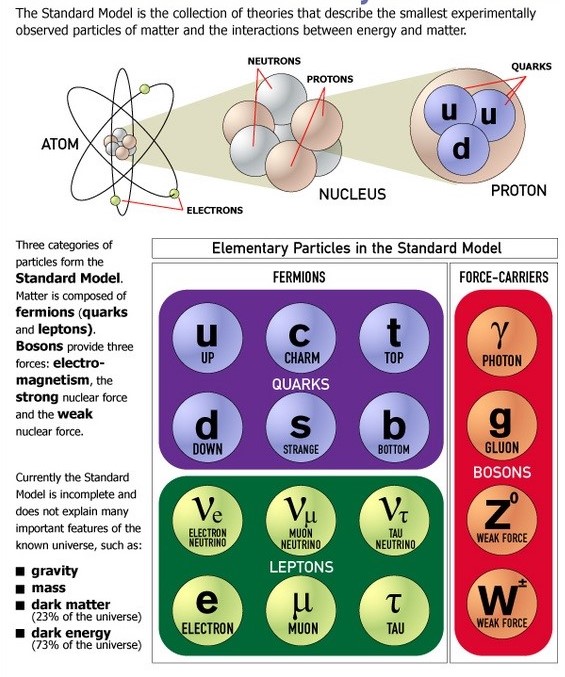
    • The Standard Model of particle physics is the theory describing three of the four known fundamental forces (the electromagnetic, weak, and strong interactions while omitting gravity) in the universe and classifying all known elementary particles.
    • It is a theoretical construct in physics that describes particles of matter and their interaction. Ex. Proton, Neutron, Electron etc.
    • It is a description that views the elementary particles of the world as being connected by mathematical symmetries, just as an object and its mirror image are connected by a bilateral (left–right) symmetry.
    • These are mathematical groups generated by continuous transformations from, say, one particle to another.
    • According to this model there are a finite number of fundamental particles which are represented by the characteristic “eigen” states of these groups.
    • The particles predicted by the model, such as the Z boson, have been seen in experiments and the last to be discovered, in 2012, was the Higgs boson which gives mass to the heavy particles.

    Why is the standard model believed to be incomplete?

    • The standard model is thought to be incomplete because it gives a unified picture of only three of the four fundamental forces of nature and it totally omits gravity.
    • So, in the grand plan of unifying all forces so that a single equation would describe all the interactions of matter, the standard model was found to be lacking.
    • The other gap in the standard model is that it does not include a description of dark matter particles.

    How are the symmetries related to particles?

    • The symmetries of the standard model are known as gauge symmetries, as they are generated by “gauge transformations” which are a set of continuous transformations (like rotation is a continuous transformation).
    • Each symmetry is associated with a gauge boson.
    • For example, the gauge boson associated with electromagnetic interactions is the photon.
    • The gauge bosons associated with weak interactions are the W and Z bosons. There are two W bosons — W+ and W-.

    What is the main result of the recent experiment?

    • The recent experiment at CDF, which measured the mass of the W boson as 80,433.5 +/- 9.4 Mev/c2, which is approximately 80 times the mass of a hydrogen nucleus.
    • This came out to be more than what is expected from the standard model.
    • The expected value using the standard model is 80,357 +/- 8 MeV/c2 .
    • Thus, the W boson mass itself is a prediction of the standard model.
    • Therefore, any discrepancy in its mass means a lack of self-consistency in the standard model.

    What is the discrepancy they obtained?

    • The mass discrepancy of the W boson needs to be checked and confirmed to the same accuracy by other facilities, for example, the Large Hadron Collider (LHC).

    Where do we stand now in terms of new physics?

    • New physics is in the air, and experiments have been gearing up for some years now to detect new particles.
    • With its high-precision determination of the W boson mass, the CDF has struck at the heart of the standard model.
    • So it is a significant finding and if this is confirmed by the LHC and other experiments, it will throw open the field for ideas and experiment.


    UPSC 2023 countdown has begun! Get your personal guidance plan now! (Click here)

  • What is the Xiaomi Scam?

    Last week, the Enforcement Directorate had seized Rs 5551.27 crore ($725 million) from the local bank accounts of the Chinese smartphones company, Xiaomi.

    Unfolding the Xiaomi Scam

    • Xiaomi faces charges of having made illegal remittances to foreign entities by passing them off as royalty payments.
    • It is a charge that Xiaomi has been continuously facing in India.
    • The ‘royalty and licence fee’ paid by Xiaomi India were not being added to the transaction value of the goods imported by the company and its contract manufacturers.
    • By not adding “royalty and licence fee” into the transaction value, Xiaomi was evading Customs duty.

    What is the recent probe?

    • The Enforcement Directorate has seized the bank account assets from Xiaomi Technology India, under the provisions of Foreign Exchange Management Act (FEMA.
    • The company had remitted over Rs 5500 crore to foreign-based entities, including one Xiaomi group entity, in the guise of royalty payments.
    • Such huge amounts in the name of royalties were remitted on the instructions of their Chinese parent group entities.

    Xiaomi’s response

    • Xiaomi, for its part, said that it is committed to working closely with government authorities to clarify any misunderstandings.
    • It argued that the royalty payments and statements to the bank are all legit and truthful and were made for the in-licensed technologies and IPs used in our Indian version products.
    • It is a legitimate commercial arrangement for Xiaomi India to make such royalty payments.
    • But it is a typical corporate response, something on the lines that Xiaomi did on the previous occasion too.

    How has China responded?

    • China firmly support its companies in protecting their lawful rights and interests.
    • It urged India to provide a fair, just and non-discriminatory business environment for Chinese companies making investment and operating in the country.
    • It is visible that China has made a dovish statement as they usually do.
    • Xiaomi now has alleged its top executives faced threats of “physical violence” and coercion during questioning by ED.

    Indian govt on strong wicket

    • Indian governmental authorities have made it clear that the Chinese companies were not being targeted.
    • And financial misdemeanours had indeed been committed by these companies.
    • The government has also explained the various cases in details and what it has seized so far.
    • But the Chinese companies seem to be playing the victim card.

    Back2Basics: Directorate of Enforcement (ED)

    • ED is a law enforcement agency and economic intelligence agency responsible for enforcing economic laws and fighting economic crime (esp Money Laundering) in India.
    • It is part of the Department of Revenue of the Ministry of Finance.
    • It is composed of officers from the Indian Revenue Service, Indian Police Service and the Indian Administrative Service as well as promoted officers from its own cadre.
    • The total strength of the department is less than 2000 officers out of which around 70% of officials came from deputation from other organizations while ED has its own cadre, too.
    • The prime objective of the Enforcement Directorate is the enforcement of two key Acts namely:
    1. Foreign Exchange Management Act 1999 (FEMA) and
    2. Prevention of Money Laundering Act 2002 (PMLA)


    UPSC 2023 countdown has begun! Get your personal guidance plan now! (Click here)

  • What is Monkeypox?

    The UK health authorities have confirmed a case of Monkeypox, which is a virus passed from infected animals such as rodents to humans, in someone with a recent travel history to Nigeria where they are believed to have caught it.

    What is Monkeypox?

    • The monkeypox virus is an orthopoxvirus, which is a genus of viruses that also includes the variola virus, which causes smallpox, and vaccinia virus, which was used in the smallpox vaccine.
    • It causes symptoms similar to smallpox, although they are less severe.
    • While vaccination eradicated smallpox worldwide in 1980, monkeypox continues to occur in a swathe of countries in Central and West Africa, and has on occasion showed up elsewhere.
    • According to the WHO, two distinct clade are identified: the West African clade and the Congo Basin clade, also known as the Central African clade.

    Its origin

    • Monkeypox is a zoonosis, that is, a disease that is transmitted from infected animals to humans.
    • Monkeypox virus infection has been detected in squirrels, Gambian poached rats, dormice, and some species of monkeys.
    • According to the WHO, cases occur close to tropical rainforests inhabited by animals that carry the virus.

    Symptoms and treatment

    • Monkeypox begins with a fever, headache, muscle aches, back ache, and exhaustion.
    • It also causes the lymph nodes to swell (lymphadenopathy), which smallpox does not.
    • The WHO underlines that it is important to not confuse monkeypox with chickenpox, measles, bacterial skin infections, scabies, syphilis and medication-associated allergies.
    • The incubation period (time from infection to symptoms) for monkeypox is usually 7-14 days but can range from 5-21 days.
    • There is no safe, proven treatment for monkeypox yet.


    UPSC 2023 countdown has begun! Get your personal guidance plan now! (Click here)