💥Mains Ready By December. Smash Mains & Smash PYQ Admissions Open

GS Paper: GS3-24.Various Security Forces and Agencies and their Mandate.

  • INS Mysore arrives at Lumut, Malaysia for Exercise Samudra Laksamana [MENTION]

    PIB class: Press Release. Ministry: Ministry of Defence.

    Why in News

    Indian Naval Ship (INS) Mysore arrived at Lumut, Malaysia for the 4th edition of Exercise Samudra Laksamana.

    Static Context (the exam value sits here)

    1. Exercise Samudra Laksamana is the bilateral naval exercise between India and Malaysia. It builds maritime interoperability between the two navies.
    2. Lumut hosts the main base of the Royal Malaysian Navy. It sits on the west coast of Peninsular Malaysia facing the Strait of Malacca.
    3. INS Mysore is a guided missile destroyer of the Indian Navy. It belongs to the Delhi class of destroyers.
    4. The exercise supports India’s Act East Policy and Indo Pacific outreach. Malaysia is an ASEAN member and a maritime neighbour across the Bay of Bengal.

    Prelims angle

    Pairing exercises with countries. Samudra Laksamana is India and Malaysia. Location cue Lumut and the Strait of Malacca as a chokepoint. Distinguish from other India naval exercises such as Varuna with France and Malabar with the United States, Japan and Australia.

    Mains angle

    GS3, security, and GS2, India and its neighbourhood. Naval diplomacy and maritime security cooperation in the Indo Pacific.

    Matching Previous Year Question

    “No direct PYQ on this bilateral exercise was traced in the provided files. Closest tracked Microtheme is Defence and India’s maritime security cooperation.”

  • Defence Acquisition Council clears capital acquisition proposals worth about ₹1.10 lakh crore

    Defence Acquisition Council clears capital acquisition proposals worth about ₹1.10 lakh crore

    Why in the News

    The Defence Acquisition Council (DAC), chaired by Defence Minister Rajnath Singh, has accorded Acceptance of Necessity (AoN) for defence acquisition proposals worth around ₹1.10 lakh crore.

    • About 98% of the approved procurements are planned from Indian industry, reinforcing the government’s focus on defence indigenisation and self reliance.

    What is the DAC?

    • Defence Acquisition Council (DAC) is the highest decision-making body in the Ministry of Defence for defence procurement.
    • It was constituted in 2001 following the recommendations of the Group of Ministers after the Kargil War.
    • Chairperson: Union Defence Minister.
    • It deals with major decisions related to acquisition of capital assets for the Armed Forces.

    What has the DAC approved?

    Indian Army

    • CBRN reconnaissance vehicles: Detect, identify, monitor and mark areas contaminated by chemical, biological, radiological and nuclear agents.
    • High Mobility Vehicles (HMVs): Improve operational mobility and logistics in difficult terrain.
    • Self Propelled Mechanical Mine Layers (MMLs): Provide faster mine laying capability.
    • Advanced Light Helicopters (ALHs): Support operations across diverse terrains.
    • Trawl tanks: Facilitate movement through mine contaminated areas.
    • Sarvatra Bridge System: Provides rapid bridging and crossing capability during military operations.

    Indian Navy

    • Arudhra radars: To replace existing air route surveillance radars at naval air stations.
    • Marine Gas Turbines (MGTs): Indigenous design, development and procurement for warship propulsion, reducing dependence on foreign vendors.

    Indian Air Force and Defence Forces

    • Proposals to enhance capabilities of fighter aircraft, transport aircraft and helicopters.
    • Ground Based Multi Purpose Jammers (GBMPJ): Provide jamming capability against adversary radars.
    • Defence Forces Secure Access Card (DEFSAC): Replace paper based identity cards, passes and permits with interoperable RFID based smart cards.

    Why is Defence Indigenisation Important?

    • Strategic autonomy: Reduces dependence on foreign suppliers for critical military systems.
    • Operational security: Minimises vulnerabilities arising from dependence on external vendors.
    • Domestic manufacturing: Creates demand for Indian defence companies and strengthens the defence industrial base.
    • Technology development: Encourages indigenous R&D and advanced defence technologies.
    • Economic benefits: Generates skilled employment and strengthens domestic supply chains.

    Prelims Pointers

    • Total value: Around ₹1.10 lakh crore.
    • DAC: Defence Acquisition Council, chaired by the Defence Minister.
    • AoN: Acceptance of Necessity, the initial approval for a defence procurement proposal.
    • CBRN: Chemical, Biological, Radiological and Nuclear.
    • ALH: Advanced Light Helicopter.
    • MGT: Marine Gas Turbine.
    • DEFSAC: Defence Forces Secure Access Card.
    • 98%: Approximately 98% of the approved procurement value is planned to be sourced from Indian industry.

    [2026] Which of the following items of defence hardware is/are manufactured in India?
    1.Su-30 MKT Fighter Jects
    2.T-90 MKI-III Tanks
    3.Akula Class Submarine
    Select the answer using the code given below:

    [A] 1 and 2

    [B] 1 and 3

    [C] 1 only

    [D] 2 only

  • Govt. to spend Rs 24,000 crore to modernise police force

    Govt. to spend Rs 24,000 crore to modernise police force

    Why in the News

    The Union government has told the Supreme Court that it has begun implementing an umbrella Police Modernisation Mission worth Rs 24,000 crore over the next five years.

    What is the Police Modernisation Mission?

    1. Its form: It is an umbrella scheme, meaning several police modernisation components are funded through a single mission rather than as separate schemes.
    2. Its size and horizon: The outlay is Rs 24,000 crore, to be spent over five years.
    3. Who it covers: It targets the internal security capabilities of both State police forces and the Central Armed Police Forces.
    4. Its stated route: The capability gain is to come through greater use of technology, which is the only delivery mechanism named in the submission.

    Why was the disclosure made in a court proceeding?

    1. The proceeding was begun by the Court itself: The suo motu case was initiated in 2025 after the Court took note of a media report on non functional CCTV cameras at Udaipur police stations.
    2. The Court widened it into a compliance review: It sought compliance reports from the Centre, the States and the Union Territories on the installation and functioning of cameras.
    3. The Bench: The matter is before a Bench of Justices Vikram Nath and Sandeep Mehta, with the Centre represented by an Additional Solicitor-General.
    4. The mission answers the compliance question with an outlay: The Centre’s response to a record of equipment not working is a larger programme to buy equipment, and no separate maintenance or functioning guarantee was placed before the Court.

    What did Paramvir Singh Saini versus Baljit Singh require?

    1. Cameras at specified locations: The 2021 judgment mandated CCTV cameras at key locations in police stations, including lock ups and the rooms of inspectors and sub-inspectors.
    2. Cameras of a specified capability: The directions required night vision and audio recording, so that an interrogation is recorded and not merely observed.
    3. Footage retention: Recordings were to be preserved for a stated minimum period, so that a complaint filed months later can still be tested against the record.
    4. Oversight bodies: State level and district level oversight committees were to be constituted to purchase, maintain and monitor the systems and to review footage.
    5. Notice to the public: Police stations were to display notices telling visitors that the premises are under camera cover and that a complaint of human rights violation may be made.

    Challenges to the Police Modernisation Mission

    1. Modernisation money has historically gone unspent: Releases under police modernisation schemes stall on State matching shares and pending utilisation certificates. Eg. Successive Comptroller and Auditor General audits have flagged underutilisation of police modernisation grants by States.
      The Fix: Release tranches against verified physical milestones, meaning equipment installed and functioning, rather than against expenditure statements.
    2. Central money buys equipment, not reform: Police is a State subject under Entry 2 of the State List, so a central mission can fund hardware without touching recruitment, tenure or accountability. Eg. Directions in Prakash Singh versus Union of India (2006) on fixed tenure and a State Security Commission remain only partly implemented across States.
      The Fix: Condition a share of each State’s mission grant on enactment of the police board and fixed tenure directions.
    3. Technology fails at the point of maintenance: Installed systems stop working for want of annual maintenance contracts, spares and power backup, and the capital grant does not cover them. Eg. Audits have found Crime and Criminal Tracking Network and Systems terminals installed but not in use at a large number of police stations.
      The Fix: Fund a five year maintenance and consumables line inside each equipment sanction, instead of leaving it as a separate State liability.
    4. Manpower shortfall caps what technology can deliver: A camera or a database still needs an officer to operate, review and act on it, and State forces run well below sanctioned strength. Eg. Bureau of Police Research and Development data records an actual police strength close to 150 personnel per lakh population, against the United Nations recommended figure of 222.
      The Fix: Tie mission approval to a State recruitment schedule closing sanctioned vacancies across the same five years.
    5. Surveillance capacity grows faster than the oversight around it: Equipment installed for accountability also expands the force’s own recording and identification capability, with no independent auditor of its use. Eg. Access logs for police station footage are held and reviewed by the same force whose conduct the footage records.
      The Fix: Place footage access logs and retention compliance under an independent State level oversight body publishing an annual report.

    Conclusion

    The mission has moved from announcement to implementation, and it was disclosed in a proceeding about equipment already mandated and not functioning. Buying capability and sustaining it are different problems, and only the first has an outlay attached to it. The next point to watch is the compliance reports the Court has sought from the Centre, the States and the Union Territories, which is where the gap between equipment sanctioned and equipment working becomes visible.

    Back2Basics: Central Armed Police Forces

    1. What they are: Seven armed forces of the Union under the Ministry of Home Affairs, distinct both from the armed forces under the Ministry of Defence and from State police.
    2. The seven forces: Central Reserve Police Force, Border Security Force, Central Industrial Security Force, Indo-Tibetan Border Police, Sashastra Seema Bal, Assam Rifles and the National Security Guard.
    3. How they are used: They are deployed to States on requisition for internal security duty, election duty and disaster response, and guard specified international border sectors.
    4. Command and recruitment: Each is headed by a Director General, with officer recruitment through the Union Public Service Commission and other ranks through the Staff Selection Commission.

    [2023, GS3, 15 marks] What are the internal security challenges being faced by India? Give out the role of Central Intelligence and Investigative Agencies tasked to counter such threats.

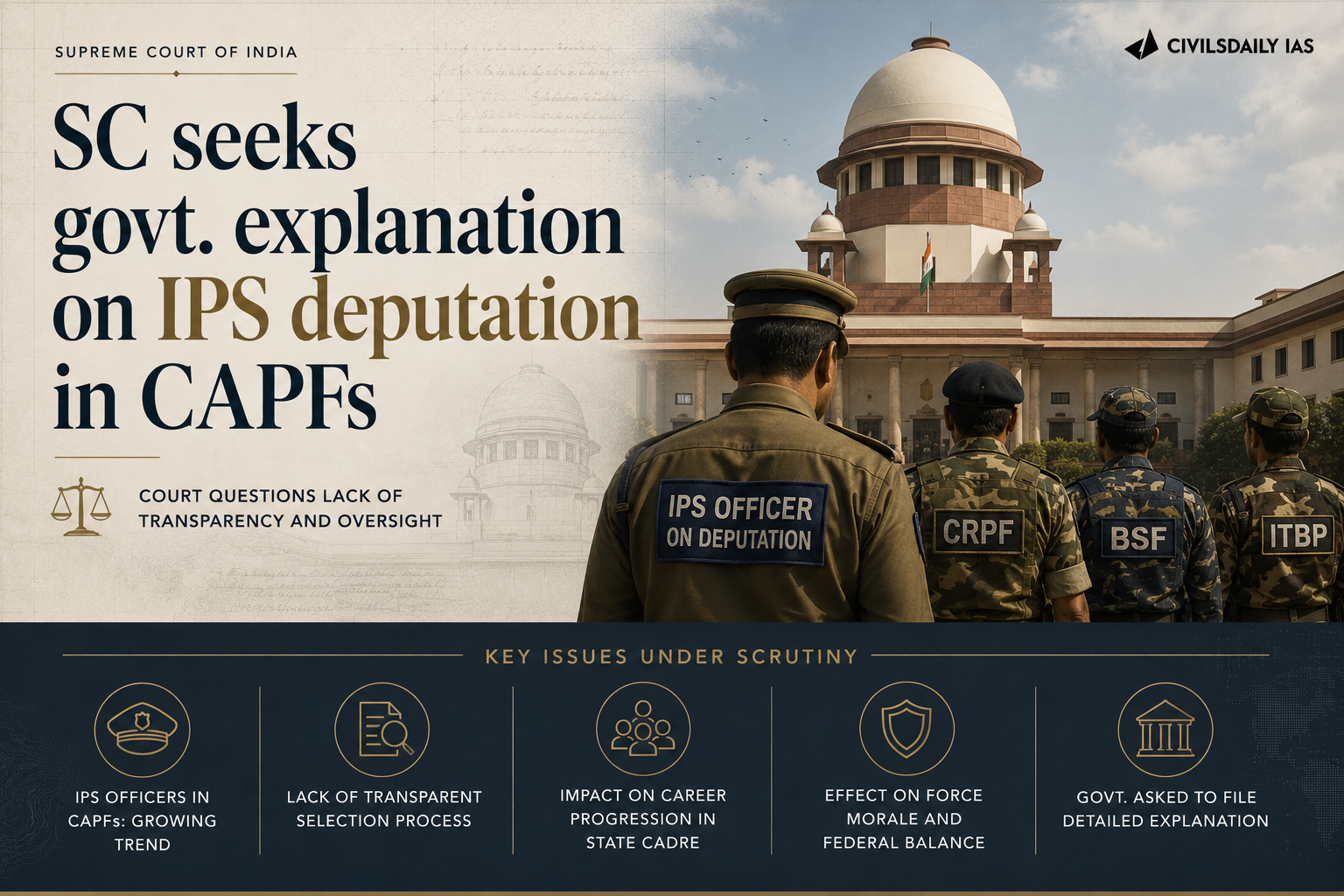
  • SC seeks govt. explanation on IPS deputation in CAPFs

    SC seeks govt. explanation on IPS deputation in CAPFs

    Why in the News

    The Supreme Court has sought an explanation from the Union Home Secretary on the implementation of its judgment of 23 May 2025, which directed the Centre to progressively reduce the deputation of Indian Police Service (IPS) officers to senior posts in the Central Armed Police Forces (CAPFs).

    What did the 2025 judgment direct?

    1. The direction: Deputation posts held by IPS officers in the Senior Administrative Grade (SAG), the level up to the rank of Inspector General, in the CAPFs were to be progressively reduced over a period of time, within an outer limit of two years.
    2. The Bench: The ruling was delivered by a two judge Bench, one of whose members has since retired.
    3. The direction has been tested once already: The Union Home Ministry’s review petition against the judgment was dismissed on 28 October 2025.

    What has the Centre reported as compliance?

    1. A cadre review across every force: Following the dismissal of the review petition, all CAPFs were directed to submit detailed cadre review proposals, which the Ministry examined and forwarded to the Department of Personnel and Training (DoPT) with the Home Minister’s approval.
    2. The proposals are in the pipeline, dated: Cadre review proposals for the CRPF, BSF, CISF, ITBP and SSB were sent between 27 July and 3 August 2026, and were forwarded to the Department of Expenditure with the DoPT’s observations and recommendations on 17 August.
    3. The remaining steps have not been taken: After the Department of Expenditure comments, the proposals go to the Cadre Review Committee headed by the Cabinet Secretary, whose recommendations are then to be considered for approval by the competent authority.
    4. Other measures claimed: The Ministry stated that it had also examined the issue of IPS deputation and undertaken statutory changes.

    Why does the Court read the compliance record differently?

    1. Deputations continued after the judgment: An affidavit informed the Court that 46 IPS officers have been brought on deputation to the CAPFs up to the SAG level since the 2025 ruling.
    2. The Bench questioned the premise of the practice: It asked whether there are no competent officers within the CAPFs to hold responsible positions, and described the position as totally wrong.
    3. The service record cited against the practice: Officers with over 25 years of service defend the borders and have made supreme sacrifices, and the Bench held that a strong lobby leaves those cadre officers completely stifled.

    How does the CAPFs (General Administration) Act, 2026 change the dispute?

    1. A statute now occupies the ground the judgment covered: The Central Armed Police Forces (General Administration) Act, 2026 was published in the Gazette on 9 April, and the stated effect is to circumvent the 2025 judgment.
    2. The Act is itself under challenge: Five writ petitions challenging the legislation have been filed and are listed for hearing on 18 November.
    3. The affected constituency is organised: Members of the All Ex-Paramilitary Forces Welfare Association staged protests against the Bill before its enactment.
    4. The next date on the compliance track: The contempt matter is listed for hearing on 22 September.

    Challenges to reducing IPS deputation in the CAPFs

    1. The forces were designed around an officer shortfall they never closed: Direct entry recruitment into CAPF cadres has not kept pace with sanctioned strength at senior levels, which is the stated justification for deputation in the first place. Eg. Vacancies across CAPF officer ranks have been reported repeatedly to Parliament by the Ministry of Home Affairs.
      The Fix: Fix a dated recruitment and promotion calendar in each cadre review, so the shortfall that justifies deputation is closed rather than carried forward.
    2. Cadre review is an executive process with no judicial deadline attached: Every stage between a force’s proposal and the competent authority’s approval is discretionary in timing. Eg. The proposals here moved between three departments over several months without reaching the Cadre Review Committee.
      The Fix: Attach an outer time limit to each stage of the cadre review chain, reported to the Court as a compliance schedule rather than as a status update.
    3. Command experience is concentrated where promotion is blocked: Officers who spend a full career in one force acquire the operational knowledge that senior posts need, and are then passed over at exactly that level. Eg. Border guarding, counter insurgency and industrial security each demand force specific expertise that a short deputation tenure cannot build.
      The Fix: Reserve a fixed proportion of Inspector General level posts in each force for cadre officers, notified in the recruitment rules rather than settled case by case.
    4. A statute can displace a judicial direction unless the underlying defect is cured: New legislation on the same subject shifts the dispute from contempt to constitutional validity and restarts the litigation clock. Eg. The five writ petitions against the 2026 Act put the question back at the beginning after a judgment and a dismissed review.
      The Fix: Amend the recruitment rules of each force to give effect to the direction, so compliance rests on subordinate legislation the Court has already read rather than on a fresh statute.
    5. Organisational identity is unresolved in law: The forces are described as paramilitary in public and as police organisations in service rules, and the ambiguity drives the parity claims on pay, pension and command. Eg. The demand for organised group A service status for CAPF cadres was itself settled only through litigation.
      The Fix: Settle the service classification of each force explicitly in the rules framed under the governing statute, so command structure follows from a stated status.

    Conclusion

    The question before the Court has changed shape since it was first answered. It began as a service dispute about who commands a force, moved to whether a direction on that dispute was being implemented, and now turns on whether a statute passed after the judgment can occupy the same ground. That last question is the one that decides the other two, and it is the pending challenge to the new Act, not the contempt proceeding, that will settle it. What to watch is whether the recruitment rules of the individual forces are amended at all, because a direction that never reaches the rules governing promotion has not been implemented whatever the affidavits record.

    Back2Basics: Central Armed Police Forces

    1. What they are: Seven armed forces of the Union under the Ministry of Home Affairs, distinct from the armed forces under the Ministry of Defence and from the State police, raised for internal security and border guarding duties.
    2. The seven forces: Assam Rifles, Border Security Force, Central Industrial Security Force, Central Reserve Police Force, Indo-Tibetan Border Police, National Security Guard and Sashastra Seema Bal.
    3. Command structure: Each force has its own directly recruited cadre, and senior posts are filled by a combination of that cadre and IPS officers on deputation from State cadres.
    4. Constitutional basis: They are raised under Entry 2A of the Union List, which covers deployment of any armed force of the Union in a State in aid of the civil power.

    [2023, GS3, 15 marks] What are the internal security challenges being faced by India? Give out the role of Central Intelligence and Investigative Agencies tasked to counter such threats.”


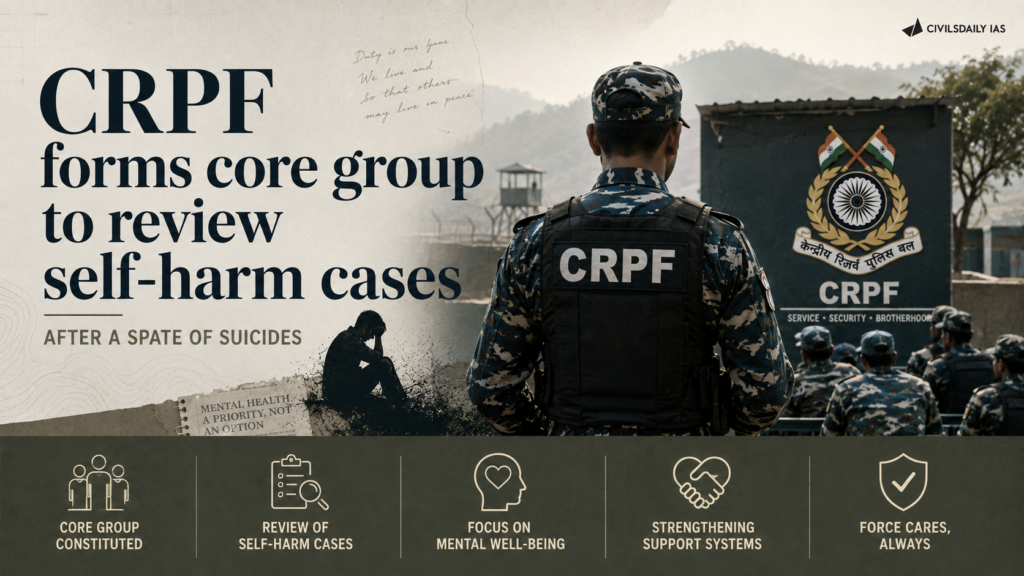
  • CRPF forms core group to review self-harm cases after a spate of suicides

    Why in the News

    The Central Reserve Police Force (CRPF) has constituted a high level core group to conduct monthly reviews of self harm cases among its personnel. Deaths by suicide in the force touched a five year high of 59 in 2025, which moves the response from unit level handling of individual incidents to a standing headquarters mechanism.

    What is the Central Reserve Police Force?

    1. Mandate: The Central Reserve Police Force is the Union’s principal internal security force, deployed on requisition to States for counter insurgency, anti Left Wing Extremism operations, law and order duty and election security.
    2. Command: It functions under the Ministry of Home Affairs and is headed by a Director General, with operations organised through executive battalions and specialised wings.
    3. Scale: It is the largest of the Central Armed Police Forces, with a sanctioned strength above three lakh personnel spread across every State and Union Territory.

    What do the suicide figures in the force since 2021 show?

    1. Five year peak in 2025: Fifty nine CRPF personnel died by suicide in 2025, the highest figure in the five year series and the trigger for the present review mechanism.
    2. The full series: The force recorded 57 such deaths in 2021, 43 in 2022, 57 in 2023, 46 in 2024 and 59 in 2025.
    3. The current year: Nineteen such deaths were reported till 30 May 2026.
    4. No downward trend: The numbers oscillate within a narrow band rather than falling, which indicates that existing unit level welfare measures have not shifted the underlying pattern.
    5. Deaths on duty: The figures from 2021 to May 2026 show that several of these deaths took place while the personnel were on duty, not while on leave or at home.

    Why has a headquarters level core group been created rather than leaving reviews to individual units?

    1. A structured mechanism: Senior officers at a meeting in the CRPF headquarters earlier this month identified the absence of a structured mechanism to examine such incidents as the gap to be closed.
    2. Recurring risk factors: A unit examining a single death cannot detect a factor that repeats across battalions, so pattern identification requires a body sitting above the unit.
    3. Command level ownership: The core group is headed by the Director General of the force, which places accountability for prevention at the apex of the command chain rather than with the battalion commandant.
    4. Fixed periodicity: The group is to meet every month, converting review from an event triggered by a death into a standing calendar obligation.
    5. Four review heads: Each monthly meeting is to cover the self harm incidents reported, the causes and circumstances behind them, the availability and use of welfare or psychological support, and the preventive steps taken by the unit concerned.

    What drives self harm among central armed police force personnel?

    1. Prolonged separation from family: Personnel serve long tenures in field formations away from their home States, with leave frequently curtailed during active operations.
    2. Operational stress in insurgency theatres: Extended deployment in Left Wing Extremism affected districts and in Jammu and Kashmir combines physical risk with an absence of privacy and rest.
    3. Domestic and financial distress: Land disputes, family illness and debt at the home station cannot be attended to from a field posting, and the inability to act is itself a stressor.
    4. Grievance and leave denial: Perceived unfairness in leave sanction, posting and promotion converts an administrative decision into a personal grievance with no accessible appeal.
    5. Stigma around psychological help: Seeking counselling is read within the force as an admission of unfitness for armed duty, which suppresses the demand for the support that does exist.

    What does the National Human Rights Commission’s intervention add to the response?

    1. External scrutiny: The National Human Rights Commission took note of the rising figures last week and sought reports from the Ministry of Home Affairs and the Director General of the force.
    2. Reframing the issue as a rights question: The Commission’s entry treats deaths in service as a question of the State’s obligation to its own personnel rather than as an internal personnel matter.
    3. A reporting obligation: A requisition from the Commission compels a written response from both the administrative ministry and the force, creating a record that survives changes in command.
    4. Timing: The core group’s formation and the Commission’s notice fall in the same month, so the force’s internal mechanism now operates under an external deadline.

    Challenges to the CRPF’s self harm prevention mechanism

    1. A review body without a treatment capacity: A monthly review can classify causes but cannot supply the clinical care the classification points to, and psychiatrist and counsellor strength in the central armed police forces remains far below the deployed strength. Eg. Composite hospitals of the central armed police forces routinely operate with a single mental health specialist serving several battalions spread across districts.
    2. Under reporting of distress: Personnel avoid recording psychological symptoms because a medical entry can affect weapon issue, posting and promotion prospects. Eg. Screening drives in armed forces and central police organisations consistently record self reported distress far below the levels found in anonymous surveys of the same units.
    3. Housing and family accommodation deficit: Family accommodation available to central armed police force personnel falls well short of the authorised requirement, which keeps families separated even at peace stations. Eg. The Parliamentary Standing Committee on Home Affairs has repeatedly recorded a housing satisfaction ratio below half the sanctioned entitlement across the central armed police forces.
    4. Leave and rotation practice: Announced entitlements are overridden by operational exigency in the very theatres where the stress is highest. Eg. The force’s initiative to give personnel around 100 days with their families each year has proved hardest to implement in the Left Wing Extremism theatre where deployment density is greatest.
    5. Weapon access at the point of crisis: Personnel on duty carry service weapons continuously, which removes the interval between intent and act that prevention depends on. Eg. Several of the deaths recorded between 2021 and May 2026 occurred while the personnel were on duty, when the service weapon was in hand.
    6. Fratricide and grievance escalation: Unresolved interpersonal grievance within a small deployed unit escalates into violence against colleagues as well as self harm. Eg. Fratricide incidents in central armed police force camps have prompted the Bureau of Police Research and Development to study stress and grievance handling in deployed units.

    Conclusion

    The Central Reserve Police Force has moved suicide prevention from ad hoc unit level handling to a monthly review chaired by its Director General, after 2025 recorded the highest figure in five years. The immediate status is that the core group stands constituted and the National Human Rights Commission has sought reports from the Ministry of Home Affairs and the force. The next expected step is the submission of those reports and the first monthly review sitting of the core group.

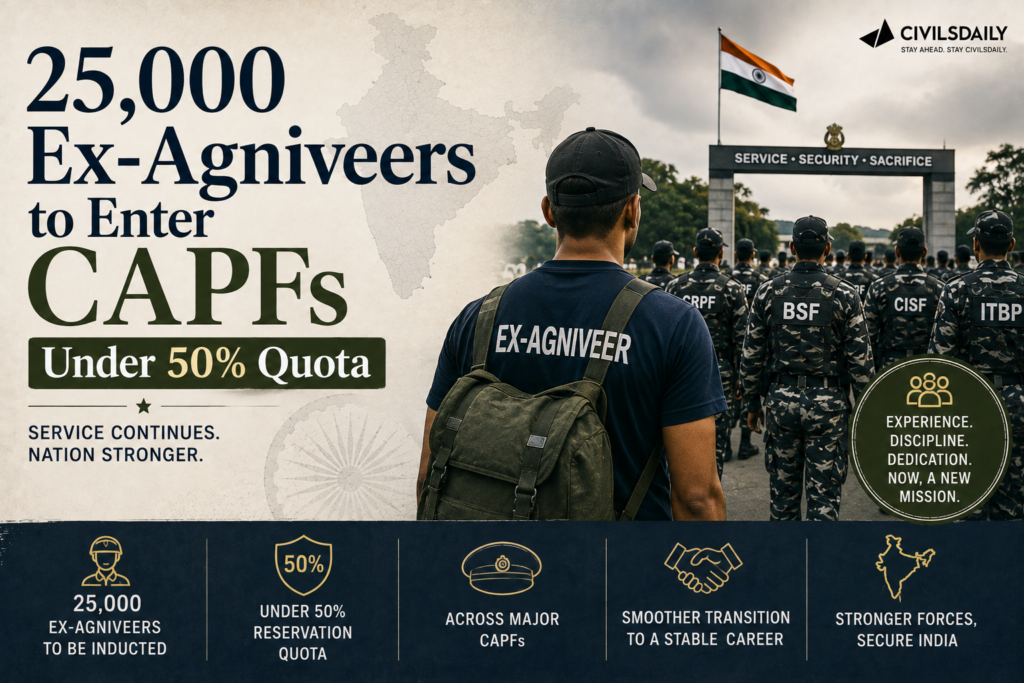
  • 25,000 Ex-Agniveers to Enter CAPFs Under 50% Quota

    Why in the News

    The armed forces will provide lists of eligible Agniveers to CAPFs for recruitment under the 50% reservation for former Agniveers. The first batch of around 25,000 Army Agniveers is expected to exit by December.

    What is Agnipath?

    • Agniveers are recruited for a fixed 4-year tenure, including training.
    • Up to 25% are retained in the regular armed forces based on merit and organisational requirements.
    • The remaining 75% exit with a Seva Nidhi package.
    • They do not receive pension or gratuity.

    What are CAPFs?

    • Central Armed Police Forces operate under the Ministry of Home Affairs, unlike the Armed Forces under the Ministry of Defence.
    • They include: BSF, CRPF, CISF, ITBP, SSB, Assam Rifles, and NSG

    CAPF Recruitment for Former Agniveers

    • 50% of Constable (GD) vacancies reserved for former Agniveers.
    • Eligible personnel will be identified through lists furnished by the Armed Forces.
    • Written examination, Physical Standard Test and Physical Efficiency Test are waived for former Agniveers.
    • Remaining 50% vacancies are filled through open recruitment.
    • Unfilled reserved vacancies are carried forward to open recruitment.

    Why is it Important?

    • The framework provides Agniveers a pathway to a longer career, as CAPF personnel can serve up to 60 years, compared with the shorter service period in the armed forces.

    Key Concerns

    • Eligibility depends on service-prepared lists, rather than direct application.
    • Criteria for inclusion in these lists are not clearly specified.
    • 50% of CAPF Constable GD vacancies are reserved.
    • Former Agniveers enter at the entry grade without seniority/pay protection for military service.
    • Different States have adopted different reservation and age-relaxation policies.

    Prelims Quick Facts

    • Agnipath tenure: 4 years
    • Retention: Up to 25%
    • Exit: Seva Nidhi, no pension/gratuity
    • CAPF quota: 50% of Constable GD vacancies
    • CAPFs: Under MHA
    • Armed Forces: Under Ministry of Defence
    • First Army Agniveer batch: About 25,000 expected to exit by December

    “[2023] With reference to Home Guards, consider the following statements:
    1. Home Guards are raised under the Home Guards Act and Rules of the Central Government.
    2. The role of the Home Guards is to serve as an auxiliary force to the police in maintenance of internal security.
    3. To prevent infiltration on the international border/coastal areas, the Border Wing Home Guards Battalions have been raised in some States.
    How many of the above statements are correct?
    (a) Only one
    (b) Only two
    (c) All three
    (d) None

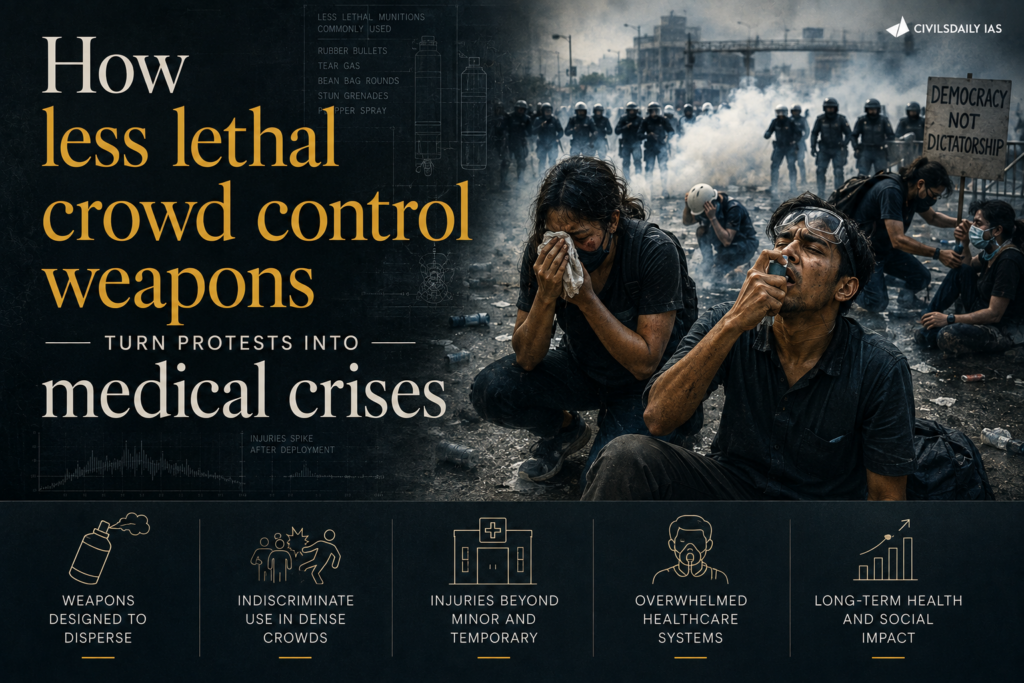
  • How excessive police force turns peaceful marches into medical crises 

    Why in the News

    An analysis examines how crowd control weapons meant to be non lethal cause serious injury during protests. The tension is between the state’s duty to maintain order and its obligation to protect the right to protest safely.

    What are less lethal weapons?

    1. Non lethal intent: Less lethal weapons are meant to disperse crowds without killing, but can cause serious harm.
    2. Common types: They include tear gas, pepper and PAVA spray, lathis, pellet guns, and shock batons.
    3. Chemical agents: Tear gas is a riot control agent that irritates the eyes and respiratory tract.

    Which are the types of less lethal weapons?

    1. Tear Gas: A chemical riot-control agent that causes intense eye irritation, tearing, coughing, breathing difficulty, and temporary disorientation. Its main chemical compounds include CS Gas (2-chlorobenzalmalononitrile), CN Gas (Chloroacetophenone), OC Gas (Oleoresin Capsicum), CR Gas (Dibenzoxazepine) and Chloropicrin (PS).
    2. Pepper Spray: An oleoresin capsicum (OC)-based spray that causes severe burning of the eyes, skin, and respiratory tract, leading to temporary incapacitation.
    3. PAVA Spray: A synthetic pepper spray (Pelargonic Acid Vanillylamide) that causes intense eye irritation and pain with a more controlled and consistent effect than natural pepper spray.
    4. Lathi: A wooden or polycarbonate baton used by police for crowd control through physical force.
    5. Pellet Guns: Firearms that discharge multiple small pellets to disperse crowds; they can cause serious injuries, particularly to the eyes. They are loaded with cartridges containing hundreds of small metal sub-projectiles.
    6. Shock Batons (Stun Batons): Handheld electroshock devices that deliver a brief electric shock to temporarily immobilise a person through pain and muscle disruption.

    Why do these weapons cause medical crises?

    1. Misuse at range: Pellet guns fired at close range or at the head cause blinding injuries.
    2. Enclosed spaces: Tear gas used in confined areas raises the risk of asphyxiation.
    3. Vulnerable groups: Children and people with respiratory illness face higher harm.

    What do international and domestic norms say?

    1. Chemical Weapons Convention: Under the Organisation for the Prohibition of Chemical Weapons rules, the Chemical Weapons Convention bans tear gas in warfare while permitting it for domestic policing.
    2. UN guidance: The United Nations Guidance on Less Lethal Weapons sets limits on their use.
    3. Precedent: The 2016 pellet gun injuries in Jammu and Kashmir left many with permanent vision loss.

    Conclusion

    The weapons are lawful for policing yet routinely cause disproportionate harm in practice. The unresolved gap is enforceable standards on how and when they are deployed.

    Back2Basics

    The United Nations Guidance on Less Lethal Weapons

    The United Nations Human Rights Guidance on the Use of Less-Lethal Weapons in Law Enforcement, released by the UN Human Rights Office (OHCHR), provides international standards for the lawful design, testing, training, and deployment of less-lethal equipment to prevent unnecessary harm, abuse, and human rights violations during policing and assemblies.

    Core Principles

    1. Legality: Use must be strictly authorized by domestic and international law.
    2. Necessity: Force is applied only when strictly necessary to achieve a legitimate law enforcement objective.
    3. Proportionality: Harm caused must not outweigh the objective; excessive force is prohibited.
    4. Accountability: States and agencies must track, record, and review every deployment of less-lethal systems.

    Scope and Covered Equipment

    1. Chemical Irritants: Regulations on tear gas and pepper spray deployment parameters.
    2. Kinetic Impact Projectiles: Standards for rubber bullets and beanbag rounds to avoid lethal head or torso strikes.
    3. Electric-Shock Weapons: Protocols for Tasers and other projectile stun systems.
    4. Area-Effect Tools: Oversight on water cannons and acoustic disruption gear.

    PYQ Relevance

    [UPSC 2021] Though the Human Rights Commissions have contributed immensely to the protection of human rights in India, yet they have failed to assert themselves against the mighty and powerful. Analyzing their structural and practical limitations, suggest remedial measures.

    Linkage: The PYQ examines India’s human rights protection framework and institutional accountability. The article highlights excessive use of less-lethal weapons and the need for stronger human rights safeguards and accountability.

  • Over 70% of police personnel favour immunity for use of force, “Status of Policing in India 2025” finds

    Why in the News

    The “Status of Policing in India 2025” report finds that over 70% of police personnel favour immunity for using force without accountability. The report also flags that National Crime Records Bureau (NCRB) custodial injury data is unreliable, undermining independent verification of police conduct.

    Why does the immunity preference expose an accountability gap?

    1. Majority preference: A 70% plus preference for immunity among serving police personnel indicates the demand for accountability protection is not a fringe view but a majority institutional stance.
    2. Data unreliability: If NCRB custodial injury data is unreliable, external oversight bodies cannot independently verify whether force used against civilians was proportionate, regardless of internal police attitudes.
    3. Compounding effect: An accountability averse police culture combined with unreliable official data on custodial injury creates a structure where excessive force is both preferred by personnel and difficult to prove externally.

    Conclusion

    1. The central idea is that police demand for immunity and unreliable custodial injury data reinforce each other, since neither internal culture nor official data currently supports independent verification of force used against civilians. Addressing this requires fixing NCRB data reliability before any accountability reform on use of force can be meaningfully enforced.

    Back2Basics

    National Crime Records Bureau (NCRB): Statutory body under the Ministry of Home Affairs that compiles crime and criminal justice statistics across India, including custodial injury and death data.

    1. Indian government has recently strengthened the anti-terrorism laws by amending the unlawful activities (Prevention) Act (UAPA), 1967 and the NIA Act. Analyze the changes in the context of prevailing security environment while discussing the scope and reasons for opposing the UAPA by human rights organizations.

      In response to the evolving internal security threat posed by terrorism, GoI amended the UAPA, 1967 and NIA Act in 2019 to strengthen ‘zero tolerance for terrorism’ strategy.

      Amendment to UAPA,1967

      The central government can designate an individual as a terrorist (under Schedule IV of the Act)

      Empowers the NIA officers of the rank of Inspector or above to investigate cases of terrorism

      Adds the International Convention for Suppression of Acts of Nuclear Terrorism (2005) to the schedule

      Empowers the Director-General, NIA to grant approval of seizure of property when the case is being investigated by the agency.

      Amendment to NIA Act

      Widen the authority of the NIA – Includes human trafficking, counterfeit currency, manufacture or sale of prohibited arms, cyber-terrorism, and offences under the Explosive Substances Act.

      Extends the NIA’s jurisdiction outside India

      Constitution of special courts by the Centre in order to conduct trials

      Significance of the changes in the context of the prevailing security environment

      Shifts counter-terror strategy from reactive to preventive – Enables early disruption of terror ecosystems.

      Allows designation of individuals like Masood Azhar as terrorist

      Brings Clarity and uniformity by removing inter-state jurisdictional constraints

      Addresses evolving terror threat landscape – Responds to decentralised, module-based and lone-wolf terrorism.

      Targets terror support networks – Focuses on financiers, facilitators, propagandists and over-ground workers. Eg- NIA Raids on separatist leaders in J&K

      Improves investigation of transnational terror networks. Eg- Khalistan movement in Canada

      Extend powers of NIA to investigate terrorist-organised crime linkage

      Alignment with Global Counter-Terror Norms. Eg- Action against terror financing and international networks.

      Ensures timely and speedy prosecution of terrorists through special courts

      Criticism and Opposition by Human Rights Organisations

      Violation of Personal Liberty – Stringent bail provisions and prolonged detention (180 days) affect Article 21.

      Risk of Misuse – Broad definitions allow targeting of activists, journalists and dissenters.

      Absence of Prior Judicial Oversight – Individual can be designated as terrorist without conviction or trial.

      Departure from criminal jurisprudence norm of innocent until proven guilty – Burden of proof shifts to accused.

      Low conviction rate for UAPA cases between 2019 and 2023 (only 3.1%)

      Vague Definitions – Terms like “unlawful activity” and “terrorist act” are broadly defined

      Lack of procedural safeguards – The government is not required to provide grounds for arrest or detention.

      Against the federal structure – amendment has made the NIA “a parallel police structure”

      Way Forward

      Strengthen Procedural Safeguards

      Clear Legal Definitions

      Periodic review

      Time-Bound Investigations and Trials

      A law and institution as powerful as UAPA and NIA respectively, must be wielded with precision, accountability, and a deep commitment to constitutional values.