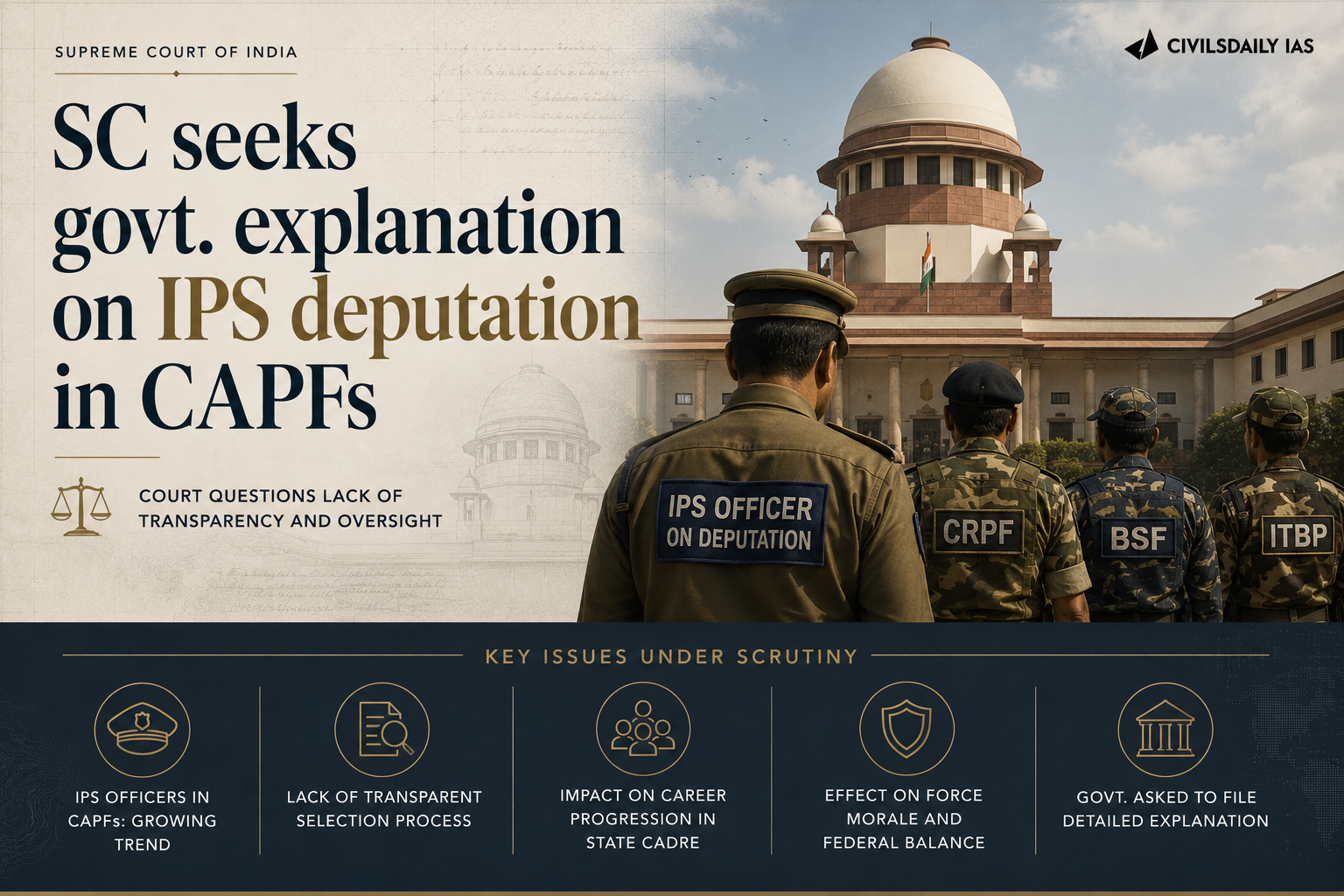
Why in the News
The Supreme Court has sought an explanation from the Union Home Secretary on the implementation of its judgment of 23 May 2025, which directed the Centre to progressively reduce the deputation of Indian Police Service (IPS) officers to senior posts in the Central Armed Police Forces (CAPFs).
What did the 2025 judgment direct?
- The direction: Deputation posts held by IPS officers in the Senior Administrative Grade (SAG), the level up to the rank of Inspector General, in the CAPFs were to be progressively reduced over a period of time, within an outer limit of two years.
- The Bench: The ruling was delivered by a two judge Bench, one of whose members has since retired.
- The direction has been tested once already: The Union Home Ministry’s review petition against the judgment was dismissed on 28 October 2025.
What has the Centre reported as compliance?
- A cadre review across every force: Following the dismissal of the review petition, all CAPFs were directed to submit detailed cadre review proposals, which the Ministry examined and forwarded to the Department of Personnel and Training (DoPT) with the Home Minister’s approval.
- The proposals are in the pipeline, dated: Cadre review proposals for the CRPF, BSF, CISF, ITBP and SSB were sent between 27 July and 3 August 2026, and were forwarded to the Department of Expenditure with the DoPT’s observations and recommendations on 17 August.
- The remaining steps have not been taken: After the Department of Expenditure comments, the proposals go to the Cadre Review Committee headed by the Cabinet Secretary, whose recommendations are then to be considered for approval by the competent authority.
- Other measures claimed: The Ministry stated that it had also examined the issue of IPS deputation and undertaken statutory changes.
Why does the Court read the compliance record differently?
- Deputations continued after the judgment: An affidavit informed the Court that 46 IPS officers have been brought on deputation to the CAPFs up to the SAG level since the 2025 ruling.
- The Bench questioned the premise of the practice: It asked whether there are no competent officers within the CAPFs to hold responsible positions, and described the position as totally wrong.
- The service record cited against the practice: Officers with over 25 years of service defend the borders and have made supreme sacrifices, and the Bench held that a strong lobby leaves those cadre officers completely stifled.
How does the CAPFs (General Administration) Act, 2026 change the dispute?
- A statute now occupies the ground the judgment covered: The Central Armed Police Forces (General Administration) Act, 2026 was published in the Gazette on 9 April, and the stated effect is to circumvent the 2025 judgment.
- The Act is itself under challenge: Five writ petitions challenging the legislation have been filed and are listed for hearing on 18 November.
- The affected constituency is organised: Members of the All Ex-Paramilitary Forces Welfare Association staged protests against the Bill before its enactment.
- The next date on the compliance track: The contempt matter is listed for hearing on 22 September.
Challenges to reducing IPS deputation in the CAPFs
- The forces were designed around an officer shortfall they never closed: Direct entry recruitment into CAPF cadres has not kept pace with sanctioned strength at senior levels, which is the stated justification for deputation in the first place. Eg. Vacancies across CAPF officer ranks have been reported repeatedly to Parliament by the Ministry of Home Affairs.
The Fix: Fix a dated recruitment and promotion calendar in each cadre review, so the shortfall that justifies deputation is closed rather than carried forward. - Cadre review is an executive process with no judicial deadline attached: Every stage between a force’s proposal and the competent authority’s approval is discretionary in timing. Eg. The proposals here moved between three departments over several months without reaching the Cadre Review Committee.
The Fix: Attach an outer time limit to each stage of the cadre review chain, reported to the Court as a compliance schedule rather than as a status update. - Command experience is concentrated where promotion is blocked: Officers who spend a full career in one force acquire the operational knowledge that senior posts need, and are then passed over at exactly that level. Eg. Border guarding, counter insurgency and industrial security each demand force specific expertise that a short deputation tenure cannot build.
The Fix: Reserve a fixed proportion of Inspector General level posts in each force for cadre officers, notified in the recruitment rules rather than settled case by case. - A statute can displace a judicial direction unless the underlying defect is cured: New legislation on the same subject shifts the dispute from contempt to constitutional validity and restarts the litigation clock. Eg. The five writ petitions against the 2026 Act put the question back at the beginning after a judgment and a dismissed review.
The Fix: Amend the recruitment rules of each force to give effect to the direction, so compliance rests on subordinate legislation the Court has already read rather than on a fresh statute. - Organisational identity is unresolved in law: The forces are described as paramilitary in public and as police organisations in service rules, and the ambiguity drives the parity claims on pay, pension and command. Eg. The demand for organised group A service status for CAPF cadres was itself settled only through litigation.
The Fix: Settle the service classification of each force explicitly in the rules framed under the governing statute, so command structure follows from a stated status.
Conclusion
The question before the Court has changed shape since it was first answered. It began as a service dispute about who commands a force, moved to whether a direction on that dispute was being implemented, and now turns on whether a statute passed after the judgment can occupy the same ground. That last question is the one that decides the other two, and it is the pending challenge to the new Act, not the contempt proceeding, that will settle it. What to watch is whether the recruitment rules of the individual forces are amended at all, because a direction that never reaches the rules governing promotion has not been implemented whatever the affidavits record.
Back2Basics: Central Armed Police Forces
- What they are: Seven armed forces of the Union under the Ministry of Home Affairs, distinct from the armed forces under the Ministry of Defence and from the State police, raised for internal security and border guarding duties.
- The seven forces: Assam Rifles, Border Security Force, Central Industrial Security Force, Central Reserve Police Force, Indo-Tibetan Border Police, National Security Guard and Sashastra Seema Bal.
- Command structure: Each force has its own directly recruited cadre, and senior posts are filled by a combination of that cadre and IPS officers on deputation from State cadres.
- Constitutional basis: They are raised under Entry 2A of the Union List, which covers deployment of any armed force of the Union in a State in aid of the civil power.
[2023, GS3, 15 marks] What are the internal security challenges being faced by India? Give out the role of Central Intelligence and Investigative Agencies tasked to counter such threats.”
