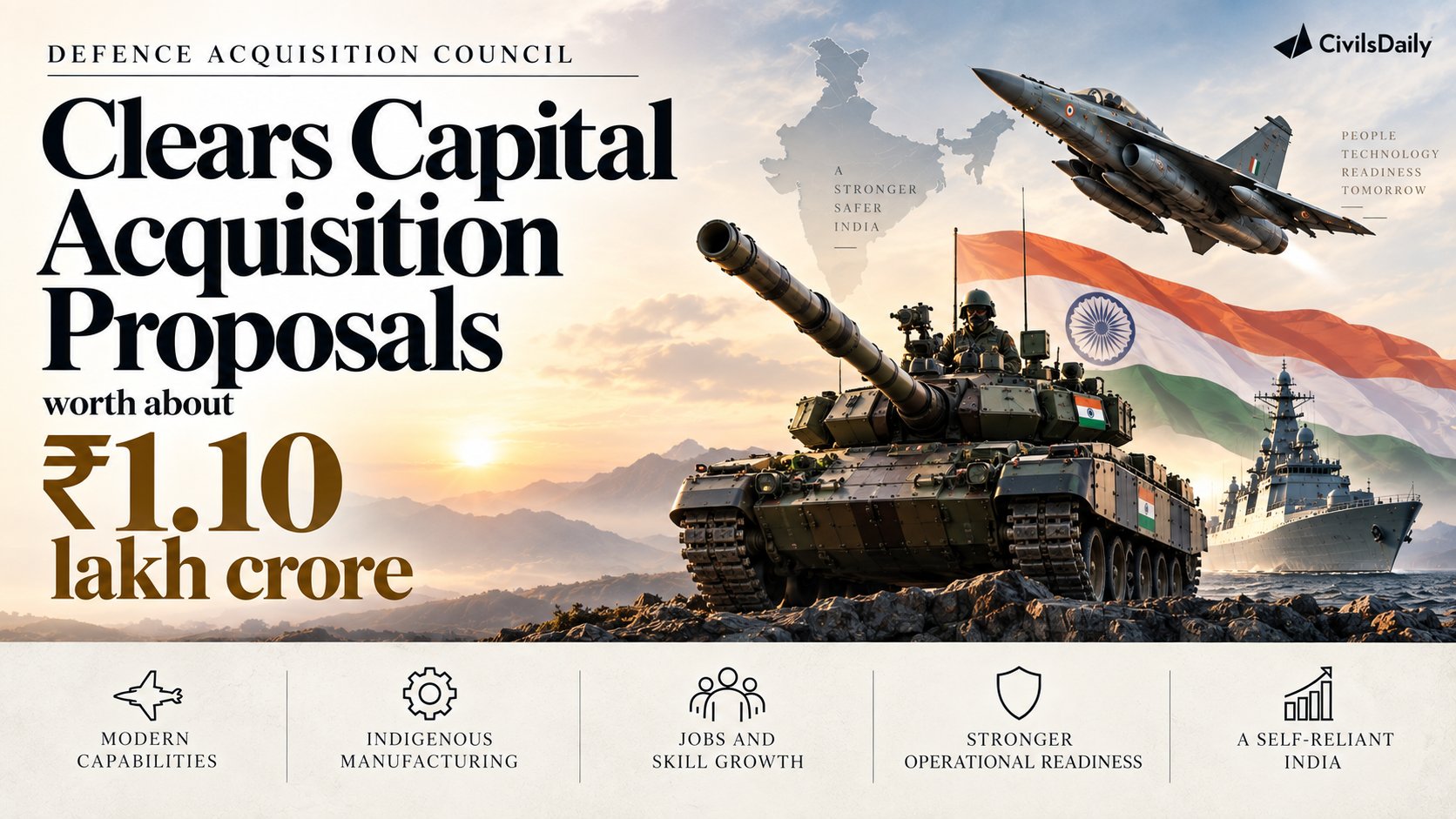
Why in the News
The Defence Acquisition Council (DAC), chaired by Defence Minister Rajnath Singh, has accorded Acceptance of Necessity (AoN) for defence acquisition proposals worth around ₹1.10 lakh crore.
- About 98% of the approved procurements are planned from Indian industry, reinforcing the government’s focus on defence indigenisation and self reliance.
What is the DAC?
- Defence Acquisition Council (DAC) is the highest decision-making body in the Ministry of Defence for defence procurement.
- It was constituted in 2001 following the recommendations of the Group of Ministers after the Kargil War.
- Chairperson: Union Defence Minister.
- It deals with major decisions related to acquisition of capital assets for the Armed Forces.
What has the DAC approved?
Indian Army
- CBRN reconnaissance vehicles: Detect, identify, monitor and mark areas contaminated by chemical, biological, radiological and nuclear agents.
- High Mobility Vehicles (HMVs): Improve operational mobility and logistics in difficult terrain.
- Self Propelled Mechanical Mine Layers (MMLs): Provide faster mine laying capability.
- Advanced Light Helicopters (ALHs): Support operations across diverse terrains.
- Trawl tanks: Facilitate movement through mine contaminated areas.
- Sarvatra Bridge System: Provides rapid bridging and crossing capability during military operations.
Indian Navy
- Arudhra radars: To replace existing air route surveillance radars at naval air stations.
- Marine Gas Turbines (MGTs): Indigenous design, development and procurement for warship propulsion, reducing dependence on foreign vendors.
Indian Air Force and Defence Forces
- Proposals to enhance capabilities of fighter aircraft, transport aircraft and helicopters.
- Ground Based Multi Purpose Jammers (GBMPJ): Provide jamming capability against adversary radars.
- Defence Forces Secure Access Card (DEFSAC): Replace paper based identity cards, passes and permits with interoperable RFID based smart cards.
Why is Defence Indigenisation Important?
- Strategic autonomy: Reduces dependence on foreign suppliers for critical military systems.
- Operational security: Minimises vulnerabilities arising from dependence on external vendors.
- Domestic manufacturing: Creates demand for Indian defence companies and strengthens the defence industrial base.
- Technology development: Encourages indigenous R&D and advanced defence technologies.
- Economic benefits: Generates skilled employment and strengthens domestic supply chains.
Prelims Pointers
- Total value: Around ₹1.10 lakh crore.
- DAC: Defence Acquisition Council, chaired by the Defence Minister.
- AoN: Acceptance of Necessity, the initial approval for a defence procurement proposal.
- CBRN: Chemical, Biological, Radiological and Nuclear.
- ALH: Advanced Light Helicopter.
- MGT: Marine Gas Turbine.
- DEFSAC: Defence Forces Secure Access Card.
- 98%: Approximately 98% of the approved procurement value is planned to be sourced from Indian industry.
[2026] Which of the following items of defence hardware is/are manufactured in India?
1.Su-30 MKT Fighter Jects
2.T-90 MKI-III Tanks
3.Akula Class Submarine
Select the answer using the code given below:
[A] 1 and 2
[B] 1 and 3
[C] 1 only
[D] 2 only
