Why in the News
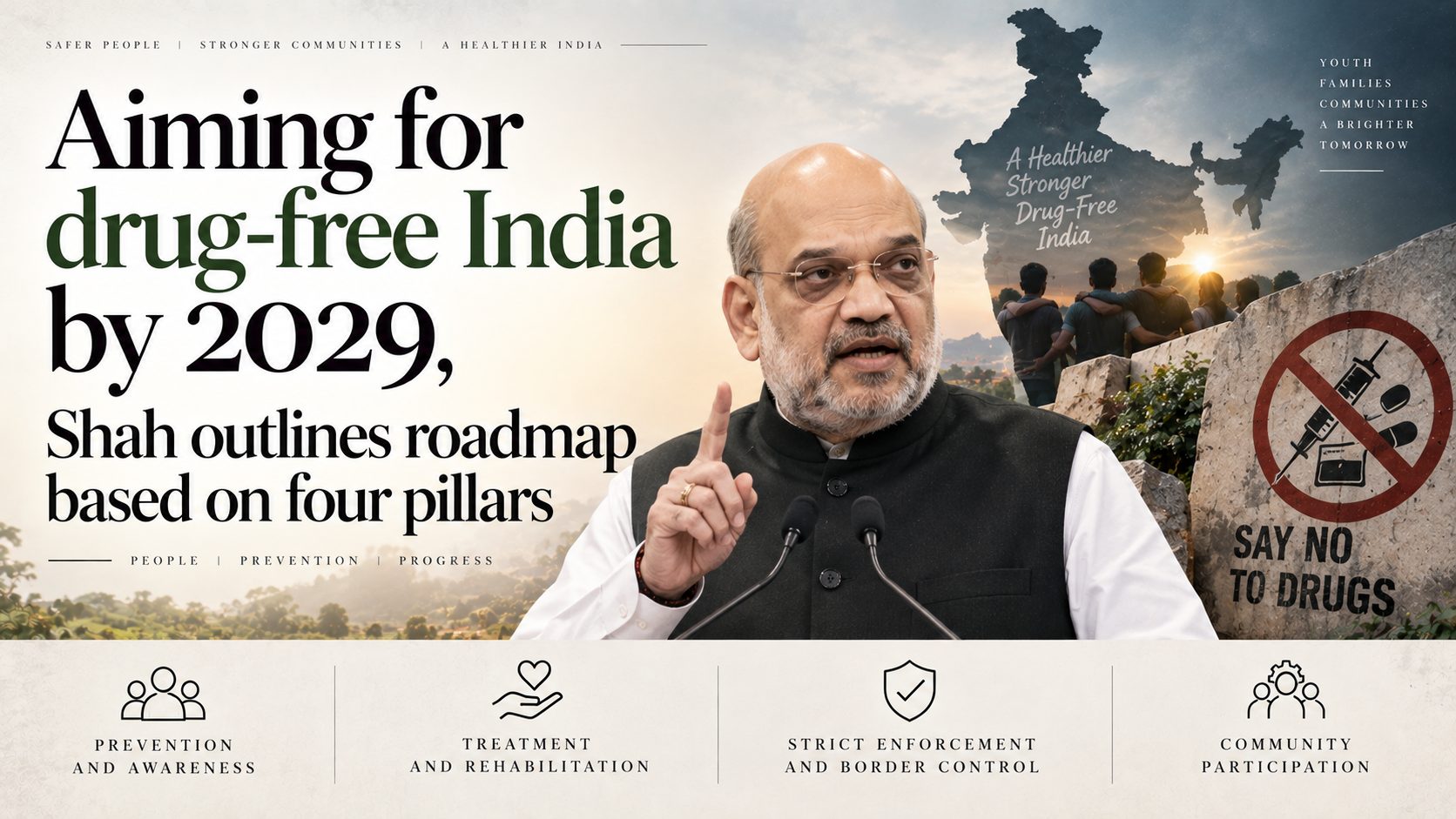
The Union Home Minister has released a three-year roadmap and a vision document for narcotics control, targeting a drug-free India by 2029. The roadmap declares 2026-29 a mission-mode period and shifts enforcement doctrine from seizure-centric action to network-centric enforcement.
What is the doctrinal shift the roadmap announces?
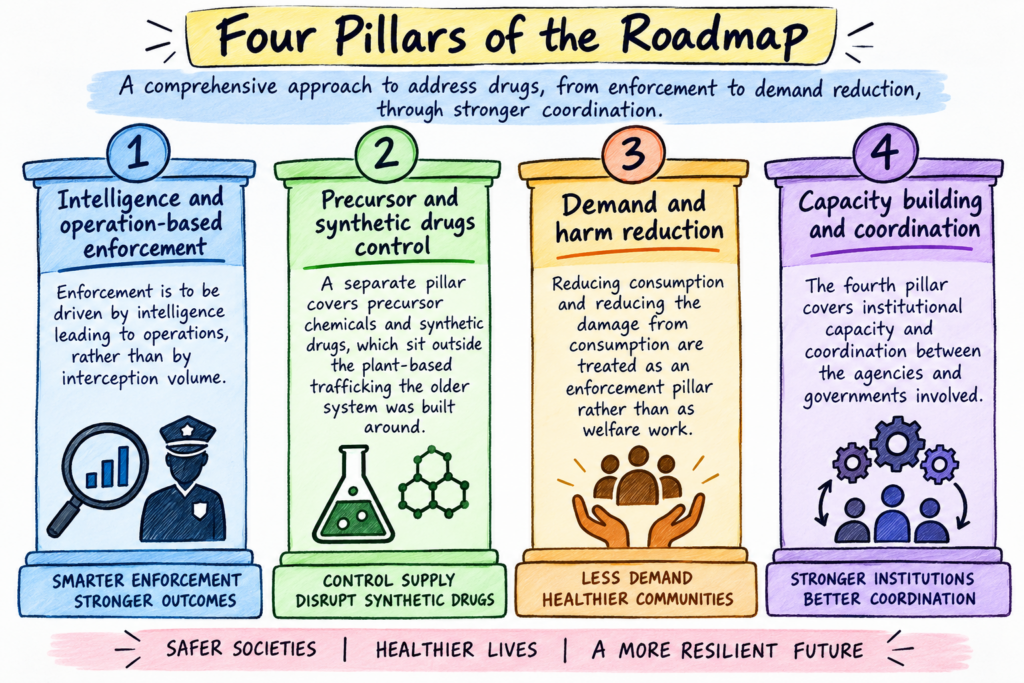
- From seizures to networks: Enforcement moves from seizure-centric action to network-centric enforcement aimed at kingpins, associates, distributors and suppliers.
- Investigation runs both ways: Cases are to be worked bottom-to-top and top-to-bottom, so a street-level recovery is pursued upward to the financier and a financier is pursued downward to distribution.
- Three stated outcomes: The strategy is to be judged on supply reduction, demand reduction and harm reduction.
What makes the 2026-29 period different from earlier drives?
- Mission mode with owners: Every goal is to carry a timeline and a responsible ministry, so a missed target has a named holder.
- Measurement is built in: Goals carry measurable outcomes, quarterly reviews and result-based accountability.
- The stated contrast: Action before 2014 is described as taken in bits and pieces and in silos, limited to small seizures.
- The seizure record cited: From 2004 to 2014, 26 lakh kg of narcotic and psychotropic substances were seized. From 2014 to July 2026 the figure was over 1.19 crore kg.
What institutional machinery already exists?
- A four-tier coordination mechanism: The Narco Coordination Centre (NCORD) mechanism was created in 2019 and operates at the executive, State and district levels.
- Dedicated State-level task forces: Anti-Narcotics Task Forces have been constituted in every State and Union Territory, with local police linked into the national strategy.
- A joint decision forum: A Joint Coordination Committee was formed in 2019 for Central agencies and State governments to act together on major drug networks, their international connections and operational gaps.
- The central agency was rebuilt: The Narcotics Control Bureau has been strengthened through cadre reorganisation and an increase in manpower, zonal presence and operational capability.
What does the demand side of the strategy rest on?
- A national helpline: The MANAS helpline on 1933 was introduced to support persons with drug addiction.
- Four interventions linked to enforcement: Awareness, treatment, rehabilitation and livelihood opportunities have been tied into the anti-narcotics campaign rather than run separately from it.
Challenges to a drug-free India by 2029
- Synthetic drugs move production inside the country: Precursor chemicals diverted from a large legitimate pharmaceutical industry let manufacture happen domestically, so border interdiction misses the source. Eg. Mephedrone manufacturing units have been dismantled in Gujarat, Maharashtra and Rajasthan in successive operations.
The Fix: Place named precursor chemicals under end-use licensing, with mandatory sales reporting by manufacturers to the Narcotics Control Bureau. - Maritime consignments dwarf land recoveries: Container traffic carries volumes that drone and border interdiction cannot match. Eg. Nearly 3,000 kg of heroin was seized in a single consignment at Mundra Port, Gujarat, in September 2021.
The Fix: Extend risk-based non-intrusive container scanning to every major port instead of sample checking. - Consumption is punishable, which deters treatment-seeking: A user who comes forward risks prosecution for the act that brought them to treatment. Eg. Section 27 of the Narcotic Drugs and Psychotropic Substances Act, 1985 punishes consumption, and the immunity under Section 64A applies only to an addict who volunteers for treatment.
The Fix: Make the Section 64A immunity operate automatically on enrolment in a recognised de-addiction facility, certified by the facility rather than by the police. - Demand reduction sits in a different ministry: Treatment and rehabilitation are run outside the ministry running enforcement, so targets and review cycles do not align. Eg. The Nasha Mukt Bharat Abhiyaan, launched in 2020, is run by the Ministry of Social Justice and Empowerment.
The Fix: Bring demand reduction targets into the same quarterly review as enforcement targets, reported in a single format.
Conclusion
Counting seizures measures effort, and dismantling networks measures result. The second is far harder to demonstrate from public data, because a network that stops operating produces no headline recovery. Nothing announced commits the government to publishing the baseline against which the 2029 target will be judged. Whether the vision document’s targets and the findings of the quarterly reviews are placed in the public domain is the marker to watch.
Back2Basics
- Narcotics Control Bureau: The apex coordinating agency for drug law enforcement in India, functioning under the Ministry of Home Affairs.
- Statutory basis: It was constituted in 1986 under Section 4(3) of the Narcotic Drugs and Psychotropic Substances Act, 1985.
- Function: It coordinates action between Central and State enforcement agencies and collects and disseminates drug trafficking intelligence.
- International role: It is India’s nodal point for obligations under the United Nations drug control conventions and for liaison with foreign drug enforcement agencies.
[2018, GS3, 15 marks] India’s proximity to two of the world’s biggest illicit opium-growing states has enhanced her internal security concerns. Explain the linkages between drug trafficking and other illicit activities such as gunrunning, money laundering and human trafficking. What counter-measures should be taken to prevent the same?”
