Why in the News
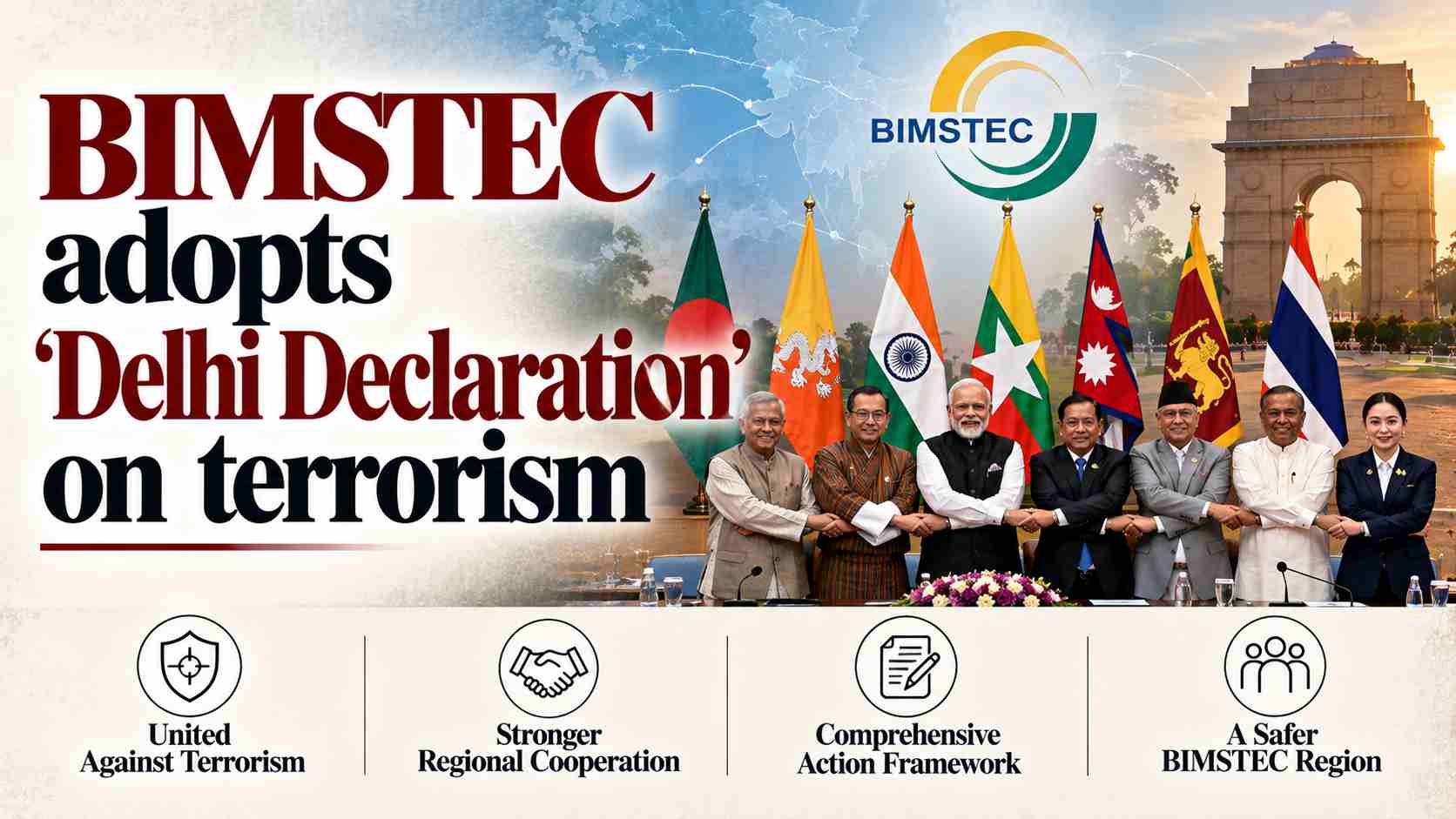
For the first time, the Home Ministers of the Bay of Bengal Initiative for Multi-Sectoral Technical and Economic Cooperation (BIMSTEC) have met as a group and adopted a common counter terrorism text, the Delhi Declaration. India hosted the meeting, which also covered drugs, cybercrime and fugitive criminals.
What does the Delhi Declaration commit members to?
- What it is: The Delhi Declaration is a shared pledge on terrorism by all seven members, Bangladesh, Bhutan, India, Myanmar, Nepal, Sri Lanka and Thailand, like neighbours agreeing to guard one street.
- Four commitments: Members will:
- counter radicalisation and violent extremism conducive to terrorism;
- prevent misuse of new and emerging technologies for terrorist purposes;
- tackle terrorist recruitment;
- curb terror financing through internationally agreed counter terror financing and anti money laundering standards.
- Condemnation: Members “strongly condemn terrorism” in all its forms, “including cross-border terrorism, wherever, by whomsoever”, and want perpetrators brought to justice under domestic and international law.
- UN sanctions: The declaration seeks full use of United Nations (UN) Security Council sanctions. These include the 1267 Sanctions Committee list, which freezes assets of ISIL and Al-Qaida linked people and bans their travel.
- The takeaway: A region that lacked any common text on terrorism now has one that names cross border terrorism, which India has long sought in regional forums.
What cooperation did India seek?
- Five areas: The Union Home Minister named drug control; counter terrorism and legal cooperation; repatriation of fugitive criminals; cybersecurity and cybercrime investigation; and institutional cooperation and capacity building.
- Changing terrorist tactics: Terror groups now recruit through encrypted communication and social media. They also use drones, cryptocurrency and the dark web, the hidden part of the internet, to spread illegal activity.
- Real time intelligence: The Home Minister called for real time sharing of actionable intelligence and closer work among police, intelligence and border management agencies.
- No safe haven: No member should shelter fugitive criminals, and members should cooperate in their extradition.
- Illicit finance: India sought a coordinated regional approach to illicit financial transactions and terror financing.
Why does a regional approach matter?
- Crime across borders: Criminal networks operate beyond national borders and exploit regional lacunae, gaps no single country’s law can reach, so regional cooperation is needed.
- India’s framing: India says it believes in sovereignty and peaceful resolution of disputes, and seeks joint action against international terrorism, organised crime and narco trade.
- “Cyber slavery”: The Home Minister flagged human trafficking and cyber slavery, meaning trafficking people into online scam centres and forcing them to defraud others, as grave concerns.
- Bangladesh’s representation: Bangladesh, the current BIMSTEC chair, sent a Senior Secretary of its Home Ministry rather than its Home Minister.
Challenges
- Bilateral frictions: Disputes between members weaken joint action. Eg. The Rohingya refugee crisis between Bangladesh and Myanmar.
- Drug routes through Myanmar: Instability in Myanmar keeps trafficking routes into India’s Northeast open. Eg. Heroin and methamphetamine from the Golden Triangle.
- Weak secretariat: BIMSTEC’s secretariat has little executive authority and limited funds, so follow up depends on each member.
- Shifting political priorities: Changes of government alter regional commitments. Eg. The political transition in Bangladesh since 2024.
Way Forward
- Binding legal instruments: Convert the declaration into ratified agreements on mutual legal assistance and extradition among all seven members.
- Linked financial intelligence: Connect members’ Financial Intelligence Units, the agencies that track suspicious money, to trace terror funds, including cryptocurrency flows.
- Joint action on scam centres: Run coordinated rescues and prosecutions against cyber slavery compounds and the networks that recruit victims.
- Regular ministerial review: Make the Home Ministers’ meeting a standing annual forum that reviews progress on the declaration.
Conclusion
BIMSTEC now has a shared text on terrorism, but its value depends on members acting on it inside their own borders. Whether the Home Ministers meet again and turn India’s areas of cooperation into working legal and intelligence arrangements is what to watch.
Back2Basics: BIMSTEC
- Origin: Formed by the Bangkok Declaration of June 1997 as BIST-EC (Bangladesh, India, Sri Lanka, Thailand). Myanmar joined that year, and Nepal and Bhutan in 2004.
- Institutions: Its permanent secretariat has been in Dhaka since 2014. The BIMSTEC Charter, adopted at the fifth summit in 2022, gives the grouping legal status.
- Role for India: It links India’s Neighbourhood First and Act East policies and offers a working alternative to a dormant South Asian Association for Regional Cooperation (SAARC).
- Bangkok Vision 2030: Adopted at the sixth summit in April 2025 as a roadmap for a prosperous, resilient and open region.
Matching Previous Year Question
“[2026] Match List I (BIMSTEC Centre) with List II (Location): A. BIMSTEC Cultural Industries Observatory B. BIMSTEC Energy Centre C. BIMSTEC Centre for Weather and Climate D. BIMSTEC Technology Transfer Facility 1. NOIDA 2. Bengaluru 3. Colombo 4. Thimphu (a) A-3, B-2, C-1, D-4 (b) A-3, B-1, C-2, D-4 (c) A-4, B-2, C-1, D-3 (d) A-4, B-1, C-2, D-3 ANSWER: C”
